
Environmental temperature is linked with variations in the growth and life cycle stages of organisms (Angilletta, 2009). In the plant-parasitic nematode genus Meloidogyne Göldi, 1892 (root-knot nematodes), differences in temperature are associated with variations in egg survival and the development of second-stage juveniles (J2). As the invasive stage outside the host plant, J2 exhibits a close relationship with environmental conditions (Bird and Wallace, 1965; Wallace, 1966; Davide and Triantaphyllou, 1968; Bird, 1972; Prot and Van Gundy, 1981; Evans and Perry, 2009). Temperature variations also correspond to differences observed in subsequent developmental stages, including sexually mature forms (Bergeson, 1959; Boroș et al., 2018).
Furthermore, organismal body size and biomass exhibit distinct variations across different temperature ranges. In poikilotherms, colder environments are associated with protracted growth rates and larger terminal body sizes (Atkinson, 1994; Atkinson et al., 2003). Concurrently, the poikilotherm biomass values demonstrate systematic variations in relation to temperature regimes (Van der Have and De Jong, 1996). The biomass index is a parameter used in studies examining the interactions between various nematode species, such as M. incognita (Kofoid & White, 1919) Chitwood, 1949 and M. graminicola Golden and Birchfield, 1965, and their host plants (Melakeberhan and Ferris, 1988; Singh et al., 2006). For instance, a comparative study noted that M. hapla Chitwood, 1949 (northern root-knot nematode) females grown on tomato roots at 20–25°C exhibited lower biomass than M. javanica (Treub, 1885) Chitwood, 1949 females maintained under the same conditions (Bird and Wallace, 1965).
The research presented in this study focused on M. hapla, one of Europe’s most widespread plant-parasitic nematodes (Karssen, 1999; Hunt and Handoo, 2009; Skwiercz et al., 2019). This species is a major pest of several dicotyledonous crops such as carrot, celery, cucumber, parsley, pepper, potato and tomato (Belair, 1992; Widmer et al., 1999; Mitkowski et al., 2002; Nemaplex). This study investigated the associations between varying environmental temperatures, egg characteristics and the body size traits – specifically body length, width, and mass – of emergent J2. To our knowledge, the baseline relationship between temperature and the body size traits of J2 of M. hapla has not been previously quantified, and this research aims to fill that knowledge gap. While the present work establishes these co-variations, future long-term research is required to determine the precise casual mechanisms driving temperature impacts on M. hapla. Elucidating these mechanistic pathways could ultimately inform the development of novel agricultural control strategies, particularly those leveraging temperature thresholds to induce lethal effects on this pest.
1. Material and methods
1.1. Culturing Meloidogyne hapla on tomato plants for harvesting nematode eggs
Egg masses of M. hapla were collected from the roots of common carrots (Daucus carota L.) obtained from a commercial farm in the Sieradz district (Łódź Voivodeship, Central Poland). Eggs were mechanically isolated using a dissecting needle. The nematodes were reared on tomato plants (Solanum lycopersicum L., “Moneymaker” variety), a standard model host for studying plant-parasitic nematode (Meloidogyne spp.) interactions (Seid et al., 2015).
Tomato plants were initially grown in pots with soil substrate under controlled conditions in a growth chamber: 20°C during the day and 18°C at night, with a 16 h day and 8 h photoperiod and 58% humidity day/night. They were maintained until four to five true leaves developed (BBCH 14–15, a scale used across European Union Member States to identify phytophenological stages of crop growth) (Hack et al., 1992). Subsequently, the plants were repotted into a 1:1 (v/v) mixture of gravel and commercial vegetable soil. This new substrate was inoculated at a density of 50 J2 per 200 cm3 of soil. Inoculated plants were maintained for 60 days and irrigated two to three times weekly (Dobosz et al., 2023). Fertilization was performed using a commercial tomato fertilizer containing a complete nutrient solution (3% N, 2% K, 70 mg/L Cu, 400 mg/L Fe, 170 mg/L Mn, 20 mg/L Mo, and 150 mg/L Zn) diluted 1:400 (v/v). Each pot received a dose of 50 mL in accordance with the manufacturer’s protocols (Dobosz and Krawczyk, 2021).
Following the 60-days incubation period, the roots were harvested and gently rinsed with tap water. Nematode egg masses were mechanically isolated from the cleaned root systems using a dissecting needle. Egg masses were subsequently sorted by size and coloration under a Leica M205 C stereomicroscope. Freshly deposited egg masses, which are smaller and off-white, contain embryonated eggs developing into first-stage juveniles (J1). In contrast, mature egg masses are larger and brownish, holding eggs with larvae, i.e., J1, and ready to emerge J2 (De Luca et al., 2009; Evans and Perry, 2009; Díaz-Manzano et al., 2016). Only the off-white, freshly deposited egg masses were selected for examination.
1.2. Experimental design: Nematode egg incubation at varied temperatures and exposure times
Egg incubation experiments were adapted from the method described by Rocha et al. (2015). Individual eggs were isolated using a dissecting needle and a plastic Pasteur pipette, and their viability was confirmed using a stereomicroscope based on the presence of a distinct, ordered cellular structure (Calderón-Urrea et al., 2016). In each Petri dish (diameter: 3.5 cm, height: 1 cm), nematode eggs were immersed in distilled water (4 mL). The experiment was conducted in triplicate, utilizing three independent biological replicates per treatment (10 eggs per dish × 3 dishes, n = 30 eggs per treatment). The egg dishes were incubated at temperatures of 5, 10, 20, 30, 35, and 40°C for 1, 2, 8, and 24 h. Thermal treatments for M. hapla were classified as either stress or non-stress temperatures. Stress temperatures for M. hapla were considered to be 5, 35, and 40°C, as these conditions significantly limit development (Table 1). Specifically, at 6°C, embryogenesis arrests at the gastrula stage (Charchar and Santo, 2001), while at 35°C, egg-laying by M. hapla females is impaired (Thomason and Lear, 1961). Non-stress temperatures encompassed the range from 10 to 30°C, with the species’ development progressing at varying rates within this range (Thomason and Lear, 1961; Inserra et al., 1983). For the experiment, M. hapla eggs were exposed to these temperatures in an incubator (Shaking incubator, NB-205V) in the dark. The optimal development temperature of 20°C (Bird and Wallace, 1965; Kinloch and Allen, 1972) served as the control. Following the exposure, all egg dishes were incubated at 20°C until J2 emerged, with a maximum incubation period of 25 days (Inserra et al., 1983), as this is the time required for Meloidogyne egg development to the J2 stage at 20°C. The incubation duration was not longer than 25 days because, according to Inserra et al. (1983), at 20°C, the development from egg to J2 in M. hapla can take as long as 25 days. Eggs failing to hatch within this 25-days window were considered non-viable. Emerging J2 were collected within 24 h of hatching, quantified, and mounted on microscope slides for further analysis (Table 1).
1.3. Measurements of body size traits of emergent J2
Body size traits, including body length, width, and mass, were measured using a Leica DM 5000 B microscope equipped with Leica Application Suite Version 3.7 software installed. For each temperature and exposure time combination (5, 10, 20, 30, 35, 40°C × 1, 2, 8, 24 h), ten emerged J2 were permanently mounted on glass microscope slides using the paraffin-ring method (Hooper, 1986). To ensure comparability, body width was measured at the widest point of the nematode body, halfway along the body length. Based on the obtained data, the body mass of each J2 was calculated using the modified Andrássy formula (1956) according to Rocha et al. (2015):
where BM represents body mass (µg), W is the maximum body width (mid-body width) (µm), L is the body length (µm), 1.6 is a constant specific to the formula, 10 6 is a conversion coefficient from cubic micrometers to micrograms, n is the number of nematodes, i is the summation index (Rocha et al., 2015).1.4. Statistical analysis
The data were modelled using generalized linear models (GLM), with a Gaussian (normal) error distribution (Biecek, 2013). Visual inspection of the residual distributions and residual vs fitted plots for the final models revealed no substantial deviations from normality or homoscedasticity, supporting the use of Gaussian error distributions. All calculations were carried out in the R computing environment v. 4.5.1 (R Core Team, 2025).
Body size traits, specifically length, width, and body mass, were measured in J2 nematodes. These nematodes emerged from eggs incubated at varying temperatures and exposure times, and these characteristics served as the dependent variables. Temperature and incubation time were the primary predictors in all models, with their effects being tested both separately and jointly, allowing for a possible interaction. Both variables were treated as categorical factors, with temperature values of 5, 10, 20°C (control), 30, 35, and 40°C and incubation times of 1, 2, 8, and 24 h. The reference level for temperature was 20°C, while for incubation time, it was 1 h. Body mass was calculated from body length and width and was analyzed separately as a dependent variable, not included in the same models as length or width to avoid collinearity. The length, width, and body mass of J2 were analyzed as continuous variables.
Four alternative models were generated for each dependent variable, differing in their sets of explanatory variables: temperature alone, incubation time alone, additive effects of temperature and incubation time, and their interaction. Model selection was performed using an information theoretic approach (Burnham and Anderson, 2002). The primary criterion for model assessment was the corrected Akaike information criterion for small data sets (AICc), with model weight (i.e., the probability that a given model is the best-fitting model in the analyzed set) serving as a supplementary criterion. The model with the lowest AICc value was considered the best-fitting model within the analyzed set (McCarthy, 2015; Murray et al., 2020). In most cases, one model clearly outperformed the others, indicated by a near-zero model weight, eliminating the need to average models with similar fit. Two-way interactions between predictors A and B were denoted by the notation “A:B.” Effect sizes of individual variables in the best-fitting model were calculated using the “effects” package (Fox and Weisberg, 2019). The “bbmle” package (Bolker and R Development Core Team, 2022) was used to calculate AICc scores in model selection procedure and “tidyverse” package (Wickham et al., 2019) was utilized for result visualization.
2. Results
2.1. Body length of emergent J2
No J2 emerged from eggs exposed to 40°C at any exposure duration (1, 2, 8, or 24 h). Consequently, this treatment was excluded from further analysis. Conversely, the remaining experimental cohorts exhibited high hatching success, ranging from 90 to 97% (Supplementary material Table S1).
The experiment demonstrated a relationship between the incubation temperature of eggs and the body length of emergent J2 (Figure 1). Model selection using the AICc indicated that Model 1 from Table 2 was best supported by the data. This model suggested that temperature alone provided the most parsimonious explanation for variation in J2 body length. Although minor variation across duration was observed, the model without time had the lowest AICc. Parameter estimates of the optimal model are provided in Supplementary material Table S2.
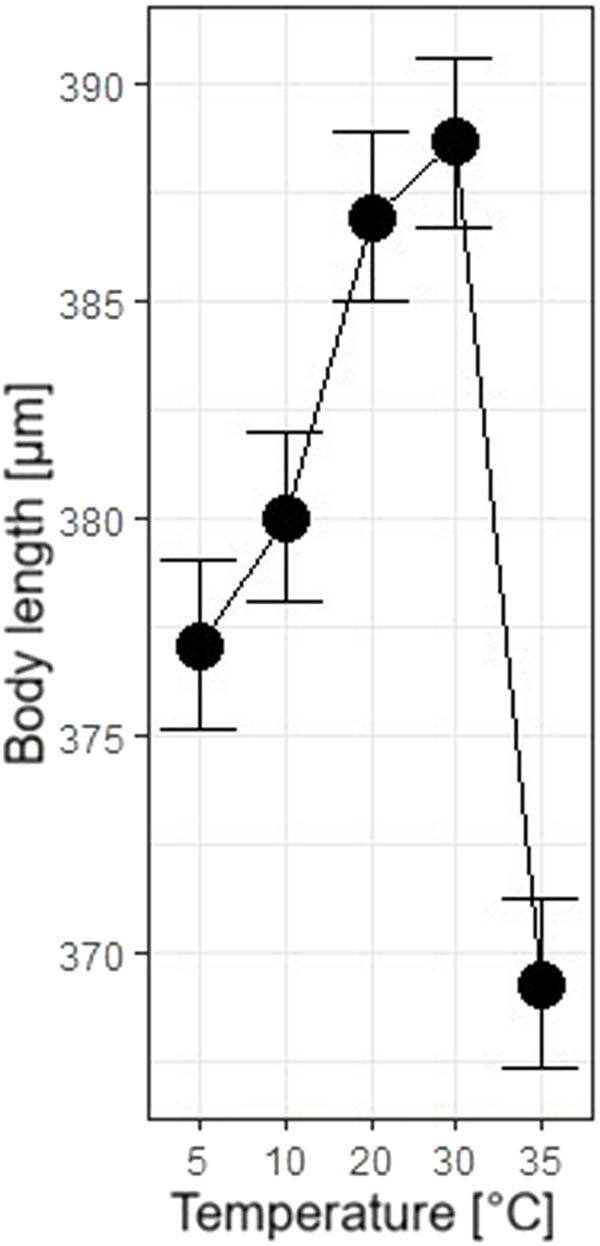
Figure 1
Association between Meloidogyne hapla J2 body length and temperature. Control = temperature 20°C. Averaged effects (marginal means) estimated for the best model indicated in the model selection are presented (Table 2, model 1). The dot indicates the value of the estimate, the whiskers indicate the 95% confidence interval of this estimate.
Table 2
Selection of GLM models explaining differences in body length of J2 Meloidogyne hapla in relation to egg incubation temperature/duration
| No. | Model (predictors) | LL | AICc | Δ AICc | df | weight |
|---|---|---|---|---|---|---|
| 1 | Body length ∼ temperature | −2283.2 | 4578.6 | 0.0 | 6 | 0.88 |
| 2 | Body length ∼ temperature + incubation duration | −282.2 | 4582.6 | 4.0 | 9 | 0.12 |
| 3 | Body length ∼ temperature + incubation duration + temperature: incubation duration | −278.6 | 4600.8 | 22.2 | 21 | <0.001 |
| 4 | Body length ∼ incubation duration | −386.6 | 4783.2 | 204.6 | 5 | <0.001 |
For each model, the variables used as predictors, are given: the logarithm of the maximum likelihood (LL), the value of the AICc, the difference in the AICc values of the given model and the model with the minimum AICc in the analyzed set of models (Δ AICc), the number of degrees of freedom (df), and the Akaike weight of the given model (weight).
At 30°C, the maximum body length in emergent J2 was similarly high across all durations, with a slight increase at 24 h (390.2 ± 2.0 µm). It was longer by only 0.85% compared to the body length of emergent J2 from the 20°C control group. The results were consistent for all incubation times at this temperature. The control temperature of 20°C resulted in the second-longest emergent J2 (386.9 ± 2.0 µm). Within the 35°C treatment, statistically significant shortest body lengths were observed for emerged J2 following 24 h of incubation (365.5 ± 2.0 µm), a trend of shorter length persisted across all other exposure times within this thermal regimen (Supplementary material Table S3, Figure 1).
2.2. Body width of emergent J2
The body width of emergent J2 was related to egg incubation temperature and duration (Figure 2). Model 1 from Table 3, which incorporated an interaction between temperature and time, best explained the data as indicated by AICc. The specific parameter estimates for this optimal model are provided in Supplementary material Table S4.
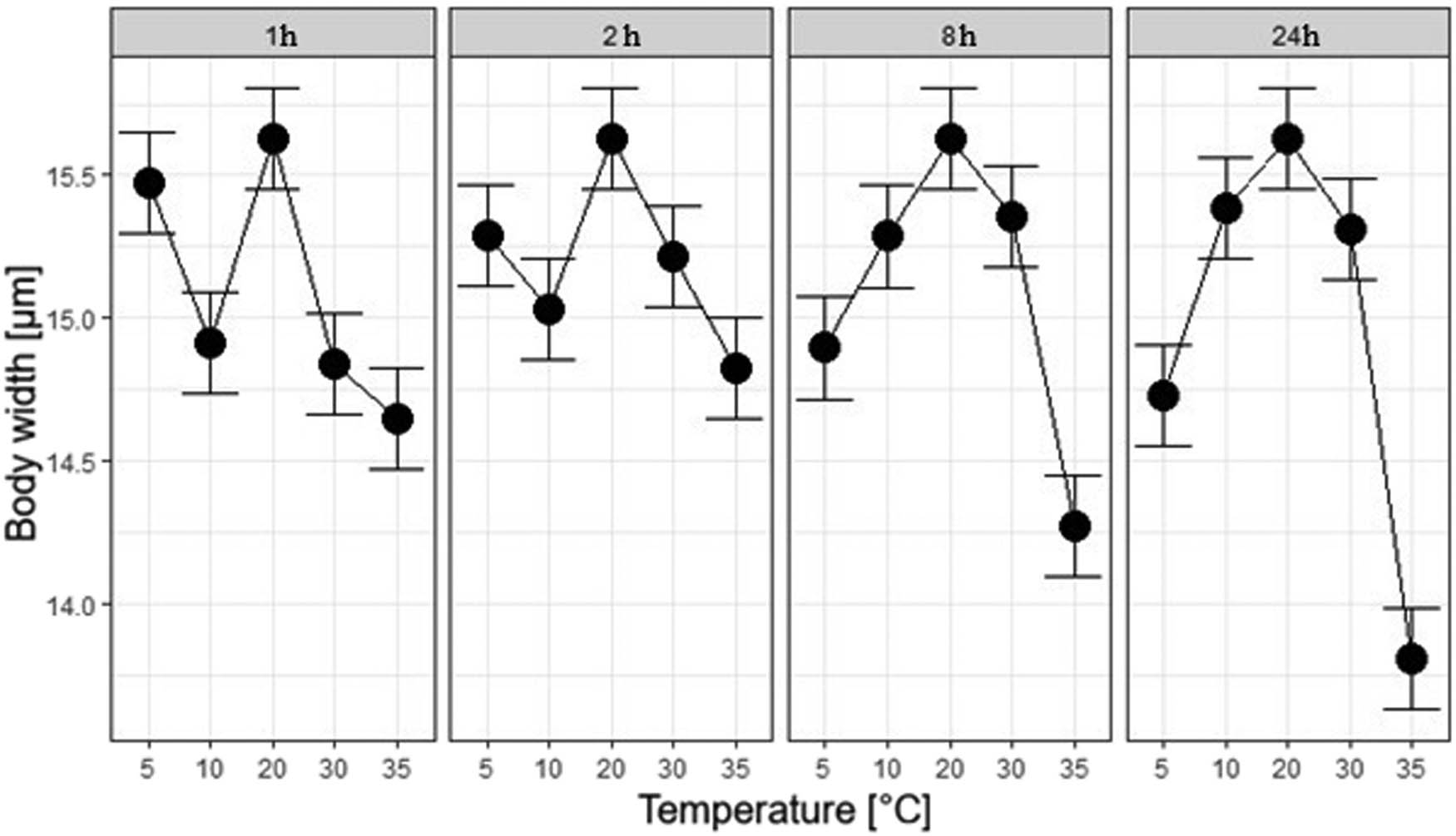
Figure 2
Association between body width of Meloidogyne hapla J2 and egg incubation temperature and duration (h – hour, individual panels). Control = temperature 20°C. Averaged effects (marginal means) estimated for the best model indicated in the GLM model selection are presented (Table 3, model 1). The dot indicates the value of the estimate, the whiskers indicate the 95% confidence interval of this estimate.
Table 3
Selection of GLM models explaining differences in body width of J2 Meloidogyne hapla in relation to egg incubation temperature/duration
| No. | Model (predictors) | LL | AICc | Δ AICc | df | weight |
|---|---|---|---|---|---|---|
| 1 | Body width ∼ temperature + incubation duration + temperature: incubation duration | −417.1 | 877.8 | 0.0 | 21 | 1 |
| 2 | Body width ∼ temperature + incubation duration | −82.2 | 982.8 | 104.9 | 9 | <0.001 |
| 3 | Body width ∼ temperature | −488.7 | 989.4 | 111.6 | 6 | <0.001 |
| 4 | Body width ∼ incubation duration | −612.1 | 1234.3 | 356.5 | 5 | <0.001 |
For each model, the variables used as predictors, are given: the logarithm of the maximum likelihood (LL), the value of AICc, the difference in the AICc values of the given model and the model with the minimum AICc in the analyzed set of models (Δ AICc), the number of degrees of freedom (df), and the Akaike weight of the given model (weight).
The largest body width (15.6 ± 0.09 µm) was achieved by emergent J2 incubated at the optimum (control) temperature of 20°C. Considering all experimental conditions, the smallest statistically significant mean body width (13.8 ± 0.09 µm, a decrease of 11.5% compared to the control) was achieved by emergent J2 incubated at 35°C after 24 h of exposure. Also, in the remaining time groups of the experiment, i.e., after 1, 2, and 8 h of incubation at 35°C, body width of emergent J2 was the lowest among all treatments at this temperature. In emergent J2 incubated at 5°C, as the incubation time was extended from 1 to 24 h, a decrease in body width was observed from 15.5 ± 0.09 µm after 1 h of incubation to statistically significant 14.7 ± 0.09 µm after 24 h of incubation. At 30°C, body width increased at 1 to 8 h (from 14.8 to 15.4 µm), then decreased slightly at 24 h (15.3 µm). (Supplementary material Table S5, Figure 2).
2.3. Body mass of emergent J2
A relationship was observed between egg incubation temperature/duration and the body mass of ensuing J2 (Figure 3). Using the AICc for model selection, the best-fitting model to the data was model 1 from Table 4, which explained the differences in J2 body mass. This optimal model assumed a combined, interactive effect of incubation temperature and duration on body mass. The specific parameter estimates for this optimal model are provided in Supplementary material Table S6.
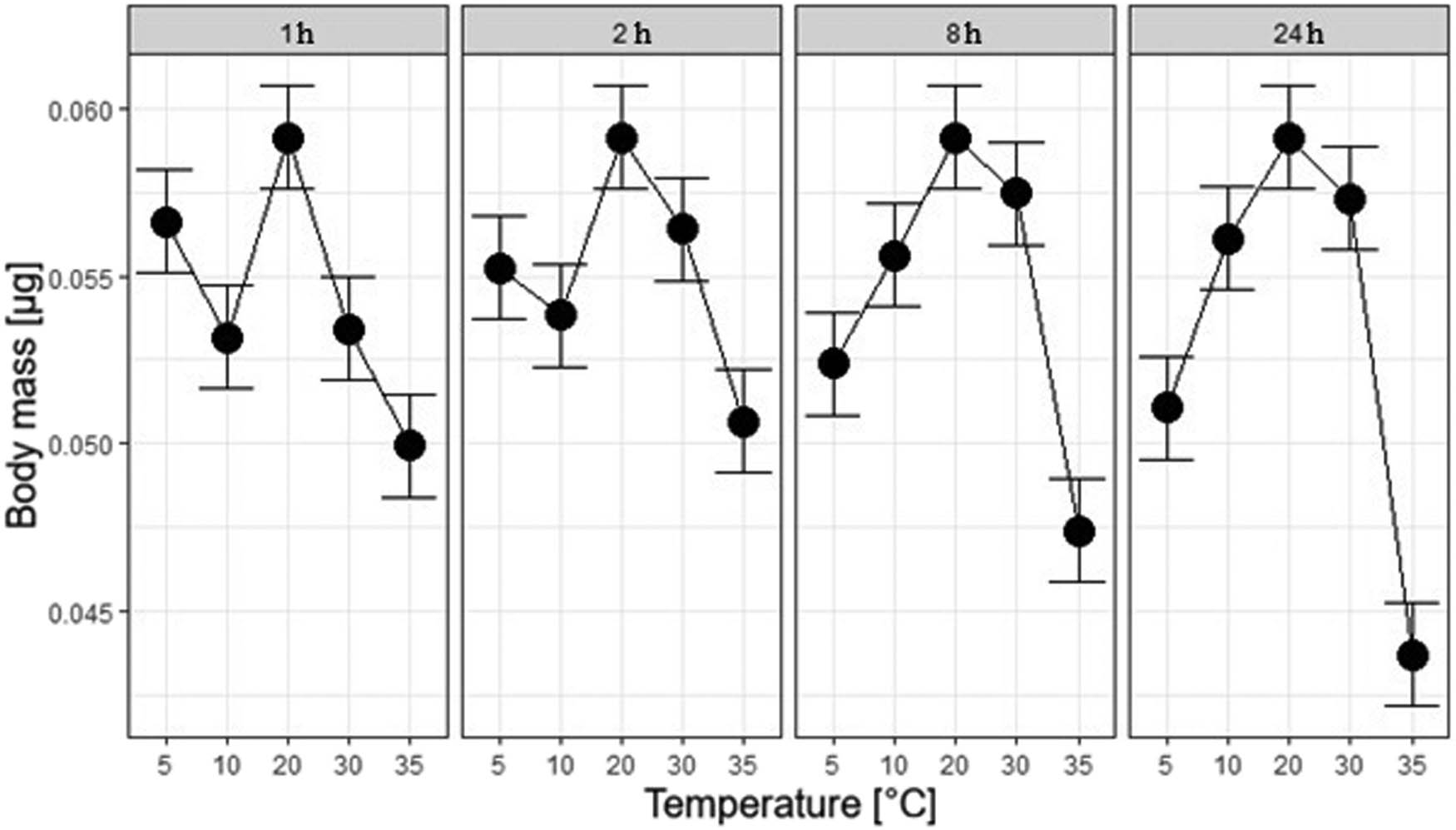
Figure 3
Association between body mass of Meloidogyne hapla J2 and egg incubation temperature/time (h – hour, individual panels). Control = temperature of 20°C. Average effects (marginal means) estimated for the best model indicated by the GLM model selection are shown (Table 4, model 1). The dot denotes the value of the estimate, the whiskers denote the 95% confidence interval of that estimate.
Table 4
Selection of GLM models explaining differences in body mass of J2 Meloidogyne hapla in relation to egg incubation temperature/duration
| No. | Model (predictors) | LL | AICc | Δ AICc | df | weight |
|---|---|---|---|---|---|---|
| 1 | Body mass ∼ temperature + incubation duration + temperature: incubation duration | 2430.0 | −4816.3 | 0.0 | 21 | 1 |
| 2 | Body mass ∼ temperature + incubation duration | 2383.7 | −4749.1 | 67.2 | 9 | <0.001 |
| 3 | Body mass ∼ temperature | 2379.1 | −4746.0 | 70.3 | 6 | <0.001 |
| 4 | Body mass ∼ incubation duration | 2232.8 | −4455.5 | 360.8 | 5 | <0.001 |
For each model, the variables used as predictors are given: the logarithm of the maximum likelihood (LL), the value of AICc, the difference in the AICc values of the given model and the model with the minimum AICc in the analyzed set of models (Δ AICc), the number of degrees of freedom (df), and the Akaike weight of the given model (weight).
The maximum body mass (0.059 ± 0.0008 µg) was achieved by emergent J2 incubated at the optimum temperature of 20°C. Across all experimental conditions, the minimum body mass (0.044 ± 0.0008 µg) was observed in emergent J2 incubated at the defined stress temperature of 35°C for 24 h. J2 body mass following a 24 h incubation at 35°C was 25.4% lower than that of the control group. Also, in the remaining time groups of the experiment, i.e., after 1, 2 and 8 h of incubation at 35°C, the average body mass of emergent J2 was the lowest among all temperature treatments. In emergent J2 incubated at 5°C, with incubation time extended from 1 to 24 h, a reduction in the body mass was observed from 0.057 ± 0.0008 µg after 1 h of incubation to 0.051 ± 0.0008 µg after 24 h of incubation. In the experiment concerning the temperature of 10°C, an increase in the mean body mass of emergent J2 was observed where incubation duration was extended. At 30°C, body mass increased from 1 h to 8 h (from 0.053 to 0.057 µg), with no further increase at 24 h (Supplementary material Table S7, Figure 3).
3. Discussion
M. hapla embryonic development rates are temperature-dependent (Inserra et al., 1983; Charchar and Santo, 2001). In this study, M. hapla eggs were incubated at various temperatures and durations before being transferred to 20°C for further development until J2 hatched. Subsequently, the body size traits of these J2 were measured, including their length, width, and body mass. A relationship was found between temperature and duration of egg incubation and the resulting body length, body width, and body mass of the emergent J2.
Direct comparison with previous studies is limited because most research on Meloidogyne embryogenesis has focused on developmental rate and hatching success rather than on body size of emergent J2 (Bird and Wallace, 1965; Bird, 1972; Vrain and Barker, 1978; Inserra et al., 1983; Zhang and Schmitt, 1995; Charchar and Santo, 2001; Mahmud, 2014; Sumita and Das, 2016). Previous studies have shown that higher temperatures (20–30°C) significantly accelerate embryogenesis in various root-knot nematode species, including M. hapla, M. chitwoodi Golden et al., 1980, M. fallax Karssen, 1996, M. incognita, M. javanica, and M. konaensis Eisenback et al. 1995 (Bird, 1972; Vrain and Barker, 1978; Inserra et al., 1983; Zhang and Schmitt, 1995; Mahmud, 2014; Sumita and Das, 2016). The optimal temperature range for M. hapla egg development, established through numerous studies, is between 20 and 30°C (Bird and Wallace, 1965; Vrain and Barker, 1978; Inserra et al., 1983; Charchar and Santo, 2001). This range was also observed to yield the highest values for the body length, width, and mass studied in emergent J2, which emerged from eggs incubated at these temperatures in the current investigation. These findings suggest that this temperature range is also optimal for the development of eggs from the M. hapla population examined in this study. The greatest J2 body length was achieved by eggs incubated at 30°C, while the highest body width and mass were observed in J2 from eggs incubated at 20°C. Notably, these results demonstrate that while 20–30°C is the established optimal range for M. hapla egg development, the highest body length in our J2 occurred at 30°C, and peak width and mass were at 20°C.
Embryogenesis of M. hapla was reported by Charchar and Santo (2001) to cease at a temperature of 6°C, with development not progressing beyond the gastrula stage. In the present research, at 5°C, the body length, width, and mass of emergent J2 were among the lowest values recorded across all temperatures studied, after both 8 and 24 h of incubation. The inhibition of embryogenesis at 6°C, as demonstrated by Charchar and Santo (2001), may partly account for the reduced body size observed in J2 emerging from eggs incubated at 5°C in this study.
Our experiments demonstrated that an incubation temperature of 40°C is strongly associated with egg inviability, as reflected by a complete absence of J2 development and eclosion under these conditions. Previous research by Daulton and Nusbaum (1961) similarly indicated that exposure to 36°C and 40°C compromises egg viability. While Bird and Wallace (1965) reported a complete absence of J2 emergence following a six-day egg exposure to 35°C, our study utilized shorter exposure durations (1–24 hours) and successfully captured hatching events, albeit with reduced body size. This study identified significant variations in the body size traits of J2 corresponding with the 35°C temperature treatment. The lowest body length values occurred in J2 emerging from eggs incubated at 35°C, with this trait scaling downward as the incubation period lengthened, particularly at 24 h. Body width and body mass similarly reached their lowest values at 35°C after 24 h of egg incubation. Consequently, synthesized with existing literature, the current findings indicate that incubation temperatures of 5°C and 35°C correspond to distinct morphometric thresholds for the measured characteristics of emergent J2. These findings align with established thermal biology principles demonstrating that environmental temperature heavily modulates the ontogenetic body size and metabolic rates of poikilotherms (Abram et al., 2017). While prior literature confirms that nematode embryogenesis and post-embryonic development are highly sensitive to environmental temperature variations (Lee and Atkinson, 1976; Begasse et al., 2015), it is critical to emphasize that the present study identified statistical associations between incubation temperatures and emergent J2 body size traits, rather than establishing a direct causative mechanism. Hypothesized physiological pathways – such as thermal stress inducing a suppressed metabolic rate that subsequently constrains physical growth – require direct empirical validation. Nonetheless, empirical support for such temperature-dependent body size variation is widespread; temperature variations during embryogenesis consistently correlate with altered body size across numerous poikilothermic taxa (Takatsu et al., 2022). Within the Meloidogyne genus specifically, developmental kinetics exhibit strong, species-specific dependencies on thermal regimes (Maleita et al., 2012).
Elucidating the impact of pre-hatch temperatures on emergent M. hapla J2 holds significant translational value for optimizing physical management strategies against plant-parasitic nematodes, such as hydrothermal therapy of propagation material, soil steaming, or soil solarization (Karssen and Moens, 2006; Wesemael and Moens, 2008). Solarization, which relies on plastic mulching to capture solar radiation (Katan et al., 1976), has historically been restricted to arid or Mediterranean climates due to its high thermal requirements (Wesemael et al., 2011). However, under contemporary climate change projections driving prolonged, severe summer anomalies across Europe (King and Karoly, 2017), such thermal disinfection strategies may become increasingly viable for suppressing M. hapla populations within temperate zones.
In conclusion, characterizing the association between pre-hatch temperature and body size traits of emergent M. hapla J2 establishes a critical baseline for predictive modelling and the optimization of physical management strategies. Specifically, acute pre-hatch temperature exposure at 40°C corresponds to a complete arrest of M. hapla embryogenesis. Conversely, optimal incubation regimes between 20 and 30°C are associated with the highest observed body size values in emergent J2. In contrast, pre-hatch exposures to 5 and 35°C are associated with significantly reduced body size measurements.
Acknowledgments
The authors would like to thank Grażyna Winiszewska, Marcin Wardal, and the anonymous reviewers for their constructive comments and suggestions, which have significantly improved the manuscript.
Funding information
This research was funded by Poland’s National Science Centre, grant type Preludium, under grant number No. 2016/21/N/NZ9/03434 (Narodowe Centrum Nauki – NCN; ncn.gov.pl).
Author contributions
Łukasz Flis: Conceptualization, methodology design, conducting the investigation, data collection, data analysis support, preparing the original draft, project administration, funding acquisition, review & editing. Renata Dobosz: Methodology design, nematode culturing, review & editing. Aneta Chałańska: Review & editing. Przemysław Chylarecki: Data analysis, review & editing. All authors have read and agreed to the published version of the manuscript.
Conflict of interest statement
Authors state no conflict of interest.
Data availability statement
Further data are available in the “Supplementary Materials” section.