
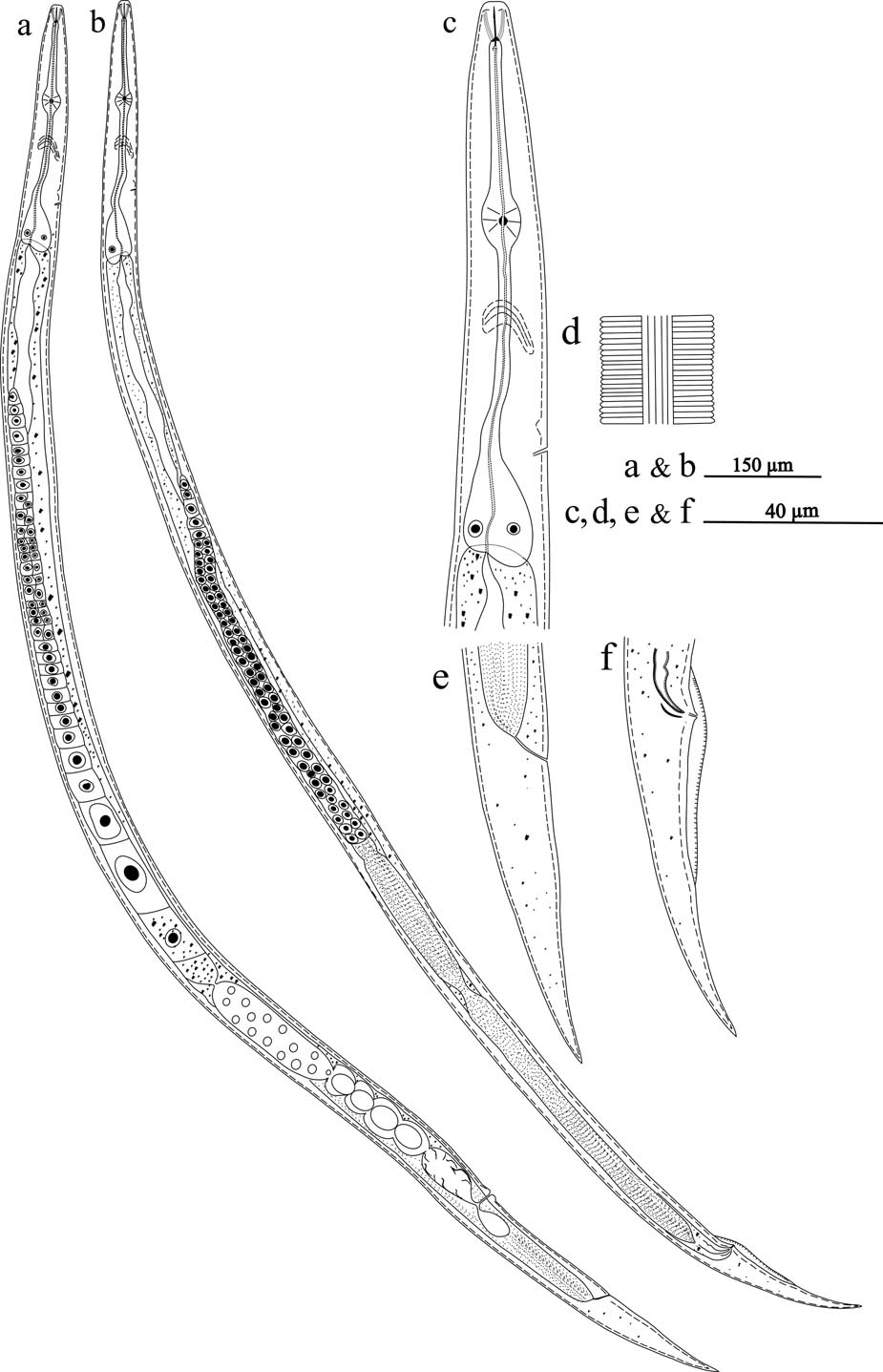
Figure 1
Line drawings of Ditylenchus behradi n. sp. (a and b) Total body of female and male, respectively; (c) pharyngeal region; (d) lateral field at mid-body; and (e and f) posterior body region of female and male, respectively.
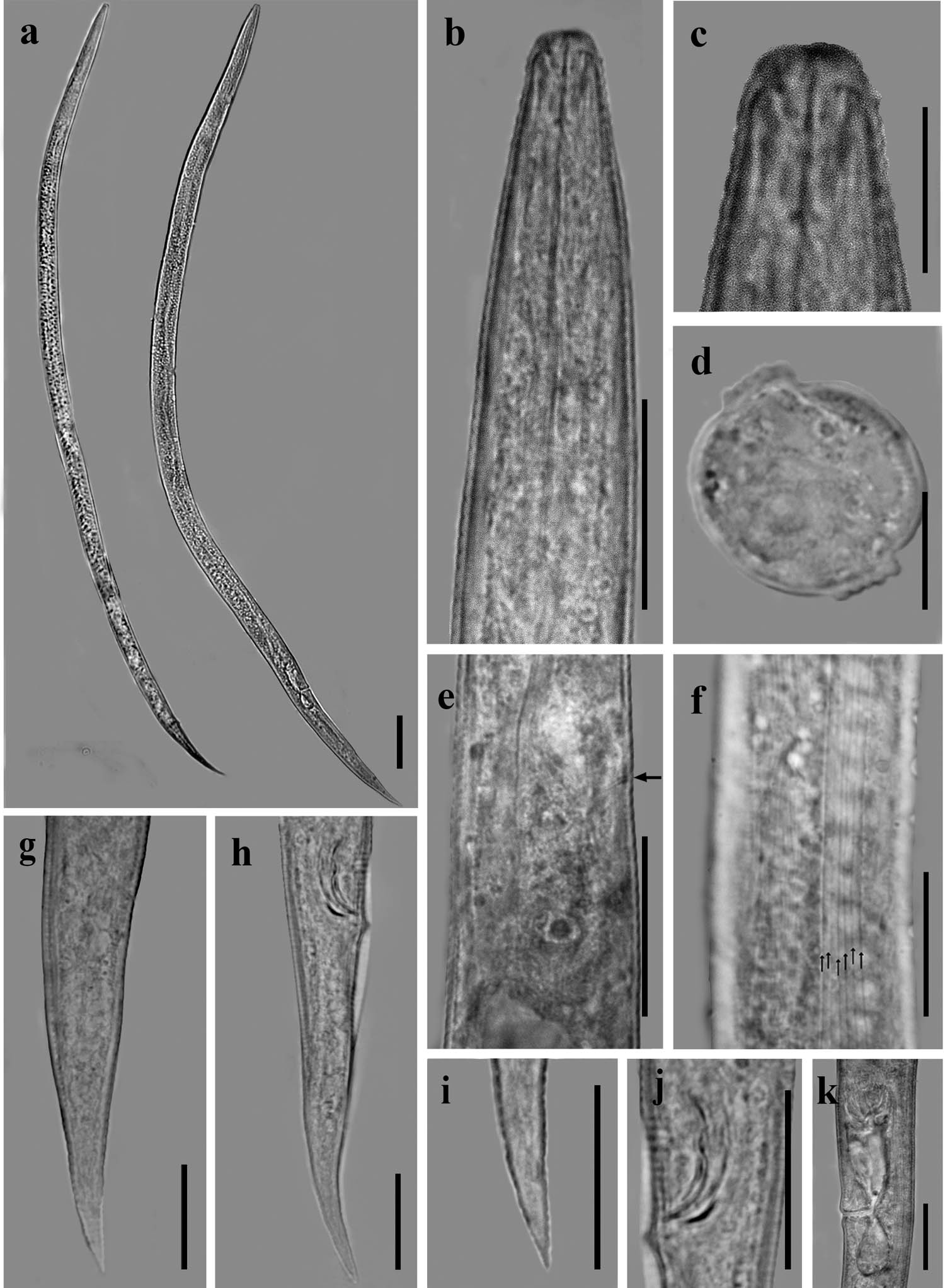
Figure 2
Light photomicrographs of Ditylenchus behradi n. sp. (a) Total body of male and female; (b and c) anterior body region and stylet; (d) cross section at mid-body; (e) terminal bulb and S-E pore; (f) lateral field at mid-body; (g and h) posterior body region of female and male, respectively; (i) female tail tip; (j) spicules; and (k) part of reproductive system. Scale bars: a = 100 µm, d = 10 µm, b, c, and e–k = 20 µm.
Table 1
Morphometrics of Ditylenchus behradi n. sp. from Razavi Khorasan province, Iran. All measurements are in µm and in the form: mean ± S.D. (range)
| Characters | Holotype | Paratypes | |
|---|---|---|---|
| Female | Females | males | |
| n | 12 | 9 | |
| L | 899.9 | 874.4 ± 45.1 (801–932) | 696 ± 72 (581–819) |
| a | 34.1 | 33.9 ± 2.8 (27.9–38.0) | 36.6 ± 4.6 (30.7–46.3) |
| b | 7.3 | 6.7 ± 0.4 (6.1–7.3) | 5.9 ± 0.6 (4.8–6.7) |
| c | 12.7 | 12.8 ± 1.6 (11.5–16.8) | 11.0 ± 1.1 (9.6–12.9) |
| c' | 4.4 | 5.0 ± 0.5 (4.1–6.0) | 5.0 ± 0.6 (3.9–5.6) |
| V or T | 82.9 | 82.2 ± 0.9 (80.2–83.5) | — |
| Lip region height | 2.1 | 2.1 ± 0.2 (1.8–2.5) | 2.2 ± 0.2 (2.0–2.5) |
| Lip region width | 6.2 | 6.1 ± 0.2 (5.8–6.4) | 6.1 ± 0.1 (5.9–6.2) |
| Stylet | 8.1 | 8.5 ± 0.3 (8.1–9.2) | 8.2 ± 0.4 (7.8–8.8) |
| Conus | 3.1 | 3.5 ± 0.3 (3.1–4.0) | 3.2 ± 0.3 (2.6–3.5) |
| m | 38.3 | 40.1 ± 3.3 (36.8–46.5) | 34.6 ± 2.2 (30.4–36.8) |
| S-E pore | 104.3 | 103.4 ± 4.1 (95.8–108.7) | 88.0 ± 8.5 (76.1–97.0) |
| Pharynx | 122.9 | 133.7 ± 7.1 (122.9–150.8) | 119.9 ± 8.9 (108.7–130.7) |
| Median bulb | 50.3 | 51.0 ± 3.1 (45.2–58.4) | 46.2 ± 4.6 (39.7–51.6) |
| MB | 40.9 | 38.2 ± 1.7 (34.8–40.9) | 35.6 ± 5.2 (26.9–39.4) |
| Anterior end to vulva | 746.2 | 718.9 ± 39.5 (650.8–777.9) | — |
| Maximum body width | 26.4 | 26.0 ± 2.7 (22.0–30.6) | 19.3 ± 3.0 (13.5–22.5) |
| Vulval body width | 22.1 | 21.7 ± 1.8 (19.6–25.7) | — |
| Vulva-anus | 82.6 | 86.4 ± 9.7 (75.1–106.5) | — |
| Tail | 71.1 | 69.1 ± 5.9 (54.1–78.4) | 64.1 ± 9.2 (48.3–73.6) |
| Tail/vulva-anus | 0.9 | 0.8 ± 0.1 (0.5–1.0) | — |
| Anal body width | 16.1 | 13.9 ± 1.8 (12–18) | 12.7 ± 1.3 (10.5–15.3) |
| PUS | 19.1 | 23.2 ± 2.0 (19.1–27.1) | — |
| PUS/VBW | 0.9 | 1.1 ± 0.1 (0.9–1.2) | — |
| PUS/V-a | 23.2 | 27.3 ± 3.8 (20.2–32.7) | — |
| Spicules | — | — | 18.0 ± 0.9 (17.1–19.8) |
| Gubernaculum | — | — | 5.8 ± 0.6 (5.1–6.4) |
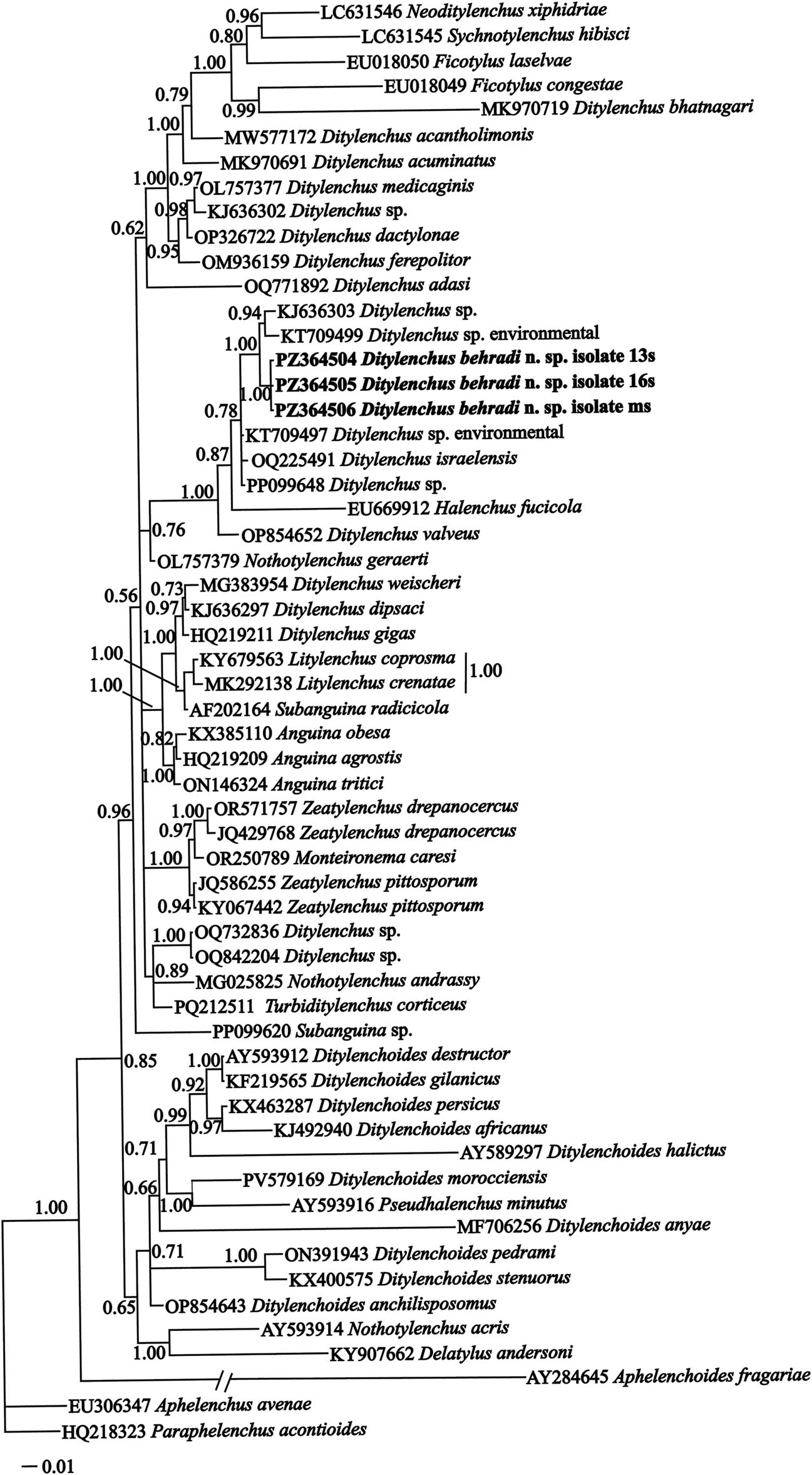
Figure 3
Bayesian 50% majority rule consensus tree inferred from analysis of the 18S rDNA gene of Ditylenchus behradi n. sp. under the GTR + G + I model. Bayesian posterior probability values of more than 0.50 are given for appropriate clades. New sequences are indicated in bold. Aphelenchoides fragariae (AY284645), Aphelenchus avenae (EU306347), and Paraphelenchus acontioides (HQ218323) used as outgroup taxa.
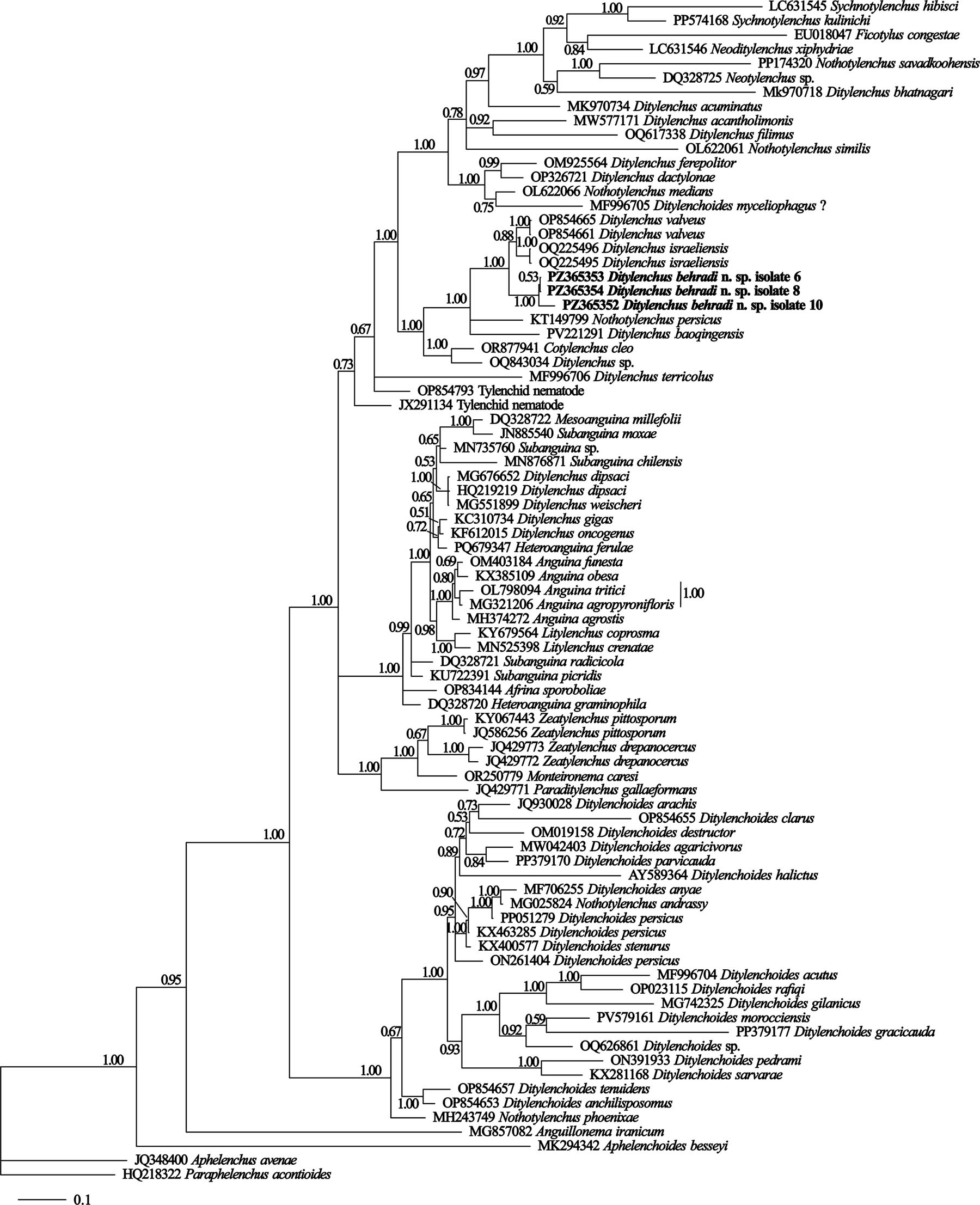
Figure 4
Bayesian 50% majority rule consensus tree inferred from analysis of the D2–D3 domains of the LSU rDNA sequences of Ditylenchus behradi n. sp. under the GTR + G + I model. Bayesian posterior probability values of more than 0.50 are given for appropriate clades. New sequences are indicated in bold. Aphelenchoides besseyi (MK294342), Aphelenchus avenae (JQ348400), and Paraphelenchus acontioides (HQ218322) used as outgroup taxa.
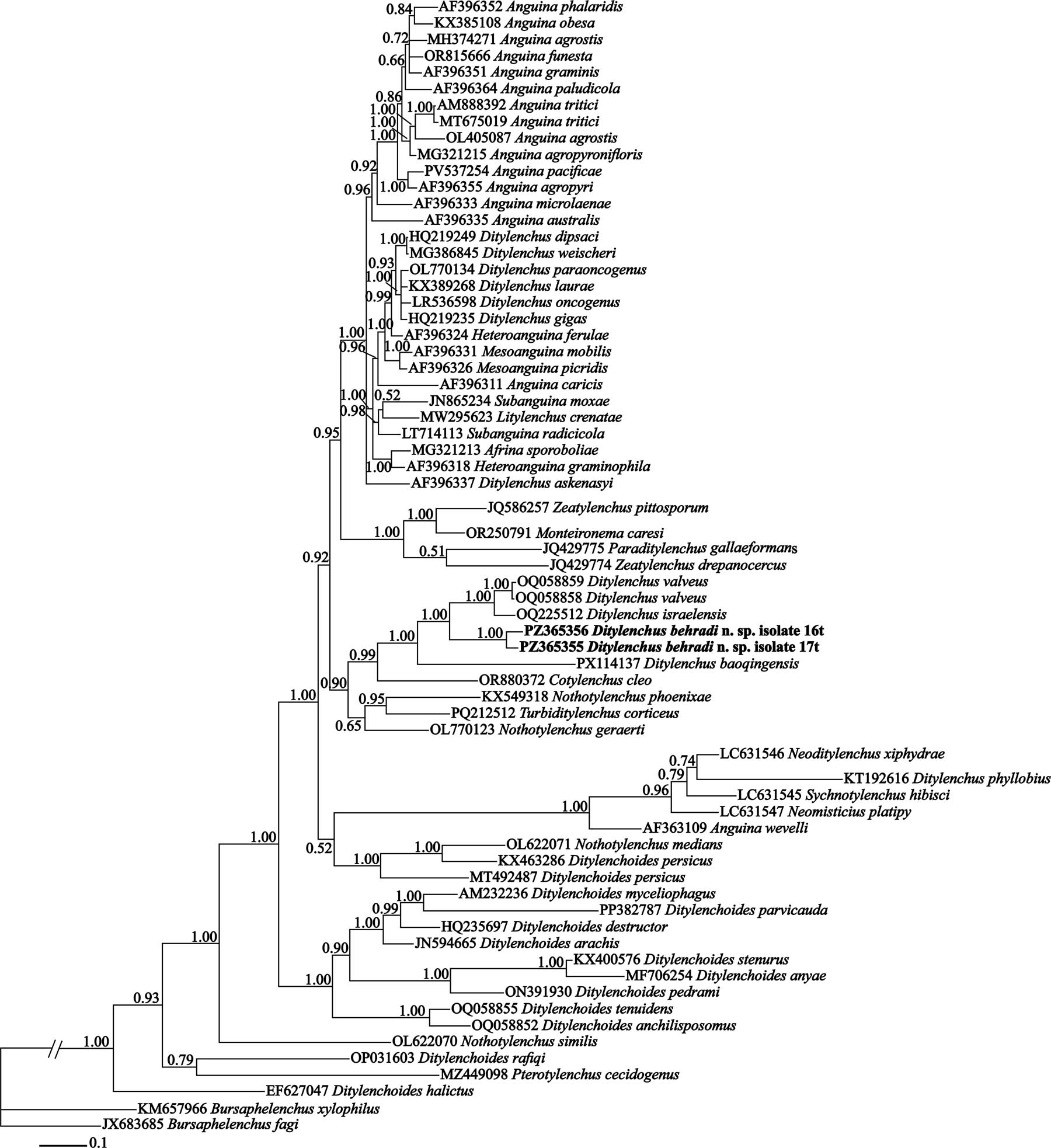
Figure 5
Bayesian 50% majority rule consensus tree inferred from analysis of the ITS rDNA gene of Ditylenchus behradi n. sp. under the GTR + G + I model. Bayesian posterior probability values of more than 0.50 are given for appropriate clades. New sequences are indicated in bold. Bursaphelenchus xylophilus (KM657966) and Bursaphelenchus fagi (JX683685) used as outgroup taxa.