
The family Anguinidae Nicoll, 1935, comprises a diverse group of nematodes exhibiting a wide range of feeding habits and biological associations, including mycophagy and phytoparasitism (Fortuner & Maggenti, 1987; Brzeski, 1991; Siddiqi, 2000; Salazar-García et al., 2025). Among them, the genus Ditylenchus Filipjev, 1936, sensu lato has long been considered one of the most taxonomically challenging groups within Tylenchomorpha due to the presence of highly conserved morphological characters, overlapping morphometrics, and cryptic species complexes (Subbotin et al., 2005; Vovlas et al., 2011). Recent integrative taxonomic studies based on molecular phylogenetic analyses and comparative morphology have demonstrated that Ditylenchus sensu lato is paraphyletic (Qiao et al., 2016; Subbotin & Ryss, 2024). Consequently, Subbotin and Ryss (2024) proposed a narrower concept of Ditylenchus sensu stricto and established the new genera Ditylenchoides Subbotin and Ryss, 2024 and Paraditylenchus Subbotin and Ryss, 2024 to accommodate several former Ditylenchus species associated mainly with fungi or underground plant tissues. In addition to the narrowly defined Ditylenchus sensu stricto, several closely related taxa occurring outside this clade have been referred to as Ditylenchus-like nematodes (Subbotin & Ryss, 2024).
Iran represents an important center of diversity for anguinid nematodes associated with natural and agricultural ecosystems (Hashemi & Karegar, 2019; Behdani et al., 2024). More recently, several additional taxa have been described from the country, including Ditylenchus azarbaijanensis (Khakbaz et al., 2021), D. acantholimonis (Aliverdi et al., 2022), D. paraoncogenus (Hashemi et al., 2022), Ditylenchoides pedrami (Azimi & Abdolkhani, 2022; Subbotin & Ryss, 2024), and Ditylenchoides anyae (Esmaeili et al., 2024). In addition, the first molecular characterization of an Iranian population of Ditylenchus filimus (Anderson, 1983) and the first record of D. weischeri (Chizhov et al., 2010) from Iran have recently been reported (Zarei & Azimi, 2023; Nobakht et al., 2023).
In the present study, an unidentified population of Ditylenchus was recovered from the rhizosphere of pistachio roots (Pistacia vera L.) in Gonabad county, Razavi Khorasan province, Iran. An integrative taxonomic approach based on morphological, morphometric, and molecular phylogenetic analyses was employed to characterize and describe the population as a new species and to infer its phylogenetic relationships with related taxa within Anguinidae.
1. Materials and methods
1.1. Sampling, nematode extraction, and morphological characterization
Soil samples were collected from the rhizosphere of pistachio (Pistacia vera L.) trees in Gonabad county, Razavi Khorasan province, Iran, at depths of 30–60 cm. Samples were placed in plastic bags, labeled with the relevant collection data, and transferred to the laboratory for further processing. Nematodes were extracted from the soil using the centrifugal flotation method of Jenkins (1964) and subsequently processed to anhydrous glycerin according to the modified method of De Grisse (1969). Permanent microscope slides were prepared for morphological examination. Observations, measurements, and photomicrographs were obtained using an Olympus BH2 light microscope equipped with a drawing tube and a digital camera. Line drawings were prepared based on microscopic observations and subsequently refined using CorelDRAW 2020 software.
1.2. DNA extraction, polymerase chain reaction (PCR), and sequencing
For DNA extraction, a single live female specimen was handpicked and transferred to a drop of sterile distilled water on a clean glass slide. After washing and preliminary morphological examination, photomicrographs of the specimen were taken, and its diagnostic morphological features were documented prior to DNA extraction. The nematode was transferred to a 15 μl drop of TE buffer (10 mM Tris-Cl, 0.5 mM EDTA; pH 9.0) and crushed using a clean coverslip. The resulting DNA suspension was collected and stored at −18°C until used as a template for PCR amplification.
Three ribosomal DNA (rDNA) regions were amplified. The D2–D3 expansion segments of the large subunit (LSU) rDNA were amplified using forward D2A (5′-ACA AGT ACC GTG AGG GAA AGT TG-3′) and reverse D3B (5′-TCG GAA GGA ACC AGC TAC TA-3′) primers (Nunn, 1992). The small subunit (SSU) rDNA was amplified using forward F22 (5′-TCCAA. GGAAGGCAGCAGGC-3′) (Dorris et al., 2002) and reverse 1573 R (5′-TACAAAGGGCAGGGACGTAAT-3′) primers (Mullin et al., 2005). The ITS1-5.8S-ITS2 region was amplified using forward rDNA1 (5′-TTGATTACGTCCC TGCCCTTT-3′) and reverse rDNA2 (5′-TTTCACTCGCCG TTACTAAGG-3′) primers (Vrain et al., 1992). PCR conditions for all loci followed the study by Azimi and Abdolkhani (2022). Amplification products were examined by electrophoresis on 1% agarose gels stained with an appropriate nucleic acid dye. Successfully amplified products were purified and sequenced in both directions using the same primers employed for PCR amplification. Newly obtained sequences were deposited in GenBank under the accession numbers indicated in the corresponding phylogenetic trees.
1.3. Phylogenetic analyses
The newly generated sequences were compared with those available in GenBank using the BLAST algorithm. Separate datasets were assembled for each marker, including sequences of the new species, representative species of Ditylenchus, selected taxa from Anguinidae and Neotylenchidae (Thorne, 1940), and appropriate outgroup taxa based on previous phylogenetic studies (Yaghoubi et al., 2018; Heydari et al., 2020; Mirzaie Fouladvand et al., 2025). Multiple sequence alignments were generated using the online version of Mafft v7 with the Q-INS-i algorithm (http://mafft.cbrc.jp/alignment/server/) (Katoh & Standley, 2013). The best-fitting nucleotide substitution model was selected using MrModeltest 2 (Nylander, 2004) under the Akaike information criterion, resulting in the GTR + G + I model for all datasets. Phylogenetic relationships were inferred using the Bayesian inference (BI) implemented in MrBayes v3.1.2. Analyses were run for 5 × 10⁶ generations, and the Markov chain Monte Carlo algorithm was used to estimate the posterior probabilities for the resulting trees (Larget & Simon, 1999). After discarding burn-in samples, a 50% majority-rule consensus tree was generated, and Bayesian posterior probabilities (BPP) greater than 0.50 indicated on the corresponding nodes. Phylogenetic trees were visualized using Dendroscope v3.2.8 (Huson & Scornavacca, 2012) and subsequently edited for publication using CorelDRAW 2020.
2. Results
2.1. Description
The line drawings and photomicrographs of Ditylenchus behradi n. sp. are presented in Figures 1 and 2, respectively. The morphometrics of D. behradi n. sp. are shown in Table 1.
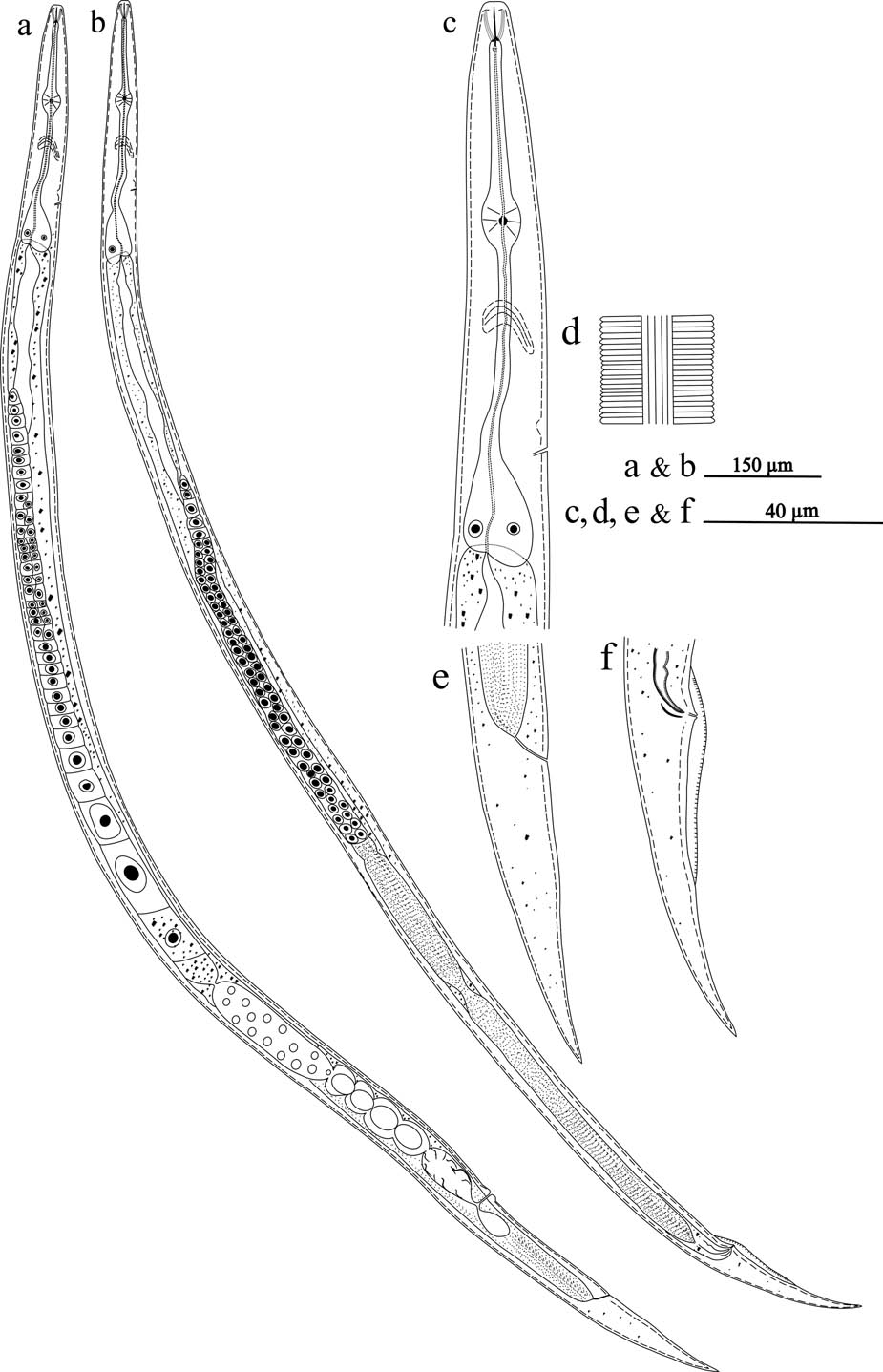
Figure 1
Line drawings of Ditylenchus behradi n. sp. (a and b) Total body of female and male, respectively; (c) pharyngeal region; (d) lateral field at mid-body; and (e and f) posterior body region of female and male, respectively.
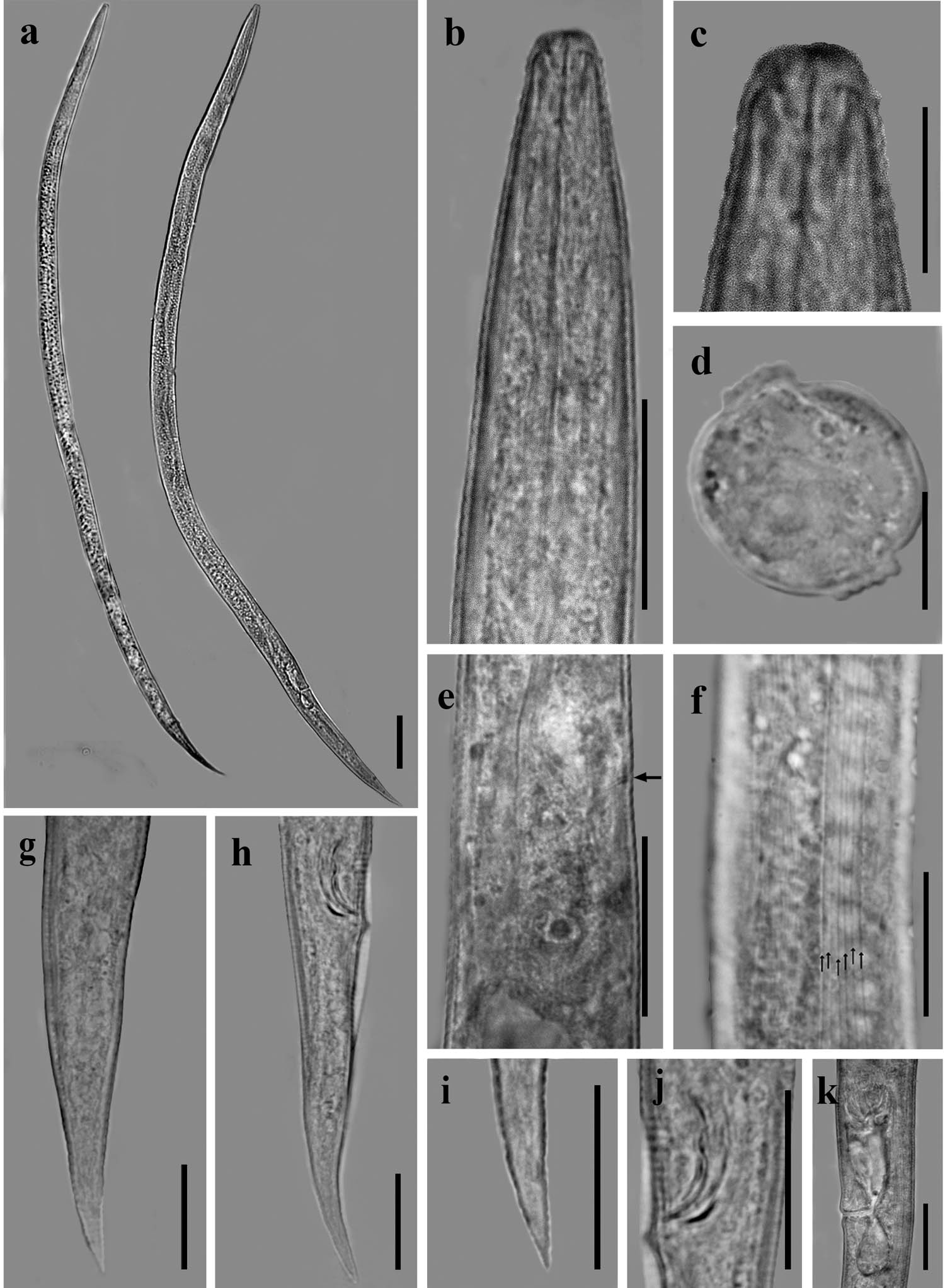
Figure 2
Light photomicrographs of Ditylenchus behradi n. sp. (a) Total body of male and female; (b and c) anterior body region and stylet; (d) cross section at mid-body; (e) terminal bulb and S-E pore; (f) lateral field at mid-body; (g and h) posterior body region of female and male, respectively; (i) female tail tip; (j) spicules; and (k) part of reproductive system. Scale bars: a = 100 µm, d = 10 µm, b, c, and e–k = 20 µm.
Table 1
Morphometrics of Ditylenchus behradi n. sp. from Razavi Khorasan province, Iran. All measurements are in µm and in the form: mean ± S.D. (range)
| Characters | Holotype | Paratypes | |
|---|---|---|---|
| Female | Females | males | |
| n | 12 | 9 | |
| L | 899.9 | 874.4 ± 45.1 (801–932) | 696 ± 72 (581–819) |
| a | 34.1 | 33.9 ± 2.8 (27.9–38.0) | 36.6 ± 4.6 (30.7–46.3) |
| b | 7.3 | 6.7 ± 0.4 (6.1–7.3) | 5.9 ± 0.6 (4.8–6.7) |
| c | 12.7 | 12.8 ± 1.6 (11.5–16.8) | 11.0 ± 1.1 (9.6–12.9) |
| c' | 4.4 | 5.0 ± 0.5 (4.1–6.0) | 5.0 ± 0.6 (3.9–5.6) |
| V or T | 82.9 | 82.2 ± 0.9 (80.2–83.5) | — |
| Lip region height | 2.1 | 2.1 ± 0.2 (1.8–2.5) | 2.2 ± 0.2 (2.0–2.5) |
| Lip region width | 6.2 | 6.1 ± 0.2 (5.8–6.4) | 6.1 ± 0.1 (5.9–6.2) |
| Stylet | 8.1 | 8.5 ± 0.3 (8.1–9.2) | 8.2 ± 0.4 (7.8–8.8) |
| Conus | 3.1 | 3.5 ± 0.3 (3.1–4.0) | 3.2 ± 0.3 (2.6–3.5) |
| m | 38.3 | 40.1 ± 3.3 (36.8–46.5) | 34.6 ± 2.2 (30.4–36.8) |
| S-E pore | 104.3 | 103.4 ± 4.1 (95.8–108.7) | 88.0 ± 8.5 (76.1–97.0) |
| Pharynx | 122.9 | 133.7 ± 7.1 (122.9–150.8) | 119.9 ± 8.9 (108.7–130.7) |
| Median bulb | 50.3 | 51.0 ± 3.1 (45.2–58.4) | 46.2 ± 4.6 (39.7–51.6) |
| MB | 40.9 | 38.2 ± 1.7 (34.8–40.9) | 35.6 ± 5.2 (26.9–39.4) |
| Anterior end to vulva | 746.2 | 718.9 ± 39.5 (650.8–777.9) | — |
| Maximum body width | 26.4 | 26.0 ± 2.7 (22.0–30.6) | 19.3 ± 3.0 (13.5–22.5) |
| Vulval body width | 22.1 | 21.7 ± 1.8 (19.6–25.7) | — |
| Vulva-anus | 82.6 | 86.4 ± 9.7 (75.1–106.5) | — |
| Tail | 71.1 | 69.1 ± 5.9 (54.1–78.4) | 64.1 ± 9.2 (48.3–73.6) |
| Tail/vulva-anus | 0.9 | 0.8 ± 0.1 (0.5–1.0) | — |
| Anal body width | 16.1 | 13.9 ± 1.8 (12–18) | 12.7 ± 1.3 (10.5–15.3) |
| PUS | 19.1 | 23.2 ± 2.0 (19.1–27.1) | — |
| PUS/VBW | 0.9 | 1.1 ± 0.1 (0.9–1.2) | — |
| PUS/V-a | 23.2 | 27.3 ± 3.8 (20.2–32.7) | — |
| Spicules | — | — | 18.0 ± 0.9 (17.1–19.8) |
| Gubernaculum | — | — | 5.8 ± 0.6 (5.1–6.4) |
2.1.1. Female
The body is straight to slightly ventrally curved after heat killing. The cuticule is finely annulated, with annuli that is approximately 1.5 µm wide, and lateral fields feature six incisures. The lip region is low, anteriorly flattened, 1.8–2.2 µm high by 5.8–6.2 µm wide, and continuous with the body contour. The cephalic framework is weak to slightly sclerotized. The stylet is delicate, with small basal knobs and conus occupying 37.6–42.0% of the total stylet length. The median pharyngeal bulb is elliptical and is 8.0–9.5 µm wide, with a distinct valvular apparatus, basal pharyngeal bulb elongated to pyriform, slightly overlapping the intestine. The hemizonid is distinct and located approximately eight µm anterior to the secretory excretory (S-E) pore. The reproductive system is monodelphic-prodelphic and the ovary is outstretched, with oocytes arranged in two rows. In some specimens, the spermatheca is elongated and axial and contains rounded sperm. Furthermore, the crustaformeria is quadricolumellate, and the vulva forms a transverse slit located at 80.2–83.5% of body length. The post-vulval uterine sac (PUS) is present, which is relatively short and 1.0–1.2 times the corresponding vulval body diameter long. Finally, the tail is conical and about 4.8 times the anal body diameter long, and the tail terminus is bluntly rounded to occasionally pointed.
2.1.2. Male
The male is similar to the female in general morphology except for the reproductive system. The male reproductive system consists of a single outstretched testis, with the spermatocytes arranged in two distinct rows. The spicules are tylenchoid and ventrally curved, measuring between 17.1–19.8 µm in length. The gubernaculum is crescent shaped and ranges from 5.1 to 6.4 µm long. Finally, a bursa with annulated margins is present, which extends nearly to the tail terminus.
2.2. Type habitat and locality
The type population of D. behradi n. sp. was recovered from the soil collected in the rhizosphere of pistachio (Pistacia vera L.) in Gonabad county, Razavi Khorasan province, northeastern Iran (34° 37.144′N, 58° 38.000′E).
2.3. Type material
The holotype female, 11 paratype females, and nine paratype males were deposited in the Nematode Type Collection, Faculty of Agriculture, Tarbiat Modares University, Tehran, Iran. The ZooBank Life Science Identifier (LSID) for this publication is: urn:lsid:zoobank.org:pub:990A78F3-4F2B-4CBE-AB46-27C899E490EA.
2.4. Etymology
The species epithet behradi is a patronym honoring Behrad, the son of the first author. The ZooBank LSID for this nomenclatural act is: urn:lsid:zoobank.org:act:8FED919F-6D63-4580-A4A9-DE5653DDC572.
2.5. Diagnosis and relationships
Ditylenchus behradi n. sp. is characterized by females having a cylindrical body that is 801–932 µm long, lateral fields with six incisures, a slender stylet 8.1–9.2 µm long, S-E pore located 95.8–108.7 µm from the anterior end, a short PUS (21.5–27.1 µm long), and an elongate conoid tail 54.0–78.4 µm long with a bluntly rounded to occasionally pointed terminus. Males possess arcuate spicules 17.1–19.8 µm long.
The new species is morphologically most similar to Ditylenchus baoqingensis (Qiu et al., 2026), Ditylenchus israelensis (Gu et al., 2023), Ditylenchus triformis (Hirschmann & Sasser, 1955), Ditylenchus valveus (Thorne & Malek, 1968), and Ditylenchus zeae (Das & Bajaj, 2005), but can be distinguished from these species by a combination of morphological and morphometric characters. The following comparisons are based primarily on female characters; differences in male morphology are indicated separately where relevant.
It differs from D. baoqingensis by having a shorter body (801–932 vs. 722–1081 µm), longer stylet (8.1−9.2 vs. 7.2−8.1 µm), slightly overlapping basal pharyngeal glands (vs. offset), six lateral lines (vs. four), lower a (27.9–38.0 vs. 43.3–58.3) and c (11.5−16.8 vs. 9.4−13.0) values, lower c′ value (4.1−6.0 vs. 4.9−8.1), shorter tail (54−78 vs. 69.9−92.1 µm), and a different tail terminus shape (bluntly rounded to occasionally pointed vs. rounded). Males differ by having longer spicules (17.1−19.8 vs. 16.8–17.8 µm).
It differs from D. israelensis by having a longer stylet (8.1−9.2 vs. 7.0−7.5 µm), higher c value (11.5−16.8 vs. 9.6−11.8), lower c′ value (4.1−6.0 vs. 5.3−8.3), and a shorter tail (54−78 vs. 82−96 µm).
It differs from D. triformis by having slightly overlapping basal pharyngeal glands (vs. offset), and six lateral lines in anal region (vs. four). Males further differ by having longer spicules (17.1−19.8 vs. 13−16 µm).
It differs from D. valveus by having a higher c value (11.5−16.8 vs. 8.4−12.0) and tail terminus shape (bluntly rounded to occasionally pointed vs. sharply pointed or mucronate).
It differs from D. zeae by having a higher b value (6.1−7.3 vs. 5.5) and shorter PUS relative to vulval body diameter (1.0−1.2 vs. 1.6−1.7).
2.6. Remarks
The present species is assigned to Ditylenchus-like group based on a combination of morphological and molecular evidence. Morphologically, it shares several general features with species of Ditylenchus, including the general body form, lateral field structure, and pharyngeal morphology characteristic of the genus. At the same time, it lacks several diagnostic features reported for species currently assigned to Ditylenchoides and Paraditylenchus.
Phylogenetic analyses based on SSU, LSU D2–D3, and ITS rDNA sequences consistently placed the new species within the group of Ditylenchus-like taxa, outside the narrowly defined Ditylenchus sensu stricto clade. In all inferred trees, Ditylenchus behradi n. sp. formed a distinct and well-supported lineage closely related to D. israelensis and D. valveus. The combined morphological and molecular evidence therefore supports its recognition as a new species of the Ditylenchus-like group, provisionally retained in the genus Ditylenchus pending further phylogenetic and taxonomic assessment of this group.
2.7. Molecular profiles and phylogenetic status
2.7.1. Partial SSU rDNA
PCR amplification of the partial SSU rDNA region was performed for three specimens, and the resulting amplicons were subsequently sequenced. The obtained sequences were 1,148, 836, and 1,084 bp in length and were deposited in GenBank under accession numbers PZ364504, PZ364505, and PZ364506, respectively. BLAST searches revealed that the newly generated SSU sequences shared the highest similarity with Ditylenchus sp. (KJ636303; 99.54% identity) and an environmental Ditylenchus sequence (KT709499; 99.21% identity). Pairwise comparison revealed that the SSU sequence of D. behradi n. sp. differed by seven nucleotides from both Ditylenchus sp. (KJ636303) and the environmental Ditylenchus (KT709499) sequences.
The SSU rDNA phylogenetic tree was reconstructed based on a dataset comprising 55 sequences, with three aphelenchid taxa (AY284645, EU306347, and HQ218323) included as outgroups (Figure 3). In the inferred tree, the new species formed a maximally supported clade with Ditylenchus sp. (KJ636303) and the environmental Ditylenchus sequence (KT709499). The topology of the tree was generally consistent with the previously published SSU-based phylogenies of Anguinidae and supported the phylogenetic placement of the new species within the Ditylenchus-like group, outside the narrowly defined Ditylenchus sensu stricto clade.
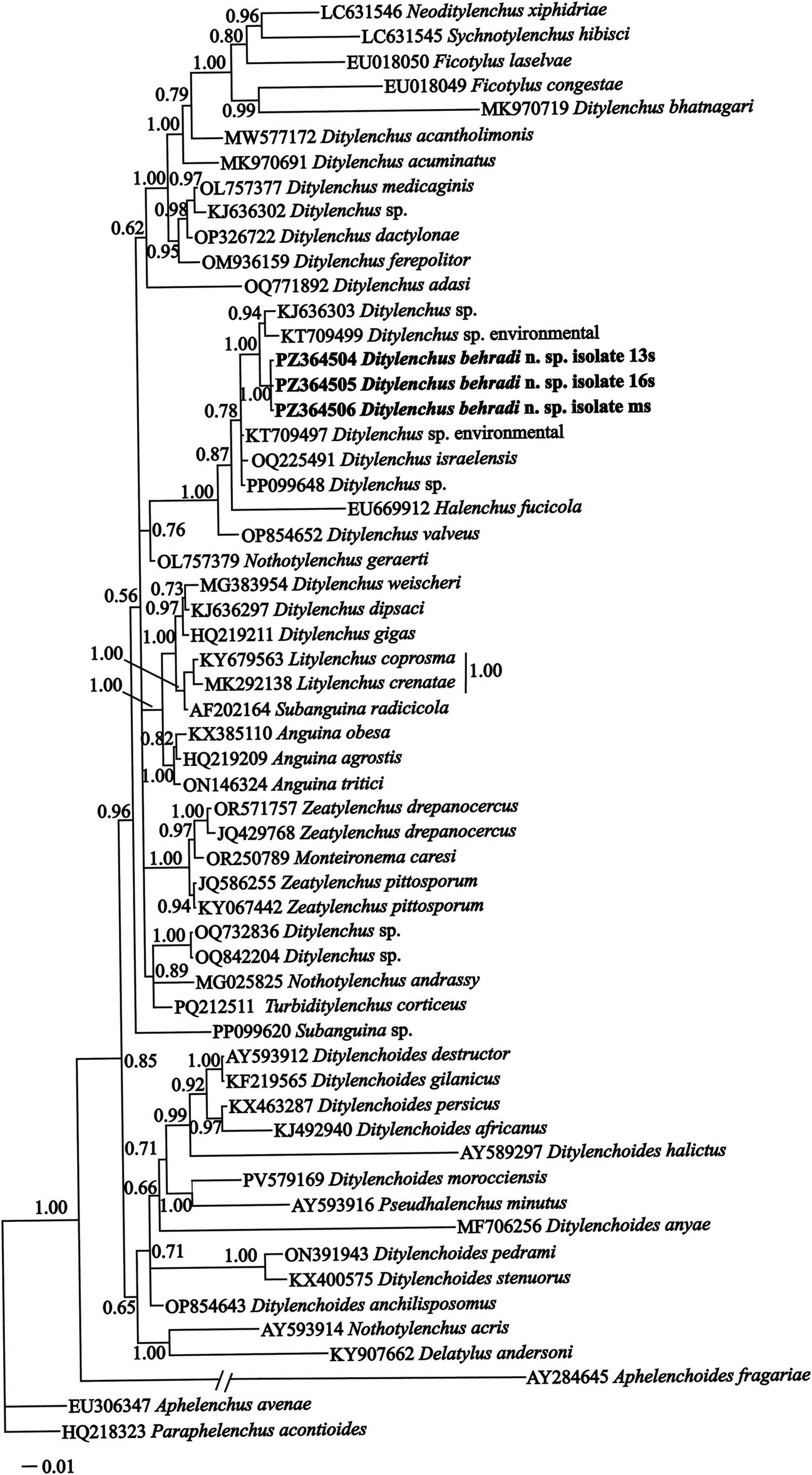
Figure 3
Bayesian 50% majority rule consensus tree inferred from analysis of the 18S rDNA gene of Ditylenchus behradi n. sp. under the GTR + G + I model. Bayesian posterior probability values of more than 0.50 are given for appropriate clades. New sequences are indicated in bold. Aphelenchoides fragariae (AY284645), Aphelenchus avenae (EU306347), and Paraphelenchus acontioides (HQ218323) used as outgroup taxa.
2.7.2. D2–D3 expansion fragments of LSU rDNA
PCR amplification of the D2–D3 expansion segments of the LSU rDNA was performed for three specimens, and the resulting amplicons were subsequently sequenced. The obtained sequences were 711, 606, and 649 bp in length and were deposited in GenBank under accession numbers PZ365352, PZ365353, and PZ365354, respectively. BLAST analysis of the longest sequence showed the highest similarity to Ditylenchus valveus (OP854661; 93.04% identity) and D. israelensis (OQ225495; 92.97% identity). Pairwise comparison revealed that the LSU D2–D3 sequence of D. behradi n. sp. differed by 50 nucleotides from both D. valveus (OP854661) and D. israelensis (OQ225495) sequences. For phylogenetic reconstruction, a dataset comprising 83 sequences was assembled, including representatives of Anguinidae, the newly generated sequences, and three sequences from Aphelenchoididae (Skarbilovich, 1947) used as outgroup taxa. The Bayesian phylogenetic tree is presented in Figure 4. In the inferred tree, sequences of D. behradi n. sp. formed a highly supported clade with D. valveus and D. israelensis (BPP = 1.00), indicating a close phylogenetic relationship among these species.
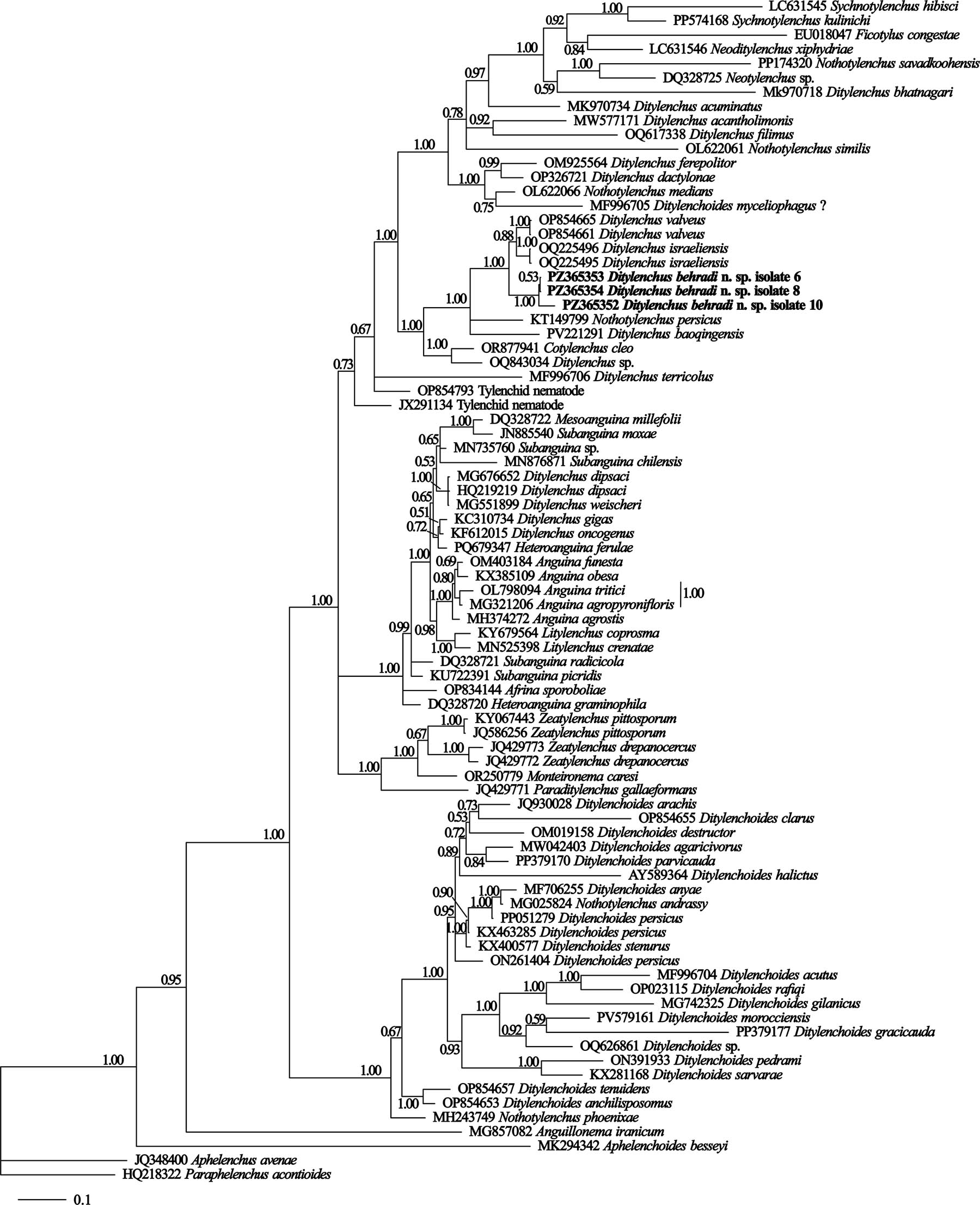
Figure 4
Bayesian 50% majority rule consensus tree inferred from analysis of the D2–D3 domains of the LSU rDNA sequences of Ditylenchus behradi n. sp. under the GTR + G + I model. Bayesian posterior probability values of more than 0.50 are given for appropriate clades. New sequences are indicated in bold. Aphelenchoides besseyi (MK294342), Aphelenchus avenae (JQ348400), and Paraphelenchus acontioides (HQ218322) used as outgroup taxa.
2.7.3. Partial ITS rDNA
PCR amplification of the ITS rDNA region was performed for two specimens, and the resulting amplicons were subsequently sequenced. The obtained sequences were 679 and 565 bp in length and were deposited in GenBank under accession numbers PZ365355 and PZ365356, respectively. BLAST searches revealed that the ITS sequences shared the highest similarity with D. valveus (OQ058859; 91.97% identity) and D. israelensis (OQ225512; 90.89% identity). Pairwise comparison revealed that the ITS sequence of D. behradi n. sp. differed from D. valveus (OQ058859) and D. israelensis (OQ225512) sequences by 40 and 54 nucleotides, respectively. Phylogenetic analysis was performed using a dataset comprising the newly generated ITS sequences, 65 sequences representing members of Anguinidae and 2 sequences of Aphelenchoididae used as outgroups. The resulting Bayesian phylogenetic tree is shown in Figure 5. Similar to the LSU phylogeny, the sequences of D. behradi n. sp. formed a fully supported clade with D. valveus and D. israelensis (BPP = 1.00), further corroborating the close relationships among these taxa inferred from both ribosomal markers.
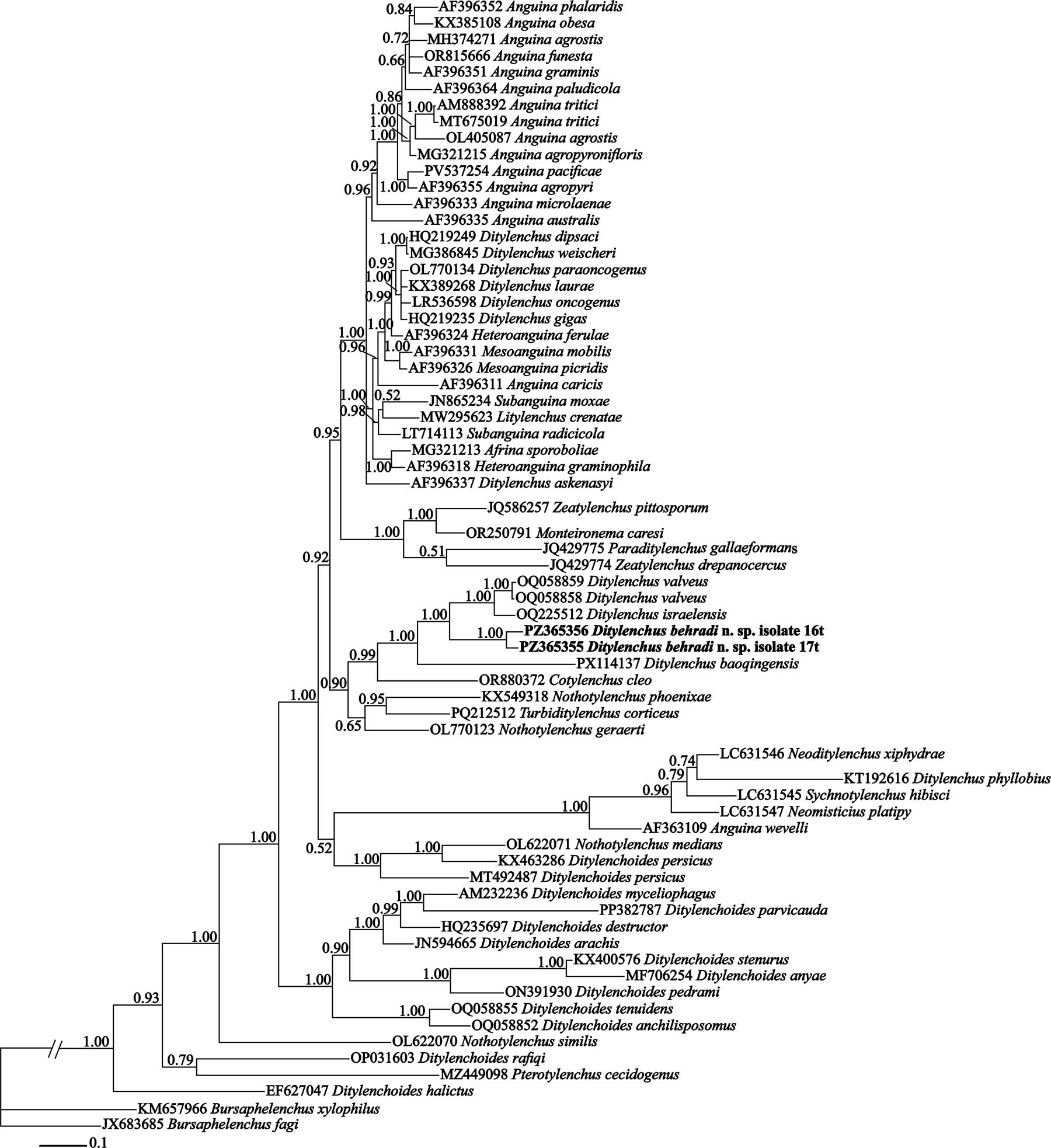
Figure 5
Bayesian 50% majority rule consensus tree inferred from analysis of the ITS rDNA gene of Ditylenchus behradi n. sp. under the GTR + G + I model. Bayesian posterior probability values of more than 0.50 are given for appropriate clades. New sequences are indicated in bold. Bursaphelenchus xylophilus (KM657966) and Bursaphelenchus fagi (JX683685) used as outgroup taxa.
3. Discussion
The morphological and morphometric characteristics of many Ditylenchus species are highly similar, and identification based solely on morphological data may lead to misidentification (Brzeski, 1991; Vovlas et al., 2011; Singh et al., 2021; Azimi & Abdolkhani, 2022; Subbotin & Ryss, 2024). Therefore, an integrative taxonomic approach combining morphological and molecular analyses was employed in the present study to characterize and describe the new species. Morphologically, D. israelensis, D. baoqingensis, and D. valveus exhibited considerable resemblance to D. behradi n. sp. Phylogenetic analyses based on LSU D2–D3 and ITS rDNA sequences also revealed that these species formed a well-supported clade with the new species, indicating close evolutionary relationships among these taxa. The congruence between morphological comparisons and molecular phylogenetic analyses further supports the recognition of D. behradi n. sp. as a distinct species.
The present study further highlights the taxonomic complexity of Ditylenchus sensu lato and demonstrates the importance of integrative taxonomy for species delimitation within Anguinidae, where morphology alone may be insufficient because of overlapping diagnostic characters and cryptic diversity (Hashemi & Karegar, 2019; Munawar et al., 2023; Rezaei et al., 2024).
Although these sequences may represent closely related or potentially conspecific populations, the absence of accompanying morphological data prevents definitive taxonomic conclusions.
Previous studies have demonstrated that Ditylenchus sensu lato is paraphyletic (Subbotin & Ryss, 2024). Based on molecular phylogenetic analyses and morphological evidence, Subbotin and Ryss (2024) proposed a narrower concept of Ditylenchus sensu stricto and established the new genera Ditylenchoides and Paraditylenchus to accommodate several former Ditylenchus species (Subbotin & Ryss, 2024). Several closely related taxa occurring outside the narrowly defined Ditylenchus sensu stricto clade have been referred to as Ditylenchus-like nematodes (Subbotin & Ryss, 2024). The phylogenetic position of D. behradi n. sp. in the present study is consistent with this Ditylenchus-like group. The phylogenetic relationships inferred in the present study are generally consistent with those reported in previous studies and support the complex evolutionary relationships within Anguinidae.
Despite recent advances in molecular characterization of Ditylenchus species (Aliverdi et al., 2022; Hashemi et al., 2022; Munawar et al., 2023; Zarei & Azimi, 2023; Azimi & Abdolkhani, 2022; Gu et al., 2023; Rezaei et al., 2024; Qiu et al., 2026), many taxa still lack molecular data and remain known only from morphological descriptions. This deficiency limits accurate phylogenetic placement and complicates species delimitation within the genus. Therefore, the incorporation of additional molecular data from diverse Ditylenchus populations will be essential for resolving remaining taxonomic ambiguities and improving our understanding of phylogenetic relationships within Anguinidae.
The recovery of the new species from the pistachio rhizosphere expands the current knowledge of anguinid diversity associated with agricultural ecosystems in Iran. Nevertheless, its ecological status and biological relationship with pistachio remain uncertain because the species was recovered only from rhizosphere soil. Further ecological and pathogenicity studies are required to clarify its host association and biological characteristics. The present finding is consistent with recent studies, indicating that the diversity of anguinid nematodes in Iran is still incompletely known and continues to expand through surveys and integrative taxonomic investigations (e.g., Hashemi et al., 2022; Azimi & Abdolkhani, 2022; Zarei & Azimi, 2023; Nobakht et al., 2023; Behdani et al., 2024).
4. Conclusion
An integrative taxonomic approach combining morphology, morphometrics, and molecular phylogenetic analyses supported the establishment of Ditylenchus behradi n. sp. recovered from the pistachio rhizosphere in Iran. The present findings contribute to the current understanding of diversity and phylogenetic relationships within Ditylenchus sensu lato and emphasize the continuing importance of molecular characterization for resolving taxonomic ambiguities within Anguinidae.
Acknowledgments
The specimens examined in this study were recovered during a commissioned national research project entitled “Determination of the distribution and species identification of root-knot nematodes in pistachio orchards of South Khorasan, Razavi Khorasan and Kerman provinces” (Project No. 124-44-16-061-99018-990397). The authors gratefully acknowledge the South Khorasan Agricultural and Natural Resources Research and Education Center, Agricultural Research, Education and Extension Organization (AREEO), Birjand, Iran, for providing the laboratory facilities used in this study.
Funding information
The authors state that no funding information.
Author contributions
Conceptualization: MB. Methodology: MB. Investigation: MB, FJA, RMM. Formal analysis: MB, FJA. Data curation: MB, FJA. Writing-draft: MB, FJA. Writing-review and editing: MB, FJA, RMM. Visualization: MB, FJA.
Conflict of interest statement
The authors state no conflict of interest.
Data availability statement
Data are available from the corresponding author upon reasonable request.