
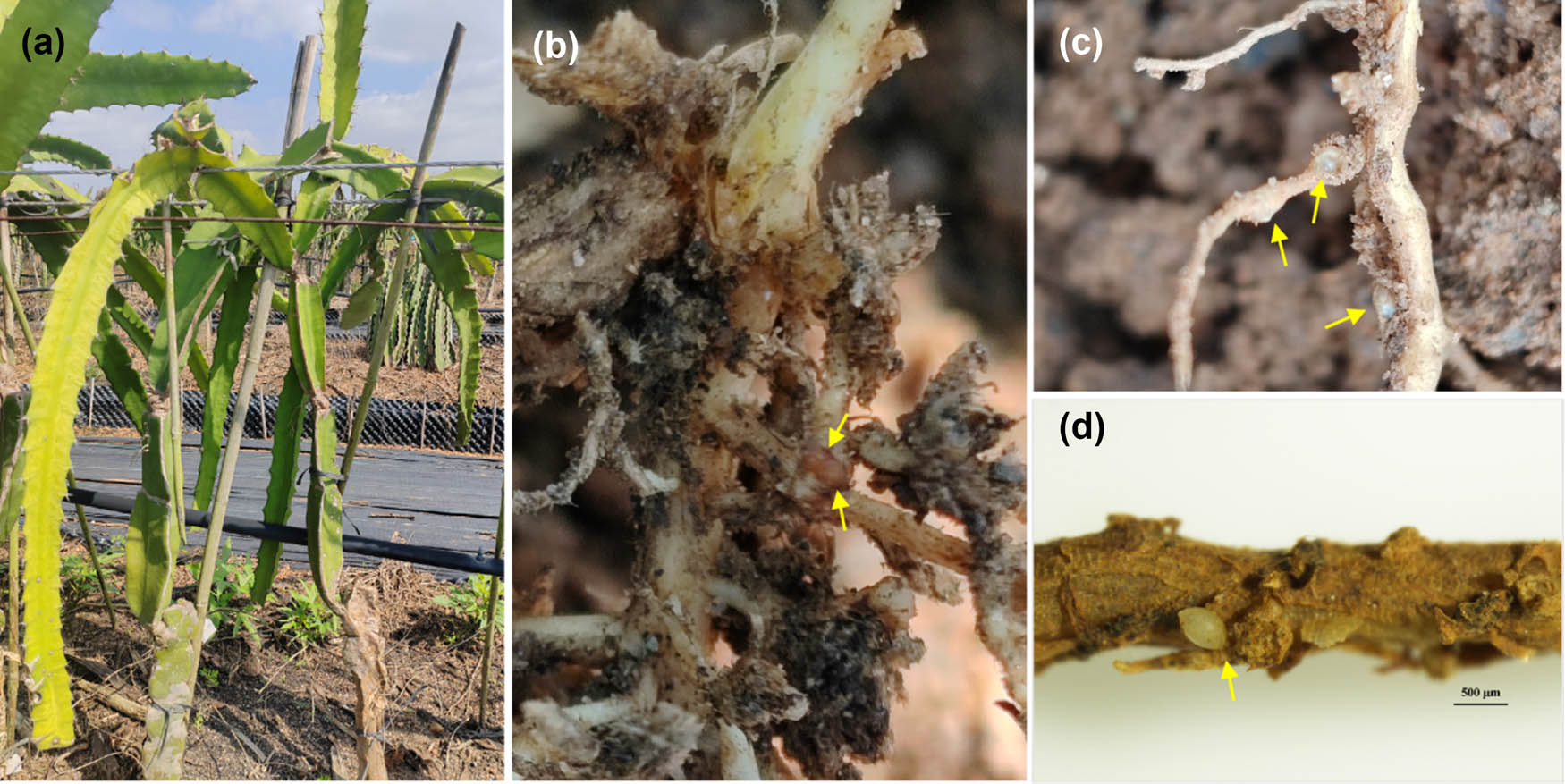
Figure 1
Symptoms of dragon fruit infected by Cactodera cacti. Stunted and yellowing plant (a); roots showing cyst nematode (indicated by arrows) (b–d).
Table 1
Morphometric measurements of Cactodera cacti from Hainan Province and four reference populations from China, Taiwan, Vietnam, and the Netherlands
| Character | The Netherlands (Adam, 1932) | China (Duan et al., 2012) | Taiwan (Chan et al., 2016) | Vietnam (Thanh Thi Vo et al., 2026) | Hainan China |
|---|---|---|---|---|---|
| n | 20 | 20 | 20 | 30 | 15 |
| Body length | 486 (428–584) | 513.8 (467.3–542.5) | 479.7 (426.5–578.6) | 447.6 ± 38 (341–485) | 503.1 (434.6–549.1) |
| Body width | — | — | 23.98 (19.7–28.2) | 20.37 ± 1.16 (17–23) | 20.1 (17.8–24.1) |
| Stylet length | 25.2 (22–28.2) | 24.6 (23.0–25.8) | 24.74 (22.6–27.4) | 27.63 ± 1.3 (25–31) | 22.6 (18.9–26.0) |
| Tail length | — | 52.2 (45.9–59.5) | 53.11 (45.6–59.3) | 52.8 ± 4.89 (39–61) | 51.4 (39.2–59.9) |
| Hyaline tail | — | 19.1 (16.3–23.2) | 20.18 (16.1–24.7) | 19.37 ± 2.28 (13–25) | 20.7 (16.9–25.4) |
| DGO | — | _ | 4.32 (2.4–6.7) | — | — |
All measurements of J2s are in μm.
DGO: Distance from Dorsal Gland Opening to top of median bulb.
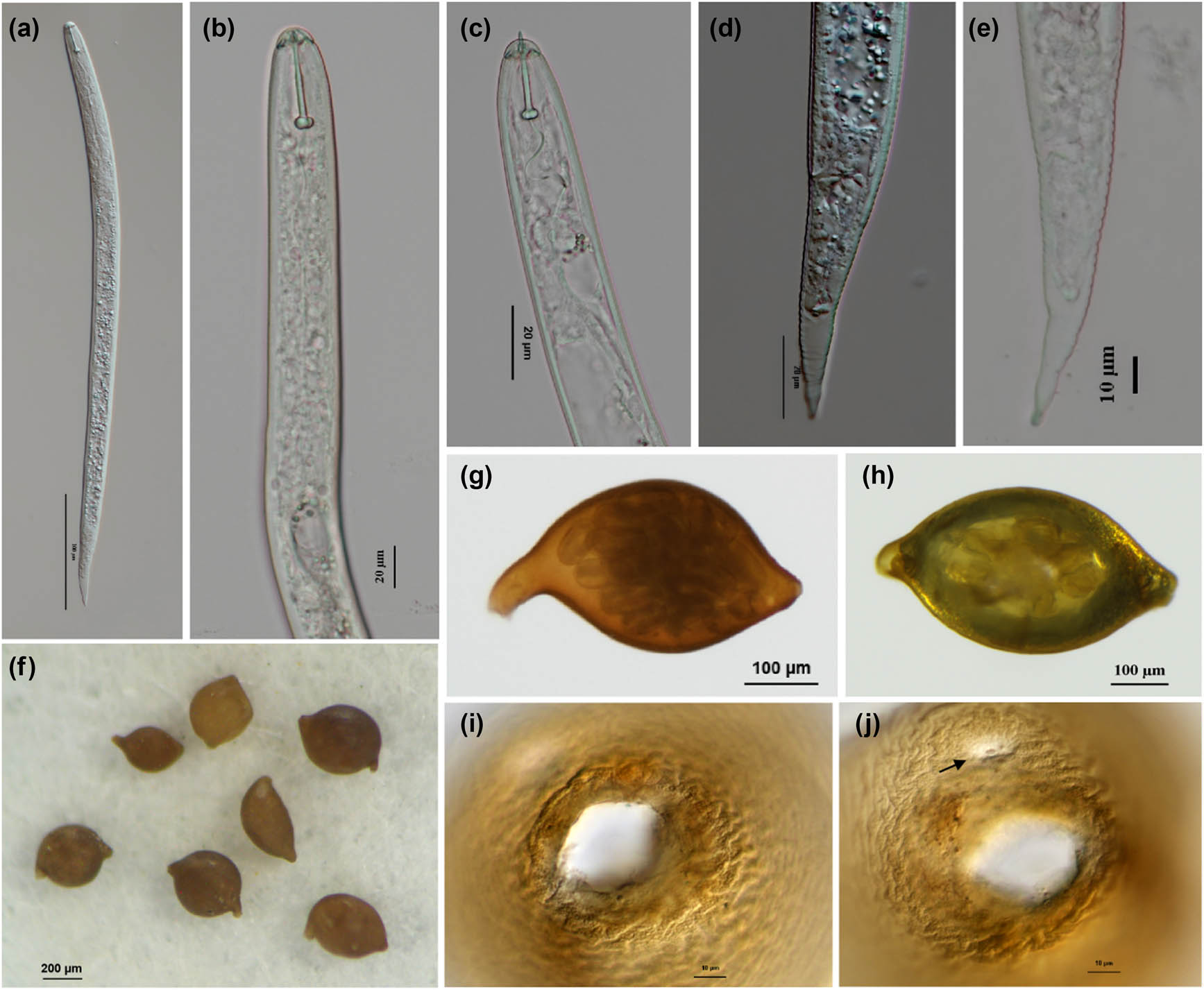
Figure 2
Morphological characteristics of second-stage juveniles (J2), cysts, and vulval cone of C. cacti. Entire J2 body (a); anterior end of J2 (b and c); posterior end of J2 (d and e); lemon shaped cyst (f–h); vulva (i and j). Arrow shows the anus (j). Scale bar: 200 μm (f); 100 μm (a, g, h); 20 μm (c, d); 10 μm (e, i, j).
Table 2
Morphometrics of Cactodera cacti cyst from Hainan Province population and five reference populations from the Netherlands, Italy, Iran, Taiwan, and Vietnam
| Population characters | The Netherlands (Adam, 1932) | Italy (Ambrogioni, 1969) | Iran (Maafi, 2003) | Taiwan (Chan et al., 2016) | Vietnam (Thanh Thi Vo et al., 2026 | Hainan China |
|---|---|---|---|---|---|---|
| n | 50 | 25 | 21 | 20 | 10 | 15 |
| Length | 497 (328–617) | 536 (384–780) | 490 (380–600) | 457 (358–563) | 411 ± 102 (284–647) | 391 (299–454) |
| Width | 447 (309–598) | 378 (240–588) | 382 (280–490) | 359 (296–475) | 332 ± 88 (200–491) | 274 (239–330) |
| L/W | 1.1 | 1.4 (1.1–2.0) | _ | 1.28 (1.1–1.6) | 1.26 ± 0.17 (1.07–1.66) | 1.44 (1.03–1.89) |
| Fenestral diameter | _ | (26–28) | 28 ± 3.3 (23–35) | 23.2 (20–29) | _ | 21.4 (19–23) |
All measurements are in μm.
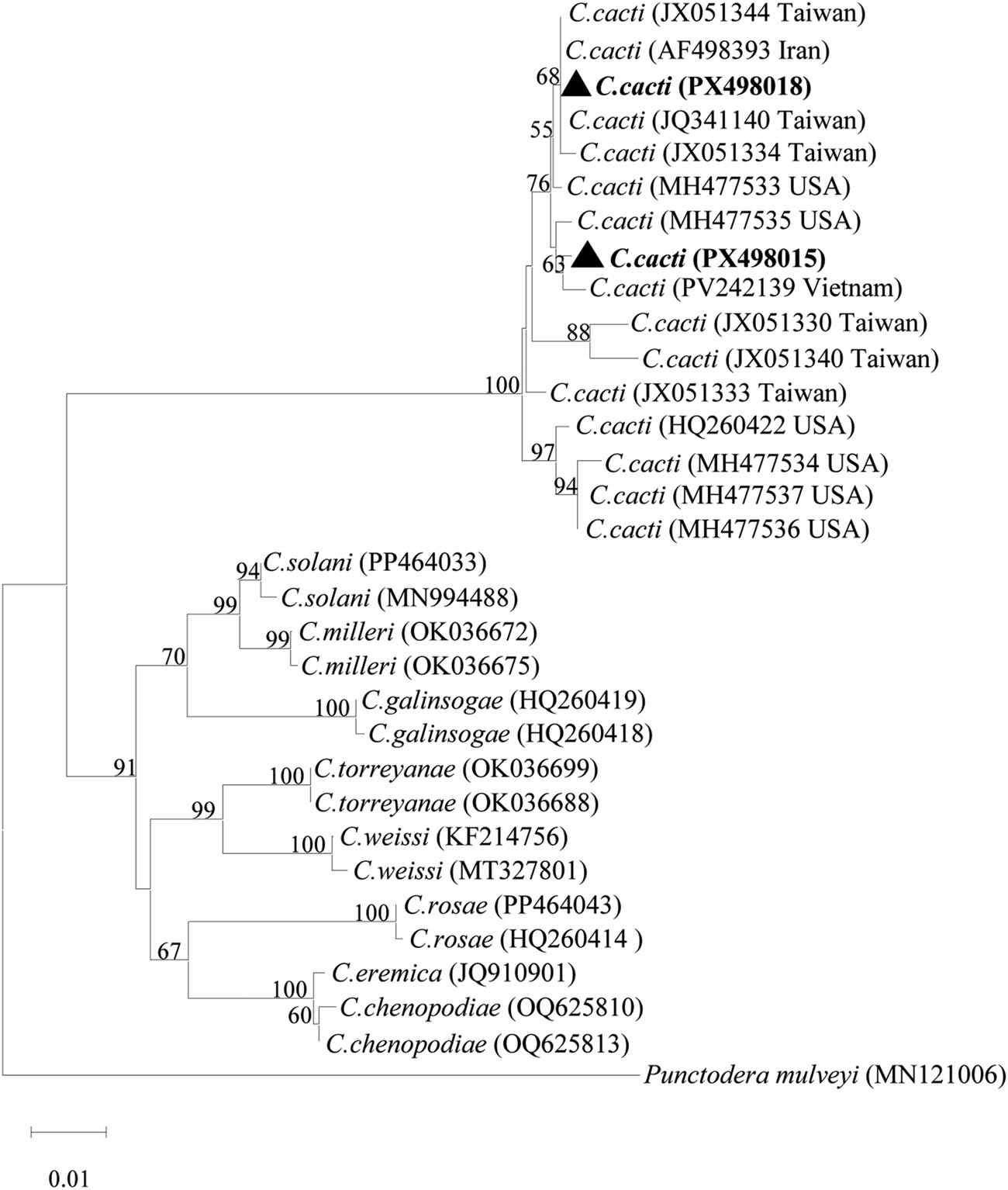
Figure 3
Phylogenetic tree based on ITS rDNA sequences of the genus Cactodera. The tree was constructed using the NJ method with bootstrap support from 1,000 replicates. Bootstrap values are shown at each node. Sequences obtained in this study are marked in bold (PX498015 and PX498018). Sequences of Cactodera cacti used in the phylogenetic analysis are labeled with accession numbers and geographic origin. Sequences originating from Taiwan Province of China are labeled as “Taiwan” in the tree to maintain consistency with GenBank records.
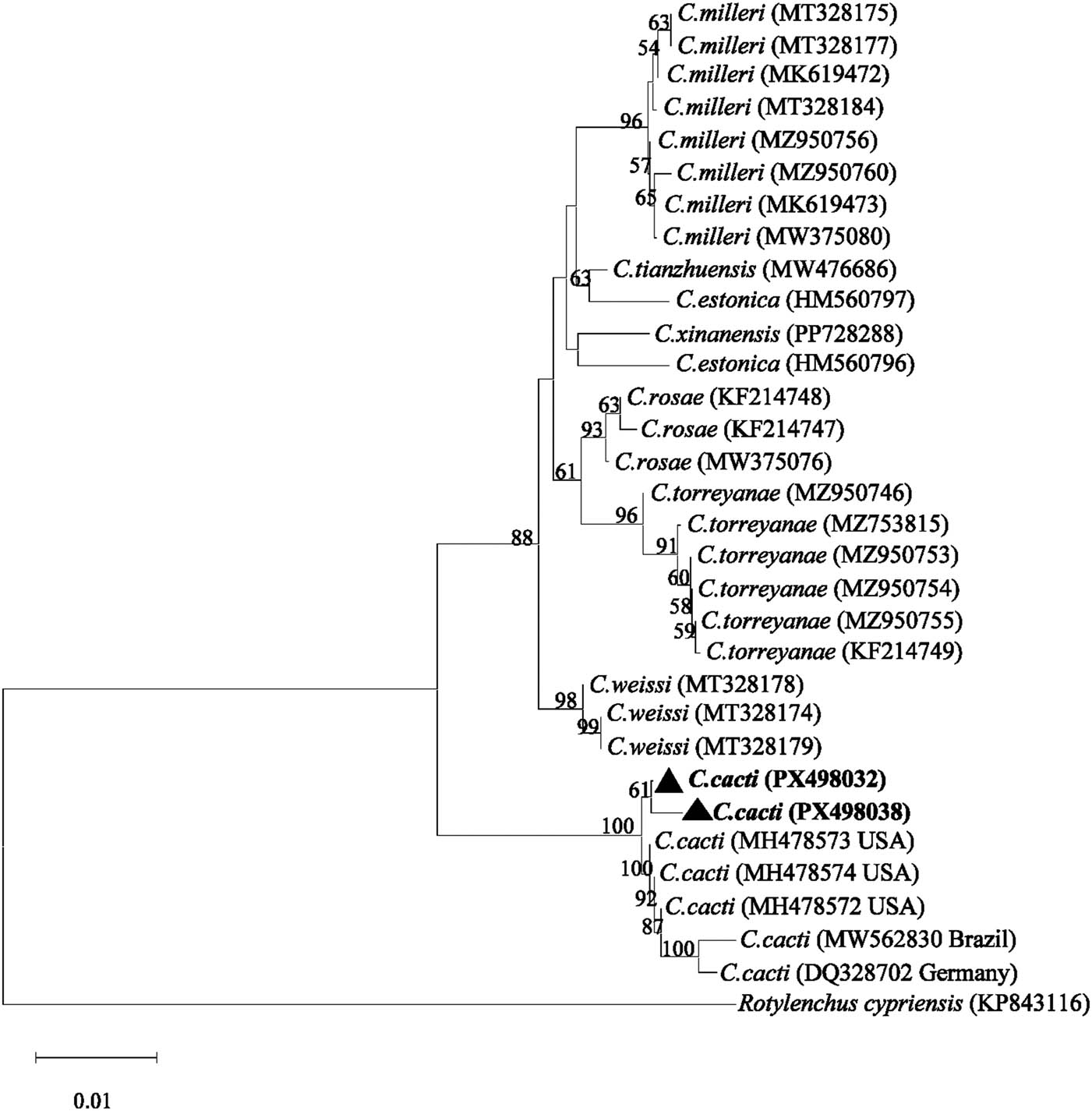
Figure 4
Phylogenetic tree based on D2–D3 28S rDNA sequences of the genus Cactodera. The tree was constructed using the NJ method with bootstrap support from 1,000 replicates. Bootstrap values are shown at each node. Sequences obtained in this study are marked in bold (PX498032 and PX498038).
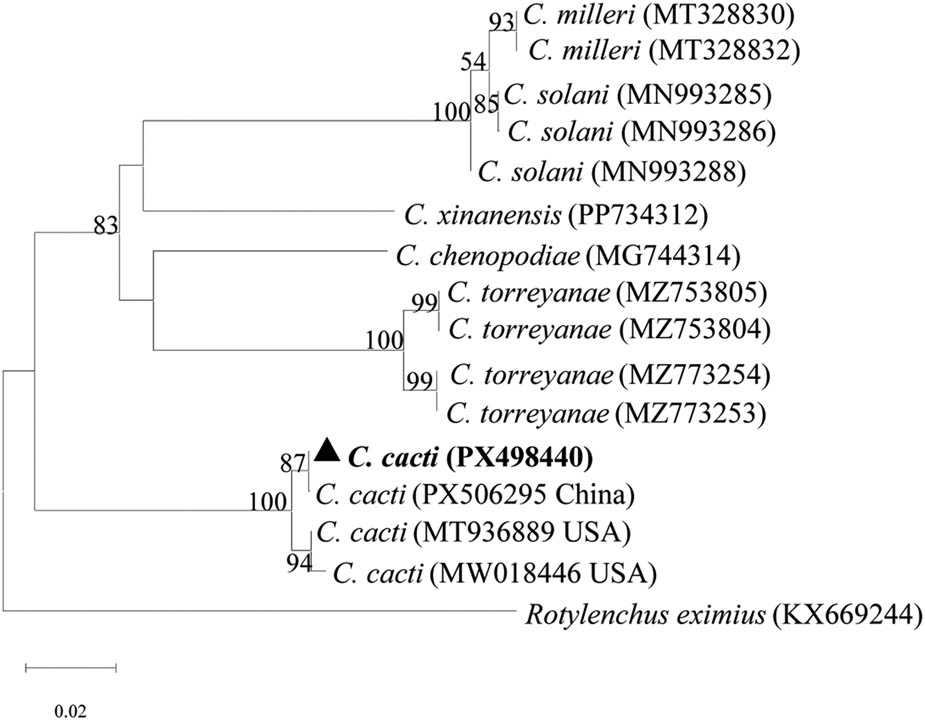
Figure 5
Phylogenetic tree based on COI mtDNA sequences of the genus Cactodera. The tree was constructed using the NJ method with bootstrap support from 1,000 replicates. Bootstrap values are shown at each node. Sequence obtained in this study are marked in bold (PX498440).
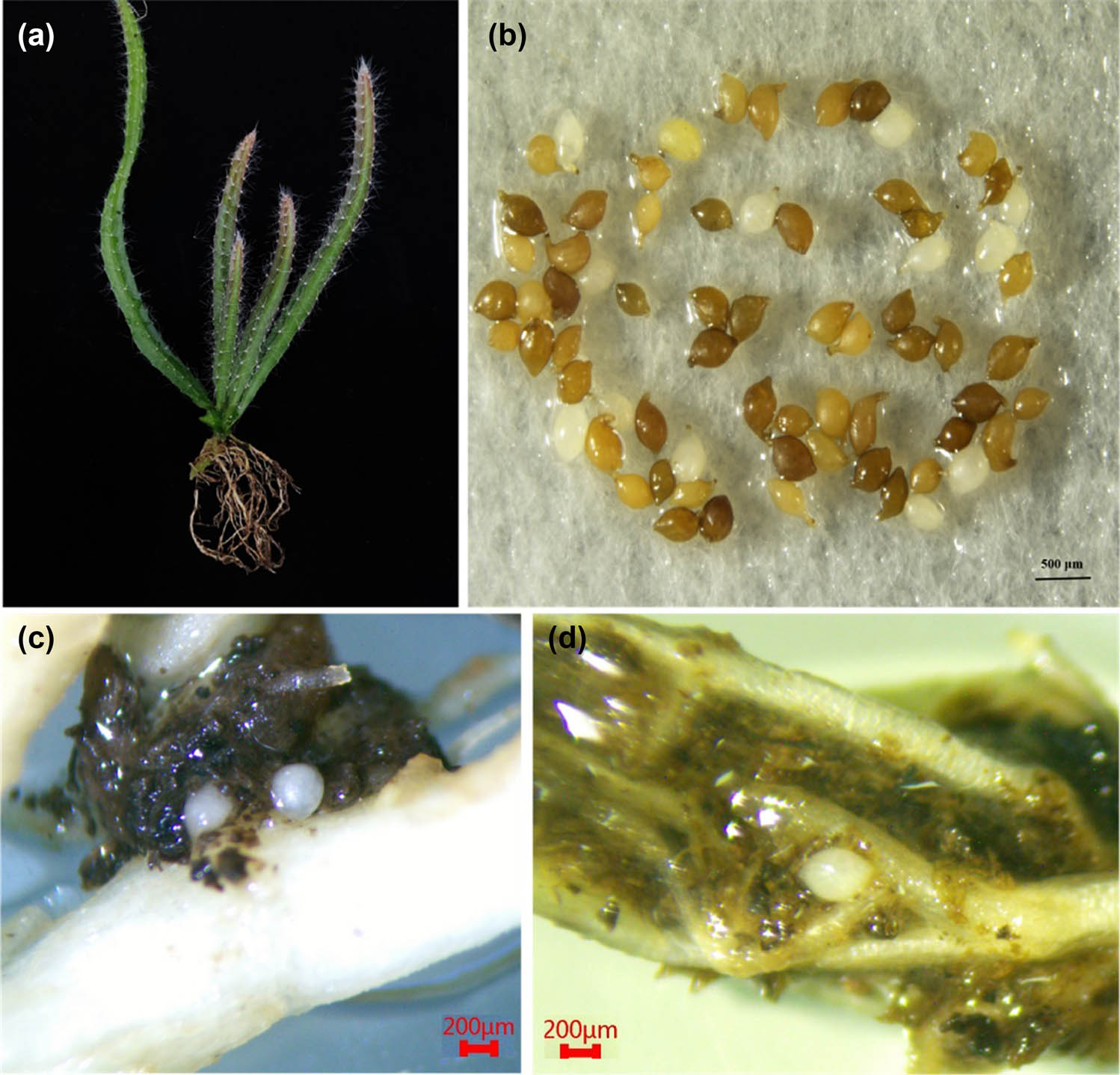
Figure 6
Pathogenicity test of C. cacti on dragon fruit. Dragon fruit seedling inoculated with C. cacti (a); cysts and white females recovered from roots and soil (b); and white females parasitizing on roots (c and d).