
1. Introduction
Nematode advisory programs were established in various states to assess the damage caused by plant-parasitic nematodes to diverse crops including turfgrass used for golf (Barker & Imbriani, 1984). In the eastern United States, nematode assay labs use one of two extraction methods: the N.C. State Model semi-automatic elutriator (Byrd et al., 1976) or hand sieving with centrifugation–floatation (Jenkins, 1964). The elutriator is more effective with a larger soil sample (250–500 cm3), and hand sieving is limited to a smaller sample size (100 cm3). However, the elutriator is expensive ($70,000) (Weimin Yi, North Carolina Department of Agriculture, personal comm.) compared to the lower cost of materials needed for hand sieving ($500) (Jenkins, 1964). Both methods use similar sieves, centrifuges, and sugar solutions, but the elutriator processes more samples per hour with less manual labor, though it requires substantially more water. Processing fees vary among labs, ranging from $0 to $75 per sample, with greater charges ($10–$75) for out-of-state submissions.
Assessing the damage caused by the plant-parasitic nematodes (PPNs) on different crops across different states is costly and has rarely been conducted beyond the early years of plant nematology. As a result, each state has its own recommendations based on research identifying the harmful nematodes in turfgrass used for golf. Some states adapt data from neighboring states, adjusting for climate and environmental differences, while others rely on a state lab nematologist to refine recommendations for diagnosing nematode-related damage specific to their conditions (Jagdale, 2013; Mehl and Langston, 2024; Strayer-Scherer et al., 2025).
This study aimed to evaluate the efficiency of 10 nematode assay labs in the eastern United States for quantifying nematode populations and to compare the turfgrass management recommendations for golf greens. Three locations were selected including the green at the Virginia Tech Turfgrass Research Center (VTTRC); Augustine Golf Course (AGC) in Stafford, VA; and the Philadelphia Country Club Golf Course (PCCGC) in Gladwyne, PA. The VTTRC was selected because it was known to have an abundant population of root-knot nematodes (Meloidogyne naasi Franklin, 1965). AGC and PCCGC were selected based on previous sampling that identified elevated PPN populations and recommendations indicating potential turf damage.
2. Materials and methods
This study included nematode assay laboratories from 10 states: Alabama, Florida, Georgia, Louisiana, Massachusetts, Michigan, Mississippi, North Carolina, South Carolina, and Virginia were used in this study. Soil samples were collected from three locations – two in Virginia and one in Pennsylvania. Due to greater processing costs, only samples from the Philadelphia Country Club were analyzed by the Massachusetts lab.
Nineteen liters of soil were collected from each of three sites by raking fall aerification soil cores of the bentgrass greens. The soil from each site was thoroughly mixed for 5 min using a concrete mixer, then divided into 30 samples of 500 cm3 each, and placed into 1-L plastic bags. Three 500 cm3 soil samples from the three turfgrass sites with varying levels of nematode populations were sent to 10 nematode assay labs. Samples were shipped in Styrofoam coolers overnight although the previous research indicates that shipping has minimal impact on extraction efficiency (Riggs et al., 1997).
Each lab processed the samples using its standard protocols and provided recommendations based on assay results and state guidelines. Standard extraction protocols for Virginia, North Carolina, and Louisiana involved the use of semi-automatic elutriation followed by sucrose centrifugation, while the remaining seven labs extracted nematodes through hand sieving followed by sucrose centrifugation.
Population means of nematode genera per 100 cm3 of soil by state lab and by extraction methods were compared using an analysis of variance with means separated using Tukey’s Honestly Significant Difference post hoc test (α = 0.05) in JMP® Pro 18 (SAS Institute Inc., Cary, NC) (Table 2). Virginia and South Carolina labs further subdivided samples to assess assay efficiency. South Carolina, which typically uses 100 cm3 of soil, divided each sample into three subsamples, while Virginia, using 250 cm3, divided each sample into two. To account for differences in soil volume used across labs, all results were standardized to nematodes per 100 cm3 of soil. State-specific recommendations were also compared.
3. Results
The study investigated the nematode extraction efficiencies and compared recommendations from 10 state nematode assay labs in the eastern United States using soil samples from three locations.
3.1. Virginia tech turfgrass research center
Total PPN counts were greatest in South Carolina (567, 533, 483 per 500 cm3 of soil) and lowest in Louisiana (13 per 500 cm3 of soil), which detected only Mesocriconema spp. (Figure 1). Tylenchorhynchus spp. were found in low numbers by SC1, VA1, VA2, FL, GA, MA, and MS (<20 per 500 cm3 of soil) but absent in SC2, SC3, MI, AL, NC, and LA. Hoplolaimus spp. were reported in all states except for Louisiana, while Meloidogyne spp. were found in all states except for VA1, AL, and LA. The greatest number of Meloidogyne spp. were recorded in SC1, SC2, and SC3 (267, 233, 233 per 500 cm3 of soil). Mesocriconema spp. were present in all states, but varied ranging from 267 per 500 cm3 of soil in MI, to as low as 13 and 7 per 500 cm3 of soil in LA and NC, respectively. Only AL and NC identified a possible turf issue due to Meloidogyne spp. (40 and 156 per 500 cm3 of soil, respectively) despite greater counts in SC1, SC2, SC3, and FL (267, 233, 233, 122 per 500 cm3 of soil, respectively) (Table 1).
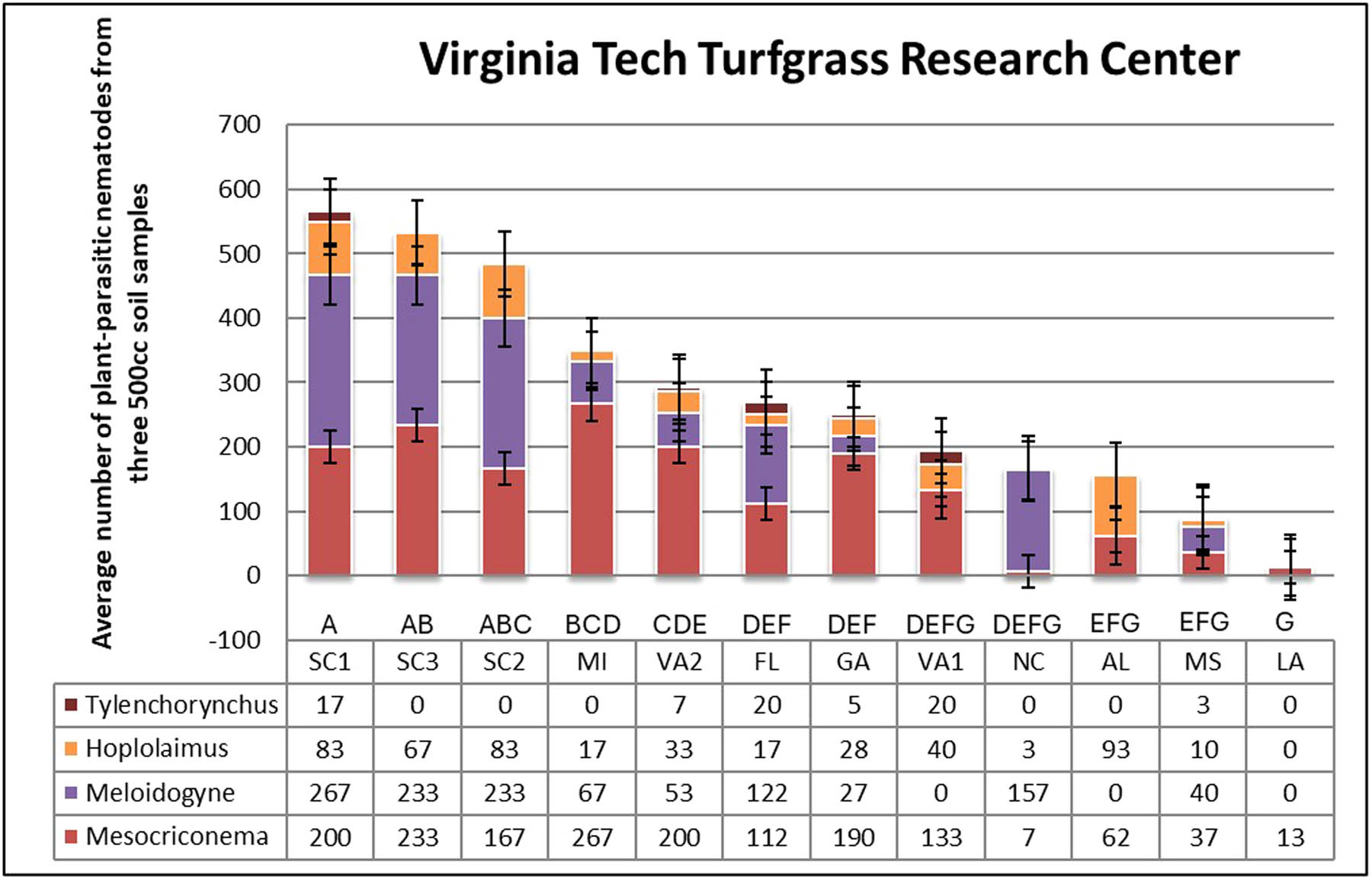
Figure 1
Comparison of nematode extraction efficiencies among 10 state nematode assay labs for the four most common genera of plant-parasitic nematodes at the Virginia Tech Turfgrass Research Center, Blacksburg, VA. Total means in each column followed by the same letters are not significantly different according to Tukey’s Honestly significant difference (P < 0.05).
Table 1
Comparisons of nematode assay lab recommendations for three locations
| State | Sampling site | Nematode | Technique | Soil | Rec.* |
|---|---|---|---|---|---|
| Alabama | TRC | Root-knot | Hand sieve | 100 cm3 | B, B, B |
| Florida | TRC | Hand sieve | 100 cm3 | A, A, A | |
| Georgia | TRC | Hand sieve | 100 cm3 | A, A, A | |
| Louisiana | TRC | Elutriator | 500 cm3 | A, A, A | |
| Michigan | TRC | Hand sieve | 100 cm3 | A, A, A | |
| Mississippi | VTRC | Hand sieve | 100 cm3 | A, A, A | |
| North Carolina | VTRC | Root-knot | Elutriator | 500 cm3 | B, B, B |
| South Carolina 1 | VTRC | Hand sieve | 100 cm3 | A, A, A | |
| South Carolina 2 | VTRC | Hand sieve | 100 cm3 | A, A, A | |
| South Carolina 3 | VTRC | Hand sieve | 100 cm3 | A, A, A | |
| Virginia 1 | VTRC | Elutriator | 500 cm3 | A, A, A | |
| Virginia 2 | VTRC | Elutriator | 500 cm3 | A, A, A | |
| Alabama | AGC | Hand sieve | 100 cm3 | A, A, A | |
| Florida | AGC | Hand sieve | 100 cm3 | A, A, A | |
| Georgia | AGC | Hand sieve | 100 cm3 | A, A, A | |
| Louisiana | AGC | Elutriator | 500 cm3 | A, A, A | |
| Michigan | AGC | Hand sieve | 100 cm3 | A, A, A | |
| Mississippi | AGC | Hand sieve | 100 cm3 | A, A, A | |
| North Carolina | AGC | Elutriator | 500 cm3 | A, A, A | |
| South Carolina 1 | AGC | Hand sieve | 100 cm3 | A, A, A | |
| South Carolina 2 | AGC | Hand sieve | 100 cm3 | A, A, A | |
| South Carolina 3 | AGC | Hand sieve | 100 cm3 | A, A, A | |
| Virginia 1 | AGC | Elutriator | 500 cm3 | A, A, A | |
| Virginia 2 | AGC | Elutriator | 500 cm3 | A, A, A | |
| Alabama | PCCGC | Ring | Hand sieve | 100 cm3 | C, C, C |
| Florida | PCCGC | Hand sieve | 100 cm3 | A, A, A | |
| Georgia | PCCGC | Hand sieve | 100 cm3 | A, A, A | |
| Louisiana | PCCGC | Elutriator | 500 cm3 | A, A, A | |
| Massachusetts | PCCGC | Ring, Stunt | Hand sieve | 100 cm3 | B, C, C |
| Michigan | PCCGC | Ring, Stunt | Hand sieve | 100 cm3 | B, B, C |
| Mississippi | PCCGC | Hand sieve | 100 cm3 | A, A, A | |
| North Carolina | PCCGC | Elutriator | 500 cm3 | A, A, A | |
| South Carolina 1 | PCCGC | Ring | Hand sieve | 100 cm3 | B, C, C |
| South Carolina 2 | PCCGC | Ring | Hand sieve | 100 cm3 | C, C, C |
| South Carolina 3 | PCCGC | Ring | Hand sieve | 100 cm3 | C, C, C |
| Virginia 1 | PCCGC | Ring | Elutriator | 500 cm3 | B, C, C |
| Virginia 2 | PCCGC | Ring | Elutriator | 500 cm3 | B, C, C |
This table presents the recommendations of 10 nematode assay labs for three turfgrass locations: Virginia Tech Turfgrass Research Center (TRC), Blacksburg, VA.; Augustine Golf Course (AGC), Stafford, VA.; and Philadelphia Country Club Golf Course (PCCGC), Gladwyne, PA. A = nematodes are not likely to cause a problem, B = nematodes may cause a problem, and C = nematodes are likely to cause a problem. Cells that are shaded indicate a B or C recommendation. *Rec. = recommendation.
3.2. Augustine golf course
Michigan recorded the greatest total plant-parasitic nematode counts (317 per 500 cm3 of soil) while Louisiana had the lowest detecting only Mesocriconema spp. (13 per 500 cm3 of soil) (Figure 2). North Carolina did not find Mesocriconema spp. but reported Tylenchoryhnchus spp. (3 per 500 cm3 of soil) and Meloidogyne spp. (7 per 500 cm3 of soil). Tylenchoryhnchus spp. were detected only in SC2, SC3, VA1, VA2, and NC. Meloidogyne spp. were found by SC1, SC2, SC3, VA1, GA, FL, MS, and NC. Hoplolaimus spp. were reported by all labs except for MI, LA, and NC with the greatest counts recorded in SC. Mesocriconema spp. were present in all labs except NC, with counts ranging from 317 (MI) to 13 per 500 cm3 of soil (LA). None of the labs identified nematodes as a significant problem on this green (Table 1).
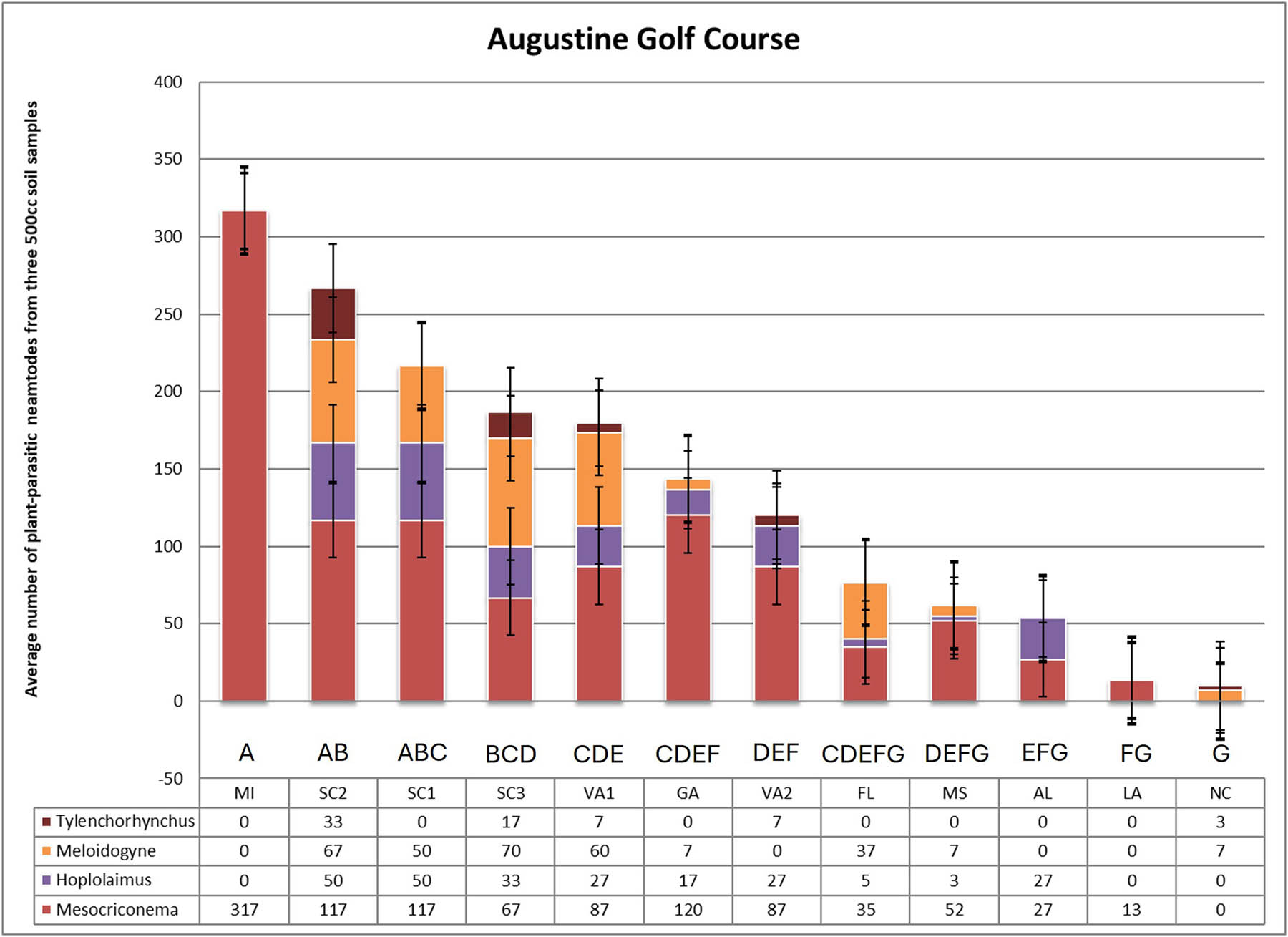
Figure 2
Comparison of nematode extraction efficiencies among 10 state nematode assay labs for the four most common genera of plant-parasitic nematodes from the Augustine Golf Course, Stafford, VA. Total means in each column followed by the same letters are not significantly different according to Tukey’s Honestly significant difference (P < 0.05).
3.3. Philadelphia country club golf course
Massachusetts and Michigan reported the greatest total PPN counts for this green (14,239, 11,800 per 500 cm3 of soil, respectively), while Mississippi and North Carolina recorded the lowest (849, 260 per 500 cm3 of soil, respectively) (Figure 3). Paratrichodorus spp. were found in MI, VA1, VA2, SC2, SC3, GA, MS, and NC, with MI reporting the greatest count (50 per 500 cm3 of soil) and NC the lowest (10 per 500 cm3 of soil). Meloidogyne spp. were detected in MI, VA1, SC2, SC3, GA, MS, and NC with MI having the greatest count (50 per 500 cm3 of soil). Mesocriconema spp. were present in all labs, with MI and MA (6,900, 4,553 per 500 cm3 of soil, respectively) reporting the greatest counts, and the lowest counts in LA, MS, and NC (1,413, 477,170 per 500 cm3 of soil, respectively). Tylenchorhynchus spp. were extracted from all labs, most abundant in MA (9,686 per 500 cm3 of soil) and MI (4,800 per 500 cm3 of soil), and least common in MS, LA, and NC (336, 173, 67 per 500 cm3 of soil, respectively). Half of the labs (AL, MA, MI, SC, and VA) provided recommendations indicating potential nematode damage, while the other half (FL, GA, LA, MS, and NC) did not consider the population levels great enough to cause harm (Table 1).
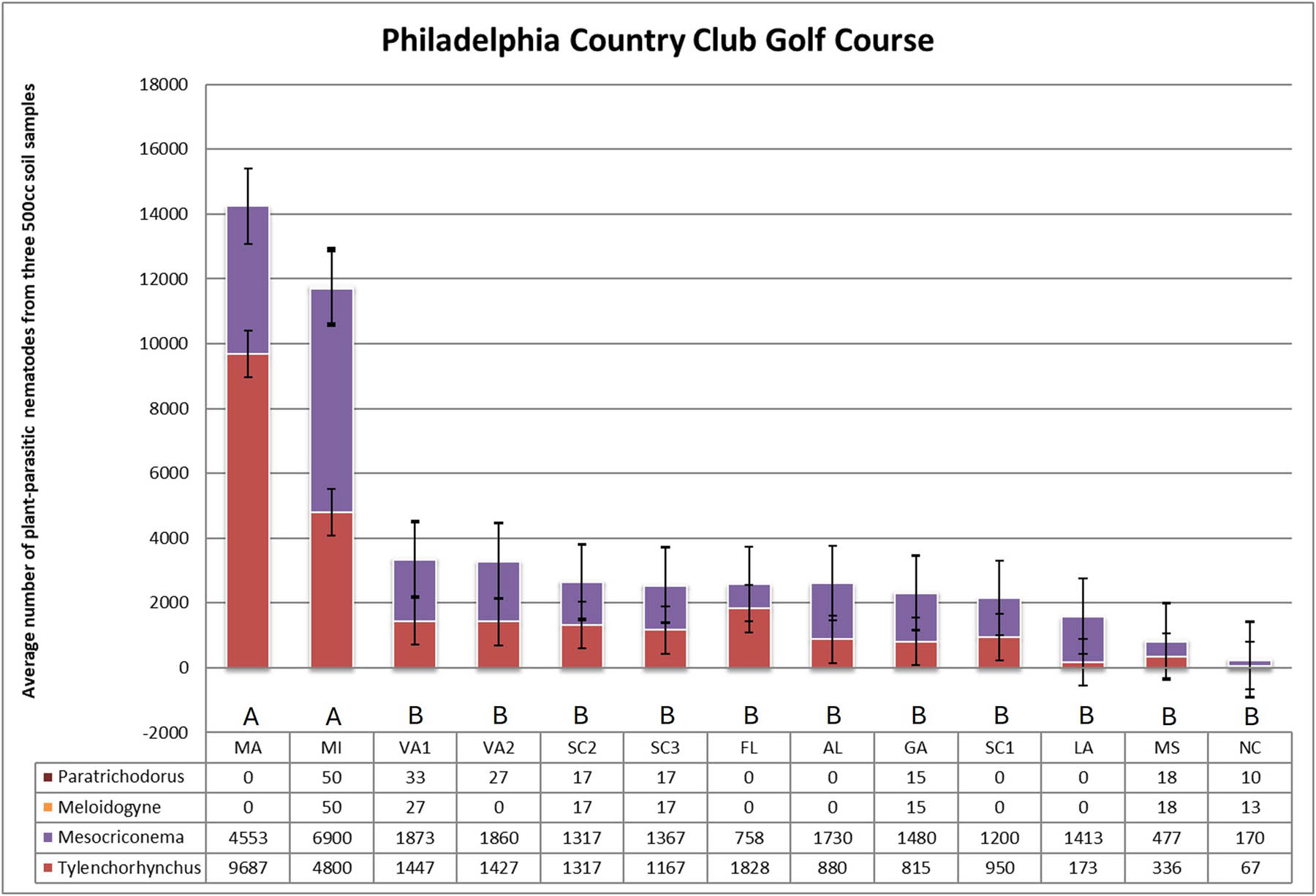
Figure 3
Comparison of nematode extraction efficiencies among 10 state nematode assay labs of the four most common genera of plant-parasitic nematodes at the Philadelphia Country Club Golf Course, Gladwyne, PA. Total means in each column followed by the same letters are not significantly different based on Tukey’s Honestly significant difference (P < 0.05).
3.4. Comparing nematode lab methods
Two nematode extraction methods were used across the 10 labs: (1) semi-automatic elutriation with modified sugar flotation and (2) hand-sieving with modified sugar floatation. Three labs (Virginia, North Carolina, and Louisiana) used an elutriator, while the remaining seven labs used hand-sieving. Nematode counts varied by state for five of the six PPN genera (Table 2). Helicotylenchus spp. were the genera that all labs reported occurring at similar population levels. Among the labs using elutriation, only Hoplolaimus spp. showed significant (P < 0.05) differences in counts across all locations (Table 2). The elutriation extraction reported similar (P > 0.05) numbers for Helicotylenchus spp., Meloidogyne spp., Mesocriconema spp., Paratrichodorus spp., and Tylenchorhynchus spp. In contrast, four of six PPN genera exhibited differences in nematode population levels among labs using the hand-sieving method (Table 2). Hoplolaimus spp., Helicotylenchus spp., Paratrichodorus spp., and Tylenchorhynchus spp. were found at significantly different (P < 0.05) different levels in four labs.
Table 2
Comparison of nematode extraction efficiencies among six genera of plant-parasitic nematode by state and by extraction method
| Comparison by state | Comparison by semi-automatic elutriation | Comparison by hand-sieving | ||||
|---|---|---|---|---|---|---|
| P value | F ratio | P value | F ratio | P value | F ratio | |
| Hoplolaimus spp. | 0.0001* | 4.2557* | 0.0021* | 7.5056* | 0.0027* | 3.8647* |
| Mesocriconema spp. | 0.0385* | 2.0908* | 0.1487 | 2.0200 | 0.1030 | 1.8655 |
| Tylenchorhynchus spp. | 0.0051* | 2.8722* | 0.1001 | 2.4703 | 0.0344* | 2.4698* |
| Meloidogyne spp. | 0.0329* | 2.1530* | 0.0639 | 2.9928 | 0.0802 | 2.0054 |
| Helicotylenchus spp. | 0.443 | 1.0023 | 0.3678 | 1.0313 | 0.0066* | 3.3684* |
| Paratrichodorus spp. | 0.0191* | 2.3648* | 0.5025 | 0.7027 | 0.0462* | 2.3093* |
*Statistical significance (α = 0.05). P-values and F ratios were determined using analysis of variance in JMP® Pro 18 (SAS Institute, Cary, NC) and Tukey’s Honestly significant difference post hoc test were used to compare means.
4. Discussion
Nematode assay results varied across labs. Alabama and North Carolina identified a nematode problem at VTTRC. Alabama used hand sieving and a 100 cm3 sample, whereas NC employed an elutriator with a 500 cm3 sample. Virginia did not detect a significant root-knot population despite a previous finding indicating a problem (personal comm.). Meloidogyne spp. was found in one sample, but not in the another. The South Carolina lab (SC1, SC2, SC3) reported the greatest root-knot nematode counts, but did not consider them to be damaging. Assessing Meloidogyne spp. nematodes in golf greens is challenging due to their patchy distribution and the fact that the J2 stage infects the root, and all following life stages are completely contained within the roots (Crow, 2021; Karssen et al., 2013). Juveniles of M. naasi, one of the most common PPN on turf, have very long tails, which inexperienced counters, may misidentify as Tylenchus spp. Most labs agreed that plant-parasitic nematodes were not a problem on this green.
The labs agreed that plant-parasitic nematode populations at the AGC were too low to cause damage that would warrant a nematicide application. While the genera and counts varied among nematode assay labs, the previously reported damaging level of lance nematode was not detected (personal comm.). Discussions with the assistant superintendent revealed that the original sample had been collected as a single cup-cutter plug, which is inadequate for accurate nematodes assessment. Standard recommendations call for at least 20 soil cores (2.54 cm in diameter) taken at root depth, mixed, and submitted as a 500 cm3 sample per green (Jagdale, 2011; Galle and Kerns, 2024). Since nematodes are unevenly distributed in soil, multiple subsamples are necessary to account for their patchy distribution. Submitting a single cup-cutter plug to one or more labs may yield inconsistent results.
Half of the labs recommended action for the elevated plant-parasitic nematode levels on the Philadelphia golf course green. Southern labs (VA, SC, AL) attributed turf damage to Mesocriconema spp., while northern labs (MA, MI) identified both the Mesocriconema spp. and Tylenchorhynchus spp. as the cause. Although SC, FL, and GA found similar Mesocriconema spp. nematode counts, they did not consider the levels great enough to harm turfgrass. Interestingly, the northern labs detected significantly greater populations of both Mesocriconema spp. and Tylenchorhynchus spp., though the reason for this discrepancy is unclear. Both used hand-sieving for extraction, yet the nematode counts for the VTTRC green and AGC were not significantly different from the other labs.
Results showed significant variability in counts across state labs though this had little impact on management recommendations for each location. Nematode recommendations are typically based on population ranges. Despite differences in counts, most labs provided similar recommendations. Notably, Hoplolaimus spp. was the only genus with differences among labs using elutriation with modified sugar floatation method. This may be due to its biology as a migratory endoparasite which is not well studied in turfgrass systems, particularly in relation to its movement in and out of the root based on biological rhythms (Settle et al., 2006; Martin, 2017). In contrast, the hand-sieving with modified sugar floatation resulted in counts for four of six genera, indicating greater variability. These findings suggest that while hand-sieving introduces more variability, semi-automatic elutriation may provide more consistent data.
To ensure reliable results, golf course superintendent should choose a single nematode assay lab to send samples. Using multiple labs can be time consuming, costly, and lead to inconsistent results. More importantly, proper sample collection plays a greater role in accuracy than lab selection. Additionally, state nematode assay labs should regularly evaluate their extraction methods to maintain efficiency and accuracy, ensuring that recommendations are supported by field trials and proven nematode management practices.
Funding information
Authors state no funding involved.
Author contributions
M. Aaron Tucker: Writing, editing, data analysis. David McCall: editing. Jonathan D. Esisenback: data collection, writing, and editing.
Conflict of interest statement
Authors state no conflict of interest.