
Soybean (Glycine max [L.] Merrill) is one of the most important oilseed crops in the U.S.. In Arkansas (AR) alone, an annual average of 3.1 million acres were planted between 2015 and 2024, producing 155.8 million bushels valued at $1.7 billion (USDA-NASS, 2025). Soybean production in the U.S. is challenged by several foliar and soilborne pathogens, with Meloidogyne incognita (Kofoid & White) Chitwood (southern root-knot nematode) ranked as the second most destructive pathogen in the southern U.S. from 2020 to 2025 (Telenko et al., 2025). In AR, M. incognita accounted for an estimated annual loss of 7 million bushels valued at $75.2 million between 2015 and 2024 (Crop Protection Network, 2025). These losses highlight the need to evaluate additional management strategies for AR and the southern U.S. more broadly.
Management of plant-parasitic nematodes relies on an integrated approach that includes nematode-resistant cultivars, nematicides, and crop rotation. Nematode-resistant soybean cultivars reduce reproduction and infection (Emerson et al., 2023); however, the availability of M. incognita-resistant soybean cultivars is uneven across maturity groups (MG). There are more resistant cultivars in later MGs (MG V through VII) than in the earlier maturing groups (MG III and IV) that are commonly grown in AR (Faske et al., 2021). The previously identified M. incognita resistance locus, Rmi1 (Luzzi et al., 1994), in the soybean genome was recently mapped to a quantitative trait locus on chromosome 10, suggesting that resistance is associated with cell wall modification (Goode et al., 2025). While host resistance remains the most economical and effective strategy for M. incognita management (Sikora et al., 2005; Faske et al., 2021), cultivar considerations such as maturity group, herbicide tolerance traits, and salt tolerance can limit adoption. Thus, farmers may rely on nematicides when resistant cultivars are unavailable or unsuitable for use in their production system. In AR, seed- and soil-applied nematicides are labeled for use in soybean production (Faske, 2026), with the majority being applied to the seed coat. Nematicides do not provide season-long root protection against soybean nematodes and do not always protect grain yield (Spinks et al., 2020; Kessler & Koehler, 2023; Bissonnette et al., 2024; Baker et al., 2026). Nematicides are most often recommended when nematode populations are low to moderate, in part because of the limited movement of some nematicides in sandy soils (Faske & Brown, 2019; Faske, 2026). These limitations have prompted interest in nematicides not currently labeled for soybean production in AR to investigate their usefulness in nematode management. Two such nematicides, aldicarb and fluazaindolizine, are commercially available as AgLogic 15 GG (AgLogic Chemical, Chapel Hill, NC) and Salibro 4.17 SC (Corteva Agriscience, Indianapolis, IN), respectively. Aldicarb is registered for soybean nematode management in Georgia, North Carolina, South Carolina, and Virginia, while fluazaindolizine is only registered for select vegetable, fruit, and tree crops in the United States. Currently, there is no information on the field efficacy of aldicarb for management of M. incognita in an AR soybean production system, or fluazaindolizine in soybean production generally. Thus, the objective of this study was to evaluate the use of aldicarb and fluazaindolizine to manage M. incognita on soybean in AR.
1. Materials and methods
1.1. Soybean cultivars and nematicides
Two separate field experiments were conducted over 4 years near Kerr, AR in silt loam soils (average composition: 36.6% sand, 57.3% silt, 6.1% clay) with a history of M. incognita infestation. Experiments where aldicarb or fluazaindolizine were being compared to the other tested nematicides will hereafter be referred to as the “aldicarb experiments” or “fluazaindolizine experiments,” respectively. Aldicarb experiments were conducted in 2017, 2019, and 2022, while fluazaindolizine experiments were conducted in 2019, 2020, and 2022. The fields were on a corn-soybean rotation, with a winter fallow period between cropping seasons.
In the aldicarb experiments, Delta Grow DG4940 GLY was used in all 3 years, which is moderately resistant to M. incognita. In 2017, the susceptible cultivar was Delta Grow DG4870 RR, while in 2019 and 2022, it was Delta Grow DG4880 GLY. The selection of the M. incognita-susceptible cultivar was based on seed availability. In the fluazaindolizine experiments, the susceptible cultivar DG4880 GLY was used in all 3 years. All soybean cultivars were MG IV, and seed was sourced from the Delta Grow Seed Company (England, AR).
A nematicide was not included in the base seed treatment, so the non-nematicide treatment is hereafter referred to as the non-nematicide treated control (NTC) for both the aldicarb and fluazaindolizine experiments. The base seed treatment for the NTC was imidacloprid (as 0.12 mg ai/seed of Gaucho 600 FS, Bayer Crop Science, St. Louis, MO) in 2017, 2019, and 2020, while in 2022 the base seed treatment included thiamethoxam + mefenoxam + fludioxonil + sedaxane (as 0.0945 mg ai/seed of CruiserMaxx Vibrance FC, Syngenta Crop Protection, Greensboro, NC). For the nematicide treatments, the seed was treated with either imidacloprid (as 0.12 mg ai/seed of Gaucho 600 FS, Bayer Crop Science), thiamethoxam (as 0.079 mg ai/seed of Cruiser 5 FS, Syngenta Crop Protection), thiamethoxam + mefenoxam + fludioxonil + sedaxane (as 0.0945 mg ai/seed of CruiserMaxx Vibrance FC, Syngenta Crop Protection), or prothioconazole + penflufen + metalaxyl (as 0.014 mg ai/seed of Evergol Energy SB, Bayer Crop Science) depending on the year and treatment.
In the aldicarb experiments, additional seed treatments included abamectin (as 0.15 mg ai/seed of Avicta 500 FS, Syngenta Crop Protection), clothianidin + Bacillus firmus (as 0.13 mg ai/seed of Poncho/Votivo 5.0 FS, BASF Corporation, Florham Park, NJ; hereafter referred to only by the active ingredient against nematodes, Bacillus firmus), and fluopyram (as 0.15 mg ai/seed of Ilevo 600 FS, BASF Corporation). Aldicarb was applied at-planting as 841 g ai/ha of AgLogic 15 GG (AgLogic Chemical, Chapel Hill, NC) applied through Gandy granular meter boxes (Gandy Company, Owatonna, MN) attached to the planter that directed the formulation into the seed furrow.
In the fluazaindolizine experiments, additional seed treatments included abamectin (as 0.15 mg ai/seed of Avicta 500 FS, Syngenta Crop Protection) and fluopyram (as 0.25 mg ai/seed of Ilevo 600 FS, BASF Corporation). Soil-applied treatments were applied at planting, including aldicarb (as 841 g ai/ha of AgLogic 15 GG, AgLogic Chemical) applied as previously described, as well as fluazaindolizine (as 281 g ai/ha of Salibro 4.17 SC, Corteva Agriscience, Indianapolis, IN) and oxamyl (as 298 g ai/ha of Vydate 3.77 C-LV, Corteva Agriscience) applied through 0.18 cm diameter poly tubing using a pressurized sprayer to deliver 61 L/ha at 2.4 kph. Oxamyl is not labeled for use in soybeans, so the rate tested in this study was for experimental purposes only. For a summary description of treatments for both the aldicarb and fluazaindolizine experiments, refer Table 1.
Table 1
Nematicide treatments evaluated in each aldicarb and fluazaindolizine experiment in Meloidogyne incognita-infested fields
| Experiment | Treatmentsa | Application type | Rate | Years evaluated |
|---|---|---|---|---|
| Aldicarb | Abamectin | Seed | 0.15 mg ai/seed | 2017, 2019, 2022 |
| Aldicarb | In-furrow | 841 g ai/ha | 2017, 2019, 2022 | |
| Bacillus firmus | Seed | 0.13 mg ai/seed | 2017, 2019, 2022 | |
| Fluopyram | Seed | 0.15 mg ai/seed | 2017, 2019, 2022 | |
| Abamectin + Aldicarb | Seed + In-furrow | – b | 2017, 2019, 2022 | |
| Aldicarb + B. firmus | In-furrow + Seed | — | 2019, 2022 | |
| Aldicarb + Fluopyram | In-furrow + Seed | — | 2017, 2019, 2022 | |
| Fluopyram + B. firmus | Seed + Seed | — | 2017, 2019, 2022 | |
| Fluazaindolizine | Abamectin | Seed | 0.15 mg ai/seed | 2019, 2020, 2022 |
| Fluazaindolizine | In-furrow | 281 g ai/ha | 2019, 2020, 2022 | |
| Fluopyram | Seed | 0.25 mg ai/seed | 2019, 2020, 2022 | |
| Oxamyl | In-furrow | 298 g ai/ha | 2019, 2020 |
1.2. Experimental design and data collection
The experimental design was a randomized complete block with four or six replicates per treatment in the fluazaindolizine and aldicarb experiments, respectively. Individual plots consisted of four rows, 9.1 m in length, spaced 76.2 cm apart, separated by a 1.5 m fallow alley, that were planted at a rate of 370,500 seed/ha. For planting and harvest dates, total rainfall within 14 days after planting (DAP), and nematode population density at harvest, refer Table 2. Stand counts were taken 14 DAP as the number of seedlings per 3.0 m of harvest row (one of two center rows) in 2017 and 2022 of the aldicarb experiments, and 2020 and 2022 of the fluazaindolizine experiments. Vigor ratings were taken 14 DAP on a six-point scale based on the visually assessed overall health of soybean plants in a plot (0 = dead plants and 5 = vigorous, healthy plants) in all 3 years of both experiments. Phytotoxicity ratings were taken 14 DAP on a six-point scale assessing discoloration of the cotyledons (0 = no phytotoxicity and 5 = severe foliar necrosis) in all 3 years of the aldicarb experiment, and in 2019 and 2022 of the fluazaindolizine experiment. Galling was assessed 45–60 DAP by collecting eight root systems per plot and visually estimating the percent of the root system galled in all 3 years of both experiments. Yield was determined by harvesting the middle two rows in a plot using mechanical harvest equipment with a weight system and reported as kilograms per hectare (kg/ha) in all 3 years of both experiments. Soybean grain yield was adjusted to 13.3% moisture for final analysis, and all the grain was disposed of so as to not enter the food chain. For each experimental year, nematode population density was assessed by collecting samples by replication (four or six samples) at harvest of approximately 10 soil cores (15–20 cm deep) using a 1.9 cm diameter soil probe taken outside the treatment area, but within 15 cm of the soybean stand. Soil samples were processed using a modified Baermann pan method to estimate end-of-season population density. Vermiform nematodes were enumerated using a stereoscope, and densities were calculated as second-stage juveniles (J2) per 100 cm3 soil.
Table 2
Experimental characteristics of each aldicarb and fluazaindolizine experimental year in Meloidogyne incognita-infested fields
| Experiment | Year | Planting date | Harvest date | Total rainfall (14 DAP)a | Nematode density at harvest b |
|---|---|---|---|---|---|
| Aldicarb | 2017 | 9 May | 2 Oct | 11.79 | 1,628 |
| 2019 | 28 May | 4 Nov | 6.48 | 914 | |
| 2022 | 14 Jun | 17 Oct | 0.05 | 125 | |
| Fluazaindolizine | 2019 | 28 May | 4 Nov | 6.48 | 1,019 |
| 2020 | 2 Jun | 21 Oct | 6.35 | 336 | |
| 2022 | 14 Jun | 17 Oct | 0.05 | 38 |
1.3. Statistical analysis
Stand, percent root system galled, and yield data were subject to a mixed model analysis of variance (ANOVA) by year where cultivar (aldicarb experiment only) and nematicide were modeled as fixed variables and replication was modeled as a random variable. When appropriate, mean values were separated using Tukey’s HSD at α = 0.05. Vigor and phytotoxicity ratings were analyzed by year using a Kruskal–Wallis test alongside a pairwise Wilcoxon test with a Benjamini-Hochberg correction to account for the limited rating scale used to evaluate those metrics. Galling data were square root transformed prior to analysis to normalize, and the non-transformed data are reported. All analyses were performed in R Studio (R version 4.4.3), and differences were considered significant at p ≤ 0.05.
2. Results
2.1. Aldicarb experiments
In the 2017 and 2022 aldicarb experiments, the moderately resistant cultivar had greater (p < 0.01) stand than the susceptible cultivars with an average of 61.5 and 65.8/3.0 m of row, compared to 50.6 and 57.9/3.0 m of row, respectively. In 2022, seedlings of the moderately resistant cultivar were more (p < 0.01) vigorous than those of the susceptible cultivar with mean vigor ratings of 5.0 and 4.4, respectively. Cultivar did not affect phytotoxicity, and nematicide did not affect stand or vigor in any experiment; however, nematicide effects on phytotoxicity were observed in 2017 and 2022. In 2017, fluopyram (1.9), fluopyram + B. firmus (2.0), and aldicarb + fluopyram (2.3) had significantly more phytotoxicity than the NTC (1.0). Similarly, in 2022, B. firmus (1.0), aldicarb + B. firmus (1.0), and fluopyram + B. firmus (2.0) significantly increased phytotoxicity relative to the NTC (0.0).
In all three aldicarb experiments, the moderately resistant cultivar exhibited significantly lower galling than the susceptible cultivar (Table 3). Treatment effects on galling differed by cultivar and year, with a significant (p < 0.01) cultivar by treatment interaction observed in all three experiments. Aldicarb and abamectin + aldicarb were the only treatments that significantly reduced galling compared to the NTC across cultivars in all 3 years (Table 3). In 2017, all treatments other than abamectin and fluopyram + B. firmus on the susceptible cultivar reduced galling compared to the susceptible NTC, while no treatment on the moderately resistant cultivar reduced galling compared to the moderately resistant NTC (Figure 1a). In 2019, aldicarb + B. firmus and aldicarb + fluopyram on both the susceptible and moderately resistant cultivars reduced galling compared to their respective NTC (Figure 1b). Additionally, in 2019, abamectin and fluopyram on the moderately resistant cultivar reduced galling compared to the moderately resistant NTC. Finally, in 2022, no treatment on the susceptible cultivar reduced galling compared to the susceptible NTC; however, aldicarb, fluopyram, abamectin + aldicarb, aldicarb + fluopyram, and fluopyram + B. firmus on the moderately resistant cultivar all reduced galling compared to the moderately resistant NTC (Figure 1c).
Table 3
Effect of cultivar and treatment on percentage of the root system galled, yield, and percent yield change compared to the control in aldicarb experiments in Meloidogyne incognita-infested fields
| 2017 Experiment | 2019 Experiment | 2022 Experiment | ||||||||
|---|---|---|---|---|---|---|---|---|---|---|
| % gall | Yield (kg/ha) | % yield changea | % gall | Yield (kg/ha) | % yield change | % gall | Yield (kg/ha) | % yield change | ||
| Cultivarb | Susceptible | 8.7 ac | 2,381 b | 5.2 a | 3,329 b | 2.5 a | 2,966 b | |||
| Moderately resistant | 1.5 b | 4,923 a | 106.8 | 1.7 b | 4,008 a | 20.4 | 0.5 b | 3,847 a | 29.7 | |
| Treatmente | NTC | 8.3 a | 3,679 | 5.3 a | 3,450 b | 2.6 a | 3,416 | |||
| Abamectin | 6.1 | 3,168 | −13.9 | 9.1 a | 3,719 ab | 7.8 | 1.2 ab | 3,416 | 0.0 | |
| Aldicarb | 1.9 d | 3,786 | 2.9 | 0.8 bc | 3,719 ab | 7.8 | 1.2 bc | 3,295 | −3.5 | |
| Bacillus firmus | 4.8 b | 3,995 | 8.6 | 6.9 a | 3,410 ab | −1.2 | 1.9 ab | 3,295 | −3.5 | |
| Fluopyram | 5.6 ab | 3,302 | −10.2 | 1.6 bc | 3,611 ab | 4.7 | 0.7 d | 3,430 | 0.4 | |
| Abamectin + Aldicarb | 2.5 c | 4,075 | 10.8 | 1.0 b | 3,430 ab | −0.6 | 1.1 c | 3,416 | 0.0 | |
| Aldicarb + B. firmus | — | — | — | 1.0 b | 3,907 ab | 13.2 | 1.9 ab | 3,389 | −0.8 | |
| Aldicarb + Fluopyram | 3.5 c | 3,450 | −6.2 | 0.4 | 4,049 a | 17.4 | 1.4 ab | 3,383 | −1.0 | |
| Fluopyram + B. firmus | 8.3 a | 3,591 | −2.4 | 4.1 ab | 3,901 ab | 13.1 | 1.0 cd | 3,618 | 5.9 | |
| P-value | Cultivar | <0.01 | <0.01 | — | <0.01 | <0.01 | — | <0.01 | <0.01 | — |
| Nematicide | <0.01 | 0.04 | — | <0.01 | <0.01 | — | <0.01 | 0.41 | — | |
[i] aPercent yield change = [(yield of cultivar or treatment – yield of susceptible cultivar or NTC)/(yield of susceptible cultivar or NTC) × 100].
[ii] bCultivars: susceptible = Delta Grow DG4870 RR (2017) and DG4880 GLY (2019, 2022), moderately resistant = DG4940 GLY (all years).
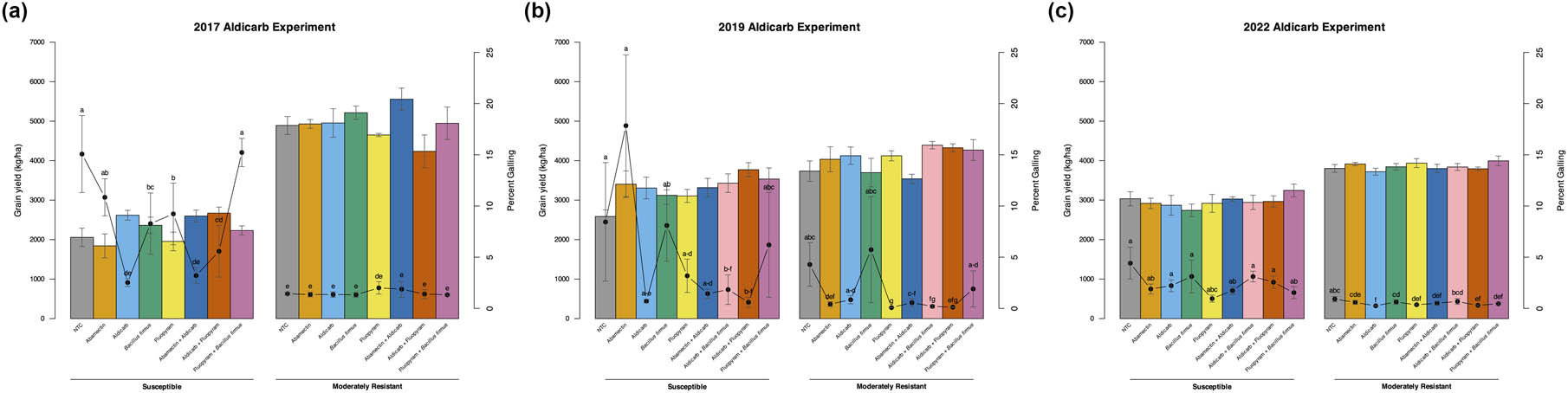
Figure 1
Effect of cultivar and nematicide treatment on root galling by Meloidogyne incognita and grain yield in three field experiments. The cultivar by treatment interaction had a significant (p < 0.01) effect on galling, but not yield, in all 3 years. Bars are grain yield (kg/ha), and the dotted line represents percent root system galled. Different letters on the dotted line indicate a significant difference according to Tukey’s HSD at α = 0.05, and error bars represent standard error. (a) 2017 aldicarb experiment, (b) 2019 aldicarb experiment, and (c) 2022 aldicarb experiment.
Consistent with galling results, the moderately resistant cultivar significantly outyielded the susceptible cultivar in all three aldicarb experiments (Table 3), with yield differences between the cultivars being greatest in 2017, the year with the highest nematode population density. Galling levels of the susceptible cultivar NTC declined across years, averaging 15.1, 8.4, and 4.3% of the root system galled in 2017, 2019, and 2022, respectively. This decline corresponded with decreasing nematode population densities at harvest, averaging 1,628 J2/100 cm3 soil in 2017, 914 in 2019, and 125 in 2022. In contrast, galling levels of the moderately resistant NTC were 1.4, 4.3, and 0.9% in 2017, 2019, and 2022, respectively. Nematicide effects on yield were only observed in 2019 where aldicarb + fluopyram was the only treatment to significantly protect grain yield over the NTC across cultivars (Table 3). Meloidogyne incognita populations at harvest were above the AR soybean damage threshold of 60 J2/100 cm3 (Kirkpatrick et al., 2014) in all experiments.
2.2. Fluazaindolizine experiments
The tested nematicides did not affect stand, vigor, or phytotoxicity with averages of 71.8/3.0 m of row, 4.8, and 0.5, respectively, across all treatments. In all 3 years, treatment significantly affected galling, although the effect differed by year (Table 4). In 2019, fluazaindolizine reduced galling compared to the NTC, and fluopyram did so in 2022. In 2020, no treatment reduced galling compared to the NTC; instead, oxamyl reduced galling compared to abamectin. While some treatments provided numerical yield protection, none did so significantly (Table 4). Average nematode population densities exceeded the AR soybean damage threshold at harvest in 2019 and 2020 with densities of 1,019 and 336 J2/100 cm3, respectively. However, in 2022, average densities at harvest were below threshold with 38 J2/100 cm3. Taken together, the fluazaindolizine experiments showed that the nematicide significantly reduced galling in only 1 of 3 years, and did not significantly protect yield in any year (Table 4).
Table 4
Effect of treatment on percentage of the root system galled, yield, and percent yield change compared to the control in fluazaindolizine experiments in Meloidogyne incognita-infested fields
| 2019 Experiment | 2020 Experiment | 2022 Experiment | ||||||||
|---|---|---|---|---|---|---|---|---|---|---|
| % Gall | Yield (kg/ha) | % yield changea | % Gall | Yield (kg/ha) | % yield change | % Gall | Yield (kg/ha) | % yield change | ||
| Treatmentb | NTC | 13.1 ab c | 3,396 | 3.3 ab | 2,986 | 1.9 a | 3,060 | |||
| Abamectin | 18.0 a | 3,134 | −7.7 | 4.4 a | 3,147 | 5.4 | 1.3 ab | 2,999 | −2.0 | |
| Fluazaindolizine | 1.0 c | 3,477 | 2.4 | 2.7 ab | 3,295 | 10.3 | 1.3 a | 2,925 | −4.4 | |
| Fluopyram | 5.0 bc | 3,430 | 1.0 | 2.7 ab | 2,993 | 0.2 | 0.6 b | 3,322 | 8.6 | |
| Oxamyl | 5.0 bc | 3,268 | −3.8 | 2.2 b | 3,248 | 8.8 | — | — | — | |
| P-value | Nematicide | <0.01 | 0.67 | — | 0.03 | 0.84 | — | <0.01 | 0.44 | — |
3. Discussion
These data indicate that aldicarb and fluazaindolizine may reduce galling caused by M. incognita in soybean; however, nematode control at mid-season does not always translate to a yield benefit. Furthermore, these nematicides are not as effective as a moderately resistant cultivar, DG4940 GLY, in a field with a high population density of M. incognita. On average, the moderately resistant cultivar in this study provided a 52.3% yield benefit. As seen in the present study, the effectiveness of M. incognita-resistant soybean cultivars is well documented (Niblack et al., 1986; Herman et al., 1990; Minton & Bondari, 1994; Kruger et al., 2008; Baker et al., 2026). While M. incognita resistance is commercially available, cultivars with different herbicide technologies and salt tolerances need to be identified across MGs to increase adoption (Faske et al., 2021).
While genetic resistance remains a reliable option for M. incognita management, chemical control options are limited. In AR, the economic damage threshold for soybean in fall samples is 60 J2/100 cm3 of soil, yet most nematicides are only recommended when M. incognita populations are close to that threshold, not when they are well above (Faske, 2026). Thus, evaluating nematicide performance in fields with nematode populations that are well above threshold is important to evaluate their utility in high pressure fields, which is often when farmers recognize a M. incognita issue in the field. In the present study, M. incognita populations exceeded the threshold in all 3 years of the aldicarb experiments. Average nematode densities were highest in 2017 and 2019 (1,628 and 914 J2/100 cm3 soil, respectively) and substantially lower in 2022 (124 J2/100 cm3 soil).
In all aldicarb experiments, the cultivar by treatment interaction on galling was significant, but the effect of the nematicides on the cultivars was inconsistent across years. In 2017, the highest nematode population year, no nematicide provided an added benefit on the moderately resistant cultivar, but all treatments that included aldicarb reduced galling on the susceptible cultivar. In 2019, aldicarb alone did not provide additional galling reduction on either cultivar; however, aldicarb in combination with B. firmus or fluopyram seed treatments provided additional galling reductions on both the susceptible and moderately resistant cultivars. Finally, in 2022, the lowest nematode population year, no nematicide offered added galling reduction on the susceptible cultivar; however, several nematicides on the moderately resistant cultivar reduced galling, including aldicarb and aldicarb + fluopyram. The added benefit of aldicarb alone and/or in combination with seed treatments on a moderately resistant cultivar in 2019 and 2022 was similar to that reported in Alabama, where aldicarb used on a resistant cultivar reduced M. incognita population densities in one experiment (Herbert et al., 1987). Conversely, the lack of galling reduction observed in the high nematode population year is consistent with a multi-year experiment by Minton (1992) in high M. incognita population fields where aldicarb did not reduce galling in combination with host-plant resistance.
The cultivar by treatment interaction on galling varied considerably by year, yet this interaction was not significant for yield in any experiment, and nematicides only protected yield in 1 of 3 years. What consistently impacted yield was cultivar, with the moderately resistant cultivar outyielding the susceptible cultivar in all 3 years. Nematicides only protected yield in 2019 when aldicarb + fluopyram outyielded the NTC across cultivars. Others have reported that aldicarb can protect soybean yield in M. incognita-infested fields, although, tested MGs and rates of aldicarb varied among the studies (Minton et al., 1980; Barker et al., 1988; Minton & Bondari 1994). In the present study, aldicarb numerically protected yield in the two higher nematode population years but not in the lower population year. The variability in yield response, combined with known interactions between aldicarb efficacy and soil type (Barker et al., 1988), suggests that further evaluation in different soil types is warranted to better define the yield protection potential of aldicarb in AR soybean production.
In the fluazaindolizine experiments, a resistant cultivar was not evaluated, so the results reflect the efficacy of the tested nematicides independent of host resistance. Similar to the aldicarb experiments, nematode pressure varied from year to year, with the highest densities in 2019 (1,019 J2/100 cm3), moderate levels in 2020 (336 J2/100 cm3), and below threshold in 2022 (38 J2/100 cm3). In 2019, when nematode densities were high, fluazaindolizine significantly lowered galling compared to the NTC. In contrast, another in-furrow product, oxamyl, did not provide significant control. This aligns with previous research in potato (Solanum tuberosum) where oxamyl applied in-furrow did not provide significant control of Paratrichodorus allius (Jensen) Siddiqi (stubby-root nematode) (Charlton et al., 2010). In 2022, when nematode densities were low, seed-applied fluopyram reduced galling compared to the NTC, while in-furrow fluazaindolizine did not. The differential effect of application method by population level further suggests that some in-furrow nematicides are more effective under higher nematode pressure than seed-applied nematicides.
To the best of our knowledge, fluazaindolizine has not been previously evaluated for control of M. incognita in soybean, but has been shown to be effective in vegetable crops such as carrots (Daucus carota; Becker et al., 2019), squash (Cucurbita pepo; Qiao et al., 2021), and sweet potatoes (Ipomoea batatas; Liu & Grabau, 2022), as well as bermudagrass (Cynodon dactylon; Groover & Lawrence, 2021). Evaluation of fluazaindolizine in row crops remains limited. However, Lawaju & Lawrence (2020) conducted a greenhouse pot study that assessed the effectiveness of fluazaindolizine in cotton (Gossypium hirsutum). In their study, fluazaindolizine significantly reduced egg hatch and soil populations of M. incognita and Rotylenchulus reniformis Linford & Oliveira (reniform nematode). Additionally, M. incognita is more sensitive to fluazaindolizine than other Meloidogyne species and nematode genera (Wram & Zasada, 2020; Watson 2022; Poudel et al., 2025). The toxicity of fluazaindolizine against M. incognita is further illustrated by the fact that the reduction in motility and infectivity caused by the nematicide is not reversed by washing under laboratory conditions (Thoden & Wiles, 2019). Generally, there is interest in nematicides that pose a lower risk to the handler and are more selective in their action. Fluazaindolizine is less toxic than aldicarb, as well as being more selective in that it does not have any known activity against free-living nematodes (Thoden & Wiles, 2019; Desaeger et al., 2020).
Weather conditions following planting can impact the efficacy of at-plant nematicides, particularly rainfall. In this study, rainfall 14 DAP varied among years, but did not appear to impact efficacy. Early-season rainfall was highest in 2017 and lowest in 2022; however, both years showed significant reductions in galling by nematicides and did not show an impact of nematicide on grain yield. Rainfall can impact nematicide efficacy through water percolation into the soil profile that assists in moving the chemical from the seed coat or furrow toward the root zone. However, the physical properties of nematicides can affect their soil mobility and water solubility, thus impacting movement by rainfall (Gruber et al., 1990; Faske & Brown, 2019; Hawk & Faske, 2020). Taken together, while rainfall following planting has the potential to influence nematicide performance, the range of early-season rainfall observed in this study was not a determining factor in nematicide efficacy.
Overall, aldicarb and fluazaindolizine reduced M. incognita infection on soybean in AR, but their efficacy varied by year and appeared to be influenced by nematode population density. Furthermore, aldicarb and fluazaindolizine alone did not protect grain yield. If made available to AR soybean farmers, these nematicides may provide value under high nematode pressure, particularly when a susceptible cultivar is used. Finally, this study reinforced that nematode-resistant soybean cultivars are a foundational tool for managing nematode populations and protecting grain yield.
Acknowledgments
The authors would like to recognize the hourly and farm workers that contributed to this study.
Funding information
Arkansas Soybean Promotion Board.
Author contributions
M. Sturdivant: formal analysis, writing – original draft. M. Emerson: investigation, methodology, project administration, writing – review & editing. B. Baker: investigation, writing – review & editing. T. Faske: conceptualization, funding acquisition, investigation, methodology, project administration, writing – review & editing.
Conflict of interest statement
Authors state no conflict of interest.