
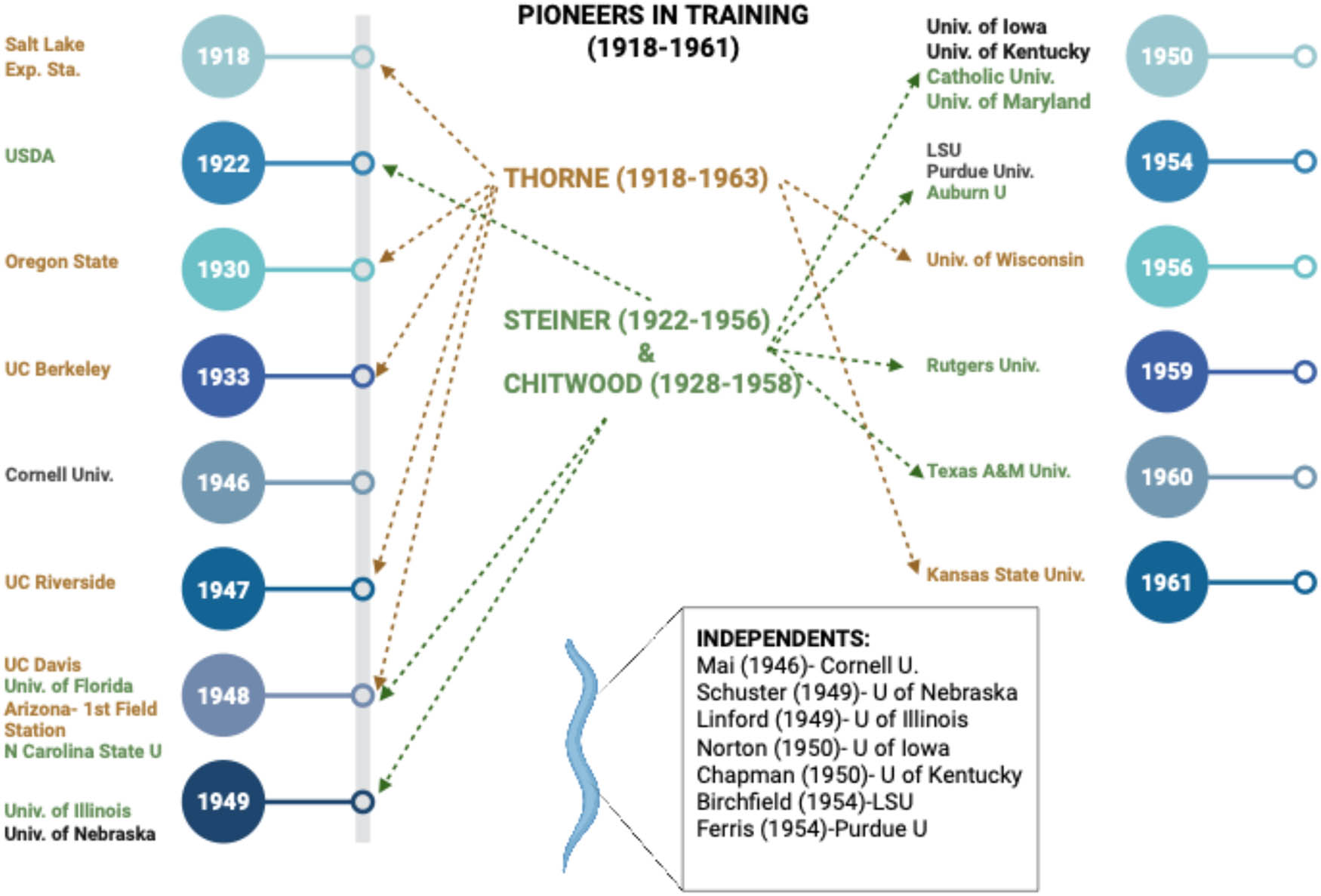
Figure 1
Genealogy of nematology training in the United States (after Webster et al., 2008). Eastern, Western, and independent branches are illustrated and the central role of mentorship networks in workforce formation is highlighted. Color codes match the connection to the founder (Image created with BioRender).


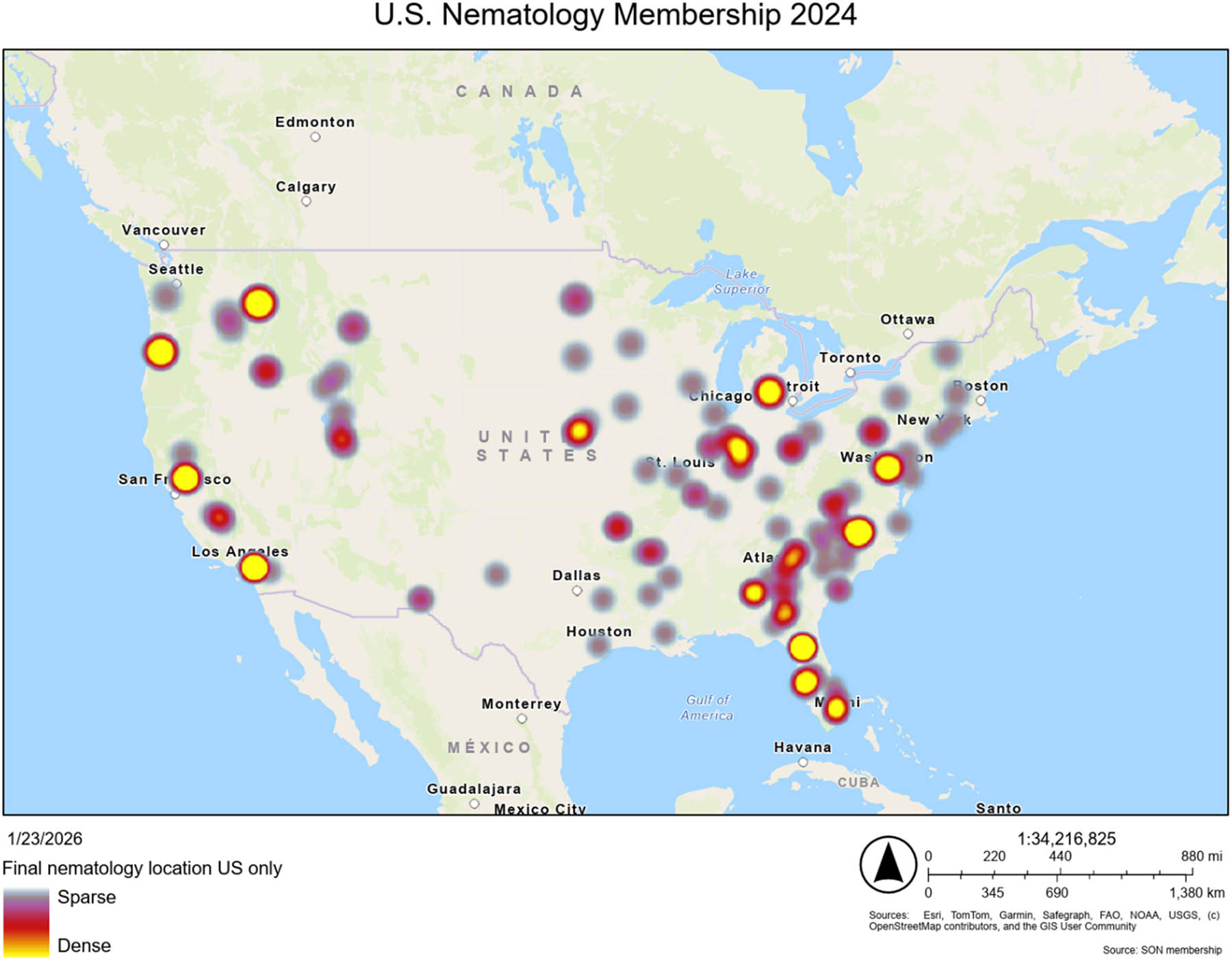
Figure 2
Distribution of United States nematology members by cluster areas in 2024. (Created in ArcGIS Online.).
Table 2
Faculty composition and the membership of the SON change at selected United States institutions (2009–2024)
| Name of institution | Membership change (in #) | Name of the department | Professor rank | Assoc. Prof. rank | Ass. (Research) Prof. rank | Emeritus status/courtesy appt. | Total |
|---|---|---|---|---|---|---|---|
| Michigan State University | 2–9 | Department of Entomology -Applied Nematology, Ecology and Acoustical Signatures | 0 | 0 | 1 | 1 | 2 |
| Oregon State University | 3–7 | Department of Botany and Plant Pathology | 0 | 0 | 1 | 3 | 4 |
| University of California Riverside | 17–20 | Department of Nematology | 5 | 1 | 3 | 2 | 11 |
| University of California Davis | 9–14 | Department of Entomology and Nematology | 2 | 1 | 1 | 0 | 4 |
| University of Arkansas | 3–6 | Department of Entomology and Plant Pathology | 0 | 0 | 1 | 2 | 3 |
| University of Florida | 13–28 | Entomology and Nematology Department | 2 | 4 | 2 | 1 | 9 |
| University of Hawaii-Manoa | 6–11 | Department of Plant and Environmental Protection Sciences | 2 | 0 | 0 | 0 | 2 |
| University of Idaho | 2–10 | Department of Entomology, Plant Pathology, and Nematology | 1 | 0 | 0 | 0 | 1 |
Discrepancies between faculty numbers and membership totals highlight the extent to which some programs rely on student-heavy or emeritus-heavy structures.
Table 3
Regional coordinators for widely prevalent plant-parasitic nematodes in the United States
| Regional coordinators for prevalent PPNs | |||
|---|---|---|---|
| No. | Institution | Name of coordinator | States covered |
| 1 | New Mexico State University | Jacqueline Beacham (retired) | AZ, NM, NV |
| 2 | University of Tennessee | Ernest C. Bernard | KY, TN |
| 3 | University of Minnesota | Senyu Chen | MN |
| 4 | University of Georgia | Intiaz Chowdhury | GA |
| 5 | Montana State University | Alan Dyer | MT, WY |
| 6 | Virginia Polytechnic Institute and State University | Jonathan D. Eisenback | VA |
| 7 | University of Arkansas | Travis Faske | AR, MO |
| 8 | University of Idaho | Retired | ID |
| 9 | Penn State University | Mihail Kantor | PA |
| 10 | Clemson University | Churamani Khanal | SC |
| 11 | University of Delaware | Alyssa Koehler | DE |
| 12 | West Virginia University | Retired | WV |
| 13 | Mississippi State University | Gary Lawrence (retired) | MS |
| 14 | Auburn University | Kathy Lawrence | All |
| 15 | The Ohio State University | Horacio Lopez-Nicora | OH |
| 16 | University of Wisconsin-Madison | Ann MacGuidwin (retired) | WI |
| 17 | University of Rhode Island | Nathaniel Mitkowski | RI |
| 18 | University of Vermont | Deborah Neher.(retired) | VT |
| 19 | Utah State University | Claudia Nischwitz | UT |
| 20 | Cornell University | Sarah Jane Pethybridge | NY |
| 21 | University of Nebraska-Lincoln | Thomas Powers | AK, CO, ME, NE, NJ, UT |
| 22 | Michigan State University | Marisol Quintanilla | MI |
| 23 | University of Illinois | Nathan Schroeder | IL |
| 24 | Kansas State University | William Rutter | KS |
| 25 | Iowa State University | Gregory Tylka | IA |
| 26 | University of Hawaii | Koon-Hui Wang | HI |
| 27 | Texas A&M University | Terry Wheeler | OK, TX |
| 28 | North Dakota State University | Guiping Yan | ND, SD |
| 29 | North Carolina State University | Weimin Ye | NC |
| 30 | Purdue University | Lei Zhang | IN |
| 31 | Louisiana State University AgCenter | Tristan Watson | All |
| 32 | Connecticut Agricultural Experiment Station | Raquel Rocha | CT, MA, NH |
| 33 | USDA ARS | Paulo Vieira | DC, MD |
| 34 | Florida Department of Agriculture and Consumer Services | Jason Stanley | FL |
| 35 | California Department of Food and Agriculture | Sergei Subbotin | CA |
| 36 | USDA ARS | Retired | OR, WA |
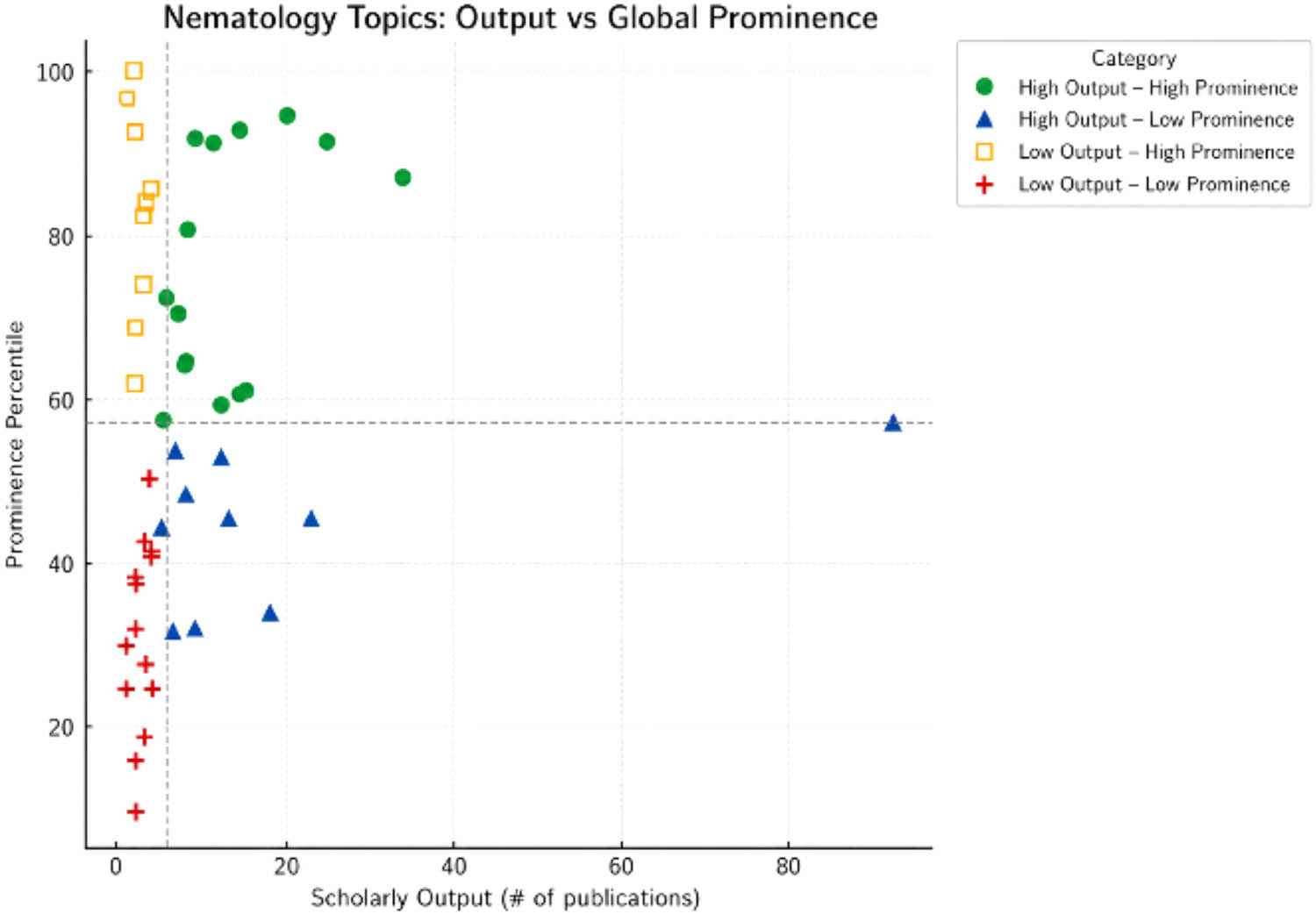
Figure 3
Quadrant analysis of nematology research topics based on output and prominence (SciVal, Elsevier). Dashed lines indicate the median split for output and prominence. Data source: SciVal Elsevier; accessed September 19, 2025.
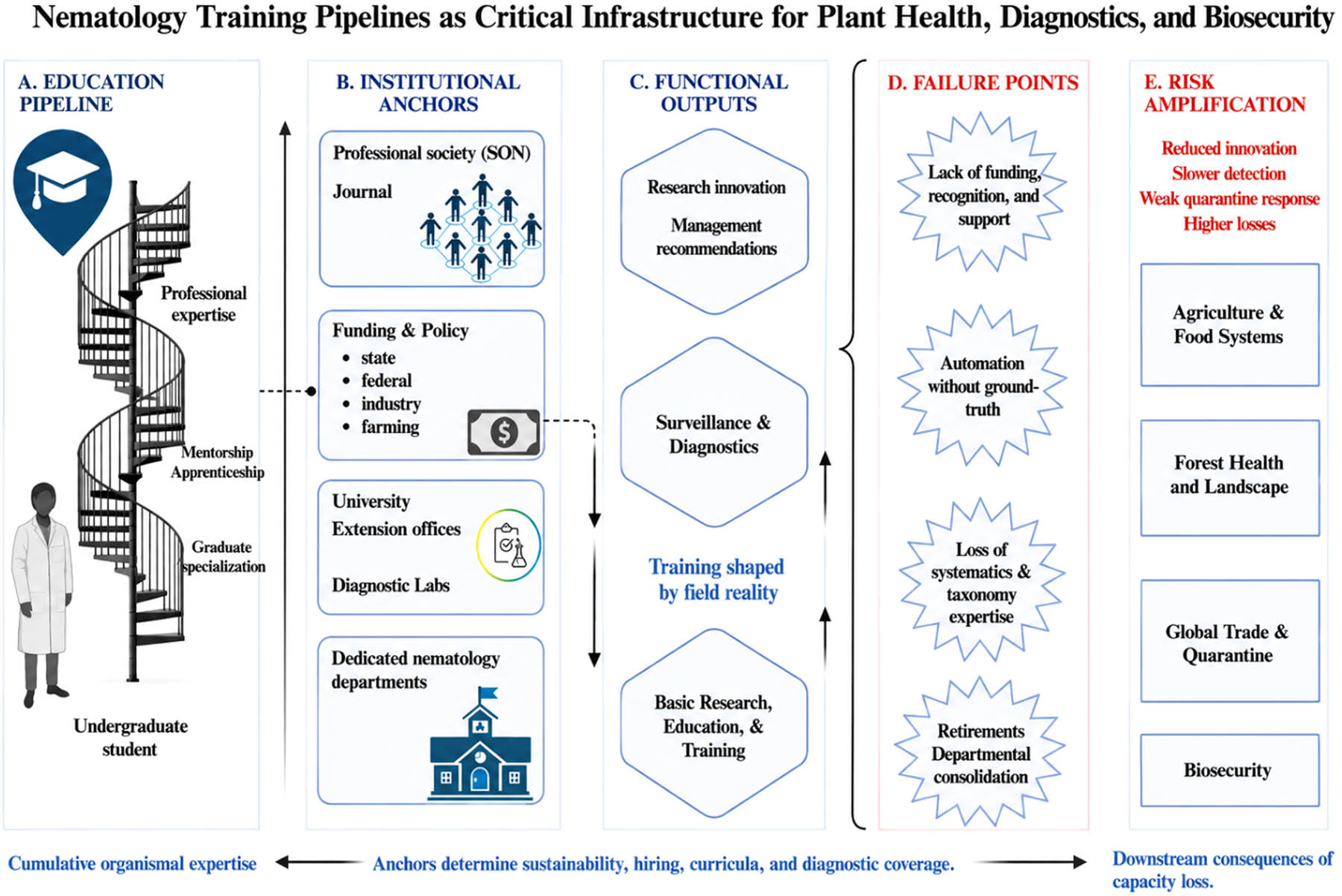
Figure 4
Nematology pipeline conceptual synthesis. How education and training (Panel A), sustained by institutional anchors (Panel B), generate functional agricultural or forest health outputs (Panel C) that reduce risk across agricultural, natural, socioeconomic, and geopolitical systems (Panel E) is illustrated. Failure points (Panel D), including retirements without replacement, departmental consolidation, loss of systematics and taxonomy expertise, automation without ground truth, and inadequate recognition and support, disrupt continuity and amplify vulnerability across all outputs. Panels are vertically aligned to emphasize parallel, interdependent components rather than a strictly linear sequence. (Image created with BioRender.).