
1. Introduction: Why nematology still matters
“If all the matter in the universe except the nematodes were swept away, our world would still be dimly recognizable…” - Nathan A. Cobb (1915)
Nematodes are among the most abundant, diverse, and ecologically consequential metazoans on Earth, often exceeding all other animal groups in numerical abundance in soil ecosystems. They occupy virtually every habitat where liquid water is present, even if only briefly (Gardner, 2001). Their roles span soil nutrient cycling, ecosystem regulation, biological control, and, critically, plant, animal, and human disease, making them central to both ecosystem functioning and global food security. Cobb’s often-cited observation was not rhetorical exaggeration, but a recognition that nematodes are a hidden yet structurally fundamental component of biological systems.
Nematodes can be grouped broadly into three functional categories: plant-parasitic nematodes (PPNs), which damage crops; free-living nematodes, which contribute to decomposition and nutrient cycling; and animal and human-parasitic nematodes, which cause disease.
In contemporary research, one free-living nematode, Caenorhabditis elegans (Maupas, 1900) Dougherty, 1955, is widely recognized as a major model organism and has enabled landmark discoveries in molecular and cell biology since the publication of the first multicellular organism genome in 1998 (Nigon & Félix, 2018). Since Sydney Brenner’s pioneering work in the 1960s established C. elegans as a genetic system, this species has underpinned four Nobel Prizes and thousands of publications (Ambros et al., 2025). Nevertheless, broad awareness of C. elegans has not translated into comparable recognition of nematodes as major determinants of agricultural productivity, ecosystem stability, and biosecurity risk (Kiontke & Fitch, 2013).
Historical evidence shows that nematologists have been critical, though often underrecognized, contributors to agricultural resilience, forest protection, and national biosecurity systems (Afzal & Mukhtar, 2024; Kantor et al., 2025). Collectively, PPNs parasitize a wide range of host plants and cause global crop losses of $80–157 billion, with actual losses likely higher because many countries lack sufficient nematology capacity (Deeikshana et al., 2025). From a supply-chain perspective, global trade and the movement of plant material are major pathways for nematode dissemination; any process that moves soil or plant tissue can disperse PPNs and contribute to substantial crop losses or forest decline (Kantor et al., 2024). In soybean, for example, the soybean cyst nematode (SCN) (Heterodera glycines Ichinohe, 1952) is highly destructive, causing an estimated 559.3 million bushels of yield loss in the United States and Canada from 2015 to 2019 (Bradley et al., 2021) and an estimated $26 billion in losses to the United States and Canada from 2010 to 2014 (Allen et al., 2017). A multistate survey of soybean diseases for 2010–2014 concluded that SCN caused roughly “twice as much yield loss than any other disease” (Allen et al., 2017). Because aboveground symptoms are often subtle or absent early in infestations, SCN is frequently underdiagnosed without soil sampling and cyst quantification (Bradley et al., 2021) procedures typically performed in nematology laboratories.
Root-knot nematodes (RKNs), including Meloidogyne incognita (Kofoid and White, 1919; Chitwood, 1949), are among the most destructive PPNs and infect more than 3,000 plant species worldwide, including major crops such as tomatoes (Solanum lycopersicum L.), cotton (Gossypium hirsutum L.), and rice (Oryza sativa L.) (Pan et al., 2026). Nematology researchers have described more than 100 species of RKNs (El-Qurashi et al., 2025) and enabled the identification and mapping of genes that confer resistance to them (Mi-1, Mi-2, Mi-3, Mi-4, Mi-5, Mi-6, Mi-7, Mi-8, Mi-9, and Mi-HT) (El-Sappah et al., 2019). They also developed biocontrol strategies for their sustainable management (Sharma et al., 2025; El-Qurashi et al., 2025). In forestry, diseases caused by the pinewood nematode, Bursaphelenchus xylophilus (Steiner & Buhrer, 1934) Nickle 1970 and, more recently, the beech leaf nematode (Litylenchus crenatae mccannii Carta et al., 2020), have severely affected pine (Pinus spp.) and American beech (Fagus grandifolia Ehrh.) forests (Kanzaki et al., 2019; Carta et al., 2020; Kantor et al., 2025). Although eradication remains difficult, nematology researchers have substantially improved understanding of the biological and chemical processes, as well as the relevant hosts, vectors, and dispersal dynamics. Their work has led to more integrated nematode management strategies and some progress in biological control (Goraya et al., 2024; Wang et al., 2026).
The discovery of entomopathogenic nematode-bacteria symbioses enabled the mass production and commercialization of biological control agents. These biopesticides helped control pests such as corn rootworm (Diabrotica spp.), fungus gnats (Bradysia spp.), and white grubs (Scarabaeidae), thereby reducing reliance on chemical insecticides (Shapiro-Ilan & Lewis, 2024).
Together, these examples show that nematology functions as a foundation enabling discipline, much like plant pathology and entomology, but with far less institutional visibility. Although new PPN detection approaches use Artificial Intelligence (AI)/Machine Learning for large-scale surveillance (Park et al., 2026), conventional detection methods, including microscopic examination of infected roots and PCR-based assays, remain the gold standard for PPN detection because of their specificity and reliability, especially when combined with morphological expertise.
Despite its ubiquity and importance, nematology remains one of the least visible and most institutionally fragile biological disciplines in North America, creating a mismatch between societal need and investment. This paradox does not reflect scientific irrelevance or lack of innovation. On the contrary, nematology has contributed foundational knowledge to agriculture, forestry, ecology, parasitology, molecular biology, genetics, and biosecurity, including the development of C. elegans as a premier model organism. Rather, long-term structural and institutional decisions progressively dismantled dedicated academic programs, diagnostic capacity, and workforce-renewal pipelines.
This work examines the evolution of nematology as a scientific discipline in the United States, with comparative insight from Canada, to understand how workforce, training, and institutional structures shape our capacity to respond to emerging biological threats. By integrating historical scholarship, professional-society records, faculty demographics, diagnostic-laboratory infrastructure, and bibliometric analyses, we argue that the limited visibility and support afforded to nematology reflect structural disinvestment in training, diagnostics, and faculty positions rather than scientific relevance.
2. From organism to discipline: The birth of nematology as a discipline
Nematology is a comparatively young scientific discipline when contrasted with biology, zoology, or even closely related applied fields such as entomology and plant pathology. Although nematodes were observed shortly after the invention of the microscope in the seventeenth century, there is no universal agreement on when modern nematology began. Some historians trace its origins to nineteenth-century taxonomic work (Raski, 1959; Thorne, 1961), whereas others (Webster et al., 2008) identify the mid-twentieth century, particularly the introduction of chemical nematicides in the 1940s, as the turning point when nematodes emerged as a recognized agricultural threat requiring specialized expertise.
In Canada and the United Kingdom, nematology was historically housed within entomology, whereas in the United States, nematology developed primarily within plant pathology (Webster, 2024).
Yet, from its earliest development, leading figures argued that nematology was neither a narrow subfield nor merely an applied service discipline. In the 1960 volume Nematology, co-edited by Sasser and Jenkins, Steiner characterized nematology as both “a science of its own” and a synthesis of multiple disciplines, including parasitology, zoology, soil science, plant pathology, agronomy, plant breeding, economic entomology, freshwater biology, and marine biology. In the same volume, Christie similarly argued that nematologists should be trained broadly enough – “in the broadest sense and in all its aspects” – to “talk more intelligently” with adjacent disciplines while retaining specialized organismal expertise. More conservatively, Oostenbrink (1960) situated plant nematology between phytopathology (mycology) and zoology (entomology), while still acknowledging its distinctive methods and conceptual foundations (Sasser & Jenkins, 1960).
The emergence of nematology as a discipline aligns closely with theoretical models of disciplinary formation. According to Krishnan (2009), a discipline requires a defined object of study (even if that object overlaps with other fields), specialized knowledge, theoretical frameworks, and methodological coherence. Brady and Stolzer (2015) further emphasize institutional markers such as dedicated faculty, peer-reviewed journals, professional societies, and a sustained presence in higher education. The creation of the Society of Nematologists (SON) was therefore a pivotal milestone in the formalization of nematology. Together, SON, the launch of the Journal of Nematology (JON) in 1969, and the establishment of formal academic programs in 1954 at the University of California (Barker, 2003, 2004) transformed nematology from a loosely connected set of practices into a recognized scientific discipline (Wiseman, 2025).
3. Rise of nematology (1940s–1980s): Training pipelines, mentorship, and institutional commitment
3.1. Apprenticeship and on-the-job training
Early records of nematodes associated with crop plants in the United States and Canada date to the mid- to late nineteenth century. In Principles of Nematology, Gerald Thorne credited Joseph Leidy with the first report of free-living nematodes in North America. Leidy reported Anguillulula longa in 1851 to the Philadelphia Academy of Natural Sciences (Thorne, 1961), whereas the first PPNs, including Meloidogyne spp., were documented between 1888 and 1891 by Atkinson (Alabama), Neal (Florida), Halstead (New Jersey), Schribner (Tennessee), and Stone and Smith (Massachusetts) (Thorne, 1961). Nathan A. Cobb played a central role in shaping early American nematology, training a second generation of nematologists, including Gotthold Steiner, Jessie R. Christie, Gerald Thorne, Benjamin G. Chitwood, Albert L. Taylor, and Edna Buhrer, largely through laboratory-based apprenticeship (Huettel & Golden, 1991).
At this stage, however, nematology lacked formal academic programs. Training occurred almost exclusively through on-the-job mentorship networks. This model produced dense genealogies of nematology training, later documented by Webster and colleagues (Webster, 2024; Barker, 2003), linking federal laboratories, land-grant universities, and experiment stations across the United States.
The discovery of chemical nematicides in the 1940s marked a critical inflection point. By revealing the scale of crop losses caused by nematodes, nematicides helped establish nematology as an essential agricultural science. Over time, this focus expanded to include free-living nematodes associated with forest trees as well as those inhabiting freshwater and marine ecosystems (Raski et al., 2008; Van Gundy, 1965; 1980). This recognition coincided with postwar concern about global food security and spurred investment from government agencies, industry, and regional research committees (Schmitt and Schmitt, 2007). This period demonstrates that nematology’s early growth was driven not only by scientific curiosity but by clear societal demand and national need.
3.2. Institutionalization and academic programs in the United States
The most consequential institutional commitment to nematology occurred on the United States West Coast. In 1948, Merlin W. Allen taught the first formal university-level nematology course at the University of California (UC) Berkeley (Webster et al., 2008). In 1954, the UC system established the world’s first standalone Department of Nematology, with faculty distributed across Berkeley, Davis, and Riverside (University of California Davis, 2026). This unprecedented move formally recognized nematology as a discipline distinct from plant pathology, entomology, or parasitology, and integrated teaching, research, and Cooperative Extension.
Over the following decade, the UC system expanded its nematology faculty and curricula. By 1960, 13 professional nematologists were employed across UC campuses. Subsequent decentralization allowed UC Riverside and UC Davis to develop independent programs that became enduring centers of nematology education and research, with Cooperative Extension specialists ensuring its practical relevance in agriculture. The UC model demonstrated how sustained institutional support for dedicated departments could anchor long-term workforce development.
On the East Coast, nematology developed through strong federal-academic partnerships. Steiner and Jeffers taught nematology at the University of Maryland under United States Department of Agriculture (USDA) agreements, while B. G. Chitwood offered courses at the Catholic University of America from 1950 to 1952. The National Science Foundation played an early and influential role by funding graduate summer schools in nematology at North Carolina State University in 1959 and Cornell University in 1962, attracting students from across the United States and abroad (Mai & Motsinger, 1987). Regional technical committees and boards, including the Southern and Northeastern regional technical committees, provided formal mechanisms through which university and USDA scientists could exchange information, coordinate research and education, and combine complementary expertise. By organizing multistate activities, these committees promoted more efficient use of institutional resources and reduced unnecessary duplication of research capacity.
Industry also contributed to early training through applied workshops sponsored by chemical companies (Mai & Motsinger, 1987). Nevertheless, most nematologists in this period continued to learn through laboratory-based mentorship, then established their own programs (Oostenbrink, 1960), a model that proved remarkably effective for building national capacity.
3.3. Genealogies of training and the consolidation of a discipline
By 1960, the United States employed an estimated 100–200 full-time nematology “scientific workers” (Oostenbrink, 1960). Webster et al. (2008) later documented three major genealogical branches of nematology training – Eastern, Western, and Independent, tracing lineages back to founders such as Cobb, Steiner, Chitwood, and Thorne (Figure 1).
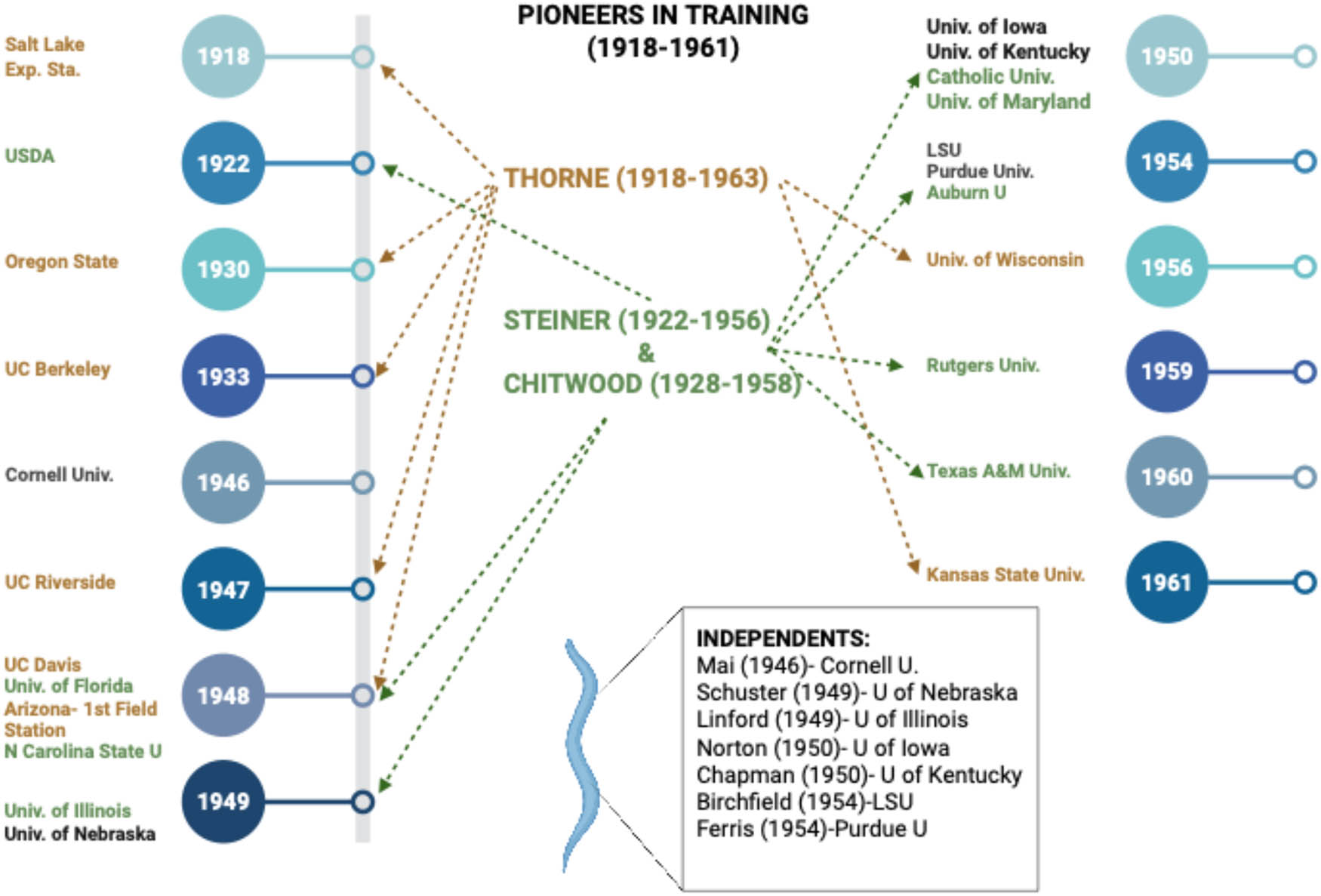
Figure 1
Genealogy of nematology training in the United States (after Webster et al., 2008). Eastern, Western, and independent branches are illustrated and the central role of mentorship networks in workforce formation is highlighted. Color codes match the connection to the founder (Image created with BioRender).
The Western branch, centered at UC Riverside and UC Davis, became particularly influential in applied plant–nematode interactions, taxonomy, and ecology. The Eastern branch, rooted in USDA laboratories and universities, such as Maryland, Florida, Auburn, Illinois, and North Carolina State, produced leaders in diagnostics, taxonomy, and nematode management. Together these networks show that nematology’s success depended on sustained, intentional training pipelines rather than isolated individual achievements.
3.4. Professional society and scholarly infrastructure
The consolidation of nematology as a discipline was formalized through the creation of the SON in 1961 and the launch of the JON in 1969. By December 1961, SON had 155 paying members and a newsletter (Mai & Motsinger, 1987). The first SON meeting, held in Corvallis, Oregon, in 1962, initiated a series of annual gatherings that helped define the field and created opportunities for engagement, networking, exchanges of ideas, and training of the next generation of nematologists. By 1985, SON membership peaked at more than 900 members. Another milestone was the creation of a journal “devoted to all phases of nematology” (Taylor, 1959). The first issue of the JON appeared in January 1969 and was dedicated to N. A. Cobb in “recognition of his pioneering work in nematology” (Schmitt & Schmitt, 2007).
These developments provided not only venues for scholarly exchange but also a professional identity that reinforced the legitimacy of nematology. The period from roughly 1960 to 1986 can justifiably be described as the rise of nematology in North America.
4. Decline by design: Structural erosion, not scientific obsolescence
Despite its successes, nematology entered a period of contraction beginning in the late 1980s. This change did not stem from diminishing scientific relevance. Instead, it resulted from a convergence of structural forces: retirements of senior nematologists without replacement, consolidation of academic departments, shifting funding priorities toward molecular and biotechnological research, and reduced public investment in agriculture.
The introductory essays by Steiner and Christie in Nematology (Christie, 1960; Steiner 1960) reveal how nematologists were often regarded by zoologists, plant pathologists, and other agricultural scientists as a “lowly breed” (Steiner, 1960) or “looked upon as a collection of misinformed oddities” (Christie, 1960) working in a field that was “never fashionable” (Steiner, 1960). In other words, the field has long struggled for recognition as worthy of dedicated credentials, institutional support, and sustained scientific investments.
The rise of C. elegans as a molecular model system reshaped the funding landscape, privileging laboratory-based genetics over organismal and applied expertise (Schmitt & Schmitt, 2007). At the same time, the increased regulation and eventual discontinuation of many chemical nematicides redirected research agendas and reduced industry demand for applied nematology positions. Diagnostic, systematics, and extension-focused roles were therefore disproportionately lost.
In Dawning of a New Generation, Schmitt and Schmitt (Schmitt & Schmitt, 2007) provide a more detailed overview of the evolution, causes, and consequences of these shifts. Additional factors likely contributed to this decline, including a broader societal move away from agriculture as a career path, industry increasingly becoming the primary source of seed and treatment recommendations, and, more speculative, but still worth considering, a loss of urgency among key stakeholders, including farmers, prospective students, funders, and policymakers.
By 1990, fewer than 30 students in the United States were pursuing advanced degrees in nematology, roughly half of them at the doctoral level (Schmitt & Schmitt, 2007). This contraction of the training pipeline had long-term consequences that continue to unfold.
5. Canada as a parallel case study: Rise, peak, and contraction
Canada provides a useful comparison with the United States because both countries operate agricultural research systems that include land-grant or land-grant-like universities, federal and provincial or state laboratories, and extension-oriented mandates. Examining Canada, therefore, helps determine whether the contraction of nematology reflects unique dynamics or a broader structural vulnerability in North American plant health research systems.
Canada’s experience of the nematology discipline development is closely parallel to that of the United States. After modest beginnings in the early twentieth century, when plant pathologists occasionally noted nematode infestations in crops (Estey, 1994), Canadian nematology expanded rapidly in the post-Second World War period. The federal Department of Agriculture established a Nematology Section at the Entomology Research Institute in Ottawa (Webster, 2004a), signaling official recognition of nematodes as a distinct threat to crops. In parallel, university-level instruction introduced by Professor Ralph H. Estey at McGill University’s Macdonald College in 1960 helped develop a nationally distributed nematology workforce (Estey, 2007).
By the 1960s and 1970s, Canada hosted world-leading expertise in nematode taxonomy, diagnostics, and management, with active laboratories in nearly every province. For example, Agriculture Canada’s Vineland Station in Ontario housed the country’s largest cluster of field nematologists under W. F. (Bill) Mountain and addressed nematode problems in horticultural and field crops (Webster, 2006).
The 1970s and 1980s are often regarded as the rise of plant nematology in Canada. During these decades, research activity broadened to encompass many crops, and new management techniques were explored. Across the country, nematologists addressed a diverse array of nematode pests. Root-lesion nematodes (Pratylenchus spp.) were studied intensively in Ontario because of the damage they caused in field and orchard crops, whereas the threat posed by the potato rot nematode (Ditylenchus destructor Thorne, 1945) on Prince Edward Island was recognized through survey work and prompted specialized investigation and control efforts (Kimpinski, 1987). Investigation of PPN in turfgrass was reported by Yu et al. (1997). Periodic outbreaks of stem and bulb nematode (Ditylenchus dipsaci Kühn, 1857) Filipjev, 1936, cyst, and RKNs also occurred in horticultural and field crops from Quebec to the Prairies (Sewell, 1970). Although these infestations caused localized yield losses, none became nationally devastating, in large part because the network of federal and provincial laboratories was able to respond with surveys, diagnostics, and grower recommendations.
During this period, Canadian nematologists played prominent roles in the field of nematology internationally, including leadership in the International Congress of Nematology and the hosting of major SON meetings. Beginning in the 1990s, however, budget restructuring, retirements, and shifting research priorities led to rapid contraction. By the early 2000s, national quarantine responsibilities for nematode diagnostics reportedly rested with only one or two specialists, and by 2004 Canada was said to employ only two full-time plant nematologists nationwide (Webster, 2004b). This erosion of capacity raised serious concerns about preparedness for invasive nematode outbreaks. Webster (2004b) cautioned that Canada was “ill-equipped to handle a plant-nematode outbreak like the one it faced 40 years ago.” highlighting the vulnerability created by the neglect of specialized nematology training.
6. Nematology today: Workforce concentration, membership data, and institutional fragility
SON membership records from 2009 to 2024 were used here as a proxy for the institutional presence of nematology expertise rather than as a direct measure of workforce size. Members self-report primary affiliations and include academic faculty, emeritus scientists, retirees, students, and professionals in government or industry. Although this approach does not capture every practicing nematologist, longitudinal analysis of membership change provides a conservative indicator of institutional continuity or loss. Importantly, even a shift from one member to zero members at a given university signals the effective disappearance of nematology representation at that institution.
Analysis of SON membership data from 2009 to 2024 (Table 1) reveals a field that appears numerically stable but is structurally fragile. Total membership remained relatively constant, at approximately 490 members), yet foreign membership declined sharply, and United States-based expertise became increasingly concentrated within a small number of institutions and regions.


Geographically, nematology expertise is concentrated in the Pacific region (California, Hawaii, Oregon, and Washington) and the South Atlantic region, especially Florida, Georgia, North Carolina, and the District of Columbia-Maryland-Virginia area, with sparse representation across much of the Midwest (Ohio, Michigan, Pennsylvania), Mountain West, and the Northeast (Figure 2).
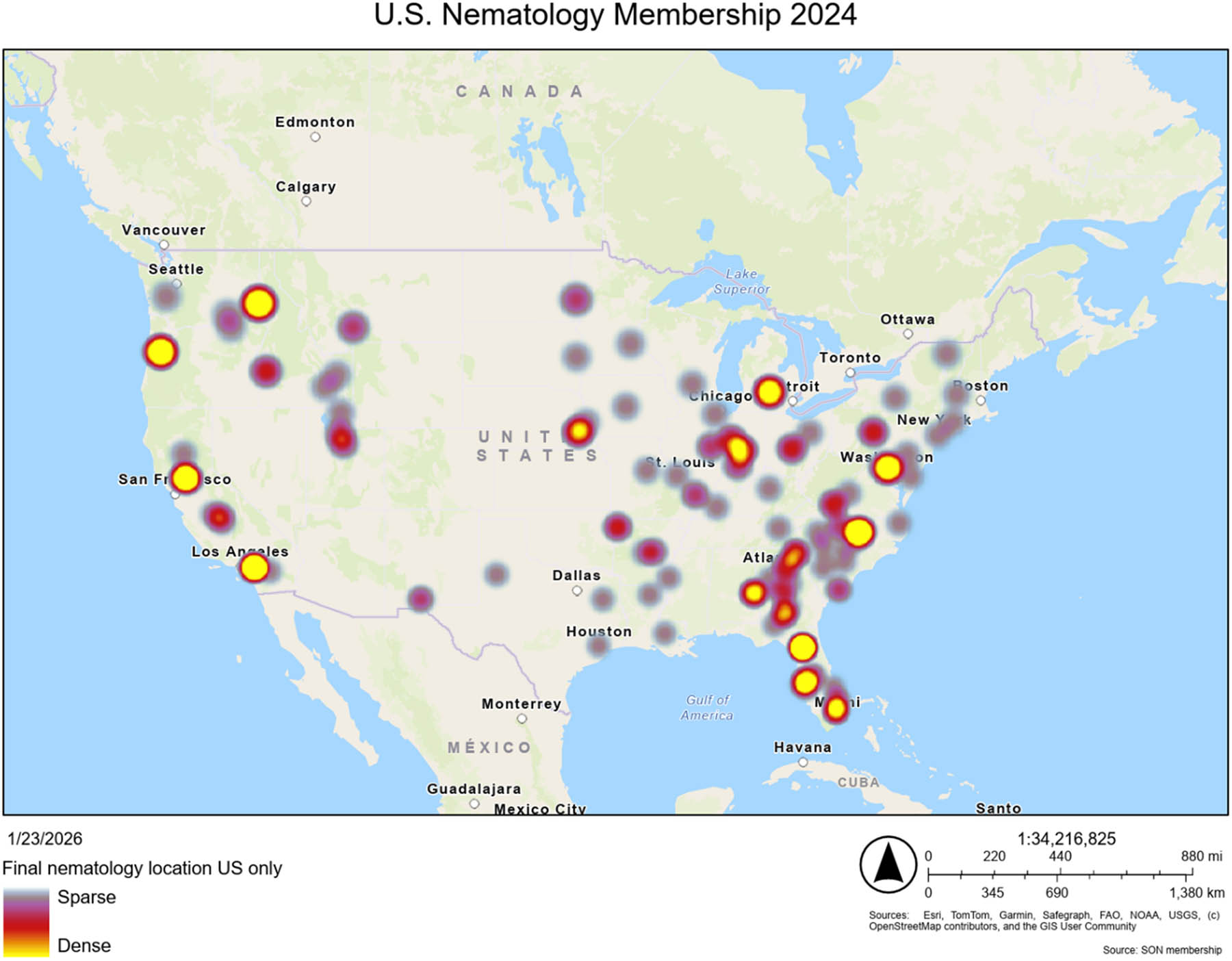
Figure 2
Distribution of United States nematology members by cluster areas in 2024. (Created in ArcGIS Online.).
Closer examination of the institutions showing membership growth (Table 2, Hawaii not included due to scale) reveals additional vulnerability. Faculty-rank distribution was used here as a proxy for program stability, based on the premise that resilient academic units maintain representation across assistant, associate, and full professor ranks. Programs dominated by a single senior faculty member, or those heavily reliant on graduate students or emeritus faculty, are structurally fragile and highly vulnerable to collapse following retirement or funding disruption. Programs with multiple faculty members across ranks, such as those at the University of Florida and UC Riverside, appear relatively stable. In contrast, programs dependent on a single faculty member, often at the full professor level, face likely contraction or collapse upon retirement. Open faculty searches in nematology remain exceedingly rare, indicating limited institutional commitment to workforce renewal.
Table 2
Faculty composition and the membership of the SON change at selected United States institutions (2009–2024)
| Name of institution | Membership change (in #) | Name of the department | Professor rank | Assoc. Prof. rank | Ass. (Research) Prof. rank | Emeritus status/courtesy appt. | Total |
|---|---|---|---|---|---|---|---|
| Michigan State University | 2–9 | Department of Entomology -Applied Nematology, Ecology and Acoustical Signatures | 0 | 0 | 1 | 1 | 2 |
| Oregon State University | 3–7 | Department of Botany and Plant Pathology | 0 | 0 | 1 | 3 | 4 |
| University of California Riverside | 17–20 | Department of Nematology | 5 | 1 | 3 | 2 | 11 |
| University of California Davis | 9–14 | Department of Entomology and Nematology | 2 | 1 | 1 | 0 | 4 |
| University of Arkansas | 3–6 | Department of Entomology and Plant Pathology | 0 | 0 | 1 | 2 | 3 |
| University of Florida | 13–28 | Entomology and Nematology Department | 2 | 4 | 2 | 1 | 9 |
| University of Hawaii-Manoa | 6–11 | Department of Plant and Environmental Protection Sciences | 2 | 0 | 0 | 0 | 2 |
| University of Idaho | 2–10 | Department of Entomology, Plant Pathology, and Nematology | 1 | 0 | 0 | 0 | 1 |
Discrepancies between faculty numbers and membership totals highlight the extent to which some programs rely on student-heavy or emeritus-heavy structures.
7. Diagnostics, stakeholders, and national biosecurity: Nematology as critical infrastructure
In this work, biosecurity is defined as the integrated capacity for surveillance, accurate diagnosis, rapid response, and informed management of plant health threats across agricultural and natural systems. Nematology expertise is foundational to this capacity because many nematode pests are cryptic, soilborne, and require specialized organismal knowledge for reliable detection and interpretation. Nematology expertise underpins plant health surveillance and diagnostic systems that serve growers, foresters, regulators, and policymakers. Diagnostic laboratories and regional coordinators operate at the intersection of field sampling, laboratory analysis, stakeholder education, and regulatory response.
Outside of academia, the USDA has played a foundational and sustained role in advancing nematology in the United States, working alongside land-grant universities and state agricultural experiment stations. It is important to note that United States nematology traces its formal beginnings to the USDA in 1907, when N.A. Cobb was hired in Washington, DC. The first USDA nematology field station was established in Utah in 1918, where G. Thorne conducted pioneering research on the sugar beet cyst nematode (Heterodera schachtii A. Schmidt, 1871). In 1935, another nematology field station was established in Tifton, Georgia by A. L. Taylor, strengthening research capacity in the southeastern United States. Two years later, in 1937, B. G. Chitwood was transferred to Long Island, New York, to work on the golden potato cyst nematode (Globodera rostochiensis [Wollenweber, 1923] Behrens, 1975). These early appointments and field stations anchored federal leadership in nematode diagnostics, taxonomy, and management during a period of expanding agricultural intensification. The USDA is also globally recognized for its contributions to nematode taxonomy and systematics. The USDA Nematode Collection was formally established in 1960 and remains one of the world’s most important resources for nematode species identification, comparative morphology, and regulatory diagnostics.
The historical precedent for nematology as a biosecurity asset is well established. In 1910, Cobb’s identification of nematode-infested cherry (Prunus spp.) trees directly influenced the development of United States plant quarantine policy, culminating in the Plant Quarantine Act of 1912 (Huettel and Golden, 1991). More than a century later, nematodes remain an underestimated but escalating threat to global food security and economic stability.
Today, the mission of the USDA Agricultural Research Service (ARS) is to deliver scientific solutions to national and global challenges, ensure a safe and abundant food supply, and support a competitive and sustainable agricultural economy. Over the past century, the USDA expanded its network of nematologists across multiple states, historically employing approximately 15–20 scientists stationed from Florida to Hawaii to address regionally important PPNs affecting specialty crops, field crops, and perennial systems. At times, this federal investment in nematology research rivaled or exceeded that of universities. In recent years, however, retirements and reductions in force have sharply reduced this capacity. At present, only six USDA scientists remain actively engaged in nematology research nationwide. This contraction represents a substantial loss of federal research capacity in a discipline that remains essential for plant health, biosecurity, and sustainable crop production.
The PPNs in the United States are monitored through a small network of experts in academia and government (Table 3). These regional coordinators conduct surveillance and update the list of widely prevalent PPNs in collaboration with plant pathology personnel designated by the state department of agriculture in each state. They are, in effect, the frontline nematology experts working at the intersection of field data collection, diagnostic services, stakeholder education, and research innovation. Several of them have retired recently, and others are approaching retirement.
Table 3
Regional coordinators for widely prevalent plant-parasitic nematodes in the United States
| Regional coordinators for prevalent PPNs | |||
|---|---|---|---|
| No. | Institution | Name of coordinator | States covered |
| 1 | New Mexico State University | Jacqueline Beacham (retired) | AZ, NM, NV |
| 2 | University of Tennessee | Ernest C. Bernard | KY, TN |
| 3 | University of Minnesota | Senyu Chen | MN |
| 4 | University of Georgia | Intiaz Chowdhury | GA |
| 5 | Montana State University | Alan Dyer | MT, WY |
| 6 | Virginia Polytechnic Institute and State University | Jonathan D. Eisenback | VA |
| 7 | University of Arkansas | Travis Faske | AR, MO |
| 8 | University of Idaho | Retired | ID |
| 9 | Penn State University | Mihail Kantor | PA |
| 10 | Clemson University | Churamani Khanal | SC |
| 11 | University of Delaware | Alyssa Koehler | DE |
| 12 | West Virginia University | Retired | WV |
| 13 | Mississippi State University | Gary Lawrence (retired) | MS |
| 14 | Auburn University | Kathy Lawrence | All |
| 15 | The Ohio State University | Horacio Lopez-Nicora | OH |
| 16 | University of Wisconsin-Madison | Ann MacGuidwin (retired) | WI |
| 17 | University of Rhode Island | Nathaniel Mitkowski | RI |
| 18 | University of Vermont | Deborah Neher.(retired) | VT |
| 19 | Utah State University | Claudia Nischwitz | UT |
| 20 | Cornell University | Sarah Jane Pethybridge | NY |
| 21 | University of Nebraska-Lincoln | Thomas Powers | AK, CO, ME, NE, NJ, UT |
| 22 | Michigan State University | Marisol Quintanilla | MI |
| 23 | University of Illinois | Nathan Schroeder | IL |
| 24 | Kansas State University | William Rutter | KS |
| 25 | Iowa State University | Gregory Tylka | IA |
| 26 | University of Hawaii | Koon-Hui Wang | HI |
| 27 | Texas A&M University | Terry Wheeler | OK, TX |
| 28 | North Dakota State University | Guiping Yan | ND, SD |
| 29 | North Carolina State University | Weimin Ye | NC |
| 30 | Purdue University | Lei Zhang | IN |
| 31 | Louisiana State University AgCenter | Tristan Watson | All |
| 32 | Connecticut Agricultural Experiment Station | Raquel Rocha | CT, MA, NH |
| 33 | USDA ARS | Paulo Vieira | DC, MD |
| 34 | Florida Department of Agriculture and Consumer Services | Jason Stanley | FL |
| 35 | California Department of Food and Agriculture | Sergei Subbotin | CA |
| 36 | USDA ARS | Retired | OR, WA |
8. Research trends and bibliometric insights: Signals for the future
To gain a better understanding of the nematology field from a research perspective, research trends in nematology were evaluated using the top 50 SciVal (Elsevier) topic nematology metrics for the period 2020–2026 collected by Scopus. Publications generated using the Top Journal Percentiles indicators show the extent to which the publications are present in the top most-cited journals in Scopus by CiteScore percentile. Topics such as “scholarly output” (publication volume) and “prominence” (a composite metric incorporating citations, views, and journal-level indicators) were used to assess field overall visibility and momentum of the discipline (Figure 3). The Outputs field indicates the extent to which the publications are present in the top 10% most-cited percentiles within Scopus. This number is then field-weighted using the Field-Weighted Citation Impact (FWCI) to normalize for differences in subject area citation patterns.
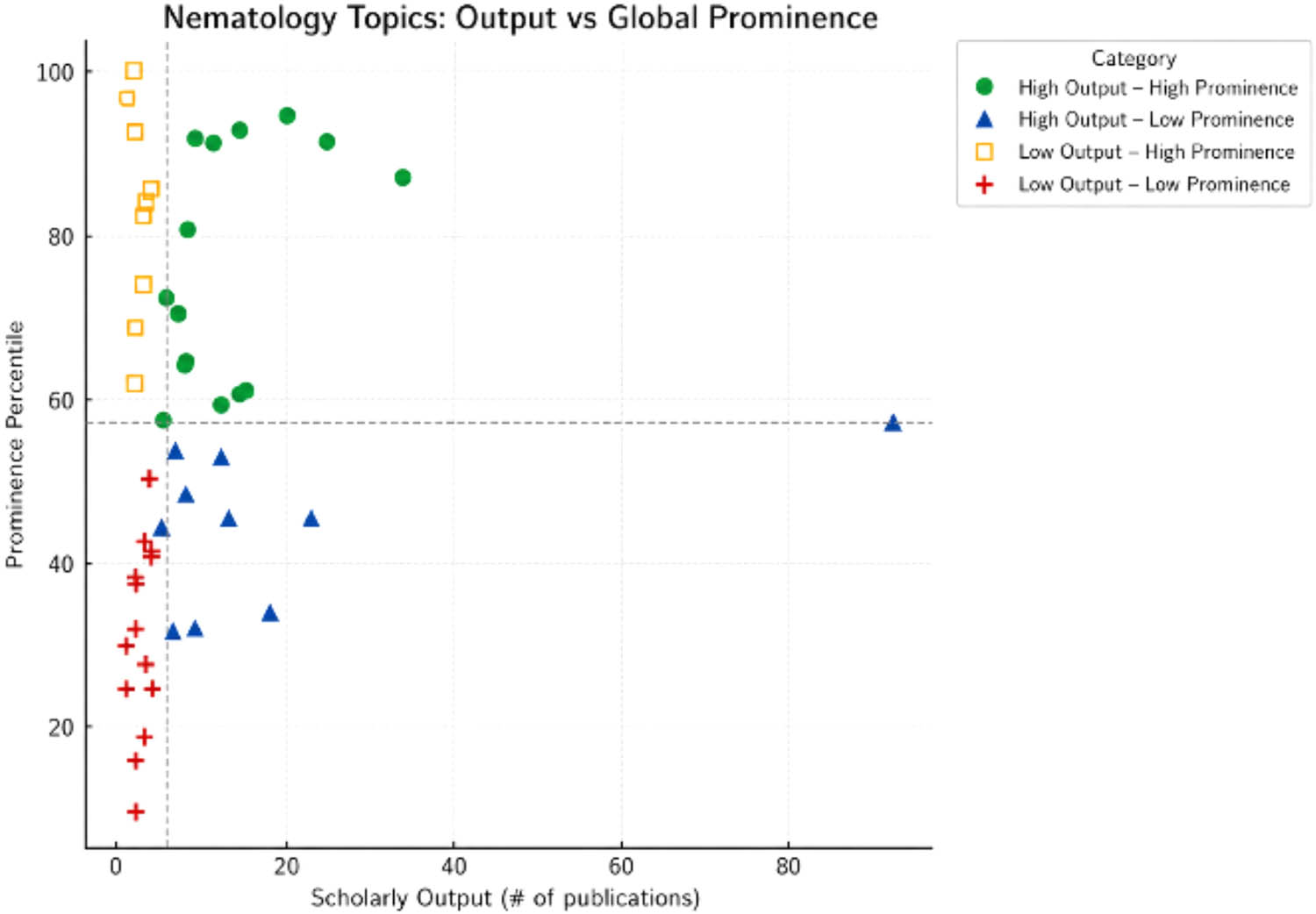
Figure 3
Quadrant analysis of nematology research topics based on output and prominence (SciVal, Elsevier). Dashed lines indicate the median split for output and prominence. Data source: SciVal Elsevier; accessed September 19, 2025.
In Figure 3, a quadrant analysis of nematology research topics based on output and prominence was created using SciVal Elsevier data. High-prominence, low-output topics represent opportunities for strategic growth. Green circles (high output-high prominence) denote core, globally visible strengths, including root-knot resistance, plant resistance mechanisms, entomopathogenic nematodes in biological control, nematode communities and soil-ecosystem dynamics, pinewood nematode and beech leaf disease impacts on forest health, and resistance mechanisms against SCN. Blue triangles (high output-low prominence) denote productive but less visible areas, usually more traditional or descriptive, such as morphological diversity and host interactions of nematodes, morphological and molecular characterization of nematodes, crop-specific nematode management, the impact of Meloidogyne graminicola Golden & Birchfield, 1965 on rice yield, and nematode management in banana (Musa spp.) cultivation. Orange squares (low output-high prominence) denote smaller topic areas with disproportionate global visibility. These often connect nematology with biotechnology, health, or global food security. The five highlighted examples are antimicrobial and anticancer applications of nanoparticles, integrated management of red palm weevil infestation, and enset’s (Ensete ventricosum (Welw.) Cheesman) role in food security and diversity, mitochondrial genome diversity and phylogenetic insight, and brassica utilization for soil health and crop protection. These growth areas include nanotech, genomics, food security links, and are highly cross-disciplinary. Red crosses (low output-low prominence) denote niche or declining areas that remain highly specialized subfields often historically or geographically limited. The five highlighted areas are nematode management in turfgrass systems, diversity and impact of Paratylenchus and Nacobus spp., nematode management in yam (Dioscorea spp.) and cassava (Manihot esculenta Crantz) cultivation, mermithid nematodes and their ecological significance, and fossil nematodes in amber.
FWCI is a field-normalized metric that compares the actual number of citations received by a publication to the expected number of citations for similar documents worldwide. An FWCI score of 1.00 means performance matches the global average, a score above 1.00 indicates higher-than-average impact, and a score below 1.00 indicates lower-than-average impact. For nematology, FWCI values were interpreted cautiously because applied, organismal disciplines such as nematology typically have lower citation densities than molecular or biomedical fields. Across the field, most nematology top topics fall within the 0.3–0.6 range, well below the global average of 1.0, indicating limited influence outside the discipline. Exceptions occur where nematology intersects with molecular methods or biological control, where citation impact approaches or slightly exceeds 0.6. This pattern suggests that cross-cutting integration can elevate the field’s visibility and relevance.
Another Scopus index, the Prominence Percentile, shows the relative momentum and visibility of a research topic globally, calculated using recent citation counts, Scopus views, and average CiteScore. Bibliometric analysis of nematology research prominence from 2020 to 2026 reveals a field anchored in traditional strengths such as morphology, plant resistance, and biological control, while also gaining prominence in cross-disciplinary areas such as soil ecosystem dynamics, forest health, and molecular diagnostics. More specifically, several nematology topics achieve high prominence percentiles (85–95) despite producing relatively modest publication output. For example, research on nematode communities and soil-ecosystem dynamics has only 20 top publications yet ranks among the highest in prominence, suggesting resonance with broader scientific audiences. These cases highlight emerging or cross-disciplinary themes that are gaining traction beyond the traditional boundaries of nematology.
Finally, the classification of topic strength indicates that the vast majority of publications are categorized as “Definitive” contributions to nematology. Very few fall into the “Weak” or “Other” categories, suggesting that the dataset is both highly focused and broadly representative of the discipline.
Although overall nematology publications’ citation impact remains below global averages, topics that intersect with broader ecological, molecular, and food security frameworks achieve disproportionate visibility. These patterns suggest that nematology’s future influence will depend on integration rather than isolation. Investment in high-prominence but currently low-output areas may help build bridges to plant science, forestry, and molecular biology communities in which broader collaboration and influence are possible.
9. Conclusion and recommendations: Rebuilding capacity for a high-risk future
The contraction of nematology education and training in North America is best understood as the result of sustained institutional de-prioritization rather than scientific obsolescence. Historical analysis, professional society data, faculty rank distributions, diagnostic infrastructure mapping, and bibliometric trends all point to the same conclusion: nematology capacity has declined even as need has intensified.
As nematode-driven threats intensify through global trade, climate-driven range expansion, and emerging forest and crop diseases, the loss of organismal expertise poses direct risks to agricultural productivity, ecosystem resilience, and national plant biosecurity. Diagnostic laboratories and regional coordinators now operate with minimal redundancy, leaving little margin for error in detection and response. The decline in nematology education and training in North America is therefore not a consequence of reduced scientific relevance, but of sustained institutional de-prioritization. The resulting erosion of diagnostic expertise and workforce renewal constitutes a growing vulnerability to agriculture, forests, and managed ecosystems.
Notably, a 1994 Report by the Committee on National Needs and Priorities in Nematology, sponsored by the Cooperative State Research Service of the USDA and the SON sought to draw attention to the societal importance of plant and soil nematodes and outlined priority research and educational needs and programmatic resources (Barker et al., 1994). The recommendations below build on that report as well as the evidence presented here:
- The United States must reinvest in nematology education and training pipelines by supporting undergraduate experiential learning, flexible graduate curricula, and postdoctoral training. We would also like to add here the need for early investments in middle and high school Science, Technology, Engineering, and Mathematics education and awareness of the field of nematology when interest in careers is still building.
- Nematode diagnostic infrastructure must be protected and expanded as a core component of plant-health surveillance.
- To attract and retain expertise, the United States government and academia must co-fund targeted nematology hires and joint appointments, especially at land-grant universities, that preserve organismal expertise while enabling cross-disciplinary integration.
- Research funding priorities must be aligned more explicitly with agricultural risk assessment, recognizing nematology as critical scientific infrastructure rather than a niche specialization.
- Modern technologies, including molecular assays, imaging platforms, and AI-enabled diagnostics, can contribute to the increased visibility of nematology. These tools are transforming how nematodes are detected, identified, and monitored, making the discipline more accessible to researchers, students, and regulatory agencies. They can also expand the scale and speed at which nematode-related questions can be addressed while creating new opportunities for interdisciplinary collaboration in agriculture, forestry, and biotechnology. Rather than replacing traditional nematology, these innovations can help broaden its reach and demonstrate its relevance to emerging scientific and societal challenges.
- Finally, despite technological advances, technology alone cannot replace the organismal knowledge and experiential judgment of trained experts. Molecular data, automated identification systems, and AI depend on accurate reference collections, validated taxonomic frameworks, and expert interpretation. Effective nematode diagnosis, risk assessment, and management continue to rely on professionals who understand nematode biology, ecology, host interactions, and field conditions. Investments in digital technologies must therefore complement, not substitute for investments in education, taxonomy, diagnostics, extension office services, and workforce development (Figure 4).
The future of nematology lies not in choosing between traditional expertise and emerging technologies, but in integrating both to build a resilient, interdisciplinary workforce capable of addressing the increasingly complex biological challenges of the twenty-first century.
Conceptual Synthesis Figure.
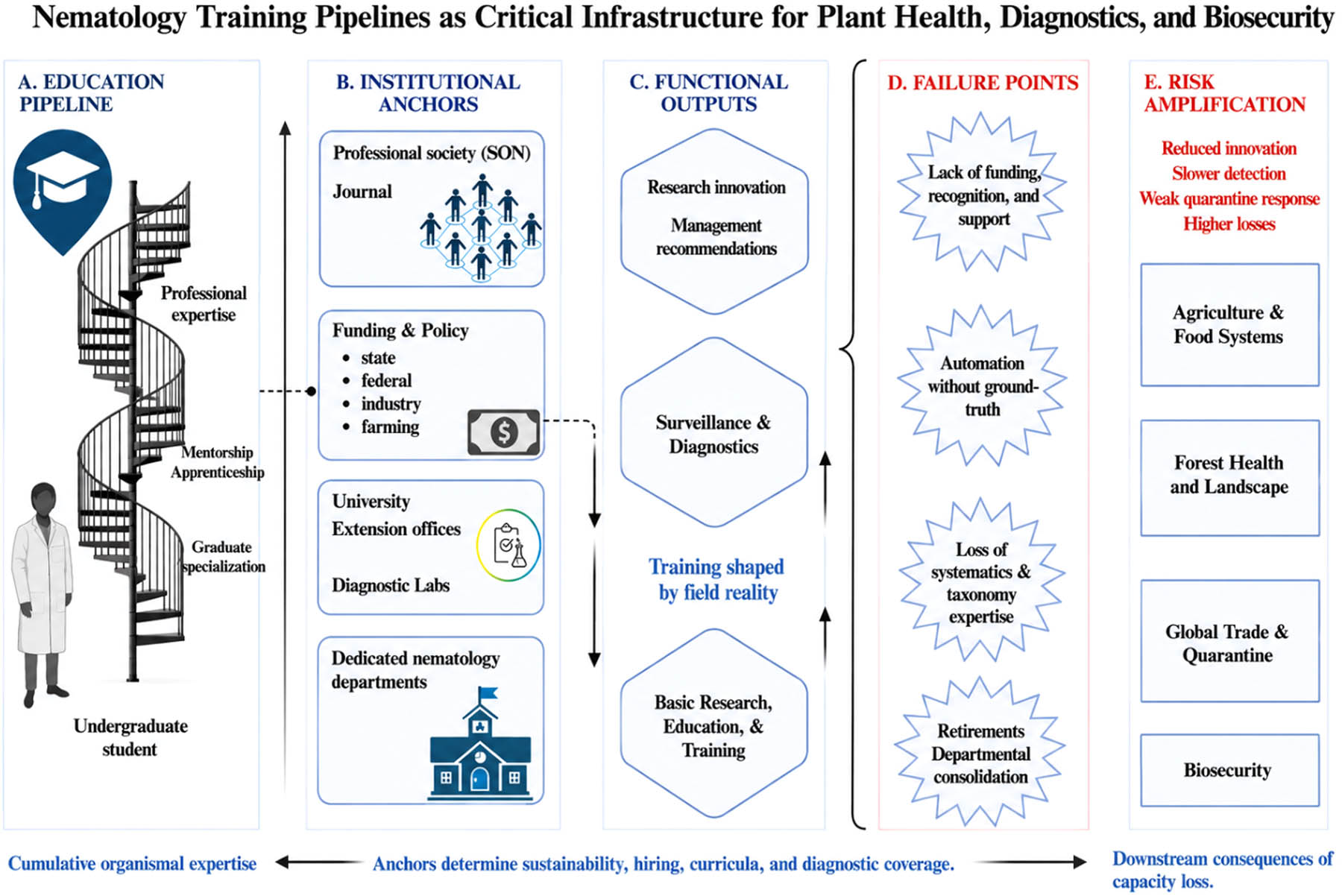
Figure 4
Nematology pipeline conceptual synthesis. How education and training (Panel A), sustained by institutional anchors (Panel B), generate functional agricultural or forest health outputs (Panel C) that reduce risk across agricultural, natural, socioeconomic, and geopolitical systems (Panel E) is illustrated. Failure points (Panel D), including retirements without replacement, departmental consolidation, loss of systematics and taxonomy expertise, automation without ground truth, and inadequate recognition and support, disrupt continuity and amplify vulnerability across all outputs. Panels are vertically aligned to emphasize parallel, interdependent components rather than a strictly linear sequence. (Image created with BioRender.).
Acknowledgements
The co-authors would like to thank the Society of Nematologists for providing membership data information.
Funding information
This study was partially supported by the USDA National Institute of Food and Agriculture (NIFA) Federal Appropriations under project PEN04828 (MK).
Author contributions
C. Kantor and M. Kantor wrote the first draft. J. Eisenback contributed text and edits to the second draft. I. Zasada contributed additional text and data. C. Kantor and M. Kantor curated and analyzed the data. C. Kantor prepared visualizations. All authors conceived the study and revised the final draft.
Conflict of interest statement
Authors state no conflict of interest.
Data availability statement
The data that support the findings of this study are available from the first author upon request.