
Table 1
Golf course sampling site information
| # | Golf course | State | Turfgrass species | Greens sampled | Sampling date |
|---|---|---|---|---|---|
| 1 | Hickory Creek Golf Course | AR | HBa | 9 | April 19, 2023 |
| 2 | Nutters Chapel Golf and Country Club | AR | HB | 9 | April 19, 2023 |
| 3 | Maumelle Country Club | AR | HB | 9 | April 19, 2023 |
| 4 | Texarkana Country Club | TX | HB | 9 | April 21, 2023 |
| 5 | Northridge Country Club | AR | HB | 9 | April 21, 2023 |
| 6 | Isabella Golf Course | AR | CBGb | 9 | April 26, 2023 |
| 7 | Granada Golf Course | AR | CBG | 9 | April 26, 2023 |
| 8 | Ponce de Leon Golf Course | AR | CBG | 9 | April 26, 2023 |
| 9 | DeSoto Golf Course | AR | HB | 9 | April 27, 2023 |
| 10 | Balboa Golf Course | AR | CBG | 9 | April 27, 2023 |
| 11 | Coronado Golf Course | AR | CBG | 9 | April 27, 2023 |
| 12 | Hardscrabble Country Club | AR | CBG | 9 | April 28, 2023 |
| 13 | Magellan Golf Course | AR | HB | 9 | May 24, 2023 |
| 14 | Cortez Golf Course | AR | CBG | 9 | May 24, 2023 |
| 15 | Springdale Country Club | AR | CBG | 9 | June 23, 2023 |
| 16 | Fayetteville Country Club | AR | CBG | 9 | June 26, 2023 |
| 17 | Stonebridge Meadows Golf Club | AR | CBG | 9 | June 26, 2023 |
| 18 | The Alotian Club | AR | CBG | 9 | March 1, 2024 |
| 19 | Blessings Club | AR | CBG | 9 | March 12, 2024 |
| 20 | Shadow Valley Country Club | AR | CBG | 9 | March 18, 2024 |
| 21 | Pinnacle Country Club | AR | CBG | 9 | March 26, 2024 |
| 22 | Pleasant Valley Country Club | AR | HB | 9 | April 2, 2024 |
| 23 | Mystic Creek Golf Club | AR | HB | 9 | July 30, 2024 |
| 24 | Lion’s Club Golf Course | AR | HB | 9 | July 30, 2024 |
| 25 | El Dorado Country Club | AR | HB | 10 | July 30, 2024 |
| 26 | Bayou DeSiard Country Club | LA | HB | 12 | July 31, 2024 |
| 27 | Squire Creek Country Club | LA | HB | 9 | July 31, 2024 |
| 28 | Twins Creek Ranch | LA | HB | 4 | July 31, 2024 |
| 29 | Meadowlake Golf and Country Club | LA | HB | 9 | July 31, 2024 |
| 30 | Conway Country Club | AR | HB | 10 | August 1, 2024 |
| 31 | Rolling Hills Country Club | AR | HB | 10 | August 12, 2024 |
| 32 | Cypress Creek Golf Club | AR | HB | 9 | August 12, 2024 |
| 33 | RidgePointe Country Club | AR | HB | 9 | August 13, 2024 |
| 34 | The Ridges at Village Creek | AR | HB | 9 | August 13, 2024 |
| 35 | Tunica National Golf and Tennis Club | MS | HB | 9 | August 21, 2024 |
| 36 | Kirkwood National Golf Club | MS | HB | 9 | August 21, 2024 |
| 37 | Spring Creek Ranch | TN | HB | 9 | August 22, 2024 |
| 38 | Ridgeway Country Club | TN | HB | 9 | August 22, 2024 |
| 39 | Timber Truss Golf Course | MS | HB | 9 | August 22, 2024 |
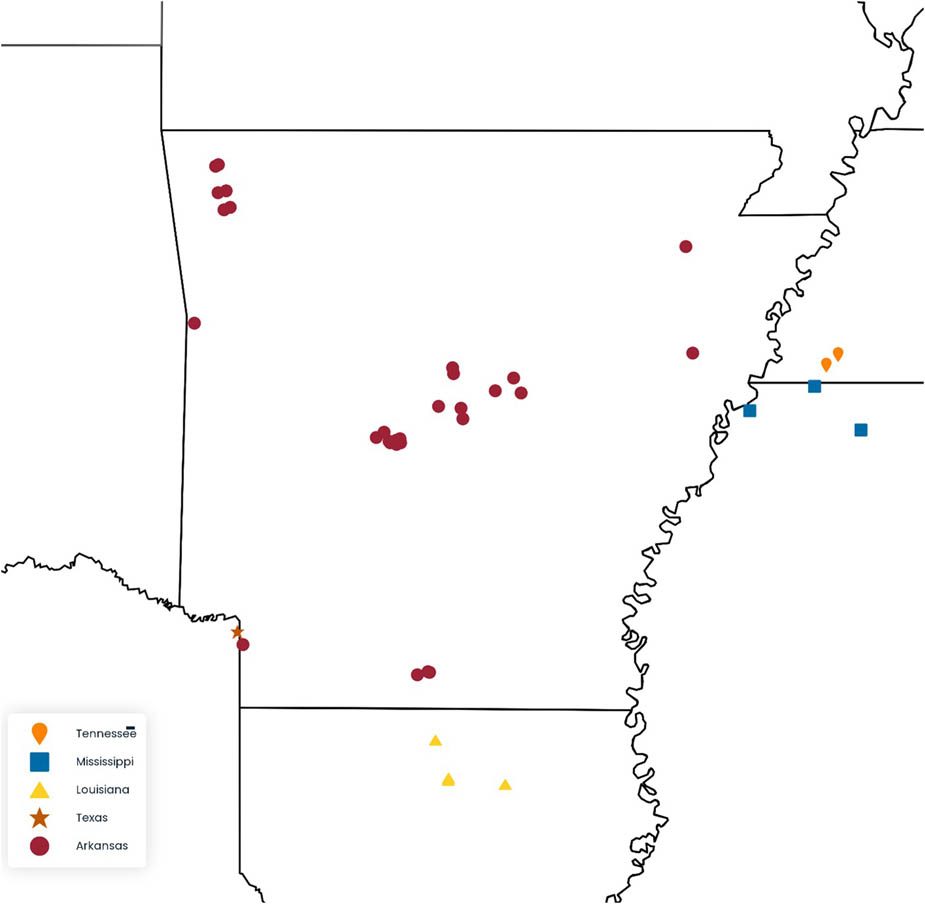
Figure 1
Map of all mid-south United States golf courses sampled for plant-parasitic nematodes and soil parameters from 2023 to 2024.
Table 2
Summary of mean plant-parasitic nematode population densities on golf course putting greens in the Mid-South United States
| # | Nematodes per 100 cc soil | ||||||||||||
|---|---|---|---|---|---|---|---|---|---|---|---|---|---|
| Dagger | Lance | Lesion | Needle | Pin | Ring | Root-knot | Sheath | Sheathoid | Spiral | Sting | Stubby-root | Stunt | |
| 1a | 0 | 9 | 0 | 0 | 0 | 4 | 0 | 0 | 0 | 21 | 0 | 0 | 0 |
| 2 | 0 | 4 | 0 | 0 | 0 | 13 | 43 | 0 | 0 | 0 | 0 | 9 | 4 |
| 3 | 0 | 4 | 0 | 0 | 0 | 32 | 4 | 0 | 0 | 5 | 0 | 0 | 0 |
| 4 | 0 | 0 | 0 | 0 | 0 | 43 | 17 | 0 | 0 | 0 | 0 | 0 | 0 |
| 5 | 0 | 47 | 0 | 0 | 0 | 30 | 0 | 0 | 0 | 17 | 0 | 13 | 0 |
| 6 | 0 | 107 | 13 | 0 | 0 | 8 | 4 | 0 | 90 | 364 | 0 | 34 | 34 |
| 7 | 0 | 1 | 0 | 0 | 4 | 14 | 60 | 0 | 30 | 64 | 0 | 9 | 0 |
| 8 | 0 | 52 | 8 | 0 | 0 | 8 | 0 | 0 | 4 | 330 | 0 | 17 | 0 |
| 9 | 0 | 0 | 4 | 1 | 0 | 0 | 8 | 0 | 8 | 0 | 0 | 0 | 0 |
| 10 | 0 | 128 | 0 | 0 | 0 | 0 | 0 | 0 | 43 | 0 | 0 | 25 | 0 |
| 11 | 0 | 30 | 0 | 0 | 0 | 9 | 0 | 0 | 38 | 0 | 0 | 17 | 4 |
| 12 | 0 | 27 | 13 | 0 | 0 | 0 | 0 | 0 | 0 | 0 | 0 | 0 | 34 |
| 13 | 0 | 9 | 0 | 0 | 0 | 34 | 4 | 0 | 4 | 0 | 0 | 0 | 0 |
| 14 | 0 | 81 | 0 | 0 | 0 | 8 | 0 | 0 | 0 | 30 | 0 | 4 | 0 |
| 15 | 0 | 0 | 0 | 0 | 0 | 43 | 0 | 0 | 0 | 137 | 0 | 0 | 9 |
| 16 | 0 | 78 | 0 | 0 | 0 | 8 | 0 | 0 | 0 | 21 | 0 | 9 | 448 |
| 17 | 0 | 27 | 0 | 0 | 0 | 85 | 0 | 0 | 13 | 73 | 0 | 47 | 0 |
| 18 | 0 | 4 | 0 | 0 | 0 | 51 | 0 | 0 | 0 | 4 | 0 | 0 | 30 |
| 19 | 0 | 0 | 0 | 0 | 0 | 21 | 0 | 0 | 0 | 0 | 0 | 0 | 0 |
| 20 | 0 | 0 | 0 | 0 | 0 | 34 | 0 | 0 | 0 | 43 | 0 | 0 | 51 |
| 21 | 0 | 4 | 0 | 0 | 0 | 51 | 4 | 4 | 0 | 0 | 0 | 0 | 0 |
| 22 | 0 | 0 | 0 | 0 | 0 | 38 | 0 | 34 | 0 | 8 | 5 | 0 | 0 |
| 23 | 0 | 0 | 0 | 0 | 0 | 48 | 26 | 0 | 0 | 4 | 0 | 8 | 0 |
| 24 | 0 | 0 | 0 | 0 | 0 | 17 | 4 | 0 | 0 | 85 | 4 | 13 | 0 |
| 25 | 0 | 0 | 4 | 5 | 0 | 127 | 15 | 62 | 0 | 12 | 0 | 8 | 0 |
| 26 | 0 | 0 | 0 | 0 | 0 | 35 | 0 | 0 | 0 | 0 | 52 | 0 | 0 |
| 27 | 0 | 0 | 51 | 0 | 0 | 179 | 107 | 9 | 0 | 0 | 1 | 13 | 0 |
| 28 | 0 | 0 | 0 | 0 | 0 | 96 | 29 | 0 | 0 | 0 | 0 | 0 | 0 |
| 29 | 0 | 0 | 0 | 21 | 0 | 30 | 4 | 0 | 0 | 267 | 0 | 21 | 0 |
| 30 | 0 | 0 | 0 | 0 | 0 | 81 | 46 | 0 | 0 | 298 | 46 | 11 | 0 |
| 31 | 0 | 0 | 0 | 0 | 0 | 4 | 8 | 0 | 0 | 4 | 17 | 0 | 0 |
| 32 | 0 | 0 | 0 | 1 | 0 | 35 | 4 | 8 | 0 | 0 | 0 | 0 | 0 |
| 33 | 0 | 0 | 0 | 7 | 0 | 427 | 0 | 9 | 0 | 4 | 0 | 13 | 0 |
| 34 | 0 | 0 | 0 | 0 | 0 | 25 | 4 | 0 | 0 | 4 | 0 | 0 | 0 |
| 35 | 4 | 0 | 0 | 0 | 0 | 68 | 0 | 0 | 0 | 21 | 0 | 0 | 0 |
| 36 | 0 | 0 | 0 | 0 | 0 | 13 | 8 | 0 | 0 | 13 | 4 | 0 | 0 |
| 37 | 0 | 0 | 0 | 0 | 0 | 94 | 0 | 0 | 0 | 0 | 0 | 0 | 0 |
| 38 | 0 | 4 | 0 | 0 | 0 | 9 | 4 | 0 | 0 | 351 | 0 | 0 | 0 |
| 39 | 0 | 4 | 0 | 1 | 0 | 26 | 4 | 0 | 0 | 0 | 4 | 0 | 0 |
a Golf course information can be found in Table 1.
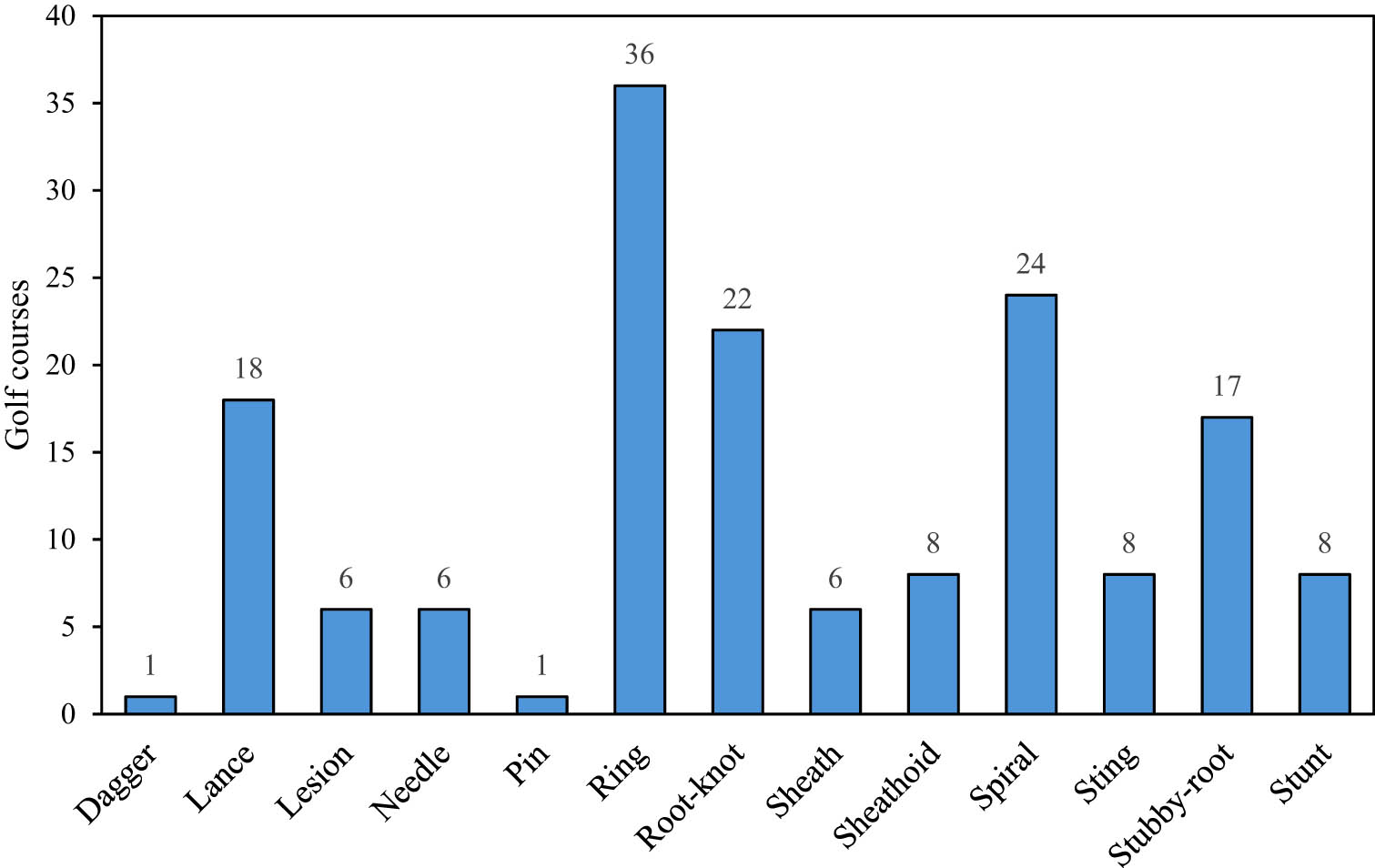
Figure 2
Prevalence of plant-parasitic nematodes (PPN) in mid-south United States golf courses (n = 39). Prevalence represents the number of golf courses where the respective PPN taxon was detected.
Table 3
Population densities and prevalence of plant-parasitic nematode (PPN) species in Mid-South United States golf courses
| Nematode | Nematodes per 100 cc soil | ||
|---|---|---|---|
| Meana | Maxb | Standard error | |
| Dagger | 0c | 38 | 0.11 |
| Lance | 16 | 381 | 2.60 |
| Lesion | 2 | 154 | 0.70 |
| Needle | 1 | 85 | 0.34 |
| Pin | 0c | 38 | 0.11 |
| Ring | 47 | 1,115 | 5.47 |
| Root-knot | 10 | 538 | 2.34 |
| Sheath | 3 | 154 | 0.94 |
| Sheathoid | 6 | 346 | 1.60 |
| Spiral | 57 | 1,662 | 9.62 |
| Sting | 4 | 200 | 1.06 |
| Stubby-root | 7 | 115 | 1.09 |
| Stunt | 16 | 1,130 | 4.95 |
| Any PPN | 169 | 1,700 | 12.93 |
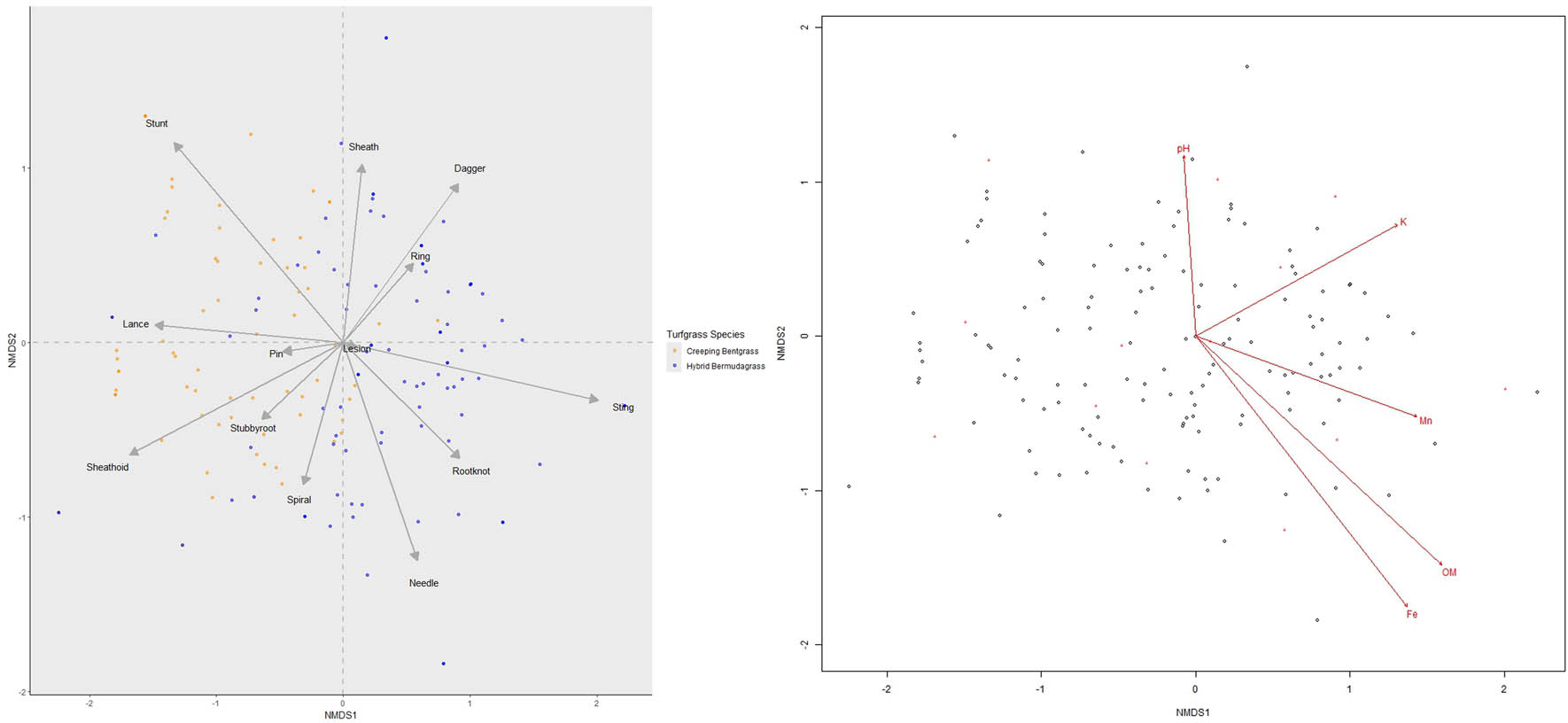
Figure 3
Nonmetric multidimensional scaling (NMDS) ordination of plant-parasitic nematode (PPN) community composition in mid-south United States golf courses. (a) Sample points are colored by turfgrass species. Species vectors (grey arrows) represent associations between individual PPN taxa and community composition gradients. (b) Environmental vectors (red arrows) indicate the direction of increasing values for each significant soil parameter, and vector length reflects the strength of association with PPN community composition.
Table 4
Comparison of plant-parasitic nematode (PPN) densities between creeping bentgrass and hybrid bermudagrass putting greens in Mid-South United States golf courses
| Nematode | Nematodes per 100 cc soil | p-Valuea | |
|---|---|---|---|
| Putting Green Species | |||
| Creeping Bentgrass | Bermudagrass | ||
| Dagger | 0.0 | 0.2 | 0.4560 |
| Lance | 38.6 | 3.2 | <0.0001 |
| Lesion | 2.4 | 2.4 | 0.9688 |
| Needle | 0.0 | 1.4 | 0.0457 |
| Pin | 0.3 | 0.0 | 0.1809 |
| Ring | 24.4 | 59.3 | 0.0021 |
| Root-knot | 4.9 | 13.2 | 0.0869 |
| Sheath | 0.3 | 5.1 | 0.0134 |
| Sheathoid | 15.5 | 0.5 | <0.0001 |
| Spiral | 76.2 | 45.8 | 0.1302 |
| Sting | 0.0 | 6.3 | 0.0042 |
| Stubby-root | 11.6 | 4.4 | 0.0015 |
| Stunt | 43.6 | 0.2 | <0.0001 |
| Total PPN Density | 217.7 | 142.0 | 0.0049 |
Table 5
Pearson’s correlation analysisa between various soil parameters and plant-parasitic nematode (PPN) densities in Mid-South United States golf courses
| Soil parameter | Nematodeb | |||||||||||
|---|---|---|---|---|---|---|---|---|---|---|---|---|
| Lance | Lesion | Needle | Ring | Root-knot | Sheath | Sheathoid | Spiral | Sting | Stubby-root | Stunt | All PPN | |
| pH | 0.116 | −0.275 | 0.305 | −0.171* | −0.400* | 0.000 | −0.407* | −0.238* | 0.050 | −0.109 | −0.044 | −0.214*** |
| Phosphorous | −0.343** | −0.246 | 0.599* | 0.057 | 0.003 | 0.304 | −0.301 | 0.149 | 0.307 | −0.039 | −0.060 | 0.032 |
| Potassium | −0.173 | 0.086 | 0.202 | 0.075 | 0.030 | 0.272 | −0.189 | −0.071 | 0.005 | 0.106 | −0.321 | −0.163** |
| Calcium | −0.300* | −0.257 | 0.553* | −0.111 | −0.288 | 0.404 | −0.412* | −0.151 | 0.203 | 0.092 | 0.085 | −0.081 |
| Magnesium | −0.211 | −0.151 | 0.522 | −0.012 | −0.140 | 0.247 | −0.406* | −0.232* | −0.089 | −0.115 | 0.079 | −0.159** |
| Sulfur | −0.336* | 0.0091 | −0.240 | 0.076 | −0.026 | 0.247 | −0.130 | 0.127 | −0.141 | −0.148 | −0.280 | −0.107 |
| Sodium | 0.009 | −0.171 | 0.563* | −0.014 | −0.160 | 0.152 | −0.225 | −0.132 | −0.090 | 0.027 | 0.598*** | 0.076 |
| Iron | −0.232 | 0.102 | 0.465 | 0.089 | 0.013 | 0.268 | −0.375 | 0.151 | 0.019 | −0.187 | −0.236 | 0.005 |
| Manganese | −0.135 | −0.133 | −0.226 | 0.004 | 0.043 | 0.063 | −0.030 | 0.089 | 0.415* | 0.054 | 0.116 | 0.050 |
| Zinc | −0.249 | 0.208 | 0.273 | −0.005 | 0.071 | 0.226 | 0.108 | −0.022 | 0.145 | 0.200 | 0.220 | 0.089 |
| Copper | −0.277* | 0.079 | 0.307 | 0.020 | 0.113 | 0.063 | −0.140 | 0.017 | 0.214 | 0.235 | −0.109 | 0.067 |
| Boron | 0.076 | −0.158 | 0.329 | −0.052 | −0.321* | 0.228 | −0.271 | 0.081 | −0.091 | 0.032 | 0.161 | 0.026 |
| Organic Matter | −0.156 | 0.164 | 0.189 | 0.056 | 0.125 | 0.146 | 0.038 | 0.073 | 0.328 | 0.043 | 0.102 | −0.002 |
Table 6
Comparison of various soil parameters between creeping bentgrass and hybrid bermudagrass putting greens in Mid-South United States golf courses
| Soil parameter | Unit | Putting green species | p-valuea | |
|---|---|---|---|---|
| Creeping Bentgrass | Bermudagrass | |||
| Boron | mg kg-1 | 0.3 | 0.3 | 0.7447 |
| Calcium | mg kg-1 | 323.5 | 279.6 | 0.0100 |
| Copper | mg kg-1 | 2.0 | 1.8 | 0.4992 |
| Iron | mg kg-1 | 56.2 | 106.8 | <0.0001 |
| Magnesium | mg kg-1 | 30.7 | 42.3 | <0.0001 |
| Manganese | mg kg-1 | 32.3 | 41.2 | 0.0015 |
| Phosphorus | mg kg-1 | 31.9 | 42.5 | <0.0001 |
| Potassium | mg kg-1 | 52.7 | 84.8 | <0.0001 |
| Sodium | mg kg-1 | 9.9 | 11.6 | 0.3013 |
| Sulfur | mg kg-1 | 10.0 | 13.8 | 0.0002 |
| Zinc | mg kg-1 | 7.2 | 8.4 | 0.0917 |
| pH | N/Ab | 5.8 | 5.7 | 0.1008 |
| Organic Matter | % | 1.0 | 1.7 | <0.0001 |
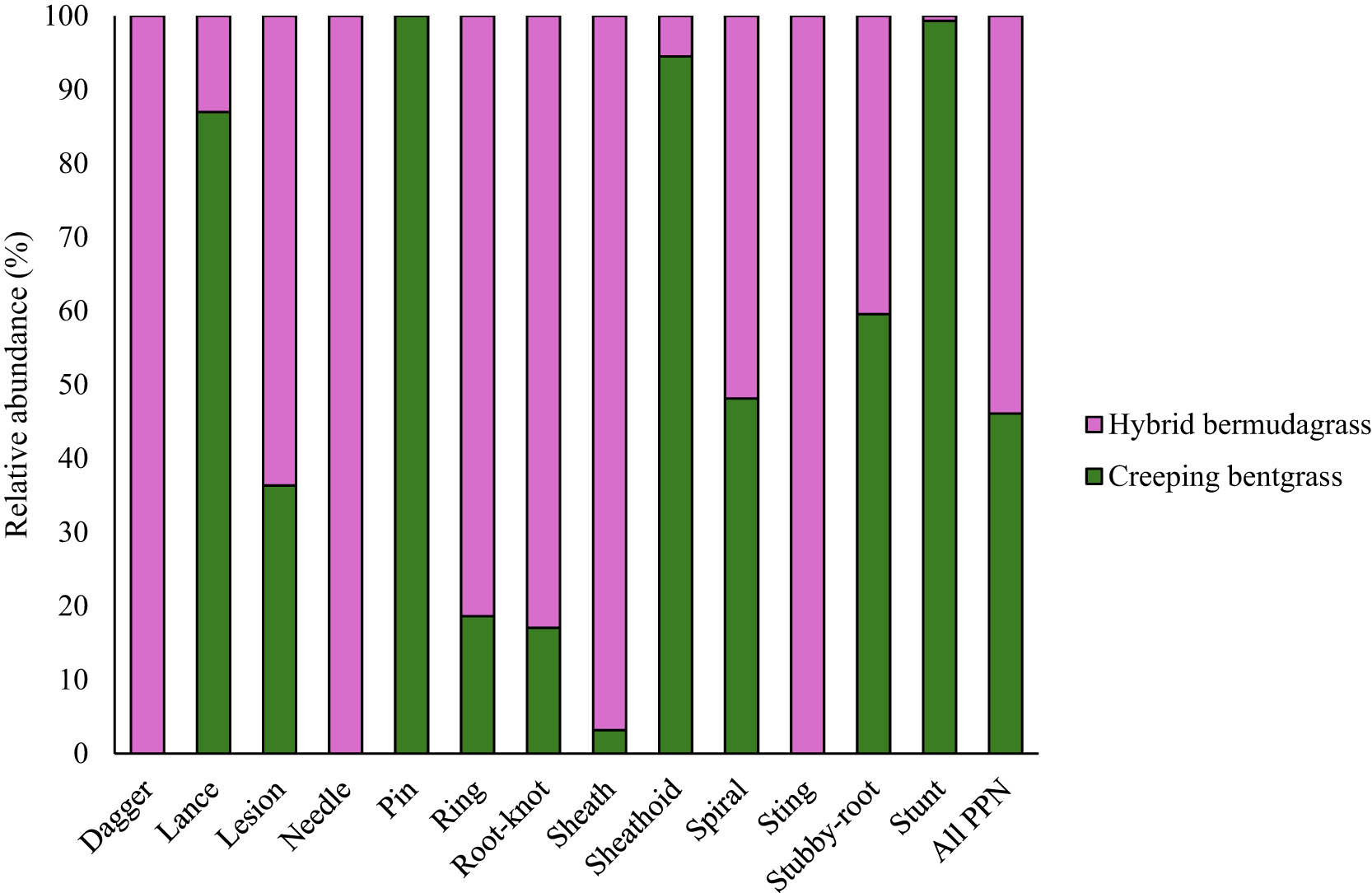
Figure 4
Relative abundance of plant-parasitic nematodes (PPN) in hybrid bermudagrass (n = 226) and creeping bentgrass (n = 126) putting greens in mid-south United States golf courses. Relative abundance represents the distribution of each PPN by turfgrass species.