
Plant-parasitic nematodes (PPNs) cause significant damage to a variety of turf and ornamental crops (Crow et al., 2023). PPNs use a stylet, a needlelike mouthpart, to pierce plant roots externally (ectoparasitic) or internally (endoparasitic) (Lambert & Bekal, 2002). In turfgrass, symptoms of PPN damage are not always present, even if significant population densities of PPN are detected in the soil. Symptom development is influenced by turfgrass health, time of year, environmental conditions, and PPN species and population densities (Crow et al., 2023). Symptoms of PPN feeding can include foliar chlorosis, wilting, thinning, and root dieback (Yu et al., 1998; Shahoveisi & Waldo, 2024); however, it is often difficult to link these symptoms to PPN feeding as symptoms are nondiscrete and exacerbated by stressful environmental conditions such as heat, drought, traffic, and other abiotic and biotic stressors (Jordan & Mitkowski, 2006).
Several genera of PPN have been identified in turfgrass worldwide. In China, spiral (Helicotylenchus spp.), stubby-root (Paratrichodorus spp.), lance (Hoplolaimus spp.), root-knot (Meloidogyne spp.), sheathoid (Hemicriconemoides spp.), and ring (Mesocriconema spp.) nematodes were most commonly identified (Dong et al., 2022). Additionally, lesion (Pratylenchus spp.), cyst (Punctodera spp. and Heterodera spp.), pin (Paratylenchus spp.), and stunt (Tylenchorhynchus spp.) nematodes were detected in Belgian turfgrass (Vandenbossche et al., 2011). Many PPN species have also been documented in Canada (Yu et al., 1998) and Korea (Mwamula & Lee, 2021). In the United States, several regional sampling studies from the Northeast (Murdoch et al., 1978; Jordan & Mitkowski, 2006), Mid-Atlantic (Zeng et al., 2012; Shahoveisi & Waldo, 2024), Midwest (Todd & Tisserat, 1990; McCurdy et al., 2024; Walker et al., 2002), Pacific Northwest (Braithwaite et al., 2025), and Southeast (Sikora et al., 2001; Hixson, 2003) have been conducted to better understand PPN occurrence within golf course putting greens. While many PPN genera were present in these sampled regions, their relative abundance varied. In addition, PPN genera differ in their damage thresholds, with some, such as sting nematode (Belonolaimus spp.), causing significant damage to bermudagrass (Cynodon spp.) at relatively low densities (<25 nematodes/100 cc soil) (Galle, 2019; Crow, 2024). Other PPNs, like ring and spiral, have estimated damage thresholds >1,000 nematodes/100 cc soil (Buckley et al., 2010; Wick, 2010).
Many soil physical and chemical properties have been examined for their effect on PPN populations (Walker et al., 2002; Widmer et al., 2002). Greater PPN densities are generally associated with coarser soil textures, although this can be species-dependent and influenced by an array of other edaphic factors including moisture, pH, and organic matter (Jones et al., 1969; Hassink et al., 1993; Neher, 2010). Because many golf course putting greens utilize sand-based rootzones, Walker et al. (2002) examined the effect of sand particle size distribution on PPN populations but reported limited relationships. In addition, the authors observed positive relationships between PPN populations densities and plant-available K, soil NO3–N, and organic matter. Limited information exists on the relationship between turfgrass PPN population densities and other soil nutrient concentrations, but this information could be useful for leveraging nutrient management decisions based on presence and density of PPN.
There are few effective chemical control options for turfgrass PPN, and their efficacy can be highly dependent on PPN species (Crow, 2024). Therefore, an accurate representation of PPN populations within a state or region would be beneficial to turfgrass managers. Many nematode sampling studies have been conducted around the United States, but no PPN population surveys on golf course putting greens have been conducted in Arkansas and much of the Mid-South region of the US (Louisiana, Mississippi, Tennessee, and Texas). The first objective of this study was to identify the PPN taxa present in golf course putting green soils throughout Arkansas and the surrounding states. The second objective of this study was to evaluate the relationship between pH, organic matter, and soil nutrients on PPN densities in golf course putting green soils throughout the Mid-South region of the United States.
1. Materials and methods
From 2023 to 2024, a total of 39 golf courses and 352 putting greens across Arkansas and four surrounding states were sampled for nematodes and various soil parameters. Some golf courses were selected based on their location, while other golf courses specifically requested the researchers sample due to suspected nematode issues. Twenty-nine courses were in Arkansas, and the remaining courses were in Louisiana (4), Mississippi (3), Tennessee (2), and Texas (1) (Table 1, Figure 1). In 2023, 17 courses were sampled from April 19 to June 26, and in 2024, 22 courses were sampled from March 1 to August 22. Putting greens were composed of either creeping bentgrass (Agrostis stolonifera L.) (n = 126) or hybrid bermudagrass (Cynodon dactylon x. C. transvaalensis Burtt Davy) (n = 226). At each golf course, 4–12 different putting greens were sampled using a soil probe (1.9 cm), and 10–15 subsamples at a 13-cm depth were taken per green in a randomized pattern. A total of nine putting greens were sampled at most 18-hole golf courses in this survey, which accounts for half of the holes. However, fewer samples were collected at some courses, such as nine-hole golf courses, and more samples were collected at certain courses, often at the request of the golf course superintendent. With variations in putting green size, the number of greens sampled, and with multiple people sampling at once, a range of 10–15 cores per green was determined rather than a single number. Turfgrass thatch and verdure were kept intact with the sampling plugs. Subsamples were homogenized into one composite sample. The composite sample was then separated into half: one half was used for nematode extraction and counting and the other half was used for soil analysis.
Table 1
Golf course sampling site information
| # | Golf course | State | Turfgrass species | Greens sampled | Sampling date |
|---|---|---|---|---|---|
| 1 | Hickory Creek Golf Course | AR | HBa | 9 | April 19, 2023 |
| 2 | Nutters Chapel Golf and Country Club | AR | HB | 9 | April 19, 2023 |
| 3 | Maumelle Country Club | AR | HB | 9 | April 19, 2023 |
| 4 | Texarkana Country Club | TX | HB | 9 | April 21, 2023 |
| 5 | Northridge Country Club | AR | HB | 9 | April 21, 2023 |
| 6 | Isabella Golf Course | AR | CBGb | 9 | April 26, 2023 |
| 7 | Granada Golf Course | AR | CBG | 9 | April 26, 2023 |
| 8 | Ponce de Leon Golf Course | AR | CBG | 9 | April 26, 2023 |
| 9 | DeSoto Golf Course | AR | HB | 9 | April 27, 2023 |
| 10 | Balboa Golf Course | AR | CBG | 9 | April 27, 2023 |
| 11 | Coronado Golf Course | AR | CBG | 9 | April 27, 2023 |
| 12 | Hardscrabble Country Club | AR | CBG | 9 | April 28, 2023 |
| 13 | Magellan Golf Course | AR | HB | 9 | May 24, 2023 |
| 14 | Cortez Golf Course | AR | CBG | 9 | May 24, 2023 |
| 15 | Springdale Country Club | AR | CBG | 9 | June 23, 2023 |
| 16 | Fayetteville Country Club | AR | CBG | 9 | June 26, 2023 |
| 17 | Stonebridge Meadows Golf Club | AR | CBG | 9 | June 26, 2023 |
| 18 | The Alotian Club | AR | CBG | 9 | March 1, 2024 |
| 19 | Blessings Club | AR | CBG | 9 | March 12, 2024 |
| 20 | Shadow Valley Country Club | AR | CBG | 9 | March 18, 2024 |
| 21 | Pinnacle Country Club | AR | CBG | 9 | March 26, 2024 |
| 22 | Pleasant Valley Country Club | AR | HB | 9 | April 2, 2024 |
| 23 | Mystic Creek Golf Club | AR | HB | 9 | July 30, 2024 |
| 24 | Lion’s Club Golf Course | AR | HB | 9 | July 30, 2024 |
| 25 | El Dorado Country Club | AR | HB | 10 | July 30, 2024 |
| 26 | Bayou DeSiard Country Club | LA | HB | 12 | July 31, 2024 |
| 27 | Squire Creek Country Club | LA | HB | 9 | July 31, 2024 |
| 28 | Twins Creek Ranch | LA | HB | 4 | July 31, 2024 |
| 29 | Meadowlake Golf and Country Club | LA | HB | 9 | July 31, 2024 |
| 30 | Conway Country Club | AR | HB | 10 | August 1, 2024 |
| 31 | Rolling Hills Country Club | AR | HB | 10 | August 12, 2024 |
| 32 | Cypress Creek Golf Club | AR | HB | 9 | August 12, 2024 |
| 33 | RidgePointe Country Club | AR | HB | 9 | August 13, 2024 |
| 34 | The Ridges at Village Creek | AR | HB | 9 | August 13, 2024 |
| 35 | Tunica National Golf and Tennis Club | MS | HB | 9 | August 21, 2024 |
| 36 | Kirkwood National Golf Club | MS | HB | 9 | August 21, 2024 |
| 37 | Spring Creek Ranch | TN | HB | 9 | August 22, 2024 |
| 38 | Ridgeway Country Club | TN | HB | 9 | August 22, 2024 |
| 39 | Timber Truss Golf Course | MS | HB | 9 | August 22, 2024 |
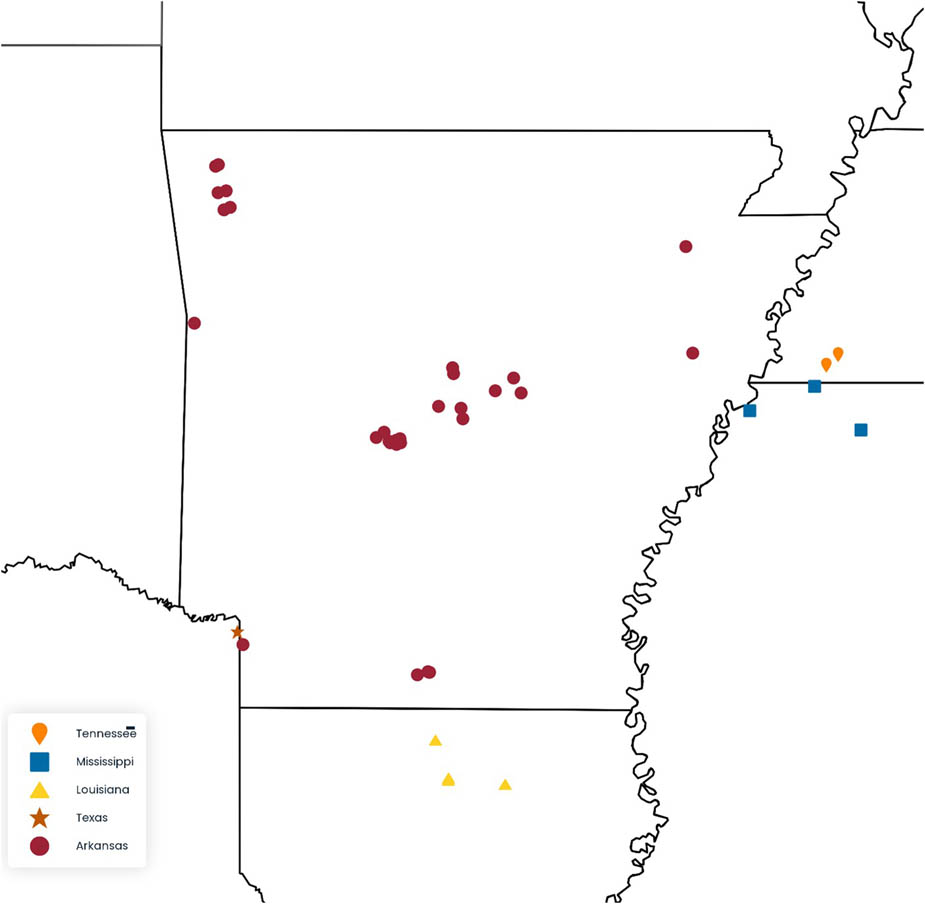
Figure 1
Map of all mid-south United States golf courses sampled for plant-parasitic nematodes and soil parameters from 2023 to 2024.
Nematode samples were sent to the Arkansas Nematode Diagnostic Laboratory in Hope, AR for nematode identification and quantification. Nematodes were extracted using a semi-automatic elutriator in combination with the centrifugal floatation method. The elutriator operated for 6 min, using 100 mL of soil per sample. Prior to extraction, a 60-mesh sieve was placed on top of each funnel to remove coarse debris, and a 400-mesh sieve was positioned beneath each funnel to capture the nematodes. The contents collected on the 400-mesh sieves were washed into centrifuge tubes, ensuring equal volumes of water across all samples. Tubes were centrifuged at 1,500 rpm for 6 min. After centrifugation, the supernatant was carefully decanted, and the remaining pellet was resuspended in a sucrose (sugar) flotation solution, thoroughly mixed, and centrifuged again at 1,500 rpm for 1 min. After the second centrifugation event, the sugar suspension from each tube was poured onto a 500-mesh sieve. The sieve was rinsed thoroughly with tap water to remove residual sugar, and the nematodes were collected into plastic bottles for counting and identification to the genus level.
Soil analysis was conducted at the Agriculture Diagnostic Laboratory in Fayetteville, AR. Soil parameters tested included pH, organic matter, phosphorus, potassium, calcium, magnesium, sulfur, sodium, iron, manganese, zinc, copper, and boron. Organic matter percentage was calculated using loss on ignition by muffle furnace (Zhang & Wang, 2014). Soil samples were oven dried at 120°C to remove moisture, followed by combustion at 360°C to remove organic matter. Nutrients were extracted using the Mehlich 3 extraction method (1:10 by weight) by Spectro ARCOS III DSOI ICP (SPECTRO Analytical Instruments, Kleve, Germany).
Data were analyzed using RStudio software (Posit team, 2025). Permutational multivariate analysis of variance (PerMANOVA; Anderson, 2001) was conducted using the “adonis2” function in the “vegan” package (Oksanen et al., 2022) to evaluate relationships between PPN population densities, soil parameters, and turfgrass species. Eight samples had missing soil data and were omitted from analysis. An additional 67 samples containing no nematode taxa were removed from analysis, resulting in 277 total observations. Bray-Curtis dissimilarities were calculated from nematode abundance data, and significance was assessed using 999 permutations. Nonmetric multidimensional scaling (NMDS) ordination based on Bray-Curtis dissimilarities was conducted in two dimensions following a Hellinger transformation of nematode abundance data. The NMDS stress was calculated to measure how well ordination distances compare to observed dissimilarities among samples. Stress values below 0.2 represent meaningful interpretation of community structure (McCune & Grace, 2002). Pearson’s correlations were performed between log10-transformed nematode densities and all soil parameters. The log transformation effectively removed all zero values, thereby reducing skewness and improving accuracy. Separate one-way analyses of variance (p < 0.05) were conducted for each response variable using the predictor variable turfgrass species (creeping bentgrass and hybrid bermudagrass) and the response variables of non-transformed nematode densities and soil parameter values.
2. Results
A total of 13 taxa were identified across all golf course greens (Table 2). Ring nematode was present in 92% (36/39) of golf courses, followed by spiral (67%), root-knot (58%), lance (46%), and stubby-root (44%) nematodes (Figure 2). Spiral and ring nematodes had the greatest population densities at 57 and 47 nematodes/100 cc soil, respectively (Table 3). Stunt nematode was identified at eight sites, but the majority were present at one location in Fayetteville, AR. Other taxa identified included sting, needle (Longidorus spp.), sheath (Hemicycliophora spp.), lesion, sheathoid, pin, and dagger (Xiphenema spp.) nematodes. Sting nematode, which had not been previously reported in Arkansas or Mississippi turfgrass, was identified at four locations in Arkansas and twice in Mississippi. Additionally, sting nematode was identified twice in Louisiana. Visible symptoms of sting nematode damage were present at two separate locations (Arkansas and Louisiana) due to exceedingly high population densities (46 and 52 nematodes/100 cc soil, respectively).
Table 2
Summary of mean plant-parasitic nematode population densities on golf course putting greens in the Mid-South United States
| # | Nematodes per 100 cc soil | ||||||||||||
|---|---|---|---|---|---|---|---|---|---|---|---|---|---|
| Dagger | Lance | Lesion | Needle | Pin | Ring | Root-knot | Sheath | Sheathoid | Spiral | Sting | Stubby-root | Stunt | |
| 1a | 0 | 9 | 0 | 0 | 0 | 4 | 0 | 0 | 0 | 21 | 0 | 0 | 0 |
| 2 | 0 | 4 | 0 | 0 | 0 | 13 | 43 | 0 | 0 | 0 | 0 | 9 | 4 |
| 3 | 0 | 4 | 0 | 0 | 0 | 32 | 4 | 0 | 0 | 5 | 0 | 0 | 0 |
| 4 | 0 | 0 | 0 | 0 | 0 | 43 | 17 | 0 | 0 | 0 | 0 | 0 | 0 |
| 5 | 0 | 47 | 0 | 0 | 0 | 30 | 0 | 0 | 0 | 17 | 0 | 13 | 0 |
| 6 | 0 | 107 | 13 | 0 | 0 | 8 | 4 | 0 | 90 | 364 | 0 | 34 | 34 |
| 7 | 0 | 1 | 0 | 0 | 4 | 14 | 60 | 0 | 30 | 64 | 0 | 9 | 0 |
| 8 | 0 | 52 | 8 | 0 | 0 | 8 | 0 | 0 | 4 | 330 | 0 | 17 | 0 |
| 9 | 0 | 0 | 4 | 1 | 0 | 0 | 8 | 0 | 8 | 0 | 0 | 0 | 0 |
| 10 | 0 | 128 | 0 | 0 | 0 | 0 | 0 | 0 | 43 | 0 | 0 | 25 | 0 |
| 11 | 0 | 30 | 0 | 0 | 0 | 9 | 0 | 0 | 38 | 0 | 0 | 17 | 4 |
| 12 | 0 | 27 | 13 | 0 | 0 | 0 | 0 | 0 | 0 | 0 | 0 | 0 | 34 |
| 13 | 0 | 9 | 0 | 0 | 0 | 34 | 4 | 0 | 4 | 0 | 0 | 0 | 0 |
| 14 | 0 | 81 | 0 | 0 | 0 | 8 | 0 | 0 | 0 | 30 | 0 | 4 | 0 |
| 15 | 0 | 0 | 0 | 0 | 0 | 43 | 0 | 0 | 0 | 137 | 0 | 0 | 9 |
| 16 | 0 | 78 | 0 | 0 | 0 | 8 | 0 | 0 | 0 | 21 | 0 | 9 | 448 |
| 17 | 0 | 27 | 0 | 0 | 0 | 85 | 0 | 0 | 13 | 73 | 0 | 47 | 0 |
| 18 | 0 | 4 | 0 | 0 | 0 | 51 | 0 | 0 | 0 | 4 | 0 | 0 | 30 |
| 19 | 0 | 0 | 0 | 0 | 0 | 21 | 0 | 0 | 0 | 0 | 0 | 0 | 0 |
| 20 | 0 | 0 | 0 | 0 | 0 | 34 | 0 | 0 | 0 | 43 | 0 | 0 | 51 |
| 21 | 0 | 4 | 0 | 0 | 0 | 51 | 4 | 4 | 0 | 0 | 0 | 0 | 0 |
| 22 | 0 | 0 | 0 | 0 | 0 | 38 | 0 | 34 | 0 | 8 | 5 | 0 | 0 |
| 23 | 0 | 0 | 0 | 0 | 0 | 48 | 26 | 0 | 0 | 4 | 0 | 8 | 0 |
| 24 | 0 | 0 | 0 | 0 | 0 | 17 | 4 | 0 | 0 | 85 | 4 | 13 | 0 |
| 25 | 0 | 0 | 4 | 5 | 0 | 127 | 15 | 62 | 0 | 12 | 0 | 8 | 0 |
| 26 | 0 | 0 | 0 | 0 | 0 | 35 | 0 | 0 | 0 | 0 | 52 | 0 | 0 |
| 27 | 0 | 0 | 51 | 0 | 0 | 179 | 107 | 9 | 0 | 0 | 1 | 13 | 0 |
| 28 | 0 | 0 | 0 | 0 | 0 | 96 | 29 | 0 | 0 | 0 | 0 | 0 | 0 |
| 29 | 0 | 0 | 0 | 21 | 0 | 30 | 4 | 0 | 0 | 267 | 0 | 21 | 0 |
| 30 | 0 | 0 | 0 | 0 | 0 | 81 | 46 | 0 | 0 | 298 | 46 | 11 | 0 |
| 31 | 0 | 0 | 0 | 0 | 0 | 4 | 8 | 0 | 0 | 4 | 17 | 0 | 0 |
| 32 | 0 | 0 | 0 | 1 | 0 | 35 | 4 | 8 | 0 | 0 | 0 | 0 | 0 |
| 33 | 0 | 0 | 0 | 7 | 0 | 427 | 0 | 9 | 0 | 4 | 0 | 13 | 0 |
| 34 | 0 | 0 | 0 | 0 | 0 | 25 | 4 | 0 | 0 | 4 | 0 | 0 | 0 |
| 35 | 4 | 0 | 0 | 0 | 0 | 68 | 0 | 0 | 0 | 21 | 0 | 0 | 0 |
| 36 | 0 | 0 | 0 | 0 | 0 | 13 | 8 | 0 | 0 | 13 | 4 | 0 | 0 |
| 37 | 0 | 0 | 0 | 0 | 0 | 94 | 0 | 0 | 0 | 0 | 0 | 0 | 0 |
| 38 | 0 | 4 | 0 | 0 | 0 | 9 | 4 | 0 | 0 | 351 | 0 | 0 | 0 |
| 39 | 0 | 4 | 0 | 1 | 0 | 26 | 4 | 0 | 0 | 0 | 4 | 0 | 0 |
a Golf course information can be found in Table 1.
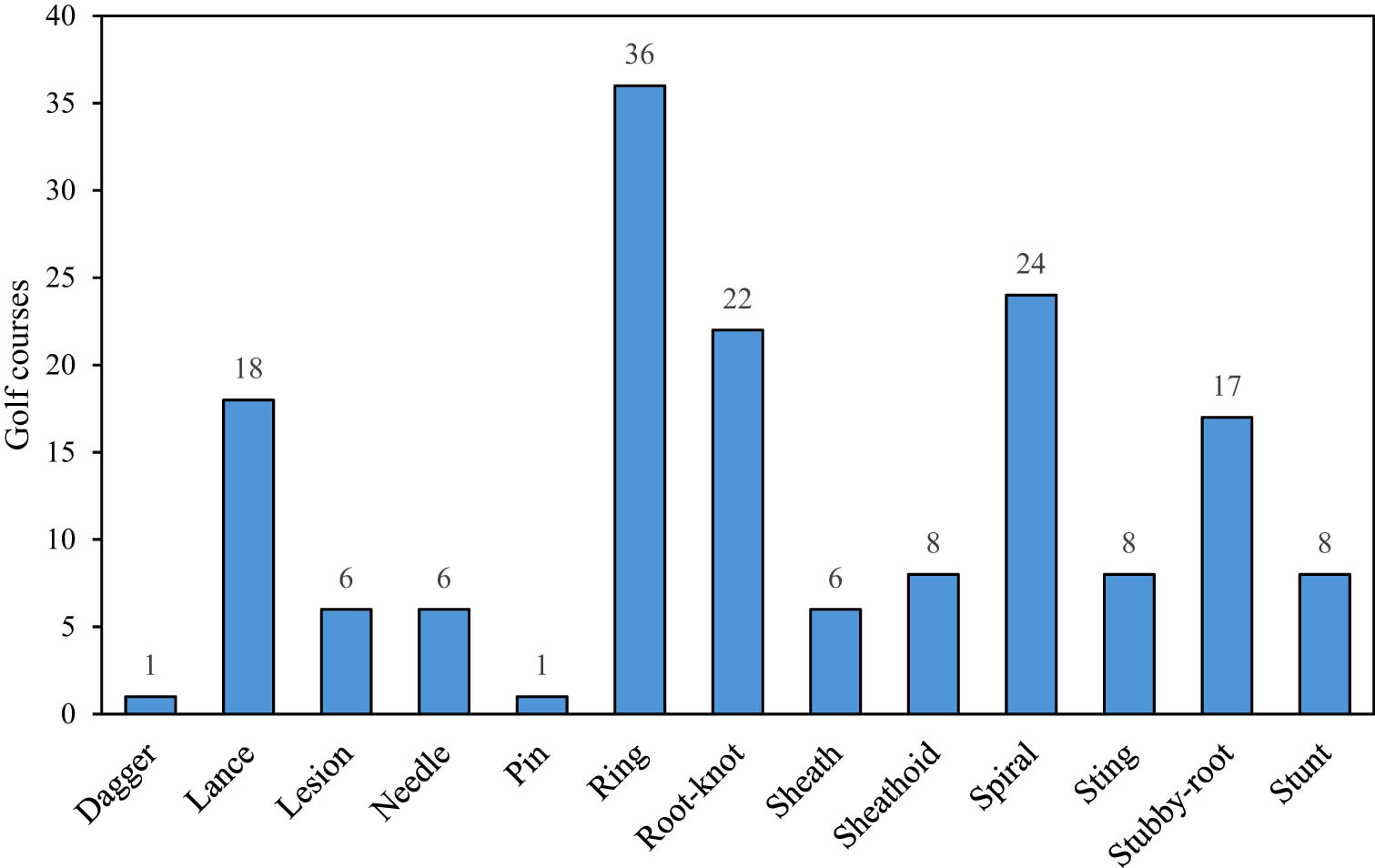
Figure 2
Prevalence of plant-parasitic nematodes (PPN) in mid-south United States golf courses (n = 39). Prevalence represents the number of golf courses where the respective PPN taxon was detected.
Table 3
Population densities and prevalence of plant-parasitic nematode (PPN) species in Mid-South United States golf courses
| Nematode | Nematodes per 100 cc soil | ||
|---|---|---|---|
| Meana | Maxb | Standard error | |
| Dagger | 0c | 38 | 0.11 |
| Lance | 16 | 381 | 2.60 |
| Lesion | 2 | 154 | 0.70 |
| Needle | 1 | 85 | 0.34 |
| Pin | 0c | 38 | 0.11 |
| Ring | 47 | 1,115 | 5.47 |
| Root-knot | 10 | 538 | 2.34 |
| Sheath | 3 | 154 | 0.94 |
| Sheathoid | 6 | 346 | 1.60 |
| Spiral | 57 | 1,662 | 9.62 |
| Sting | 4 | 200 | 1.06 |
| Stubby-root | 7 | 115 | 1.09 |
| Stunt | 16 | 1,130 | 4.95 |
| Any PPN | 169 | 1,700 | 12.93 |
PerMANOVA revealed a significant effect of soil parameters on PPN community composition (R 2 = 0.105, pseudo-F = 2.37, p < 0.001). Marginal PerMANOVA tests indicated that pH (R 2 = 0.016, p = 0.001) explained the greatest unique proportion of variation in community composition. Other significant predictors included P, K, Na, Fe, and B (p < 0.05). Separately, PPN community composition differed significantly between turfgrass species (R 2 = 0.051, pseudo-F = 14.85, p < 0.001). Homogeneity of multivariate dispersion tests indicated that dispersion did not significantly differ between turfgrass species (F = 2.70, p = 0.094).
Two-dimensional NMDS ordination produced a good representation of PPN community structure with a stress value of 0.098 (Figure 3a). Samples were colored by turfgrass species, and species vectors were overlaid on NMDS ordination to illustrate associations between individual PPN taxa and community structure gradients. Soil parameters that significantly correlated with NMDS community structure were Fe (R 2 = 0.086, p < 0.001), OM (R 2 = 0.088, p < 0.001), K (R 2 = 0.037, p < 0.005), Mn (R 2 = 0.036, p < 0.009), and pH (R 2 = 0.023, p < 0.042) (Figure 3b).
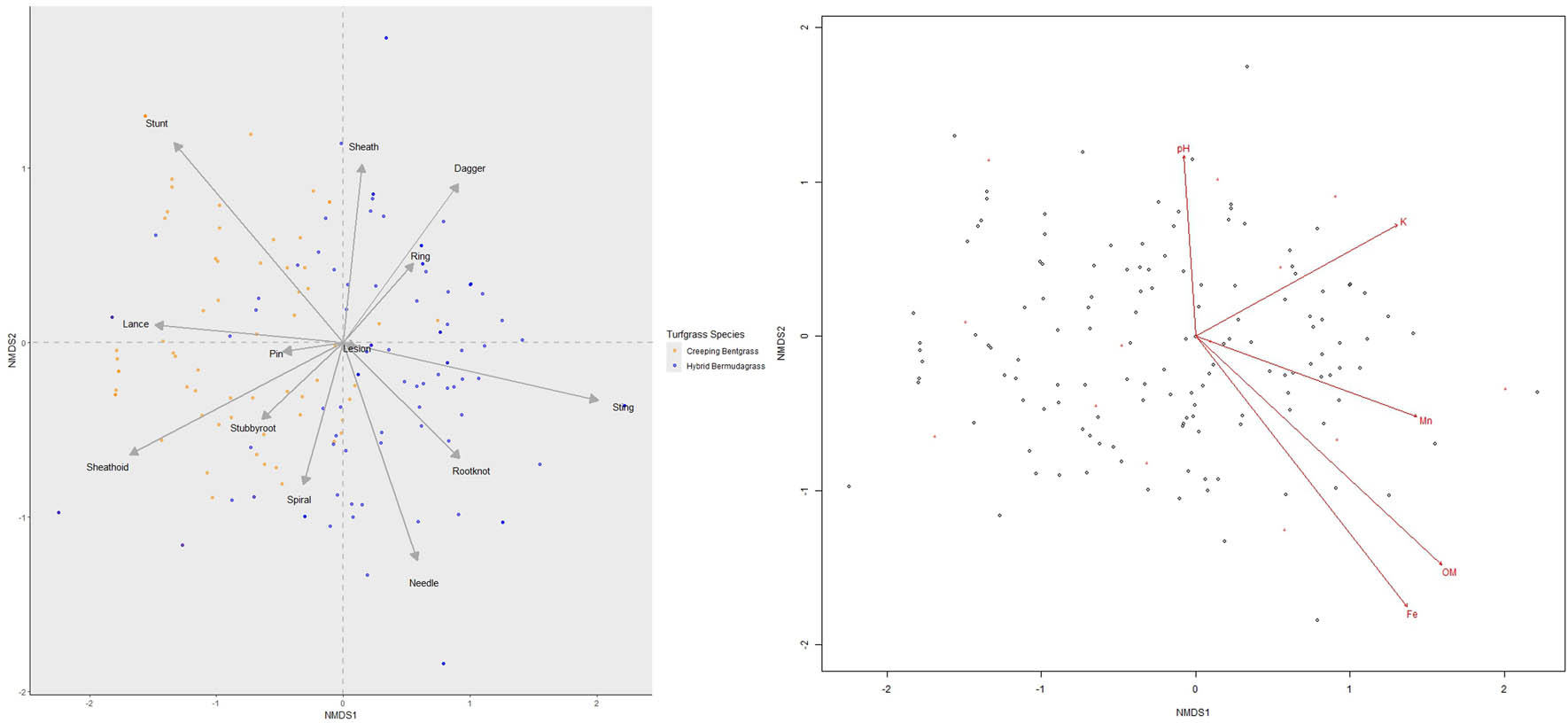
Figure 3
Nonmetric multidimensional scaling (NMDS) ordination of plant-parasitic nematode (PPN) community composition in mid-south United States golf courses. (a) Sample points are colored by turfgrass species. Species vectors (grey arrows) represent associations between individual PPN taxa and community composition gradients. (b) Environmental vectors (red arrows) indicate the direction of increasing values for each significant soil parameter, and vector length reflects the strength of association with PPN community composition.
Total PPN density was greater in creeping bentgrass (218 nematodes/100 cc soil) than hybrid bermudagrass greens (142 nematodes/100 cc soil) (Table 4). Lance nematode density was much greater in creeping bentgrass greens (39 nematodes/100 cc soil) than in hybrid bermudagrass greens (3 nematodes/100 cc soil). Ring nematode density was greater in hybrid bermudagrass (59 nematodes/100 cc soil) compared to creeping bentgrass greens (24 nematodes/100 cc soil). Sting nematode was only detected in hybrid bermudagrass greens, while stunt nematode was detected almost exclusively in creeping bentgrass greens (99.3%).
Table 4
Comparison of plant-parasitic nematode (PPN) densities between creeping bentgrass and hybrid bermudagrass putting greens in Mid-South United States golf courses
| Nematode | Nematodes per 100 cc soil | p-Valuea | |
|---|---|---|---|
| Putting Green Species | |||
| Creeping Bentgrass | Bermudagrass | ||
| Dagger | 0.0 | 0.2 | 0.4560 |
| Lance | 38.6 | 3.2 | <0.0001 |
| Lesion | 2.4 | 2.4 | 0.9688 |
| Needle | 0.0 | 1.4 | 0.0457 |
| Pin | 0.3 | 0.0 | 0.1809 |
| Ring | 24.4 | 59.3 | 0.0021 |
| Root-knot | 4.9 | 13.2 | 0.0869 |
| Sheath | 0.3 | 5.1 | 0.0134 |
| Sheathoid | 15.5 | 0.5 | <0.0001 |
| Spiral | 76.2 | 45.8 | 0.1302 |
| Sting | 0.0 | 6.3 | 0.0042 |
| Stubby-root | 11.6 | 4.4 | 0.0015 |
| Stunt | 43.6 | 0.2 | <0.0001 |
| Total PPN Density | 217.7 | 142.0 | 0.0049 |
There were mixed effects of soil parameters on PPN population densities (Table 5). There was a consistent negative correlation between pH and many PPN species, particularly ring (r = −0.171), spiral (r = −0.238), root-knot (r = −0.400), and sheathoid (r = −0.407) nematodes. There was a highly significant (p < 0.001) negative correlation between pH and total PPN density (r = −0.214). Phosphorous was negatively correlated with lance nematode (r = −0.343) and positively correlated with needle nematode (r = 0.599). There was no significant correlation between potassium and any individual PPN taxon; however, potassium was slightly negatively correlated (r = −0.163) with total PPN density. Calcium was negatively correlated with lance (r = −0.300) and sheathoid (r = −0.412) nematodes but positively correlated with needle nematode (r = 0.553). Magnesium was negatively correlated with spiral (r = −0.232), sheathoid (r = −0.406), and total PPN (r = −0.159) densities. Sulfur was only negatively correlated with lance nematode (r = −0.336). Sodium was highly positively correlated with stunt (r = 0.598) and needle (r = 0.563) nematodes. Manganese was positively correlated with sting nematode (r = 0.415), while copper and boron were negatively correlated with lance (r = −0.277) and root-knot (r = −0.321) nematodes, respectively. There were no significant correlations between iron, zinc, or organic matter with any PPN taxon.
Table 5
Pearson’s correlation analysisa between various soil parameters and plant-parasitic nematode (PPN) densities in Mid-South United States golf courses
| Soil parameter | Nematodeb | |||||||||||
|---|---|---|---|---|---|---|---|---|---|---|---|---|
| Lance | Lesion | Needle | Ring | Root-knot | Sheath | Sheathoid | Spiral | Sting | Stubby-root | Stunt | All PPN | |
| pH | 0.116 | −0.275 | 0.305 | −0.171* | −0.400* | 0.000 | −0.407* | −0.238* | 0.050 | −0.109 | −0.044 | −0.214*** |
| Phosphorous | −0.343** | −0.246 | 0.599* | 0.057 | 0.003 | 0.304 | −0.301 | 0.149 | 0.307 | −0.039 | −0.060 | 0.032 |
| Potassium | −0.173 | 0.086 | 0.202 | 0.075 | 0.030 | 0.272 | −0.189 | −0.071 | 0.005 | 0.106 | −0.321 | −0.163** |
| Calcium | −0.300* | −0.257 | 0.553* | −0.111 | −0.288 | 0.404 | −0.412* | −0.151 | 0.203 | 0.092 | 0.085 | −0.081 |
| Magnesium | −0.211 | −0.151 | 0.522 | −0.012 | −0.140 | 0.247 | −0.406* | −0.232* | −0.089 | −0.115 | 0.079 | −0.159** |
| Sulfur | −0.336* | 0.0091 | −0.240 | 0.076 | −0.026 | 0.247 | −0.130 | 0.127 | −0.141 | −0.148 | −0.280 | −0.107 |
| Sodium | 0.009 | −0.171 | 0.563* | −0.014 | −0.160 | 0.152 | −0.225 | −0.132 | −0.090 | 0.027 | 0.598*** | 0.076 |
| Iron | −0.232 | 0.102 | 0.465 | 0.089 | 0.013 | 0.268 | −0.375 | 0.151 | 0.019 | −0.187 | −0.236 | 0.005 |
| Manganese | −0.135 | −0.133 | −0.226 | 0.004 | 0.043 | 0.063 | −0.030 | 0.089 | 0.415* | 0.054 | 0.116 | 0.050 |
| Zinc | −0.249 | 0.208 | 0.273 | −0.005 | 0.071 | 0.226 | 0.108 | −0.022 | 0.145 | 0.200 | 0.220 | 0.089 |
| Copper | −0.277* | 0.079 | 0.307 | 0.020 | 0.113 | 0.063 | −0.140 | 0.017 | 0.214 | 0.235 | −0.109 | 0.067 |
| Boron | 0.076 | −0.158 | 0.329 | −0.052 | −0.321* | 0.228 | −0.271 | 0.081 | −0.091 | 0.032 | 0.161 | 0.026 |
| Organic Matter | −0.156 | 0.164 | 0.189 | 0.056 | 0.125 | 0.146 | 0.038 | 0.073 | 0.328 | 0.043 | 0.102 | −0.002 |
Soil parameters varied based on putting green species (Table 6). Phosphorous, potassium, magnesium, sulfur, iron, and manganese were all greater in hybrid bermudagrass greens, while calcium was greater in creeping bentgrass greens. Organic matter was higher in hybrid bermudagrass (1.7%) than creeping bentgrass (1.0%) greens, while pH did not differ between hybrid bermudagrass (5.7) and creeping bentgrass (5.8) greens.
Table 6
Comparison of various soil parameters between creeping bentgrass and hybrid bermudagrass putting greens in Mid-South United States golf courses
| Soil parameter | Unit | Putting green species | p-valuea | |
|---|---|---|---|---|
| Creeping Bentgrass | Bermudagrass | |||
| Boron | mg kg-1 | 0.3 | 0.3 | 0.7447 |
| Calcium | mg kg-1 | 323.5 | 279.6 | 0.0100 |
| Copper | mg kg-1 | 2.0 | 1.8 | 0.4992 |
| Iron | mg kg-1 | 56.2 | 106.8 | <0.0001 |
| Magnesium | mg kg-1 | 30.7 | 42.3 | <0.0001 |
| Manganese | mg kg-1 | 32.3 | 41.2 | 0.0015 |
| Phosphorus | mg kg-1 | 31.9 | 42.5 | <0.0001 |
| Potassium | mg kg-1 | 52.7 | 84.8 | <0.0001 |
| Sodium | mg kg-1 | 9.9 | 11.6 | 0.3013 |
| Sulfur | mg kg-1 | 10.0 | 13.8 | 0.0002 |
| Zinc | mg kg-1 | 7.2 | 8.4 | 0.0917 |
| pH | N/Ab | 5.8 | 5.7 | 0.1008 |
| Organic Matter | % | 1.0 | 1.7 | <0.0001 |
3. Discussion
This study is the first comprehensive survey of PPN occurrence and densities in golf course putting greens in Arkansas. A total of 13 taxa were identified in this study, with spiral and ring nematodes being the most common. Genera of PPN identified in this study are similar to those reported in nearby turfgrass nematode surveys from Oklahoma (Walker et al., 2002), Kansas (Todd & Tisserat, 1990), and Missouri (McCurdy et al., 2024). Sting nematode was not reported in Oklahoma or Kansas (Todd & Tisserat, 1990; Walker et al., 2002), but it was detected in Arkansas, Louisiana, and Mississippi and represented roughly 2.4% of all PPN detected in this study. Sting nematode is a highly destructive nematode capable of causing significant turfgrass damage at densities <25 nematodes/100 cc soil (Shaver et al., 2017; Crow, 2024), and its presence in Arkansas and surrounding states poses significant challenges to turfgrass managers. Notably, sting nematode was detected exclusively in hybrid bermudagrass greens and, where nematode-associated symptoms were observed, was present at elevated population densities. Although sting nematode was not detected in creeping bentgrass in this survey, the nematode has been reported in creeping bentgrass putting greens in other states (Sikora et al., 2001; Galle, 2019). One other observation about sting nematode in this study is that it was detected in a topdressing sand sample from one location (data not shown), suggesting contaminated topdressing sand could serve as a means for spreading certain PPN to golf course putting greens and other turfgrass surfaces. Further research should be conducted to elucidate the relationship between contaminated topdressing sand and PPN in putting green soils.
The stunt nematode was only detected at eight golf courses (20.5%), but the majority (72.9%) were present at one location in Fayetteville, AR. Highly concentrated population densities at one location are not surprising, as nematodes are well documented to exhibit clumping behavior across various geographic scales (Stevens et al., 2024; Jiang et al., 2025). The stunt nematode is considered problematic in the northern United States, where creeping bentgrass greens predominate. In this study, the stunt nematode was almost exclusively found in creeping bentgrass greens, as was also observed in Alabama (Sikora et al., 2001). Several other PPN taxa appeared to exhibit associations with specific turfgrass species, notably lance, ring, sting, sheathoid, and stubby-root nematodes, as was well reflected visually in the NMDS ordination (Table 4; Figures 3, 4).
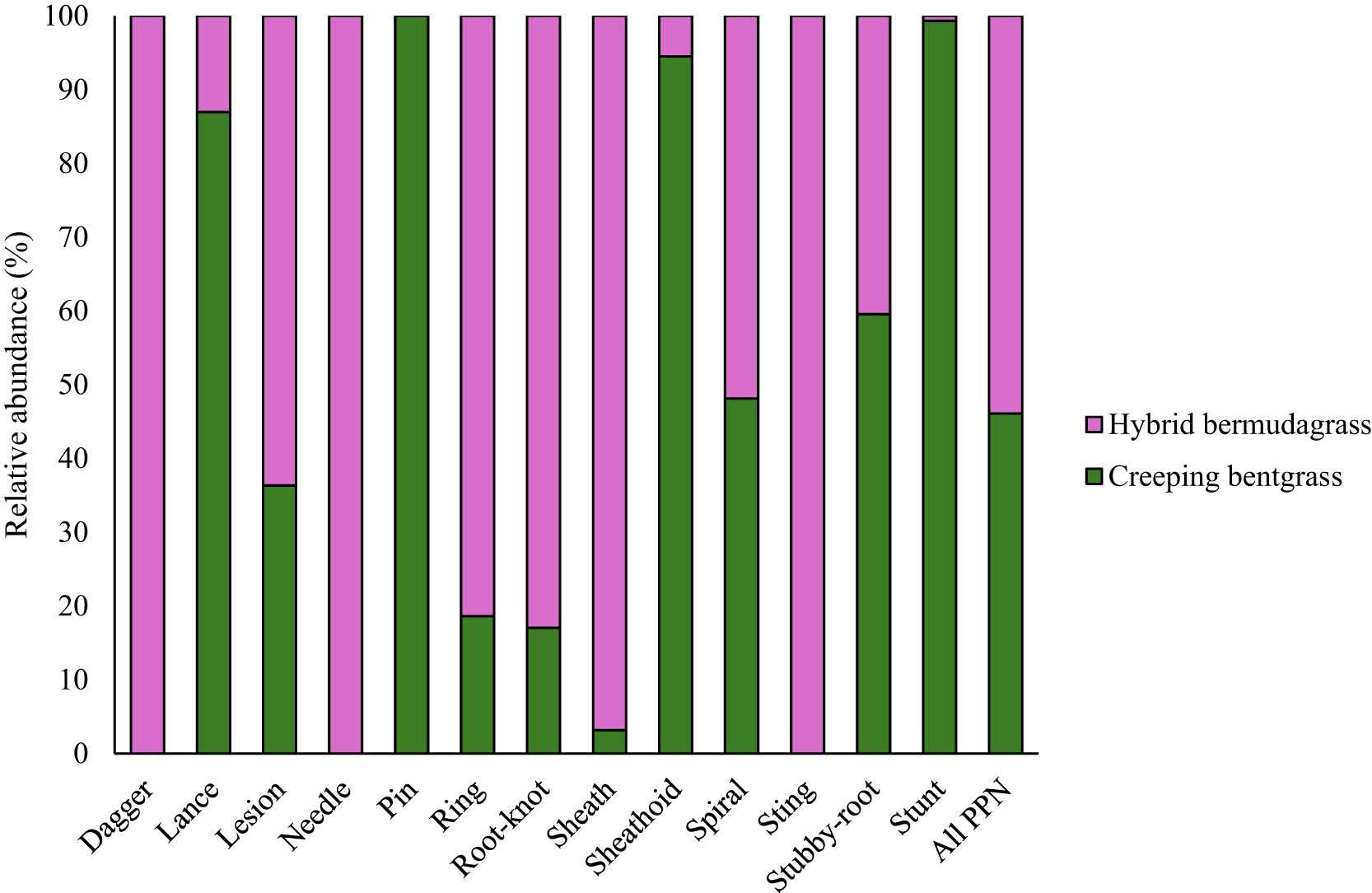
Figure 4
Relative abundance of plant-parasitic nematodes (PPN) in hybrid bermudagrass (n = 226) and creeping bentgrass (n = 126) putting greens in mid-south United States golf courses. Relative abundance represents the distribution of each PPN by turfgrass species.
The effects of soil characteristics on PPN species were highly variable. One exception was pH, where a negative relationship with total PPN population densities was observed (r = −0.214; p < 0.001). In marginal PerMANOVA tests, pH was the strongest unique predictor of community composition variation. The pH range in this study was 3.8–7.1, with a mean pH of 5.7. Previously, Walker et al. (2002) reported no effect of pH on PPN densities in Oklahoma. However, the pH range in that study was 5.6–8.8, with an average pH of 7.4. Highly acidic soil conditions may have positively influenced, directly and/or indirectly, PPN population densities in the present study. Organic matter was significantly higher in hybrid bermudagrass (1.7%) than creeping bentgrass greens (1.0%). Although there were no apparent relationships between organic matter and PPN population densities in this study, organic matter can significantly influence soil biology and indirectly affect plant-parasitic and free-living nematodes (Widmer et al., 2002).
There were limited significant correlations between soil nutrients and individual PPN taxa in this study. The lance nematode was negatively correlated with four nutrients: phosphorus, calcium, sulfur, and copper (r = −0.343, −0.300, −0.336, and −0.277, respectively). In a controlled long-term study, Waldo et al. (2024) observed greater lance nematode densities in biosolid-treated plots that had elevated levels of soil phosphorus, copper, iron, and zinc. The authors did not observe this relationship with other nematode taxa, which they speculated was due to varying tolerance to environmental contaminants. Based on these results, it is difficult to make specific nutrient recommendations for lance nematode control. Walker et al. (2002) reported total PPN density was positively correlated with potassium and organic matter, in contrast to our study. These conflicting results suggest that nematode–soil interactions are highly complex and multivariable, with any apparent associations likely influenced by a range of site-specific factors.
This study improves the current understanding of the prevalence and abundance of various PPN taxa in Arkansas and certain neighboring states. Variability of PPN population densities was high, both within and between sampling sites, as was observed in other geographic sampling studies. Turfgrass species was associated with PPN community composition and may serve as a reliable predictor of PPN taxa within golf greens. Mixed effects of various soil parameters on PPN densities were observed in this study. The lack of consistent relationships suggests that nutrient concentrations alone may not be enough to predict PPN populations. Regardless, it remains important to maintain adequate soil fertility to promote healthy, resilient turfgrass. While this study did not identify PPN to the species level, there can be important distinctions between species in a given genus, and future research should examine the PPN in Arkansas golf course putting greens to the species level.
Acknowledgements
The authors thank Amanda Greer, Cathy Howard, Lynhe Desmesyeux, PhD, and the entire Arkansas Nematode Diagnostic Laboratory for their extensive expertise and assistance with this project.
Funding information
The authors thank the United States Golf Association Mike Davis Program for Advancing Golf Course Management for providing funding for this project.
Author contributions
Michael V. Battaglia: Investigation, sampling, data collection, statistical analysis, writing – original draft. Jessica K. Anders: Investigation, sampling, data collection. Sharandeep S. Chahal: Investigation, sampling, data collection, statistical analysis, writing – review and editing. Michael D. Richardson: Supervision, resources, writing – review and editing. Wendell J. Hutchens: Methodology, funding acquisition, validation, supervision, investigation, sampling, data collection, statistical analysis, writing – review and editing.
Conflict of interest statement
Authors state no conflict of interest.