
Table 1
List of sweetpotato (Ipomoea batatas) PI acquired from the USDA-GRIN. Common names are from Slonecki et al. (2023)
| Common Name | Regional Group | Accession Number |
|---|---|---|
| ‘Tanzania’ | Africa | PI 595887 |
| ‘Frita’ | Caribbean | PI 538346 |
| ‘8520’ | Central America | PI 531102 |
| ‘Lamote’ | Central America | PI 531134 |
| ‘Chino A’ | Central America | PI 592991 |
| ‘Camote Amarillo’ | Central America | PI 595857 |
| ‘Norin No.4’ | East Asia3 | PI 1539071 |
| ‘78-2’ | East Asia3 | PI 508516 |
| ‘VSP 3’ | East Asia3 | PI 564158 |
| ‘Saing-Mi’ | East Asia3 | PI 585072 |
| ‘Tainung 63’ | East Asia3 | PI 599381 |
| ‘Duanyanghong’ | East Asia3 | PI 606252 |
| ‘Beauregard’ | North America | PI 5666132 |
| ‘Jersey Orange’ | North America | PI 566637 |
| ‘Red Jewel’ | North America | PI 566648 |
| ‘W-115’ | North America | PI 634429 |
| ‘W-231’ | North America | PI 634445 |
| ‘MD 55’ | North America | PI 634470 |
| ‘Regal’ | North America | PI 566650 |
| ‘Daxua’ | Pacific Islands | PI 315349 |
| ‘83003-12’ | Pacific Islands | PI 564122 |
| ‘Tinian’ | Pacific Islands | PI 153655 |
| ‘Talaukwe’ | Pacific Islands | PI 564152 |
| ‘Honiara’ | Pacific Islands | PI 5958691 |
| ‘IPS 10’ | Pacific Islands | PI 599373 |
| ‘Taiuani’ | Pacific Islands | PI 614794 |
| ‘Morada Sombica’ | South America | PI 508531 |
| ‘Huachano’ | South America | PI 612695 |
| ‘7’ | South America | PI 564095 |
1 Tested by Alam et al. 2024 and listed as moderately resistant to the reniform nematode.
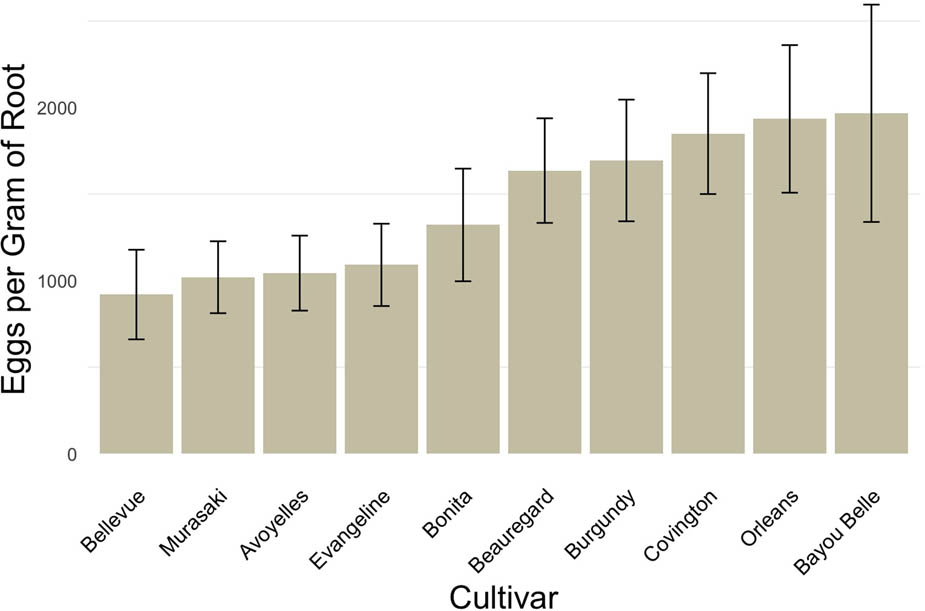
Figure 1
Rotylenchulus reniformis eggs per gram of root on sweetpotato (Ipomoea batatas) cultivars used in commercial production. Treatment means were calculated from two experiments with a total of 12 replications. Error bars represent the standard error of the mean value.
Table 2
Fibrous and storage root weights of ten commercial sweetpotato (Ipomoea batatas) cultivars from the commercial cultivar screening
| Cultivar | Fibrous root weight (g)a | Storage root weight (g)b | |
|---|---|---|---|
| Exp 1 | Exp 2 | ||
| ‘Beauregard’ (Control) | 7.5 | 33.8 a | 58.0 ab |
| ‘Avoyelles’ | 11.8 | 36.2 a | 40.8 a-d |
| ‘Bayou Belle’ | 7.6 | 31.2 a | 71.2 a |
| ‘Bellevue’ | 7.3 | 31.2 a | 66.3 ab |
| ‘Bonita’ | 11.1 | 29.1 ab | 48.5 a-d |
| ‘Burgundy’ | 10.3 | 1.9 c | 21.0 d |
| ‘Covington’ | 6.0 | 11.3 bc | 23.7 cd |
| ‘Evangeline’ | 10.6 | 20.6 ab | 51.8 abc |
| ‘Murasaki’ | 13.3 | 23.7 ab | 39.8 bcd |
| ‘Orleans’ | 7.8 | 33.8 a | 53.9 ab |
| P - value | 0.167 | <0.001 | <0.001 |
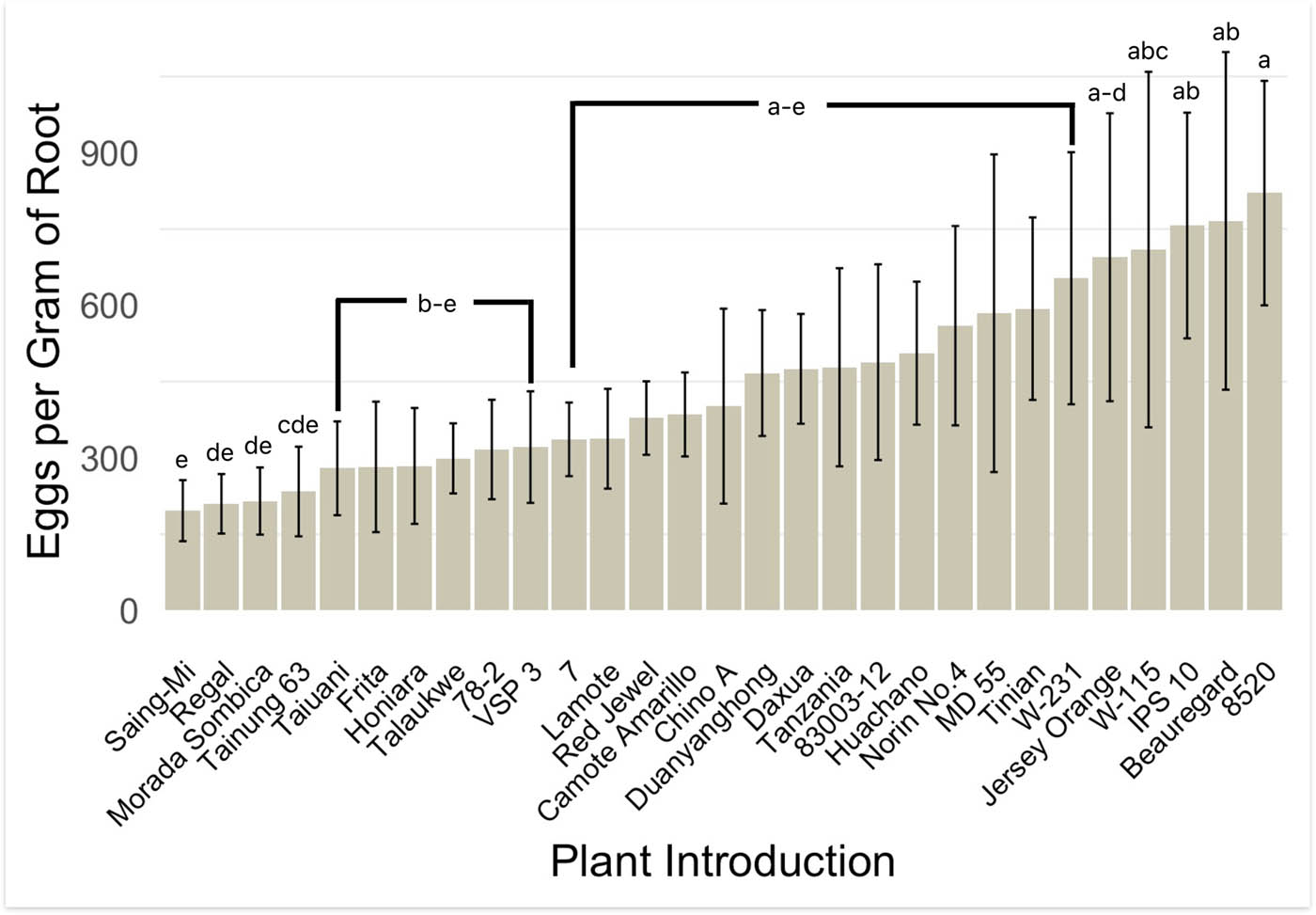
Figure 2
Rotylenchulus reniformis eggs per gram of root on 28 sweetpotato (Ipomoea batatas) PIs with ‘Beauregard’ as the susceptible control. Treatment means were calculated from two experiments with a total of seven replications. PIs with different letters indicate significantly different mean values according to Fisher’s LSD (P < 0.05). Error bars represent the standard error of the mean value.
Table 3
Fibrous and storage root weights of 28 sweetpotato (Ipomoea batatas) PIs
| PI | Storage root weight (g)a | Fibrous root weight (g) | |||||
|---|---|---|---|---|---|---|---|
| Exp 1 | Exp 2b | Exp 1 | Exp 2 | ||||
| ‘Beauregard’ | 48.6 | ab | 6.2 | 14.4 | f–i | 13.8 | jkl |
| ‘7’ | 8.7 | g–k | 0 | 24.3 | b–f | 17.0 | f–l |
| ‘78-2’ | 5.1 | ijk | 0 | 20.7 | e–i | 21.1 | l |
| ‘83003-12’ | 13.9 | h–k | 0 | 15.9 | c–i | 15.4 | b–j |
| ‘8520’ | 4.3 | e–k | 0 | 15.8 | e–i | 9.5 | h–l |
| ‘Camote Amarillo’ | 13.4 | e–k | 0 | 23.0 | b–h | 18.1 | e–k |
| ‘Chino A’ | 33.2 | bcd | 4.3 | 26.0 | bcd | 33.6 | a |
| ‘Daxua’ | 19.7 | d–i | 0 | 27.7 | bc | 28.2 | abc |
| ‘Duanyanghong’ | 19.8 | d–i | 4.1 | 20.1 | c–i | 26.0 | bcd |
| ‘Frita’ | 47.4 | ab | 7.5 | 13.0 | hi | 20.8 | c–j |
| ‘Honiara’ | 10.1 | g–k | 0 | 17.4 | d–i | 17.0 | f–l |
| ‘Huachano’ | 2.5 | jk | 0 | 16.8 | d–i | 15.5 | h–l |
| ‘IPS 10’ | 53.8 | a | 5 | 14.0 | ghi | 24.1 | b–f |
| ‘Jersey Orange’ | 27.9 | c–f | 0 | 14.6 | f–i | 24.6 | b–e |
| ‘Lamote’ | 8.5 | g–k | 0 | 14.5 | f–i | 16.0 | g–l |
| ‘MD 55’ | 23.1 | d–g | 0 | 20.9 | c–i | 23.2 | b–g |
| ‘Morada Sombica’ | 7.6 | g–k | 0 | 27.5 | bc | 21.9 | b–h |
| ‘Norin No.4’ | 43.9 | abc | 13.1 | 11.4 | i | 12.4 | kl |
| ‘Red Jewel’ | 17.8 | d–j | 0 | 23.9 | b–g | 22.8 | b–h |
| ‘Regal’ | 11.6 | f–k | 0 | 45.2 | a | 16.5 | g–l |
| ‘Saing-Mi’ | 30.2 | cde | 0 | 22.0 | b–h | 18.9 | d–k |
| ‘Tainung 63’ | 22.6 | d–h | 0.5 | 14.0 | ghi | 23.1 | b–g |
| ‘Taiuani’ | 12.0 | f–k | 0 | 25.3 | b–e | 28.6 | ab |
| ‘Talaukwe’ | 0 | k | 0 | 22.2 | b–h | 14.0 | jkl |
| ‘Tanzania’ | 12.6 | f–k | 0 | 19.6 | c–i | 21.8 | b–i |
| ‘Tinian’ | 2.2 | jk | 0 | 27.9 | bc | 22.3 | b–h |
| ‘VSP 3’ | 4.6 | h–k | 0 | 31.1 | b | 22.5 | b–h |
| ‘W-115’ | 14.6 | e–k | 0 | 15.0 | f–i | 14.4 | i–l |
| ‘W-231’ | 17.3 | d–j | 1.6 | 21.5 | b–h | 20.2 | d–j |
| P - value | <0.001 | 0.210 | <0.001 | <0.001 | |||
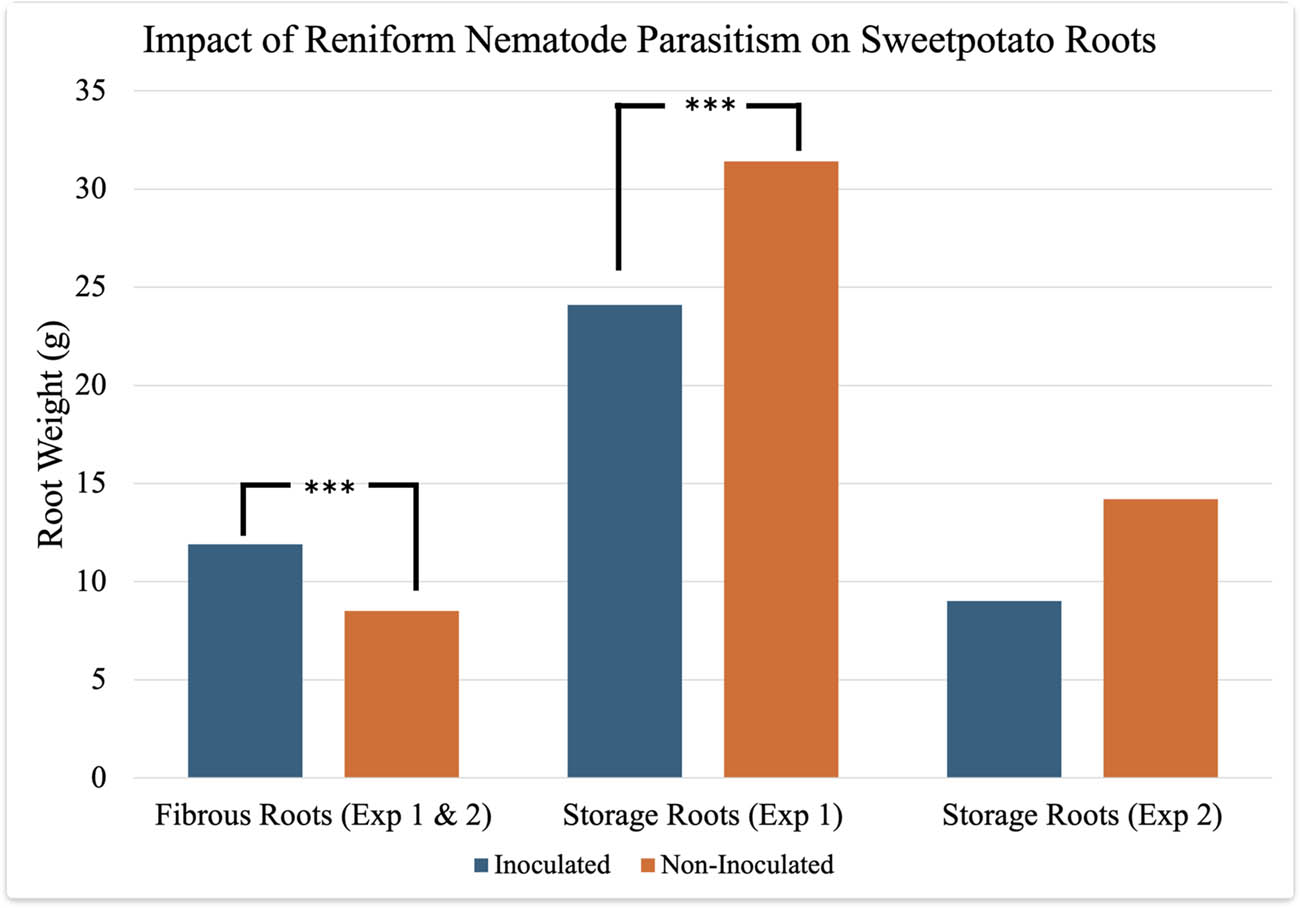
Figure 3
Sweetpotato (Ipomoea batatas) fibrous and storage root weights as influenced by Rotylenchulus reniformis inoculation in the biomass partitioning assay. Fibrous root data were pooled between experiments, as there was no significant interaction between nematode inoculation and experiment on this parameter (P = 0.609). Significant differences (P < 0.001) in root weight between inoculated and non-inoculated plants are shown by a triple asterisk (***).