
Sweetpotato (Ipomoea batatas) is an important crop globally. This crop is grown on all continents except Antarctica and used as both an export and staple crop (Clark et al., 2013). Most subsistence sweetpotato production occurs in China and Africa, while the United States, the Netherlands, and Egypt are sweetpotato exporters (Tridge, 2024). Countries that export sweetpotato rely heavily on orange-fleshed cultivars, typically seen in cultivars such as ‘Beauregard’ and ‘Covington’ (Clark et al., 2013).
An emerging nematode pest of sweetpotato is Rotylenchulus reniformis Linford & Oliveira (reniform nematode). Since the first report on sweetpotato in 1960, R. reniformis has spread extensively throughout the southern United States (Martin, 1960; Robinson, 2007). Multiple field studies have demonstrated that R. reniformis is capable of rapidly infesting large fields and displacing Meloidogyne incognita (southern root-knot nematode) (Diez et al., 2003; Moore et al., 2010; Thomas and Clark, 1983). A recent survey reported that more than half of all sweetpotato producing counties in the southern United States tested positive for R. reniformis (Faske et al., 2024). Rotylenchulus reniformis is not only a problem to the United States but is also found in nearly all tropical and sub-tropical environments (Robinson et al., 1997). Australia, another large producer of sweetpotato, has observed the same phenomenon of Meloidogyne spp. displacement by R. reniformis (Day et al., 2023).
The impact of R. reniformis on sweetpotato is different than that of Meloidogyne spp. Sweetpotato fields heavily infested with R. reniformis do not display obvious symptoms but can still lose 20–40% of the total yield (Abel et al., 2007; Miller and Watson, 2025). Rotylenchulus reniformis management in the past primarily focused on soil fumigants and nematicides. Chemical management can result in significant yield increases; however, the year-to-year efficacy of these options is highly variable (Watson et al., 2023) and there is a negative impact on soil health. Other management options, such as crop rotation and cover crops, have not consistently limited R. reniformis soil densities (Ruiz et al., 2025; Stetina et al., 2007). The use of sweetpotato cultivars resistant to R. reniformis is not possible because no studies have identified such cultivars. Past work demonstrated that cultivars resistant to Meloidogyne spp. are not resistant to R. reniformis (Miller & Watson, 2025; Thomas & Clark, 1983). A recent study reported that some sweetpotato germplasm was moderately resistant to R. reniformis (Alam et al., 2024). The commercial cultivar ‘Beauregard’ (which is one of the most widely used cultivars) has been reported as a susceptible host to R. reniformis; however, the host status of other economically important cultivars is currently unknown (Abel et al., 2007).
By evaluating the status of currently grown commercial cultivars and other diverse germplasm for susceptibility to R. reniformis, gaps in the literature regarding host resistance can be filled. The United States Department of Agriculture’s (USDA) Genetic Resource Information Network (GRIN) in Griffin, GA, has a repository of germplasm that is more genetically diverse than the cultivars used in commercial production systems and may contain sources of resistance to R. reniformis. The aim of this study is to (i) determine the host status of important sweetpotato cultivars to R. reniformis, (ii) identify potential sources of resistance among genetically diverse sweetpotato germplasm, and (iii) elucidate the effect of R. reniformis parasitism on sweetpotato root mass allocation.
1. Materials and methods
1.1. Cultivar and germplasm screening
Mixed stage R. reniformis were extracted from a field with a history of high soil population densities at the LSU AgCenter’s Macon Ridge Research Station in Winnsboro, LA (Watson, 2024). Nematode identity was confirmed via morphological characteristics (Robinson et al., 1997) and then used to inoculate tomato seedlings in a greenhouse. Rotylenchulus reniformis cultures were maintained for 3 months. Nematodes for sweetpotato inoculation were extracted from soil by modified Baermann pan (Baermann, 1917). Nematodes were collected after 24–36 h and used within 24–48 h after extraction. Temperatures in the greenhouse were recorded hourly and assessed at the conclusion of the experiment for differences between trial replications.
To evaluate the susceptibility of commercial sweetpotato cultivars to R. reniformis, vegetative sweetpotato cuttings (slips) were obtained from the LSU AgCenter Sweetpotato Research Center in Chase, LA. Nine cultivars (‘Avoyelles’, ‘Bayou Belle’, ‘Bellevue’, ‘Bonita’, ‘Burgundy’, ‘Covington’, ‘Evangeline’, ‘Murasaki’, and ‘Orleans’) were assessed for R. reniformis susceptibility, with ‘Beauregard’ included as a susceptible control. Each cultivar was assessed in two separate experiments with 6 replicates in each experiment for a total of 12 replicates per cultivar. The first experiment was planted on August 30, 2024, and harvested on November 8, 2024, with a high and low temperature of 33.3 and 20.9°C, respectively. The second experiment was planted on September 13, 2024, and harvested on November 22, 2024, with high and low temperatures of 30.9 and 18.2°C, respectively.
To evaluate diverse sweetpotato germplasm for susceptibility to R. reniformis, 28 plant introductions (PIs) from the USDA-GRIN (Griffin, GA) were obtained (Table 1). The PIs were grown as tissue culture plants in a virus-free environment, after which they were transferred to the greenhouse for multiplication. Each PI was assessed in two separate experiments with four replicates in experiment 1, and three replicates in experiment 2 for a total of seven replicates per PI. The first experiment was planted on April 28, 2025, and harvested on July 7, 2025, with a high and low temperature of 34.7 and 20.1°C, respectively. The second experiment was planted on June 26, 2025, and harvested on September 4, 2025, with high and low temperatures of 33.2 and 25.6°C, respectively.
Table 1
List of sweetpotato (Ipomoea batatas) PI acquired from the USDA-GRIN. Common names are from Slonecki et al. (2023)
| Common Name | Regional Group | Accession Number |
|---|---|---|
| ‘Tanzania’ | Africa | PI 595887 |
| ‘Frita’ | Caribbean | PI 538346 |
| ‘8520’ | Central America | PI 531102 |
| ‘Lamote’ | Central America | PI 531134 |
| ‘Chino A’ | Central America | PI 592991 |
| ‘Camote Amarillo’ | Central America | PI 595857 |
| ‘Norin No.4’ | East Asia3 | PI 1539071 |
| ‘78-2’ | East Asia3 | PI 508516 |
| ‘VSP 3’ | East Asia3 | PI 564158 |
| ‘Saing-Mi’ | East Asia3 | PI 585072 |
| ‘Tainung 63’ | East Asia3 | PI 599381 |
| ‘Duanyanghong’ | East Asia3 | PI 606252 |
| ‘Beauregard’ | North America | PI 5666132 |
| ‘Jersey Orange’ | North America | PI 566637 |
| ‘Red Jewel’ | North America | PI 566648 |
| ‘W-115’ | North America | PI 634429 |
| ‘W-231’ | North America | PI 634445 |
| ‘MD 55’ | North America | PI 634470 |
| ‘Regal’ | North America | PI 566650 |
| ‘Daxua’ | Pacific Islands | PI 315349 |
| ‘83003-12’ | Pacific Islands | PI 564122 |
| ‘Tinian’ | Pacific Islands | PI 153655 |
| ‘Talaukwe’ | Pacific Islands | PI 564152 |
| ‘Honiara’ | Pacific Islands | PI 5958691 |
| ‘IPS 10’ | Pacific Islands | PI 599373 |
| ‘Taiuani’ | Pacific Islands | PI 614794 |
| ‘Morada Sombica’ | South America | PI 508531 |
| ‘Huachano’ | South America | PI 612695 |
| ‘7’ | South America | PI 564095 |
1 Tested by Alam et al. 2024 and listed as moderately resistant to the reniform nematode.
All experiments were performed in the LSU AgCenter Plant Material Center greenhouse in Baton Rouge, LA using a randomized complete block design. Three days prior to planting, slips were placed in water to encourage early root development. Sweetpotato slips were then planted in 101 mm diameter PVC pots containing a homogenous mixture of pasteurized sand and soil, approximately 2,000 cm3 of total soil. Shortly after planting, four holes were made around the base of each slip and then filled via pipette with an aqueous solution containing 1,000 vermiform life stage R. reniformis. Holes were covered with pasteurized soil and watered. Plants were watered and fertilized on a regular schedule with occasional maintenance sprays for common greenhouse pests.
Seventy days after planting, sweetpotato roots were harvested, separated into fibrous roots (<5 mm in diameter) and storage roots (>5 mm in diameter), and weighed. Roots were stored at 4°C until processed. The fibrous roots were placed in a 0.5% sodium hypochlorite suspension and shaken for 10 min, then placed on a series of nested sieves (Eisenback, 2000). The eggs were collected from a 38 µm sieve and transferred to a centrifuge tube. Samples were further cleaned with the sucrose-centrifugation technique (Baker et al., 1985). Rotylenchulus reniformis eggs were counted on an inverted microscope (Nikon Eclipse TS100, Tokyo, Japan). Data were expressed as eggs per gram of root.
1.2. Root biomass partitioning assay
To evaluate the impact of R. reniformis inoculation on resource allocation to fibrous and storage roots, a root biomass partitioning assay was conducted. This assay compared non-inoculated sweetpotato root weights to inoculated sweetpotato root weights. In the first trial, ‘Avoyelles’, ‘Bayou Belle’, ‘Beauregard’, ‘Bellevue’, ‘Bonita’, ‘Burgundy’, ‘Covington’, ‘Evangeline’, ‘Heartogold’, ‘Murasaki’, ‘Orleans’, ‘Porto Rico’, and ‘Vermillion’ were evaluated. This trial was planted on September 13, 2024, and harvested on November 22, 2024, with high and low temperatures of 30.9 and 18.2°C, respectively. In the second trial of this experiment, only four of the main commercial cultivars (‘Avoyelles’, ‘Beauregard’, ‘Covington’, and ‘Orleans’) were evaluated. The second trial was planted on April 7, 2025, and harvested on June 16, 2025, with high and low temperatures of 34.4 and 19.8°C, respectively. Each cultivar had 12 replicates per experiment, with 6 being inoculated and 6 being non-inoculated. R. reniformis were inoculated in the same method as described above for the cultivar and germplasm experiment. Fibrous and storage root weights were recorded in both trials as described above. Nematode eggs were extracted from the inoculated plants in the same manner as described above to ensure that nematode reproduction was occurring on inoculated plants.
1.3. Statistical analysis
All statistical analyses were performed using Rstudio version 2024.09.0 (The R Foundation for Statistical Computing, Vienna, Austria). Residual diagnostics and Levene’s tests indicated approximately symmetric errors and homogeneous variances for the data collected from all experiments. Log transformations produced the same conclusions as the untransformed analyses. Given the balanced design, replication across blocks, and comparable group variances, ANOVA was considered appropriate, and results are reported on the original measurement scale to preserve biological interpretability.
The commercial cultivar and PI screening data were each analyzed with a two-way ANOVA with cultivar (or PI) and experiment as the main factors. Replicates were considered random effects in both ANOVAs. When cultivar or PI had a significant effect (P < 0.05), mean separation was accomplished using Fisher’s least significant difference (LSD). The root biomass partitioning assay was analyzed with a three-way ANOVA, with cultivar, inoculation status, and experiment as main factors. Post-hoc analysis was also done with Fisher’s LSD when P < 0.05.
2. Results
During the assessment of commercial cultivars for susceptibility to R. reniformis, the impact of cultivar on the number of eggs per gram of root was not dependent on experiment (cultivar × experiment interaction P > 0.05), thus data were pooled between experiments. There were no differences observed between the nine sweetpotato cultivars and the susceptible control (Figure 1). The cultivar with the lowest numerical nematode egg production was ‘Bellevue’; however, this difference was not statistically different from the other cultivars. The interaction between cultivar and experiment on fibrous root weight was not significant (P = 0.072), which allowed those data to be pooled as well (Table 2). Fibrous root weight did not differ among cultivars. The interaction between cultivar and experiment on storage root weight was significant (P = 0.035), necessitating separate analyses by experiment. In experiment 2, larger storage roots were produced, 60.7% larger than in experiment 1 (P < 0.001). ‘Bayou Belle’ produced the highest storage root weights while ‘Burgundy’ produced the lowest storage root weights.
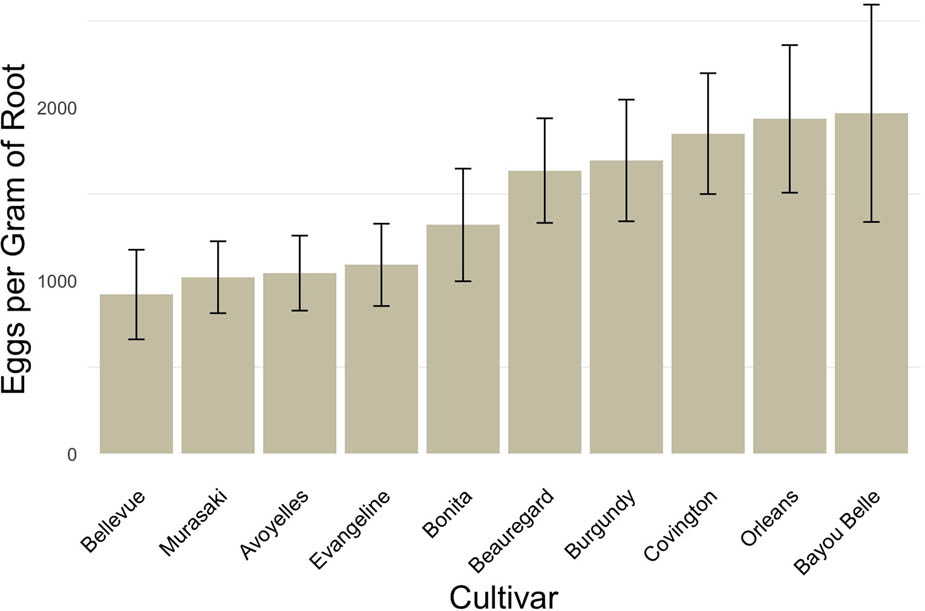
Figure 1
Rotylenchulus reniformis eggs per gram of root on sweetpotato (Ipomoea batatas) cultivars used in commercial production. Treatment means were calculated from two experiments with a total of 12 replications. Error bars represent the standard error of the mean value.
Table 2
Fibrous and storage root weights of ten commercial sweetpotato (Ipomoea batatas) cultivars from the commercial cultivar screening
| Cultivar | Fibrous root weight (g)a | Storage root weight (g)b | |
|---|---|---|---|
| Exp 1 | Exp 2 | ||
| ‘Beauregard’ (Control) | 7.5 | 33.8 a | 58.0 ab |
| ‘Avoyelles’ | 11.8 | 36.2 a | 40.8 a-d |
| ‘Bayou Belle’ | 7.6 | 31.2 a | 71.2 a |
| ‘Bellevue’ | 7.3 | 31.2 a | 66.3 ab |
| ‘Bonita’ | 11.1 | 29.1 ab | 48.5 a-d |
| ‘Burgundy’ | 10.3 | 1.9 c | 21.0 d |
| ‘Covington’ | 6.0 | 11.3 bc | 23.7 cd |
| ‘Evangeline’ | 10.6 | 20.6 ab | 51.8 abc |
| ‘Murasaki’ | 13.3 | 23.7 ab | 39.8 bcd |
| ‘Orleans’ | 7.8 | 33.8 a | 53.9 ab |
| P - value | 0.167 | <0.001 | <0.001 |
There was no significant interaction between PI and experiment on the number of nematode eggs per gram of root (P = 0.241), therefore, data from the germplasm screening repetitions were pooled. Four PI’s that allowed for significantly less reproduction than the susceptible control were identified (Figure 2). ‘Saing-Mi’, ‘Regal’, ‘Morada Sombica’, and ‘Tainung 63’ had 69, 71, 72, and 74% less eggs per gram of root than ‘Beauregard’, respectively. All other PIs were statistically similar to ‘Beauregard.’ For both fibrous and storage root data, there was a significant interaction between PI and experiment (P = 0.001 and P < 0.001, respectively), therefore the root weight data from the experiments were analyzed separately (Table 3). Most of the PIs in experiment 2 failed to produce storage roots while ‘IPS 10’ produced the most storage roots in experiment 1. ‘Regal’ and ‘Chino A’ produced the most fibrous roots in both experiments.
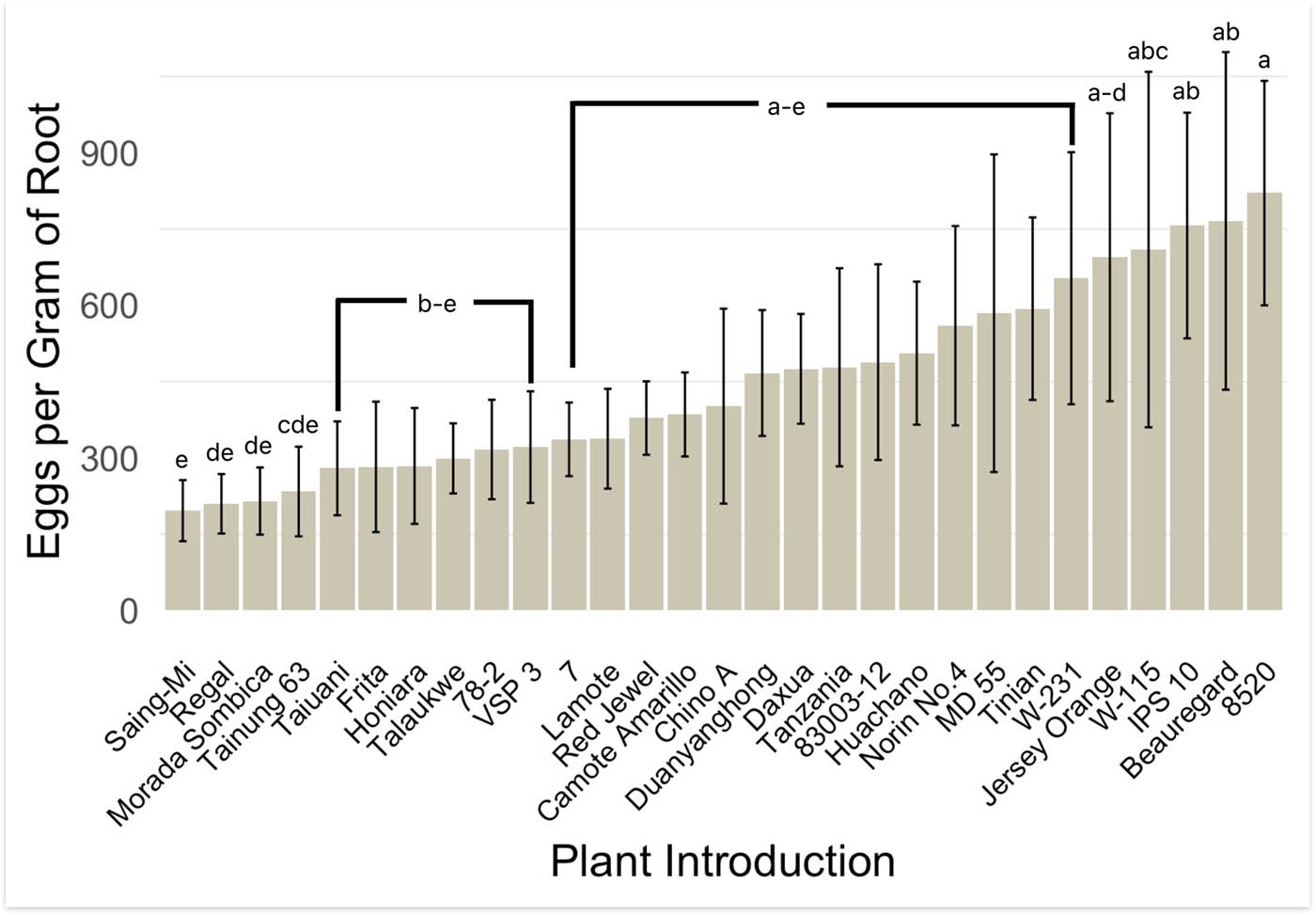
Figure 2
Rotylenchulus reniformis eggs per gram of root on 28 sweetpotato (Ipomoea batatas) PIs with ‘Beauregard’ as the susceptible control. Treatment means were calculated from two experiments with a total of seven replications. PIs with different letters indicate significantly different mean values according to Fisher’s LSD (P < 0.05). Error bars represent the standard error of the mean value.
Table 3
Fibrous and storage root weights of 28 sweetpotato (Ipomoea batatas) PIs
| PI | Storage root weight (g)a | Fibrous root weight (g) | |||||
|---|---|---|---|---|---|---|---|
| Exp 1 | Exp 2b | Exp 1 | Exp 2 | ||||
| ‘Beauregard’ | 48.6 | ab | 6.2 | 14.4 | f–i | 13.8 | jkl |
| ‘7’ | 8.7 | g–k | 0 | 24.3 | b–f | 17.0 | f–l |
| ‘78-2’ | 5.1 | ijk | 0 | 20.7 | e–i | 21.1 | l |
| ‘83003-12’ | 13.9 | h–k | 0 | 15.9 | c–i | 15.4 | b–j |
| ‘8520’ | 4.3 | e–k | 0 | 15.8 | e–i | 9.5 | h–l |
| ‘Camote Amarillo’ | 13.4 | e–k | 0 | 23.0 | b–h | 18.1 | e–k |
| ‘Chino A’ | 33.2 | bcd | 4.3 | 26.0 | bcd | 33.6 | a |
| ‘Daxua’ | 19.7 | d–i | 0 | 27.7 | bc | 28.2 | abc |
| ‘Duanyanghong’ | 19.8 | d–i | 4.1 | 20.1 | c–i | 26.0 | bcd |
| ‘Frita’ | 47.4 | ab | 7.5 | 13.0 | hi | 20.8 | c–j |
| ‘Honiara’ | 10.1 | g–k | 0 | 17.4 | d–i | 17.0 | f–l |
| ‘Huachano’ | 2.5 | jk | 0 | 16.8 | d–i | 15.5 | h–l |
| ‘IPS 10’ | 53.8 | a | 5 | 14.0 | ghi | 24.1 | b–f |
| ‘Jersey Orange’ | 27.9 | c–f | 0 | 14.6 | f–i | 24.6 | b–e |
| ‘Lamote’ | 8.5 | g–k | 0 | 14.5 | f–i | 16.0 | g–l |
| ‘MD 55’ | 23.1 | d–g | 0 | 20.9 | c–i | 23.2 | b–g |
| ‘Morada Sombica’ | 7.6 | g–k | 0 | 27.5 | bc | 21.9 | b–h |
| ‘Norin No.4’ | 43.9 | abc | 13.1 | 11.4 | i | 12.4 | kl |
| ‘Red Jewel’ | 17.8 | d–j | 0 | 23.9 | b–g | 22.8 | b–h |
| ‘Regal’ | 11.6 | f–k | 0 | 45.2 | a | 16.5 | g–l |
| ‘Saing-Mi’ | 30.2 | cde | 0 | 22.0 | b–h | 18.9 | d–k |
| ‘Tainung 63’ | 22.6 | d–h | 0.5 | 14.0 | ghi | 23.1 | b–g |
| ‘Taiuani’ | 12.0 | f–k | 0 | 25.3 | b–e | 28.6 | ab |
| ‘Talaukwe’ | 0 | k | 0 | 22.2 | b–h | 14.0 | jkl |
| ‘Tanzania’ | 12.6 | f–k | 0 | 19.6 | c–i | 21.8 | b–i |
| ‘Tinian’ | 2.2 | jk | 0 | 27.9 | bc | 22.3 | b–h |
| ‘VSP 3’ | 4.6 | h–k | 0 | 31.1 | b | 22.5 | b–h |
| ‘W-115’ | 14.6 | e–k | 0 | 15.0 | f–i | 14.4 | i–l |
| ‘W-231’ | 17.3 | d–j | 1.6 | 21.5 | b–h | 20.2 | d–j |
| P - value | <0.001 | 0.210 | <0.001 | <0.001 | |||
In the root biomass partitioning assay, there was no significant interaction between nematode inoculation, experiment, and cultivar on fibrous root weight (P = 0.609), allowing all fibrous root weights to be pooled. However, there was a significant interaction between the experiment and nematode inoculation on storage root weight (P = 0.013), necessitating that experiments were analyzed separately. Despite lower overall storage root weights in experiment 2, R. reniformis parasitism had the same negative effect on storage root weight in both experiments (Figure 3). Storage root weight was reduced by 24.3 and 36.5% in experiments 1 and 2, respectively. Fibrous root weight displayed an opposite trend, with an increase of 28.4% in inoculated plants compared to non-inoculated plants.
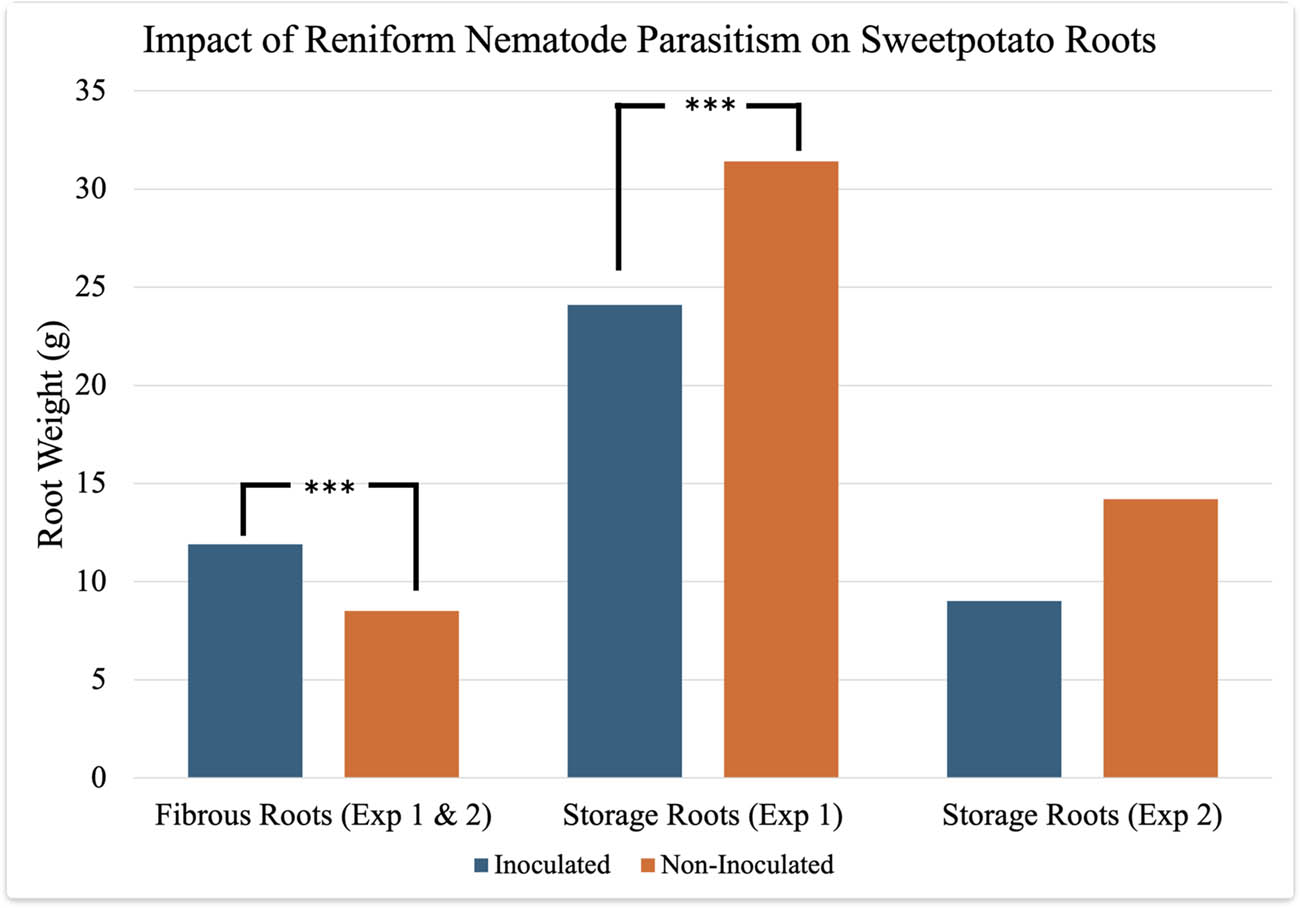
Figure 3
Sweetpotato (Ipomoea batatas) fibrous and storage root weights as influenced by Rotylenchulus reniformis inoculation in the biomass partitioning assay. Fibrous root data were pooled between experiments, as there was no significant interaction between nematode inoculation and experiment on this parameter (P = 0.609). Significant differences (P < 0.001) in root weight between inoculated and non-inoculated plants are shown by a triple asterisk (***).
3. Discussion
When identifying sweetpotato genotypes resistant to R. reniformis, the ability to suppress reproduction relative to a highly susceptible control was used as the main criteria (Matsuo et al., 2012). Four genotypes (‘Saing-Mi’, ‘Regal’, ‘Morada Sombica’, and ‘Tainung 63’) allowed for 69–74% less nematode egg production relative to ‘Beauregard’, highlighting their utility as potential sources of resistance to R. reniformis. Two of these genotypes (‘Saing-Mi’ and ‘Tainung 63’) came from the Far East region while ‘Regal’ and ‘Morada Sombica’ were from North and South America, respectively (Slonecki et al., 2023). Of these four, ‘Regal’ stands out as a high yield cultivar with good resistance to several insect and fungal pathogens (Jones et al., 1985). Additionally, ‘Regal’ was identified as moderately resistant to Meloidogyne incognita and highly resistant to Meloidogyne enterolobii, the guava root-knot nematode (Rutter et al., 2021). Host status of the other three PIs for these pests is not currently known. None of these four PIs have been reported as resistant to R. reniformis and may serve as new potential sources of resistance for sweetpotato breeding programs.
All nine commercial cultivars evaluated were equally susceptible to R. reniformis as ‘Beauregard’, emphasizing the lack of currently available host resistance. Three cultivars (‘Covington’, ‘Beauregard’, ‘Orleans’) comprise 90% of sweetpotato acreage in the southern United States (Francis et al., 2025). Widespread use of these cultivars, in addition to growing susceptible cotton (Robinson, 2007) and soybean (Kiarie et al., 2025) cultivars, may have contributed to the increased prevalence of R. reniformis in the southern United States (Faske et al., 2024). In other countries, such as Egypt and Australia, R. reniformis is also a problem and the widespread use of highly susceptible cultivars may be a contributing to nematode-associated yield losses in these production regions as well (Day et al., 2023; FAS Cairo, 2025).
The observed reduction in storage root weight seen in the root biomass partitioning assay aligns with previous reports of yield losses associated with R. reniformis (Miller & Watson, 2025). Inoculated plants exhibited a significant increase in fibrous root biomass, which appears to be a compensatory plant response to parasitism by R. reniformis. A similar plant response was observed by Villordon and Clark (2018) with M. incognita. The exact mechanism for increased root growth in the presence of plant-parasitic nematodes is unknown and has been documented in other crops as well, such as soybean and cotton (Bharti et al., 2015; Li et al., 2015). Compensatory root growth in response to nematode parasitism does not appear to be directly linked to host resistance (Galo et al., 2025), and further research is needed to determine how this impacts sweetpotato yield.
The range in R. reniformis egg production on the 28 PIs evaluated in this study suggest that currently available resistance may be polygenic, or quantitative in nature. Polygenic resistance is present when multiple genes prevent or slow down infection (Lindhout, 2002). This type of resistance is usually more durable than single-gene resistance because it places less evolutionary pressure on the pathogen. The only other recent study to screen sweetpotato PIs for resistance to R. reniformis reported a similar distribution of nematode reproduction, which corroborates the results of this study (Alam et al., 2024). While two of the PIs (‘Honiara’ and ‘Norin No.4’) noted as resistant by Alam et al. (2024) failed to distinguish themselves from the susceptible control in our study, this difference may be due to differences in R. reniformis populations. Agudelo et al. (2005) showed that R. reniformis populations collected from Louisiana and South Carolina reproduced at different levels on the same soybean cultivar, which may explain the observed difference between these experiments.
Introgression of resistance into new sweetpotato cultivars is possible but may take many years to accomplish. Sweetpotato breeding is challenging due to its hexaploid genome, characterized by the presence of six homologous sets of chromosomes in each cell (Lindqvist-Kreuze et al., 2023). For comparison, cotton is a tetraploid organism (four sets of chromosomes within each cell) and incorporation of resistance to R. reniformis required more than 30 years of research (Khanal et al., 2018; Singh et al., 2023). More research, such as a genome wide association study (GWAS) using a mapping population, is needed to pinpoint areas of the sweetpotato genome that are associated with resistance to R. reniformis. This approach has successfully been used for Meloidogyne, Heterodera, and Globodera spp. in various crops (Jing-Wen et al., 2025). Sweetpotato has recently been the subject of a GWAS to identify quantitative trait loci associated with resistance to M. enterolobii, indicating that a GWAS for such a genetically complex plant is possible (Fraher et al., 2024). The benefit of incorporating polygenic resistance into commercial sweetpotato cultivars is that this resistance may be more durable in the long term (Matsuo et al., 2012). Polygenic host resistance is more difficult for plant-parasitic nematodes to overcome because there are multiple resistance mechanisms that the parasite must surpass to successfully establish on a host (Roberts, 2002).
This study identified four sweetpotato PIs (‘Saing-Mi’, ‘Regal’, ‘Morada Sombica’, and ‘Tainung 63’) that displayed resistance to R. reniformis. Additionally, 10 commercial cultivars – including ‘Covington’ and ‘Orleans’ – were identified as highly susceptible to R. reniformis. The economic risk posed by R. reniformis to sweetpotato growers around the world is high due to this nematode’s ability to lower storage root weights. Incorporating host resistance into future management efforts may be difficult but can pay large dividends if R. reniformis continues to spread and impact sweetpotato production. Continued research should focus on identifying the regions of the sweetpotato genome associated with resistance so that breeders can use a targeted approach to integrating R. reniformis resistance into new cultivars.
Funding information
Funding for this project was provided by the Louisiana Sweet Potato Commission.
Author contributions
TSM was responsible for experimental design, data collection, data analysis, and writing of the manuscript. TTW was responsible for experimental design, data interpretation and writing of the manuscript.
Conflict of interest statement
Authors state no conflict of interest.