
1. Introduction
Development of sustainable and effective plant-parasitic nematode (PPN) control strategies represents a multi-layered challenge that spans biological, regulatory, and translational constraints (Figure 1). From a biological perspective, PPNs not only rapidly spread via planting material, nursery stock, and soil clinging to machinery but they are also highly adaptive (Espada et al., 2025). Factors such as short crop rotations, biologically simplified soil communities created by intensive monoculture, heavy chemical inputs, and rising temperatures increasingly lead to range expansion (Rashidifard et al., 2025; Kantor et al., 2024). From a regulatory viewpoint, frameworks built for synthetic pesticides often do not fit the risk profiles of biological control agents (Assefa et al., 2026). Additionally, access and benefit-sharing rules, intended to safeguard biodiversity, are frequently implemented in ways that create delays disproportionate to the risks posed by the microbes involved. Similarly, regulatory roles developed for transgenic organisms are not always well aligned with the characteristics and risk profiles of precise genome editing tools or RNAi-based products (Gunasekara et al., 2025). Finally, translational bottlenecks persist. Despite rapid progress in genomics, microbiome science, and delivery technologies, the infrastructure for diagnostics, data sharing, and large-scale demonstration trials remains under-resourced.
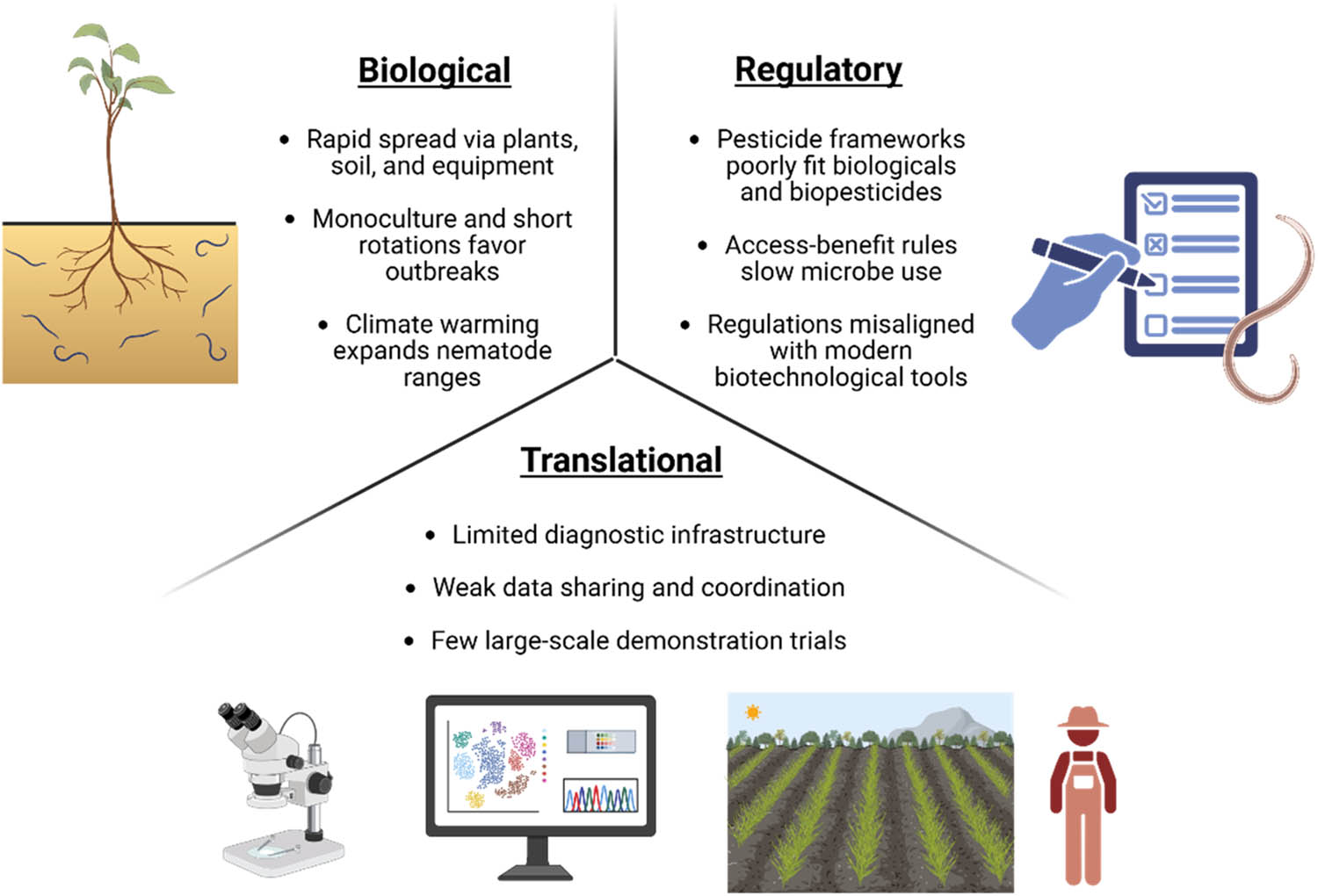
Figure 1
Challenges to the development of sustainable and effective PPN management strategies. Created with BioRender.
This study addresses these interlinked constraints through five contributions reflecting independent topics presented during the OECD-sponsored symposium. The first examines barriers to the development, registration, and uptake of biological control agents, showing how pesticide-derived data requirements, the need for repeated renewals, and current access and benefit-sharing practices raise costs and delay research. Proposed solutions include positive lists for well-characterized microbial taxa, qualified presumptions of safety, and standardized benefit-sharing templates. The second contribution explores microbiome-mediated suppression of PPNs, emphasizing cuticle-attached microbes and the specificity of those interactions. This section also discusses the broader role of free-living nematodes as key components of soil biodiversity linked to plant health. Progress in this area will require standardized sampling protocols, functional validation of candidate microbes, and field-scale trials to translate microbiome insights into practical soil management. The third contribution underscores the value of prevention and containment in protecting crops from PPNs. Furthermore, given that resistance remains the cornerstone of nematode management, this section shows how molecular understanding of plant-nematode interactions can guide precise edits to resistance receptors and susceptibility genes that mimic natural variation, strengthening the case for regulatory alignment. The fourth contribution describes an omics-enabled pipeline for optimization of the RNA interference (RNAi) method, particularly through host-induced gene silencing (HIGS), in perennial crops, emphasizing the need for sustained investment in foundational research, shared genomic infrastructure, public–private partnerships, and proactive engagement to build acceptance of novel biotechnological approaches. The fifth contribution reviews RNA-based biopesticides. As dsRNA production costs decline and low field doses are sufficient for efficacy, those products could become scalable components of an integrated nematode management toolkit. Realizing this potential will require regulatory harmonization across jurisdictions, clear data requirements, and early, transparent stakeholder engagement.
These contributions highlight shared priorities. Regulation must be proportionate to risk and suited to biological control agents, RNA technologies, and genome editing. Access and benefit-sharing should protect biodiversity without undue burdens. Strong biosecurity, sustained investment in research and field validation, and transparent stakeholder engagement are all essential to deliver scalable, science-based, and publicly trusted strategies for durable PPN management. These priorities are examined in greater detail here.
2. Current advances and challenges in PPN management
2.1. What are the barriers to the development, registration, and adoption of biological control products?
Biological control can replace many hazardous pesticides in plant protection, eliminating the problems associated with pesticide residues in food, environmental contamination, and negative health impacts (Chen et al., 2025; Assefa et al., 2026). Promoting antagonistic biodiversity in agroecosystem management is the future of plant protection. Once synthetic pesticides are significantly reduced and replaced with biological control agents, naturally occurring antagonists will contribute to the maintenance of sustainable management systems in agriculture, horticulture, and forestry. However, the introduction of safe plant protection measures has been slowed down by regulatory requirements that are not based on scientific knowledge of biocontrol agents, as well as by policy frameworks that continue to favor existing agrochemical solutions (Assefa et al., 2026). This section examines the development, successes, and regulatory challenges of biological control (biocontrol) as an alternative to chemical pesticides.
One widely cited success story is the rapid adoption of biological control in the Spanish greenhouse vegetable sector during the mid-2000s (Pilkington et al., 2010). Pest insects had developed resistance to synthetic pesticides, resulting in significant increase in pesticide use and major problems with residues. In response, European retailers developed quality specifications for residue levels that were much lower than the Maximum Residue Levels defined by governments. Conventional production could no longer adhere to these new standards. Within a few years, biological control based on beneficial macroorganisms had been implemented across a large share of Spanish greenhouse vegetable production (Pilkington et al., 2010). Producers reported healthier plants, higher yields, and the need for fewer fertilizers and less application work. This shift helped growers better meet residue expectations from retailers while reducing worker exposure to conventional insecticides.
Biocontrol approaches for the management of PPNs are not new. As early as the beginning of the twentieth century, studies demonstrated the potential of nematode-trapping fungi for managing economically damaging species (Linford and Yap, 1939). Since then, numerous biopesticides involving antagonistic microorganisms have been developed and evaluated (Chen et al., 2025). Despite their potential, the development and adoption of biological control agents for PPN management remain limited by high research, formulation, production, and registration costs, as well as the need for extensive efficacy and safety evaluations.
Nematodes themselves can also serve as biocontrol agents. Entomopathogenic nematodes (EPNs), in particular, have been successfully developed and commercialized for the management of insect pests. These nematodes are produced in liquid culture using large-scale bioreactors with volumes exceeding 100,000 L, enabling economies of scale that have contributed to reducing application costs (Ehlers, 2001). EPNs are already used in horticulture, ornamental plants production, and in forestry (Ehlers, 1996). Future markets will depend on production costs and improved application technology.
Although the market introduction of products based on biocontrol agents is accelerating, with more of them in the regulatory pipeline than chemical agents, biopesticides are currently facing major problems with exaggerating scientific and political debates surrounding “native” vs “exotic” organisms. The major barriers identified include disproportionate regulatory burdens, access-and-benefit-sharing requirements under the Nagoya Protocol, xenophobic attitudes toward non-native species, and excessive data demands on microbial biocontrol agents, which follow rules developed for synthetic pesticide regulation (Barratt et al., 2018; Mason et al, 2023). In contrast, biocontrol has a century-long record of safe use, whereas chemical pesticides are associated with escalating ecological, economic, and health costs (Zhou et al., 2025). Despite continued investment, the discovery and registration of new chemical active ingredients have become increasingly challenging. As resistance, residue issues, and bans on active ingredients erode the viability of chemical crop protection, the need for biodiversity-based pest management becomes increasingly urgent. With the expected ban on pesticides that metabolize into PFAS and TFA (so-called “forever chemicals,” e.g., the nematicide fluopyram), farmers’ toolboxes will be depleted further (Donley et al., 2024).
Consequently, we need a paradigm shift, accompanied by an exit strategy to reduce our reliance on chemical pesticides. There is an urgent need for extension services to provide knowledge-based management strategies that incorporate conservation biocontrol and the use of biocontrol products. Reforming biocontrol regulation, adopting science-based frameworks (e.g., qualified presumption of safety (QPS)/generally recognized as safe (GRAS) systems), will accelerate market access for biological control agents. The support of global biodiversity and sustainable agriculture practices is necessary for long-term food security.
2.2. How can we make the agroecosystems more resilient toward nematodes?
Resilience to PPNs is not determined by the plant alone, but rather it is an emergent property of the root-associated community. Microbial consortia, free‑living nematodes, plant defenses, and abiotic conditions interact to produce suppressive or conducive states. The goal of microbiome‑based control is to shift the community state toward suppression in ways that are durable and compatible with other practices. These mechanisms are governed by complex associations that nematodes form with microbiomes in soil, on their surface, and within the plant tissue; herein proposed as nematode holobiont associations. This section summarizes recent advances in our understanding of the mechanisms operating at the interface between nematodes and their environment, identifies key barriers to field adaptation, and offers actionable recommendations to accelerate translation.
Soil microbiomes have the potential to reduce PPN populations, and soils in which this effect is highly prominent are referred to as nematode suppressive soils (Westphal, 2005). Over the years, culturomics and DNA-based approaches have identified a range of antagonistic bacterial and fungal genera associated with nematode suppressive soils, including Pseudomonas, Pochonia, and Purpureocillium among others (Giné et al., 2016; van Himbeeck et al., 2025). Hitherto, research has shown that nematode surfaces play an important role in nematode interactions with soil microbes (Davies and Curtis, 2011). The surface coat, as the outermost glycoprotein layer of the cuticle, is involved in recognition and initial attachment of microbes (Davies and Curtis, 2011). Recent advances in microbial high-throughput sequencing have revealed diverse soil microbes attaching to the nematode surface, including several putative antagonists (Adam et al., 2014; Elhady et al., 2017, 2025; Topalović et al., 2022). The microbes attached to nematodes are not necessarily highly enriched in soil, suggesting a high attachment specificity (Elhady et al., 2017). Nonetheless, more diverse microbes were found on the J2 of Meloidogyne hapla in two suppressive soils compared to conducive soils, with enrichment of several antagonistic taxa on the J2 in suppressive soils (Topalović et al., 2022). In addition, the J2 of M. hapla were able to carry the attached microbes from a suppressive soil inside the roots, where they induced pathogen-triggered immunity against further invasion of the J2 (Topalović et al., 2020). Thus, the cuticle of nematodes represents a remarkable niche for exploring the diversity, potential, and application of soil microbes with antagonistic properties. Bridging the gap between growing research on nematode-microbe associations and the microbial agents currently available on the market could broaden and diversify the biological strategies for nematode control.
Furthermore, there is a visible shift toward a more holistic understanding of nematode-microbe associations that are not only antagonistic but that also reflect the protective or facilitating role of some microbes in nematode survival and parasitism (Topalović and Vestergård, 2021; Yergaliyev et al., 2020). For instance, it was shown that the composition of bacteria on active and moribund (dead and non-motile) J2 of M. hapla differs, and that putatively protective taxa such as Algoriphagus and Bdellovibrio were enriched on active nematodes (Topalović et al., 2023). Moreover, as complex interactions among the surrounding soil microbes affect the composition of microbes on the nematode surface and nematode activity, more knowledge is needed on the type of nematode-microbe associations in soil and the factors that govern them. Inoculants applied without understanding the community state may increase protection for the target nematode. The parasitism of endoparasitic PPN is further accompanied by restructuration of the root and rhizosphere microbiome (Masson et al., 2020; Yergaliyev et al., 2020), which opens important questions relevant for our current understanding of PPN parasitism and their biocontrol. For instance, do specific microbial taxa facilitate infection and the development of PPN through modulating plant defense machinery? How can we target these interactions to make plants more resilient toward nematodes?
Finally, the role of free-living nematodes in suppressing PPN, beyond that of some predators, remains surprisingly underexplored. Microbivore free-living nematodes interact with soil microbiomes through predation and attachment, and they may be involved in the regulation of PPN (Topalović and Geisen, 2023). Recent studies suggest microbe-mediated involvement of free-living nematodes in the suppression of Ralstonia solanacearum and root-knot nematodes (Lu et al., 2026; Xu et al., 2024). Further studies are needed to explore the suppressive mechanisms and factors that support the establishment of suppressive taxa. This could expand the range of available levers to push systems toward suppression.
For translation, two complementary axes require science-informed policy attention: one that will strengthen more holistic, microbiome-based approaches toward managing PPN and one that will diversify the toolset of biological products available on the market. To achieve this, increased investments are needed in emerging technologies to characterize the dynamics of plant-nematode-microbe associations and the factors that govern them. Downstream impact will be strengthened by adopting sustainable practices that promote the establishment and dispersal of nematode-antagonistic taxa and by stakeholder engagement to translate research findings into practical solutions. In addition, coordinated research and policy efforts are essential to explore, enhance, and harness soil biodiversity in order to improve plant health and strengthen agroecosystem resilience to PPN.
2.3. Engineering plant resistance – what tools do we have to advance nematode management?
From a nematode management perspective, prevention remains one of the most effective strategies against these damaging pests. Once established, PPNs are difficult and costly to eliminate because they can persist in soil for years, or even decades in the case of cyst-forming species. Furthermore, their spread is also challenging to control, as infested soil can move readily on machinery or planting material, and climate change may accelerate expansion by opening new ecological niches. Although biological control and cultural practices offer important alternatives to pesticides, host genetic resistance is often the most effective strategy, as it is both environmentally sustainable and economically viable for growers. Breeding has contributed substantially to the development of resistant cultivars, but progress is constrained by the scarcity of new resistance sources, the lengthy process of introgressing into elite germplasm, and the frequent erosion in the field when deployed repeatedly without appropriate rotation. These limitations underscore the urgent need for biotechnological alternatives that can accelerate the development and deployment of novel, durable resistance strategies. This section highlights the value of preventive measures and outlines effector-informed strategies for host improvement using precision genome-editing tools such as CRISPR-Cas9 (Jinek et al., 2012).
The importance of restricting nematode movement is perhaps best exemplified by the U.S. potato cyst nematode (Globodera spp.) experience, which stands in sharp contrast to the widespread distribution of those nematodes across Europe and parts of Africa. Globally, potato cyst nematodes rank among the most damaging pests of potato, with yield losses up to ∼80% in susceptible cultivars if left unmanaged (Jones et al., 2013). Accordingly, many countries enforce strict quarantine measures to prevent their introduction and spread. In Idaho, the top potato-producing state in the United States, the first U.S. detection of G. pallida in 2006 posed an immediate threat to both domestic production and market access (Hafez et al., 2007). Molecular analysis linked the new population to European isolates, suggesting intercontinental movement (Skantar et al., 2007). Prompt quarantine measures and coordinated federal–state actions have successfully contained infestations to a small fraction of Idaho acreage, thereby protecting the broader U.S. potato industry and its trade position (Dandurand et al., 2019). The Idaho case underscores that prevention is not an abstract policy but rather a high-return strategy that can determine whether a new nematode introduction remains a localized incident or escalates into a widespread problem.
Once PPNs are already present in the field, genetic resistance becomes the primary long-term management tool. Yet breeding progress is constrained not only by a limited pool of effective resistance sources but also by a poor understanding of the genetic networks underlying plant defense. As a result, different cultivars marketed as “resistant” and deployed in rotation often rely on the same core resistance genes, unintentionally increasing selection pressure and accelerating resistance breakdown. Consequently, virulent nematode populations become increasingly prevalent. This adaptation is frequently attributed to nematode effectors (Varypatakis et al., 2020). These specialized proteins, mostly secreted into plant cells through the stylet, manipulate host cellular processes, suppress immune signaling, and reprogram root tissues to establish feeding sites. Identifying and characterizing their specific host targets creates opportunities for genome editing to introduce precise changes that block virulence and strengthen resistance. Achieving this, however, depends on first building a deeper mechanistic understanding of effector biology to guide rational redesign or reinforcement of key plant genes.
A compelling example of how this approach can be leveraged is provided by the G. pallida effector RHA1B, an E3 ubiquitin ligase that enhances nematode virulence by ubiquitinating and promoting the degradation of key host defense proteins (Kud et al., 2019). RHA1B specifically targets the membrane-bound plant pattern recognition receptor NILR1 (Huang et al., 2024), which perceives the nematode pheromone Ascr#18 and represents one of the earliest signals of nematode invasion that activates plant immunity (Huang et al., 2023; Mendy et al., 2017). In addition, RHA1B mediates the degradation of intracellular resistance (R) proteins such as Gpa2, which function as a second layer of nematode detection triggered by effector recognition (Kud et al., 2019; Sacco et al., 2009). These findings show that nematode success often derives not from the absence of plant defenses, but rather from the capacity to suppress or dismantle them. Importantly, these insights create opportunities for CRISPR-engineered receptor variants that evade effector targeting while preserving immune function, potentially by mimicking the natural allelic diversity present in wild crop relatives to which nematodes have not yet adapted.
Alternatively, biotechnological engineering can also target susceptibility factors defined as host genes exploited by nematodes to complete their life cycle. Most economically significant PPNs are sedentary endoparasites that reprogram host developmental and metabolic pathways to form long-term feeding sites. Interestingly, RHA1B also targets RNA metabolism machinery, crucial for host cell cycle regulation, involved in feeding site establishment (Huang et al., 2024). Disrupting such susceptibility factors through either CRISPR-mediated gene knockout or minimal edits is a promising alternative for achieving durable nematode resistance. Overall, the striking example of RHA1B illustrates how insights into effector virulence mechanisms can guide future targeted genome editing to shield crops from PPNs.
Aligned with the Organisation for Economic Co-operation and Development s Co-operative Research Programme: Sustainable Agricultural and Food Systems (OECD-CRP), sustainable management of PPNs requires coordinated international action that links science, policy, and capacity building. Robust phytosanitary systems, supported by harmonized standards, surveillance, and rapid diagnostics, should remain the foundation for limiting cross-border spread and protecting agricultural productivity. At the same time, achieving durable resistance will depend on sustained investment in fundamental research on molecular plant–nematode interactions. Insights from genomics and functional biology can strengthen both precision genome editing and conventional breeding, particularly through pyramiding diverse resistance mechanisms. To translate these advances into practice, proportionate, science-based, and internationally coherent regulatory frameworks are essential, especially for precision edits that mimic natural variation, ensuring responsible innovation and translation of research advances into practical benefits for farmers across jurisdictions.
2.4. Biotechnology and genomics for sustainable nematode management
RNAi is a conserved biological mechanism in plants, animals, and other organisms that functions as a genetic “off switch,” silencing specific genes by degrading matching mRNA before proteins are produced (Fire et al., 1998). Over the past two decades, RNAi has been adapted into a precise biotechnological tool for crop protection by designing double-stranded RNA (dsRNA) molecules that target essential genes in pests and pathogens, thereby impairing their growth or survival without harming the plant. A key plant-based application is HIGS, where crops are engineered to express hairpin RNA molecules that are processed into short interfering RNAs (siRNAs) (Fairbairn et al., 2007; Huang et al., 2006). When pests or pathogens feed on the plant, these dsRNAs are taken up and activate gene silencing pathways in the target organism. Although HIGS has demonstrated strong proof of concept against a wide range of crop pests and pathogens, relatively few RNAi-based genetically modified crops have completed regulatory review and reached commercialization, including virus-resistant papaya (Rainbow and SunUp) (Ferreira et al., 2002), virus-resistant zucchini and yellow squash (Tricoli et al., 1995), and SmartStax® Pro maize targeting Western corn rootworm (Baum et al., 2007). Despite its high specificity and potential environmental advantages over conventional chemical pesticides, public acceptance of RNAi technologies has been mixed, particularly when used in crops intended for direct human consumption. To address both the technical challenges of developing effective RNAi-based strategies and the practical considerations that influence their deployment, this section focuses on establishing robust pipelines for HIGS target identification in PPNs. Specifically, it highlights the critical role of integrated omics approaches and shared genomic resources in enabling precise, efficient, and scalable target discovery. It also discusses the potential of transgrafting in perennial crops as an alternative to fully transgenic approach that may help ease public concerns.
Walnut orchards in California represent a particularly suitable system for HIGS to manage PPNs. The principal damaging species, Pratylenchus vulnus (walnut lesion nematode), can significantly reduce tree vigor and yield (Dai et al., 2026). Conventional chemical controls are limited and increasingly restricted by regulatory and environmental constraints, creating a clear need for alternative, durable strategies. The production system further strengthens the case for HIGS given that commercial walnut trees are clonally propagated rootstocks onto which nut-producing scions are grafted. Engineering only the rootstock to express nematode-targeting RNAi constructs would allow the scion, and thus the harvested nuts, to remain non-transgenic. The feasibility of such an approach is supported by transgrafting studies in sweet cherry, where transgene-derived siRNAs produced in engineered rootstocks were shown to move across the graft union into non-transgenic scions and conferred enhanced resistance to Prunus necrotic ringspot virus (Zhao & Song, 2014).
A central challenge in the successful deployment of HIGS is the identification of gene targets that are consistently expressed across all nematode life stages while minimizing the risk of off-target effects in the host plant or non-target organisms. In the absence of prior genomic resources, the first step was to generate a high-quality reference genome for P. vulnus. This was achieved using two complementary long-read sequencing platforms, followed by polishing with short-read data, resulting in a chromosome-scale assembly. The final assembly comprises six scaffolds corresponding to complete chromosomes, each containing telomeric repeats at both ends, indicative of high contiguity and completeness (Dai et al., 2026). Subsequently, stage-specific and host-specific transcriptomic profiling revealed that gene expression varies not only across developmental stages but also depending on the host plant. Notably, nematodes feeding on walnut express a distinct set of genes compared with those feeding on grapes. These datasets enabled systematic filtering of candidate targets based on strong expression across life stages and enrichment during parasitism of walnut. From this analysis, two functional groups were prioritized: genes encoding cell wall-modifying enzymes that likely facilitate host penetration and migration, and genes involved in movement and muscle function that are essential for nematode mobility and survival.
A second technical challenge is establishing a rapid and reliable screening pipeline to filter candidate gene targets before committing substantial time and resources to stable transgenic rootstock generation. To address this, a tube-based assay system was developed where transgenic clonal rootstock cuttings were established and inoculated with P. vulnus under standardized conditions. As expected, not all the selected gene candidates conferred meaningful protection against lesion nematodes. While silencing two genes associated with nematode muscle function and movement led to a significant reduction in nematode numbers within roots, targeting genes encoding cell wall-modifying enzymes did not significantly reduce nematode virulence (unpublished data). These findings underscore the importance of empirical validation and demonstrate the value of the screening platform in prioritizing the most promising targets before advancing to stable rootstock assays for greenhouse and field evaluation.
The pipeline established here is critical for the successful deployment of HIGS because it reduces large candidate gene lists to a manageable set of high-priority targets before advancing to costly rootstock greenhouse and field testing. Walnut provides a compelling test case because of already established clonal rootstock propagation and strong grower demand for effective nematode management solutions. While the conventional chemical control options are becoming less available, this may lower practical barriers to adoption. In a broader perspective, this framework is also transferable to other perennial cropping systems facing nematode pressure.
Two areas require sustained policy attention. First, while proof-of-concept studies support the feasibility of HIGS for managing PPNs, coordinated investment is needed to systematically assess off-target effects across plant, human, and beneficial organism genomes. Developing shared datasets, harmonized methodologies, and transparent risk-assessment criteria would strengthen confidence in specificity and safety. Equally important is the need to establish reproducible performance across diverse environments, and target nematode populations, as translating promising greenhouse results into consistent, large-scale field efficacy remains a significant challenge for RNAi-based solutions. As with other resistance traits, proactive stewardship, including rotation strategies and monitoring of nematode populations for target-site polymorphisms, should be embedded early to preserve long-term efficacy. Second, experience with earlier RNAi-based crops indicates that the greater, and often more challenging, hurdle lies beyond technical validation. Successful commercialization will depend heavily on stakeholder engagement and regulatory clarity. Building durable grower and consumer support, addressing perceptions around genetic technologies in food crops, and establishing clear, predictable regulatory pathways, particularly for root-only transgenic traits in grafted systems, are likely to be decisive factors. Without sustained attention to these societal and governance dimensions, even technically robust solutions may struggle to achieve practical deployment.
2.5. RNA‑based biopesticides, do we have regulatory and social license to operate?
Spray-induced gene silencing (SIGS) complements HIGS by utilizing exogenous dsRNA rather than expressing it within the plant. Rather than engineering the plant to produce RNA molecules, SIGS relies on topical delivery of dsRNA formulations to plant surfaces, where they are subsequently taken up by the target organism during feeding or infection. This RNAi-based biopesticide concept is attractive because it offers high precision and the potential for a favorable environmental profile, particularly by avoiding the persistent chemical residues associated with many conventional pesticides. As a non-transgenic approach, SIGS is under active development for a wide range of agricultural targets, including plant viruses, insect pests, fungal pathogens, and PPNs (Chen et al., 2025). Despite this promise, several challenges must be addressed before large-scale adoption is feasible. This section discusses critical questions for commercial and operational viability, including whether dsRNA can be manufactured affordably and whether formulations provide adequate stability and persistence under field conditions to deliver reliable efficacy. Robust and harmonized approaches for assessing non-target and environmental risks are also required. Finally, the extent to which existing regulatory and market frameworks can accommodate RNA-based biopesticides will be a determining factor in their practical deployment.
A growing body of evidence supports the field-level potential of RNAi-based biopesticides. Foliar applications provide durable protection from some plant viruses for weeks (Mitter et al., 2017). Phloem‑feeding insects such as whitefly ingest dsRNA applied to leaves and show reduced survival and fecundity (Jain et al., 2022). Following foliar application, movement of intact dsRNA from leaves to roots within hours has been recorded (Brosnan et al., 2021), suggesting above-ground applications may effectively target root-associated pests.
On the dsRNA design front, bioinformatic tools such as dsRNAmax now allow for the design of chimeric dsRNAs that target conserved gene regions across related pests while avoiding sequences present in beneficial organisms (Fletcher et al., 2025). Validation in multiple root-knot nematode species (Meloidogyne spp.) demonstrates the potential for broad-spectrum yet selective targeting within defined taxonomic groups.
At the same time, production costs have declined substantially. Recent reports indicate kilogram-scale dsRNA can now be produced at prices below one US dollar per gram (Stokstad, 2024). Field applications requiring as little as 9 g/ha have shown efficacy in certain systems, as demonstrated by GreenLight Biosciences’ Calantha™ for the control of Colorado potato beetle (Bradford et al., 2025). These developments suggest that economic barriers, once considered a primary constraint, may be diminishing.
However, the regulatory landscape for RNAi-based biopesticides remains heterogeneous across countries (Gunasekara et al., 2025). In the United States, Calantha™ has been registered as a biopesticide by the Environmental Protection Agency (US EPA, 2023), while Canada has authorized trials of other RNAi-based products. In Australia, while non‑integrated spray‑induced silencing is not classed as genetic modification at the legislative level, products will still be regulated as agricultural chemicals (Fletcher et al., 2020). Such divergence creates uncertainty for developers and investors (Gunasekara et al., 2025). Greater alignment in risk assessment approaches – particularly concerning environmental fate, non-target effects, and resistance management – would reduce fragmentation and facilitate responsible commercialization (De Neef et al., 2025; Gunasekara et al., 2025). Crucially, regulatory requirements should remain proportionate to exposure scenarios. The application of grams of biodegradable dsRNA per hectare presents a fundamentally different risk profile from that of persistent synthetic pesticides.
Achieving social acceptance requires early and clear communication (Tardin-Coelho et al., 2025). For consumers, who primarily care about safety and “naturalness,” effective communication should clearly explain that dsRNA does not integrate into genomes, does not replicate in cells, and is already present in diets as a natural component of food. For farmers, adoption is driven by a wide range of factors. While it primarily hinges on efficacy, reliability, cost, and compatibility with existing practices, farmers also value on-farm safety and environmental stewardship. Communication aimed at farmers should also demonstrate how RNAi-based biopesticides contribute to resistance management and how they integrate with broader IPM programs.
Accelerating the widespread availability of RNAi-based biopesticides depends on two key actions. First, establishing clear international guidance, particularly regarding definitions, data requirements, and risk assessment methodologies, is crucial for reducing regulatory uncertainty; the OECD is well-positioned to lead this effort. Second, developing and studying rigorous field use cases, such as those targeting nematodes, is essential. These studies must systematically measure efficacy, assess potential effects on beneficial organisms, and be accompanied by comprehensive monitoring plans (OECD, 2020).
3. Discussion
The five contributions in this session lead to a coherent set of changes that would reduce nematode movement and widen the range of practical control measures (Figure 2). The first priority is to recalibrate regulation. Data requirements and timelines should match risk. Low‑risk biologicals should be able to move through authorization processes that do not mirror the burdens designed for persistent chemicals. Positive lists and presumptions of safety would set expectations and allow authorities to focus on plausible hazards. Access and benefit‑sharing rules should be designed to work in practice for microbes with long records of safe use. In the same spirit, oversight of genome-edited and cisgenic crops should focus on the characteristics of the final product rather than the method used to produce it. Where modifications mirror natural variation or involve minimal genomic change, regulatory requirements could be correspondingly streamlined, while maintaining rigorous assessment for traits that introduce novel risk profiles.
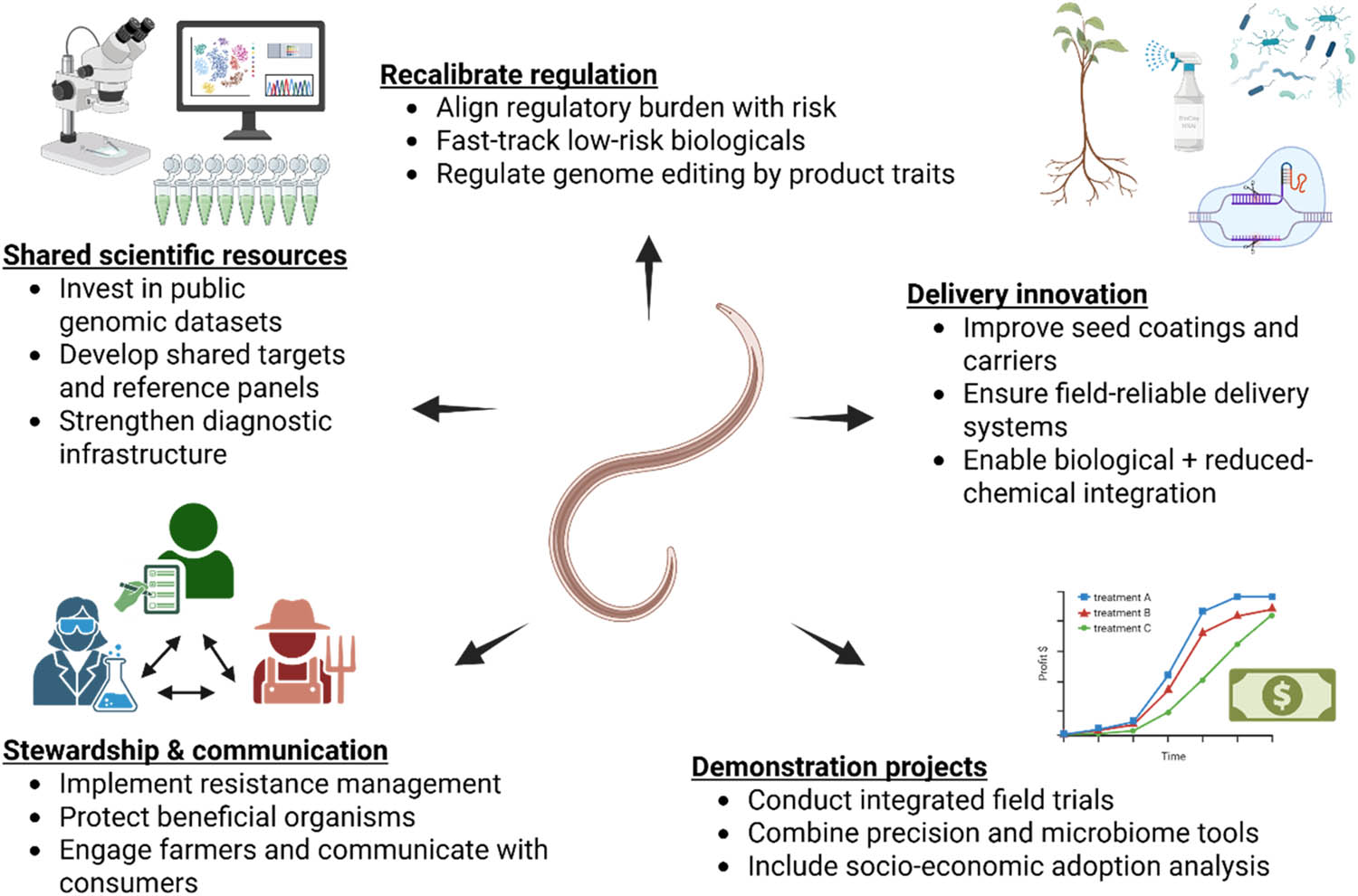
Figure 2
Strategic priorities for enabling effective and scalable PPN management. Created with BioRender.
The second priority is the development and long-term curation of shared public scientific resources. High-quality genome assemblies, expression atlases, validated target panels, and comprehensive non-target reference datasets require substantial upfront investment. Yet once established, they lower barriers to entry for researchers and developers, enable more rigorous risk assessment, and support stewardship strategies such as target rotation and resistance monitoring. Investment in diagnostic infrastructure is equally essential. Well-equipped laboratories, standardized protocols, accreditation, and trained personnel are foundational for credible regulatory decisions and for the responsible scaling of new technologies.
The third priority is to treat delivery as a central component of innovation. Effective placement of microbes or dsRNA in the rhizosphere remains technically challenging under field conditions such as heat, drought, and variable pH. Improved seed coatings and carrier systems can enhance stability and controlled release, but must perform under practical agronomic conditions. Integration with existing crop management practices is essential. Applying full-rate chemical inputs alongside biological agents often yields limited added benefit, whereas reduced-rate chemicals combined with biologicals can achieve comparable control while lowering residues and environmental load. Regulatory frameworks must allow such reduced-rate labeling under defined conditions to enable broader adoption of integrated strategies.
The fourth priority is stewardship and communication. Resistance management plans for biotechnologically improved traits and RNAi-based pesticides should be clearly defined from the outset, with monitoring frameworks and mitigation strategies in place. Compatibility with beneficial organisms must be rigorously documented to support environmental confidence. Farmers should be engaged in co-design to ensure that technologies align with operational realities, including timing and cost constraints. Transparent, accessible education and communication with consumers is equally essential to build understanding and trust.
Finally, coordinated demonstration projects are essential. Field trials that integrate seed certification, precision application, and microbiome-informed interventions can generate practical evidence on system-level performance. Embedding socio-economic assessments within these projects would help identify adoption barriers and refine implementation strategies. Such integrated pilots would ensure that policy and practice are guided by robust evidence rather than assumptions.
4. Recommendations
Advance proportionate, science-based regulatory alignment. OECD-CRP should support harmonized, risk-proportionate regulatory pathways, including fast-track mechanisms for low-risk biologicals, RNA-based products, and minimally edited genome-edited crops. Clear guidance, standardized access and benefit-sharing templates for well-characterized microbes, and regulatory flexibility for integrated approaches (e.g., reduced-rate chemical labeling) are essential. Sustained investment in diagnostic infrastructure – accreditation, training, and inter-laboratory comparisons – should underpin credible oversight and phytosanitary protection.
Strengthen shared scientific infrastructure and decision-support systems. Coordinated investment in public-good datasets – high-quality genomes, expression atlases, validated target panels, and non-target reference sequences – should be prioritized as global research infrastructure. Funding models must recognize their broad value for innovation, risk assessment, and stewardship. Development of decision-support tools integrating microbiome dynamics, climate-informed risk, and IPM options will further translate data into actionable guidance.
Embed delivery, stewardship, and stakeholder engagement in field validation. Demonstration projects should test integrated strategies under real-world conditions, placing delivery systems and resistance stewardship at the center. These pilot studies must incorporate socio-economic assessment, extension, and transparent communication from the outset, engaging farmers and consumers as active stakeholders. Such integrated efforts directly support OECD-CRP goals of managing natural capital, strengthening agricultural resilience, and accelerating the responsible translation of innovation into policy and practice.
Acknowledgements
The authors would like to thank the OECD Co-operative Research Program: Sustainable Agricultural and Food Systems (CRP) for funding this symposium, as well as the PROCINORTE Plant Health Task Force for facilitating the event and generously providing the online broadcasting platform and simultaneous translation. The authors also thank Agriculture and Agri-Food Canada. Finally, this synthesis manuscript would not have been possible without the exceptional contributions of the presenters and all participants.
Funding information
Authors state no funding involved.
Author contributions
B.M. and J.K. contributed to the conceptualization and preparation of the original draft. J.K. was responsible for visualization. All authors contributed to reviewing and editing the manuscript and read and approved the final version
Conflict of interest statement
Authors state no conflict of interest.