
Table 1
Environmental parameters associated with fluopyram trials conducted in Meloidogyne incognita fields
| Test | Year | Soil texturec | Dates of activities | Days until first rain | Rainb (cm) | Avg. air tempa(°C) | Galls/plant | Lint yield (kg/ha) | N d | |||||||
|---|---|---|---|---|---|---|---|---|---|---|---|---|---|---|---|---|
| No nematicide | Fluopyram | No nematicide | Fluopyram | |||||||||||||
| Plant | Roots dug | Mean value | SD | Mean value | SD | Mean value | SD | Mean value | SD | |||||||
| 1 | 2014 | LS | 5/19 | 7/9 | 5 | 1.98 | 23.1 | 7.7 | 5.9 | 3.2 | 2.3 | 969 | 264 | 1,061 | 172 | 12 |
| 2 | 2015 | LS | 5/11 | 7/3 | 2 | 2.54 | 19.1 | 12.2 | 20.1 | 6.2 | 7.0 | 1,083 | 147 | 1,147 | 85 | 12 |
| 3 | 2016 | LS | 5/27 | 7/8 | 4 | 3.05 | 24.7 | 15.5 | 8.6 | 7.4 | 7.2 | 1,473 | 84 | 1,559 | 88 | 16 |
| 4 | 2017 | LS | 5/11 | 6/29 | 8 | 1.27 | 20.6 | 20.2 | 8.8 | 21.4 | 7.7 | 1,116 | 273 | 1,213 | 185 | 8 |
| 5 | 2017 | LS | 5/10 | 6/29 | 9 | 1.27 | 20.4 | 16.6 | 3.7 | 15.8 | 7.8 | 1,230 | 171 | 1,513 | 148 | 12 |
| 6 | 2018 | LS | 5/14 | 7/17 | 6 | 2.13 | 25.8 | 7.7 | 3.2 | 7.0 | 4.2 | 700 | 202 | 757 | 159 | 16 |
| 7 | 2019 | LS | 5/18 | 6/28 | 16 | 2.54 | 22.2 | 7.7 | 2.0 | 6.4 | 1.9 | 823 | 96 | 749 | 99 | 8 |
| 8 | 2019 | LS | 5/18 | 6/28 | 16 | 2.54 | 22.2 | 10.0 | 6.3 | 11.0 | 4.7 | 1,385 | 196 | 1,514 | 123 | 8 |
| 9 | 2019 | LFS | 5/14 | 7/11 | 6 | 3.40 | 22.1 | 17.5 | 9.7 | 14.0 | 5.3 | 2,423 | 131 | 2,531 | 159 | 8 |
| 10 | 2021 | LS | 5/24 | 7/12 | 1 | 2.54 | 22.1 | 12.0 | 4.6 | 19.7 | 11.0 | 1,161 | 128 | 1,261 | 140 | 8 |
| 11 | 2021 | LS | 5/13 | 6/30 | 2 | 1.12 | 22.2 | 17.8 | 9.9 | 12.8 | 5.0 | — | --e | — | -- | 8 |
| 12 | 2023 | SL | 6/2 | 7/12 | 0 | 2.29 | 21.4 | 14.4 | 8.0 | 7.8 | 5.6 | 1,020 | 188 | 894 | 106 | 9 |
| 13 | 2023 | SL | 5/18 | 7/7 | 1 | 0.99 | 20.9 | 15.6 | 12.3 | 18.3 | 15.3 | 1,100 | 108 | 976 | 185 | 8 |
| 14 | 2024 | SL | 5/24 | 7/9 | 5 | 2.31 | 24.3 | 12.7 | 6.7 | 5.5 | 4.5 | 744 | 132 | 892 | 142 | 16 |
| 15 | 2025 | SCL | 6/2 | 7/24 | 1 | 4.29 | 25.0 | 29.0 | 15.8 | 13.3 | 5.6 | 1,401 | 172 | 1,672 | 131 | 10 |
Table 2
Environmental parameters associated with fluopyram (Fc) trials in Rotylenchulus reniformis fields
| Test | Year | Date of activities | Days until first rain | Rainb (cm) | Avg. air tempa(°C) | Reniform nematode/100 cm3 soil | Lint yield (kg/ha) | N c | |||||||
|---|---|---|---|---|---|---|---|---|---|---|---|---|---|---|---|
| No nematicide | Fluopyram | No nematicide | Fluopyram | ||||||||||||
| Plant | Soil sampling | Mean value | SD | Mean value | SD | Mean value | SD | Mean value | SD | ||||||
| 16 | 2014 | 5/10 | 7/9 | 13 | 4.1 | 21.3 | 165 | 124 | 118 | 101 | 812 | 116 | 749 | 131 | 16 |
| 17 | 2015 | 5/27 | 7/15 | 41 | 7.6 | 22.8 | 590 | 386 | 655 | 714 | 884 | 98 | 1,014 | 192 | 12 |
| 18 | 2016 | 5/6 | 7/18 | 3 | 7.6 | 18.9 | 535 | 187 | 418 | 280 | 734 | 208 | 657 | 170 | 12 |
| 19 | 2017 | 5/16 | 7/11 | 1 | 7.6 | 21.4 | 832 | 203 | 912 | 567 | 833 | 174 | 841 | 248 | 10 |
| 20 | 2018 | 5/29 | 7/24 | 5 | 2.3 | 27.9 | 240 | 209 | 170 | 168 | 370 | 91 | 483 | 37 | 8 |
| 21 | 2018 | 5/15 | 7/27 | 0 | 1.6 | 25.5 | 1,194 | 756 | 1,308 | 777 | 439 | 73 | 452 | 56 | 16 |
| 22 | 2019 | 5/31 | 7/15 | 2 | 1.8 | 21.7 | 592 | 443 | 360 | 303 | 577 | 143 | 536 | 125 | 10 |
| 23 | 2020 | 5/22 | 6/28 | 2 | 10.3 | 22.8 | 590 | 453 | 760 | 287 | 700 | 142 | 689 | 118 | 8 |
| 24 | 2021 | 6/8 | 7/24 | 18 | 3.2 | 28.3 | 860 | 761 | 1,510 | 1,449 | 395 | 58 | 470 | 91 | 8 |
| 25 | 2022 | 5/20 | 6/27 | 4 | 4.4 | 22.7 | 345 | 225 | 230 | 136 | 425 | 162 | 354 | 78 | 8 |
| 26 | 2022 | 5/20 | 6/24 | 4 | 4.4 | 22.7 | 113 | 50 | 47 | 12 | 756 | 22 | 943 | 118 | 6 |
| 27 | 2023 | 6/7 | 7/28 | 39 | 1.8 | 25.0 | 350 | 147 | 280 | 190 | 879 | 150 | 895 | 123 | 8 |
| 28 | 2023 | 6/7 | 7/19 | 39 | 1.8 | 25.0 | 110 | 119 | 110 | 115 | 434 | 48 | 488 | 39 | 8 |
| 29 | 2023 | 6/2 | 7/17 | 0 | 2.3 | 22.5 | 528 | 354 | 352 | 182 | 806 | 144 | 788 | 87 | 10 |
| 30 | 2024 | 5/22 | 6/27 | 7 | 1.5 | 24.0 | 92 | 110 | 112 | 64 | 673 | 152 | 688 | 82 | 10 |
| 31 | 2024 | 5/21 | 6/26 | 8 | 1.5 | 23.9 | 320 | 69 | 240 | 97 | 459 | 50 | 452 | 63 | 8 |
| 32 | 2024 | 5/21 | 6/26 | 8 | 1.5 | 23.9 | 615 | 500 | 700 | 202 | 346 | 67 | 284 | 55 | 8 |
| 33 | 2025 | 5/19 | 7/11 | 2 | 5.1 | 22.7 | 212 | 116 | 100 | 54 | 683 | 54 | 662 | 101 | 8 |
Table 3
Pearson correlation coefficients between environmental variablesa and measured plant and nematode variables, with and without fluopyram (F) in root-knot nematode trials
| Fc | First rain | Days | Air temp | Rain30 | Stand | Galls | |
|---|---|---|---|---|---|---|---|
| First rain | A | ||||||
| Days | A | 0.03 | |||||
| Air temp. | A | −0.04 | −0.03 | ||||
| Rain30 | A | 0.51***b | −0.56*** | −0.27** | |||
| Stand | N | 0.28* | 0.29* | −0.32** | −0.04 | ||
| Galls | N | −0.14 | −0.23* | −0.20 | 0.09 | −0.22 | |
| Yield | N | 0.31** | −0.04 | −0.64*** | 0.15 | 0.32** | 0.26* |
| Stand | F | 0.10 | 0.42*** | −0.22 | −0.30** | ||
| Galls | F | −0.33** | −0.02 | -0.21 | -0.22 | 0.04 | |
| Yield | F | 0.21 | 0.01 | -0.56*** | 0.10 | 0.30** | 0.25* |
[i] aFirst rain is the amount of the first rain after planting; Days is the number of days until the first rain after planting; Air temp is the average air temperature for the first 14 days after planting; Rain30 is the amount of rain for the first 30 days after planting; Stand is the plant stand; Galls is the number of galls per plant typically taken 45–60 days after planting; Yield is the cotton lint yield in a plot.
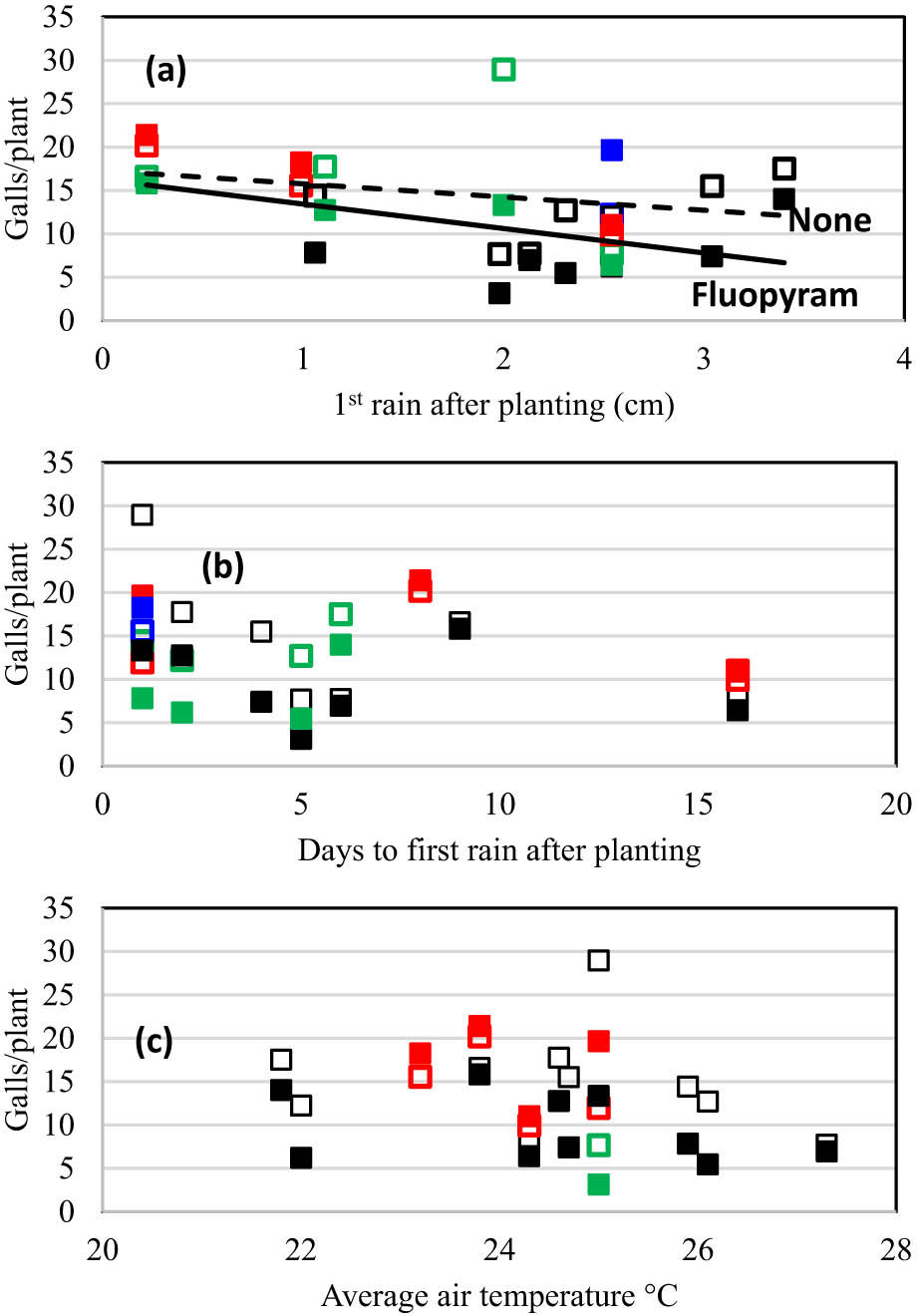
Fig. 1
Effect of fluopyram and various environmental parameters including (a) amount of the first rain after planting (interaction with rain amount and fluopyram), No Fluopyram , with Fluopyram ; (b) number of days until the first rain after planting (not significant for this parameter); and (c) average air temperature for the first 14 days after planting (not significant for this parameter), on galls/plant in Meloidogyne incognita infested field trials. Squares are the least square means for fluopyram (solid) and no nematicide (open) treatments, respectively in a trial. The two treatments have the same color for a given trial per environmental value. Red and blue squares are associated with negative responses, when root galling was higher in fluopyram-treated plots than no nematicide, while green, black, and purple are associated with positive responses, when root galling was lower in fluopyram-treated plots than no nematicide. When an environmental parameter affected root galls significantly as an interaction with treatment, the predicted lines for no nematicide and fluopyram treatments are a dashed and solid line, respectively.
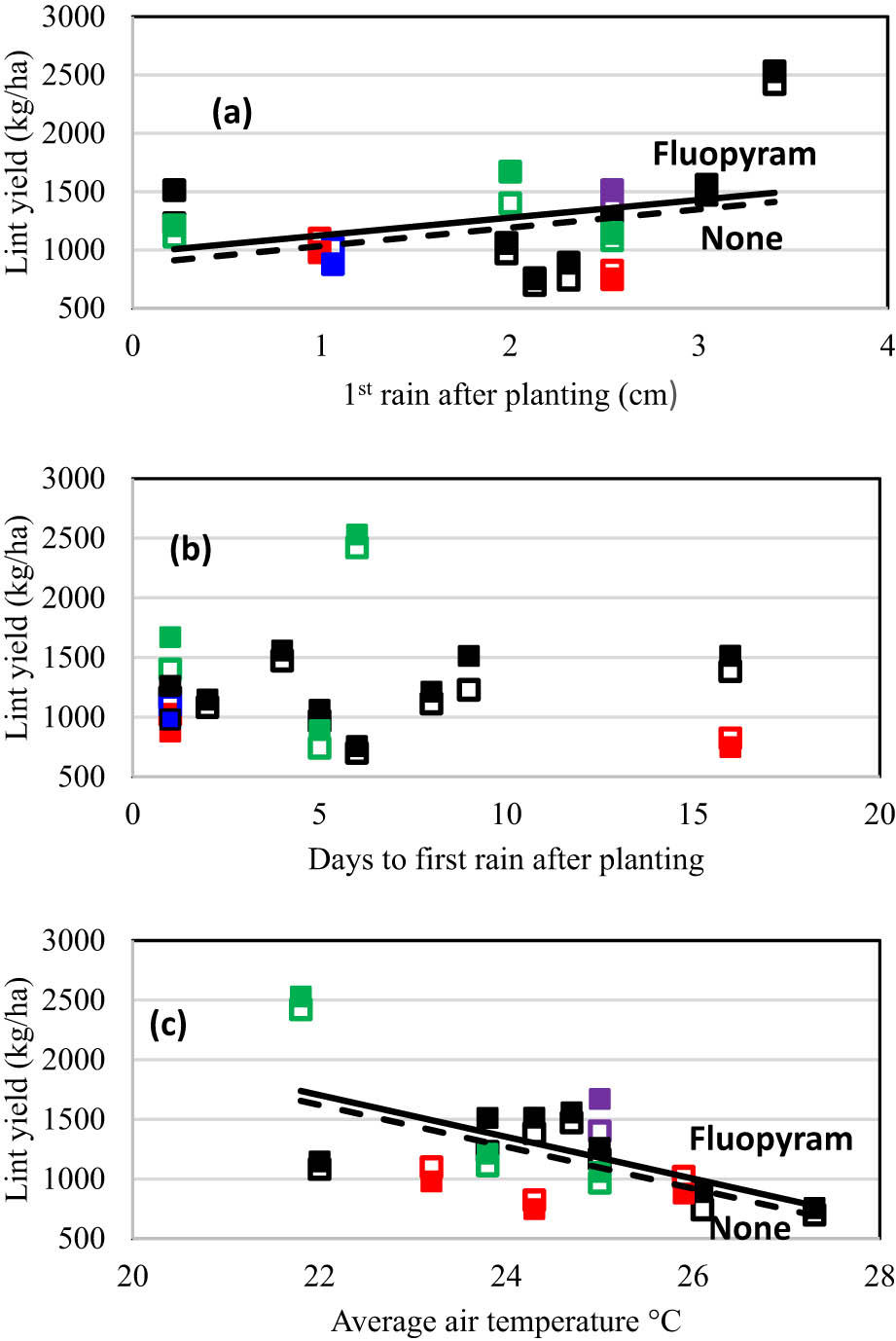
Fig. 2
Effect of fluopyram and various environmental parameters including (a) amount of the first rain after planting (interaction with fluopyram), No fluopyram: with fluopyram: ; (b) number of days until the first rain after planting (not significant for this parameter); and (c) average air temperature for the first 14 days after planting, on cotton lint yield in Meloidogyne incognita infested field trials (interaction with fluopyram), No fluopyram: , With fluopyram: . Squares are the least square means for fluopyram (solid) and no nematicide (open) treatments, respectively in a trial. The two treatments have the same color for a given trial per environmental value. Red and blue squares are associated with negative responses, when lint yield was lower in fluopyram-treated plots than no nematicide, while green, black, and purple are associated with positive responses, when lint yield was higher in fluopyram-treated plots than no nematicide. When an environmental parameter affected lint yield significantly as an interaction with fluopyram, then the predicted lines for no nematicide and fluopyram treatments are a dashed and solid line, respectively.
Table 4
Pearson correlation coefficients between environmental variablesa and measured plant and nematode variables with and without fluopyram (F) in reniform nematode trials
| − | Fc | First rain | Days | Temp | Rain30 | Stand | Ren | LREN |
|---|---|---|---|---|---|---|---|---|
| First rain | A | 0.02 | −0.53*** | 0.30*** | ||||
| Days | A | 0.02 | 0.21** | −0.34*** | ||||
| Temp | A | −0.53*** | 0.21** | −0.47*** | ||||
| Rain30 | A | 0.30*** | −0.34*** | −0.47*** | ||||
| Stand | N | −0.20 | 0.04 | 0.06 | 0.01 | |||
| Ren | N | 0.04 | −0.19 | 0.13 | −0.22* | −0.01 | ||
| LREN | N | 0.16 | −0.23* | −0.01 | −0.16 | 0.02 | 0.77*** | |
| Yield | N | 0.43*** | 0.16 | −0.54*** | −0.17 | −0.13 | 0.01 | |
| Stand | F | −0.16 | 0.07 | 0.01 | 0.02 | |||
| Ren | F | 0.07 | −0.05 | 0.24* | −0.19 | −0.01 | ||
| LREN | F | 0.19 | −0.04 | 0.06 | −0.16 | 0.04 | 0.76*** | |
| Yield | F | 0.45*** | 0.37*** | −0.33** | −0.09 | −0.06 | −0.14 | −0.12 |
[i] aFirst rain is the amount of the first rain after planting; Days is the number of days until the first rain after planting; Air temp is the average air temperature for the first 14 days after planting; Rain30 is the amount of rain for the first 30 days after planting; Stand is the plant stand; Ren is the vermiform reniform nematodes taken typically 45–60 days after planting; LREN is a LOG10 transformation of Ren/100 cm3 soil; Yield is the cotton lint yield in a plot.
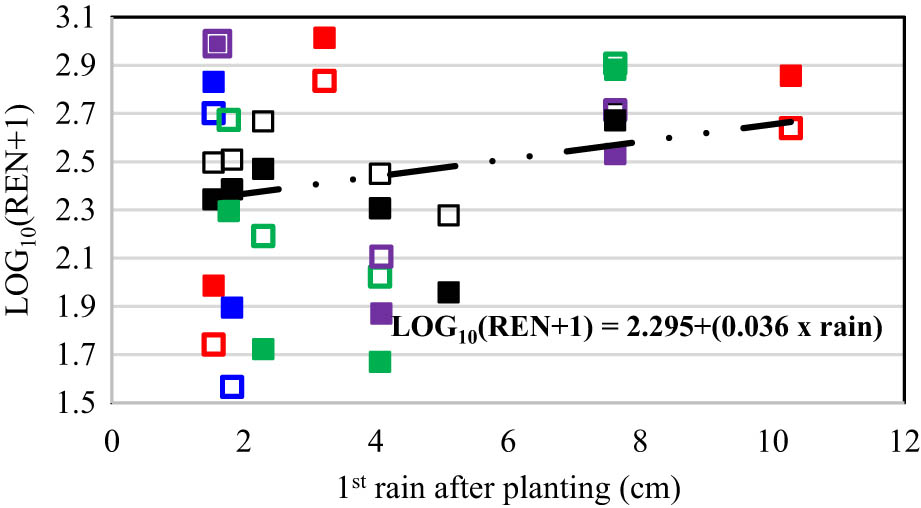
Fig. 3
Rotylenchulus reniformis vermiform stages (REN)/100 cm3 soil, with a LOG10 transformation (LREN) as affected by the amount of rain in the first rain after planting. Squares are the least square means for fluopyram (solid) and no nematicide (open) treatments, respectively in a trial. The two treatments have the same color for a given trial per environmental value. Red and blue squares are associated with negative responses, when LREN was higher in fluopyram-treated plots than no nematicide, while green, black, and purple are associated with positive responses, when LREN was lower in fluopyram-treated plots than no nematicide. The amount of the first rain after planting affected LREN, but nematicide did not, so the single line is predicted LREN based only on rain amount.
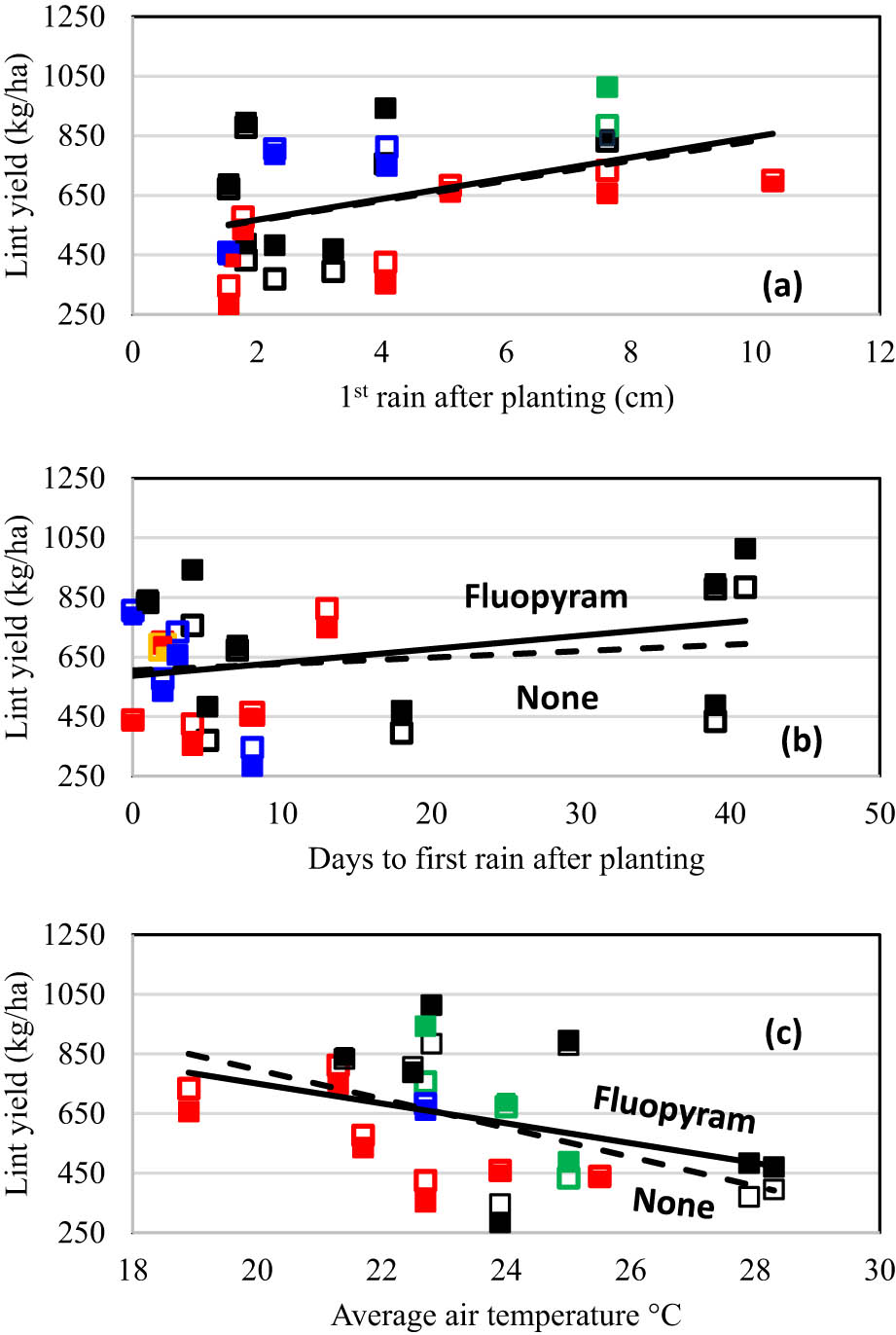
Fig. 4
Effect of fluopyram and various environmental parameters including (a) amount of the first rain after planting (interaction with fluopyram), No nematicide: , With fluopyram: ; (b) number of days until the first rain after planting (interaction with fluopyram), No nematicide: , With fluopyram: ; and (c) average air temperature for the first 14 days after planting (interaction with fluopyram), No nematicide: , With fluopyram: , on cotton lint yield in Rotylenchulus reniformis infested field trials. Squares are the least square means for fluopyram (solid) and no nematicide (open) treatments, respectively in a trial. The two treatments have the same color for a given trial per environmental value. Red, blue, or orange squares are associated with negative responses, when lint yield was lower in fluopyram-treated plots than no nematicide, while green, black, and purple are associated with positive responses, when lint yield was higher in fluopyram-treated plots than no nematicide. When an environmental parameter affected lint yield significantly as an interaction with fluopyram, then the predicted lines for no nematicide and fluopyram treatment are a dashed and solid line, respectively.