
Cotton (Gossypium spp.) is affected by several different plant parasitic nematodes including Meloidogyne incognita (root-knot nematode) and Rotylenchulus reniformis (reniform nematode). In the United States, M. incognita is commonly found in most of the states that produce cotton (Faske et al., 2023), while R. reniformis is found in most cotton producing states east of New Mexico (Faske et al., 2024a). Since yield losses to plant parasitic nematodes can be substantial, nematode management is important for profitable cotton production. Management options can include crop rotation to nonhosts, use of nematode resistant varieties, and use of nematicides including nonfumigant nematicides used as seed treatment, at-plant in-furrow application, and post-emergence application (Faske et al., 2022, 2024b; Koenning et al., 2004).
Fluopyram, which was discovered in 2007 (Fought et al., 2009), is labeled in the United States for at-plant in-furrow application. The product was originally called Velum® Total (Bayer CropScience, Research Triangle Park, North Carolina, U.S.), which included a nematicide fluopyram and an insecticide imidacloprid. This product was discontinued and became simply Velum® containing fluopyram without the insecticide component. Fluopyram, which has nematicide activity (Faske and Hurd, 2015) has lower solubility in water (15–16 mg/L at 20°C, [Rathod et al., 2022]) than aldicarb (6,000 mg/L, [Andrews et al., 1971; Mink et al., 1989]). These nematicides can be applied 1.5–4.0 cm below the soil surface in the planting furrow and must be moved via rainfall or irrigation to depths where they can contact nematodes, which are moving to infect the developing root system. Properties of nonfumigant nematicide movement in soil are complicated but can be affected by moisture applied, soil texture, organic matter, and other attributes (Noland, 1997). Fluopyram is known to have somewhat poor mobility in soil but can be highly persistent in soil (Rathod et al., 2022). So, it would not be surprising if the effectiveness of fluopyram at controlling plant parasitic nematodes was somewhat different than that of aldicarb (which is more mobile in soil).
In the semi-arid climate of the Southern High Plains of Texas, rainfall can be sporadic and overall lower in amount than in other cotton producing regions in the midsouth or southeastern U.S. There are questions as to the effectiveness of a less mobile nematicide like fluopyram in an environment with lower rainfall and limited irrigation. In addition, soil moisture and temperatures at planting can impact the rate at which nematodes hatch and move to infect plants (Trudgill, 1995; Tyler, 1933; Wallace, 1966). Both the dynamics of the nematicide and the nematodes are important in determining the effectiveness of a product, and both can be driven by environmental conditions. The objectives of this research were to determine if environmental parameters in the field such as timing of rainfall and rain amounts and temperature after planting impacted fluopyram related nematode control in cotton field trials.
1. Materials and methods
1.1. Field plots
Field trials were conducted in M. incognita or R. reniformis infested fields. Plots were four rows wide, 10.7 m long, on 1.02 m centers. Plots were planted using a cone planter with 13 seeds/m row. Each trial consisted of various treatments but included in each trial were a no nematicide treatment and fluopyram applied at-plant in-furrow at labeled rates. If Velum Total was utilized (2014–2019), then the rate was either 184 or 237 g fluopyram/ha, and if Velum was utilized, then the rate was either 218 or 249 g fluopyram/ha. All other treatments were removed from the data set. The treatments were replicated 4–5 times/trial and arranged in a randomized complete block design. The applications were made at 46.8 L/ha using a CO2 driven system set at 207 kPa, with an orifice plate size 31 (part 4916-31, TeeJet Technologies, Springfield, Illinois, U.S.). The liquid produced was a stream that was positioned to fall in the seed furrow after seed drop and before row closure. The M. incognita test sites ranged in sand content from 66 to 86% (mostly loamy sand class), with low organic matter (<1%) and high pH (range of 7.4–8.5). Site details are provided in Table 1 (M. incognita) and Table 2 (R. reniformis). Plant stand were taken by counting one entire row for each plot, once stands had stabilized (typically around 30 days after planting). Trials 1–11 were irrigated with a center pivot system; 12–15 were with subsurface drip irrigation. Trials 16–33 had furrow irrigation. Trials 1–11 and 16–33 were not irrigated until later than 30 days after planting, so rain was the only water source used for analysis. Any irrigation applied in trials 12–15 was at >40 cm depth, so did not impact fluopyram distribution.
Table 1
Environmental parameters associated with fluopyram trials conducted in Meloidogyne incognita fields
| Test | Year | Soil texturec | Dates of activities | Days until first rain | Rainb (cm) | Avg. air tempa(°C) | Galls/plant | Lint yield (kg/ha) | N d | |||||||
|---|---|---|---|---|---|---|---|---|---|---|---|---|---|---|---|---|
| No nematicide | Fluopyram | No nematicide | Fluopyram | |||||||||||||
| Plant | Roots dug | Mean value | SD | Mean value | SD | Mean value | SD | Mean value | SD | |||||||
| 1 | 2014 | LS | 5/19 | 7/9 | 5 | 1.98 | 23.1 | 7.7 | 5.9 | 3.2 | 2.3 | 969 | 264 | 1,061 | 172 | 12 |
| 2 | 2015 | LS | 5/11 | 7/3 | 2 | 2.54 | 19.1 | 12.2 | 20.1 | 6.2 | 7.0 | 1,083 | 147 | 1,147 | 85 | 12 |
| 3 | 2016 | LS | 5/27 | 7/8 | 4 | 3.05 | 24.7 | 15.5 | 8.6 | 7.4 | 7.2 | 1,473 | 84 | 1,559 | 88 | 16 |
| 4 | 2017 | LS | 5/11 | 6/29 | 8 | 1.27 | 20.6 | 20.2 | 8.8 | 21.4 | 7.7 | 1,116 | 273 | 1,213 | 185 | 8 |
| 5 | 2017 | LS | 5/10 | 6/29 | 9 | 1.27 | 20.4 | 16.6 | 3.7 | 15.8 | 7.8 | 1,230 | 171 | 1,513 | 148 | 12 |
| 6 | 2018 | LS | 5/14 | 7/17 | 6 | 2.13 | 25.8 | 7.7 | 3.2 | 7.0 | 4.2 | 700 | 202 | 757 | 159 | 16 |
| 7 | 2019 | LS | 5/18 | 6/28 | 16 | 2.54 | 22.2 | 7.7 | 2.0 | 6.4 | 1.9 | 823 | 96 | 749 | 99 | 8 |
| 8 | 2019 | LS | 5/18 | 6/28 | 16 | 2.54 | 22.2 | 10.0 | 6.3 | 11.0 | 4.7 | 1,385 | 196 | 1,514 | 123 | 8 |
| 9 | 2019 | LFS | 5/14 | 7/11 | 6 | 3.40 | 22.1 | 17.5 | 9.7 | 14.0 | 5.3 | 2,423 | 131 | 2,531 | 159 | 8 |
| 10 | 2021 | LS | 5/24 | 7/12 | 1 | 2.54 | 22.1 | 12.0 | 4.6 | 19.7 | 11.0 | 1,161 | 128 | 1,261 | 140 | 8 |
| 11 | 2021 | LS | 5/13 | 6/30 | 2 | 1.12 | 22.2 | 17.8 | 9.9 | 12.8 | 5.0 | — | --e | — | -- | 8 |
| 12 | 2023 | SL | 6/2 | 7/12 | 0 | 2.29 | 21.4 | 14.4 | 8.0 | 7.8 | 5.6 | 1,020 | 188 | 894 | 106 | 9 |
| 13 | 2023 | SL | 5/18 | 7/7 | 1 | 0.99 | 20.9 | 15.6 | 12.3 | 18.3 | 15.3 | 1,100 | 108 | 976 | 185 | 8 |
| 14 | 2024 | SL | 5/24 | 7/9 | 5 | 2.31 | 24.3 | 12.7 | 6.7 | 5.5 | 4.5 | 744 | 132 | 892 | 142 | 16 |
| 15 | 2025 | SCL | 6/2 | 7/24 | 1 | 4.29 | 25.0 | 29.0 | 15.8 | 13.3 | 5.6 | 1,401 | 172 | 1,672 | 131 | 10 |
Table 2
Environmental parameters associated with fluopyram (Fc) trials in Rotylenchulus reniformis fields
| Test | Year | Date of activities | Days until first rain | Rainb (cm) | Avg. air tempa(°C) | Reniform nematode/100 cm3 soil | Lint yield (kg/ha) | N c | |||||||
|---|---|---|---|---|---|---|---|---|---|---|---|---|---|---|---|
| No nematicide | Fluopyram | No nematicide | Fluopyram | ||||||||||||
| Plant | Soil sampling | Mean value | SD | Mean value | SD | Mean value | SD | Mean value | SD | ||||||
| 16 | 2014 | 5/10 | 7/9 | 13 | 4.1 | 21.3 | 165 | 124 | 118 | 101 | 812 | 116 | 749 | 131 | 16 |
| 17 | 2015 | 5/27 | 7/15 | 41 | 7.6 | 22.8 | 590 | 386 | 655 | 714 | 884 | 98 | 1,014 | 192 | 12 |
| 18 | 2016 | 5/6 | 7/18 | 3 | 7.6 | 18.9 | 535 | 187 | 418 | 280 | 734 | 208 | 657 | 170 | 12 |
| 19 | 2017 | 5/16 | 7/11 | 1 | 7.6 | 21.4 | 832 | 203 | 912 | 567 | 833 | 174 | 841 | 248 | 10 |
| 20 | 2018 | 5/29 | 7/24 | 5 | 2.3 | 27.9 | 240 | 209 | 170 | 168 | 370 | 91 | 483 | 37 | 8 |
| 21 | 2018 | 5/15 | 7/27 | 0 | 1.6 | 25.5 | 1,194 | 756 | 1,308 | 777 | 439 | 73 | 452 | 56 | 16 |
| 22 | 2019 | 5/31 | 7/15 | 2 | 1.8 | 21.7 | 592 | 443 | 360 | 303 | 577 | 143 | 536 | 125 | 10 |
| 23 | 2020 | 5/22 | 6/28 | 2 | 10.3 | 22.8 | 590 | 453 | 760 | 287 | 700 | 142 | 689 | 118 | 8 |
| 24 | 2021 | 6/8 | 7/24 | 18 | 3.2 | 28.3 | 860 | 761 | 1,510 | 1,449 | 395 | 58 | 470 | 91 | 8 |
| 25 | 2022 | 5/20 | 6/27 | 4 | 4.4 | 22.7 | 345 | 225 | 230 | 136 | 425 | 162 | 354 | 78 | 8 |
| 26 | 2022 | 5/20 | 6/24 | 4 | 4.4 | 22.7 | 113 | 50 | 47 | 12 | 756 | 22 | 943 | 118 | 6 |
| 27 | 2023 | 6/7 | 7/28 | 39 | 1.8 | 25.0 | 350 | 147 | 280 | 190 | 879 | 150 | 895 | 123 | 8 |
| 28 | 2023 | 6/7 | 7/19 | 39 | 1.8 | 25.0 | 110 | 119 | 110 | 115 | 434 | 48 | 488 | 39 | 8 |
| 29 | 2023 | 6/2 | 7/17 | 0 | 2.3 | 22.5 | 528 | 354 | 352 | 182 | 806 | 144 | 788 | 87 | 10 |
| 30 | 2024 | 5/22 | 6/27 | 7 | 1.5 | 24.0 | 92 | 110 | 112 | 64 | 673 | 152 | 688 | 82 | 10 |
| 31 | 2024 | 5/21 | 6/26 | 8 | 1.5 | 23.9 | 320 | 69 | 240 | 97 | 459 | 50 | 452 | 63 | 8 |
| 32 | 2024 | 5/21 | 6/26 | 8 | 1.5 | 23.9 | 615 | 500 | 700 | 202 | 346 | 67 | 284 | 55 | 8 |
| 33 | 2025 | 5/19 | 7/11 | 2 | 5.1 | 22.7 | 212 | 116 | 100 | 54 | 683 | 54 | 662 | 101 | 8 |
Plots were harvested with a two-row cotton stripper (John Deer 484) modified to catch the harvest material (lint, seed, burrs, trash) in a cage set on load cells to record total weight. A 1,000 g sample was taken and ginned to obtain the percentage of the harvest weight that was lint. Yield was the lint weight per hectare (kg/ha).
1.2. Weather measurements
Weather parameters (maximum and minimum daily temperature and rain) were monitored for each site, either on-site or with the nearest weather station. If weather stations were off-site, the first rain event after planting was verified through an on-site soil moisture sensor (10 cm depth, #6460 WaterScout SM 100 sensor and WatchDog 1200 series data logger, Spectrum Technologies, Inc., Aurora, IL). The rain amount was obtained by the weather station or rain gauge, but there had to be a measurable increase in soil moisture indicated by the soil moisture sensor to call it a “rain event.” Rain events >0.2 cm were used as the first rain event, smaller amounts of rain were not counted towards the first rain event.
The weather parameters of interest were days to first rain event after planting, amount of first rain event (cm), amount of rain (summed) for 30 days after planting, and average air temperature for 14 days after planting. The weather station was a 3000 series (air temperature and rain on 1-h intervals, manually downloaded at end of season, model now obsolete, Spectrum Technologies Inc.); and west Texas mesonet (mesonet.ttu.edu). Trials 1–8 and 11, and trials 16–32 had weather data collected with the weather stations as well as a rain gauge. Trial 9 depended on the west Texas mesonet site, which was 2.4 km from the test site. Trial 10 utilized the west Texas mesonet site, which was 20.8 km distant. Trials 12–14 used the west Texas mesonet site, which was 2.3 km away. Trial 15 used an on-site rain gauge and west Texas mesonet site for air temperature only located 6.6 km distant. Site 33 had an on-site rain gauge and west Texas mesonet site for air temperature only (located 9.8 km distant).
1.3. Nematode measurements
Plant root systems (5–10 plants/plot depending on test) for M. incognita locations were dug up at 45–60 days after planting and the number of root galls per plant were counted and averaged per plot. Soil samples taken at the root-knot nematode test sites had no other significant cotton plant parasitic nematodes (i.e., genera found were low densities of Pratylenchus and Tylenchorhynchus).
All the R. reniformis test sites were located at the Texas A&M AgriLife Research and Extension Center in Lubbock. The soil texture was a sandy clay loam with low organic matter (0.2%), high pH (7.8), and sand, silt, and clay content were 56, 16, and 28%, respectively. Composite soil samples were taken between 45 and 60 days after planting and assayed for mobile plant parasitic nematodes. Soil was mixed, and 200 cm3 soil was placed in a modified Baermann funnel apparatus called a pie-pan (Thistlethwayte, 1970). Samples were run for 48 h, and then the water was concentrated to 50–100 mL and either a 5 mL or 10 mL aliquot was used to identify and count plant parasitic nematodes. Rotylenchulus reniformis was the only plant parasitic nematode of significance for cotton that was present.
1.4. Analysis
A mixed model analysis was conducted for each nematode species separately using PROC GLIMMIX with SAS version 9.4 (SAS Institute, Cary, NC, USA). The fixed factor was fluopyram applied either at a labeled rate (given a value of 1) or no nematicide treatment (given a value of 0). A covariate term for days of the first rain event, rain amount (cm), rain amount for 30 days, and average air temperature for the first 14 days after planting were tested in models along with the fixed factor of fluopyram (Type III fixed effects). Also tested were the interaction between fluopyram and the environmental variables. The random term was replication nested within year, site, and test (random replication/subject = year(site x test)). Galls per plant, reniform nematode density, LOG10 transformed reniform nematode density, and lint yield (kg/ha) were the dependent variables. A model containing an environmental factor was accepted if the factor was significant (P = 0.05), or the interaction term was significant (P = 0.05). If both the environmental term alone and the interaction term was significant, then the model with the lowest Akaike information criterion ([AIC] Akaike, 1974) value was chosen. Only plots planted with nematode susceptible varieties were included in the analysis. The solutions function was used to provide the equation for the significant model for both fluopyram treated and no nematicide treatment. If fluopyram/no nematicide treatment did not significantly impact the dependent variable, but an environmental parameter did impact the dependent variable, then regression analysis was performed to relate the environmental parameter to the dependent variable (PROC REG, SAS version 9.4). Pearson’s correlation coefficients (PROC CORR, SAS version 9.4) were conducted separately for the root-knot and reniform nematode trials for the environmental parameters, galls/plant, reniform nematode density, transformed (LOG10(Reniform nematodes/100 cm3 soil + 1) reniform nematode density, plant stand, and yield.
2. Results
Meloidogyne incognita: The amount of rain in the first rain after planting was positively correlated with rain summed for 30 days after planting but was not correlated with the other environmental parameters (number of days until first rain and average air temperature for 14 days after planting) (Table 3). Rain summed for 30 days after planting was negatively correlated with the number of days until the first rain event and the average air temperature. For the no nematicide treatment, plant stand was positively correlated with the amount of the first rain and number of days to the first rain and negatively correlated with air temperature (Table 3). For fluopyram-treated plots, plant stand was correlated with the number of days until the first rain and negatively correlated with the sum of rain for 30 days after planting. Galls per root for no nematicide were negatively correlated with the number of days until the first rain, while for fluopyram treated plots, it was negatively correlated with the amount of the first rain. Yield for no nematicide plots was positively correlated with the amount of the first rain and negatively correlated with air temperature. Yield for fluopyram-treated plots was negatively correlated with air temperature. Yield for both nematicide-treated and no nematicide plots were positively correlated with plant stand and number of galls/root.
Table 3
Pearson correlation coefficients between environmental variablesa and measured plant and nematode variables, with and without fluopyram (F) in root-knot nematode trials
| Fc | First rain | Days | Air temp | Rain30 | Stand | Galls | |
|---|---|---|---|---|---|---|---|
| First rain | A | ||||||
| Days | A | 0.03 | |||||
| Air temp. | A | −0.04 | −0.03 | ||||
| Rain30 | A | 0.51***b | −0.56*** | −0.27** | |||
| Stand | N | 0.28* | 0.29* | −0.32** | −0.04 | ||
| Galls | N | −0.14 | −0.23* | −0.20 | 0.09 | −0.22 | |
| Yield | N | 0.31** | −0.04 | −0.64*** | 0.15 | 0.32** | 0.26* |
| Stand | F | 0.10 | 0.42*** | −0.22 | −0.30** | ||
| Galls | F | −0.33** | −0.02 | -0.21 | -0.22 | 0.04 | |
| Yield | F | 0.21 | 0.01 | -0.56*** | 0.10 | 0.30** | 0.25* |
[i] aFirst rain is the amount of the first rain after planting; Days is the number of days until the first rain after planting; Air temp is the average air temperature for the first 14 days after planting; Rain30 is the amount of rain for the first 30 days after planting; Stand is the plant stand; Galls is the number of galls per plant typically taken 45–60 days after planting; Yield is the cotton lint yield in a plot.
The ability of fluopyram to reduce root galls caused by M. incognita was significant over the 15 field trials (P = 0.005, no nematicide = 14.4 galls, fluopyram-treated plots = 10.9 galls, AIC = 1,137). The quantity of rain in the first rain event after planting was significant (P = 0.014, AIC = 1,129), as well as the interaction between fluopyram ( +/−) and quantity of the first rain event (P = 0.031, AIC = 1,126). The interaction model was chosen then to examine the impact of rain quantity on the ability of fluopyram to affect root galling (Fig. 1a). It should be noted, however, that the model improvement with rain quantity was minimal, and most of the impact on root galls was due to fluopyram application (independent of the environmental factors examined). Of the 15 data sets analyzed, in 4 cases, the average number of root galls was higher (numerically, not necessarily significant at P = 0.05) in the presence of fluopyram than in its absence. The model for galls/plant as a function of the interaction with fluopyram and the first rain event amount was as follows:
With Fluopyram where galls are galls/plant and rain is in cm.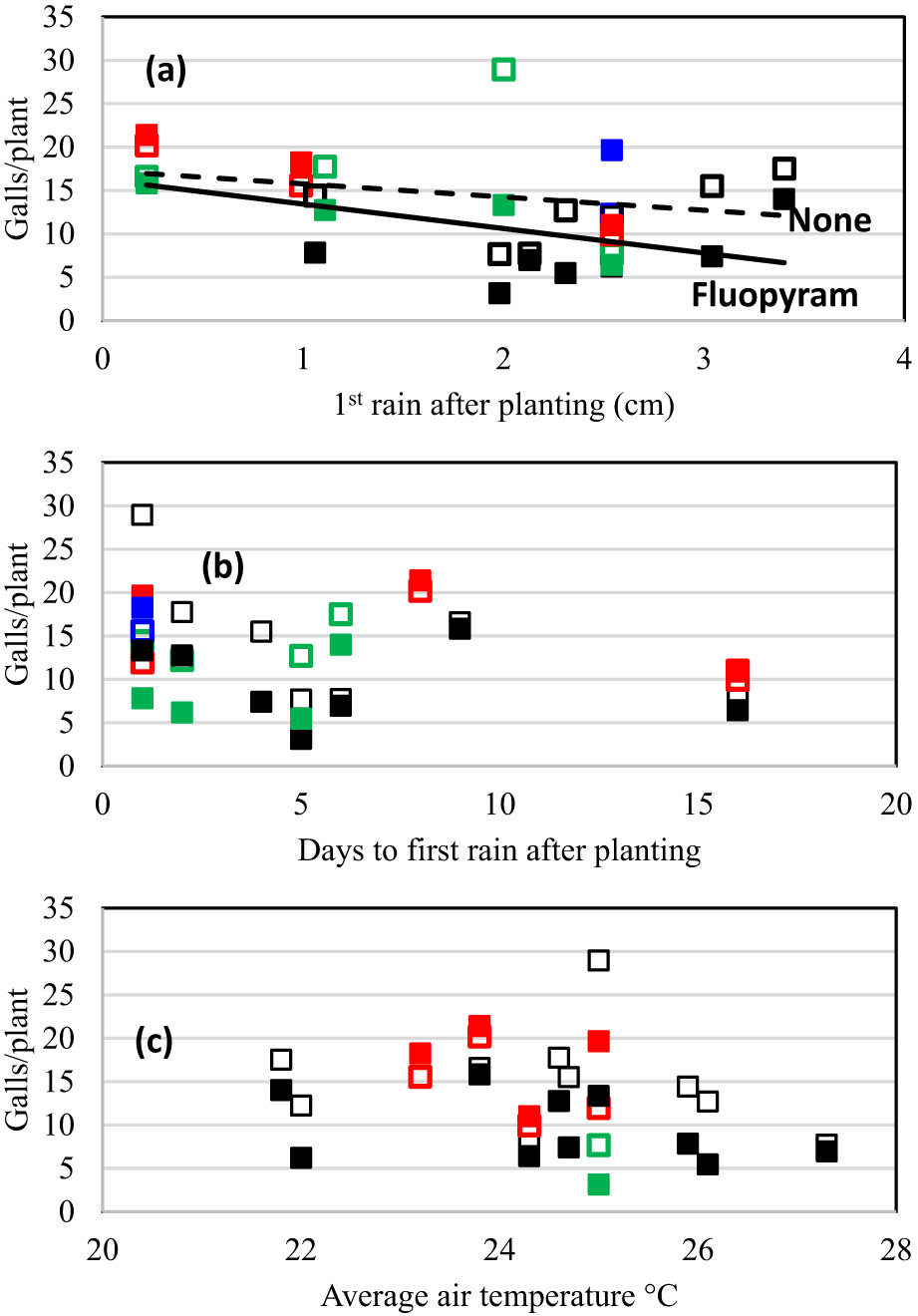
Fig. 1
Effect of fluopyram and various environmental parameters including (a) amount of the first rain after planting (interaction with rain amount and fluopyram), No Fluopyram , with Fluopyram ; (b) number of days until the first rain after planting (not significant for this parameter); and (c) average air temperature for the first 14 days after planting (not significant for this parameter), on galls/plant in Meloidogyne incognita infested field trials. Squares are the least square means for fluopyram (solid) and no nematicide (open) treatments, respectively in a trial. The two treatments have the same color for a given trial per environmental value. Red and blue squares are associated with negative responses, when root galling was higher in fluopyram-treated plots than no nematicide, while green, black, and purple are associated with positive responses, when root galling was lower in fluopyram-treated plots than no nematicide. When an environmental parameter affected root galls significantly as an interaction with treatment, the predicted lines for no nematicide and fluopyram treatments are a dashed and solid line, respectively.
While the number of galls/plant are primarily a function of the nematode pressure in that site, the dynamics of those gall numbers between the presence or absence of fluopyram is what is important. The model predicted small differences in galls at low amounts of rain, but the proportion of galls between +/− fluopyram becomes larger as the rain amount increases (Fig. 1a). The predicted reduction in galls at 1, 2, and 3 cm rain is 15%, 26%, and 39%, respectively. There was no significant (P > 0.05) impact of the number of days until the first rain event (Fig. 1b), rain amount for 30 days after planting (data not presented), and average air temperature on the number of galls per plant (Fig. 1c).
Lint yield was improved by fluopyram (P = 0.003, no nematicide = 1,185 kg lint/ha and fluopyram-treated plots = 1,270 kg lint/ha, AIC = 2,142). The quantity of the first rain after planting did impact lint yield both independent from fluopyram (P = 0.011, AIC = 2,125) and as an interaction with fluopyram (P = 0.034, AIC = 2,117). There was an increase in lint yield associated with higher rain quantities in the first rain after planting (Fig. 2a). There was higher lint yield predicted for fluopyram treated plots, but the slopes of the lines were very similar (157.4 vs 152.1).
With fluopyram: where lint yield is in kg/ha and rain is in cm.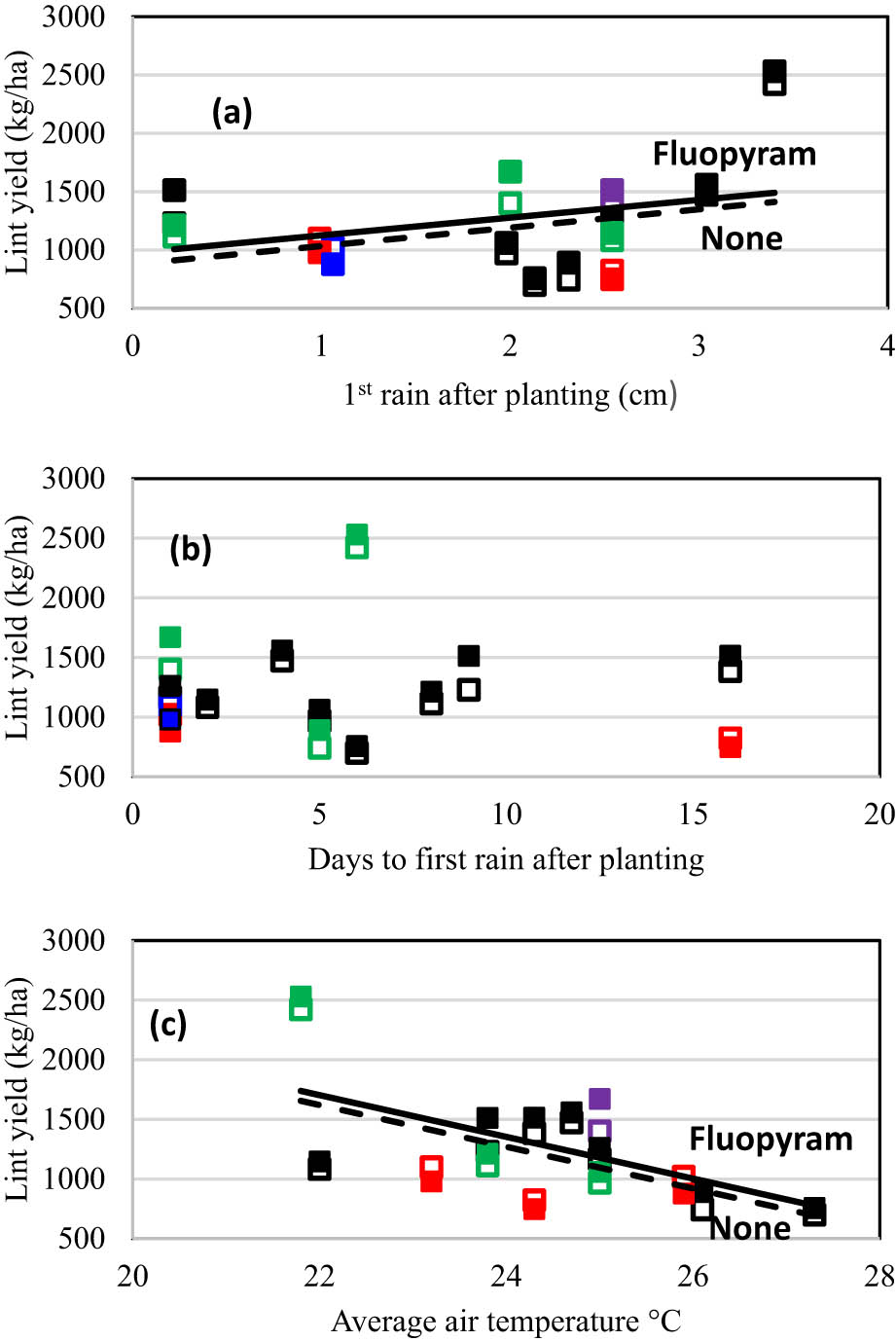
Fig. 2
Effect of fluopyram and various environmental parameters including (a) amount of the first rain after planting (interaction with fluopyram), No fluopyram: with fluopyram: ; (b) number of days until the first rain after planting (not significant for this parameter); and (c) average air temperature for the first 14 days after planting, on cotton lint yield in Meloidogyne incognita infested field trials (interaction with fluopyram), No fluopyram: , With fluopyram: . Squares are the least square means for fluopyram (solid) and no nematicide (open) treatments, respectively in a trial. The two treatments have the same color for a given trial per environmental value. Red and blue squares are associated with negative responses, when lint yield was lower in fluopyram-treated plots than no nematicide, while green, black, and purple are associated with positive responses, when lint yield was higher in fluopyram-treated plots than no nematicide. When an environmental parameter affected lint yield significantly as an interaction with fluopyram, then the predicted lines for no nematicide and fluopyram treatments are a dashed and solid line, respectively.
The number of days until the first rain event did not impact lint yield either alone (P = 0.916) or with an interaction with fluopyram (P = 0.920) (Fig. 2b). Average air temperature for the first 14 days after planting was significant both alone (P = 0.011, AIC = 1,896) and with an interaction with fluopyram (P = 0.001, AIC = 1,888). The general trend was that lint yield decreased as air temperature increased (Fig. 2c). Fluopyram-treated plots had higher yields than those with no nematicide, but the slopes of the two lines were very similar (177.5 vs 177.4).
With fluopyram: where lint yield is in kg/ha, and air temperature is in °C. Rain amount over the first 30 days did not impact lint yield either alone (P = 0.107) or as an interaction term with fluopyram (P = 0.261).Rotylenchulus reniformis: The amount of the first rain after planting was negatively correlated with average air temperature for 14 days and positively correlated with rain for 30 days (Table 4). The number of days until the first rain was positively correlated with air temperature for 14 days and negatively correlated with rain for 30 days after planting. Rain for 30 days after planting was positively correlated with the first rain amount and negatively correlated with the number of days until the first rain, and average air temperature for 14 days. Air temperature for the first 14 days was negatively correlated with first rain amount. Plant stand (with and without fluopyram plots) was not correlated with any environmental parameters, or reniform nematode density, or yield. Reniform nematode density was positively correlated with average air temperature in fluopyram-treated plots and negatively correlated with rain for 30 days after planting in the nontreated plots. Transformed reniform nematode density was correlated with reniform nematode density, and in the no nematicide plots, it was negatively correlated with the number of days until the first rain. Yield was positively correlated with the amount of the first rain and negatively correlated with the air temperature for all plots. With fluopyram-treated plots, yield was positively correlated with the number of days until the first rain. Yield was not correlated with plant stand, reniform nematode density, or transformed nematode density.
Table 4
Pearson correlation coefficients between environmental variablesa and measured plant and nematode variables with and without fluopyram (F) in reniform nematode trials
| − | Fc | First rain | Days | Temp | Rain30 | Stand | Ren | LREN |
|---|---|---|---|---|---|---|---|---|
| First rain | A | 0.02 | −0.53*** | 0.30*** | ||||
| Days | A | 0.02 | 0.21** | −0.34*** | ||||
| Temp | A | −0.53*** | 0.21** | −0.47*** | ||||
| Rain30 | A | 0.30*** | −0.34*** | −0.47*** | ||||
| Stand | N | −0.20 | 0.04 | 0.06 | 0.01 | |||
| Ren | N | 0.04 | −0.19 | 0.13 | −0.22* | −0.01 | ||
| LREN | N | 0.16 | −0.23* | −0.01 | −0.16 | 0.02 | 0.77*** | |
| Yield | N | 0.43*** | 0.16 | −0.54*** | −0.17 | −0.13 | 0.01 | |
| Stand | F | −0.16 | 0.07 | 0.01 | 0.02 | |||
| Ren | F | 0.07 | −0.05 | 0.24* | −0.19 | −0.01 | ||
| LREN | F | 0.19 | −0.04 | 0.06 | −0.16 | 0.04 | 0.76*** | |
| Yield | F | 0.45*** | 0.37*** | −0.33** | −0.09 | −0.06 | −0.14 | −0.12 |
[i] aFirst rain is the amount of the first rain after planting; Days is the number of days until the first rain after planting; Air temp is the average air temperature for the first 14 days after planting; Rain30 is the amount of rain for the first 30 days after planting; Stand is the plant stand; Ren is the vermiform reniform nematodes taken typically 45–60 days after planting; LREN is a LOG10 transformation of Ren/100 cm3 soil; Yield is the cotton lint yield in a plot.
The application of fluopyram was not effective at reducing R. reniformis density at the time plots were sampled (P = 0.923, no nematicide averaged 472 vermiform nematodes [REN]/100 cm3 soil, and with fluopyram was 478 REN). There was no significant effect of the quantity of the first rain after planting, quantity of rain for 30 days after planting, number of days after planting until the first rain, or average air temperature for 14 days after planting.
Fluopyram did not affect transformed REN (P = 0.159, no nematicide = 2.461 LOG10(REN + 1), with fluopyram = 2.386 LOG10(REN + 1). There was an effect of the first rain amount after planting and LOG10(REN + 1) (P = 0.029, Fig. 3). However, the interaction of this parameter with fluopyram was not significant (P = 0.090). As rain amount increased, LOG10(REN + 1) increased (Fig. 3), described by the equation:
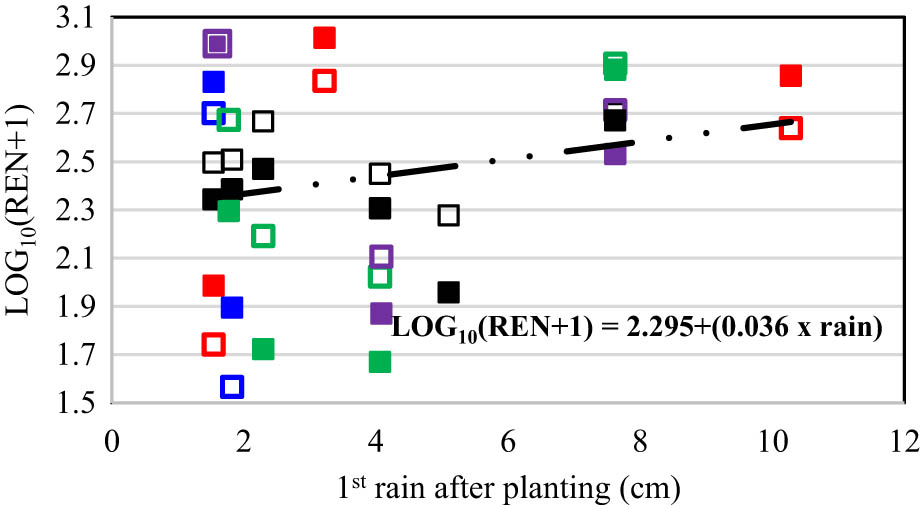
Fig. 3
Rotylenchulus reniformis vermiform stages (REN)/100 cm3 soil, with a LOG10 transformation (LREN) as affected by the amount of rain in the first rain after planting. Squares are the least square means for fluopyram (solid) and no nematicide (open) treatments, respectively in a trial. The two treatments have the same color for a given trial per environmental value. Red and blue squares are associated with negative responses, when LREN was higher in fluopyram-treated plots than no nematicide, while green, black, and purple are associated with positive responses, when LREN was lower in fluopyram-treated plots than no nematicide. The amount of the first rain after planting affected LREN, but nematicide did not, so the single line is predicted LREN based only on rain amount.
, P = 0.022, R 2 = 0.03 and where rain is measured in cm. There was no effect of quantity of rain for 30 days after planting, the number of days after planting until the first rain or the average air temperature for 14 days after planting on transformed REN.
Lint yield was not significantly impacted by fluopyram in the R. reniformis trials (P = 0.686, no nematicide lint yield was 628 kg/ha, fluopyram lint yield of 635 kg/ha). The amount of the first rain after planting did impact lint yield and there was a significant interaction with fluopyram (P = 0.0004, AIC = 2,240). Lint yield increased as the quantity of the first rain increased (Fig. 4a), with small yield differences between the presence or absence of fluopyram.
With fluopyram: where lint yield is in kg/ha and rain amount in cm.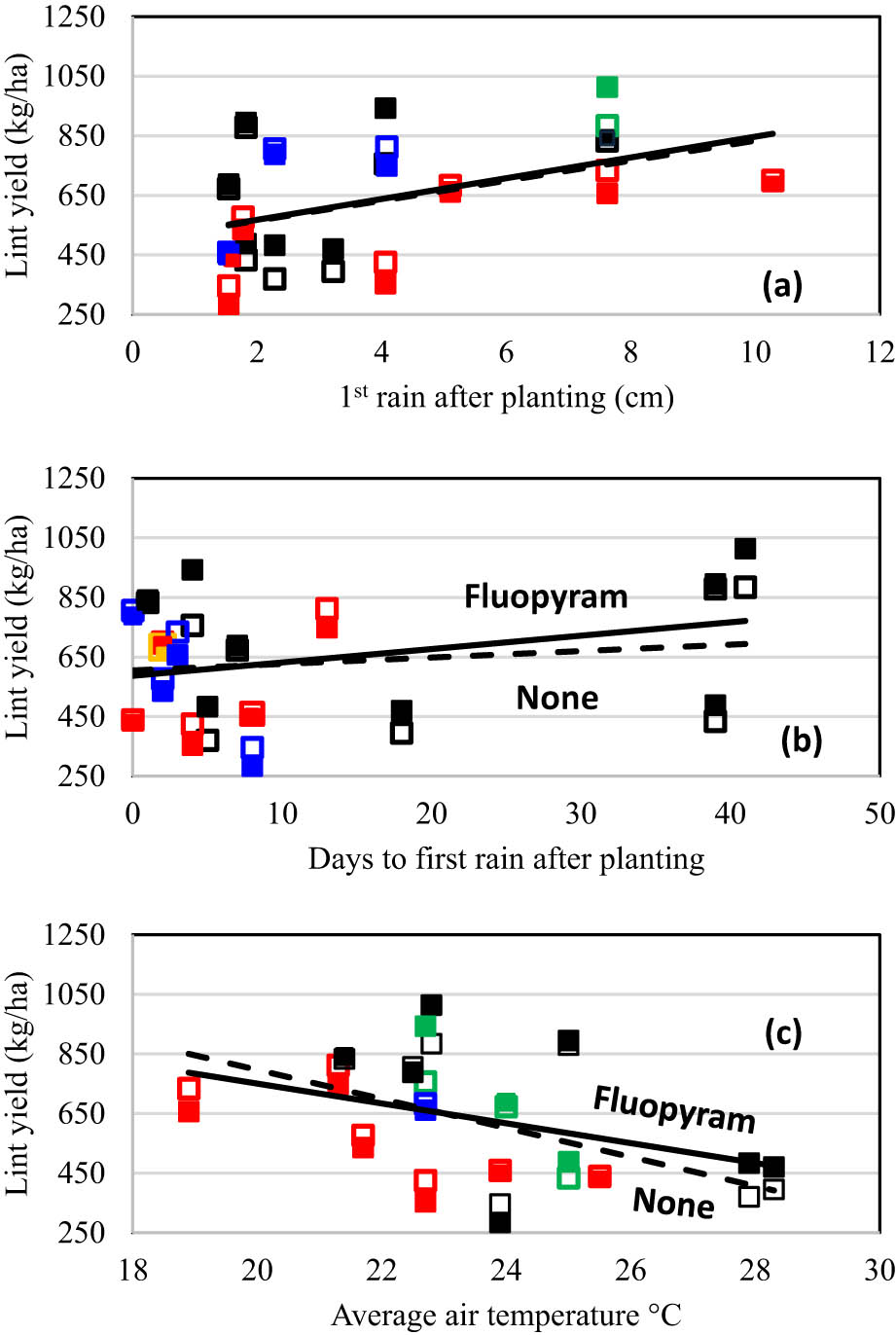
Fig. 4
Effect of fluopyram and various environmental parameters including (a) amount of the first rain after planting (interaction with fluopyram), No nematicide: , With fluopyram: ; (b) number of days until the first rain after planting (interaction with fluopyram), No nematicide: , With fluopyram: ; and (c) average air temperature for the first 14 days after planting (interaction with fluopyram), No nematicide: , With fluopyram: , on cotton lint yield in Rotylenchulus reniformis infested field trials. Squares are the least square means for fluopyram (solid) and no nematicide (open) treatments, respectively in a trial. The two treatments have the same color for a given trial per environmental value. Red, blue, or orange squares are associated with negative responses, when lint yield was lower in fluopyram-treated plots than no nematicide, while green, black, and purple are associated with positive responses, when lint yield was higher in fluopyram-treated plots than no nematicide. When an environmental parameter affected lint yield significantly as an interaction with fluopyram, then the predicted lines for no nematicide and fluopyram treatment are a dashed and solid line, respectively.
Lint yield was significantly affected by the interaction of the number of days until the first rain after planting and fluopyram (P = 0.027, AIC = 2,255). The longer the interval between planting and the first rain, the higher the lint yield, and the more fluopyram-treated plots yielded better than no nematicide plots (Fig. 4b).
No nematicide:
With fluopyram: where lint yield is in kg/ha days are the number of days.Lint yield was significantly affected by an interaction between average air temperature for the 14 days after planting and fluopyram (P = 0.0001, AIC = 2,236). As air temperature increased, lint yield decreased, with a slightly slower decrease associated with fluopyram-treated plots than no nematicide plots (Fig. 4c).
No nematicide:
With fluopyram: where lint yield is in kg/ha and air temperature is in °C. The quantity of rain for 30 days after planting had no effect on lint yield.3. Discussion
The amount of the first rain after planting impacted fluopyram activity on M. incognita galls, where higher amounts of rain were associated with greater reduction in galling in fluopyram-treated plots vs no nematicide plots. It is likely that fluopyram was distributed deeper into the soil with higher rain amounts or had a larger zone of nematicide concentration. Similarly, use of double drip tape to apply fluopyram resulted in lower root-knot nematode density and higher yields compared to single drip tape application (Bui and Desaeger, 2023). More soil moisture in May after planting was found to reduce galling for at-plant, in-furrow applications of aldicarb in west Texas (Wheeler et al., 2013). Fluopyram was treated on M. incognita infested carrot field and performed only slightly better than the no nematicide check (Becker et al., 2019). They attributed the poor performance to low soil mobility of fluopyram and indicated that initially it provided good root-knot nematode protection, but only to the depth of mechanical incorporation. So, by harvest the top 6–8 cm of the taproot were often free of symptoms, but the lower parts were disfigured and severely galled. Liu et al. (2025) examined the distribution of fluopyram when applied in different water applications (irrigation applied directly to the area around the roots; to the furrow between beds; through drip irrigation laid close to the plant on the surface; and via plowing in the product). The best distribution of product was with the physical soil mixing. Li et al. (2020) optimized fluopyram control of Meloidogyne spp. in a field by applying the product in 200 L/ha irrigation water (vs 100 L/ha).
Fluopyram performed poorly overall in the 18 R. reniformis trials and did not reduce nematode density or increase lint yield significantly. However, the number of days until the first rain and average air temperature for the first 14 days after planting could affect the lint yield of fluopyram-treated plots compared to no nematicide plots. Yields were predicted to be similar between the two treatments at 7.8 days until the first rain, but then as days increased beyond this number for the first rain, the yield advantage was associated with fluopyram-treated plots. Similarly, at an average air temperature of 23°C for the first 14 days after planting, lint yield was predicted to be similar between fluopyram-treated and no nematicide plots. As temperature increased beyond this value, fluopyram-treated plots were predicted to yield higher than no nematicide plots, though overall, yield for both treatments would decrease with increasing air temperature. Air temperature of 25°C was found to have better efficacy of fluopyram against M. javanica, than at 15 or 5°C (Bui and Desaeger, 2021). The R. reniformis testing site was a more northern and generally cooler location than most of the M. incognita testing sites; however, for the first 14 days after planting, the M. incognita sites were about 1°C cooler on average than the R. reniformis site.
Other studies have found inconsistent impact on R. reniformis density and cotton lint yield associated with fluopyram at-plant, in-furrow applications (Faske et al., 2022; Grabau et al., 2021; Watson et al., 2023). There are several factors that should be considered in the different responses of fluopyram with M. incognita and R. reniformis. The soil texture was very different with lighter texture soils for all the M. incognita sites, and a heavier silt loam soil for the R. reniformis trials. The product may behave differently depending on soil texture (Rathod et al., 2022).
Sensitivity to fluopyram may be different between the two nematode species. Faske and Hurd (2015) in a laboratory setting found M. incognita motility was more sensitive to fluopyram (EC50 = 5.18 µg/ml) than with R. reniformis (EC50 = 12.99 µg/mL). The threshold density of the nematode species that survives the nematicide and successfully infects the root may differ. In the semi-arid west Texas environment, a 50% reduction in R. reniformis (by fumigation) was unsuccessful at improving cotton lint yield (Wheeler et al., 2008). They found that 203 vermiform R. reniformis/100 cm3 soil (at-plant) resulted in a 70% yield loss of cotton.
Factors that may also have favored fluopyram activity in the Meloidgyne trials over R. reniformis trials may include attractiveness of the chemistry to the nematode species. Meloidogyne spp. second-stage juveniles can be attracted and actively move toward fluopyram (Oka, 2023). It is unknown whether R. reniformis will encounter fluopyram randomly in the soil profile or by seeking it out. If in fact there is an attraction element of fluopyram to some plant parasitic nematodes, then tighter soil texture (i.e., silt loam soil vs sandier soil) could affect the movement of the odor molecules. The complexity of nematicide efficacy in the soil environment as well as plant root growth and nematode hatch, movement to roots, reproduction, and general aggressiveness to the host all potentially impact fluopyram effectiveness.
Acknowledgments
We appreciate the support from Bayer CropScience and the National Cotton Council Nematology Committee for the trials presented in this manuscript.
Funding information
Author states no funding involved.
Author contributions
T. A. Wheeler conducted the experiments, did the analysis, and wrote the manuscript.
Conflict of interest statement
Author states no conflict of interest.