
Table 1
Taxonomical and quantitative composition of the two artificially composed sample sets (Set 1 and 2)
| Taxon (order, family, feeding strategy) | Set 1 (nematode treated with DESS, replicates: 1aCD-1cCD and 1dQ-1fQ) | Set 2 (freshly extracted nematodes, replicates: 2aCD-2cCD and 2dQ-2fQ) | |||
|---|---|---|---|---|---|
| Sampling details: locality, environment, associated plant, sampling year | # Individuals per each replicate | Sampling details: locality, environment, associated plant, sampling year | # Individuals per each replicate | ||
| 1 | Meloidogyne hapla (Rhabditida, Meloidogynidae, plant parasite) | Solanum lycopersicum L. (culture),a 2019 | 100 | Solanum lycopersicum L. (culture),a 2020 | 100 |
| 2 | Aphelenchoides ritzemabosi (Rhabditida, Aphelenchoididae, fungivore) | Brunnera sp. C. Steven (culture),b 2018 | 20 | Clematis sp. L. (culture 2018),b 2020 | 20 |
| 3 | Acrobeles sp. (Rhabditida, Cephalobidae, bacterivore) | Mistrzewice, meadow, Berteroa incana (L.) DC., 2019 | 20 | Mistrzewice, meadow, Berteroa incana (L.) DC., 2020 | 20 |
| 4 | Anaplectus sp. (Plectida, Plectidae, bacterivore) | Mistrzewice, Bzura river bank plants, Rubus caesius L., 2019 | 10 | Mistrzewice, Bzura river bank plants, Rubus caesius L., 2020 | 10 |
| 5 | Rotylenchus uniformis (Rhabditida, Hoplolaimidae, plant parasite) | Dziekanów Leśny, garden, Ribes sp. L., 2010 | 10 | Dziekanów Leśny, garden, Ribes sp. L., 2020 | 10 |
| 6 | Helicotylenchus sp. (Rhabditida, Hoplolaimidae, plant parasite) | Mistrzewice, meadow, Berteroa incana (L.) DC., 2019 | 25 | Mistrzewice, meadow, Berteroa incana (L.) DC., 2020 | 20 |
| 7 | Qudsianematidae (Dorylaimida, omnivore) | Mistrzewice, forest, Quercus robur L., 2019 | 20 | Mistrzewice, forest, Quercus robur L., 2020 | 10 |
| 8 | Longidorus sp. (Dorylaimida, Longidoridae, plant parasite) | Augustów, herbaceus plants near Alnus Mill., 2019 | 5 | Mistrzewice, field cultivation, Zea mays L., 2020 | 2 |
| 9 | Mesocriconema xenoplax (Rhabditida, Criconematidae, plant parasite) | Mistrzewice, Bzura river bank plants, Rubus caesius L., 2019 | 4 | Mistrzewice, Bzura river bank plants, Rubus caesius L., 2020 | 20 |
| 10 | Paratylenchus projectus (Rhabditida, Tylenchulidae, plant parasite) | Augustów, meadow, Trifolium arvense L., 2019 | 20 | — | |
| 11 | Tylenchorhynchus sp. (Rhabditida, Dolichodoridae, plant parasite) | Mistrzewice, meadow, Linaria vulgaris Mill., 2019 | 10 | — | |
| 12 | Tripylina cf. arenicola (Enoplida, Trefusiidae, predaceous) | Mistrzewice, meadow, Berteroa incana (L.) DC., 2019 | 10 | — | |
| 13 | Plectus sp. (Plectida, Plectidae, bacterivore) | Augustów, herbaceus plants near Alnus Mill., 2019; Mistrzewice, Bzura river bank plants, Rubus caesius L., 2019 | 10 | — | |
| 14 | Aporcelaimidae (Dorylaimida, omnivore) | Mistrzewice, Bzura river bank plants, Rubus caesius L., 2019 | 5 | — | |
| 15 | Tylocephalus auriculatus (Plectida, Plectidae, bacterivore) | Augustów, meadow, Trifolium arvense L., 2019 | 2 | — | |
| 16 | Coomansus parvus (Mononchida, Mononchidae, predaceaus) | Mistrzewice, meadow, Berteroa incana (L.) DC., 2019 | 2 | — | |
| 17 | Helicotylenchus pseudorobustus (Rhabditida, Hoplolaimidae, plant parasite) | — | Łomna, wasteland, Juncus sp. L., 2020 | 20 | |
| 18 | Pratylenchus sp. (Rhabditida, Pratylenchidae, plant parasite) | — | Łomna, wasteland, Pyrus sp. L., 2020 | 20 | |
| 19 | Paratrichodorus pachydermus (Triplonchida, Trichodoridae, plant parasite) | — | Mistrzewice, forest, Quercus robur L., 2020 | 20 | |
| 20 | Rotylenchus goodeyi (Rhabditida, Hoplolaimidae, plant parasite) | — | Łomna, wasteland, Juncus sp. L., 2020 | 10 | |
| 21 | Geocenamus longus (Rhabditida, Dolichodoridae, plant parasite) | — | Mistrzewice, forest, Quercus robur L., 2020 | 10 | |
| 22 | Alaimidae (Enoplida, bacterivore) | — | Mistrzewice, forest, Quercus robur L., 2020 | 5 | |
| 23 | Discolaimus major (Dorylaimida, Qudsianematidae, omnivore) | — | Mistrzewice, field cultivation, Zea mays L., 2020 | 5 | |
| 24 | Mylonchulus sp. (Mononchida, Mylonchulidae, predaceaus) | — | Dziekanów Leśny, garden, Ribes sp. L., 2020 | 2 | |
| ∑ | 273 | 304 | |||
Note: Each sample set was prepared in six replicates: aCD-cCD (destined for the DNA isolation with the “CD” kit) and dQ-fQ (destined for DNA isolation with “Q” kit). Systematics according to Nemys: World Database of Nematodes (Bezerra et al. 2023). Origins of each nematode species are given in column with the sampling details.
anematodes were extracted from roots, courtesy of Dr. Łukasz Flis (Museum and Institute of Zoology PAS, Poland).
bnematodes were extracted from leaves, courtesy of Dr. Aneta Chałańska (NEFscience, Skierniewice, Poland).
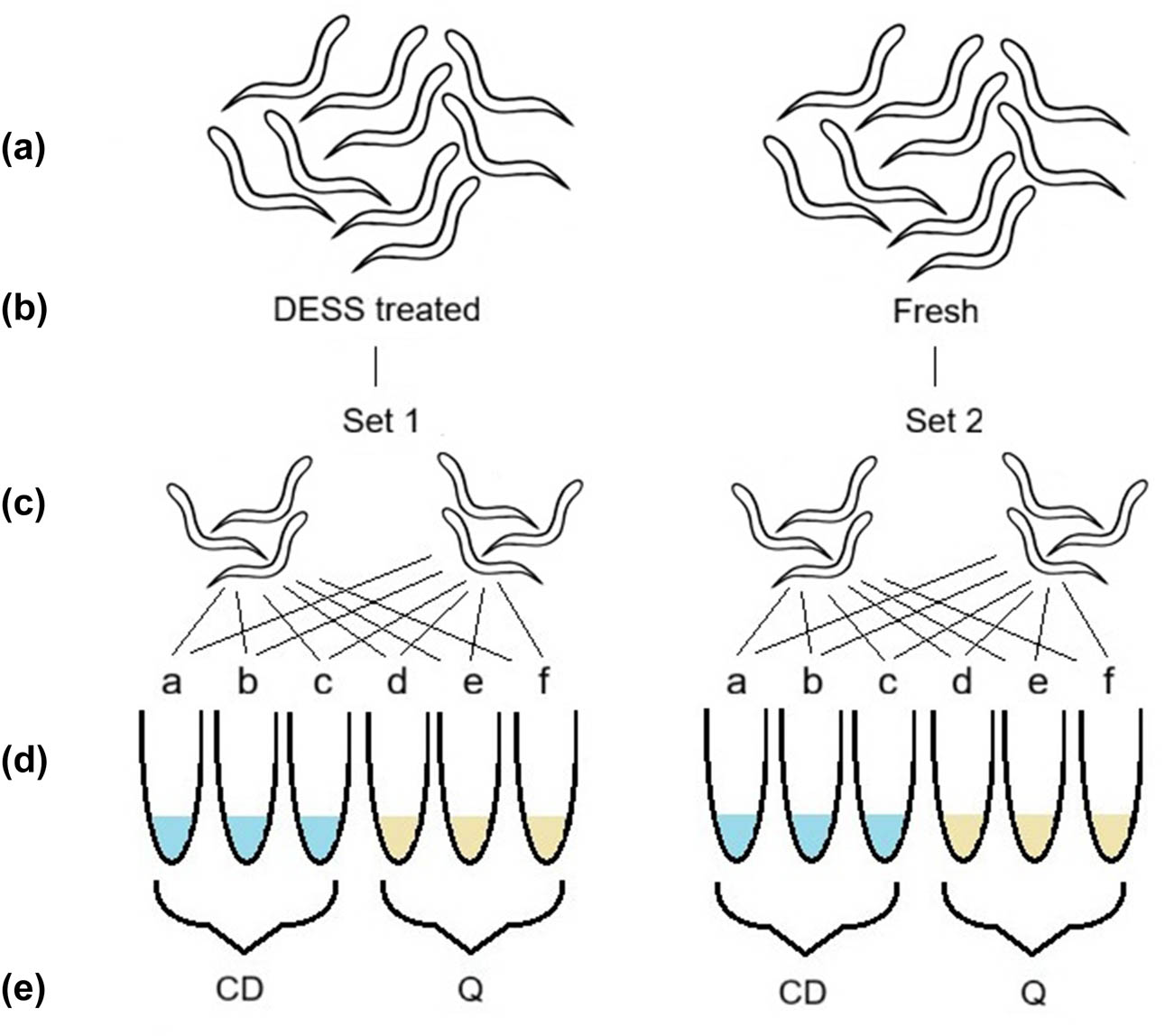
Figure 1
Simplified scheme of (mock) community sample preparation used for metabarcoding analyses. (a) Extracted heat-killed nematodes. (b) DESS preservative treatment or lack of treatment. (c) Transfer of the individual representatives of the segregated and identified nematode taxa into the test tubes. (d) Replicates containing milliQ water (marked in blue) or ATL buffer (yellow). Sets 1 and 2 differed in taxa composition (Table 1). Each replicate within the same set comprised of the same taxa and their amounts. (e) DNA isolation either with “CD” or “Q” method. As a result, 12 DNA samples were prepared and further analysed: 1aCD-1cCD, 1dQ-1fQ, 2aCD-2cCD, and 2dQ-2fQ.
Table 2
Information on the primer combinations used in this metabarcoding study
| Primer pair codes | Genomic region | Nucleotide primer sequences (bolded) including the Illumina adapter (5′–3′) | Approx. amplicon length (bp) | Reference |
|---|---|---|---|---|
| NemFopt 18Sr2bRopt | 18S rDNA | 5′-TCGTCGGCAGCGTCAGATGTGTATAAGAGACAG-GGGGWAGTATGGTTGCAAA-3′5′-GTCTCGTGGGCTCGGAGATGTGTATAAGAGACAG-TGTGTACAAAKGRCAGGGAC-3′ | 500 | Waeyenberge et al. (2019) |
| D2A D2 | 28S rDNA | 5′-TCGTCGGCAGCGTCAGATGTGTATAAGAGACAG-ACAAGTACCGTGAGGGAAAGTTG-3′5′-GTCTCGTGGGCTCGGAGATGTGTATAAGAGACAG-TCCGTGTTTCAAGACGGG-3′ | 400 | Nunn (1992); Chombard, et al. (1998) |
Table 3
PERMANOVA test results for differences in number of reads obtained for various nematode taxa, that were: (A) both, the DESS-treated and DESS-untreated (Fresh), (B) DESS-treated, and (C) DESS-untreated (Fresh)
| A | ||||||||||
|---|---|---|---|---|---|---|---|---|---|---|
| Taxon | DESS-treated and DESS-untreated (Fresh) | |||||||||
| Influence of all factors: preservation, primers, and isolation | Joint influence of preservation and isolation | Joint influence of preservation and primers | Influence of preservation | |||||||
| All treatments | 18S treatments | 28S treatments | CD treatments | Q treatments | 18S/CD treatments | 18S/Q treatments | 28S/CD treatments | 28S/Q treatments | ||
| 1 | M. hapla | <2.2 × 10⁻¹⁶*** | <2.2 × 10⁻¹⁶*** | 2 × 10⁻⁴*** | <2.2 × 10⁻¹⁶*** | <2.2 × 10⁻¹⁶*** | 0.001389** | 0.001389** | 0.1 | 1 |
| 2 | A. ritzemabosi | <2.2 × 10⁻¹⁶*** | <2.2 × 10⁻¹⁶*** | <2.2 × 10⁻¹⁶*** | <2.2 × 10⁻¹⁶*** | 2 × 10⁻⁴*** | 0.001389** | 0.001389** | 1 | 1 |
| 3 | Acrobeles sp. | <2.2 × 10⁻¹⁶*** | <2.2 × 10⁻¹⁶*** | <2.2 × 10⁻¹⁶*** | 0.0082** | 6 × 10⁻⁴*** | 0.7014 | 0.001389** | 0.3014 | 0.001389** |
| 4 | Anaplectus sp. | <2.2 × 10⁻¹⁶*** | 8 × 10⁻⁴*** | 6 × 10⁻⁴*** | 0.003** | <2.2 × 10⁻¹⁶*** | 0.001389** | 0.2014 | 0.001389** | 0.8014 |
| 5 | R. uniformis | <2.2 × 10⁻¹⁶*** | <2.2 × 10⁻¹⁶*** | <2.2 × 10⁻¹⁶*** | <2.2 × 10⁻¹⁶*** | 0.006** | 0.001389** | 0.001389** | 0.001389** | 0.001389** |
| 6 | Helicotylenchus sp. | <2.2 × 10⁻¹⁶*** | 0.0172* | <2.2 × 10⁻¹⁶*** | <2.2 × 10⁻¹⁶*** | <2.2 × 10⁻¹⁶*** | 0.001389** | 0.001389** | 0.001389** | 0.001389** |
| 7 | Qudsianematidae | <2.2 × 10⁻¹⁶*** | 0.0012** | 6 × 10⁻⁴*** | 0.0034** | 2 × 10⁻⁴*** | 0.001389** | 0.001389** | 0.001389** | 0.1014 |
| 8 | Longidorus sp. | 0.0036** | 0.0018** | 0.0044** | 0.0078** | 0.0102* | 0.5014 | 0.7014 | 0.2014 | 0.5014 |
| 9 | M. xenoplax | <2.2 × 10⁻¹⁶*** | 0.002** | 0.0034** | 2 × 10⁻⁴*** | 0.011* | 0.001389** | 0.4 | 0.001389** | 0.001389** |
| Total | <2.2 × 10⁻¹⁶*** | 0.0048** | 0.0048** | <2.2 × 10⁻¹⁶*** | 2 × 10⁻⁴*** | 0.001389** | 0.2014 | 0.4014 | 0.1014 | |
| B | ||||||
|---|---|---|---|---|---|---|
| Taxon | DESS-treated | |||||
| Joint influence of primers and isolation | Influence of isolation | Influence of primers | ||||
| All treatments | 18S treatments | 28S treatments | CD treatments | Q treatments | ||
| 1 | M. hapla | 0.005** | 0.1014 | NRO | 0.001389** | 0.001389** |
| 2 | A. ritzemabosi | 4 × 10⁻⁴*** | 0.001389** | NRO | 0.001389** | 0.001389** |
| 3 | Acrobeles sp. | 0.003** | 0.001389** | 0.001389** | 0.9014 | 0.5014 |
| 4 | Anaplectus sp. | <2.2 × 10⁻¹⁶*** | 0.001389** | 0.1014 | 0.4014 | 0.001389** |
| 5 | R. uniformis | 0.001*** | 0.001389** | 0.001389** | 0.001389** | 0.001389** |
| 6 | Helicotylenchus sp. | 4 × 10⁻⁴*** | 0.001389** | 0.001389** | 0.001389** | 0.001389** |
| 7 | Qudsianematidae | 4 × 10⁻⁴*** | 0.001389** | 0.001389** | 0.6014 | 0.001389** |
| 8 | Longidorus sp. | 2 × 10⁻⁴*** | 0.001389** | 0.001389** | 0.001389** | 0.2014 |
| 9 | M. xenoplax | NRO | NRO | NRO | NRO | NRO |
| 10 | P. projectus | 6 × 10⁻⁴*** | 0.001389** | 0.001389** | 0.1014 | 0.001389** |
| 11 | Tylenchorhynchus sp. | 0.0014** | 0.1014 | 0.3014 | 0.1014 | 0.001389** |
| 12 | T. arenicola | 0.8061 | 0.7014 | 0.3014 | 0.5014 | 0.4014 |
| 13 | Plectus sp. | 2 × 10⁻⁴*** | 0.001389** | 0.5014 | 0.001389** | 0.001389** |
| 14 | Aporcelaimidae | 0.0088** | 0.3014 | 0.2014 | 0.5014 | 0.9014 |
| 15 | T. auriculatus | 0.0054** | 0.9014 | 0.9014 | 0.001389** | 0.001389** |
| 16 | C. parvus | 0.002** | 0.001389** | 0.001389** | 0.5014 | 0.4014 |
| Total | 8 × 10⁻⁴*** | 0.6014 | 0.001389** | 0.001389** | 0.001389** | |
| C | ||||||
|---|---|---|---|---|---|---|
| Taxon | DESS-untreated (Fresh) | |||||
| Joint influence of primers and isolation | Influence of isolation | Influence of primers | ||||
| All treatments | 18S treatments | 28S treatments | CD treatments | Q treatments | ||
| 1 | M. hapla | 0.0036** | 0.3014 | 1 | 0.001389** | 0.001389** |
| 2 | A. ritzemabosi | <2.2 × 10⁻¹⁶*** | 0.001389** | 1 | 0.001389** | 0.001389** |
| 3 | Acrobeles sp. | <2.2 × 10⁻¹⁶*** | 0.001389** | 0.001389** | 0.001389** | 0.3014 |
| 4 | Anaplectus sp. | 8 × 10⁻⁴*** | 0.001389** | 0.001389** | 0.5014 | 0.001389** |
| 5 | R. uniformis | <2.2 × 10⁻¹⁶*** | 0.001389** | 0.001389** | 0.001389** | 0.001389** |
| 6 | Helicotylenchus sp. | <2.2 × 10⁻¹⁶*** | 0.001389** | 0.8014 | 0.001389** | 0.001389** |
| 7 | Qudsianematidae | 0.0064** | 0.1014 | 0.7014 | 0.6014 | 0.001389** |
| 8 | Longidorus sp. | 0.0014** | 0.1014 | 0.001389** | 0.9014 | 0.5014 |
| 9 | M. xenoplax | 4 × 10⁻⁴*** | 0.001389** | 0.001389** | 0.001389** | 0.2014 |
| 17 | H. pseudorobustus | <2.2 × 10⁻¹⁶*** | 0.001389** | 0.3014 | 0.001389** | 0.001389** |
| 18 | Pratylenchus sp. | 0.0024** | 0.001389** | 0.001389** | 0.4014 | 0.001389** |
| 19 | P. pachydermus | <2.2 × 10⁻¹⁶*** | 0.001389** | 0.001389** | 0.001389** | 0.6014 |
| 20 | R. goodeyi | <2.2 × 10⁻¹⁶*** | 0.001389** | 0.001389** | 0.001389** | 0.001389** |
| 21 | G. longus | <2.2 × 10⁻¹⁶*** | 0.001389** | 0.001389** | 0.4014 | 0.2014 |
| 22 | Alaimidae | 6 × 10⁻⁴*** | 0.001389** | 0.001389** | 0.5014 | 0.001389** |
| 23 | D. major | <2.2 × 10⁻¹⁶*** | 0.001389** | 0.001389** | 0.001389** | 0.1014 |
| 24 | M. brachyuris | <2.2 × 10⁻¹⁶*** | 0.001389** | 0.001389** | 0.001389** | 0.001389** |
| Total | <2.2 × 10⁻¹⁶*** | 0.001389** | 0.4014 | 0.001389** | 0.001389** | |
Various treatments were defined and compared (see suppl. data S2), which may indicate joined and separate influence of three investigated factors: preservation (DESS treatment), primers (18S or 28S rDNA), and isolation method (“CD” or “Q”). Statistical significance codes: 0 “***”, 0.001 “**”, 0.01 “*”, NRO: “No reads obtained.” Taxa numeration corresponds with the one of Table 1.
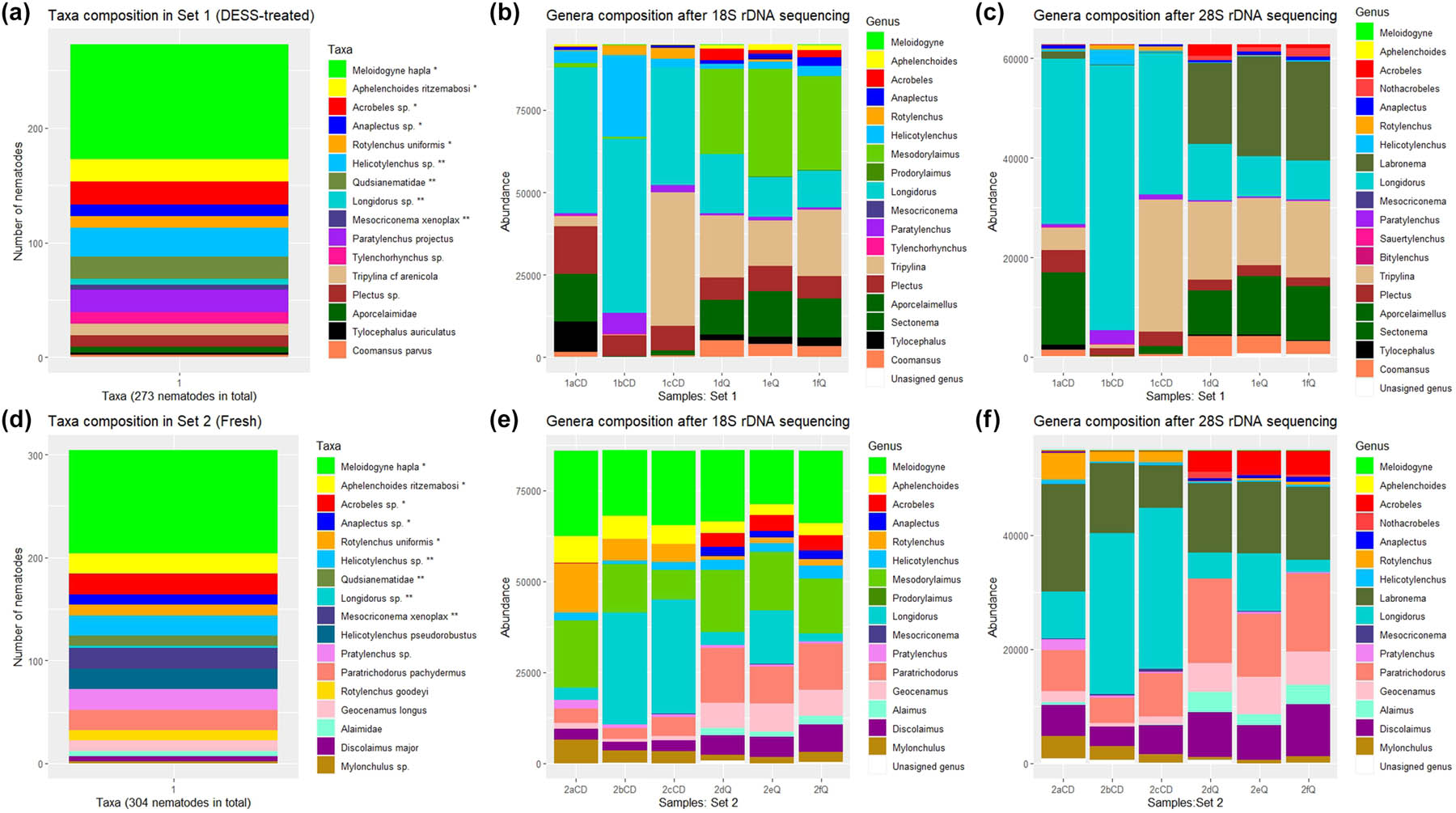
Figure 2
Taxa abundance and composition in two mock nematode community sets. (a–c) Set 1, DESS-pretreated nematodes. (d–f) Set 2, DESS-untreated, freshly extracted nematodes. (a) Exact numbers of nematode taxa included in the samples 1aCD-1cCD and 1dQ-1fQ. (d) Exact numbers of nematode taxa, included into the samples 2aCD-2cCD and 2dQ-2fQ. Taxa initially occurring in the two nematode community sets in the same amounts (Table 1) are marked with an asterisk. Taxa occurring in the two nematode community sets in the different amounts are marked with two asterisks. (b and e) Read numbers and retrieved genera after 18S rDNA sequencing. (c and f) Read numbers and retrieved genera after 28S rDNA sequencing. The obtained false-positive reads were not included into the visualization and the corresponding data are available in the suppl. data S1. “CD” and “Q” samples were isolated with the Clear Detection or Qiagen DNA extraction kits, respectively.
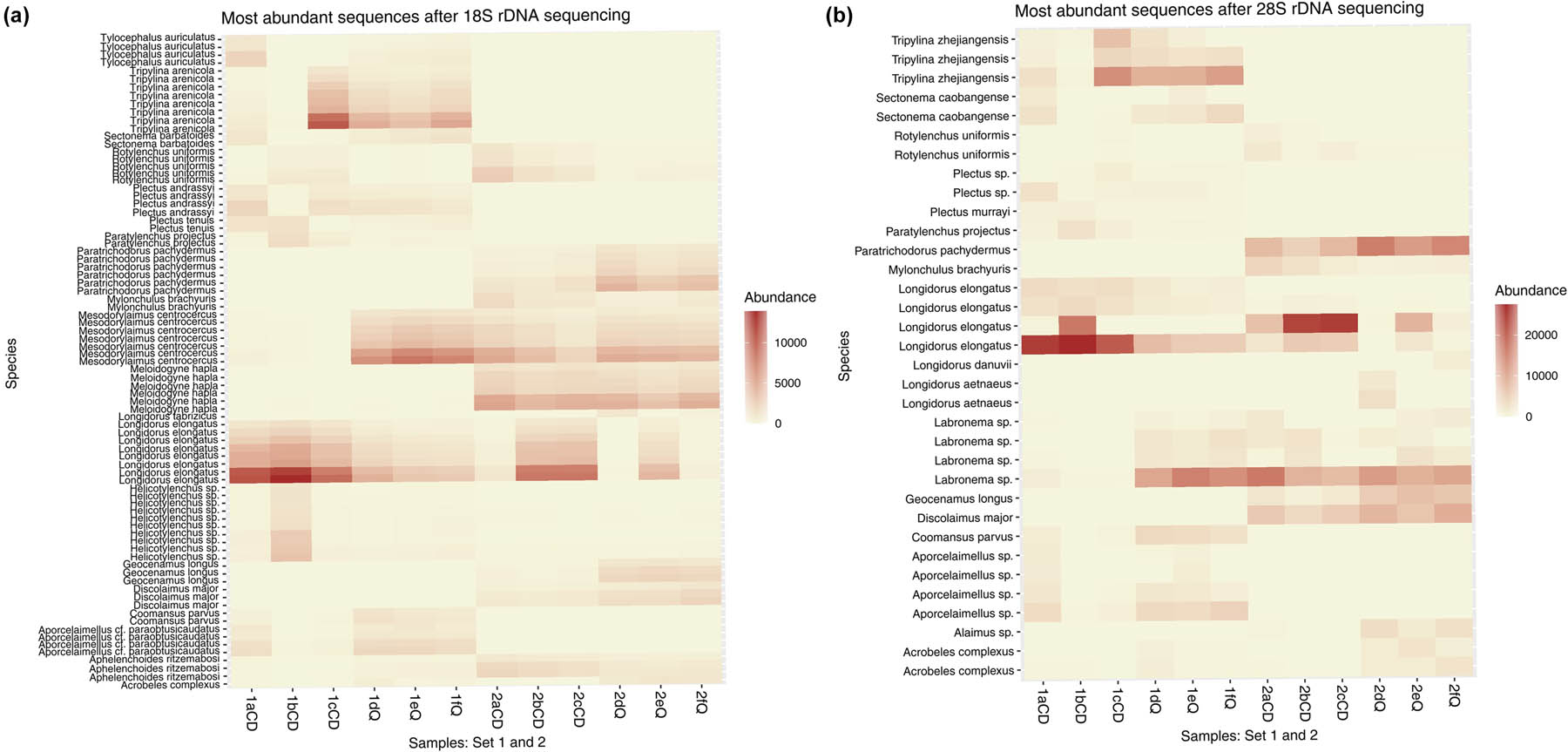
Figure 3
Heatmaps of the most abundant sequences obtained after metabarcoding sequencing of sample replicates (a–f), representing two mock nematode communities (Sets 1 and 2), isolated with two DNA extraction kits (“CD” and “Q”). (a) Most abundant nematode species sequences after 18S rDNA sequencing. (b) Most abundant nematode species sequences after 28S rDNA sequencing.
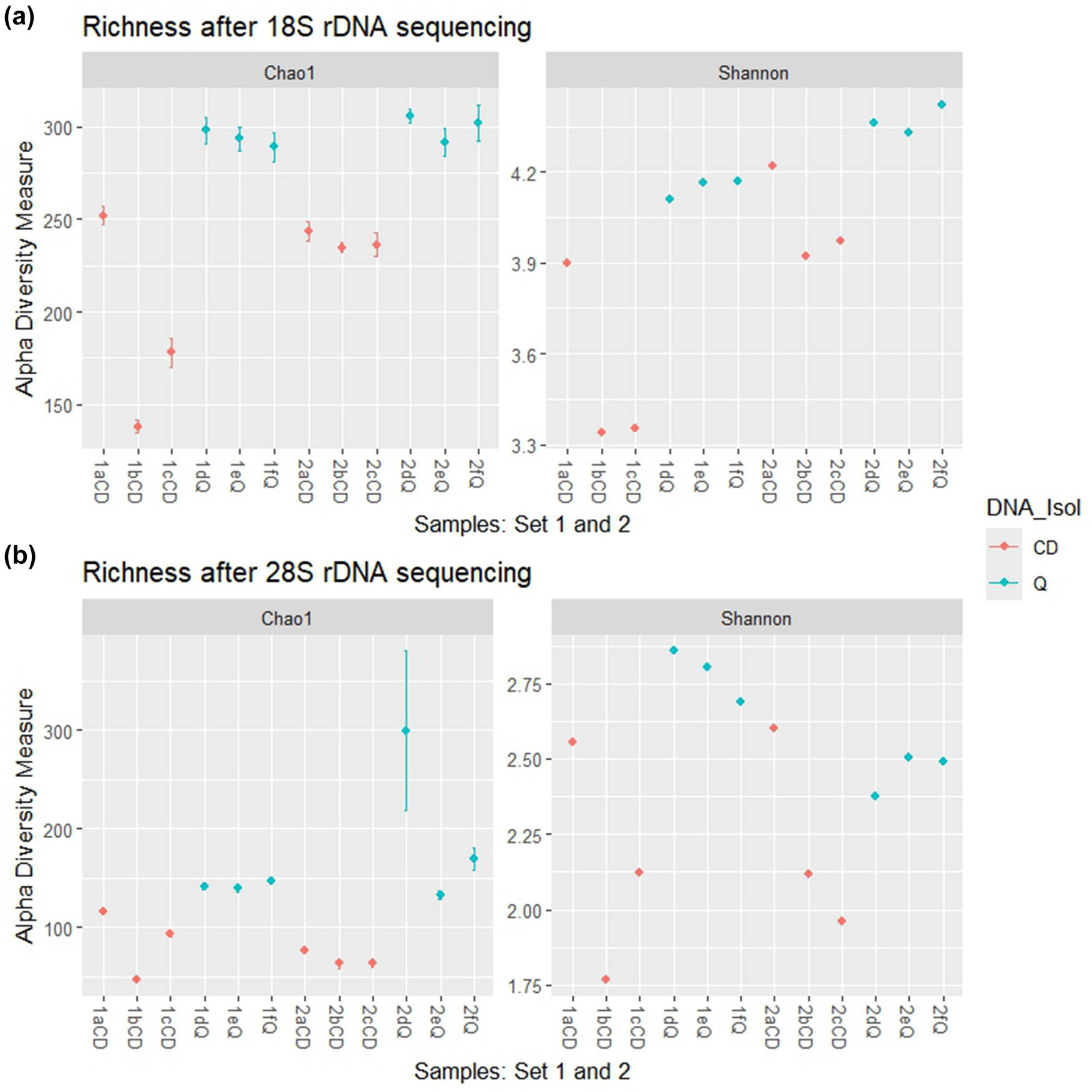
Figure 4
ZOTUs richness estimated with Chao1 and Shannon indices obtained after 18S (a) and 28S rDNA (b) metabarcoding sequencing of sample replicates (a–f), representing two mock nematode communities (Sets 1 and 2), isolated with two DNA extraction kits (“CD” and “Q”).