
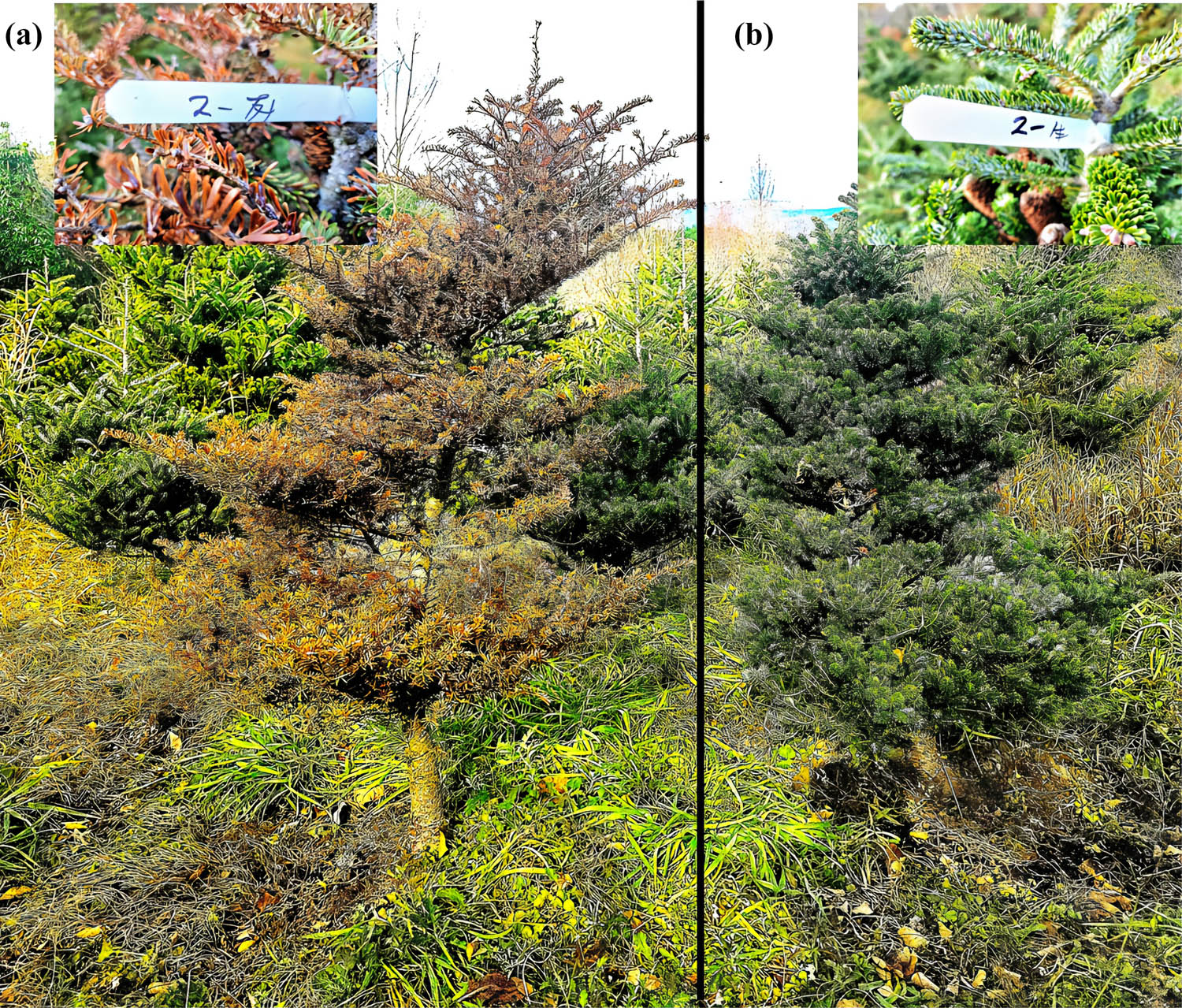
Figure 1
The state of the host plant (Abies koreana Wils.) at the type locality (a, b). (a) Dead Korean fir plant (inset: Dead, brown twigs/shoot); (b) Healthy Korean fir plant (inset: Healthy twigs/shoot).
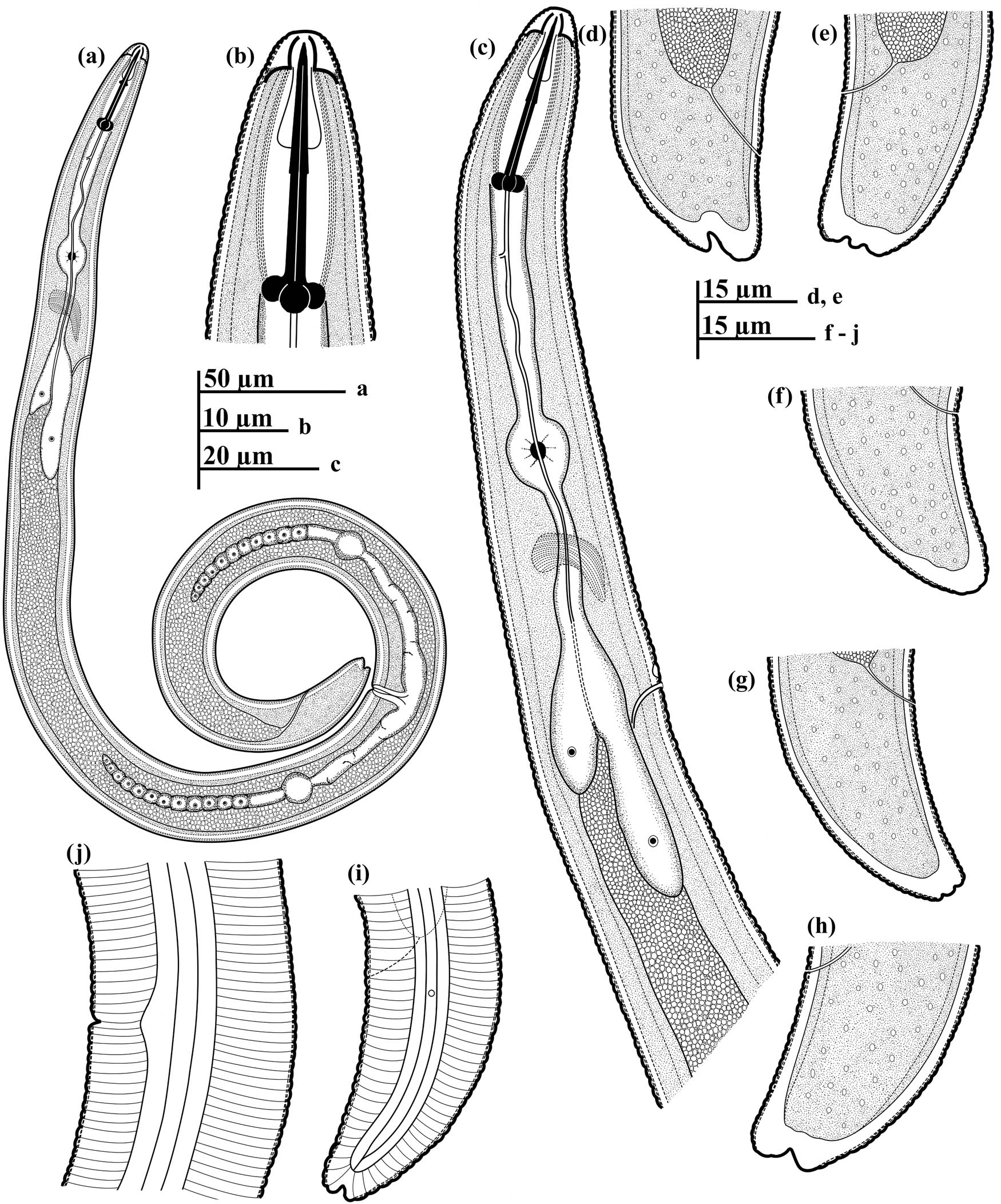
Figure 2
Line drawings of Helicotylenchus coreanus n. sp. (a–j). (a) Female entire body; (b) head region; (c) pharyngeal region; (d–h) variation in female tail; (i) lateral field in tail region; and (j) lateral field at level of vulva.
Table 1
Morphometrics of Helicotylenchus coreanus n. sp. from Korea
| Type population (H03) | Population two (H04) | ||
|---|---|---|---|
| Character | Holotype ♀ | ♀♀ | ♀♀ |
| n | — | 17 | 12 |
| L | 684 | 649.5 ± 41.7 (576–716) | 719.6 ± 44.9 (643–774) |
| a | 25.5 | 23.7 ± 1.5 (20.9–26.4) | 24.1 ± 1.7 (21.1–26.8) |
| b | 5.8 | 5.3 ± 0.5 (4.6–6.0) | 5.8 ± 0.5 (4.9–6.7) |
| b′ | 4.6 | 4.5 ± 0.3 (4.0–4.9) | 4.8 ± 0.3 (4.3–5.2) |
| c | 24.7 | 25.1 ± 3.8 (19.6–31.4) | 28.5 ± 6.7 (22.0–45.7) |
| c' | 1.6 | 1.5 ± 0.3 (1.0–1.9) | 1.4 ± 0.3 (0.9–1.9) |
| V | 59.9 | 61.2 ± 1.4 (59.1–63.8) | 61.3 ± 2.0 (58.4–64.1) |
| G 1 | 16.1 | 17.6 ± 1.4 (15.7–20.5) | 17.0 ± 1.4 (14.7–19.4) |
| G 2 | 15.8 | 17.1 ± 1.4 (15.2–19.5) | 16.7 ± 1.2 (14.6–18.1) |
| MB | 49.3 | 51.6 ± 3.6 (43.9–58.3) | 48.1 ± 4.2 (40.1–53.5) |
| M | 48.1 | 47.3 ± 1.8 (44.0–49.5) | 47.4 ± 1.0 (45.2–48.8) |
| O | 32.5 | 32.8 ± 3.4 (26.1–37.5) | 34.0 ± 3.7 (28.6–41.8) |
| Lip height | 5.0 | 5.4 ± 0.5 (4.5–6.5) | 5.3 ± 0.6 (4.5–6.0) |
| Lip diam. | 8.0 | 8.2 ± 0.3 (7.5–9.0) | 8.4 ± 0.5 (7.5–9.5) |
| Anterior to the median bulb valve | 73.0 | 75.0 ± 5.7 (63.5–83.5) | 72.4 ± 6.6 (61.0–81.5) |
| Stylet length | 29.5 | 30.1 ± 1.1 (28.0–32.0) | 29.6 ± 1.6 (28.0–32.0) |
| Conus length | 14.5 | 14.2 ± 0.9 (12.5–15.5) | 14.0 ± 0.8 (13.0–15.5) |
| DGO | 9.5 | 9.9 ± 0.9 (8.0–11.0) | 10.1 ± 1.0 (8.0–12.0) |
| Anterior to nerve ring | 82.0 | 89.7 ± 7.5 (80.0–104.5) | 89.5 ± 7.6 (78.0–104.0) |
| Secretory-Excretory pore | 109.0 | 112.7 ± 6.7 (96.0–123.5) | 116.0 ± 5.7 (104.0–123.0) |
| Esophageal–intestinal junction | 119.0 | 124.0 ± 7.7 (110.5–144.0) | 125.5 ± 11.1 (105.0–138.0) |
| Anterior to end of glandular overlap | 148.0 | 145.5 ± 7.1 (131.5–157.5) | 150.5 ± 3.0 (145.0–155.5) |
| Maximum body diam. | 27.0 | 27.5 ± 1.9 (24.0–31.5) | 29.9 ± 2.2 (26.0–33.5) |
| Lateral fields at mid-body | 7.0 | 6.7 ± 0.5 (6.0–7.5) | 7.4 ± 0.5 (7.0–8.5) |
| Lateral fields at vulva | 9.0 | 8.6 ± 0.7 (7.5–10.0) | 9.3 ± 0.4 (9.0–10.0) |
| Rectum length | 10.5 | 11.4 ± 2.0 (9.0–15.0) | 12.4 ± 1.8 (10.0–16.0) |
| Anal body diam. | 17.5 | 18.0 ± 1.6 (14.0–21.0) | 18.8 ± 1.4 (17.0–21.0) |
| Tail length | 28.0 | 26.4 ± 3.9 (19.5–31.5) | 26.4 ± 5.8 (15.5–34.5) |
| Tail annuli | 19.0 | 20.6 ± 3.7 (16.0–31.0) | 19.5 ± 3.9 (13.0–24.0) |
| Annuli to phasmids | 5.0 | 2.3 ± 2.7 *3/ (0.0–7.0) | 1.2 ± 2.2 (0.0–6.0) |
| Hyaline length | 4.5 | 4.2 ± 0.6 (3.0–5.0) | 4.3 ± 0.7 (3.0–5.5) |
*Unusual position of phasmids in one specimen (3 annuli anterior to anal opening).
All measurements are in μm and in the form: average ± SD (range).
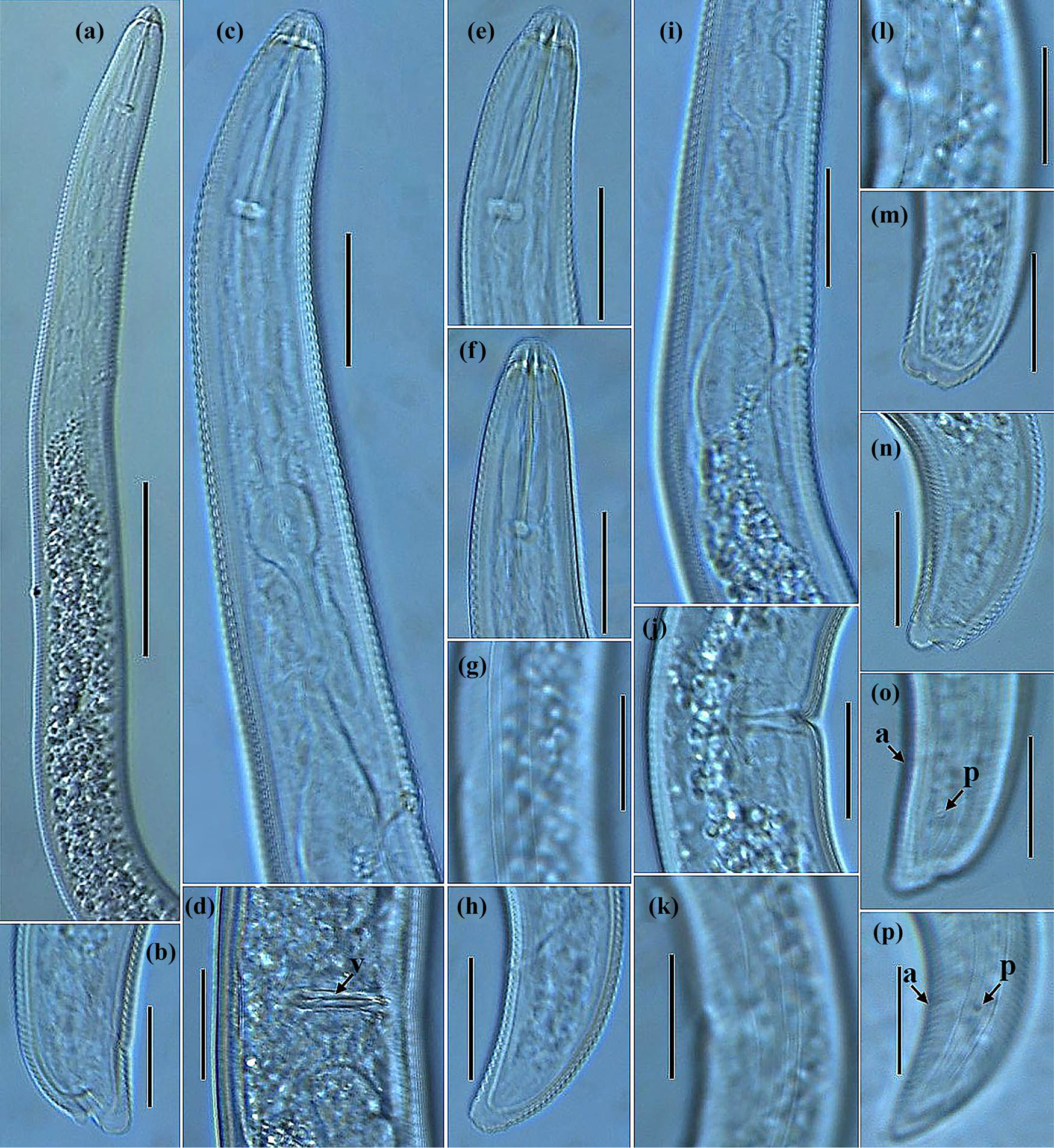
Figure 3
Light micrographs of Helicotylenchus coreanus n. sp. (a–p). (a) Female anterior region (b, h, m, n) variation in female tail; (c) pharyngeal region; (d) vulval region (ventral view); (e, f) head region; (g) lateral field at mid-body; (i) posterior pharyngeal region; J: vulval region (lateral view); (k, l) lateral field at level of vulva; (o, p) variation in position of phasmids. The arrows labeled v, a, and p indicate the position of vulva, anus, and phasmids, respectively (scale bars: a = 50 μm and b–p = 20 μm).
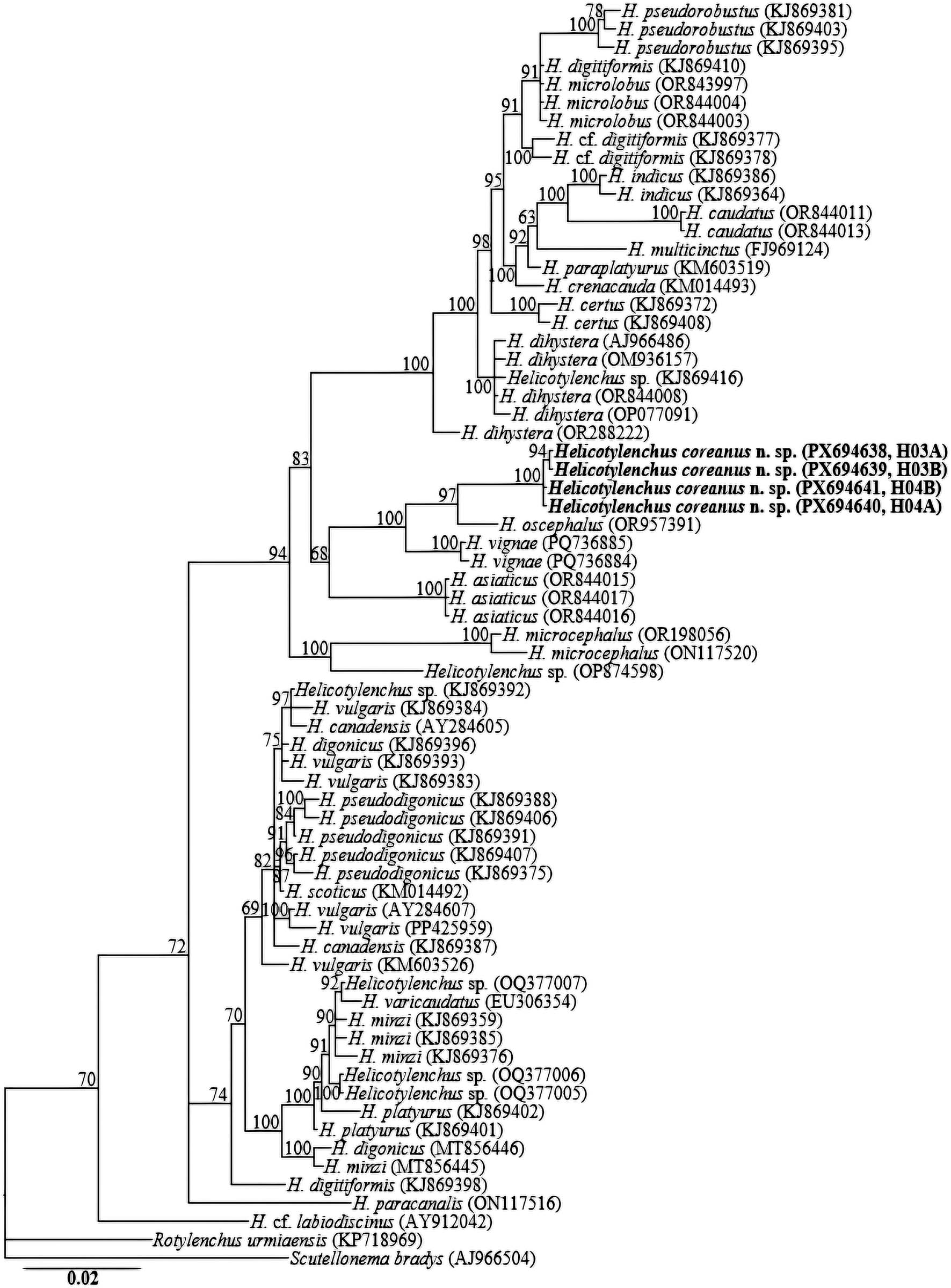
Figure 4
Bayesian tree inferred under the GTR + I + G model from 18S-rRNA gene sequences of Helicotylenchus spp. Posterior probability values exceeding 50% are given on appropriate clades. The studied populations are indicated in bold text.
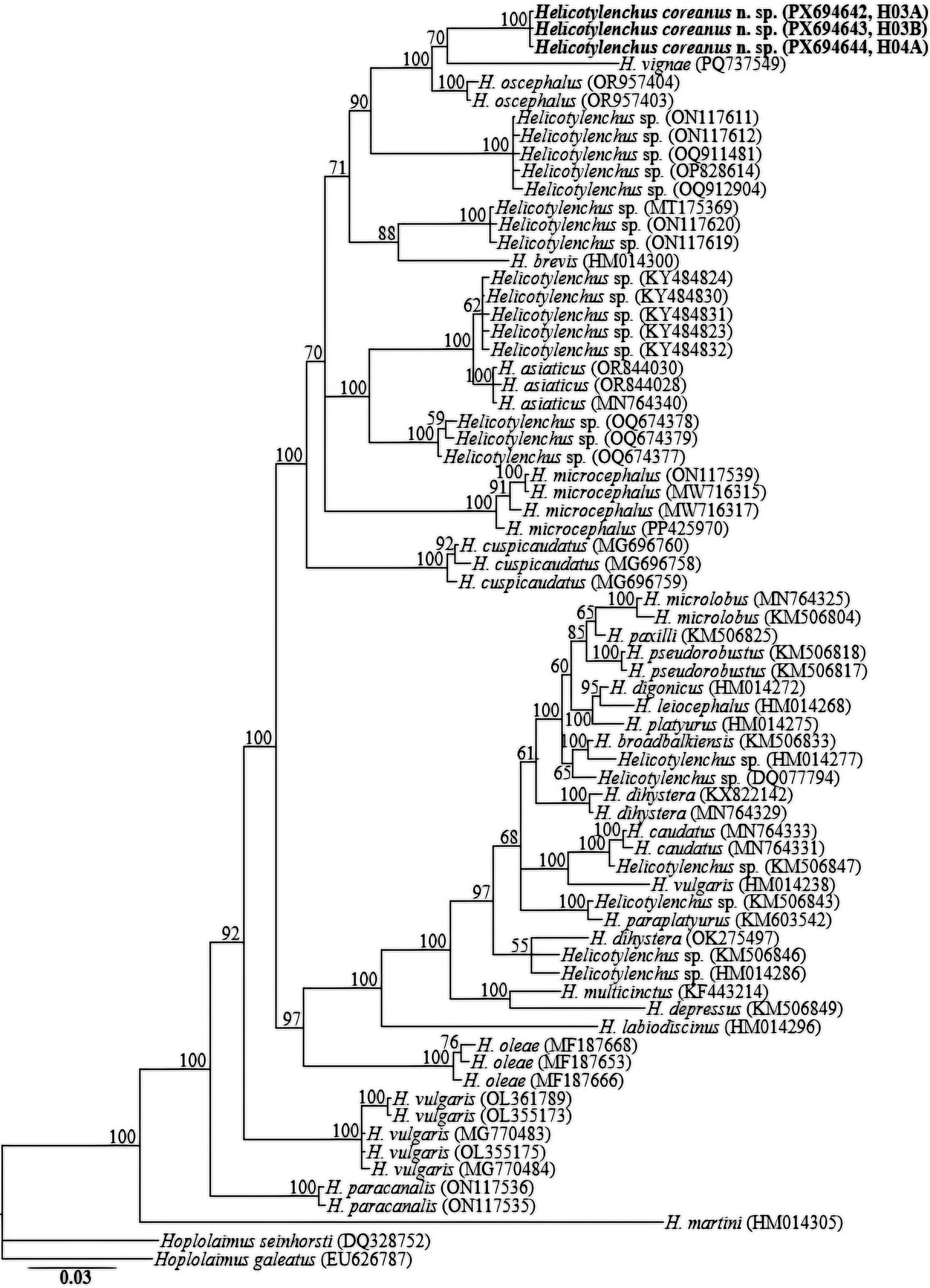
Figure 5
Bayesian tree inferred under the GTR + I + G model from LSU D2–D3 partial sequences of Helicotylenchus spp. Posterior probability values exceeding 50% are given on appropriate clades. The studied populations are indicated in bold text.
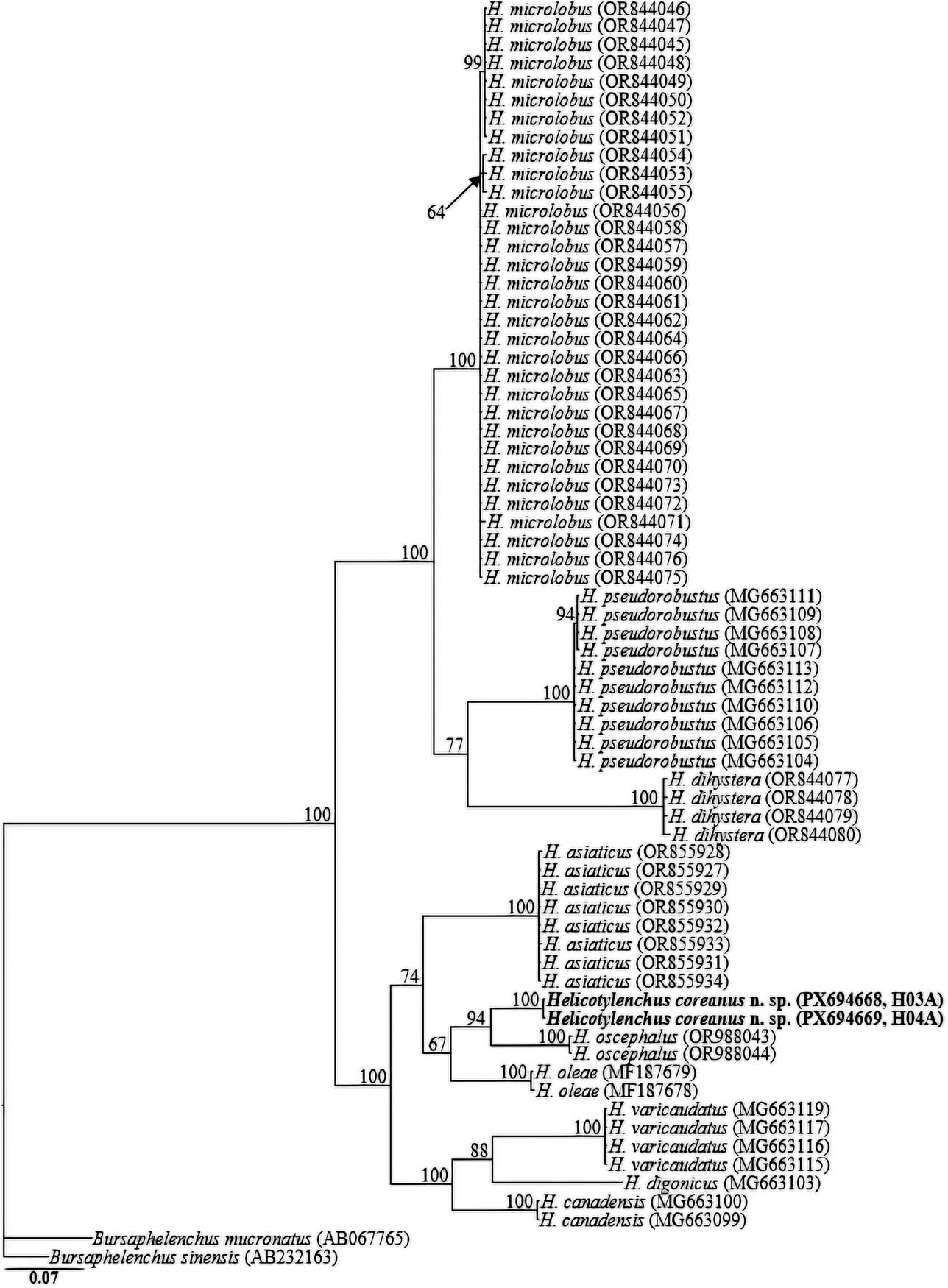
Figure 6
Bayesian tree inferred under the GTR + I + G model from COI gene sequences of Helicotylenchus spp. Posterior probability values exceeding 50% are given on appropriate clades. The studied populations are indicated in bold text.