
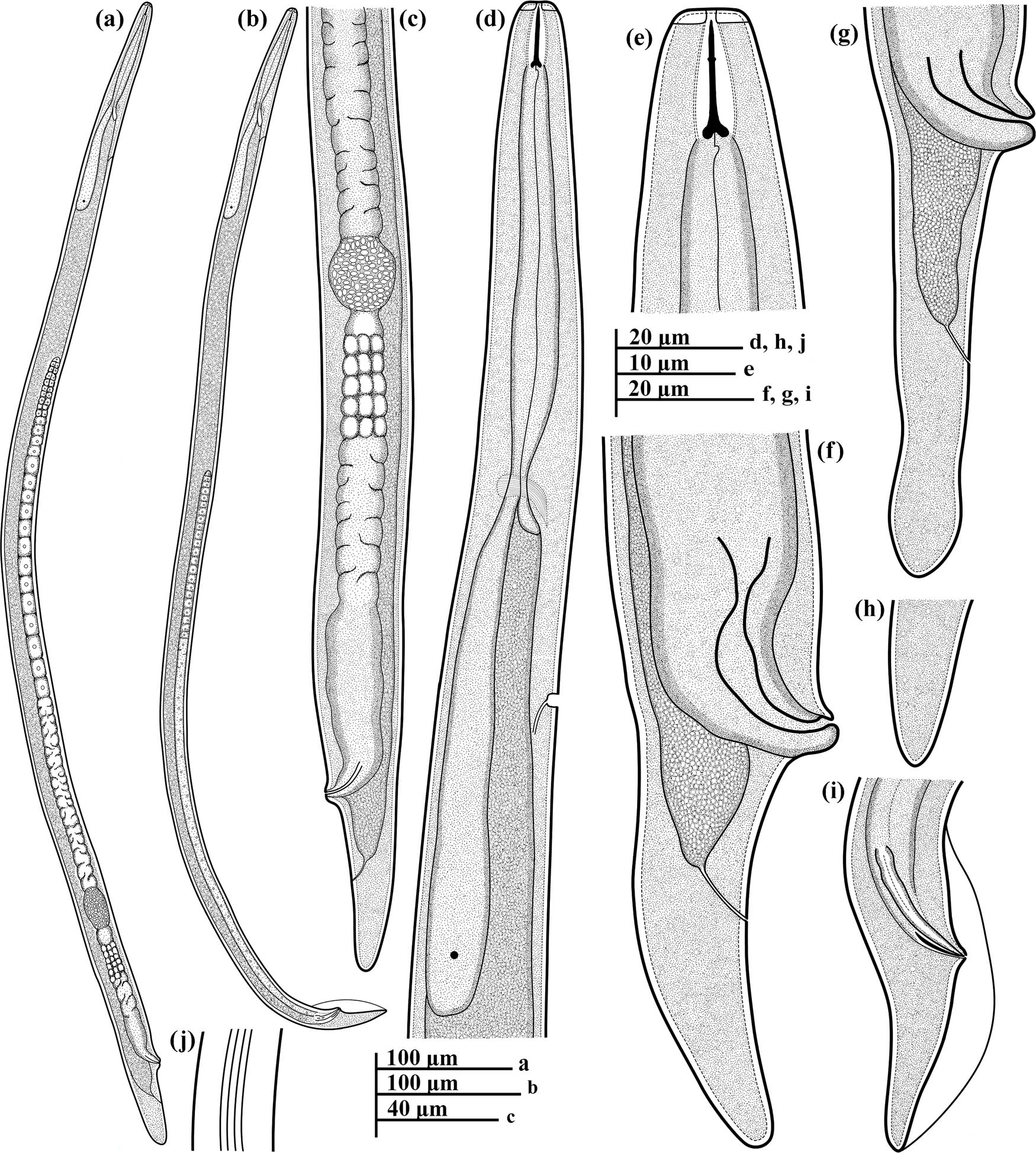
Figure 1
Line drawings of Deladenus coreanus n. sp. (a–j): (a) female entire body; (b) male entire body; (c) part of female genital branch; (d) female pharyngeal region; (e) anterior body region; (f and g) variation in female tail and vulvar region; (h) tail end; (i) male tail; and (j) lateral field.
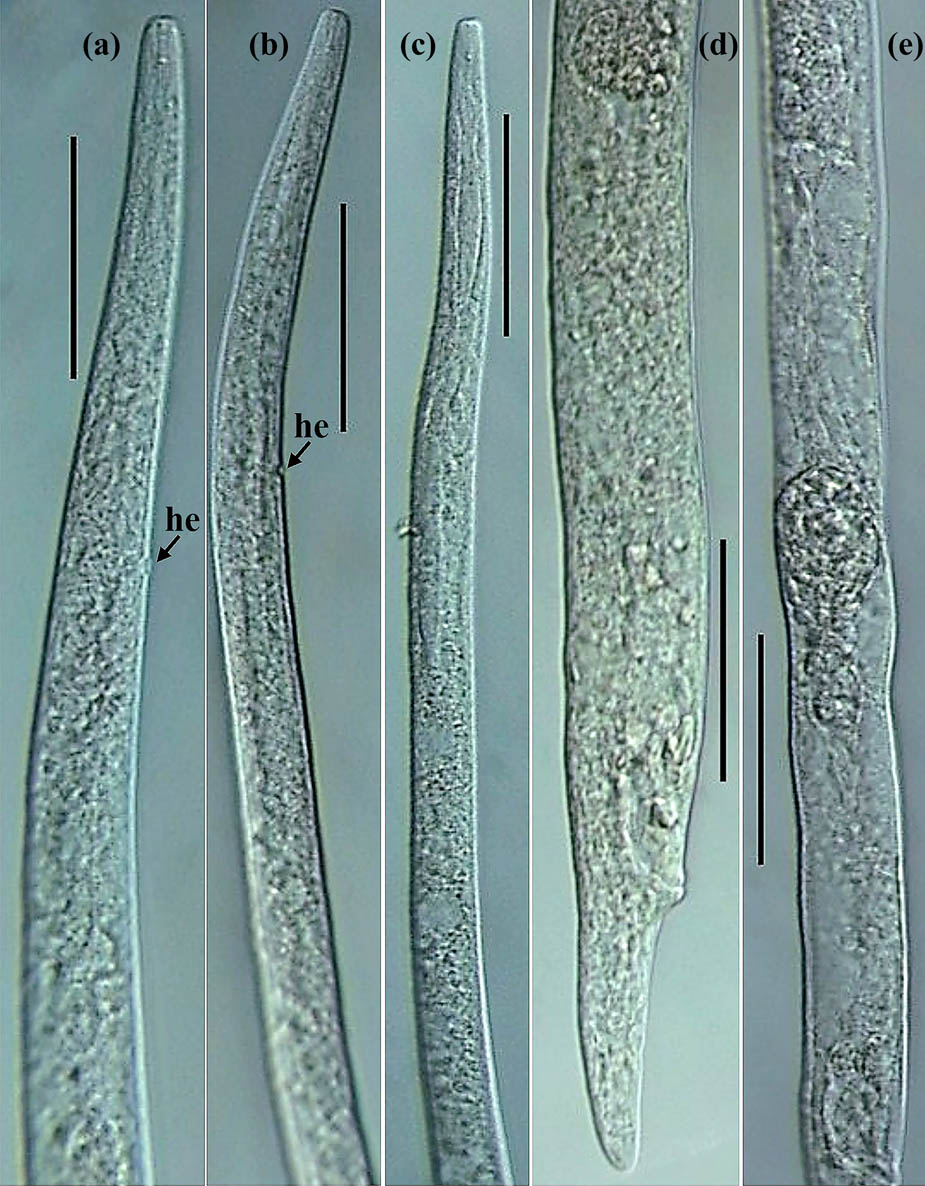
Figure 2
Light micrographs of Deladenus coreanus n. sp. (a–e). (a and b) female pharyngeal region (arrowheads showing hemizonid, he); (c) male pharyngeal region; (d) female posterior region; (e) female genital branch (scale bars: a–e = 50 μm).
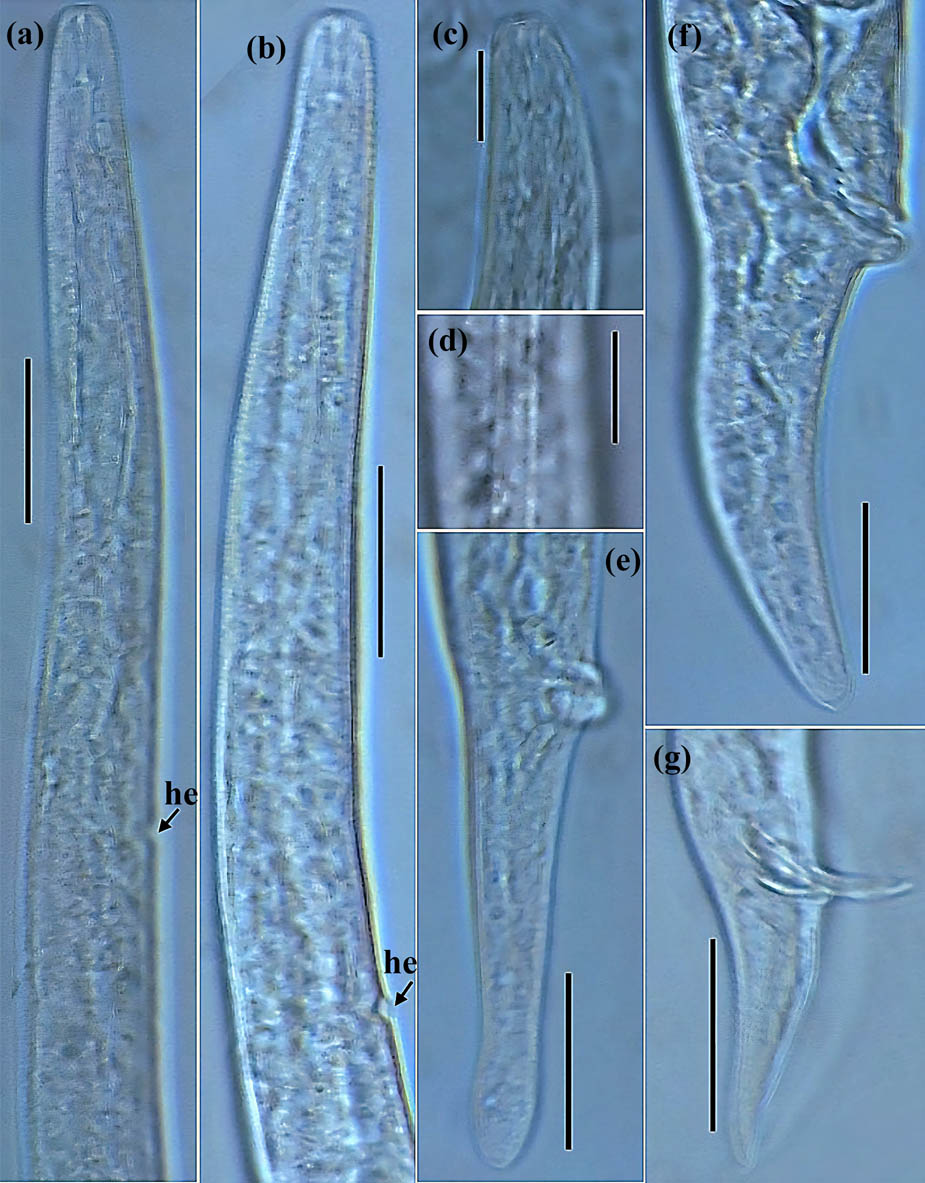
Figure 3
Light micrographs of Deladenus coreanus n. sp. (a–g). (a) male pharyngeal region (arrowheads showing hemizonid, he); (b) female pharyngeal region (arrowheads showing hemizonid, he); (c) lip region; (d) lateral field; (e and f) variation in female tail; (g) male tail (scale bars: a and b, e–g = 20 μm; c and d = 10 μm).
Table 1
Morphometrics of the mycetophagous population of Deladenus coreanus n. sp. from Korea
| Character | Holotype ♀ | ♀♀ | ♂♂ |
|---|---|---|---|
| n | — | 14 | 5 |
| L | 1,002 | 968 ± 106.3 (852–1,225) | 808 ± 63.2 (758–885) |
| a | 40.4 | 39.7 ± 4.8 (30.6–48.2) | 40.6 ± 5.6 (36.4–48.3) |
| b | 12.8 | 12.2 ± 1.2 (10.7–14.2) | 11.2 ± 0.5 (10.5–11.8) |
| b′ | 6.0 | 6.0 ± 0.6 (5.1–7.2) | 5.4 ± 0.8 (4.6–6.3) |
| c | 33.2 | 32.7 ± 2.8 (28.8–39.7) | 27.5 ± 2.5 (25.0–31.1) |
| c′ | 2.5 | 2.6 ± 0.4 (1.8–3.5) | 2.6 ± 0.3 (2.2–3.1) |
| V | 93.7 | 93.8 ± 0.5 (93.0–94.9) | — |
| G 1 or T | 53.7 | 62.0 ± 6.6 (52.0–75.8) | 53.9 ± 7.1 (41.9–60.5) |
| Lip diam. | 6.0 | 6.0 ± 0.5 (5.0–7.0) | 5.6 ± 0.1 (5.5–6.0) |
| Stylet length | 9.5 | 9.2 ± 0.5 (8.0–10.0) | 8.7 ± 0.4 (8.5–9.5) |
| Anterior to nerve ring | 72 | 73.1 ± 2.4 (71–79) | 66.2 ± 3.2 (63–71) |
| Pharyngo-intestinal junction | 78 | 79.1 ± 2.9 (75–87) | 72.4 ± 3.1 (69–76) |
| Anterior to Hemizonid | 108 | 101.4 ± 8.5 (86–116) | 90.1 ± 1.7 (87–91) |
| Glandular overlap | 89 | 82.0 ± 7.5 (64–89) | 78.5 ± 12.1 (65–92) |
| Anterior end to end of glandular overlap | 167 | 161.1 ± 7.6 (143–172) | 150.9 ± 9.9 (140–164) |
| Maximum body diam. | 25.0 | 24.9 ± 4.9 (18.0–35.0) | 20.0 ± 1.2 (18.0–21.0) |
| Vulval body diam. | 20.5 | 19.0 ± 3.1 (14.0–25.0) | — |
| Vulva-to-anus distance (VA) | 31.0 | 28.5 ± 3.1 (22.5–34.0) | — |
| Anal or cloacal body diam. | 12.0 | 11.7 ± 2.3 (8.0–17.0) | 11.3 ± 0.9 (10.0–12.5) |
| Tail length | 30.0 | 29.7 ± 3.3 (23.5–34.0) | 29.4 ± 1.5 (28.0–31.0) |
| Ratio of VA to tail length | 1.0 | 1.0 ± 0.1 (0.8–1.1) | — |
| Spicules | — | — | 20.1 ± 0.9 (19.0–21.0) |
| Gubernaculum | — | — | 6.7 ± 0.2 (6.5–7.0) |
All measurements are in μm and in the form: average ± SD (range).
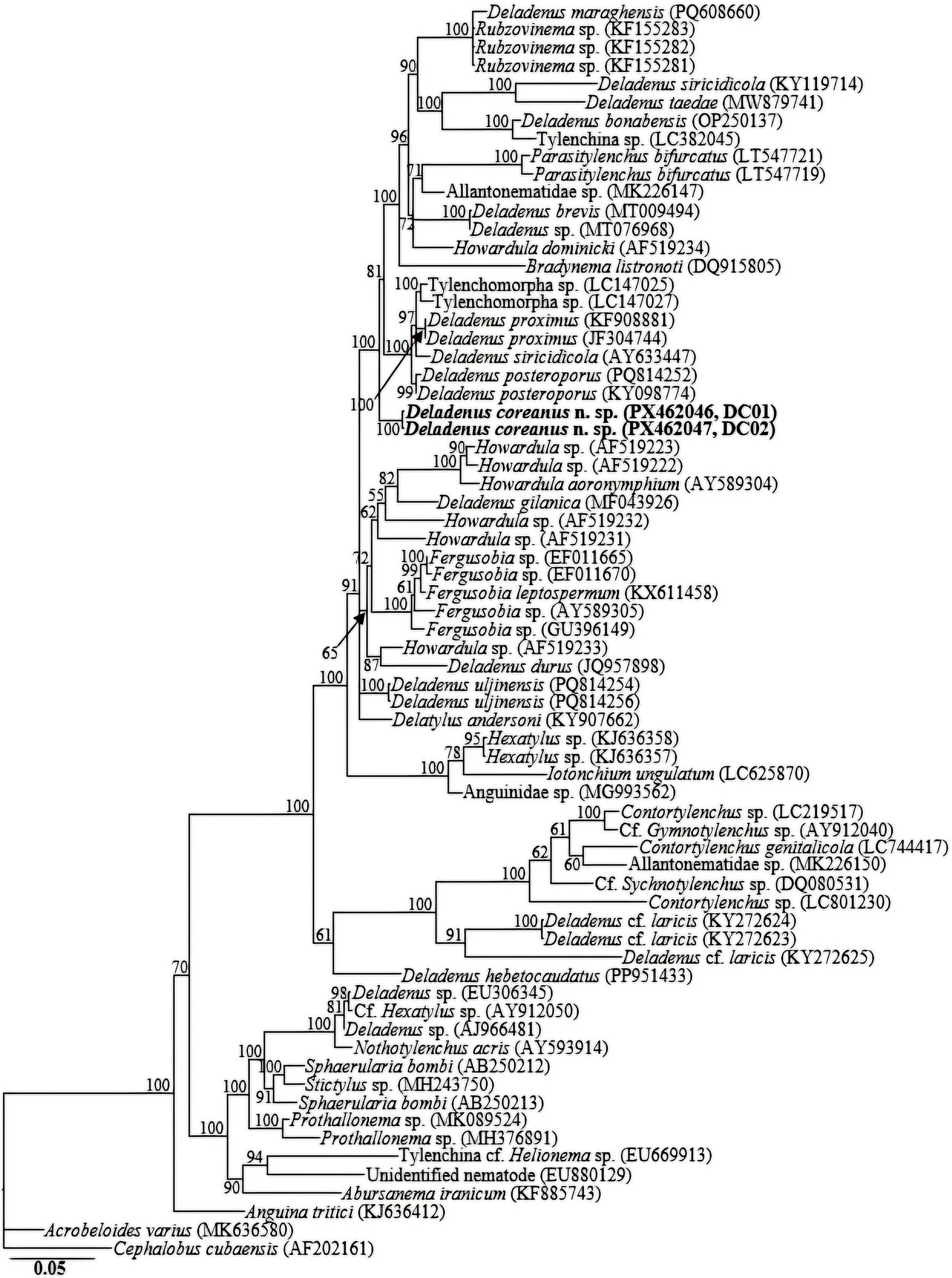
Figure 4
Bayesian tree inferred using 18S rRNA gene sequences of Deladenus spp. and other related species from various genera under the GTR + I + G model. Posterior probability values exceeding 50% are given on appropriate clades. The studied population is indicated in bold text.
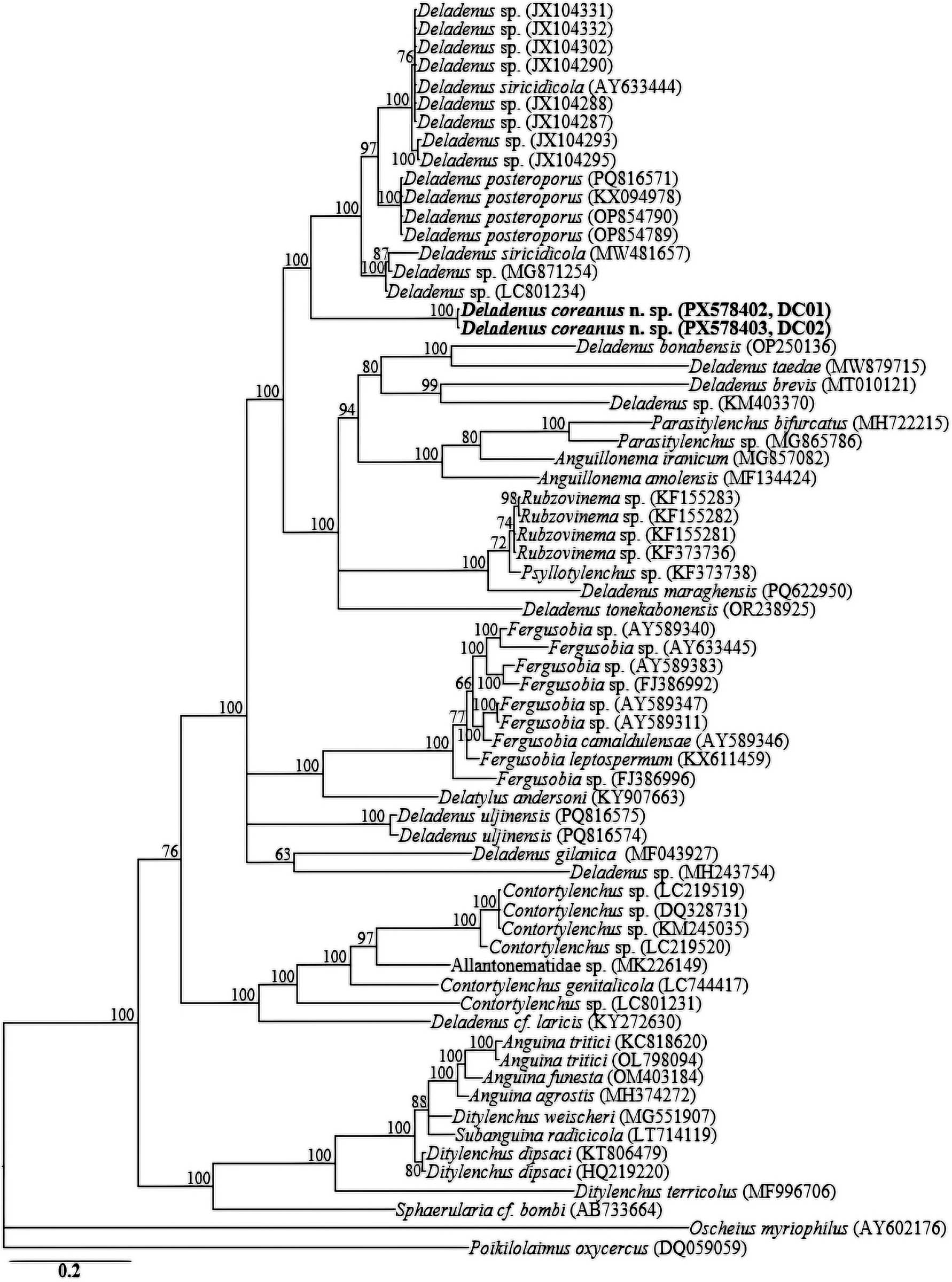
Figure 5
Bayesian tree inferred using LSU D2-D3 partial gene sequences of Deladenus spp. and other related species from various genera under the GTR + I + G model. Posterior probability values exceeding 50% are given on appropriate clades. The studied population is indicated in bold text.
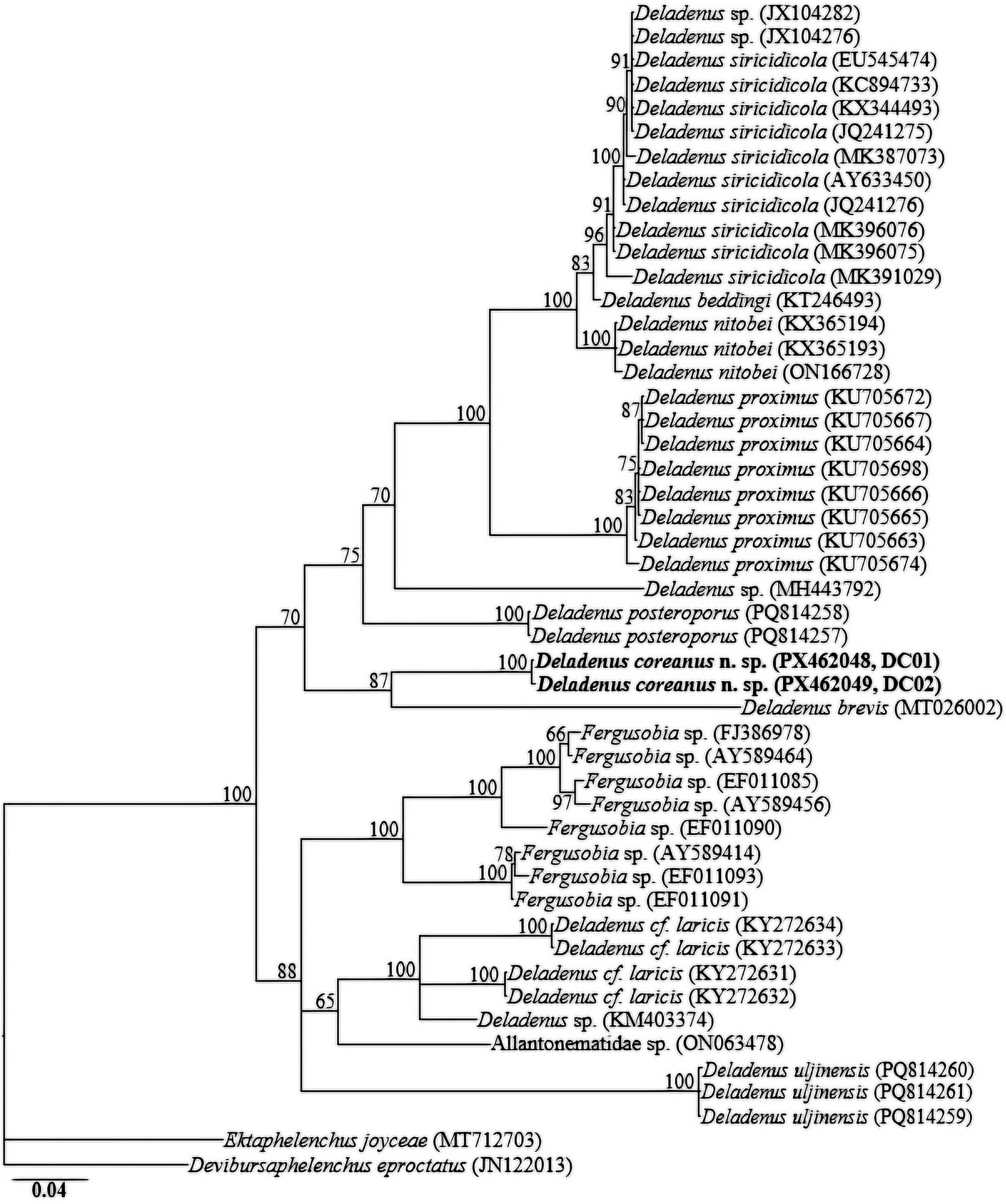
Figure 6
Bayesian tree inferred using COI gene sequences of Deladenus spp. and other related species from various genera under the GTR + I + G model. Posterior probability values exceeding 50% are given on appropriate clades. The studied population is indicated in bold text.