
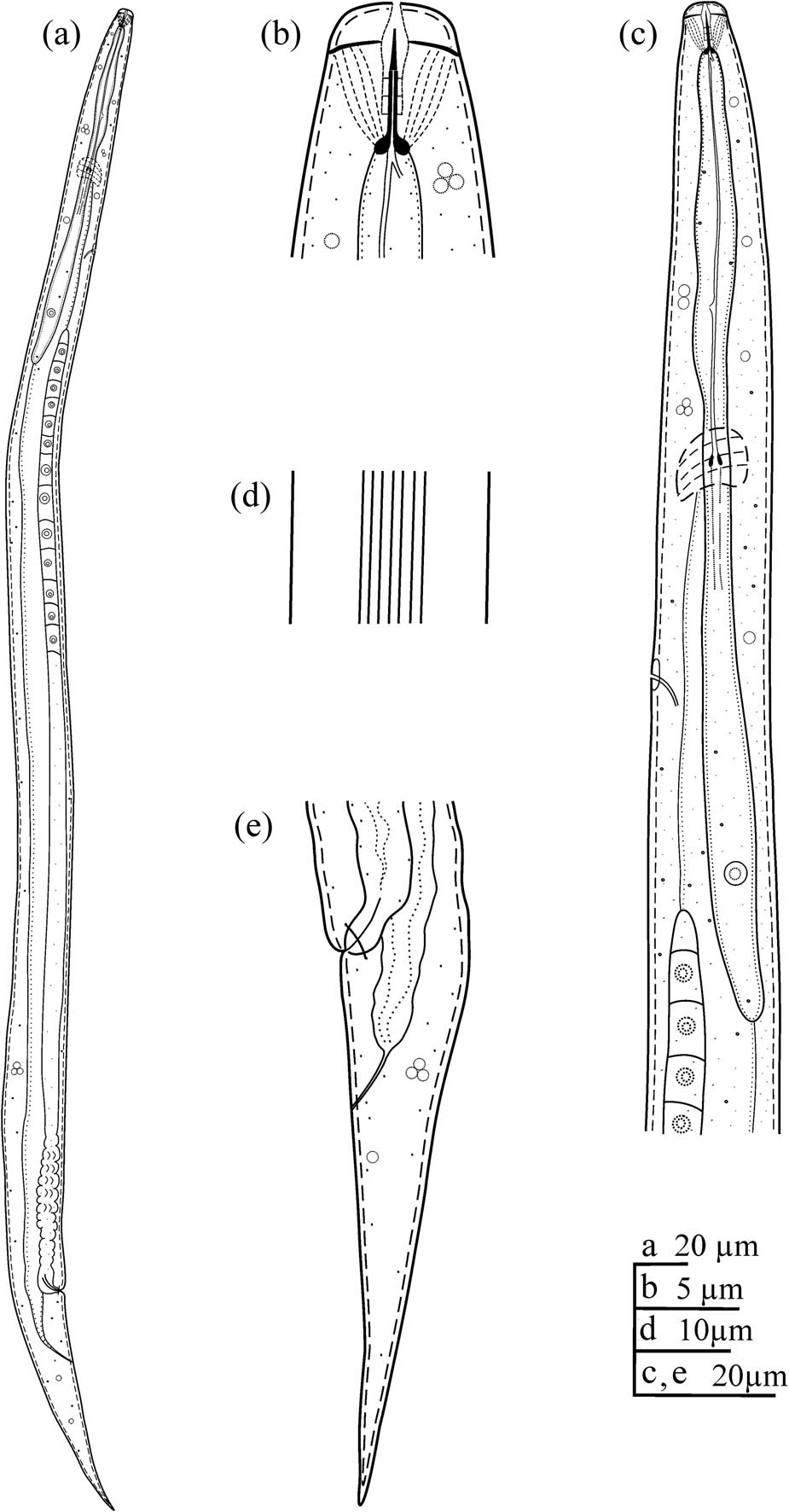
Figure 1
Line drawings of Deladenus longicaudatus n. sp. (mycetophagous female). (a) Total body. (b) Anterior body region. (c) Pharyngeal region. (d) Lateral lines. (e) Posterior body region.
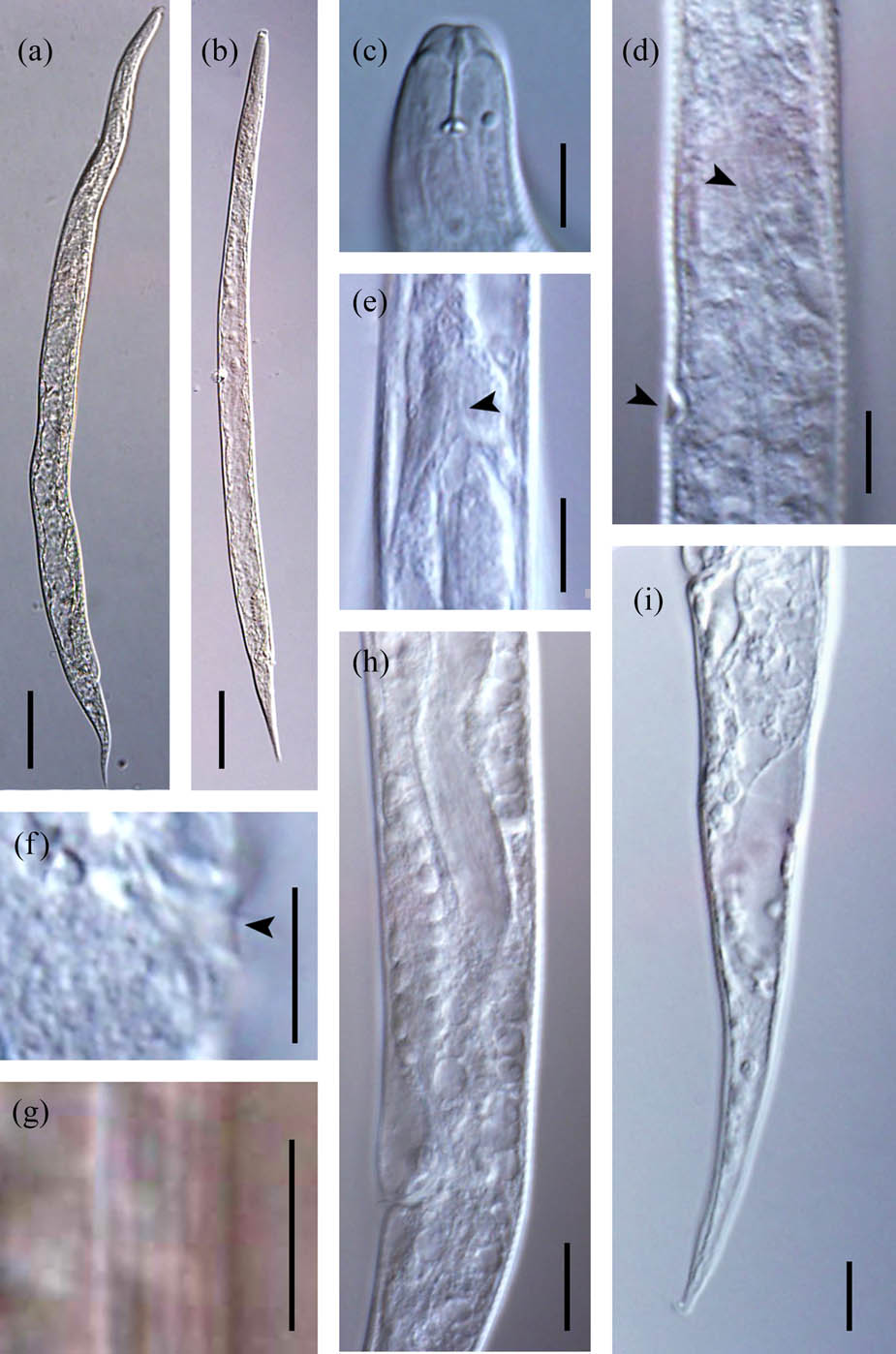
Figure 2
Photomicrographs of Deladenus longicaudatus n. sp. (mycetophagous female). (a and b) Total body. (c) Cephalic region and stylet (fresh sample in water). (d) Position of nerve ring (upper arrowhead) and hemizonid (lower arrowhead). (e) Position of pharyngo-intestinal junction at the level with the nerve ring (arrowhead). (f) Lateral vulval flap (arrowhead). (g) Lateral lines. (h) Part of reproductive system. (i) Posterior body region. (Scale bars: a and b = 40 µm, c and g = 5 µm, d–f, h and i = 10 µm).
Table 1
Morphometrics of Deladenus longicaudatus n. sp.
| Female | ||
|---|---|---|
| Character | Holotype | Paratypes |
| n | 1 | 11 |
| L | 570 | 579 ± 51 |
| (523–682) | ||
| a | 26 | 27 ± 5 |
| (19.5–34.0) | ||
| b | 9.8 | 9.3 ± 1.0 |
| (8–11) | ||
| b′ | 4.5 | 5 ± 1 |
| (3.8–6.7) | ||
| c | 9.8 | 10.1 ± 0.5 |
| (9.3–11.0) | ||
| c′ | 4.6 | 4.7 ± 0.4 |
| (3.9–5.3) | ||
| V | 85.0 | 86.3 ± 1.2 |
| (84.5–89.0) | ||
| Lip region height | 2 | 2.0 ± 0.3 |
| (1.8–2.5) | ||
| Lip region width | 6 | 6.0 ± 0.2 |
| (5.8–6.2) | ||
| Stylet | 6.5 | 6.0 ± 0.5 |
| (5.0–6.5) | ||
| Conus | 2.5 | 2.3 ± 0.2 |
| (2.0–2.5) | ||
| m | 38 | 37.0 ± 3.1 |
| (31.5 ± 40.5) | ||
| Nerve ring | 57 | 61 ± 5 |
| (51–67) | ||
| Hemizonid | 89 | 97 ± 10 |
| (84–110) | ||
| S–E pore | 91 | 99 ± 10 |
| (86–112) | ||
| Pharynx | 58 | 62 ± 5 |
| (51–69) | ||
| Anterior end to end of glands | 126 | 121 ± 16 |
| (102–142) | ||
| Overlapping | 68 | 59 ± 13 |
| (39–76) | ||
| Anterior end to vulva | 485 | 500 ± 50 |
| (442–607) | ||
| Maximum body diameter | 22 | 22 ± 4 |
| (16–27) | ||
| Vulval body width | 19 | 17.5 ± 2.0 |
| (14.5–20.5) | ||
| Anal body width | 12.5 | 12.0 ± 1.5 |
| (8.5–13.5) | ||
| Vulva-anus | 27 | 25 ± 3 |
| (21–31) | ||
| Tail | 58 | 56.5 ± 4.0 |
| (51–63) | ||
All measurements are in μm and in the form: Mean value ± standard deviation (range).
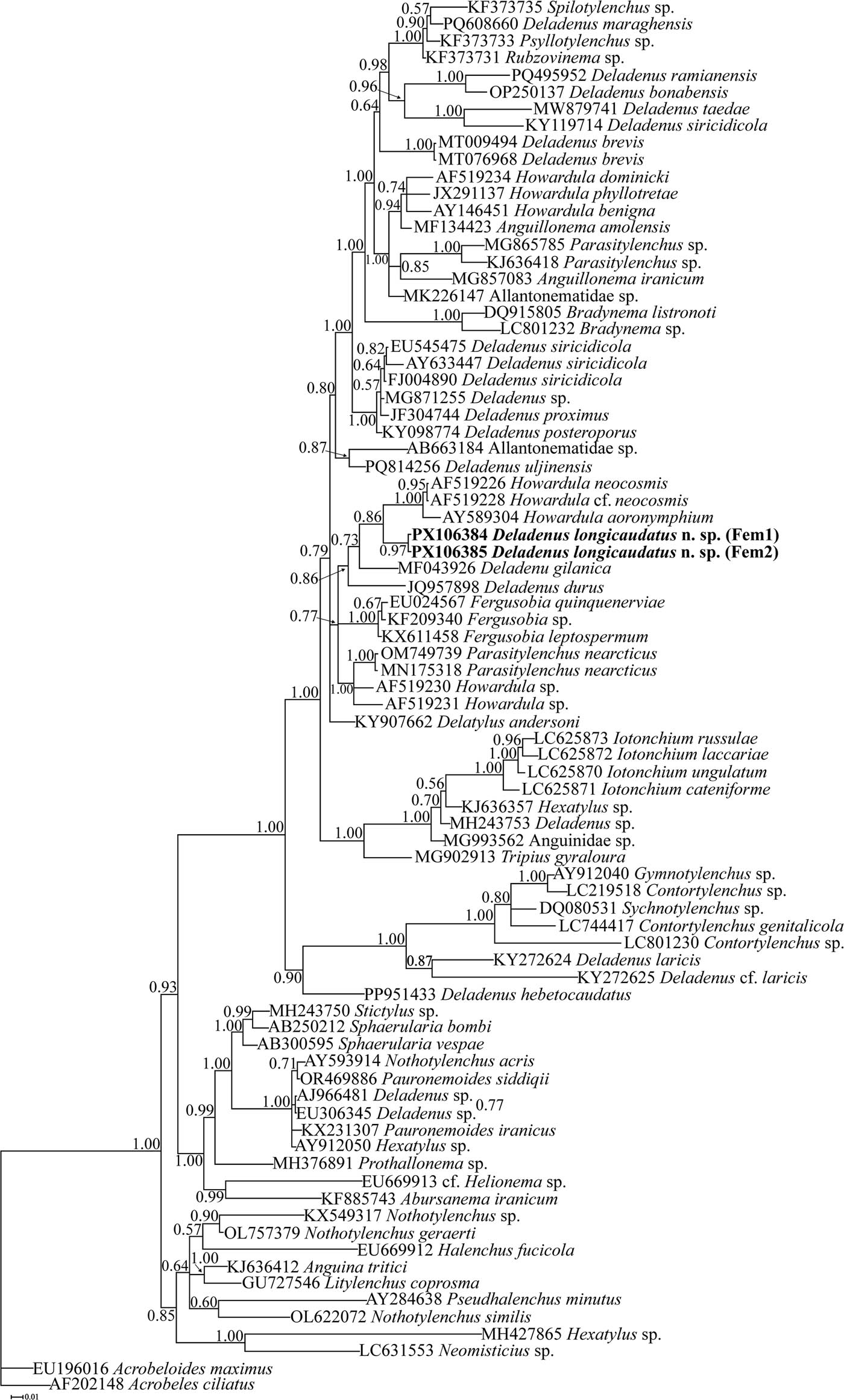
Figure 3
Bayesian 50% majority rule consensus tree of Deladenus spp. and other related species from various genera based on SSU rDNA sequences under GTR + I + G model. BPP values more than 0.50 are given for appropriate clades. The newly generated sequences are indicated in bold.
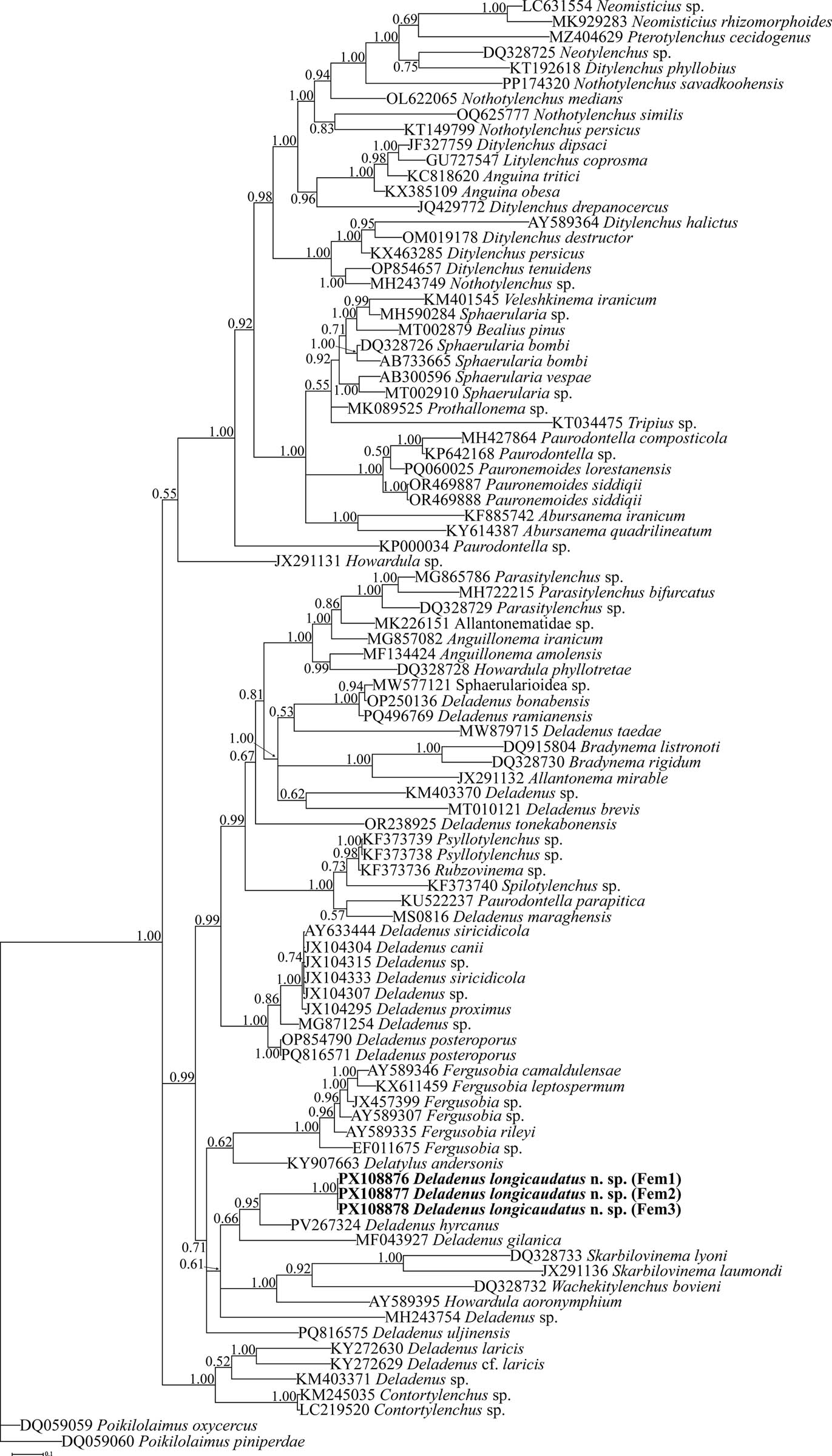
Figure 4
Bayesian 50% majority rule consensus tree of Deladenus spp. and other related species from various genera based on LSU rDNA D2–D3 sequences under GTR + I + G model. BPP values more than 0.50 are given for appropriate clades. The newly generated sequences are indicated in bold.