
The genus Deladenus Thorne, 1941 comprises nematodes with two distinct main life phases: a free-living phase, feeding on fungi (the mycetophagous phase), and an insect-parasitic phase (the entomoparasitic phase). The infective and mycetophagous phases dwell in soil, decaying organic matter, wood, and the bark of trees (mostly dead and dying trees). Species identification in this genus relies on several morphological features, including body shape, vulva position, number of lateral lines, stylet length, the positions of the pharyngo-intestinal junction, secretory–excretory (S–E) pore and hemizonid, tail shape, and male characters. Due to morphological and biological similarities in the mycetophagous phase of three genera Deladenus, Hexatylus Goodey, 1926, and Rubzovinema Slobodyanyuk, 1991, Rezaei et al. (2025) have recently urged that the mycetophagous Deladenus-like forms (species of the three aforementioned genera) need to be compared with all species under these genera when only free-living phase is available.
Since its establishment, Deladenus has attracted considerable attention of taxonomists. According to Aliramaji et al. (2024), a total of 42 valid species were described by 2024. Since then, the genus has been enriched by description of five more species, including D. hebetocaudatus Rezaei, Pourjam, Atighi, Kanzaki, Giblin-Davis and Pedram, 2025, D. uljinensis Mwamula, Bae, Kim and Lee, 2025, D. ramianensis Ajoudani, Pourjam, Jahanshahi Afshar, Atighi and Pedram, 2025, D. maraghensis Saberi, Jahanshahi Afshar, Atighi, Kanzaki, Giblin-Davis and Pedram, 2025, and D. hyrcanus Agh Atabai, Aliramaji and Shokoohi, 2025. Eighteen species listed by Aliramaji et al. (2024), along with five species described after 2024, were characterized solely based on their free-living phase.
In Iran, the genus was first recorded by recovering D. durus (Cobb, 1922) Thorne, 1941 (Jahanshahi Afshar et al., 2014). Later, several species were described or reported from the country (Ajoudani et al., 2025). The species D. ramianensis, D. maraghensis, and D. hyrcanus represent the latest species added to the genus from Iran (Ajoudani et al., 2025; Saberi et al., 2025; Agh Atabai et al., 2025).
During a recent study on nematodes associated with deadwood in forests of Javaherdeh in Ramsar county, Mazandaran province, northern Iran, in 2024–2025, free-living stages of a Deladenus-like population sensu Rezaei et al. (2025) were recovered from decaying wood of a broad-leaf forest tree. Detailed morphological studies of this population after comparison with all species of relevant genera indicated that it represents an undescribed species. Thus, the aims of the present study are to describe this population using morphological features and to reconstruct its phylogenetic relationships with relevant species and genera using sequences of small subunit (SSU) and D2–D3 expansion segments of the large subunit (LSU) rDNA.
1. Materials and methods
1.1. Wood and bark sampling, nematode extraction, and morphological characterization
Decaying wood and bark samples were collected in natural forests of Javaherdeh, Ramsar county, Mazandaran province, northern Iran. Nematodes were extracted using the tray method (Whitehead and Hemming, 1965). Live specimens were handpicked under a Nikon SMZ1000 stereomicroscope, heat-killed in hot 4% formaldehyde solution, and processed to anhydrous glycerin following De Grisse (1969). Permanent slides were prepared and examined with a Nikon Eclipse E600 microscope. Photomicrographs were obtained using an Olympus DP72 digital camera attached to an Olympus BX51 microscope equipped with differential interference contrast optics. Line drawings were made with a drawing tube and digitally drawn in CorelDRAW® software version 2020.
Deladenus in its broad sense was accepted in this research (Chitambar, 1991). The new species was compared with the mycetophagous phases of three genera, Deladenus, Hexatylus, and Rubzovinema, according to Rezaei et al. (2025) [valid species of the latter two genera according to Siddiqi (2000)].
1.2. DNA extraction, polymerase chain reaction (PCR), and sequencing
Three live nematode specimens of the new species were picked out and transferred individually to a small drop of tris-ethylenediaminetetraacetic acid (TE) buffer (10 mM Tris-Cl; 0.5 mM ethylenediaminetetraacetic acid; pH 9.0; Qiagen) on a clean slide and gently squashed using a clean cover slip after photomicrographic documentation. The suspension from each specimen was collected by adding 35 μL of TE buffer. DNA samples were stored at –20°C until used as PCR templates. The partial SSU rDNA was amplified using forward primer 1813F (5′-CTGCGTGAGAGGTGAAAT-3′) and reverse primer 2646R (5′-GCTACCTTGTTACGACTTTT-3′) (Holterman et al., 2006). The LSU rDNA D2–D3 expansion domains were amplified using the forward primer D2Ab (5′-ACAAGTACCGTGAGGGAAAGTTG-3′) (De Ley et al., 1999) and reverse primer 1006R (5′-GTTCGATTAGTCTTTCGCCCCT-3′) (Holterman et al., 2008). PCR reactions were performed in 35 μl volumes with an annealing temperature of 52°C. The successfully amplified PCR products were sequenced with the same primers used in PCR by Pishgam Corporation (Tehran, Iran), using an ABI 3730XL sequencer. The newly obtained sequences were deposited in the GenBank database under the accession numbers PX106384 and PX106385 for SSU rDNA; and PX108876, PX108877, and PX108878 for LSU rDNA.
1.3. Phylogenetic analyses
The newly obtained SSU and LSU sequences of the new species were compared with those of other nematode species available in the GenBank database using the BLAST homology search program. For phylogenetic reconstruction, two independent datasets were prepared: the SSU and LSU. Sequences of both loci were aligned using MUSCLE implemented in MEGA7 (Kumar et al., 2016) and manually edited to remove poorly aligned or ambiguous positions. Model selection for nucleotide substitution was performed with MrModeltest v2 (Nylander, 2004), applying the Akaike information criterion. The analysis indicated that the general time reversible model, incorporating both a gamma distribution of rate heterogeneity among sites and a proportion of invariant sites (GTR + G + I), was the most suitable, and was therefore used for further analyses. Bayesian inference was performed using MrBayes v3.1.2 (Ronquist and Huelsenbeck, 2003) for 5,000,000 generations for each dataset. Twenty-five percent of the samples were discarded as burn-in. The Markov chain Monte Carlo method within a Bayesian framework was used to estimate posterior probabilities of phylogenetic trees using the 50% majority rule. For the SSU phylogeny, sequences of Acrobeloides maximus Thorne, 1925 and Acrobeles ciliatus von Linstow, 1877 were used as outgroups, whereas for the LSU phylogeny, sequences of Poikilolaimus oxycerca de Man, 1895 and P. piniperdae Fuchs, 1930 served as outgroups. The resulting phylogenetic trees were visualized using Dendroscope v3.2.8 (Huson and Scornavacca, 2012) and subsequently digitally drawn in CorelDRAW® software version 2020.
2. Results
2.1. Description
2.1.1. The line drawings and photomicrographs of Deladenus longicaudatus n. sp. are presented in Figs. 1 and 2, respectively
2.1.2. The morphometrics of Deladenus longicaudatus n. sp. are shown in Table 1
Female (free-living mycetophagous phase):
Body small to medium-sized, almost fusiform, not obese, nearly straight to very slightly ventrally curved after fixation, gradually tapering toward both anterior and posterior ends, more at the posterior body region, with an elongate conical tail. Cuticle with fine annuli (1.3–1.5 μm wide at mid-body). Lateral field with seven lines at mid-body. Cephalic region low, 2.4–3.2 times wider than high, continuous with body contour, slightly depressed at base, anteriorly flattened to slightly concave. Stylet small, with three distinct posteriorly directed knobs, the conus occupying ca 31–40% of total stylet length. Dorsal gland orifice just posterior to stylet knobs. S–E pore posterior to nerve ring, at the same level with hemizonid. Deirid not observed. Pharynx without a distinct median bulb, lacking a chamber, its junction with intestine at the level with the nerve ring, dorsal pharyngeal gland forming a long overlap over intestine, subventral glands shorter, their orifice slightly posterior to mid-pharynx. Intestine simple, rectum and anus functional. Reproductive system monodelphic-prodelphic, with ovary outstretched, maturing oocytes in one or two rows, oviduct narrow, tube-like and long, spermatheca not observed; crustoformeria with more than four cells in each row, uterus and vagina with moderately sclerotized wall, vulva in the shape of a wide slit, with lateral flaps (seen in ventro-lateral focus). Postvulval uterine sac (PUS) absent. Vulva-anus distance less than tail length (tail/vulva to anus 2–3). Tail elongate conical, gradually tapering to a finely rounded tip.
Male (free-living mycetophagous):
Not found.
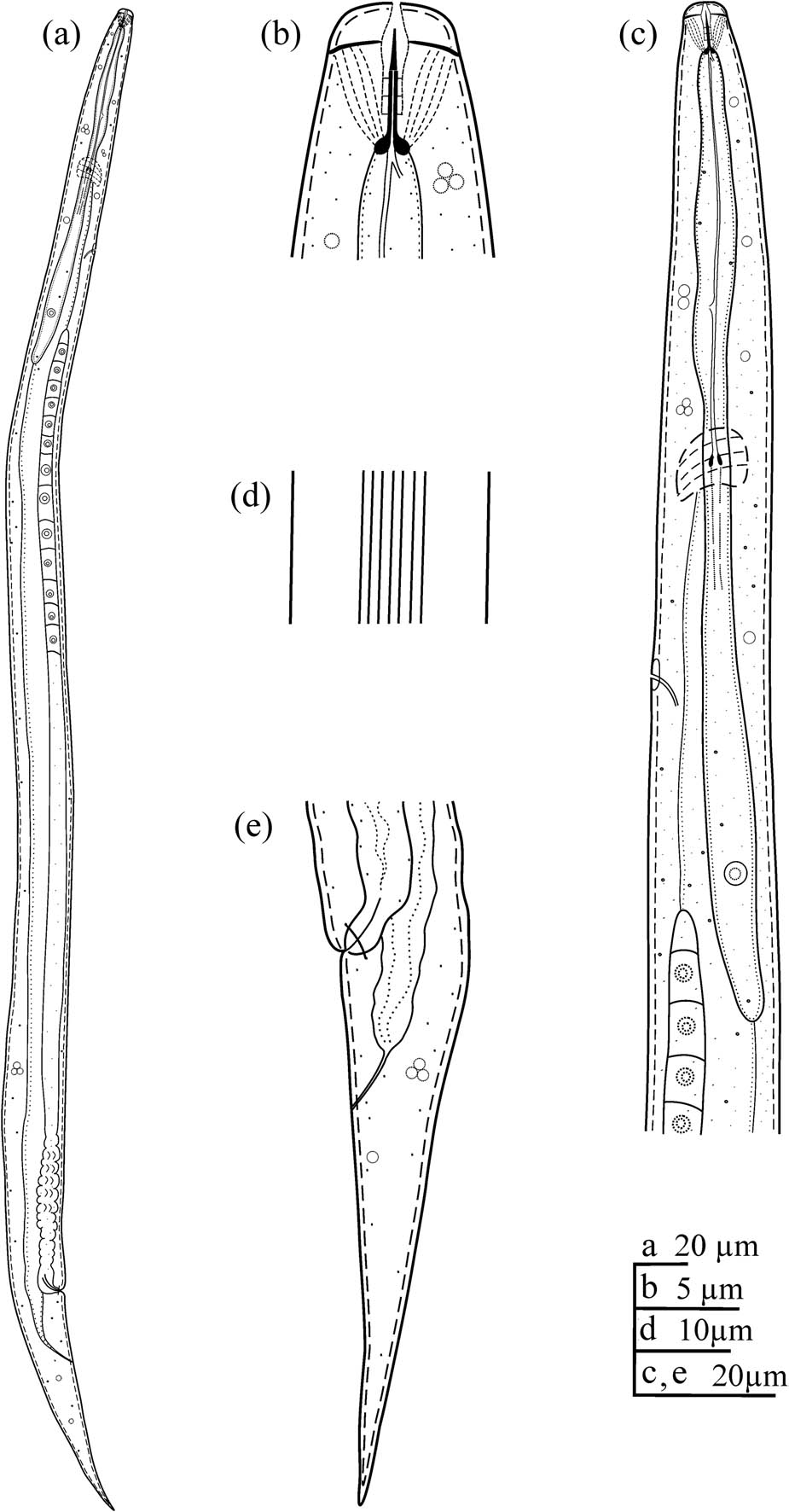
Figure 1
Line drawings of Deladenus longicaudatus n. sp. (mycetophagous female). (a) Total body. (b) Anterior body region. (c) Pharyngeal region. (d) Lateral lines. (e) Posterior body region.
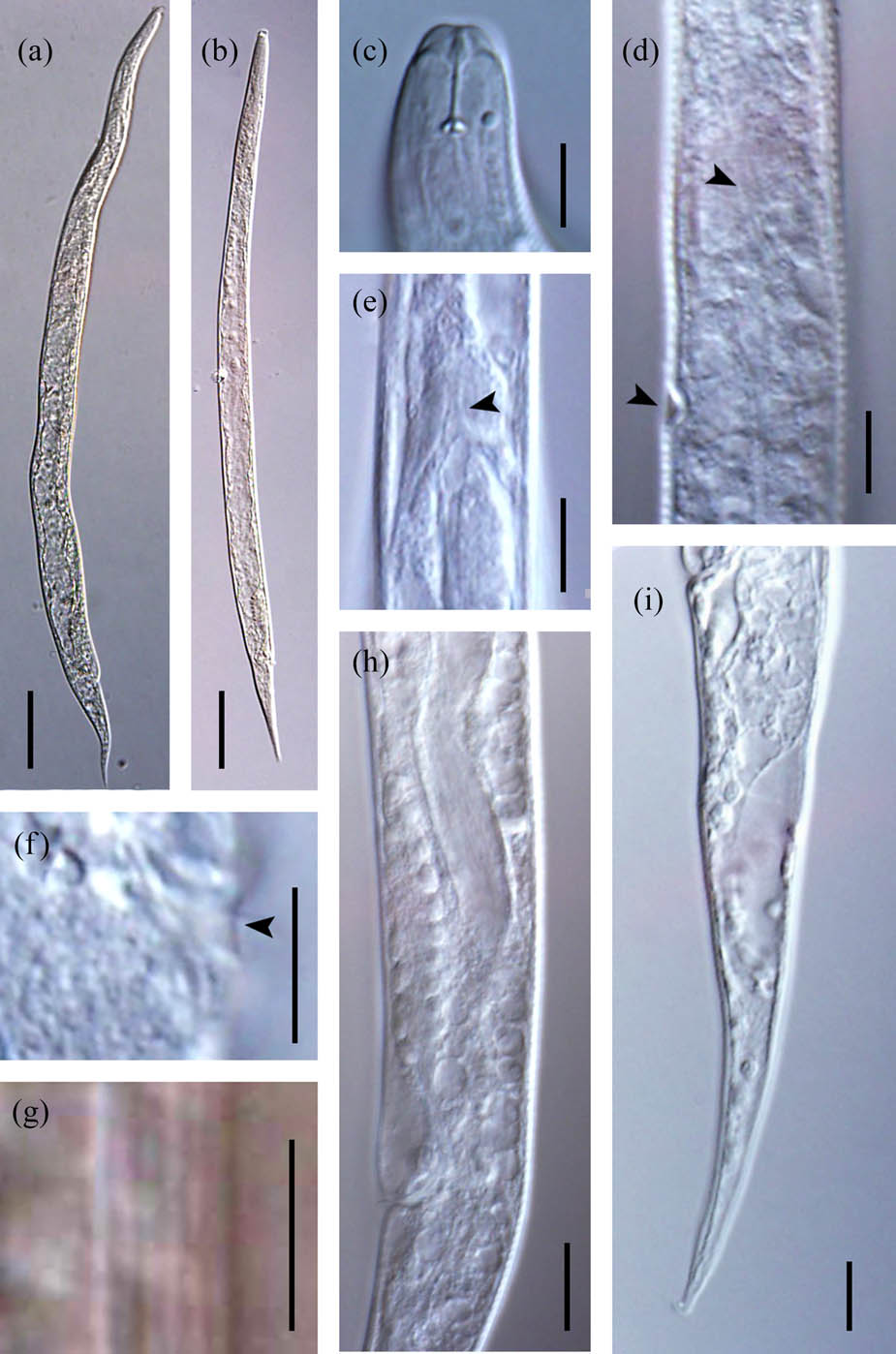
Figure 2
Photomicrographs of Deladenus longicaudatus n. sp. (mycetophagous female). (a and b) Total body. (c) Cephalic region and stylet (fresh sample in water). (d) Position of nerve ring (upper arrowhead) and hemizonid (lower arrowhead). (e) Position of pharyngo-intestinal junction at the level with the nerve ring (arrowhead). (f) Lateral vulval flap (arrowhead). (g) Lateral lines. (h) Part of reproductive system. (i) Posterior body region. (Scale bars: a and b = 40 µm, c and g = 5 µm, d–f, h and i = 10 µm).
Table 1
Morphometrics of Deladenus longicaudatus n. sp.
| Female | ||
|---|---|---|
| Character | Holotype | Paratypes |
| n | 1 | 11 |
| L | 570 | 579 ± 51 |
| (523–682) | ||
| a | 26 | 27 ± 5 |
| (19.5–34.0) | ||
| b | 9.8 | 9.3 ± 1.0 |
| (8–11) | ||
| b′ | 4.5 | 5 ± 1 |
| (3.8–6.7) | ||
| c | 9.8 | 10.1 ± 0.5 |
| (9.3–11.0) | ||
| c′ | 4.6 | 4.7 ± 0.4 |
| (3.9–5.3) | ||
| V | 85.0 | 86.3 ± 1.2 |
| (84.5–89.0) | ||
| Lip region height | 2 | 2.0 ± 0.3 |
| (1.8–2.5) | ||
| Lip region width | 6 | 6.0 ± 0.2 |
| (5.8–6.2) | ||
| Stylet | 6.5 | 6.0 ± 0.5 |
| (5.0–6.5) | ||
| Conus | 2.5 | 2.3 ± 0.2 |
| (2.0–2.5) | ||
| m | 38 | 37.0 ± 3.1 |
| (31.5 ± 40.5) | ||
| Nerve ring | 57 | 61 ± 5 |
| (51–67) | ||
| Hemizonid | 89 | 97 ± 10 |
| (84–110) | ||
| S–E pore | 91 | 99 ± 10 |
| (86–112) | ||
| Pharynx | 58 | 62 ± 5 |
| (51–69) | ||
| Anterior end to end of glands | 126 | 121 ± 16 |
| (102–142) | ||
| Overlapping | 68 | 59 ± 13 |
| (39–76) | ||
| Anterior end to vulva | 485 | 500 ± 50 |
| (442–607) | ||
| Maximum body diameter | 22 | 22 ± 4 |
| (16–27) | ||
| Vulval body width | 19 | 17.5 ± 2.0 |
| (14.5–20.5) | ||
| Anal body width | 12.5 | 12.0 ± 1.5 |
| (8.5–13.5) | ||
| Vulva-anus | 27 | 25 ± 3 |
| (21–31) | ||
| Tail | 58 | 56.5 ± 4.0 |
| (51–63) | ||
All measurements are in μm and in the form: Mean value ± standard deviation (range).
2.2. Infective female
Not found.
2.3. Parasitic female
Not found.
2.4. Type habitat and locality
Decaying wood and bark of a dead broadleaf tree in forests of Javaherdeh, Ramsar county, Mazandaran province, northern Iran. GPS coordinates: 36°52′70″N, 50°33′39.5″E.
2.5. Type material
Holotype female and 11 paratype females were deposited at the WaNeCo nematode collection of Wageningen University, The Netherlands. The LSID code of this publication is: urn:lsid:zoobank.org:pub:800CA2DA-5C2C-47F8-9DED-95445BBDBCB0
2.6. Etymology
The specific epithet refers to the elongate conical tail of the new species.
2.7. Diagnosis and relationship
The mycetophagous females of the new species are mainly characterized by an elongate conical tail gradually tapering to a finely rounded terminus (51–63 µm long, c = 9.3–11.0, c′ = 3.9–5.3), a relatively anterior vulval position (V = 84.5–89.0%), and a tail length 2–3 times the vulva–anus distance long. Deladenus longicaudatus n. sp. is further characterized by 523–682 µm long females having the pharyngo-intestinal junction at the level with the nerve ring, the S–E pore posterior to the nerve ring and at the level with the hemizonid, seven lines in the lateral fields, a short stylet (5.0–6.5 µm), small lateral vulval flaps, and absence of a PUS.
By having similarities in tail shape, c′ ratio greater than 3 and position of S–E pore and hemizonid posterior to nerve ring as well as no PUS, the new species is comparable to four known species of the genus, namely, D. gilanica Jalalinasab, Esmaeili, Ye and Heydari, 2020, D. hyrcanus, D. parvus Zell, 1985, and D. zyzyphus Bajaj, 2015. The new species differs from D. gilanica by a longer body (523–682 vs 314–422 µm), shorter stylet (5.0–6.5 vs 7.5–8.0 µm), S–E pore 86–112 µm from anterior end (vs 61–76 µm), number of lateral field lines (seven vs eight), presence of lateral vulval flaps (vs absence), and longer tail (51–63 vs 27–32 µm); from D. hyrcanus by a shorter body (523–682 vs 718–806 µm), shorter stylet (5.0–6.5 vs 7.5–10.0 µm), shorter pharynx (51–69 vs 71–86 µm), vulva-anus distance (21–31 vs 28.5–46.0 µm), and presence of lateral vulval flaps (vs absence); from D. parvus by number of lateral field lines (seven vs four), a posterior vulval position (V = 84.5–89.0 vs 79.8–85.4%), presence of lateral vulval flaps (vs absence), and a finely rounded tail tip (vs having a short hairy process); from D. zyzyphus by shorter body (523–682 vs 790–1,110 μm), shorter stylet (5.0–6.5 vs 7–9 μm), S–E pore at the level with hemizonid (vs posterior to hemizonid), number of lateral lines (seven vs four), lower a ratio (19.5–34.0 vs 45–51), lower c′ ratio (3.9–5.3 vs 6.1–7.0), presence of lateral vulval flaps (vs absence), shorter tail (51–63 vs 69–90 μm), and absence of males (vs presence).
Among the mycetophagous phases of the species under the genera Hexatylus and Rubzovinema, the new species is typologically comparable to Hexatylus vigissi Skarbilovich, 1952 (a poorly known species), but differs from it by a shorter body (523–682 vs 986–1,326 μm), shorter stylet (5.0–6.5 vs 6–8 µm), S–E pore 86–112 µm from anterior end (vs 112–125 µm), lower c ratio (9.3–11.0 vs 12.7–16.5), and shorter tail (51–63 vs 60–100 µm).
2.8. Remark
Description of Hexatylus vigissi includes no data on the rectum acting as a feeding pump. This feature is regarded as one of the main generic characters of Hexatylus, as defined by Siddiqi (2000).
2.9. Molecular profiles and phylogenetic status
2.9.1. Partial SSU rDNA
The partial sequencing of SSU rDNA from two specimens of the new species yielded two fragments of 786 nucleotides which were identical after aligning. The BLAST search using these two fragments revealed that all available sequences in GenBank shared less than 98% identity with them. A set of 80 sphaerularioid SSU sequences (including two sequences of the new species) and sequences of two classic rhabditids as outgroups were used in SSU phylogeny (accession numbers and species in the tree). Fig. 3 represents the SSU phylogeny resulting from this dataset. In this tree, SSU sequences assigned to Deladenus spp. occupied distant placements across the tree, indicating that the genus is polyphyletic based on this marker and currently available data. The SSU sequences of the new species clustered with sequences of Howardula neocosmis Poinar, Jaenike and Shoemaker, 1998 (AF519226), H. cf. neocosmis (AF519228), and H. aoronymphium Welch, 1959 (AY589304) inside a clade that also includes sequences of Deladenus gilanica (MF43926) and the sequence assigned to D. durus (JQ957898), with a moderate Bayesian posterior probability (BPP = 0.86).
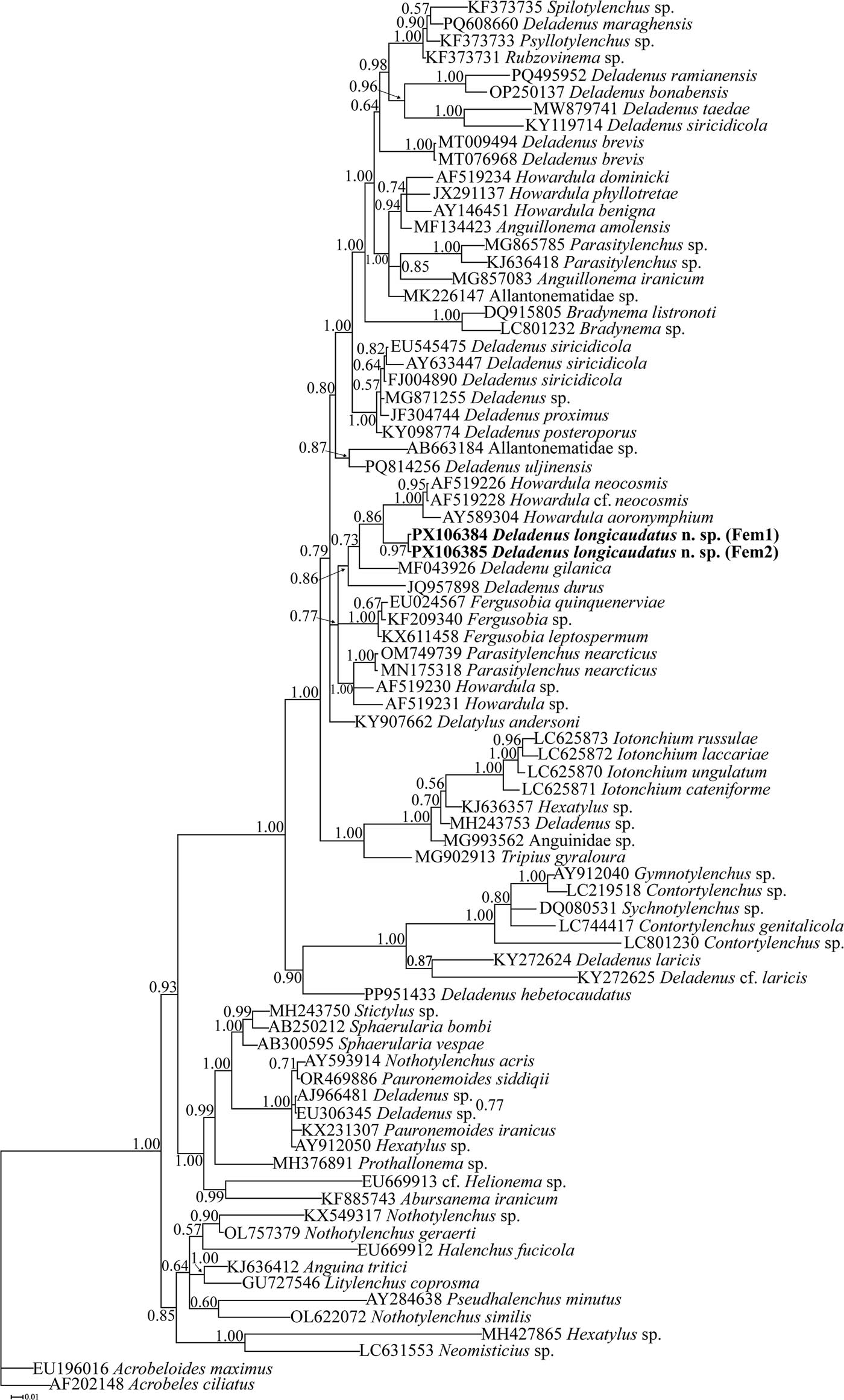
Figure 3
Bayesian 50% majority rule consensus tree of Deladenus spp. and other related species from various genera based on SSU rDNA sequences under GTR + I + G model. BPP values more than 0.50 are given for appropriate clades. The newly generated sequences are indicated in bold.
2.9.2. D2–D3 fragments of LSU rDNA
Partial sequencing of the D2–D3 expansion segments of LSU rDNA of three individuals of the new species yielded three fragments of 724 nucleotides which were identical after aligning. The BLAST search revealed that all available sequences in GenBank shared less than 90% identity with them. For LSU phylogeny reconstruction, 92 sphaerularioid sequences (including three sequences of the new species) and sequences of two classic rhabditid taxa as outgroups were included (accession numbers and species in the tree). Fig. 4 represents the LSU phylogeny resulting from this dataset. In this tree, LSU sequences assigned to Deladenus spp. were scattered across different clades, indicating that the genus is polyphyletic based on the LSU marker and currently available data. The LSU sequences of the new species formed a clade with the corresponding sequence of Deladenus hyrcanus (PV267324), and the relationship of this clade with the LSU sequence of D. gilanica (MF043927) was not supported (BPP = 0.66).
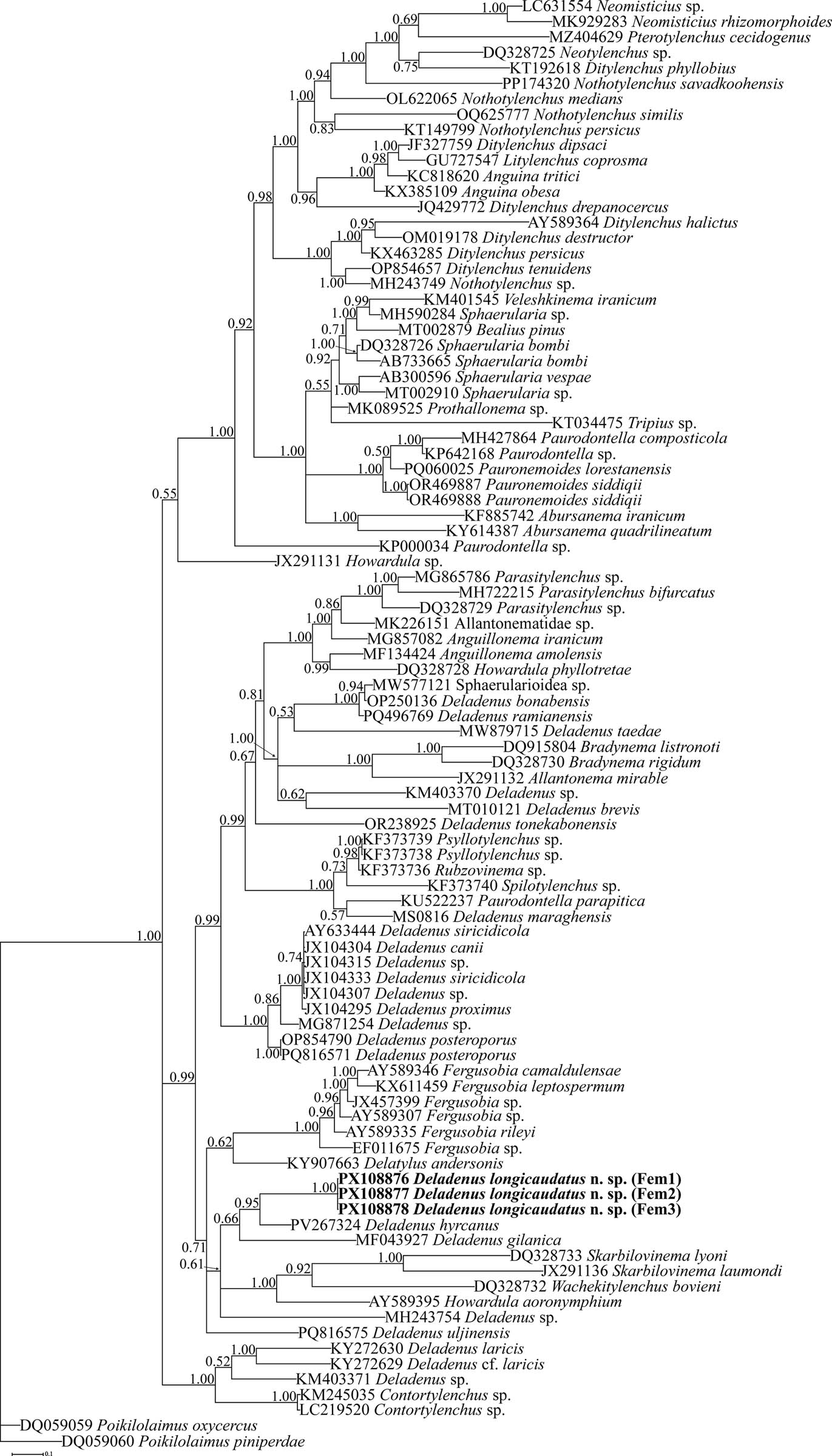
Figure 4
Bayesian 50% majority rule consensus tree of Deladenus spp. and other related species from various genera based on LSU rDNA D2–D3 sequences under GTR + I + G model. BPP values more than 0.50 are given for appropriate clades. The newly generated sequences are indicated in bold.
2.10. Remark
Attempts to amplify the cytochrome c oxidase subunit 1 gene of the new species failed.
3. Discussion
In this study, a new species of the genus Deladenus was described and characterized using an integrative approach, combining morphological and molecular data. To date, six species of genus Deladenus, characterized by a long conical tail (the c′ ratio ≥3) ending in a pointed or finely rounded terminus, have been described. Among them, D. megacondylus (Mulvey, 1969) Sumenkova, 1975 and D. saccatus Andrássy, 1954 possess a PUS and were therefore excluded from comparisons with the new species. The remaining four species have already been morphologically compared with the new species in diagnosis and relationships.
As emphasized by Rezaei et al. (2025), most species currently placed in the genus Hexatylus are poorly described. Although its type species is well delimited by the morphology of its stylet knobs, the descriptions of other species lack details on the basal cephalic sectors and the rectum acting as a feeding tube, which have been emphasized as generic traits by Siddiqi (2000). At the current status, no taxonomic changes are proposed for the species currently placed in Hexatylus, as it is beyond the scope of this study.
The reconstructed SSU and LSU phylogenies in the present study revealed that, in line with previous analyses (e.g., Amiri Bonab et al., 2023; Saberi et al., 2025; Ajoudani et al., 2025), ribosomal sequences of Deladenus and other sphaerularioid genera do not form monophyletic groups based on the currently available data. Although several independent phylogenetic genera could be proposed based on the varying positions of currently sequenced species in phylogenetic trees, such an action would further complicate the taxonomy of Deladenus. In that case, the generic status of Deladenus-like species would become entirely dependent on sequencing results. Moreover, the parasitic stages and molecular data of many species remain unknown or insufficiently studied. Therefore, any tentative revision of Deladenus requires additional data in the future. The description of the present new species supports the findings of Saberi et al. (2025), Ajoudani et al. (2025), and Agh Atabai et al. (2025), highlighting the potentially high diversity of the genus Deladenus in Iran.
Acknowledgments
The authors gratefully acknowledge the financial support provided by Tarbiat Modares University.
Funding information
Authors state that no funding information.
Author contributions
Mehdi Salemi: Sampling, methodology, writing. Farahnaz Jahanshahi Afshar: Methodology, writing, review and editing, data curation, financial support in part. Mohammad Reza Atighi: Methodology, writing, review and editing, data curation. Majid Pedram: Methodology, writing, review and editing, data curation, resources, project administration, investigation, funding acquisition, conceptualization.
Conflict of interest statement
Authors state no conflict of interest.