
I. Introduction
In recent years, “customer harassment” has become a major problem in Japan. The term “customer harassment” is a Waseieigo, meaning a term in Japanese derived from the combination of English words -- in this case, “customer” and “harassment.” Although it may seem ambiguous for English speakers to comprehend the meaning, it is a term that signifies “abuse of workers by customers”. 2 Customer harassment is defined as significant disruptive behaviors perpetrated by customers against service providers, including but not limited to assault, threats, severe verbal abuse, and unreasonable demands. 3
It has been noted that the severity of this problem was accelerated by the COVID-19 disaster. Long working hours, low pay raises, rising inflation, a weak yen, and various other factors have caused some people to take their anger out on service workers and others. In Japan, the issue of customer harassment has recently been identified by the government and various companies and organizations as a matter of significant urgency, prompting the implementation of a range of measures.
On September 1, 2023, the Ministry of Health, Labour and Welfare (MHLW) incorporated customer harassment into the evaluation criteria for workers’ compensation for depression and other illnesses caused by work 4. Moreover, the MHLW is considering amending the Comprehensive Labor Policy Promotion Law to reinforce measures against customer harassment and mandate that companies implement measures to safeguard their employees.
On October 4, 2024, the Tokyo Metropolitan Government passed the first “Customer Harassment Prevention Ordinance” in Japan. It went into effect on April 1, 2025. 5 Subsequently, on November 26, 2024, Hokkaido enacted a customer harassment prevention ordinance, which took effect on April 1, 2025. 6 In the current moment, a multitude of local administrations are engaged in the implementation of measures designed to address this critical issue. For instance, an ordinance against customer harassment was passed and enacted in Kuwana City, Mie Prefecture, on December 25, 2024, and came into effect on April 1, 2025. The ordinance stipulates that in cases of maliciousness, the perpetrator’s name will be made public. 7 According to the city, this is the first time such a sanction has been introduced nationwide. 8
This article examines the circumstances surrounding customer harassment in Japan and the underlying factors that contribute to its prevalence. The article examines the various forms that customer harassment can take, the factors that contribute to its occurrence, and the mechanisms by which it is perpetrated. It then focuses particularly on customer harassment in the Japanese life insurance industry. Finally, it examines the issues that the government and the insurance industry should address in the future. Supplementary material in the Appendix provides a concrete example of the prevailing circumstances of customer harassment within the Japanese life insurance industry and the optimal responses to such issues, using select information from a life insurance company’s manual on customer harassment.
II. Customer Harassment Issues in Japan
In Japan, people often say “the customer is God.” In the United States, they say “the customer is always right.” And in the United Kingdom, they say “the customer is king.” These expressions are very similar. Furthermore, customer harassment issues can be observed in any country, region, or culture worldwide. However, considerable regional discrepancies exist with respect to both the forms and the frequency of customer harassment incidents.
The author stayed in Massachusetts, U.S.A., for a year from August 2022 for overseas research. When receiving or purchasing services or products, I felt that the relationship and position with the provider was more equal than in Japan. This was true whether the provider was a public institution or a private business. Indeed, the issue of customer harassment in Japan has not always been thoroughly grasped by the general U.S. population when it has been explained to them.
The phenomenon of customer harassment has been present for some time, but in recent years it has gained significant attention due to extensive coverage in mass media 9 and the plethora of social networking services. In Japan, shifts in the work environment and heightened awareness of customer harassment, including reforms in work practices and labour shortages, have resulted in an increase in instances where employees have spoken out about the issue. 10 This has brought to the fore a customer harassment problem that had been dormant for some time.
Some grievances from customers and other parties are valid and do not inherently pose a significant problem. In certain cases, they can act as a catalyst for the improvement of existing products and services or the development of new ones. Furthermore, as previously indicated in a leaflet published by the MHLW, complaints and grievances have the potential to facilitate enhancements in a company’s operational procedures. 11
It is therefore incumbent upon companies and employees to discern whether a complaint or grievance represents a legitimate or an unreasonable demand and to address it accordingly. The leaflet published by the MHLW enumerates two circumstances under which claims and complaints from customers, etc. are deemed to constitute “customer harassment.”
The first situation pertains to circumstances in which the customer’s demands are deemed unwarranted. Examples of unjustified demands include cases where “there are no defects or errors in the products or services provided by the company” or where “the demands are unrelated to the products or services provided by the company.”
The second situation is when the means and manner of fulfilling the request are considered to be socially inappropriate. “Cases where there is a high possibility of the request being inappropriate, regardless of how valid the request is,” include, for example, physical attacks (assault, injury), mental attacks (threats, slander, defamation, insults, verbal abuse), or requests to get down on one’s knees. “Cases where the request is considered inappropriate based on its content,” could involve, for example, requests to exchange products or requests for monetary compensation.
A. Prevalence of Customer Harassment
As detailed in the “Report on the Actual Conditions of Harassment in the Workplace” 12 published by the MHLW in 2020, 15.0% of male and female workers aged 20 to 64 employed by companies and organizations across Japan reported experiencing significant annoyance from customers and others at their workplace at least once in the past three years. 13 The percentage of individuals who have experienced customer harassment is not significantly different between genders, with 14.9% of men and 15.0% of women reporting such experiences.
In the preceding three-year period, 19.5% of companies have indicated that they have received consultations pertaining to customer harassment. The prevalence of customer harassment is notable, ranking third after power harassment (48.2%) and sexual harassment (29.8%). By industry, the highest rates of customer harassment were observed in the following sectors: lifestyle-related services and entertainment (25.1%), electricity, gas, heat supply and water (23.3%), real estate and goods rental (22.6%), and wholesale and retail (21.9%).
The types of customer harassment received from customers, etc., were as follows: “being detained for a long time 14 or complaining excessively about the same things over and over” (52.0%), “defamation, insults, and severe verbal abuse” (46.9%), and “extremely unreasonable demands (demands for money, forcing people to get down on their knees, etc.)” (24.9%).
A survey conducted by UA Zensen 15 between January and March 2024 among members of its affiliated unions revealed that 46.8% of respondents had experienced customer harassment within the previous two years. Of the 210 unions that responded to the survey, 33,133 cases were reported. Furthermore, the “Quantitative Survey on Customer Harassment,” conducted by the PERSOL Research Institute from February to March 2024, revealed that approximately 20,000 individuals aged 20–69 employed in service occupations across Japan had experienced customer harassment, with 35.5% of respondents indicating that they had been victims of such incidents. Of these, 20.8% reported that they had been victimized within the past three years. Although there are some discrepancies in the data, the findings of both surveys suggest that customer harassment is a pervasive issue in Japanese society.
B. Mental and Physical Effects of Customer Harassment
The results of a survey conducted by the MHLW indicate that the most prevalent physical and mental effects of significant customer and other interpersonal annoyance are “feelings of anger, frustration, and anxiety” (67.6%), followed by “decreased motivation to work” (46.2%).
According to the results of the 2022 RENGO (Japanese Trade Union Confederation) Survey on Customer Harassment 16, 76.4% of respondents indicated that they had experienced alterations in their lives as a consequence of being subjected to customer harassment. 17 The most prevalent changes in respondents’ lives were as follows: “feelings of depression about going to work” (38.2%), “the onset of physical and mental health problems” (26.7%), “difficulties in concentrating at work” (24.3%), “sleep disturbances” (17.6%), and “a general sense of apprehension about social interactions” (16.9%).
The Persol Research Institute survey revealed a significant correlation between the experience of customer harassment and an elevated annual turnover rate. The survey findings indicated that individuals who had encountered customer harassment within the past year exhibited a turnover rate that was 1.3 times higher than those who had not.
The results of this study demonstrate that the occurrence of customer harassment has a detrimental effect on the working environment and motivation of employees. From the perspective of human resource management and human resource development, the prevalence of customer harassment represents a significant challenge for companies. The MHLW survey revealed that the secondary effects of initiatives to prevent and resolve harassment, including power harassment and sexual harassment, include “enhanced communication in the workplace” (35.9%) and “alterations in the work environment resulting from changes in managers’ awareness” (32.4%). 18
III. Background of Customer Harassment in Japan
In Japan, the provision of excellent customer service has long been a key focus. As a result, customer expectations and service demand levels have become high, creating a climate in which customer harassment can easily occur.
A. Cultural Background
It is important to note that customer harassment is not a phenomenon exclusive to a specific culture or country. Rather, it can occur in any country or culture where individuals engage in harassing behaviors. However, the prevalence and manifestations of customer harassment may vary across different regions and cultural contexts.
While there are several factors that may influence the occurrence of customer harassment, cultural context is considered to be a particularly influential factor. Cultural norms and expectations regarding customer interactions exhibit considerable variation across countries and regions. In some cultural contexts, such as Japan, there is a high tolerance for customers’ self-assertion and high demands. However, in other cultural contexts, this may not be the case.
In Japan, the use of polite language and helpful responses to customers is a key aspect of business practice. The presence of honorifics in the Japanese language may also contribute to customer harassment. For many years, Japan has been known for its excellent customer service, which has become a benchmark for other countries. As a result, customers seem to expect to receive very good service and tend to express discontent if they do not.
In Japan, the pursuit of customer orientation has traditionally resulted in an overly permissive attitude toward customer demands and attitudes. This has led to a risk of distortions in the balance of power, which could potentially result in customer harassment. This is due to customers mistakenly believing that they have the right to use salespeople and others for jaw-dropping purposes.
The specific norms regarding communication methods, personal space (the area within which one feels uncomfortable when approached by others), and customer interaction vary across regional and national cultures. These cultural differences may contribute to the occurrence of customer harassment.
Furthermore, in certain cultural contexts, there is a notable disparity in gender power dynamics that can manifest as harassment directed primarily towards individuals of a specific gender. According to the 2020 UA Zensen survey, 74.8% of customers who engaged in customer harassment were male. A comparable trend, though with some variations, can be observed in the findings of the Persol Research Institute. There is a greater prevalence of male perpetrators of customer harassment compared to female perpetrators.
Japan is a country where significant disparities exist between the wages and occupational roles of men and women. As indicated in the 2021 White Paper on Gender Equality published by the Gender Equality Bureau of the Cabinet Office, a considerable proportion of women are non-regular workers, particularly in the “accommodation and catering” and “living and entertainment” sectors. These are also the industries in which reports of customer harassment victimization are highest. Therefore, although the gender difference in customer harassment victimization is currently not as pronounced in Japan, the results may differ in the future as the actual state of customer harassment is revealed in various surveys.
Significant age-related differences are also evident with respect to customer harassment. According to the results of a survey administered in Japan by UA Zensen in 2020, 90% of customers who engaged in customer harassment were in their 40s or older. Those in their 50s (30.8%) and 60s (28.0%) were particularly prevalent. The findings of the Persol Research Institute’s survey indicate that perpetrators of customer harassment are more likely to be in older age groups, whereas victims are more likely to be younger.
B. Heightened Consciousness of Customer Harassment
In recent years, there has been an observable increase in the number of reports of customer harassment in Japan. 19 This phenomenon can be attributed to a multifaceted combination of factors.
First, there has been an increase in awareness of the problem of customer harassment, with a growing number of individuals becoming aware of the issue and reporting it. There is a growing recognition that customer harassment constitutes a form of abuse, can constitute criminal acts such as intimidation and coercion, and is unequivocally condemned. In the past, the prevailing perspective in Japan was that a modicum of customer harassment should be regarded as an inevitable consequence of operating in a customer-centric environment. However, as awareness has heightened and the scope of information has expanded through extensive media coverage, victims have become increasingly inclined to discuss their experiences.
The advent of social media has also had a profound impact on this issue. Individuals who have been subjected to customer harassment are increasingly able to share their experiences with a wider audience, thereby raising awareness of this problem. By disseminating their experiences on social media and garnering support from others, victims of customer harassment can hold perpetrators accountable or even exert pressure on companies and authorities to effectively address the issue.
Some effects can be attributed to reforms in work styles and changes in the work environment and employment practices. Additionally, there is a mounting concern regarding the mental health of workers and the quality of the work environment. In Japan, there has been a notable increase in non-regular and part-time employment in recent years, particularly within the service industry. 20 Among these non-regular and part-time workers are individuals who may be less tolerant of customer harassment and possess the means to report such incidents. These workers may be more inclined to voice their concerns than regular workers due to their greater employment mobility.
IV. Customer Harassment in the Finance and Insurance Industries
According to the RENGO’s “Survey on Customer Harassment 2022,” the triggers of customer harassment (multiple response format) that respondents themselves have experienced were as follows: “customer’s misunderstanding or ill will” (47.4%), “dissatisfaction with product/service provision” (40.4%), and “mistakes in product/service provision” (17.2%). The results by industry indicate that the most prevalent reasons for dissatisfaction were “dissatisfaction with product/service provision” (40.4%) and “mistakes in product/service provision” (17.2%). A comparative analysis of results by industry reveals that the financial and insurance sectors were particularly impacted by “dissatisfaction with product/service provision” (55.0%), followed by “customer’s misunderstanding or ill-will” (50.0%) and “mistakes in product/service provision” (27.5%). This finding suggests that the impact related to product/service provision is more significant in these sectors compared to other industries.
According to the survey, the most prevalent forms of customer harassment reported over the past three years included “abusive language” (55.3%), “lecturing or an authoritative demeanor” (46.7%), “persistent repetition of the same complaint”(32.4%), “threats or intimidation”(31.9%), “unreasonable complaints or postings at the workplace”(23.9%), “being detained for a long time”(17.5%) 21, and “unjustified requests to replace the person in charge” (13.8%) (see Figure 1 below).
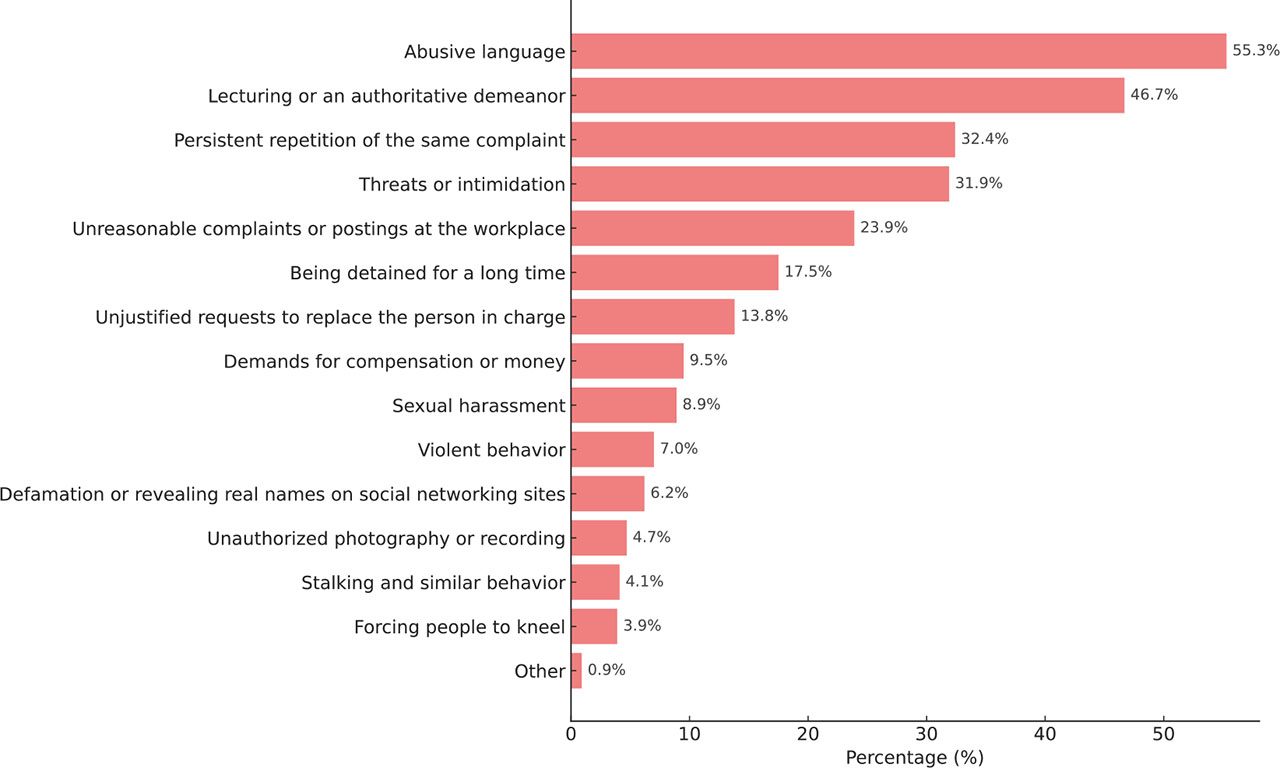
Figure 1.
Customer Harassment Experienced (Multiple Responses)
Source: Created by the author based on page 4 of RENGO “Survey on Customer Harassment 2022”.
The most prevalent form of customer harassment experienced by employees in the finance and insurance sectors was “abusive language”, accounting for 62.5% of cases, followed by “persistent repetition of the same complaint”, which accounted for 50% (see Figure 2 below). Among all industries, the finance and insurance sectors exhibited the highest percentages for both “abusive language” and “persistent repetition of the same complaint”.
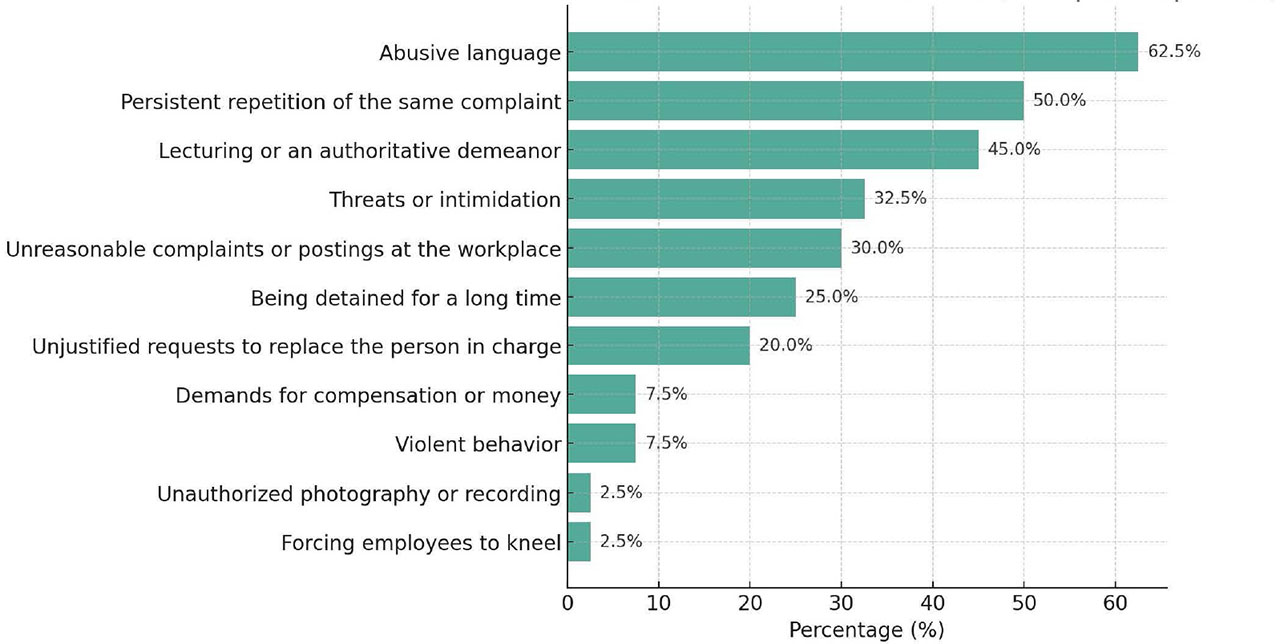
Figure 2.
Customer Harassment Experienced by Employees in the Finance and Insurance Industries (Multiple Responses)
Source: Created by the author based on p. 5 of RENGO “Survey on Customer Harassment 2022”.
This finding indicates a context in which instances of customer harassment primarily manifest in the form of verbal interactions within the financial and insurance sectors. Customers may use abusive language, insults, or derogatory remarks during telephone conversations, face-to-face interactions with customers, or online communications.
Employees in the finance and insurance industries experienced various types of customer harassment (multiple responses). In addition to “abusive language” (62.5%) and “persistent repetition of the same complaint” (50.0%), employees reported “being lectured or treated with an authoritative demeanor” (45%), “receiving threats or intimidation” (32.5%), “dealing with unreasonable complaints or postings at the workplace” (30.0%), “being detained for a long time”(25.0%), and “receiving unjustified requests to replace the person in charge” (20%). It is important to note that discrimination often lies behind these unjustified requests for a change of staff. These requests often appear to be based on gender, age, appearance, or other personal characteristics.
According to the results of a survey conducted by the MHLW 22 the incidence of customer harassment in the financial and insurance industry is not significantly higher than the average for all industries (16.4% in the financial and insurance industry compared to an average of 15.0% for all industries). However, the insurance and financial services industries should always exercise caution with regard to customer harassment.
First, due to the sensitivity and potential confidentiality of the personal information handled by the financial and insurance industries, it may be difficult to publicize or identify such problems. However, the complexity of financial and insurance products can be difficult for customers to understand. This can lead to customer stress and dissatisfaction, and to a higher number of cases than average.
In the context of the Japanese life insurance industry, sales staff represent the predominant conduit for the acquisition of life insurance policies, constituting 55.9% of the total sales volume. 23 A notable attribute of this industry is the preponderance of female sales personnel, a phenomenon that merits further examination.
Excessive accusations by customers may be triggered by sales staff’s aggressive sales efforts to achieve quotas, leading to dissatisfaction and distrust from customers and others. Alternatively, customer harassment may be caused by the incomprehensibility of life insurance products, which makes it difficult for customers to fully understand them. Consequently, customers may be overwhelmed or confused by the information provided.
It is also possible that the customer’s prior purchase of insurance may provide sufficient reassurance, despite the possibility of a lack of comprehensive understanding of the insurance product’s specifics or the presence of unrealistic coverage expectations by the customer. Life insurance, in particular, often disburses claims only after an extended period, potentially leading to the realization that the insurance does not adequately meet the customer’s expectations. Such circumstances are conducive to the escalation of customer dissatisfaction and distrust in insurance companies.
In general, life insurance is not a product that customers actively seek to purchase; rather, it is a product that must be actively marketed and sold. Sales staff often engage in discussions about sensitive topics such as illness, long-term care, old age, death, and lack of funds in such cases. Due to the nature of these conversations, customers may experience emotional strain and frustration, which may lead to customer harassment.
In the context of customer relations, a complaint stemming from an inadequate (or false) explanation provided by a sales staff member is considered a legitimate customer concern. This does not, in itself, constitute customer harassment. However, if the complaint involves excessive blame, characterized by means and manner that are deemed socially unacceptable, it is considered customer harassment. In such instances, the company or management is obligated to take action to protect and support the employee.
While the stringent sales culture and challenging product characteristics inherent in the Japanese life insurance industry do not directly result in customer harassment, they can foster an environment conducive to customer dissatisfaction and mistrust of sales personnel.
On the other hand, the fact that women comprise the majority of sales staff may, in some respects, engender a greater likelihood of customer harassment. Customer harassment is predicated on the power relationship between the customer and the customer service representative. Although this relationship is subjective from the customer’s point of view, some customers harbor a mistaken perception of superior rank, assuming the customer service staff should listen to them. Furthermore, some customers exhibit discriminatory attitudes and stereotypes toward women. It is plausible to hypothesize that such customer-sales staff relationships facilitate the occurrence of customer harassment.
V. Measures to Address Customer Harassment
The increasing prevalence of public concern surrounding customer harassment underscores the necessity for government policymakers and private organizations to address this issue and to guarantee a secure and respectful work environment. This section examines the current state of efforts to address customer harassment in Japan and subsequently discusses the necessary measures within the life insurance industry.
A. Status of Efforts to Address Customer Harassment in Japan
The “Guidelines on Measures Employers Should Take in Employment Management Concerning Problems Caused by Language and Behaviours in the Workplace Based on Superior Relationships” (Ministry of Health, Labour and Welfare Notice No. 5, 2020), formulated in January 2020, includes a reference to customer harassment. This document stipulates that employers should establish a system to provide consultation and respond appropriately to customer harassment. Furthermore, it states that employers should take measures to consider victims and ensure that they are effective in taking measures to prevent damage.
In February 2022, the MHLW promulgated a “Company Manual on Customer Harassment Prevention” to assist companies and other entities in comprehending the imperative for customer harassment prevention and in fostering voluntary initiatives.
According to Kyodo News 24 on March 11, 2025, the Japanese government made a decision to change the rules for the Labor Measures Comprehensive Promotion Act. This will require all companies to prevent customer harassment. Companies will take measures based on the government’s guidelines and promote initiatives to protect employees. The government will create these guidelines after the new law is passed.
The guidelines will require companies to clearly state their own policies in advance and to develop systems for receiving employee consultations. One of these measures is the creation of manuals for dealing with cases of workplace harassment.
If companies neglect to take action, the government will be able to provide guidance and recommendations, and if they fail to comply, the names of the companies will be made public. The Labor Measures Comprehensive Promotion Act also covers local governments, and they will also be obliged to take measures.
The revised bill defines customer harassment as something that satisfies the following three elements: (1) it is carried out by customers, business partners, or facility users; (2) the words and actions go beyond what is considered acceptable; and (3) the working environment is harmed.
In December of 2023, the Ryokan Business Law (Inns and Hotels Act) underwent amendments that granted hotels and inns the prerogative to decline unreasonable requests for discounts, excessive apologies, and other such requests. While this legislation enables these establishments to refuse accommodations to customers engaging in customer harassment, numerous cases have emerged where hotels and inns have been hesitant to deny accommodations to customers exhibiting such behaviors. This reluctance is largely attributed to concerns regarding adverse online reviews and the absence of explicit criteria for denying accommodations. The ambiguity surrounding the definition of customer harassment and the associated repercussions, such as the potential for negative reviews, further complicates the matter. It is anticipated that ongoing efforts to delineate clear standards and to refine these criteria through trial and error will continue to play a pivotal role in various industries in the near future.
B. Issues of Customer Harassment Prevention in the Life Insurance Industry
Japanese life insurers are strongly encouraged to establish a work environment that fosters employee well-being and mitigates the adverse effects of victimization by implementing measures to address customer harassment. It is imperative for organizations to cultivate a corporate culture that prioritizes employee support and fosters positive relationships with customers.
A review of recent initiatives to prevent customer harassment across different industries shows that the financial and insurance industry has a higher percentage of companies that have implemented measures than other industries. 25 For example, 53.8% of companies in this industry responded that they have implemented measures to improve consultation systems, which is the highest percentage of all industries (the average is 27.5%). Furthermore, 36.1% of companies in the financial and insurance industry reported implementing measures to address victims who have been significantly inconvenienced by customers, such as measures to address mental health problems. This figure ranked third, after the lifestyle-related services and entertainment industry (37.8%) and the medical and welfare industry (37.7%), indicative of a high level of commitment to addressing customer-related issues. The average for all industries was 22.1%.
According to RENGO’s “Survey on Customer Harassment 2022,” the following measures are considered most effective in preventing customer harassment, as indicated by respondents. Firstly, “the establishment of a support system in the event of customer harassment” was identified as a priority (81.7%), 26 followed by “the provision of care for victims (including measures to address mental health concerns)” (81.0%). Additionally, “the creation of manuals to address customer harassment” was identified as a crucial measure (80.9%), along with “the recording of customer responses (on-site and telephonic)” (79.7%) and “the formulation of a corporate policy that explicitly prohibits customer harassment” (79.6%). The items mentioned above received high ratings, suggesting that employees possess a substantial understanding of the perils associated with customer harassment.
Furthermore, when queried about the necessity of measures implemented by the government or other organizations to eliminate customer harassment and establish an appropriate environment, the most prevalent response (78.9%) indicated that “industry organizations should develop guidelines for the industry as a whole to address customer harassment.”
In light of these findings, it is anticipated that the life insurance industry will adopt a cross-industry approach, encompassing the preliminary development of industry guidelines and codes of conduct, the creation of manuals (templates) that can be utilized by individual companies, and the establishment of an industry-wide support system, with the Life Insurance Association of Japan and other entities taking the initiative in this regard.
The Persol Research Institute survey indicates that “the automatic recording of telephone calls,” “the publication of company and industry policies and positions,” and “the elimination of full names on nameplates” exhibit the lowest implementation rates in relation to employee expectations. It is imperative to implement appropriate measures while taking into consideration the rights and privacy of customers.
Customer harassment has been demonstrated to exert a considerable emotional burden on employees, thereby engendering elevated levels of stress, anxiety, and burnout. This phenomenon can also exert a deleterious influence on employees’ work performance, mental health, and overall well-being, encompassing the physical, mental, and social dimensions of health.
In the event that customer harassment persists, yet adequate support is not furnished by the company, employees may experience a sense of being unsupported, undervalued, or that the workplace is unsafe. Consequently, employee satisfaction and a sense of belonging to the company or organization may diminish, potentially leading to increased turnover. It is imperative for life insurance companies to cultivate a corporate culture and work environment that respects and supports employees and does not tolerate customer harassment. It is imperative to delineate the unacceptable behavior of customers and devise policies that delineate the organizational response to instances of harassment.
The initial phase in the establishment of a support system for employees subjected to customer harassment entails the dissemination of information regarding the reporting process, the available support resources, and the employees’ rights. The support system may encompass a designated point of contact for reporting such incidents, internal and external counseling services, access to a dedicated individual who can provide guidance and assistance, regular meetings with a supervisor, and support from colleagues.
It is imperative to acknowledge the pivotal role that managers play in addressing incidents of customer harassment. To this end, it is essential that managers receive regular education and training to ensure that they are able to recognize and respond promptly to incidents of harassment. Furthermore, managers must be equipped with the skills to provide emotional support to employees and take the necessary steps to ensure a work environment where employees are treated with respect.
It is incumbent upon companies to prioritize initiatives aimed at enhancing customer awareness, in conjunction with the implementation of training programs that inculcate employees with the requisite skills and communication methodologies to adeptly manage challenging customer interactions and prevent harassment. The life insurance industry is recommended to adopt educational campaigns that foster customer understanding and respect for salespeople. For instance, Uber’s rating system enables customers to evaluate drivers and drivers to assess customers. Following Uber’s example, if a salesperson feels that a customer has treated him or her with respect, that customer will be offered an incentive, such as promotional merchandise or expert health advice. This could lead to a change in consumer attitudes. Life insurance company management should strive to create a respectful work environment for sales representatives while maintaining positive customer relationships. This will correct the problem of employee turnover and ultimately benefit customers.
VI. Conclusion
This paper endeavors to ascertain the prevailing state of customer harassment within the Japanese insurance industry, with a particular focus on the life insurance sector, and the measures that are imperative to rectify these issues.
A number of customer harassment issues remain under the radar. The objective of disseminating information on this subject in this paper is to facilitate the establishment of trust between customers and front-line employees in the insurance industry through the implementation of appropriate measures by industry participants and regulatory agencies.
The recognition of the issue of customer harassment, coupled with the implementation of adequate measures by insurance companies, holds the potential to enhance the overall well-being of the industry, encompassing the physical, mental, and social dimensions. This enhancement in well-being can lead to an improvement in professional conduct within the industry, thereby facilitating prolonged employment opportunities. Consequently, this initiative would contribute to the cultivation of greater trust in the insurance industry and the enhancement of customer satisfaction.
Customer harassment is never permissible, irrespective of cultural or regional context. It is imperative to prioritize the identification and prevention of customer harassment in all situations to ensure a safe and respectful environment for both customers and product and service providers.
It is incumbent upon insurance companies to establish a clear policy on the issue of customer harassment and to educate their employees on appropriate attitudes and behaviors. The handling of harassment cases based on cross-industry rules and measures would be advantageous, as would the accumulation and sharing of data on harassment cases and responses within the industry, rather than each company responding to harassment cases individually. By fostering a comprehensive understanding of customer harassment and facilitating the dissemination of knowledge and information regarding effective responses throughout the industry, it becomes more feasible to respond to customer harassment issues in a timely and satisfactory manner.
Nevertheless, the issue of customer harassment is challenging to address solely through the initiatives of private entities, such as insurance companies. The government’s distinct role and responsibility, including its legislative function, is also paramount. It is imperative that all stakeholders, including insurance industry personnel, regulatory authorities, policymakers, and consumers, demonstrate a high level of interest in the matter of customer harassment and address it as a matter of urgency. This will result in enhanced utility for society as a whole.
Acknowledgment
This study was funded by the Kampo Foundation’s 2023 Survey Research Grant.
Appendices
Appendix
This section will examine specific examples and the measures implemented to address this issue. In order to comprehend the prevailing circumstances of customer harassment within the Japanese life insurance industry and the optimal responses to such issues, a review of select information from a de-identified company’s (“Company A”) manual on customer harassment was conducted. Company A is a life insurance company that primarily utilizes the sales staff channel. Company A’s documentation offers a valuable perspective on the current state of customer harassment within the Japanese life insurance industry and the specific measures implemented in the sales field.
A. Examples of Customer Harassment Provided in the Manual
Shouting “You idiot,” “Die,” or “You’ll never get away with it, “etc.
Violence and threats, such as banging on desks or throwing objects.
Demanding money that is much more than what is fair.
Forced apologies that go beyond what is normal, like saying “Get down on your knees.”
Saying things like “Bring out the company president” and “You take responsibility.”
Sexual jokes, constant invitations to meals, dates, etc.
Physical contact (touching the chest, waist, buttocks, thighs, etc.)
Referring to disadvantages such as termination or expiration of the contract for refusal to comply with sexual demands or actions, etc.
Persistently sending lines and emails
Ambush at home or near the sales office
Company A’s manual permit two major groupings of incidents of customer harassment. The cases enumerated in the manual as instances of customer harassment, from cases 1 through 5, are regarded by customers as being the epitome of exaggeration. Conversely, cases 6 through 8 are classified as instances of sexual harassment. However, cases 9 and 10 remain ambiguous in terms of their categorization, as they could be interpreted as falling under either of these two categories.
Moreover, while instances 6 through 10 of customer harassment outlined in the manual are predominantly regarded as sexual harassment, particularly within the context of the life insurance industry, where women constitute the preponderance of sales personnel, responses to sexual harassment are deemed to be an integral component of the overall customer harassment response strategy. Indeed, Company A’s measures to address customer harassment are commensurate with this approach.
B. Countermeasures against Customer Harassment Provided in the Manual
Prepare a method of talking about how to respond to customer harassment and ensure that all employees and vendors are aware of it.
As a measure against sexual harassment, ensure that sales staff are aware of the following are aware of the following points to keep in mind:
Always carry a company smartphone and security buzzer.
Dress in accordance with the dress code and behave in a manner that does not mislead customers.
Restrict the use of e-mail, LINE, etc. on company smartphones to business-related communications (as much as possible between 9:00 a.m. and 5:00 p.m. on weekdays).
Try to avoid visiting customers’ homes alone (accompanied by a manager or another employee).
When visiting a customer’s home alone, ask a family member to be present, answer the door, record the conversation, etc.
Ride in clients’ cars as little as possible (if you have no choice but to ride in the car, sit in the back seat) and avoid transporting clients in your own car as much as possible.
In the event of a customer harassment report, managers should immediately notify the person in charge of crime prevention and the General Affairs Department. If necessary, they should also file a damage report with the police.
Provide mental health care to employees and sales staff who are victims of harassment and sexual harassment as needed.