
1. Introduction
In this article, we investigate the impact of the Russian invasion of Ukraine on structural breaks and the changes in the direction and amplitude of short-term inflation expectations of consumers and professionals in Ukraine and Poland. Events such as political shocks and natural disasters have significant and long-lasting effects on private expectations about the future (Dräger et al., 2022). War changes the economy’s structure and the focus of a central bank, which moves from price stability to macroeconomic stabilisation and ensures smooth financing of the war effort (Danylyshyn & Bohdan, 2022). On the other hand, inflation expectations constitute a pivotal variable from the monetary policy point of view (Woodford, 2003), and central banks closely observe their evolution. This holds especially true if inflation targeting (IT) is implemented as a monetary policy framework, which is the case for both countries studied. In the wake of the war, the National Bank of Ukraine (NBU) expressed concerns about expectations’ de-anchoring and inducing an inflationary spiral (NBU, 2022a).
This article compares expectations evolution during the war in two countries, namely in Ukraine (the attacked country) and Poland (the neighbouring economy). Ukraine adopted IT in 2016 after switching to a floating exchange rate of the hryvnia about 2 years earlier. The NBU implements fully-fledged IT. However, there were some concerns regarding its independence. The Ukrainian economy experienced two-digit inflation, reaching more than 50% not later than 10 years ago. Keeping inflation close to the 5% target or even below the target before the global surge in inflation could denote the success of the newly adopted framework. Just before the switch to the new regime, Ukraine was affected by a severe banking crisis (2014–2016). Even though Ukraine has been at the centre of geopolitical interest since February 2022, the country has been at war since 2014 and the Russian annexation of Crimea. Stabilising inflation and managing private agents' expectations was quite challenging.
Poland adds a comparative context to our study: it has a stronger institutional setup and a more developed market economy. It is also more experienced in IT, as this framework has been implemented since 1999. IT enabled successful disinflation and maintained price stability even though inflation diverged temporarily from the target of 2.5%. The invasion has affected Poland indirectly. As presented by Maurya et al. (2023), the Russian invasion of Ukraine triggered inflation globally. However, the geographical proximity and trading activity with Ukraine and Russia determined the degree of inflation increase. Thus, Poland constitutes an example of an economy for which we can expect a significant effect of the war due to its close vicinity and engagement in hosting refugees and providing corridors for military and non-military purposes. The uncertainty regarding the possible consequences of the war is reflected in the violent rise of costs of hedging against the risk of Poland’s default on US dollar-denominated government debt, i.e. an increase in credit default swaps (Borowski & Jaworski, 2024). Moreover, economic agents in high-inflation environments, such as Ukraine, behave differently, paying more attention to inflation than consumers and firms in advanced economies with a longer history of successful IT implementation do (Coibion et al., 2020). The latter is the case in Poland.
We test the existence of structural breaks in consumer and professional expectations after February 2022 and the increase in private forecasts due to the war and war-related structural changes in the economy and supply-side shocks. The novelty of this article is that it provides the first empirical analysis of expectations evolution in Ukraine and Poland during the war. We assume that the invasion initiated the increase in expectations of consumers and professionals in both economies, which was stronger in Ukraine.
A causal interference analysis based on Bayesian modelling (Brodersen et al., 2015) is applied to identify the effect of the invasion (intervention) on expectations. For consumers, we use consumer survey data (Business and Consumer Survey for Poland and NBU data for Ukraine) and Consensus Forecasts of Consensus Economics for professionals. We study short-run expectations due to consumers’ time series availability (12M). The sample spans January 2018–March 2024. The wartime subsample is relatively short, so the econometric exercises are restricted to interference analysis. We recognise that the invasion started when global inflation was about to increase sharply after 1 year of elevated figures. Nevertheless, we are interested in the expectations’ reactions to the specific moment of political shock – the war eruption.
The results of this study suggest that professional forecasters from both economies and consumers from Poland responded to the war eruption in the expected way – their expectations increased – with a higher amplitude in Ukraine – and remained elevated. We found no reaction from Ukrainian consumers. This finding differs from our assumption, and we attribute it mainly to the quality of survey data just after the invasion began. The second possible explanation is the importance of exchange rate evolution in shaping private agents’ expectations. Ukrainian consumers closely observed the UAH/USD exchange rate when forecasting inflation, and the exchange rate switched to a fixed rate just after the day of the invasion. Finally, fiscal policy measures might reduce household expectations or prevent their increase.
The remainder of this article is organised as follows: The next section briefly reviews existing literature in the field, and the third section describes the study’s data and methods. The fourth section presents and discusses our results and analyses. Finally, the results summary is provided.
2. Literature review
A strand of the literature regarding the behaviour of expectations after the invasion starts with discussing the possible effects of war on inflation. Experts and academics expected an increase in inflation expectations in Ukraine and worldwide due to the supply-side shocks and surge in energy costs (Seiler, 2022), and the war was expected to add approximately 2% to global inflation in 2022 and 1% in 2023 (Liadze et al., 2023). As presented by Maurya et al. (2023), the Russian invasion of Ukraine triggered inflation globally. However, the geographic proximity and trading activity with Ukraine and Russia determined the degree of inflation increase. This strand of the literature justifies searching for changes in expectation formation in Ukraine and Poland. It presents the possible effect of the war on inflation, not on expectations, but these are closely linked to inflation evolution. The upward trend in global inflation was fed by factors related directly to the war, which resulted in structural changes in the economy and supply-side shocks.
Studies directly analysing expectations after the invasion were run for Germany and Italy. They suggested that the invasion immediately changed expectations in Germany (Afunts et al., 2023) and Italy (Ropele & Tagliabracci, 2024). These two works presented the results of survey-based expectation assessments among individuals and companies. The surveys began before the eruption of war and continued afterwards. Thus, its setting could be compared to a natural experiment, and its replication for Ukrainian data is impossible.
A similar study run in Germany immediately after the war eruption confirmed that expectations increased above the on-going inflation trend (Dräger et al., 2022). The economic experts increased short-run inflation expectations for 2022 by about 0.75 p.p., twice as large as the estimated effect for household expectations. Moreover, experts reacted immediately, whereas consumers reacted a few days after the invasion. Thus, we can search for differences in consumers’ and professionals’ reactions. Dräger et al. (2022) also provided a semantic analysis of experts’ responses to distinguish the channel initiated by the war from other potential mechanisms. Their survey included an open-ended question that asked participants to write a brief statement about their perceived causes of inflation. About 40% of the words used in the responses referred directly to the invasion or supply-side factors affecting the increases in inflation and its forecasts. This finding justifies the search for structural breaks in expectations directly linked to war.
When discussing the war's effect on expectations indirectly, one can refer to the war consequences as supply chains and energy shocks. These shocks were the most immediate economic results of the Russian invasion of Ukraine. Although articles discussing the effects of this invasion in countries of our interests have not yet been published, past shocks to supply chains mattered to inflation evolution during the pandemic, as presented by di Giovanni et al. (2022) for the euro area and the US shocks to global supply chain were the key drivers of euro area inflation in 2022, having a highly persistent and hump-shaped impact on inflation (Ascari et al., 2024). The long-run study discussing the effects of supply chains and oil shocks on inflation suggests that the impact of the global supply chain aligns much better with the inflation rate than the oil prices in the short and long run, including the subprime crisis, COVID-19 outbreak, and the beginning of the Russian invasion of Ukraine (Ye et al., 2023). In the euro area, energy price shocks contributed to about 60% of inflation in the 2022Q4, to core inflation – from 20 to 50%, depending on the model. Since the pandemic outbreak, the pass-through of energy prices to core inflation has also been greater (Neri et al., 2023). The energy prices pass-through to inflation is diversified across countries and groups of products from the consumption basket (Markowski & Kotliński, 2025).
Past studies suggest that breaks in inflation could also be expected due to the war in Ukraine. However, links between these shocks and expectations, the variable of interest in this study, have got even less research attention than the studies of energy and supply shocks' effects on inflation. As inflation expectations are linked to past inflation, we can expect the impact of energy and supply chain shocks on expectations through inflation. Still, only one study by An et al. (2023) has investigated it empirically recently. It suggests that the perceived oil price shock explains only 10% of the fluctuations, on average, in global inflation expectations from January 2012 to December 2022 and accounts for an even smaller fraction during the COVID-19 pandemic.
Economic agents’ purposeful inattentiveness or the epidemiological theory of expectations explain the theoretical premises that could change expectations due to the political shock. The former, by Mankiw and Reis (2002) and Reis (2006), discusses expectations formation, considering expectations and the costs of acquiring and processing information. It assumes that economic agents could ignore available information, slowly absorb it, and incorporate it into financial decisions. If uncertainty increases, they do it faster. The latter theory assumes that news on inflation spreads to consumers through media news, not directly by central bank announcements (Carroll, 2003). Both approaches acknowledge that economic agents need time to adjust to on-going economic situations. However, political shock, such as an invasion, is not a standard macro news that spreads slowly among society. The importance of the message can transform into expectation formation much faster than standard news.
The review of existing works reveals a need to directly investigate the evolution of expectations during the invasion, especially in Ukraine.
3. Data and methods
We discuss the 12M inflation expectations of consumers and professionals. There are no surveys of longer-term consumer expectations in the studied economies. The consumer data are derived from the NBU datasets for Ukraine and qualitative Business and Consumer Surveys for Poland. In Ukraine, the survey question is: How do you think the prices for basic consumer goods and services will change in the next 12 months? Respondents collect one answer from a set of inflation intervals starting with “prices will decrease or remain stable,” and finishing with “it’s difficult to answer.” The set of inflation intervals may change depending on the economic situation. The NBU provides quantified survey results.
For Poland, the qualitative data from Business and Consumer Surveys were quantified with the standard probabilistic method adjusted for a five-answer structure (Batchelor & Orr, 1988; Carlson & Parkin, 1975). As probabilistic methods are well described in the literature and widely used, we refrain from their detailed description.
The professional expectations for both economies are Consensus Forecasts of Consensus Economics transformed into fixed-horizon forecasts (12M) with correction according to the method of Dovern et al. (2012). We use monthly data spanning January 2018–March 2024. Inflation is derived from national statistical offices’ data collection.
We use causal inference analysis (the invasion is the intervention in this study) and apply Bayesian structural time series modelling. The advantage of this approach is that it allows us to operate on inflation levels instead of inflation changes. Although inflation should be stationary in the long run, it has different statistical properties locally. Thus, applying other relevant methods, such as event analysis, would require us to differentiate the data to obtain locally stationary time series. Secondly, the models applied in this study make it possible to infer the temporal evolution of attributable impact and consider various potential sources of variation (e.g. local trends, seasonality, etc.) – Brodersen et al. (2015). The method can be perceived as a generalisation of the difference-in-difference approach.
Through a state-space model, we predict the dependent variable's counterfactual response that would have occurred if no intervention (invasion) had occurred. We denote by a vector of observed data and by – the vector of latent variables, also called the “state.”
Two equations define a structural time series model. The first is called the observation equation, and the second is the transition equation (Brodersen et al., 2015). One can accommodate various assumptions about the latent state and the process underlying the observed data by including, e.g. trends or seasonality.
The simplest model, a local-level model with no covariates, has the following form (Brodersen et al., 2015):
where and .The observations are modelled as noisy observations of a level that is subject to random changes over time, described by a random walk (Campagnoli et al., 2009).
The model is estimated via the Bayesian approach with the R package “CausalImpact” (Brodersen et al., 2015). The model assumes the following:
Regarding the variances, it is assumed that:
where is the gamma distribution with the expected value . Therefore, is a prior estimate of and is the weight assigned to the prior estimate.The parameters are obtained by sampling from the conditional distribution via the Markov Chain Monte Carlo algorithm. We assume that the dynamics of the state is driven by a latent Markov chain with state space and transition probabilities . Conditionally on the ’s are independent and depends on only. Thus, the state space model is completely specified by the initial distribution and the conditional densities and Thus, for any : (Campagnoli et al., 2009). Let us denote by the parameter vector. Using a Gibbs sampler, it is possible to simulate a sequence from a Markov chain of a stationary distribution (see (Brodersen et al., 2015) for details).
In our study, we also use the local linear trend model, which has the same observation equation as the local-level model but includes a time-varying slope in the dynamics for .
whereThere are no control variables in our model. It would be justifiable to introduce standard inflation drives (past inflation, production, interest rates, exchange rates, and oil prices) into the model to explain the expectations. However, this method assumes that the controls are not subjected to intervention. We test all possible drivers of expectations, finding changes in their evolution due to the intervention (yet, due to the limited length of the article, we do not provide the results in this article – they are available upon request).
As a robustness check, we run the Chow (1960) test to determine the changes in expectations in both countries. Although there exist more structural break tests, such as Bai and Perron (1998) or Hansen (1992) tests or even more sophisticated procedures suggested by Russell and Rambaccussing (2019) applicable for searching structural breaks in inflation, we have chosen the Chow one, as it allowed us to verify whether this particular moment in time is justified to be considered a structural break. On the contrary, the Bai and Perron test returns the dates of a pre-specified number of structural breaks, while Hansen’s test answers whether parameters are stable in time (in other words – whether a structural break is present somewhere in the data). Specifically, we estimate regressions of the following form:
for the pre-and-war periods and test the null hypothesis of the equality of the β values in both periods. denotes the stationary change in expectations, i.e. .4. Results and discussion
The time series of inflation and the expectations of consumers and professionals for Ukraine and Poland are presented in Figures 1 and 2, respectively. The evolution of the data confirms a more stable disinflation process in Poland and greater alignment between the series. Notably, in Ukraine, consumer expectations do not follow actual inflation as closely as professionals, which is expected in an economy where the disinflation process is not finished. When economic agents face an inflation surge, they are more likely to change the expectation formation process and adjust their beliefs to accord with the elevated inflation, which aligns with theoretical (see (Reis, 2006)) and empirical findings (Bracha & Tang, 2022). Generally, expectations management was difficult due to the country's recent turbulent economic and political history.
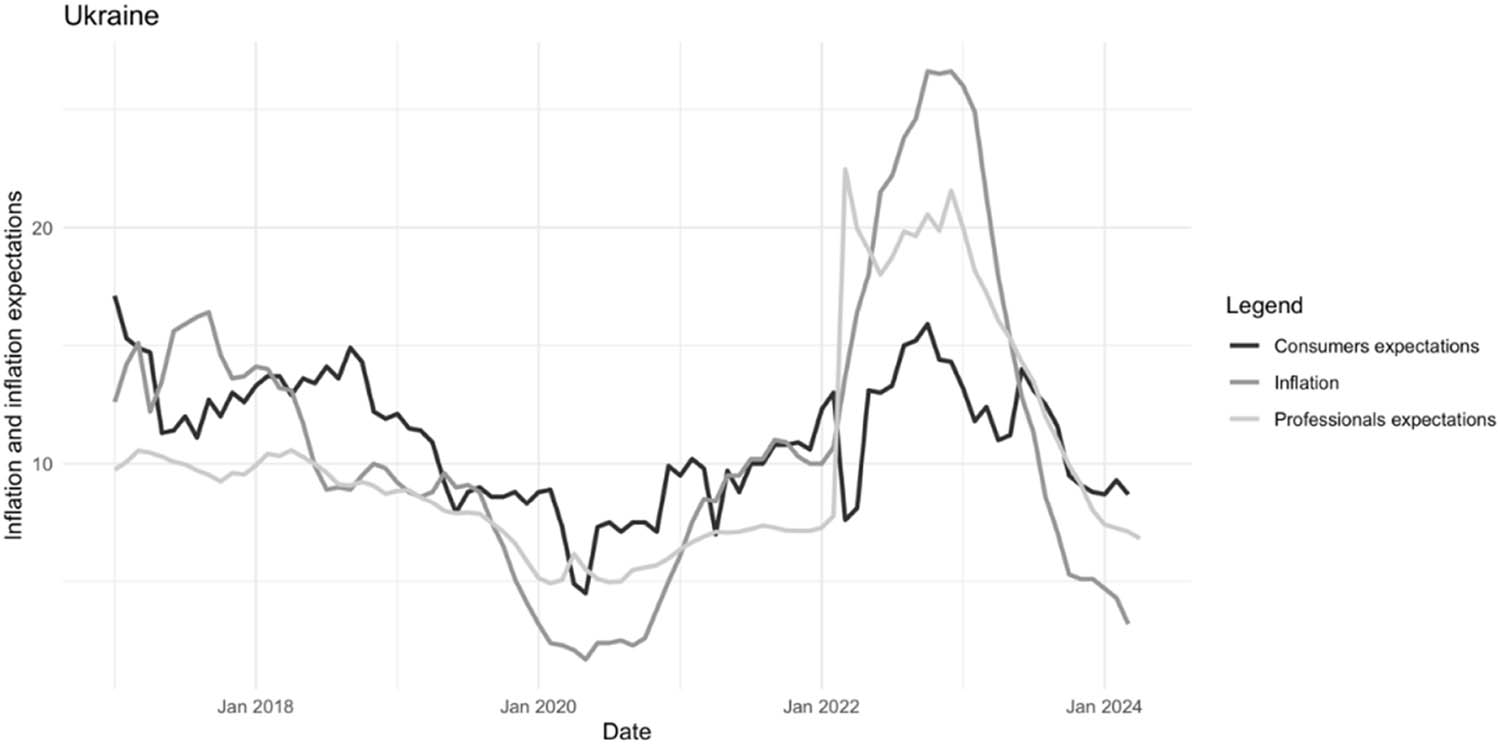
Figure 1
Inflation and expectations in Ukraine.
Source: Consumer expectations: NBU data; professional expectations: Consensus Forecasts of Consensus Economics transformed into fixed horizon forecast by authors; inflation: Ukrstat data.
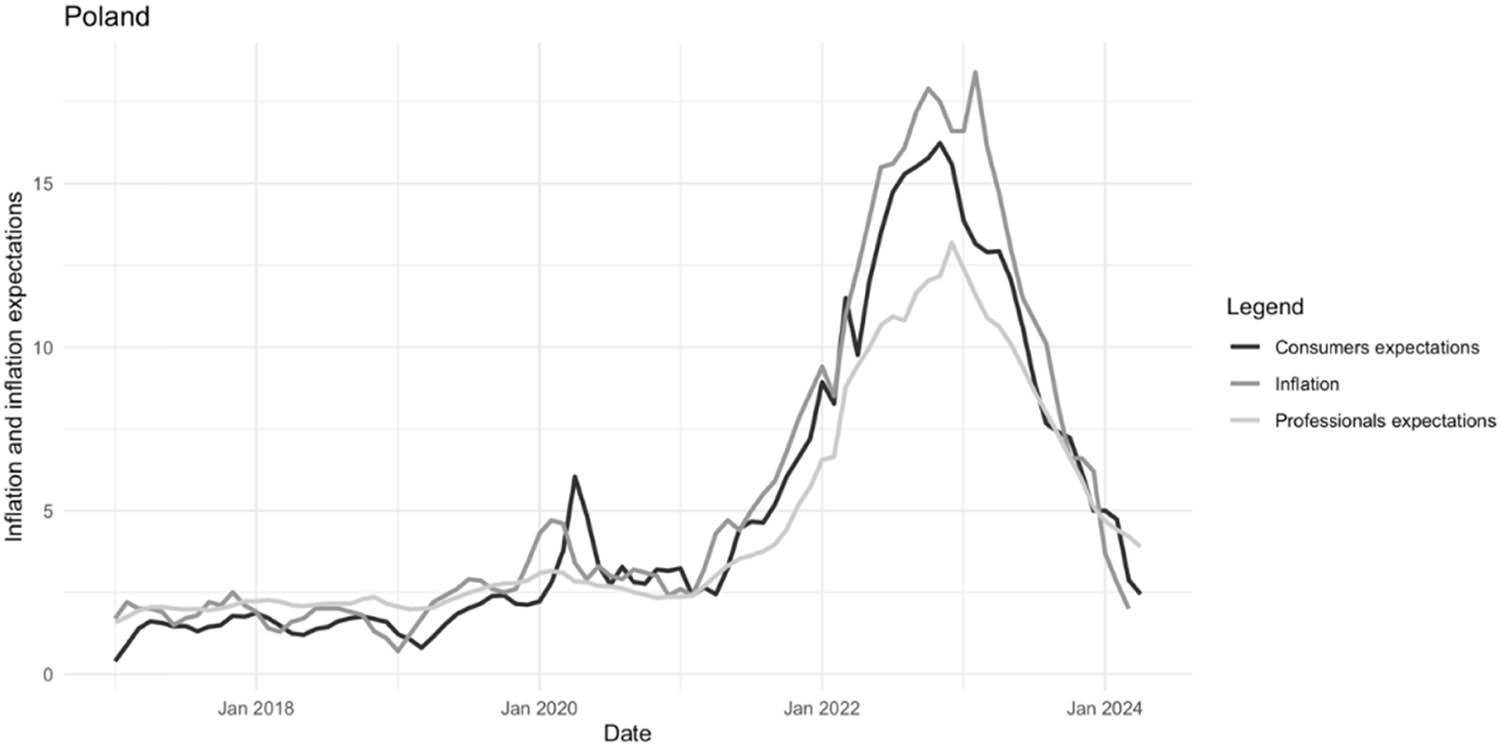
Figure 2
Inflation and expectations in Poland.
Source: Consumer expectations: Business and Consumer Survey, quantified by authors; professional expectations: Consensus Forecasts of Consensus Economics transformed into fixed horizon forecast by authors; inflation: GUS data.
Survey data published by the NBU reveal a consumer expectation level of approximately 10% from mid-2021 to the end of the year. Consumer expectations increased to 13.0% in February 2022 and, surprisingly, dropped to 7.6 and 8.1% in March and April 2022, respectively. Then, they rebounded. The NBU did not comment on this extraordinary evolution.
First, we present the descriptive statistics of our series (inflation and expectations of professionals and consumers; the first differences as time series are not stationary), results of the Snedecor–Cochrane F test for the existence of differences in variances1, and the results of the Wilcoxon test for the location shift (Table 1). Our pre-invasion and wartime samples do not have the same variances and means (at a 5% significance level; only for inflation in Poland, we rejected the null in the Wilcoxon test at 8.5% significance).
Table 1
Descriptive statistics of stationary differences in inflation and expectations and p-values of the Wilcoxon test and Snedecor–Cochrane F-test for equality of variances before and during the war outbreak.
| Variable | Ukraine | Poland | |||||
|---|---|---|---|---|---|---|---|
| Before | During | p-Value | Before | During | p-Value | ||
| Inflation | Mean | −0.0311 | −0.0300 | 0.0073 | 0.1115 | −0.2600 | 0.0850 |
| SD | 0.9125 | 1.9607 | <0.001 | 0.4673 | 0.2600 | <0.001 | |
| Consumer expectations | Man | −0.0672 | −0.1720 | 0.0157 | 0.1291 | −0.2241 | 0.0196 |
| SD | 1.1763 | 1.8279 | 0.0060 | 0.5762 | 1.2493 | <0.001 | |
| Professional expectations | Mean | −0.0322 | −0.0369 | 0.0001 | 0.0765 | −0.0972 | 0.0247 |
| SD | 0.3329 | 3.1434 | <0.001 | 0.1981 | 0.7512 | 0.0030 | |
Note: p values are for the F test of equality of variances (the null hypothesis is that the variances are equal) and for the Wilcoxon test (the null hypothesis is that the distributions of x and y differ by a location shift of µ; the alternative is that they differ by some other location shift).
Source: Author’s contribution.
Second, we discuss the changes in consumer expectations in Ukraine (Figure 3) and Poland (Figure 4) after the invasion. The upper panel shows the data and model fit, and a counterfactual prediction for the post-treatment period with a 95% posterior predictive interval. The lower panel shows the difference between the observed data and counterfactual predictions. This is the pointwise causal effect as estimated by the model, and again, we present its 95% posterior predictive interval. We assume the effect is significant (in a classical sense) when the interval does not cover zero.
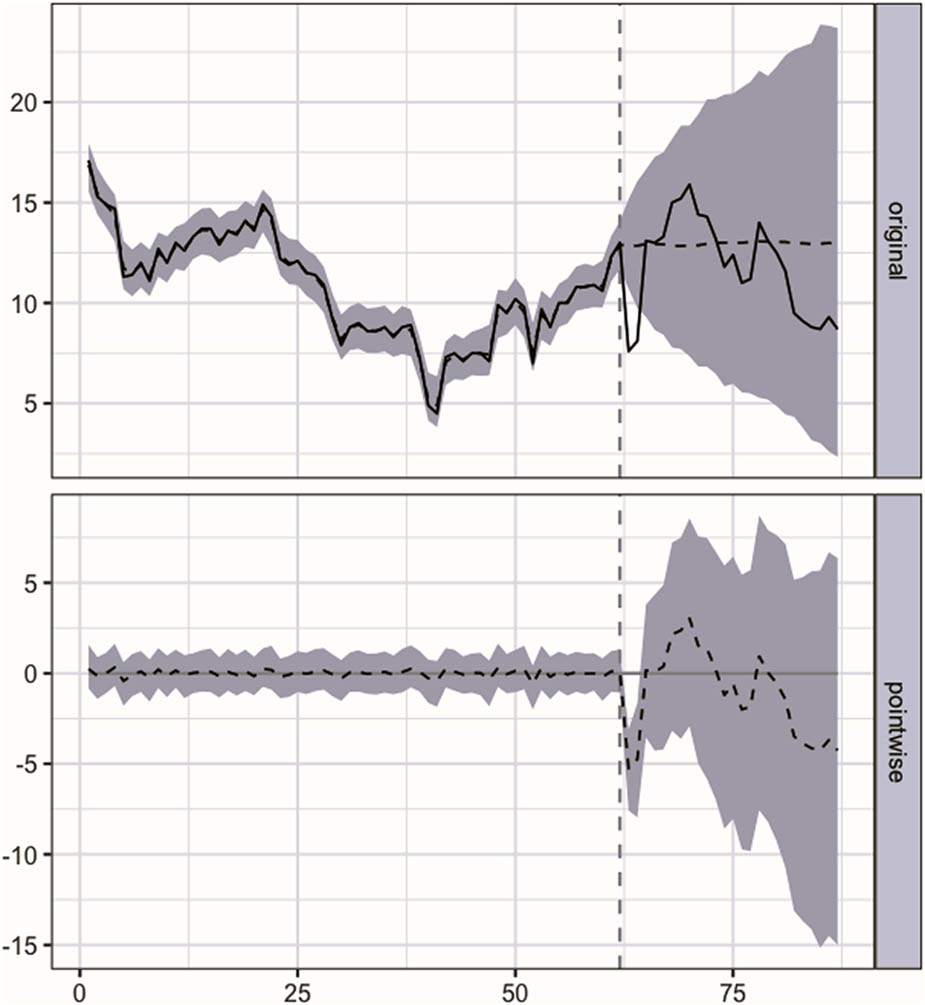
Figure 3
Consumer inflation expectations in Ukraine. Note: During the post-war-outbreak period, the response variable had an average value of approx. 11.79. In the absence of the war, we would have expected an average response of 12.95. The 95% interval of this counterfactual prediction is [6.98, 19.36]. The causal effect (obtained by subtracting the prediction from the response) is −1.16, with a 95% interval of [−7.57, 4.81]. In relative terms, the response variable decreased by −3%. The 95% interval of this percentage is [−39%, +69%]. The probability of obtaining this effect by chance is p = 0.367. This means that the effect may be spurious.
Source: Author’s contribution.
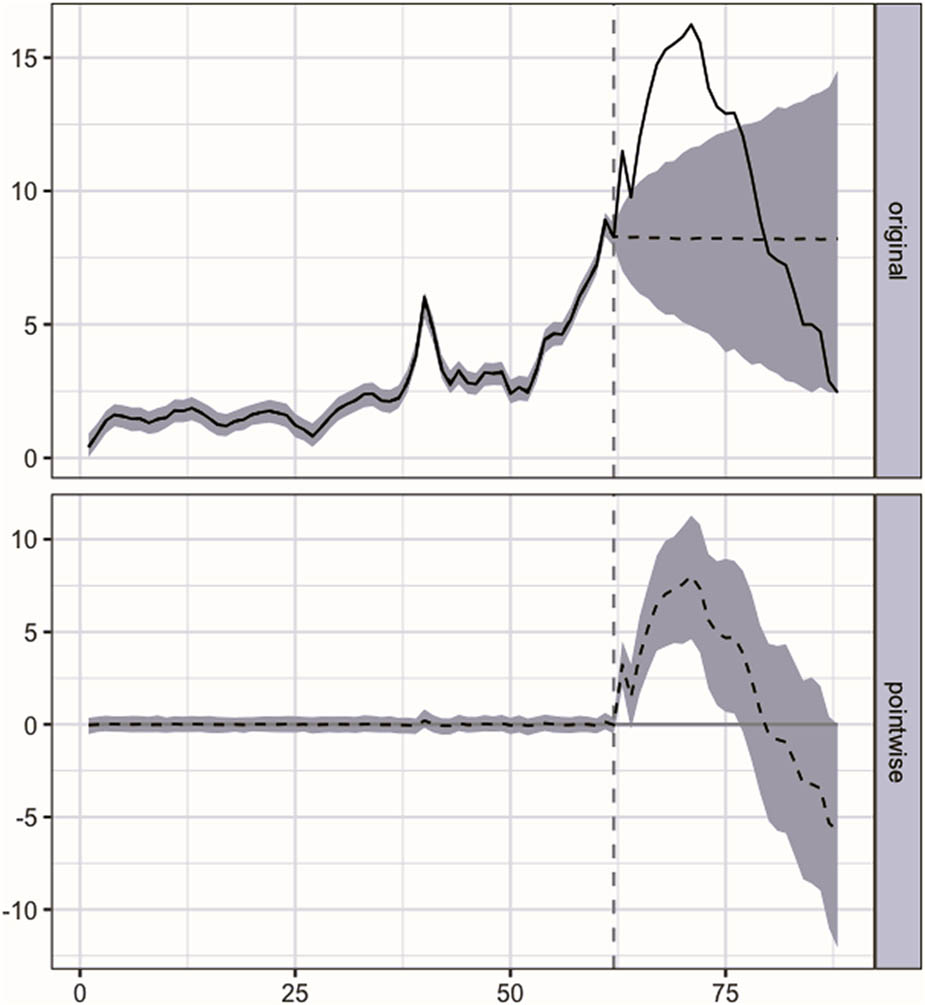
Figure 4
Consumer inflation expectations in Poland. Note: During the post-intervention period, the response variable had an average value of approx. 10.49. In the absence of an intervention, we would have expected an average response of 8.27. The 95% interval of this counterfactual prediction is [4.75, 11.66]. The causal effect (obtained by subtracting the prediction from the response) is 2.22, with a 95% interval of [−1.17, 5.75]. In relative terms, the response variable showed an increase of +33%. The 95% interval of this percentage is [−10%, +121%]. The probability of obtaining this effect by chance is p = 0.091.
Source: Author’s contribution.
Figure 3 presents the behaviour of consumer expectations in Ukraine, which is surprising. Although the intervention appears to have caused an effect, this effect is, on average, negative and disappears very quickly. When we analyse the entire post-intervention period, we observe that most of the time, the 95% posterior predictive interval of the causal effect covers zero (lower panel). In a classical statistical approach, we would consider it a lack of reaction to the war. A decrease in consumer expectations just after the invasion is suggested despite the global inflation trend occurring during Q1 of 2022 and the invasion that boosted the pro-inflationary environment. Moreover, in the past, Ukrainian consumers and companies, given the history of domestic inflation, put a disproportionately large weight on changes in the UAH/USD exchange rate to infer the inflation rate (Coibion & Gorodnichenko, 2015a). The Ukrainian consumers could consider the NBU actions, switching to fixing the UAH/USD exchange rate and imposing several administrative restrictions on FX transactions and capital movement (NBU, 2022b), as an option for successfully stabilising inflation in the future. Moreover, just after the beginning of the full-scale invasion, the government reduced the indirect taxes and postponed the rise in gas and heating prices. These movements might reduce inflation pressure and household inflation assessments in the coming months. Finally, the basket of available goods and services changed, as some were unavailable. This could also affect the way consumers perceive and forecast inflation.
As noted, two surprising observations were made from the Ukrainian survey data regarding decreasing expectations just after the beginning of the invasion. As specified above, these decreasing expectations could contribute to the random fluctuation effect. The NBU did not comment on these survey results. On the contrary, it expressed concerns about de-anchoring short-run inflation expectations (NBU, 2022a). It fixed the exchange rate to prevent further increases in expectations and an inflationary spiral. The NBU mainly focused on the rise in expectations, ignoring the unusual behaviour of consumer expectations. The survey conducted at the beginning of the invasion could have been biased. Nevertheless, according to the NBU survey data, consumers’ inflation expectations never spiked to approximately 20%, as was the case for other groups of economic agents (firms, banks, and financial market specialists).
Polish consumers’ beliefs regarding the evolution of inflation behaved more expectedly (Figure 4). The differences between actual and model-based expectations were positive, with an average effect of 2.22 p.p., which, in relative terms, represents 33%. The effect is persistent and disappears after five quarters.
Professional expectations for Ukraine (Figure 5) and Poland (Figure 6) show the same pattern: we report an increase in expectations after the war eruption, with a more substantial causal effect in Ukraine (7.42 p.p., 100%) than in Poland (2.33 p.p., 36%). In both cases, the effect is maintained for approximately one and a half years.
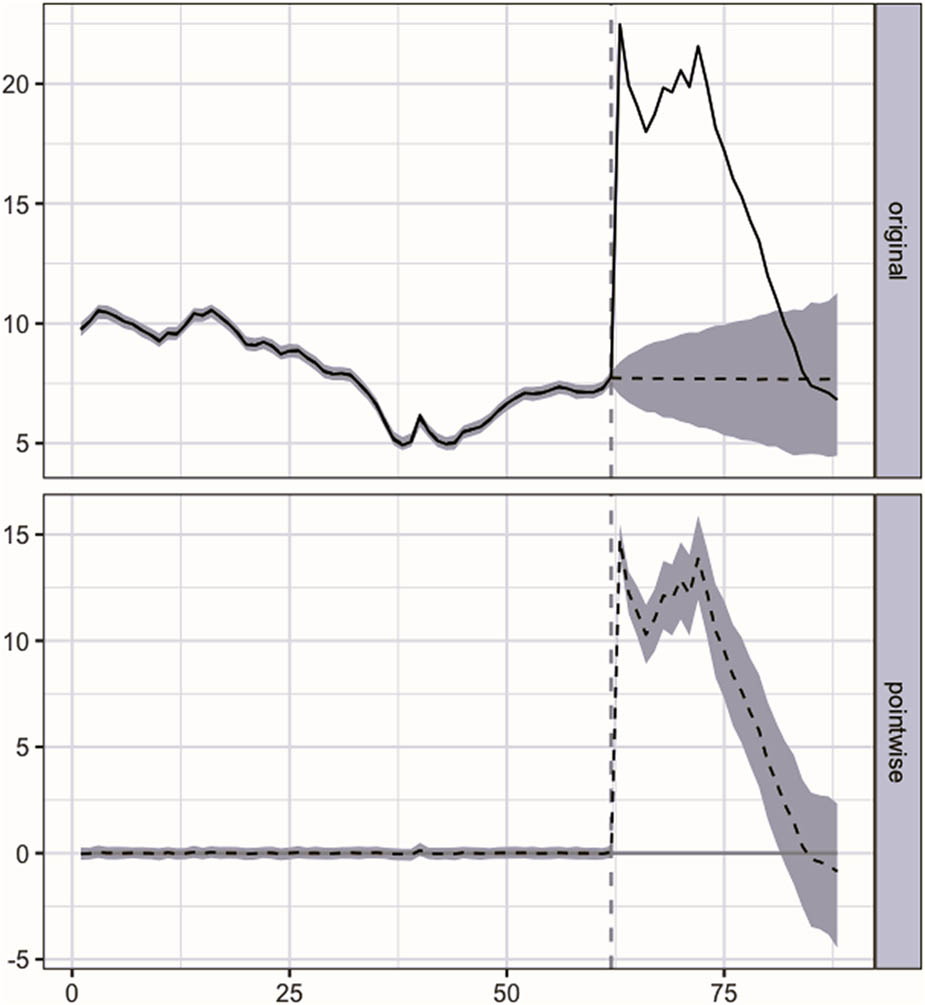
Figure 5
Professional inflation expectations in Ukraine. Note: During the post-war outbreak period, the response variable had an average value of approx. 15.11. In contrast, we would have expected an average response of 7.69 without an intervention. The 95% interval of this counterfactual prediction is [5.66, 9.65]. The causal effect (obtained by subtracting the prediction from the response) is 7.42, with a 95% interval of [5.45, 9.45]. The above results are given in terms of absolute numbers. In relative terms, the response variable showed an increase of +100%. The 95% interval of this percentage is [+56%, +167%]. The probability of obtaining this effect by chance is very small (Bayesian one-sided tail-area probability p = 0.001).
Source: Author’s contribution.
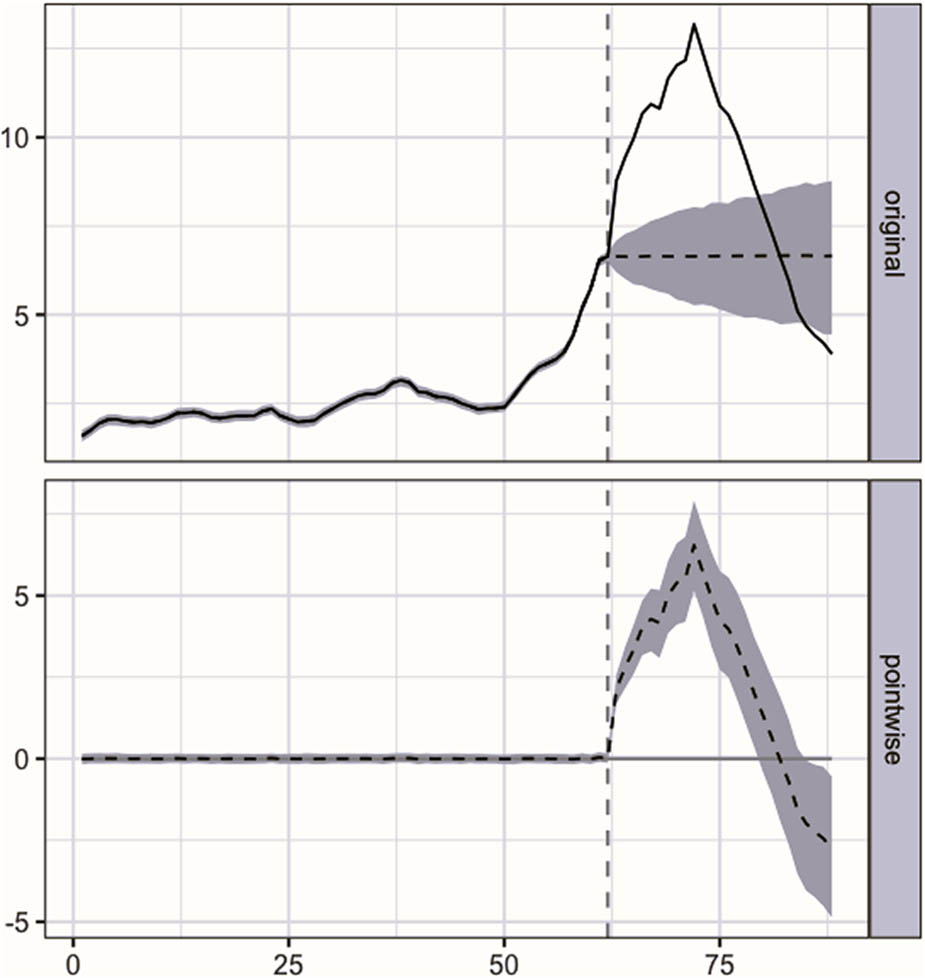
Figure 6
Professional inflation expectations in Poland. Note: During the post-intervention period, the response variable had an average value of approximately 8.98. In contrast, we would have expected an average response of 6.65 in the absence of war. The 95% interval of this counterfactual prediction is [5.35, 7.96]. The causal effect (obtained by subtracting the prediction from the response) is 2.33, with a 95% interval of [1.02, 3.63]. In relative terms, the response variable showed an increase of +36%. The 95% interval of this percentage is [+13%, +68%]. This means that the positive effect observed during the intervention period is unlikely to be due to random fluctuations.
Source: Author’s contribution.
As a robustness test, we run the Chow (1960) test for structural breaks (equation (11)). We present the results of the Chow test in Table 2. We estimate the regressions for stationary differences in the time series. The results of the test confirm the previous findings. The war eruption was a breakpoint for all expectations apart from consumer expectations in Ukraine. It is worth noting that the Wilcoxon test identified different variances of Ukrainian expectations in the pre-invasion and during the war sample with a lower probability than for the remaining cases.
Table 2
Results of the Chow test for a structural break at the outbreak of the war.
| Country | Expectations | Test statistic | p-Value |
|---|---|---|---|
| Ukraine | Consumers | 0.248 | 0.620 |
| Professionals | 3.039 | 0.085 | |
| Poland | Consumers | 5.272 | 0.024 |
| Professionals | 13.064 | 0.001 |
Note: The null hypothesis is that the tendencies are the same in both periods. Small p-values indicate the rejection of the hypothesis (the existence of a break). We analyse the changes in the expectations.
Source: Author’s contribution.
5. Conclusion
We contribute to the empirical literature on inflation expectations by providing the first analysis of the effect of the war on consumer and professional expectations in Ukraine and Poland. An interesting result was reported for Ukrainian consumers, for whom the pre-war pattern of expectation formation did not diverge from the war pattern. Thus, differences between the actual expectations and model-based expectations were not captured. Despite the NBU’s concerns regarding de-anchoring inflation expectations and becoming trapped in an inflationary spiral, consumer expectations remained relatively low compared to professionals.
Polish economic agents’ expectations changed in the expected way after the invasion, as did forecasts by Ukrainian professionals.
The study has some limitations. The most important one is linked to the sample size and the inability to run econometric modelling to identify the causal effect of inflation drivers on expectations during the war. Still, as expectation formation has important implications for central banks, this analysis is also contributive.
The possible policy implications from this study are related to the importance of central bank actions that could reduce the war’s effect on expectations. Moreover, different patterns of expectations and reactions in Ukraine for consumers and professionals create additional challenges for the NBU. Its instruments are not selective and cannot target both groups of economic agents differently. As suggested by Coibion and Gorodnichenko (2015b), consumer expectations matter more for the evolution of inflation. No reaction which could be regarded as significant in a classical-statistical sense was found for Ukrainian consumers, even though we can observe untypical changes in expectations, so the NBU actions should consider this behaviour.
The issue of expectation evolution needs more profound attention when the time series is longer, which we hope will not occur during the war period.
Funding information
This study was financed with funds from the Foundation for Polish Science in the framework of the For Ukraine program, grant no. PL-UA/2023/1.
Author contributions
Magdalena Szyszko: writing – review & editing, writing – original draft, project administration, investigation, funding acquisition, data curation, conceptualization. Agata Kliber: visualization, software, methodology, formal analysis, data curation. Olena Motuzka: writing – review & editing, data curation.
Conflict of interest statement
Authors state no conflict of interest.