
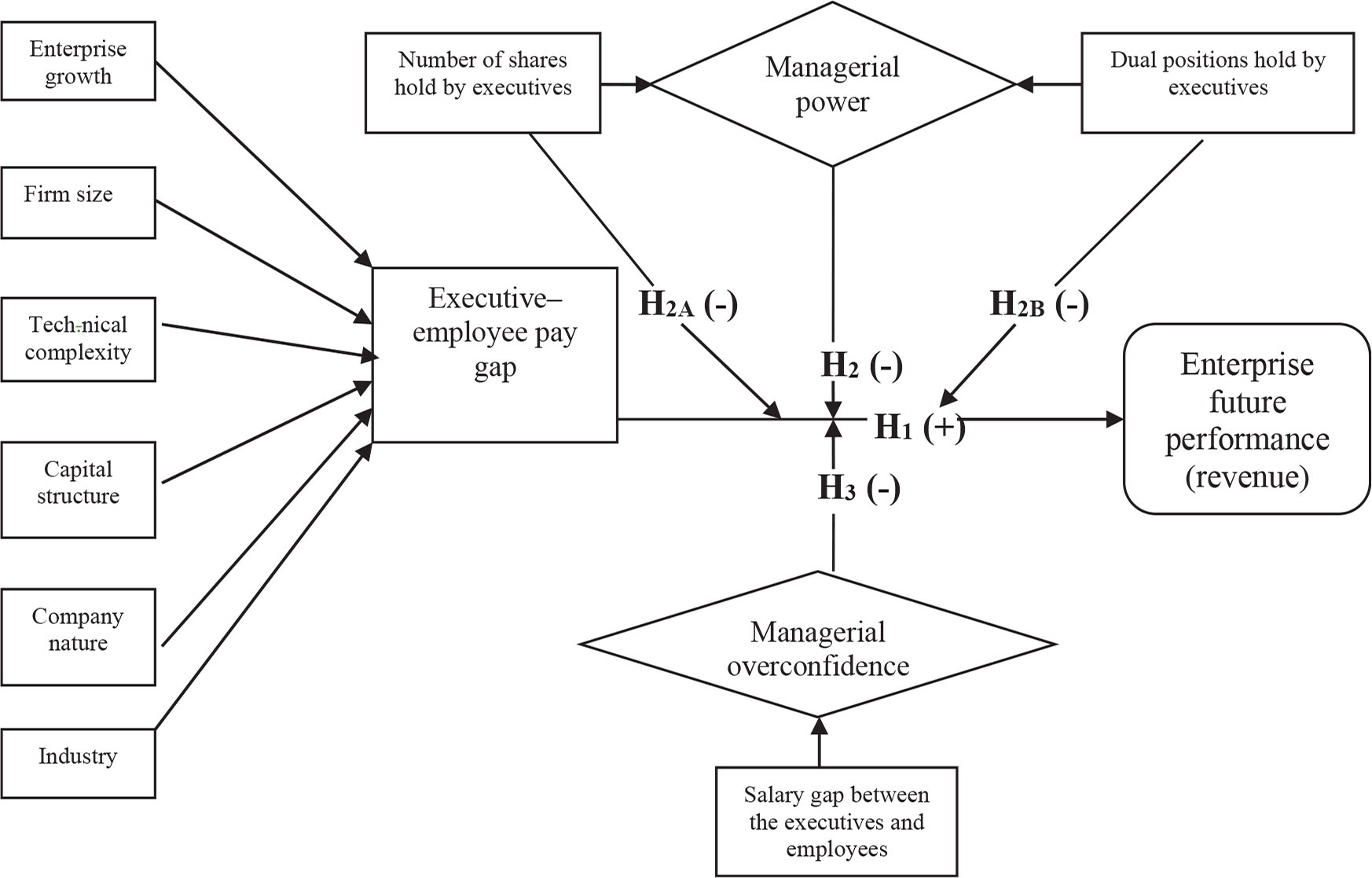
Figure 1
Theoretical framework of the study.
Table 1
Common measures for future performance of domestic (Chinese) firms
| Author(s) | Performance metrics |
|---|---|
| Zhang [2008] and Cao et al. [2016] | t+1 total asset yield for the year |
| Hou et al. [2016] | t+1 EPS for the year |
| Chen [2004] | t+1 total asset return and net assets utilization for the year |
| Lin [2015] | Company future performance (first year, second year, and third years’ average performance) |
| Chen et al. [2005] | The total asset yield of the company in the second year and the average total asset yield for the following 3 years |
[i] EPS, earnings per share.
Table 2
Common metrics for executive pay
| Author(s) | Compensation indicator metrics |
|---|---|
| Xin and Lin [2006] and Fang [2009] | Logarithm of the average remuneration of the top three directors |
| Lurui [2007], Zhou et al. [2013], and Wang [2015] | Logarithm of the average remuneration of the top three highest paid executives |
| Tong and Lu [2005] and Lu and Zhao [2008] | Ratio of total annual salary of directors, supervisors, and senior executives to the total number of salaried executives |
| Zhang [2008] and Chen and Xu [2001] | Total annual salary of directors, supervisors, and senior executives |
| Haung and Yao [2013] | The ratio of directors, supervisors, and executives’ salaries to the total number of executives |
| Lu [2014] | Ratio of total annual salary of directors, supervisors, and senior executives to the total number of executives |
| Kato and Long [2006] | Logarithm of the average remuneration of the top three directors, supervisors, and senior executives |
Table 3
Common metrics for employee compensation
| Author(s) | Compensation indicator metrics |
|---|---|
| Philip and Paul [2008] | Cash paid to employees-total management salary/cash received from sales of goods or service |
| Shen et al. [2013] | Cash paid to employees/average number of employees per year |
| Fang [2009] and Lu [2014] | (Cash paid to workers+employee compensation at the end of the quarter)-(employee compensation at the beginning of the quarter-executive annual pay)/(total employees-executive number) |
| Chen and Li [2011] | (Cash paid to employees and supervisors-the total annual remuneration of supervisors)/(total number of employees-total number of executives) |
Table 4
Common metrics used for management authority
| Author(s) | Management power metrics |
|---|---|
| Bebchuk et al. [2002] | CEO term and number of years of service, board independence, whether the CEO serves as chairman, whether the CEO retires within 2 years, and whether the CEOs are the major shareholders or not |
| Cheng et al. [2008] | Whether the CEO is the founder, chairman, and sole internal director with a large representation of the right or not |
| Coombs [2007] | Term of office, shareholding ratio, and two posts concurrently |
| Lurui [2007] | Second grade, share diversification, and senior executive tenure |
| Yan et al. [2015], Graham et al. [2017], Grinstein and Hribar [2003], Shin [2008] and Dai [2014] | Years of service as CEO, double duty, equity concentration, and whether the CEO is the founder or not |
| Schwab and Thomas [2006] | CEO’s preference of rights to bargain for |
| Justin et al. [2016] | Degree of decentralization and concurrent and independent directors ratio |
| Chen and Li [2008] and Shaojian De and Zhang [2014] | Integration of two posts, internal director ratio, board size, and shareholding ratio of the first major shareholders |
| Yu [2015] | Unification of two posts, diversification of shareholding, and proportion of management |
| Becht et al. [2003] | The proportion of control rights, the degree of separation of two rights, and the unification of two posts |
| Graham et al. [2017] | Unification of two posts, diversification of shareholding, size of board directors, and proportion of independent directors |
| Long and He [2018] | The number of board, executive title, senior management qualifications, senior management executive ownership, senior management tenure, and stock rights dispersed |
Table 5
Common metrics used for managerial overconfidence
| Substitution variables | Measurement method | Principle |
|---|---|---|
| Management relative compensation | Top three executive compensation/all executive compensation | The higher the management’s relative pay, the stronger its ability to control the firm with confidence [Hayward and Hambrick, 1997; Liu et al., 2010; Kang, 2016] |
| The historical performance of the enterprise | High performance in company’s annual reports | Managers tend to attribute high historical performance to their outstanding talent and decision-making power [Bettman and Weitz, 1983; Hayward and Hambrick, 1997] |
| Mainstream media evaluation | The vocabulary used to collect reports, as shown in self-confidence, optimism and so on with overconfidence, appears robust and reliable | The more number of words describing optimism, the more overconfident they are [Hayward and Hambrick, 1997] |
| Deviation of enterprise profit forecast | Compare the forecast profit of the enterprise with actual one | The more assertive an executive, the easier it is to estimate its profitability optimistically [Lin et al., 2005; Xia et al., 2014] |
| Management stock change | Management to increase shareholding | If management is optimistic about the future development of enterprises, it increases their holdings [Carpenter, 1998; Claessens et al., 2002; Malmendier and Tate, 2008] |
| How often the management implements mergers and acquisitions | Number of merger acquisition decisions made by executives over a period of time | The more assertive executives are inclined to overestimate mergers and acquisitions, the more they are engaged frequently with mergers and acquisitions [Doukas and Petmezas, 2007] |
| Industry sentiment index | Index interval is 0–1, if >100 is considered as overconfident | The larger the index, the more overconfident the executives are [Zou et al., 2006; Baker and Jeffrey, 2007] |
| Consumer confidence index | Consumers’ estimation of current market situation and subjective perception of consumption psychology | The larger the product value, the more overconfidence the executives represent [Oliver, 2005] |
Table 6
Variable tools
| Variable type | Variable code | Measurement formula | ||
|---|---|---|---|---|
| Explained variables | Future performance of the firm | EPS | Final net profit/total number of closing units | |
| Interpreting variables | Pay gap between employees and executives | Megap | LN (average remuneration for directors, supervisors, and top three employees-average pay for general employees) | |
| Adjusting variables | Management power characteristics | Executive shareholding ratios | Share | Total executive stock holdings/total number of shares |
| Two posts concurrently | Duality | If the chairman and general managers concurrently hold two posts, the value is 1; otherwise, it is 0 | ||
| Management power features | Management holdings | Overcon | If the management holdings increased during the 2-year research period, the value will be 1; otherwise, it is 0 | |
| Management overconfidence features | Changes | |||
| Control variables | Growth of enterprise | Growth | (Final total assets-opening total assets)/opening total assets | |
| Technical complexity | Tech | Total number of developments/total employees | ||
| Capital structure | Lever | Total liabilities/total assets | ||
| Enterprise scale | Size | LN (year-end total assets) | ||
| Company nature | SOE | The value of state-owned firm is 1; otherwise it is 0 | ||
| Industry | Ind | The value of manufacturing industry is 1; otherwise, it is 0 | ||
[i] EPS, earnings per share; Megap, pay gap between executives and ordinary employees; SOE, state-owned enterprise.
Table 7
Industry distribution of samples
| Industry code | Industry type | Number of firms | Percentage |
|---|---|---|---|
| B | Mining | 30 | 2.5 |
| C | Manufacturing | 933 | 78.5 |
| D | Electricity, heating, gas, and water production and supply | 18 | 1.5 |
| E | Construction | 29 | 2.4 |
| F | Wholesale and retail trade | 34 | 2.9 |
| G | Transportation, warehousing, and postal services | 13 | 1.1 |
| H | Accommodation and catering | 1 | 0.1 |
| I | Information transmission, software, and information technology | 80 | 6.7 |
| K | Real estate | 12 | 1 |
| L | Leasing and business services | 9 | 0.8 |
| M | Scientific research and technology | 9 | 0.8 |
| N | Water conservatory, environment, and public facilities management | 6 | 0.5 |
| P | Education | 1 | 0.1 |
| Q | Health and social work | 2 | 0.2 |
| R | Culture, sports, and entertainment | 12 | 1 |
Table 8
Variables involved in descriptive statistics
| Variable | Full sample | ||||
|---|---|---|---|---|---|
| Average | Medium | Standard deviation | Minimum value | Maximum value | |
| EPS | 0.32 | 0.21 | 0.63 | −3.12 | 14.27 |
| Megap | 13.26 | 13.22 | 0.65 | 10.75 | 16.09 |
| Share | 0.11 | 0.01 | 0.16 | 0.00 | 0.70 |
| Duality | 0.24 | 0.00 | 0.43 | 0.00 | 1.00 |
| Overcon | 0.20 | 0.00 | 0.40 | 0.00 | 1.00 |
| Growth | 0.22 | 0.12 | 0.47 | −0.38 | 8.55 |
| Tech | 14.23 | 11.29 | 12.97 | 0.00 | 85.53 |
| Lever | 0.43 | 0.41 | 0.19 | 0.04 | 1.04 |
| Size | 22.39 | 22.24 | 1.12 | 19.21 | 27.83 |
| SOE | 0.41 | 0.00 | 0.49 | 0.00 | 1.00 |
| Ind | 0.78 | 1.00 | 0.41 | 0.00 | 1.00 |
[i] EPS, earnings per share; Megap, pay gap between executives and ordinary employees; SOE, state-owned enterprise.
Table 9
Descriptive statistics of dependent (EPS) and independent variables (Megap)
| Industry | EPS | Megap | ||||
|---|---|---|---|---|---|---|
| Average | Minimum value | Maximum value | Average | Minimum value | Maximum value | |
| B | 0.06 | −2.17 | 0.74 | 13.12 | 11.99 | 14.23 |
| C | 0.31 | −3.12 | 14.27 | 13.22 | 11.12 | 16.09 |
| D | 0.41 | 0.02 | 0.95 | 13.14 | 12.45 | 13.94 |
| E | 0.39 | 0.05 | 1.37 | 13.33 | 10.75 | 14.42 |
| F | 0.40 | −0.32 | 3.16 | 13.59 | 12.45 | 14.84 |
| G | 0.36 | 0.19 | 0.82 | 13.24 | 12.52 | 14.43 |
| H | 0.49 | 0.49 | 0.49 | 13.43 | 13.43 | 13.43 |
| I | 0.35 | −0.48 | 2.25 | 13.46 | 12.25 | 15.09 |
| K | 0.63 | 0.19 | 1.44 | 14.33 | 13.34 | 15.57 |
| L | 0.41 | 0.04 | 1.63 | 13.38 | 12.60 | 14.47 |
| M | 0.20 | −0.51 | 0.72 | 13.45 | 12.56 | 14.58 |
| N | 0.44 | 0.12 | 1.27 | 13.03 | 12.54 | 13.43 |
| P | 0.70 | 0.70 | 0.70 | 13.25 | 13.25 | 13.25 |
| Q | 0.36 | 0.16 | 0.56 | 13.24 | 13.19 | 13.28 |
| R | 0.51 | 0.05 | 1.06 | 13.59 | 12.78 | 15.17 |
[i] EPS, earnings per share; Megap, pay gap between executives and ordinary employees.
Table 10
Pearson’s correlation factor among the relationship between the variables
| Variables | EPS | Megap | Share | Duality | Overcon | Growth | Tech | Lever | Size | SOE | Ind |
|---|---|---|---|---|---|---|---|---|---|---|---|
| EPS | 1 | ||||||||||
| Megap | 0.248** | 1 | |||||||||
| Share | −0.026 | −0.064* | 1 | ||||||||
| Duality | 0.000 | 0.001 | 0.258** | 1 | |||||||
| Overcon | 0.020 | 0.035 | 0.203** | 0.060* | 1 | ||||||
| Growth | 0.090** | 0.073* | 0.175** | 0.079** | 0.156** | 1 | |||||
| Tech | −0.014 | 0.057* | 0.232** | 0.092** | 0.106** | 0.156** | 1 | ||||
| Lever | −0.084** | 0.026 | −0.304** | −0.113** | −0.092** | −0.042 | −0.246** | 1 | |||
| Size | 0.208** | 0.347** | −0.263** | −0.141** | −0.003 | 0.044 | −0.229** | 0.540** | 1 | ||
| SOE | 0.043 | −0.037 | −0.512** | −0.284** | −0.204** | −0.186** | −0.178** | 0.311** | 0.290** | 1 | |
| Ind | −0.027 | −0.123** | 0.024 | 0.024 | −0.066* | −0.027 | −0.150** | −0.147** | −0.232** | −0.071* | 1 |
Table 11
Executive ownership ratio, pay gap, and future performance of the enterprise
| Predictor variables | EPS | |||
|---|---|---|---|---|
| Model 1 | Model 2 | Model 3 | Variance Inflation Factor | |
| Step 1: Control variables | ||||
| Growth | 0.097* | 0.094* | 0.096* | 1.074 |
| Tech | 0.000 | −0.001 | −0.001 | 1.192 |
| Lever | −0.922*** | −0.821*** | −0.802*** | 1.571 |
| Size | 0.197*** | 0.151*** | 0.148*** | 1.853 |
| SOE | 0.055 | 0.078 | 0.079 | 1.476 |
| Ind | 0.026 | 0.033 | 0.032 | 1.114 |
| Step 2: Interpreting variables | ||||
| Megap | 0.158*** | 0.149*** | 1.252 | |
| Share | 0.003 | −0.035 | 1.478 | |
| Step 3: Adjusting variable | ||||
| Megap*Share | −0.441* | 1.058 | ||
| Step 4: Predictor variables | ||||
| R2 | 0.104 | 0.125 | 0.129 | Durbin-Watson1.410 |
| F | 22.788*** | 21.159*** | 19.470*** | |
| Change in R2 | 0.104*** | 0.022*** | 0.004* | |
Table 12
Executives holding two posts, pay gap, and future performance of the enterprise
| Variables | Two posts concurrently | Non two posts concurrently | ||||
|---|---|---|---|---|---|---|
| Coefficient | Significance | VIF | Coefficient | Significance | VIF | |
| Constant | −3.326*** | 0.000 | −5.393*** | 0.000 | ||
| Megap | 0.088* | 0.037 | 1.366 | 0.181*** | 0.000 | 1.200 |
| Growth | 0.173** | 0.002 | 1.161 | 0.065 | 0.152 | 1.045 |
| Tech | −0.001 | 0.679 | 1.279 | −0.002 | 0.354 | 1.151 |
| Lever | −0.425** | 0.007 | 1.531 | −0.937*** | 0.000 | 1.520 |
| Size | 0.123*** | 0.000 | 2.055 | 0.161*** | 0.000 | 1.784 |
| SOE | −0.026 | 0.703 | 1.249 | 0.110* | 0.017 | 1.162 |
| Ind | −0.136* | 0.038 | 1.197 | 0.082 | 0.129 | 1.105 |
| R2 | 0.188 | 0.130 | ||||
| F | 9.236*** | 19.088*** | ||||
| Change in R2 | 0.188*** | 0.130*** | ||||
Table 13
Management share change, pay gap, and future performance of the enterprise
| Variables | Management overconfidence | Non-management overconfidence | ||||
|---|---|---|---|---|---|---|
| Coefficient | Significance | VIF | Coefficient | Significance | VIF | |
| Constant | −3.425*** | 0.000 | −5.097*** | 0.000 | ||
| Megap | 0.125** | 0.004 | 1.214 | 0.164*** | 0.000 | 1.242 |
| Growth | 0.052 | 0.0281 | 1.046 | 0.108* | 0.023 | 1.059 |
| Tech | −0.001 | 0.561 | 1.285 | −0.001 | 0.729 | 1.154 |
| Lever | −0.386* | 0.041 | 1.767 | −0.908*** | 0.000 | 1.521 |
| Size | 0.101* | 0.015 | 1.948 | 0.158*** | 0.000 | 1.879 |
| SOE | 0.022 | 0.739 | 1.136 | 0.093* | 0.040 | 1.204 |
| Ind | 1.886 | 1.000 | 1.209 | 0.052 | 0.333 | 1.105 |
| R2 | 0.098 | 0.132 | ||||
| F | 3.646*** | 20.319*** | ||||
| Change in R2 | 0.098** | 0.132*** | ||||
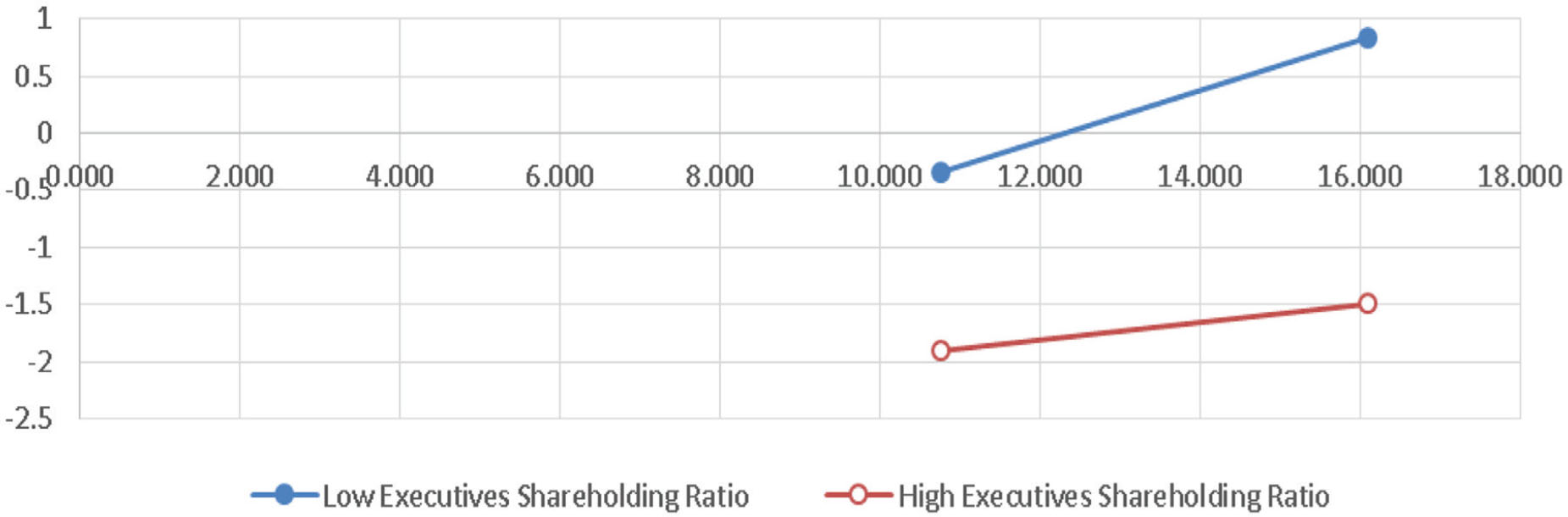
Figure 2
Adjustment effect diagram to depict the executive shareholding ratio.
Table 14
Adjustment effect for the executive shareholding ratio
| Constant | X coefficient | M coefficient | X*M | M value | X value | Low executive shareholding ratio | Low executive share-holding Ratio |
|---|---|---|---|---|---|---|---|
| −2.726 | 0.149 | −0.035 | −0.441 | −0.164 | 10.750 | −0.34208 | −1.90642 |
| 0.16378 | 16.09 | 0.839274 | −1.49645 |
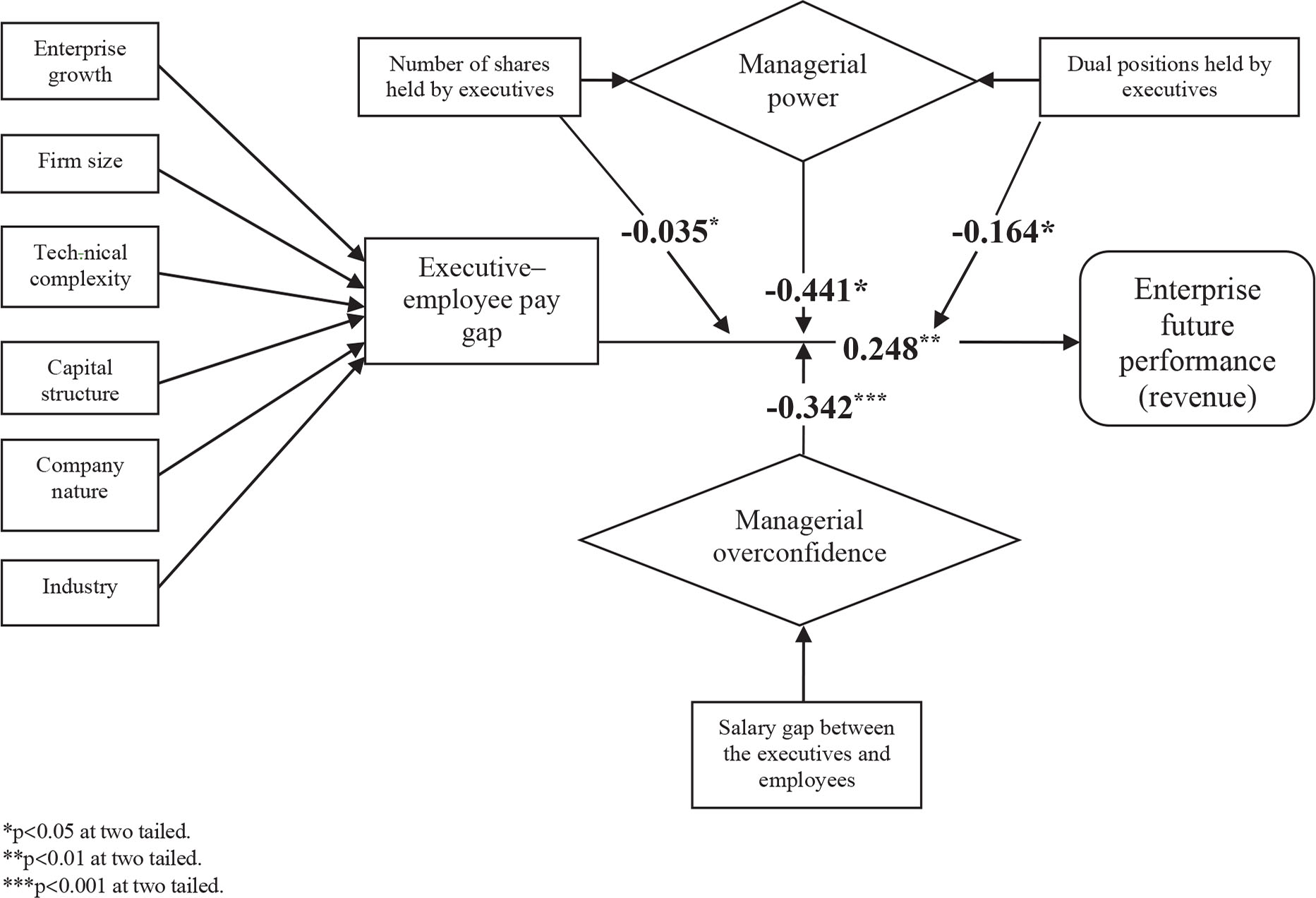
Figure 3
Depiction of validation of hypotheses through theoretical framework.
Table 15
Validation of hypotheses
| Hypotheses | Content | Verified or not |
|---|---|---|
| H1 | Executive–employee pay gap is positively correlated (0.248) with the firm’s future performance, i.e., the greater pay gap in t the year (the first t-1), the higher the performance level in that year. | Verified |
| H2 | The greater the management power, the weaker (−0.441) the positive relationship between employee pay gap and future performance | Verified |
| H2A | The higher the percentage of executive ownership, the weaker (−0.035) the positive relationship between pay gap and firm future performance | Verified |
| H2B | Chairman and general manager holding two posts concurrently weaken (−0.164) the positive relationship between pay gap and firm future performance | Verified |
| H3 | The higher the level of management overconfidence, the weaker (−3.425) the positive relationship between pay gap and firm future performance | Verified |