
Table 1:
Fundamental attributes of hackathons (based on Halvari et al. (2019))
| Attributes | Approach used in this research | |
|---|---|---|
| 1 | Short duration | The hackathon was 20 hours over two days. |
| 2 | Team coopetition | The event fostered collaborative practices among teams, emphasising mutual support and shared problem-solving. |
| 3 | Challenge | Invitation process designed to inform participants about the CE challenge and prompt them to engage with it. |
| 4 | Creation process | Participants were encouraged to approach the challenge with experimentation, exploration and commitment to learning new skills. |
| 5 | Ceremony process | A cross-disciplinary judging panel, including representatives from three European HEIs (consortium partners), regional government and local industry introduced the challenge on day one. The panel engaged with participants, providing insights and answering questions. On day two, the panel returned to evaluate and select the best idea based on participants’ presentations. |
| 6 | Collaboration | Team formation emphasised diversity, mixing participants with varied discipline backgrounds and expertise to foster innovative solutions. |
| 7 | Radical collocation | Participants physically present throughout and during evening work, promoting continuous interaction, idea exchange and collaboration. |
| 8 | Consistency | Decisions among participants throughout the event were interconnected, following the design thinking approach and ensuring alignment with the hackathon’s objectives. |
1 (source: authors, adapted from Halvari et al. (2019))
Table 2:
Participating students’ disciplines
| Discipline | Stage | |
|---|---|---|
| 1 | Construction Project management | MSc - postgraduate |
| 2 | Software Systems Development | Undergraduate |
| 3 | Business Systems | MBS - postgraduate |
| 4 | Business | Undergraduate |
| 5 | Business | Undergraduate |
| 6 | Business | Undergraduate |
| 7 | Innovative Technology Engineering | MSc - postgraduate |
| 8 | International Business | Undergraduate |
| 9 | Science | PhD – postgraduate |
| 10 | Accountancy | Undergraduate |
| 11 | Computer Science | Undergraduate |
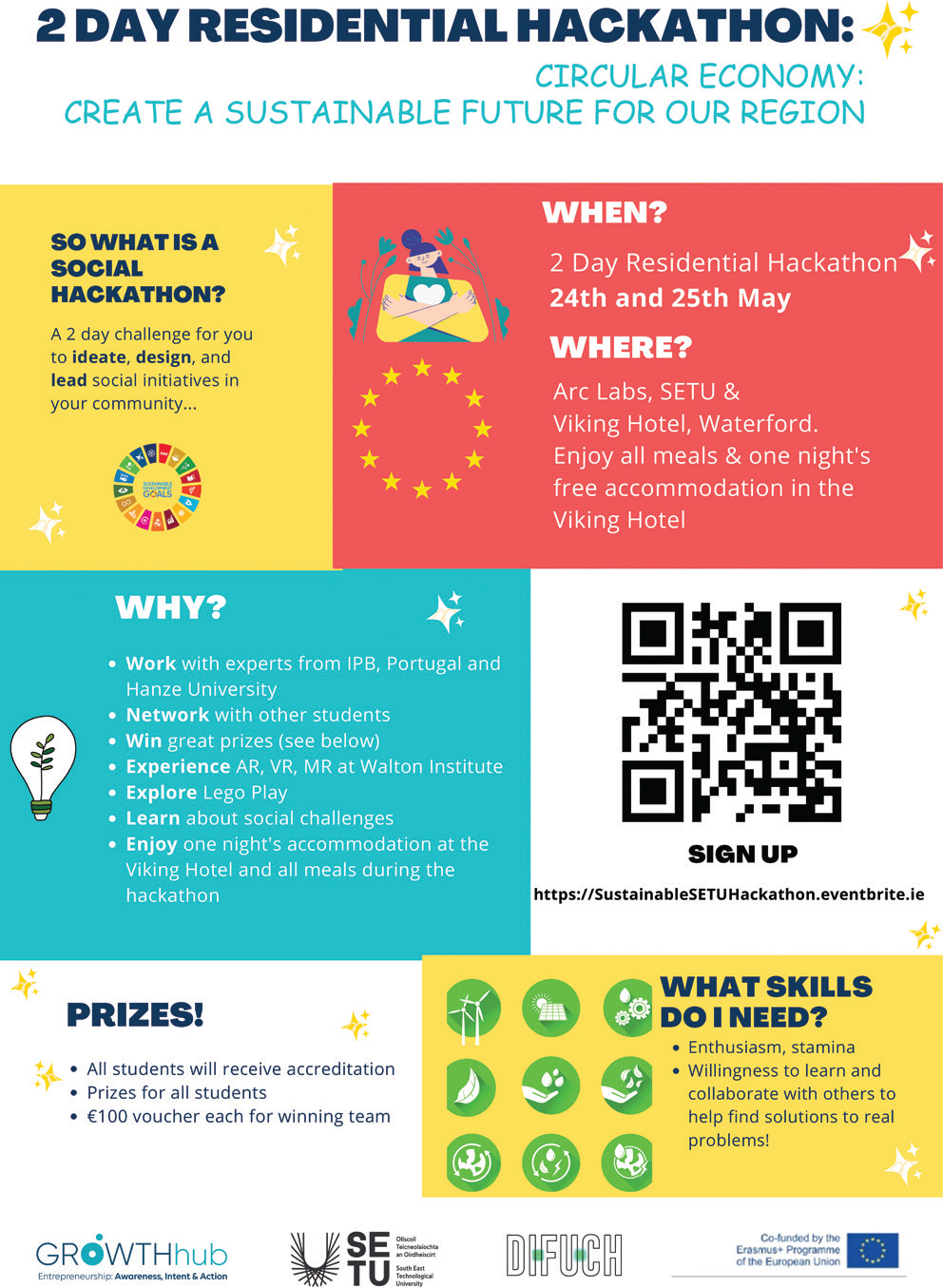
Figure 1:
Promotional Material.
Table 3:
Focus group discussion topics
| Student engagement | Extent to which students were engaged with the hackathon and tackled the CE challenge. |
| Collaboration | Extent to which participants networked and collaborated. |
| Logistics | Related to issues pertaining to the venues (university and hotel), facilities, technical support and optional Virtual Reality (VR), Augmented Reality (AR), and Mixed Reality (MR) event. |
| Learning outcomes | Issues relating to students’ experience and extent to which the hackathon model contributed to improving students’ skills/knowledge, competency development. |
| Feedback | Hackathon feedback mechanisms (surveys, interview processes). |
| Project objectives | Direct impact of the hackathon as an LTTA mechanism and broader project implications. |
| Learnings | Experiences and learnings including challenges and long-term benefits. |
Table 4:
Survey one questions
|
Table 5:
Survey two questions
|