
INTRODUCTION
Entrepreneurship holds immense potential as a powerful force for good. This is a rallying call made by an increasing number of researchers who are proclaiming the positive power of entrepreneurship in the face of immense societal, environmental and economic challenges (Dodd, Anderson, and Jack, 2023). The responsibility for empowering students to see beyond mere economic opportunities and instead to recognise and enact the benevolent and positive impacts of entrepreneurship lies largely with our universities, educators and researchers in the field of entrepreneurship education (EE) (Pérez-Pérez, González-Torres, and Nájera-Sánchez, 2021). In this case study, we report on the use of a hackathon employing a CBL methodology to successfully help students develop their knowledge of entrepreneurship beyond a profit-driven model. The research problem for this study was: ‘Evaluating hackathons as challenge-based learning (CBL) tools for enhancing entrepreneurship competences in multidisciplinary university students addressing circular economy (CE) issues in South East Ireland’. Central to the hackathon design was empowering students to develop their entrepreneurial competences and to experience how entrepreneurship can change the world for the better through addressing CE challenges.
EE is recognised for its importance in tackling economic and (increasingly) societal and environmental challenges (Turner and Gianiodis, 2018). Mirroring the real-world environment, EE is a fast-moving discipline and has seen a proliferation of pedagogical research over recent years which has given rise to new teaching processes, tools and approaches (Ratten and Usmanij, 2021). Central to new approaches is experiential learning techniques through which Higher Education Institutions (HEIs) have innovated teaching and learning strategies by using active learning methods (O’Siochru, Norton, Pilkington, Parr, Anderson, and Maslen, 2021). These approaches stress the importance of learning through experience using practice-based pedagogies to assist students to develop the skills and practices needed for entrepreneurship (van den Beemt, van de Watering, and Bots, 2023). This can be achieved through active learning, reflective practice and design-based learning. Among the approaches gaining traction are problem-based learning (PBL), team-based learning (TBL), design for learning, inquiry-based learning and CBL. These pedagogical approaches are underpinned by action based learning; with CBL emerging as an approach that demonstrates strong results (Membrillo-Hernández, García-García, Ruiz-Cantisani, Lara-Prieto, and Martínez-Ortiz, 2024). CBL requires a prior level of knowledge of the problem; it passes autonomy to students who take responsibility for solving real challenges, promoting theoretical and practical training and the development of core skills including critical thinking, creativity and decision-making (Organ, Machado, O’Brien, Ferro-Lebres, Pereira, Van Oostrom, Rodrigues, Botelho Junior, de Almeida and do Cabo, 2023). In recognition of the importance of EE in addressing future challenges, three European universities (Instituto Politécnico de Bragança (IPB), Portugal; Hanze University of Applied Sciences (Hanze), the Netherlands; and South East Technological University (SETU), Ireland) collaborated on an ERASMUS+ funded project: ‘Digital Future Challenge-Based Learning in Higher Education’ (DIFUCH) to innovate a multidisciplinary, transnational EE programme (underpinned by the UN Sustainable Development Goals (SDGs)) using a CBL methodology. As part of the testing phase for the project, the authors implemented an overnight residential hackathon titled ‘The Grand Challenges’ in May 2023. The hackathon held in the Waterford campus of SETU in the South East of Ireland, was designed to implement a CBL framework, whereby a multidisciplinary group of university students (undergraduates and postgraduates) was tasked to solve real-world problems relevant to the regions in which the three consortium universities are based. The prescribed problem area, the circular economy is relevant to the project partners’ respective regions of Trás-os-Montes, Portugal; Northeast region, the Netherlands; and South East Ireland. The CBL approach implemented during the hackathon was considered crucial because there is broad consensus that experiential learning is central to EE whereby students are given autonomy to direct their own learning while collaborating with others (Yardley, Teunissen, and Dornan, 2012). Moreover, the hackathon approach marries well with a CBL methodological framework. Also, the time-bounded element of a hackathon creates an urgent, vibrant and exciting learning environment which supports collective problem-solving and cooperation (Toros, Kangro, Lepik, Bugarszki, Sindi, Saia, and Medar, 2022). However, overnight residential hackathons require significant resources to develop and implement hence their infrequent use in academic settings (Garcia, Antezana, Garcia, Bolton, Jimenez, Prins, Banda, and Katayama, 2020). Despite the breadth of research into EE, CBL methodology and hackathon usage, there is a dearth of information and reporting on overnight residential hackathons as part of a CBL methodology to address circular economy challenges in EE. Therefore, we examined the merits of using a CBL based hackathon to enhance the entrepreneurial competences of multidisciplinary students to address circular economy issues. By employing a case study approach to provide an in-depth examination of the hackathon event and its impact, we found that the hackathon did improve collaboration between students and was a useful means to equip participating students with tools and practices to positively address real-world challenges pertaining to the CE.
The next section of this paper provides the theoretical frame for the study. It reviews EE research, the importance of EE in addressing economic, environmental and societal problems and the methods employed to affect this. We also examine new and prevailing pedagogical perspectives in EE research and the role experiential learning plays in actioning entrepreneurship for students. Following this, literature pertaining to CBL as a conduit for experiential learning within the entrepreneurship discipline, and the success of hackathons as a tool to implement CBL is reviewed. We also explore current circular economy research and the role of EE in providing momentum to related issues. We explain why the hackathon was used before outlining the research design. This includes details about the design, structure and implementation of the hackathon; the research participant process; ethical considerations; and information about the students’ circular economy proposals. Next, details of data collection and analysis techniques are provided. The study findings are then delineated; this is followed by the discussion and implications of this research for theory and practice.
Theoretical frame
EE is of central importance in higher education for diverse reasons (Carpenter and Wilson, 2022). Interest in the phenomenon was initially embedded in the economic benefits attributable to entrepreneurship. This evolved into a growing interest in sustainable entrepreneurship, benevolent entrepreneurship and the role that entrepreneurship can play in a regenerative context (Armon, 2021). Van Gelderen (2023) discussed the narrow and broad dimensions of entrepreneurship in the narrow sense, his view is that entrepreneurship is focused on starting a new venture. From a broader perspective, he suggests that new venture creation can impact various levels of ‘people, planet, and prosperity’ ranging from purely capitalist models to regenerative manifestations of benevolent entrepreneurship (Armon, 2021; Van Gelderen, 2023). Increasingly, researchers including Dodd et al. (2023) demonstrated how entrepreneurship can be a transformative power in driving change and innovation in addressing challenges such as those identified by the UN SDGs and those related to the circular economy. Framing our understanding of entrepreneurship, we draw on Dodd et al. (2023, p. 1847) who argued that entrepreneurship is a mechanism for change, achieved through the connection of “things, ideas, people and processes”.
The importance of EE from a sustainability and regenerative perspective is evidenced by the proliferation of research dedicated to the field (Fayolle, 2018). Within this broad body of research, it is acknowledged that EE sparks innovation and cultivates creative thinking by encouraging students to identify opportunities and develop innovative solutions to address economic, environmental and societal challenges (Halvari, Suominen, Jussila, Jonsson, and Bäckman, 2019). Additionally, EE provides students with leadership skills, empowering them to take initiative and tackle challenges, preparing them for effective leadership in various professional contexts as they face diverse and complex challenges from economic, social, and environmental perspectives (Cobham, Gowen, Hargrave, Jacques, Laurel, and Ringham, 2017). A growing number of researchers including Dodd et al. (2023) and Armon (2021) stress the fundamental importance of entrepreneurs as disruptive, innovative forces for good who have the power to influence and shape all of our tomorrows. For educators, the discipline breadth, and existential challenges such as our growing environmental crises, requires educators to rethink what they teach and how they teach EE (Farny et al., 2019; Turner and Gianiodis, 2018). Acknowledging these scenarios, Ratten and Usmanij (2021) posit that there is much room for improvement in teaching practices, particularly vis-a-vis understanding the power that entrepreneurship offers for positive, sustainable and regenerative change in areas such as the circular economy (Armon, 2021). There is a growing body of research suggesting that entrepreneurship must be aligned with social-ecological and environmental systems (Dodd et al., 2023). Because, whereas once upon-a-time, entrepreneurs harvested and exploited natural resources; today we see increasing evidence of how entrepreneurship can renew and regenerate in line with and support of the ‘People, Planet, Prosperity’ model (Armon, 2021). Toros et al. (2022) proffered that experiential learning methods, such as CBL, can be harnessed to effectively demonstrate the benevolent power of entrepreneurship. Experiential learning requires students to develop their learning and skill sets through addressing real-world problems faced by real-world entrepreneurs, organisations and communities; it requires learners to be actively engaged in society (Yardley et al., 2012). Common aspects of the EE teaching experience include guest speakers, group projects, case studies and ‘live’ scenarios. While there is significant merit for these approaches, it is also necessary that the discipline needs to be entrepreneurial in its delivery (Ratten and Usmanij, 2021). Clearly, according to Fayolle (2018), educational efforts in the EE field must be developed and supported by research endeavours. This notion supports the effectuation approach to entrepreneurship, whereby entrepreneurs use available resources in their innovative endeavours (Sarasvathy, 2001). Many proponents of EE argue that it should result in competency development such as learning with affective (emotional changes), cognitive (new skill development), conation (feelings that results from the learning) and outcomes (Ratten and Usmanij, 2021). These are reflected in this current research study which is informed by a focus on competency development as reflected in the UNESCO ESG guidelines and the EntreComp framework. The EntreComp framework was developed by the EU’s Joint Research Centre (JRC), in partnership with the European Commission Directorate-General (DG) for Employment and Social Affairs (Bacigalupo, Kampylis, Punie, and Van den Brande, 2016). This framework is a central pillar in the EU’s support for the development of key entrepreneurial competencies (i.e., a combination of knowledge, skills, and attitudes that enable individuals to act upon opportunities and ideas, creating value for others - this value can be financial, cultural, or social) among European citizens and organisations (Van Gelderen, 2023). Within the EE research stream, significant focus is given to experiential teaching methods and developing entrepreneurial competences through frameworks such as EntreComp (Fayolle, 2018). Extant research in the EE field demonstrates that competency development can be heightened through deliberate practice encompassing intentional and conscious efforts which ultimately become enhanced over time and with practice (Van Gelderen, 2023). There is strong evidence to support the theory that this direct practice approach is consistent with developing entrepreneurial competences (Van Gelderen, 2023). In the field of EE, a CBL methodology which is underpinned by experiential principles can support a direct practice approach, that enables students to experience and iterate in a hands-on way. Hackathons are a common method used within the CBL framework to practice these skills, as they facilitate key aspects of CBL activities including collaboration and engagement, research and action (Toros et al., 2022). Initially, most common in engineering or business schools, many universities are following such examples and integrating CBL across all schools and programmes. CBL has been found to be effective in addressing UN SDG inspired challenges. For example, many universities including the DIFUCH project’s three consortium partner universities, are employing CBL to focus on challenges such as climate change, energy renewal, healthcare, migration and biodiversity. When implemented through the medium of a hackathon, CBL provides hands-on experience, facilitating students to apply theoretical knowledge to real-world challenges, enhancing their entrepreneurial skills and understanding of future ventures (Cobham et al., 2017). Hackathons also nurture an innovation-driven mindset, compelling creativity under pressure and building resilience to handle adversity, contributing to unique problem-solving scenarios (Toros et al., 2022).
The concept of using hackathons in education has evolved over time from an IT-specific exercise consisting of a one- or two-day event where programmers develop new software applications that meet the challenge posed by sponsors (Almirall, Lee, and Majchrzak, 2014) to a more generic idea of short and intense events where groups collaborate to provide a solution to a specific problem determined by the organisers (Faludi, 2023). Hackathons have been implemented in different contexts including social services (Toros et al., 2022), entrepreneurship activities (Cobham et al., 2017), in the classroom (Gama, Alencar, Calegario, Neves, and Alessio, 2018) and for waste management solutions (Sosunova, Porras, Makarova, and Rybin, 2022). The transformative potential of hackathons is significant, as highlighted by Cobham et al. (2017) who emphasised their role in enhancing students’ innovative potential and fostering personal growth. By engaging in hackathons, students develop critical problem-solving skills, creativity and resilience, all of which contribute to their overall development and readiness for future challenges. Halvari et al. (2019) considered eight fundamental attributes for a hackathon, these are outlined in Table 1. A central point emphasised by Halvari et al. (2019) is that they consider hackathons to be short-term events. Cwikel and Simhi (2022) suggest that hackathons can last as little as three hours while Szymanska, Sesti, Motley, Puia (2020) focused on hackathon being one-day events. On the other hand, Toros et al. (2022) and Cobham et al. (2017) suggested hackathons lasting 48 hours over three days; alternatively, Taylor and Clarke (2018) approach is based on hackathons with durations ranging from six to 48 hours.
Table 1:
Fundamental attributes of hackathons (based on Halvari et al. (2019))
| Attributes | Approach used in this research | |
|---|---|---|
| 1 | Short duration | The hackathon was 20 hours over two days. |
| 2 | Team coopetition | The event fostered collaborative practices among teams, emphasising mutual support and shared problem-solving. |
| 3 | Challenge | Invitation process designed to inform participants about the CE challenge and prompt them to engage with it. |
| 4 | Creation process | Participants were encouraged to approach the challenge with experimentation, exploration and commitment to learning new skills. |
| 5 | Ceremony process | A cross-disciplinary judging panel, including representatives from three European HEIs (consortium partners), regional government and local industry introduced the challenge on day one. The panel engaged with participants, providing insights and answering questions. On day two, the panel returned to evaluate and select the best idea based on participants’ presentations. |
| 6 | Collaboration | Team formation emphasised diversity, mixing participants with varied discipline backgrounds and expertise to foster innovative solutions. |
| 7 | Radical collocation | Participants physically present throughout and during evening work, promoting continuous interaction, idea exchange and collaboration. |
| 8 | Consistency | Decisions among participants throughout the event were interconnected, following the design thinking approach and ensuring alignment with the hackathon’s objectives. |
1 (source: authors, adapted from Halvari et al. (2019))
Research into hackathons is consistent with the proposition that the integration of CBL with hackathons in EE creates a vibrant and all-encompassing learning context within which students can develop their entrepreneurial competences through practice and experience (Van Gelderen, 2023). This innovative fusion underscores the importance of active collaboration (Toros et al., 2022), urging students to engage collectively in problem-solving endeavours while developing their entrepreneurial competences. It not only cultivates interdisciplinary skills and personal competence development but also propels students into an environment that mirrors the fast-paced reality of real-world entrepreneurial challenges encompassing any aspect of people, planet and prosperity. This holistic approach not only deepens theoretical understanding but also enhances competences such as those identified in the EntreComp framework (i.e., combination of knowledge, skills, and attitudes that enable individuals to act upon opportunities and ideas, creating value (financial, cultural, or social) for others), thereby ensuring that students are well-prepared to navigate the complexities of the entrepreneurial landscape and real-world societal, economic and environmental challenges (Cobham et al., 2017).
An important aspect of the DIFUCH project was the identification of key challenges, particularly those relevant to each of the project partners. An exercise was undertaken to identify challenges facing each partner’s region which were examined through the lens of the UN SDGs. This collaborative research exercise identified that challenges underpinned by the CE featured strongly for the partners. Accordingly, this was the challenge chosen to tackle during the hackathon event. The CE is garnering an increasing degree of interest, as focus intensifies on the UN SDGs and existential environmental challenges (Dodd et al., 2023). A common understanding of the CE model is that it promotes sustainable production and consumption in a closed loop context (Del Vecchio, Secundo, Mele, and Passiante, 2021). Clearly, entrepreneurship and CE are symbiotic paradigms, with educators increasingly becoming more aware of entrepreneurship’s importance in regenerative contexts (Armon, 2021). HEIs are responding to calls to educate future leaders on challenges and opportunities associated with the CE, with EE identified as a key discipline in this context.
Why the hackathon
The Grand Challenges Residential Hackathon was part of an EU Erasmus+ Project, which involved higher education partners from Portugal, the Netherlands, and Ireland. The hackathon was one of a series of three learning, teaching, training activities (LTTA) delivered as part of the project. The purpose of this particular LTTA event was to test experiential learning specifically CBL as a means to empower students to address societal, environmental and economic challenges. The project prioritised cross-border idea generation and collaboration encompassing students, educators, researchers, and stakeholders. An emphasis on future skills development to address emerging and new challenges such as the existential challenges underpinned by the UN SDGs underscores the project’s commitment to preparing students for the dynamic and ever-changing business landscape.
RESEARCH DESIGN
To assess the effectiveness of the hackathon in fostering collaboration, ideation, prototyping, and problem-solving skills among participants, this research adopted a case study approach. According to Yin (2017), a case study is suitable for an in-depth examination of real-world cases, allowing for a comprehensive understanding of contextual conditions relevant to the specific instance being studied.
Hackathon design and implementation
Through an in-depth examination and analysis of the hackathon’s activities and processes, we explored the experiences of participants and facilitators as to how successful the event was in fostering collaboration, ideation, prototyping and problem-solving skills among participants.
The hackathon, and its programmatic content and delivery, was collaboratively designed, organised and managed by the three collaborating HEIs. The design included the use of CBL and Design Thinking tools.
The hackathon duration was 20 hours over two days and incorporated a residential element whereby participating students were provided with overnight accommodation in a hotel close to the SETU university campus. The residential aspect was a particularly unique feature of this hackathon; residential (overnight) hackathons involve more development, implementation time and incur more costs and accordingly are not a common hackathon variant in university settings. However, it was decided to include a residential aspect in this hackathon because it offered major benefits such as: affording students the opportunity to work continuously together on the implementation of their ideation late into the evening; promoting enhanced team building and collaboration and maintaining students’ focus on the challenge for the duration of the hackathon event. The hackathon was devised with the objective of empowering participating students to create a business solution that could address a challenge which was pertinent to the CE and relevant to the three regions of the ERASMUS+ project partners. The hackathon, and its workshops, were facilitated by lecturers/researchers from each of the three DIFUCH HEIs and SETU’s entrepreneurship hub (SETU Growth Hub) who were experienced practitioners in pedagogy, business disciplines, CBL and design-thinking. The workshop activities included team building exercises incorporating the establishment of teamwork rules and contracts, skills assessments and instruction on design thinking methodologies and entrepreneurship competences. Skills enhancement included developing empathy using empathy maps; problem definition using reframing and brainstorming; ideation using the SCAMPER technique (substitute, combine, adapt, modify, put to another use, eliminate, reverse); prototyping using rough techniques, collaboration and storytelling. More information on the tools used can be found on the DIFUCH website (https://difuch.ipb.pt/).
Based on a comprehensive desk study the CE was chosen as the basis for the hackathon challenge. This was informed by the project requirement that the challenge must be relevant to each project partner’s respective region and reflective of the UN SDGs. However, because the hackathon was taking place in SETU the CE challenge was examined through the lens of Ireland’s South East region.
Due to logistical issues and ERASMUS+ funding limitations for the project’s international travel policy, all participating students were from SETU. This limitation, however, did not compromise the diversity of the hackathon’s participant pool. The recruitment process commenced in April 2023, reaching 11,000 students, using SETU’s learning platform, website and lecturers disseminating the information to students. The promotional materials emphasised the requirement for participants to address existing societal challenges in South East Ireland region and the requirement to contribute to multidisciplinary teams. The material also explained the benefits of participating in the hackathon which included espousing the collaboration opportunities with academics and regional stakeholders, the overnight accommodation in a nearby hotel, the provision of food and beverages, and the prize fund.
A specific challenge in student recruitment was that the hackathon was held in May during student vacation time, as this was the only time the DIFUCH partners were available. As a result, only 24 students expressed interest in taking part in the hackathon. Ultimately, 13 committed to participate; but after recruitment, two students withdrew. On the first day of the hackathon, the 11 participating students were divided into two groups (one consisting of six students, the other of five). Four of the participants were postgraduate students; the remaining seven were undergraduates. Five of the students were female with six males. The students represented a diverse array of disciplines ranging from science, technology, engineering, and business and included international students which aligned with the ethos of the project (see Table 2).
Table 2:
Participating students’ disciplines
| Discipline | Stage | |
|---|---|---|
| 1 | Construction Project management | MSc - postgraduate |
| 2 | Software Systems Development | Undergraduate |
| 3 | Business Systems | MBS - postgraduate |
| 4 | Business | Undergraduate |
| 5 | Business | Undergraduate |
| 6 | Business | Undergraduate |
| 7 | Innovative Technology Engineering | MSc - postgraduate |
| 8 | International Business | Undergraduate |
| 9 | Science | PhD – postgraduate |
| 10 | Accountancy | Undergraduate |
| 11 | Computer Science | Undergraduate |
Printed and online introductory information on the CE challenge faced by Ireland’s South East region was emailed to participating students two days prior to the hackathon, along with details for registration, programme objectives, agenda and logistics for the two-day event. See Figure 1 for promotional material.
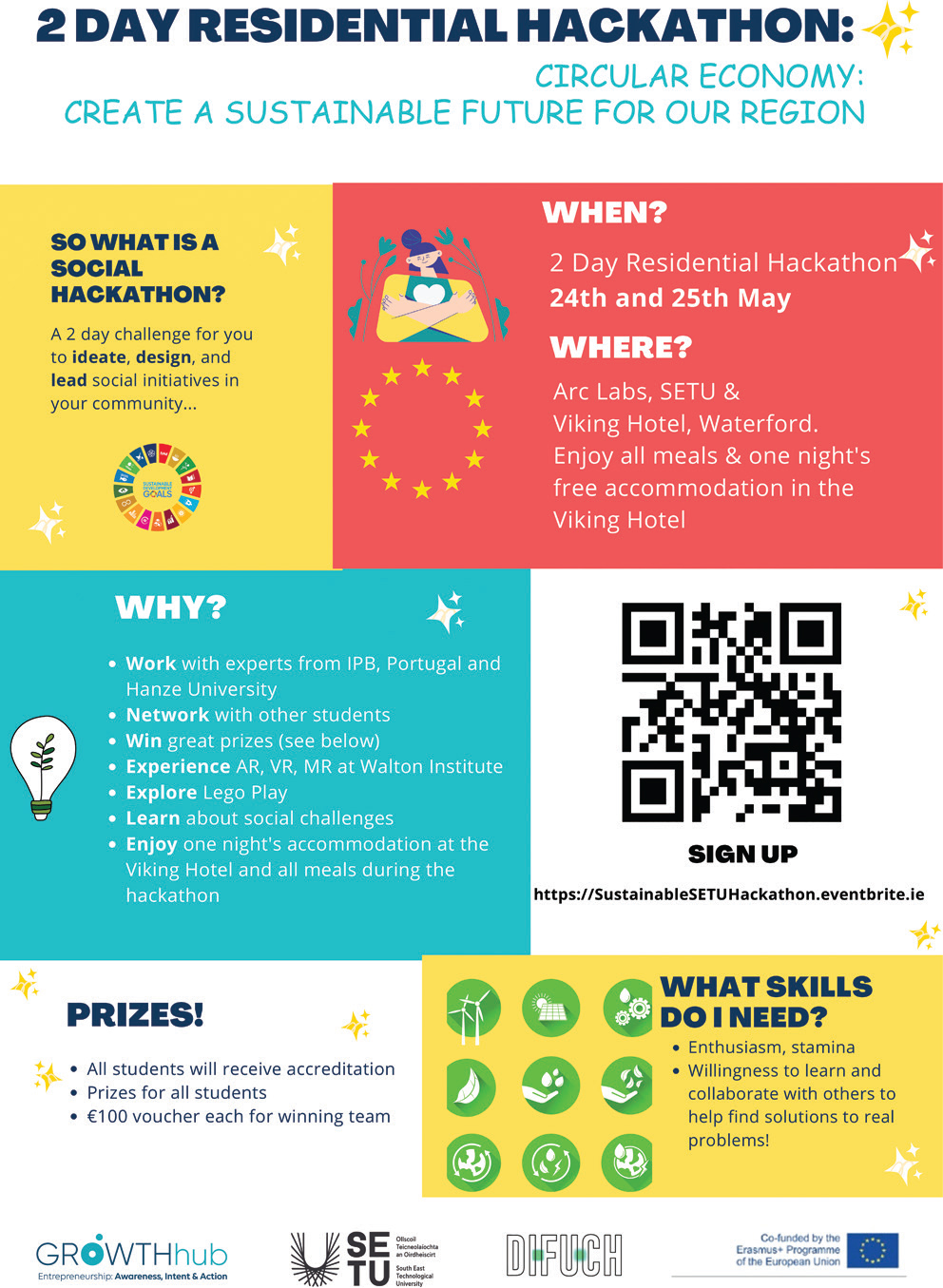
Figure 1:
Promotional Material.
The two-day hackathon (24th and 25th May 2023) was in keeping with the spirit of the hackathon model of time-bounded, consistent and concentrated effort. After the presentations, workshops and discussions on day-one, the two groups continued their work at their hotel for as long as they needed to develop their ideas and CE solutions to the problems posed. During the evening, participants were provided with pizzas and refreshments.
A critical element of the hackathon was the participation of a cross-disciplinary judging panel, this panel consisted of representatives from the three HEI project partners, Local Authority, Regional Government and local industry. On the first day, each member of the judging panel presented the CE challenge from their own perspective and its relevance to their own organisation and Ireland’s South East region. Also, each member of the judging panel engaged with students answering any questions. In keeping with recommendations from Halvari et al. (2019), the judging panel also returned at the end of the second day to select the best CE idea based on the participants’ presentations. All participants were presented with certificates of course completion and photographed with the SETU project lead. Each member of the winning team received a prize of €100 with all other students receiving a smaller individual prize.
The hackathon case study was based on participant observation to provide an in-depth examination of the hackathon event and its impact. Drawing from methodologies adopted by previous studies investigating hackathons through participant observation such as Faludi (2023) and Richterich (2019), the researchers actively participated in the hackathon, experiencing the entire development process of the event. This approach aligns with the Richterich (2019) methodology, which involves direct engagement in the event. As Faludi (2023) proposed, the researchers applied semi-structured field observations, note taking and, also, the day after the hackathon, conducted a focus group with representatives from the three HEI project consortium partners who had expertise in CBL and design thinking. Through this approach, the data analysis provided insights into how the hackathon fostered entrepreneurship, addressed societal, environmental and economic challenges and promoted sustainable solutions within the CE framework.
Ethical procedure
The research was part of the ERASMUS+ project DIFUCH, which adhered to the ERASMUS+ procedures on ethical oversight and approval. Ethical approval for the project was obtained through the coordinating institution and lead partner, IPB, Portugal, who managed the ethical review process and ensured compliance with EU ethical standards and guidelines for research. Best practice processes and procedures were followed for obtaining informed consent. Participants were provided with detailed information about the study’s purpose, procedures, potential risks and benefits, and measures for ensuring confidentiality. Participation was voluntary, and participants had the right to withdraw at any time without any consequences. All data were anonymised, securely stored and password protected to maintain confidentiality and protect participants’ privacy.
Students’ CE proposals
Following presentations by the consortium partners and external stakeholders on the CE challenges from their perspectives, students worked together in their respective teams (2) to identify CE challenges relevant to the Ireland’s South East region. Before going to their hotel, both teams had identified a challenge and independently decided to focus on fast fashion, as both teams saw this as a significant problem due to the proliferation of cheap online fashion retailers. Team A proposed a solution based on sharing and swapping clothes locally, supported by a social enterprise model with students as the customer base. This ‘wardrobe share & swop’ idea would be facilitated by an on-line app with a small monthly subscription fee. Team B focused on prolonging the life of garments by engaging with local tailors and designers to revitalise customers’ pre-loved but damaged or out-of-fashion items. They envisaged students as their primary customers, but because of living costs generally, they projected growth in other demographic segments. This initiative also aimed to provide employment opportunities for young designers and additional work and revenue for local tailors. Similar to Team A, Team B’s ‘upcycled chic’ idea would also be implemented through an on-line subscription-based app.
DATA COLLECTION
Focus group with project partners
The day after the hackathon, a 30-minute focus group was conducted during a project partners’ meeting to debrief and discuss the event and validate and expand the research notes. The focus group consisted of representatives from the three partner HEIs who had extensive expertise in CBL and design thinking, thus ensuring a comprehensive evaluation of the event. Specifically, the focus group comprised of ten participants: four from SETU, three from IPB and three from Hanze. According to Hennink and Kaiser (2022), a focus group of this size is considered acceptable for obtaining diverse insights. The observation notes served as the basis for initiating discussions during the focus group to facilitate a comprehensive validation process. Table 3 presents the topics discussed.
Table 3:
Focus group discussion topics
| Student engagement | Extent to which students were engaged with the hackathon and tackled the CE challenge. |
| Collaboration | Extent to which participants networked and collaborated. |
| Logistics | Related to issues pertaining to the venues (university and hotel), facilities, technical support and optional Virtual Reality (VR), Augmented Reality (AR), and Mixed Reality (MR) event. |
| Learning outcomes | Issues relating to students’ experience and extent to which the hackathon model contributed to improving students’ skills/knowledge, competency development. |
| Feedback | Hackathon feedback mechanisms (surveys, interview processes). |
| Project objectives | Direct impact of the hackathon as an LTTA mechanism and broader project implications. |
| Learnings | Experiences and learnings including challenges and long-term benefits. |
This research also incorporated complementary data gathering using a mixed methods approach with hackathon participants. This included two surveys (administered to all 11 participants) and short structured interviews with two participants. These findings are presented in the next section.
Survey one
At the end of the final day of the hackathon, the 11 students were invited to complete an anonymous paper-based satisfaction survey. This was a specific requirement by ERASMUS+ to establish satisfaction with LTTA exercises. The survey was adapted from previous surveys for ERASMUS+ projects. The instrument was designed to capture satisfaction with the hackathon implementation, structure and design. The survey purpose was explained to participants and took less than five minutes to complete – it was completed by all participants. Ethical considerations pertaining to consent, privacy, and confidentiality were addressed by informing participants that the survey was voluntary, and responses would be anonymised. No private, confidential, or identifiable information was gathered in the data collection process. The survey followed a self-completion and anonymous design, it employed a nine item, five-point design (1 = strongly negative; 5 = strongly positive). There were three categories of interest: (i) participation interest and satisfaction with the hackathon; (ii) hackathon effectiveness and engagement; (iii) programme components, recommendations. Three open-ended questions were also included. See Table 4 for survey one questions.
Table 4:
Survey one questions
|
Survey two
Once the hackathon was concluded, a separate survey using Qualtrics, a cloud-based platform for creating, distributing, and analysing surveys was conducted. The survey was e-mailed to participants after the summer vacation and during the following semester (post September 2023). The survey took approximately eight minutes to complete and was completed by all students. This survey was anonymous, voluntary and no private or identifying data was gathered. See Table 5 for survey two questions. The survey questions were designed to inform our research problem: ‘Evaluating hackathons as CBL tools for enhancing entrepreneurship competences in multidisciplinary university students addressing circular economy issues in South East Ireland’. Informed by the literature review, the questions examined whether the hackathon workshops and activities helped build students’ entrepreneurial knowledge and competences which are expressed in literature as vital for nurturing entrepreneurship. The other important areas included the students’ experience of working in interdisciplinary teams and the change in their level of knowledge of the CE.
Table 5:
Survey two questions
|
Short structured interviews
Short structured interviews of approximately 10 minutes each were conducted with two, randomly selected participants three months after the hackathon. During the interviews, the participants were asked to reflect specifically on the residential aspect of the hackathon, given that the scarcity of residential hackathons, particularly in education, makes this a novel but expensive endeavour. Participant confidentiality was maintained, with no identification of the participants. The participants were asked for their views as follows:
(i) Reflecting on your time in the hotel, how did the experience enhance or influence your entrepreneurship skills as a participant in the hackathon?
(ii) In what ways did the collaborative environment at the hotel contribute to the development of your CE idea during the hackathon.
DATA ANALYSIS
Focus group and interview data
The short structured interviews and focus group data were analysed using thematic analysis. This approach allowed for the identification of specific themes and areas of interest by systematically examining patterns within the data. Through categorising the responses, key insights were extracted to understand the participants’ experiences, perspectives, and their views on the overall impact of the hackathon. This method ensured a comprehensive and detailed understanding of the qualitative data, and helped to highlight important aspects including collaboration, ideation, and problem-solving as experienced during the hackathon.
Survey data
The data was analysed using Microsoft Excel. In survey one, the categories of analysis for the Likert type scales covered participant interest and satisfaction; hackathon effectiveness and engagement; programme components and recommendations. In surveys with small samples, traditional methods for assessing reliability and validity may have limitations. However, our survey instrument’s quality was supported through employing several validity measures. Content validity was established by reviewing the survey questions in advance with experts in the project partner universities to ensure that the survey adequately addressed the research objectives. Face validity was established by ensuring that the survey fulfilled its purpose, content validity was addressed through ensuring that the instrument was in line with its objectives. The option for test-retest reliability was not possible as the event occurred on just one occasion. Moreover, given the very small sample size of the survey, the use of statistical techniques to derive meaningful insights from the data was limited.
In survey two, the ten questions covered two categories, namely ‘Effectiveness of hackathons in Entrepreneurship Education’ (questions 1 to 4) and ‘Effectiveness of hackathons as tools to tackle societal challenges’ (questions 5 to 10). The three open-ended questions in survey one and the four open-ended questions in survey two were analysed using content thematic analysis (Kiger and Varpio, 2020).
FINDINGS
Project partners’ focus group
The project partners’ focus group evaluated the CBL methodology and the hackathon’s design, implementation and project alignment. Each partner expressed satisfaction with the hackathon design, particularly emphasising the ability of participants to work beyond the structured activities. This collaborative work happened both in the workshops and in the hotel where the two teams continued working together. Central to this satisfaction was the achievement of the project goals, however, beyond this, partners discussed how the hackathon improved learnings and supported interdisciplinary cooperation and collaboration. Partners expressed satisfaction that the hackathon methodology allowed in-depth and comprehensive testing of the CBL framework and design thinking tools central to the project. A key benefit expressed by the partners was the personal development aspect for all participants (students and project partners) and the opportunity for networking and future collaboration opportunities. None of the three participating universities had previously designed, implemented, managed or experienced a residential hackathon.
Survey one
The high average scores (marked out of a score of 5) emerging from the data across all questions reflect the overall success of the hackathon design and its effectiveness in EE. Of particular significance were the strongly positive responses to engagement, programme effectiveness, collaboration as well as the understanding of entrepreneurial principles. These findings highlight a positive impact on the participants and their ability to collaborate, problem-solve and network. The high satisfaction levels indicate that the hackathon design and structure informed by Halvari et al. (2019) was successful. However, it was also noted that the lower rating for the information provided to students prior to the hackathon suggests that improvements are needed for future communication strategies. Participants expressed a high level of interest in future hackathons, with an average score of 4.2, indicating a strong positive inclination to participate again. For clarity of the programme, the average score was 4.36, indicating that the students found the hackathon information clear. Similarly, the hackathon structure received positive feedback, with a score of 4.27, indicating a high level of satisfaction with organisation and design. On the question of how engaging and effective the hackathon was, the score of 4.55 indicates a high level of satisfaction. Overall effectiveness of the hackathon programme was 4.55, this is indicative of a positive impact on the students’ learning and experience. The highest score recorded of 4.91 was for the question examining interaction and collaboration, this is indicative of strong teamwork and communication among the participants. Application of the tools and workshops in real-world situations scored highly at 4.36. In answer to the question ‘would you recommend this event’, the score was 4.45, which suggests that the students had a positive experience. The lowest score of 3.91 was recorded for the information provided to students prior to the hackathon. Questions 10-12 were open-ended questions. Question 10 explored what participants liked most about the hackathon. Three themes emerged: (i) learning opportunities; (ii) collaboration; (iii) networking. In relation to learning opportunities, the participants mentioned the valuable learning experiences they gained including learning new skills, such as ideation, prototyping, innovation, collaboration and problem-solving, improving their knowledge and understanding more about societal challenges as a result. Participants also noted the benefits of collaboration and networking with their peers, mentors and stakeholders. One student stated: ‘I really liked to collaborate and see how people can come up with an infinite amount of ideas from different perspectives’. Another found the mixture of workshops and hand-on work beneficial: ‘fast paced work, quick theory delivery – practical work, lots of learning’.
In question 11, participants were asked for suggestions to improve future events. Themes that emerged included improvements to communication prior to the event; another theme centred on networking – some participants recommended follow-up sessions and events to maintain and develop the connections they made at the hackathon. Finally, some participants suggested that the workshops should cater for different skill levels. As one student suggested, ‘there should be more time to bond’ and another student advised ‘provide more information in advance to help assimilate the information.’
The final open-ended question sought suggestions and/or additional comments. The main theme was one of satisfaction with participants expressing largely positive comments, such as: ‘it was an insightful and exciting programme. I learned a lot on working as a team and presenting my ideas in a clear and concise manner’; and ‘great event, well organised’.
Survey two
The findings show that all participants agreed that the hackathon improved their understanding of entrepreneurship principles (all the respondents marked ‘yes’). In answer to question 2, themes included the panel presentations, the design thinking workshops, research conducted (by the participants) during the hackathon into the CE and business ideas. Collaboration and multidisciplinary engagement emerged as relevant, with all respondents answering ‘yes’ to whether the opportunity to collaborate with students from different disciplines and educators positively impacted their understanding of entrepreneurship. In answer to question 4 on real-world application of the workshops, themes included problem-solving, critical thinking, empathy and opportunity identification. In evaluating the question interrogating the effectiveness of hackathons as tools to tackle societal challenges, responses varied with 40% of students agreeing that the ideas generated during the hackathon could help address societal challenges in Ireland’s South East region, another 40% answering ‘Probably yes’, and the remaining 20% stating ‘definitely Yes’. Moreover, 80% of respondents considered that the hackathon enhanced their awareness of societal challenges facing Ireland’s South East region, whilst 20% answered ‘Maybe’. Responses to question 8 underscored that the hackathon helped participants’ understanding of regional challenges, the strongest theme identified in question 9 was the panel presentations on CE challenges. The students also mentioned the research they conducted into their business ideas and how this helped build knowledge. Responses to the final question showed that the students believed that hackathons are an appropriate tool to highlight and help tackle societal challenges, with all students answering ‘yes. In summary, it was clear that the workshops and collaborative multidisciplinary nature of the hackathon teams played a significant role in developing innovative solutions for the CE challenge. However, one respondent observed that the majority of participants were students in the School of Business programmes and that this may have influenced the groups’ experience and process.
Short structured interviews
The residential hackathon model is unusual in an education context; accordingly, it was important to establish whether staying on-site and working together was considered useful by the participants. In answer to the first question which asked the participants whether the time in the hotel enhanced their entrepreneurship skills, both participants agreed that it did. Participant 2 discussed how, after the intense first day, the time they spent together working in the hotel allowed them to “unpack things mentally”, this was echoed by participant 1 who outlined how “our minds were jumbled, but we could remember and bring back into play ideas from earlier in the day”. In answer to the second question which explored whether the collaborative environment at the hotel contributed to the development of their CE idea, this was also very positive. Participant 1 mentioned how the conference room in the hotel allowed them “space away from the other team” to discuss their idea privately. Participant 2 outlined how the time in the hotel facilitated them to think through their ideas and discuss them more fully, as “we didn’t have enough time, with the workshops and one thing after the next”.
In summary, the findings from survey one underscored the hackathon’s success in enhancing participant, collaboration and understanding of entrepreneurial principles. This study also highlighted opportunities for improvement, particularly in enhancing pre-event communication to better prepare participants and also emphasised the importance of future opportunities to network and collaborate. Survey two further highlighted participants’ enhanced understanding of entrepreneurship principles and the positive impact of multidisciplinary collaboration while also indicating largely positive perceptions on the hackathon’s effectiveness in addressing societal challenges. The short structured interviews revealed that the residential format of the hackathon, including the collaborative environment at the hotel, significantly contributed to participants’ entrepreneurial skills and the development of innovative ideas, particularly in the context of the CE. Project partners echoed these sentiments in their focus group, emphasising the hackathon’s alignment with the overall project goals and its success in fostering interdisciplinary cooperation and personal development among participants.
Overall, the evaluation across the focus group, surveys and interviews demonstrated the hackathon’s multifaceted benefits and its capacity to serve as an appropriate tool for EE, addressing real-world problems and sustainable innovation. Future hackathons can draw on these insights to improve shortcomings including communication strategies and expand follow-up interdisciplinary engagement and ongoing networking into the hackathon framework. Such modifications will improve the effectiveness of hackathons as tools for entrepreneurial development and problem-solving.
The case study approach employed in this research provided insights into how the hackathon approach successfully fostered entrepreneurship, collaboration and teamwork while helping the students understand and address a regional CE challenge.
DISCUSSION
The research findings strongly support previous research identifying that hackathons play a significant role in EE. For example, Cobham et al. (2017) identified that EE provides students with innovation, networking, product design and development skills. These authors also noted that participating in hackathons may result in the creation of student enterprises. In addition, Szymanska et al. (2020), found that hackathons can guide participants in identifying a viable entrepreneurial concept and help develop the ability to successfully launch a new venture by enhancing entrepreneurial skills and self-confidence, even among students with limited entrepreneurship knowledge and interest. While the current study, through its multiple data sources, did not conclusively determine whether the hackathon would lead to successful business enterprises, as demonstrated by Cobham et al. (2017) and Szymanska et al. (2020), it did align with previous research by supporting the perspective that hackathons lead to the development of entrepreneurial skills. This was evident through the research findings and the solutions the participants developed to address their chosen CE challenge. In addition, as observed by the facilitators, the students displayed skills in innovation, creativity, analysis, critical thinking, problem-solving as well as significant team working and collaboration skills; competences identified as important in the EntreComp framework. The facilitators, who were experienced in applying frameworks like EntreComp, observed participant engagement and skill application during workshops and group activities. The post-event facilitator focus group which captured facilitator observations combined with student feedback provides additional evidence for student skill and competency development. Although it must be noted that these findings are drawn from a very small base. Through its experiential and action-based context, the hackathon approach enabled the development of important transversal skills including innovation and agile problem-solving and supported the development of important competences identified in the EntreComp framework such as sustainable thinking, planning and management, spotting opportunities and creativity. In addition, the hackathon supported the CBL process of (i) engage; (ii) investigate; (iii) act through the student engagement with the programme and knowledge development, research and idea development and design. The participants’ solutions were initially developed within the first day and these were centred on a genuine CE problem, supported by research. Moreover, the time-bound nature of the hackathon presented an ever present ‘ticking clock’ thereby heightening pressure, compelling the participants to develop solutions within a specific timeframe with the solutions then presented to the expert panel on the second day.
Another important aspect of the hackathon was noted during the focus group with project partners: participants were able to collaborate after the structured activities, during their time spent at the hotel between day 1 and day 2. This collaboration significantly enhanced the entrepreneurial skills gained and quality of the students’ ideas. This finding is particularly relevant in the analysis of the hackathon, as previous studies attempting to understand the impact on EE, such as Szymanska et al. (2020), Cobham et al. (2017), and Halvari et al. (2019), did not specify whether participants spent uninterrupted time together between activities and whether this would have made an impact in their work. In the present study, it was discovered that encouraging uninterrupted time together should be promoted to improve collaboration and overall results. An essential learning for future events, is the importance of capturing the experience and perceptions of the external stakeholders. They played an important role in outlining the importance of the CE and evaluated the student ideas, however, failing to capture their feedback was a shortcoming.
Previous research indicates that the transformative potential of hackathons is significant, as highlighted by Krakhmalova (2021) who emphasised their role in enhancing participants’ innovative potential and fostering personal growth. By engaging in hackathons, students develop critical problem-solving skills, creativity and resilience, all of which contribute to their overall development and ability to face challenges. The literature highlights this transformative potential of hackathons in EE, emphasising their role in providing hands-on experiences, enhancing entrepreneurial skills, and fostering innovation (for example Cobham et al. (2017) and Krakhmalova (2021)). The integration of CBL with hackathons is noted for creating all-encompassing learning environments that motivate students toward success in entrepreneurship (Toros et al., 2022). Previous literature also suggests that hackathons cultivate collaboration, interdisciplinary skills, and a real-world problem-solving mindset, thereby aligning with the complex nature of entrepreneurship (Halvari et al., 2019). The findings from our research, albeit limited by sample size, support and contribute to existing literature on the topic. Our findings validate prior literature’s assertions on effectiveness and engagement as articulated by Halvari et al. (2019). Participants’ increased comprehension of entrepreneurial principles and the unanimous agreement on the hackathon’s positive influence on collaboration align with the literature’s emphasis on the effectiveness of hackathons in enhancing entrepreneurial skills and teamworking (Cobham et al., 2017). Hackathons are fast paced by design; however, our findings show that the residential overnight model (while incurring more costs) allows the participants time (in a less pressurised environment) to explore their ideas more fully and refine them, leading to more developed ideas and solutions. However, an important limitation in our hackathon design is participant numbers, this was heavily influenced by the timing of the hackathon. In addition to this, the study also identifies other areas for improvement, particularly in the communication of information before the hackathon. The inconclusive findings regarding the hackathon’s success in tackling societal challenges after completion of the event (and whether the participants chose to pursue the ideas developed during the hackathon) indicate the need for further exploration and planning to address this point.
The literature’s emphasis on hackathons’ effectiveness being due to their intense, time-limited activities is somewhat challenged by aspects uncovered in this study, specifically the benefits of unstructured, private group work away from the ‘formal’ hackathon environment. The identification of collaboration opportunities between participants during unstructured time, contributing to improved entrepreneurial skills adds a dimension not explicitly addressed in prior studies (Cobham et al., 2017; Halvari et al., 2019; Szymanska et al., 2020). This finding suggests that the impact of hackathons may extend beyond the structured event itself, providing insights for future research and programme design.
While case study research can be said to lack broad generalisability, the case study approach employed in this research facilitated an in-depth exploration of a hackathon event within a real-life context. This approach provides insights into participant experiences and EE and research outcomes leading to deeper understanding of the operation of a hackathon-CBL framework. In conclusion, the study effectively achieved its objectives by investigating the impact of the hackathon approach within a CBL framework on EE. The integration of CBL with hackathons emerged as a relevant and effective strategy. It was shown to support collaboration, interdisciplinary skill development and readiness for entrepreneurial challenges. The findings, reflected in the surveys high scores across various dimensions, (i.e., participants’ interest in future hackathons, and favourable feedback) support the study’s success in assessing the hackathon-CBL framework. Unanimous acknowledgment of enhanced understanding of entrepreneurship principles combined with the positive answers regarding collaboration and multidisciplinary work further validate the effectiveness of the approach. The perspectives captured in responses regarding the effectiveness of hackathons in addressing societal challenges contribute to a broader understanding of the hackathon-CBL integration. Positive feedback from the project partners in the focus group underscores the study’s achievement in meeting its objectives, highlighting improved learnings, interdisciplinary collaboration and personal development.
CONTRIBUTION
The study of this hackathon event presents numerous contributions. Firstly, the residential or overnight format of the hackathon facilitated interdisciplinary cooperation and relationship-building in EE thereby fostering robust solution development. Implemented using CBL methodology, the hackathon successfully met project requirements through its structured approach and alignment with the CE challenge, demonstrating its efficacy as a CBL tool. This approach directly supported project outcomes by addressing challenges associated with the CE. Specifically, within the CBL context, the methodology integrated with design thinking proved instrumental in providing participants with a collaborative environment to work with individuals from diverse disciplines. Moreover, the hackathon method offered additional benefits as demonstrated by the research. Our research found that collaboration opportunities during unstructured or free time contributed to participants improved entrepreneurial skills development, this is not explicitly addressed in other studies. This suggests that the impact of hackathons may extend beyond the event.
Participants and facilitators highlighted the hackathon experience as relevant for personal and professional development. However, it is important to note that organising a residential hackathon or overnight hackathon variant involves substantial planning and financial investment. Despite these challenges, the benefits, including enhanced learning and skill development, generation of innovative solutions, establishment of strong interpersonal connections and potential for future collaborations, justified the investment in the model employed. From a case study perspective, this research provided a foundational exploration into the successfulness of the hackathon approach in a specific context. Future studies can build on these findings to examine the transferability of outcomes to diverse settings and conditions, thereby enriching the understanding of hackathons as a pedagogical tool in EE.
In conclusion the findings from this research make a significant contribution to existing research on hackathons, CBL, and action research; the findings also contribute to practice by identifying techniques and practices to improve the effectiveness of hackathons.