
Table 1.
Methods used in the hybrid model
| asynchronous | synchronous |
|---|---|
| Blogs | Live webinars |
| Pre-recorded webinars | Video conferencing |
| Online forums and discussion boards | Virtual classrooms |
| Instant messaging | |
| MOOCs (massive online courses with open access for the community, including people with disabilities) | SMOC (synchronous mass online courses with Internet access, using features that make students present digitally) |
| SPOC (small private online courses, for a limited number of participants) | SSOC synchronous online courses for a limited number of participants and assuming that students are present digitally |
Table 2.
Digital transformation in the context of HEIs
| Authors | Digital transformation in the context of HEIs |
|---|---|
| NV, 2017, p. 6 | Digital transformation as a method of improvement of ‘how’ universities do their existing work. |
| Rodrigues, 2017 | (HEIs) have been exploiting emerging technologies as a way to improve performance and adapt to their increasingly technology-driven society. |
| Bygstad et al., 2022 | (…) a key aspect of digital transformation of higher education – the emergence of a digital learning space. |
| Benavides et al., 2020 | The distinctive characteristics of the digital transformation (DT) implementation process that have taken place in HEIs. |
| Antonopoulou et al., 2023 | The underpinning mechanisms that a Higher Education Institution engages upon to manage digital transformation amidst extreme uncertainty. |
| Fernandez et al., 2023; Pietersen, 2023; Yavuz et al., 2023 | The process of digital transformation is primarily concerned with the introduction of digital tools such as learning platforms, clouds or artificial intelligence. |
| Wang et al., 2023 | Key factors influencing the implementation of digital transformation in higher education institutions – (...) developing, updating, and adapting a curriculum integration of digital technologies for universal education, cloud. |
| Espinosa-Vélez et al., 2022; Carvalho et al., 2023; Linh et al., 2023; Buck & Willat, 2024 | Digital transformation and its tools influence the development of competencies, social relations and experiences of the academic community. |
| Trevisan et al., 2024 | By linking digital transformation and sustainability activities it is believed that HEIs can collaborate to face global challenges. |
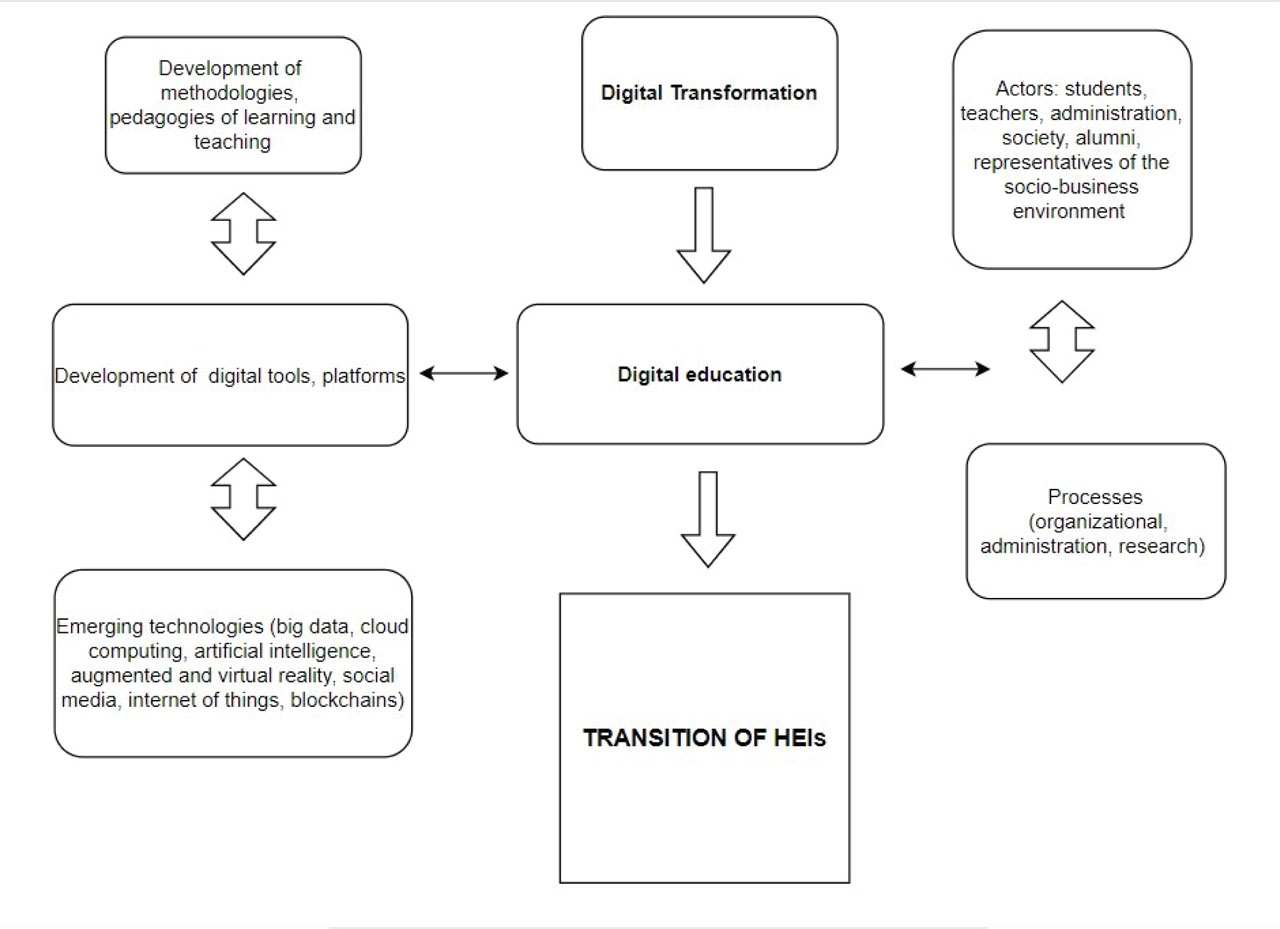
Figure 1.
The relationship between digital education, digital transformation and the transition of HEIs
Source: Authors' own work.
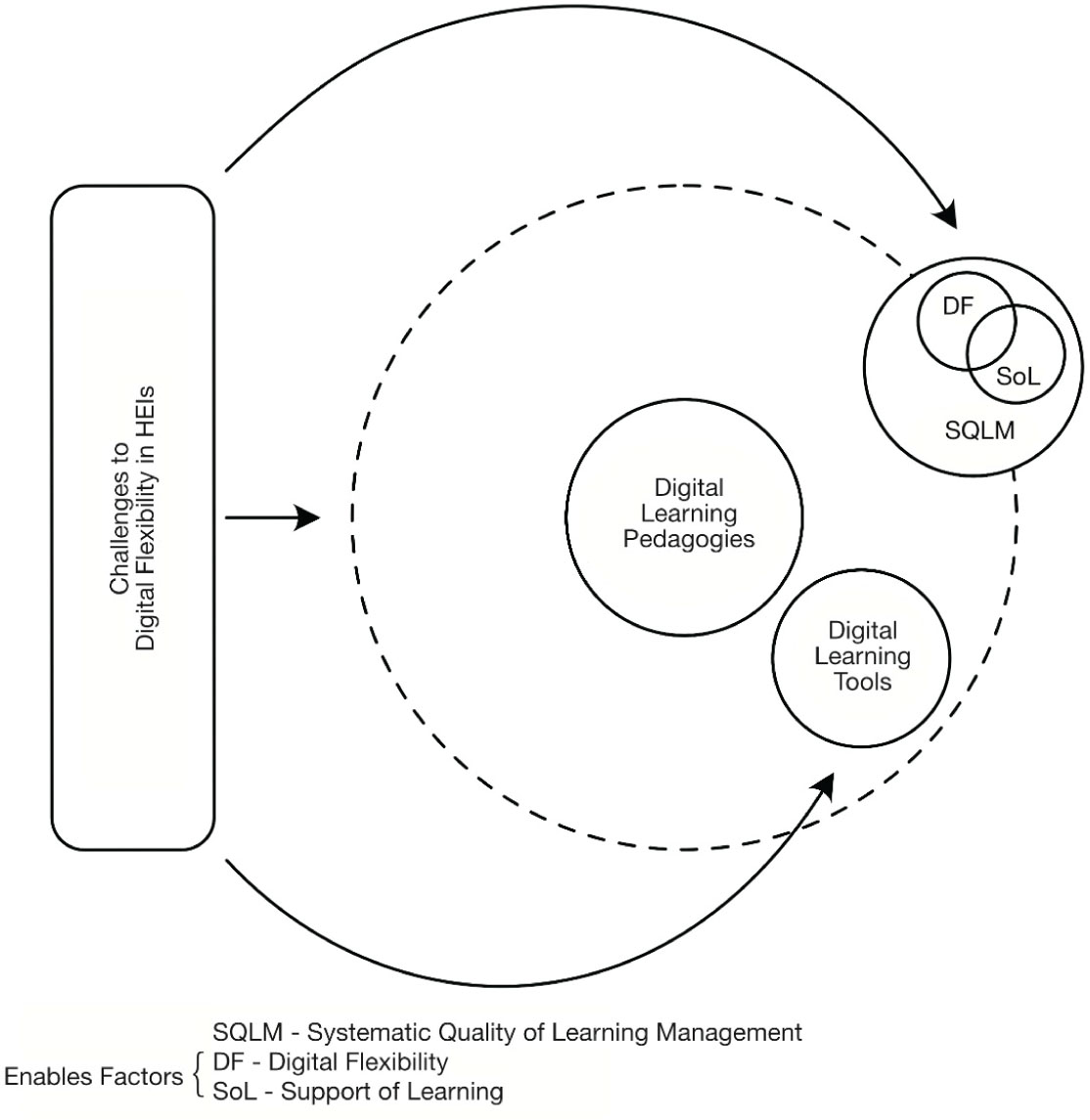
Figure 2.
A visualisation of the theoretical model of Digital Pedagogies and Quality Management in practically-oriented in HEIs
Source: Authors' own work.