
INTRODUCTION
Contradictory business environments, transformation, and growing demands have made employee innovative performance (EIP) crucial for organizational goals (Zhao et al., 2023). Rapid advances in the information and communication technology (ICT) sector highlight the need to understand how technology-driven enterprises address dynamic challenges and contradictions (Gohar et al., 2023). These issues have prompted scholars to examine organizational paradoxes, especially how employees handle competing demands. This research contributes to the discussion of paradoxical situations in ICT-driven workplaces by examining how paradoxical leadership (PXL) enables employees to balance autonomy with conflicting organizational expectations (Batool, Raziq, & Sarwar, 2023).
In this sector, employees must display innovative and discretionary behavior that causes contradictions and paradoxes. Previous studies find that an ICT company's environment can generate paradoxical, contradictory, and conflicting situations among individuals (Khan & Ullah, 2025; Madaan et al., 2024). These contradictions result from rapid technological advancement, a diverse workforce, interdependence, and overlapping tasks. Some researchers in the ICT sector have investigated how clients and customers are increasingly demanding and self-centered (Khan & Ullah, 2025; Madaan et al., 2024). This situation requires employees to deal with paradoxical, contradictory, and even opposing expectations (Zhang et al., 2024). As a result, when paradoxical or contradictory demands are voluntary, it becomes harder for employees to engage in behavior beyond their formal responsibilities (see also Megheirkouni, Abdullah, & Avdukic, 2025). Given this contradictory situation, which leadership style motivates employees to engage in discretionary effort? One possible solution could be the PXL style.
Several studies have investigated how various leadership styles (e.g., integrative, inclusive, and ethical) motivate the development of EIP in the ICT sector (Sharma & Sharma, 2024; Zhang et al., 2021; Zhao et al., 2023). However, these studies did not highlight the paradoxical nature of EIP. PXL is a leadership style that addresses the new, seemingly paradoxical, and contradictory challenges managers face in a highly volatile business environment (Zhang et al., 2024). Given the dynamic nature of the sector, further research is needed to understand better how PXL drives innovation among employees and enhances their psychological safety (Sharma & Sharma, 2024).
This study responds to calls by Devi (2024), Kundi et al. (2023), and Madaan et al. (2024) for more research on the impact of PXL on innovation, drawing on job demands-resources theory as its theoretical underpinning. The JD-R model suggested that employee outcomes in the form of innovation (EIP) are influenced by the balance between job demands (e.g., complexity, work requirements, physical, and psychological hazard) and job resources (e.g., job autonomy (JA), work relationship, opportunities, learning, support, coaching, and motivation) (Devi, 2024; Kundi et al., 2023). In our conceptual framework, PXL, job crafting (JC), and JA are resources and enablers of motivation and positive outcomes in EIP. The JA refers to an employee's flexibility and discretion in decision-making and managing their work responsibilities (Breaugh, 1999). It allows individuals to choose when, where, and how they perform their job responsibilities (Mihalca et al., 2024). JA serves as a moderator, amplifying PXL's positive influence on JC and EIP by empowering employees to exercise greater control over their tasks and decision-making. Moreover, JC can be shaped by the organizational factor (i.e., leadership) (Kamil et al., 2024). Therefore, we propose that JC functions as a transformation pathway linking PXL and EIP. The present study raises the following research question: Does PXL enhance the EIP in the ICT sector? Can JC perform a transformation pathway (mediation) between PXL and EIP? How does JA perform a multiplayer role between PXL and JC and between JC and EIP? This research addresses these three questions and makes three theoretical and managerial contributions to the present literature. Moreover, the study called for further research on PXL in EIP within uncertain and dynamic business environments, particularly in the ICT sector.
First, this study contributes to the PXL literature by proposing a multilevel framework to investigate how PXL influences EIP, grounded in the JD-R model. PXL has been examined as an independent variable across various organizational contexts. For instance, Geng et al. (2023) associated it with employee creativity through a balance of autonomy and control, while Hossain et al. (2024) indicated that it promotes organizational ambidexterity. Furthermore, Kundi et al. (2023) found that it contributed to enhanced employee engagement, and Xue et al. (2020) found that it improved employee voice behavior. Despite PXL's predictive role in reconciling conflicting job demands (EIP), its impact on EIP in the ICT sector remains underexplored (Zhang et al., 2021). It is especially noticeable in innovation-oriented organizations (e.g., IT firms), which face complex and contradictory challenges. PXL addresses the tensions inherent in the industry as a multifaceted, multilevel construct. Second, we propose a multilevel model that estimates an indirect effect of PXL on EIP via JC. We address an unresolved gap in PXL research by examining the mechanisms linking PXL to EIP, with JC as a mediator. Research using multilevel methods reduces the risk of social desirability and common-method bias in time-lagged designs, yielding robust, reliable results (Morris et al., 2011). Thirdly, our study examines the moderating role of JA in PXL-JC relationships and between JC-EIP relationships. JA amplifies PXL's positive effects on JC and enhances JC's transformative impact on EIP. Further, there is little literature on PXL and EIP among ICT workers (Madaan et al., 2024).
THEORETICAL FRAMEWORK
JD-R model
In this study, we use the JD-R model to clarify the conceptual framework and examine how PXL may influence EIP via JC. Additionally, we examine how JA enhances this relationship within job demand-resource paradigms (Rudolph et al., 2017). The JD-R model suggests that JC plays a central role in a feedback loop linking performance to improvements in both job-related and personal resources (Rudolph et al., 2017). Consistent with the JD-R model, leaders are crucial in shaping employees' abilities, represented by JA as job resources, and in converting them into EIP as job demands (Tan et al., 2024). Employees often face conflicting job demands, such as balancing autonomy and control, as well as innovation and standardization. In the JD-R framework, PXL functions as a resource-generation mechanism; it offers emotional and cognitive resources, allowing employees to reframe paradoxes in a more creative, learning-focused manner rather than as pressures. PXL serves as a leadership strategy that turns organizational conflicts into drivers of innovation and adaptation, promoting employee efficiency rather than merely maximizing resources (Chen et al., 2023; Yu et al., 2025). Within this framework, PXL provides autonomy and empowerment as job resources that significantly influence employees' job roles (JC) by aligning interests, strengths, and skill development (Kooij et al., 2017; Kundi et al., 2023), ultimately leading to enhanced EIP (Zhao et al., 2023). Moreover, JA serves as a moderator, magnifying the positive impact of JC on EIP by enabling employees to explore and implement innovative ideas (Clausen et al., 2022). Thus, the JD-R model offers a comprehensive understanding of how the interplay between PXL, JC, and JA can significantly influence EIP. In summary, the JD-R model explains how PXL improves EIP through JC and JA, while Paradox Theory clarifies why leaders adopt PXL: it helps manage conflicting needs, such as innovation and standardization. Additionally, JA serves as a dual moderator, encouraging creativity through experimentation and self-directed work changes, thereby strengthening the linkages between JC and PXL and between JC and EIP.
JD-R model
In this study, we use the JD-R model to clarify the conceptual framework and examine how PXL may influence EIP via JC. Additionally, we examine how JA enhances this relationship within job demand-resource paradigms (Rudolph et al., 2017). The JD-R model suggests that JC plays a central role in a feedback loop linking performance to improvements in both job-related and personal resources (Rudolph et al., 2017). Consistent with the JD-R model, leaders are crucial in shaping employees' abilities, represented by JA as job resources, and in converting them into EIP as job demands (Tan et al., 2024). Employees often face conflicting job demands, such as balancing autonomy and control, as well as innovation and standardization. In the JD-R framework, PXL functions as a resource-generation mechanism; it offers emotional and cognitive resources, allowing employees to reframe paradoxes in a more creative, learning-focused manner rather than as pressures. PXL serves as a leadership strategy that turns organizational conflicts into drivers of innovation and adaptation, promoting employee efficiency rather than merely maximizing resources (Chen et al., 2023; Yu et al., 2025). Within this framework, PXL provides autonomy and empowerment as job resources that significantly influence employees' job roles (JC) by aligning interests, strengths, and skill development (Kooij et al., 2017; Kundi et al., 2023), ultimately leading to enhanced EIP (Zhao et al., 2023). Moreover, JA serves as a moderator, magnifying the positive impact of JC on EIP by enabling employees to explore and implement innovative ideas (Clausen et al., 2022). Thus, the JD-R model offers a comprehensive understanding of how the interplay between PXL, JC, and JA can significantly influence EIP. In summary, the JD-R model explains how PXL improves EIP through JC and JA, while Paradox Theory clarifies why leaders adopt PXL: it helps manage conflicting needs, such as innovation and standardization. Additionally, JA serves as a dual moderator, encouraging creativity through experimentation and self-directed work changes, thereby strengthening the linkages between JC and PXL and between JC and EIP.
Paradoxical Leadership and Employee Innovative Performance
Leadership has been recognized as an essential factor that impacts EIP. Previous studies investigated the effectiveness of “top-down” leadership such as bureaucratic leadership (Ohemeng et al., 2020), transactional leadership (Rashwan & Ghaly, 2022), and directive leadership (Chen et al., 2017), which are styles that focus on using a leader's power and shaping follower behaviors. Other researchers focus on the “bottom-up” leadership approach like empowering leadership (Burhan & Khan, 2024) servant leadership (Raub et al., 2024), and humble leadership (El-Gazar et al., 2022). These approaches focus on placing employees at the center of leadership and decision-making, fostering enhanced innovation and performance. There are few studies that investigate the integration of seemingly contradictory leadership approaches, such as combining “top-down” and “bottom-up” approaches, to enhance the EIP (Zhang et al., 2024). The EIP concept can be defined as a deliberate approach to generating, promoting, and realizing valuable and genuine ideas within the work environment, team, or organization to improve individual, group, and organizational performance (Qian et al., 2024). Leadership is pivotal to fostering innovative behavior among employees (Devi, 2024). Conflicting but interrelated behaviors are increasingly acknowledged as critical enablers of EIP, including control versus empowerment, flexibility versus standardization, and self-centeredness versus other-centeredness.
PXL, which emphasizes balancing conflicting demands such as control versus empowerment and standardization versus flexibility, is increasingly recognized as a critical enabler of EIP (Zhang et al., 2021). Leaders who exhibit paradoxical traits can integrate contradictory expectations, thereby fostering an environment in which employees feel both challenged and supported. Recent literature, e.g., Khan et al. (2025), has documented that such leaders reconcile contradictions and tensions, such as stability versus change and global versus local needs, in contexts where ambiguity and competing demands are prevalent. In addition, studies indicate that a “top-down” leadership approach fosters a supportive environment, while a “bottom-up” approach can intrinsically motivate employees through autonomy (Tan et al., 2024); both are essential for EIP (Alghamdi, 2018). However, EIP is not only about task compliance but also about the ability to identify and resolve contradictory problems innovatively. It requires employees to generate and promote novel ideas while reshaping their work processes to accommodate evolving organizational needs. These formers require not only completing tasks with formal work requirements but also stepping beyond routine tasks to address challenges and introduce improvements creatively. By integrating “top-down” and “bottom-up” leadership approaches, we identified PXL as a potential predictor of EIP.
H1: Paradoxical Leadership positively influences Employee Innovative Performance.
Paradoxical Leadership and Job Crafting
JC is a proactive work behavior in which employees modify their job characteristics and work environment to align with their interests, skills, and priorities (Kim & Park, 2024; Kooij et al., 2017). It includes a “bottom-up,” proactive change to the entire job design. According to Kuijpers et al. (2020), JC encompasses three distinct dimensions: strength crafting, interest crafting, and development crafting. The benefit of aligning organizational tasks with individual strengths is that it maximizes performance and enhances confidence in the employee's role (Kooij et al., 2017). Interest crafting aligns tasks with personal interest, fostering intrinsic motivation and engagement, which makes enjoyable tasks to demonstrate innovation (Kooij et al., 2017). Development crafting seeks new opportunities, skills, and knowledge to make work more fulfilling (Kooij et al., 2017). These dimensions combine to make proactive behavior, which is essential for survival in a dynamic, contradictory, and competitive business environment (Bindl et al., 2019). It requires initial forethought and a reactive response to task modifications in job duties through clarifying role expectations while offering autonomy for task modification (Lidman et al., 2023; Zhang et al., 2021). PXL enhances adaptive and competitive behavior by providing both a supportive and a challenging environment to shape work roles that align with strengths, interests, and development aspirations (Akhtar & Riaz, 2024).
PXL demands high standards of employee performance and resources; at the same time, it provides employees with a comprehensive understanding and support, encourages flexibility, and balances contradictory demands when employees engage in JC activities (Akhtar & Riaz, 2024). The JD-R model documented that job demands, such as workload and complexity, and job resources, including autonomy and support, interact to affect employee adaptive performance (Tan et al., 2024). This theory claims that leaders play an essential role in job demand and resources (Bindl et al., 2019). PXL is developing a workplace that embraces paradoxical tensions in an uncertain environment and accepts contradictory and competing demands as integral to JC (Akhtar & Riaz, 2024). PXL enhances JC by acting as a resource that mitigates the strain of high job demands while simultaneously empowering employees to reallocate and optimize their resources (Kamil et al., 2024). For instance, when leaders emphasize both performance expectations and individual autonomy, employees are better equipped to proactively adjust their tasks, relationships, and work methods to manage demands effectively and boost their performance (Akhtar & Riaz, 2024; Kamil et al., 2024). Therefore, PXL will have a positive impact on JC's promotion.
H2: Paradoxical Leadership positively influences Job Crafting.
Job Crafting and Employee Innovative Performance
According to the JD-R model, job resources are provided through a “top-down” approach (e.g., supervisor feedback and support for employees). However, employees can also modify or create resources through a “bottom-up” approach and seek input and support from a supervisor (Afsar et al., 2019). The availability of associated job resources can enhance employees' work engagement and motivation, which fosters innovation and creativity through current job resources (Yasin Ghadi, 2024). Therefore, JC plays a vital role in enhancing EIP by enabling individuals to proactively shape their work tasks, relationships, and environments for their safety (Yang et al., 2025).
When employees align their roles with their strengths, interests, and development, they are intrinsically motivated and engaged in innovative activities (Kim, Im, & Qu, 2018). Indeed, employees are interested in investing their time and resources to gain new skills and build further resources (Kooij et al., 2017). According to this paradigm, we suggested that motivated and engaged employees will have abundant resources for their working tasks (Afsar et al., 2019). This access to resources creates enthusiasm in their work role and behavior, which benefits them and the organization (Yasin Ghadi, 2024). Therefore, these resources encourage employees to explore new approaches, identify opportunities for improvement, and implement fresh ideas that contribute to EIP.
According to Kooij et al. (2017), JC is a process in which employees act as agents, using their job resources to meet demands (EIP) and align their interests, strengths, and skill development with their job roles. By the underpinning of the JD-R model theory, JC helps employees to optimize job resources such as autonomy, social and supervisor support, and feedback while effectively managing job demands like workload, contradictory issues, and role ambiguity (Tan et al., 2024). This balance reduces strain, enhances motivation and engagement, and creates an environment conducive to EIP (Yang et al., 2025). When individuals craft or modify their jobs, they alter their relationships and tasks, resulting in reduced hindrance demands and the development of new job resources (Kooij et al., 2017). It can make essential changes in their demands and resources to better align with their personal and professional needs, helping them seek out challenges, minimize role ambiguity, and increase their job resources (Kuijpers et al., 2020). Therefore, JC is an ideal and strategic tool for them in the context of creativity, innovation, and implementation of new ideas. Hence, in the spotlight of previous arguments, we propose a hypothesis:
H3: Job Crafting positively influences Employee Innovative Performance.
The mediating role of Job Crafting
JC involves proactive efforts to modify employees' relationships and tasks to better align with their interests, strengths, and skill development (Kooij et al., 2017). It involves employees changing aspects of their relationships with other employees and their perceptions of their job roles (Yasin Ghadi, 2024). When they think positively, they navigate contradictory actions in the context of task modification, which could help improve performance and make work more enjoyable (Kamil et al., 2024). EIP includes actions that are not typically rewarded intensively but are still beneficial to the organization (Qian et al., 2024). Unlike traditional “top-down” and “bottom-up” approaches to job design, JC entails proactive changes to align job design with primary job demands (Tan et al., 2024). As the underpinning theory of the JD-R model, job resources such as leadership support, empowerment, and opportunities for personal and professional development play a pivotal role in motivating employees to craft their jobs in favor of EIP (Alghamdi, 2018).
In the context of PXL, leaders' seemingly opposing yet interrelated demands are simultaneously (Zhang et al., 2024). In contrast to the contingent leadership style, which focuses on “either/or” paradigms, PXL leaders embrace a “both/and” mindset that provides control while allowing flexibility and encourages exploration while maintaining focus (Zhang et al., 2022). PXL's leadership approach equips employees with job resources essential to JC (Akhtar & Riaz, 2024). Employees engage in more innovative activities in the workplace when they feel autonomy and support from their leader (Devi, 2024). PXL exemplifies characteristics such as cultivating strong employee relationships and empowering employees to make decisions (Gohar et al., 2023). For instance, the clear structure and support provided by PXL help employees navigate the complexities of their roles, while autonomy and empowerment foster a sense of psychological safety (Kamil et al., 2024). Such workplaces offer opportunities to craft their jobs and to recognize the importance of initiating a particular behavior, thereby bridging the gap between leadership behaviors and innovative outcomes (Kim, Im, Qu, et al., 2018). Therefore, JC serves as a platform between PXL and EIP, mediating the translation of leadership resources into creative outcomes. Hence, based on the above discussion, we propose a hypothesis:
H4: Job Crafting mediates the relationship between Paradoxical Leadership and Employee Innovative Performance.
Integrative Role of Job Autonomy as a Dual Moderator
Job Autonomy (JA) is defined as the independent control over one's work role, including the freedom to make decisions and manage work requirements (Breaugh, 1999). It allows individuals to choose when, where, and how they perform their job responsibilities (Clausen et al., 2022). In our study, it plays a dual moderating role between PXL and JC, and between JC and EIP. According to the JD-R model, PXL plays a key role in shaping the environment and job characteristics, which are divided into job demands and job resources that are conducive to JC (Akhtar & Riaz, 2024). However, the success of leaders in fostering creativity and innovation largely depends on the JA afforded to employees (Cho et al., 2021). It is a crucial aspect of an employee's role that not only shapes their career choices but is also essential to converting their crafted roles into innovative outputs, and hinges on their freedom to act without undue constraints (Akhtar & Riaz, 2024). Therefore, enhancing JA employees' granted freedom, independence, and choices towards their strengths and interests can amplify the positive impacts of both PXL and JC.
According to Slemp et al. (2015), JA is a significant antecedent of JC, yet its crucial role remains debated. In this respect, in the JD-R model, we considered JA as a factor that empowers employees to align their job roles with their personal strengths, interests, and development with organizational objectives. However, PXL is recognized in innovation literature for enhancing the critical role that balances control with empowerment and providing an ideal environment where employees feel supported to take ownership of their roles (Sulphey & Jasim, 2022). However, a person who occupies a position to better suit their interests and address their shortcomings depends significantly on the level of empowerment and autonomy they experience (Clausen et al., 2022). Therefore, when JA is high, employees feel greater autonomy to modify their job roles and to leverage their existing resources and future opportunities to do so (Slemp et al., 2015). They effectively channel the opportunities created by PXL into meaningful JC activities (Kamil et al., 2024). Conversely, low autonomy may constrain such proactive behaviors, limiting the leader's ability to foster creativity and adaptability through JA.
Furthermore, the relationship between JC and EIP is also influenced by the degree of autonomy employees experience in their roles (Slemp et al., 2015). Extensively researched within the JD-R model, JC is influenced by job demands and resources, which are perfectly associated with JA, such as time pressure, workload, physical and emotional demands, job control, task variety, and managerial support, as documented in previous studies and meta-analyses (Rudolph et al., 2017). According to this underpinning framework, JC improves employees' skills and abilities, provides job resources, and mitigates job demands, which are essential for creativity and innovation (Afsar et al., 2019). JA strengthens the link between JC and EIP by enabling employees to experiment, independently modify their assigned tasks, and implement creative ideas. This autonomy enhances JC's effectiveness by empowering individuals to turn preemptive job redesign into creative outcomes (Yang et al., 2025). However, this relationship is positively associated when employees feel greater autonomy and empowerment in their work roles, as these conditions enable them to experiment with new ideas, implement changes, and take calculated risks without excessive managerial oversight (Slemp et al., 2015). JA provides high levels of empowerment, supported by job control and a job tailored to their interests and strengths (Kim, Im, Qu, et al., 2018). In contrast, low autonomy may hinder the translation of JC efforts into EIP, as rigid structures and micromanagement can stifle employees' capacity to act on their ideas (See Figure 1).
H5: Job Autonomy moderates the relationship between Paradoxical Leadership and Job Crafting.
H6: Job Autonomy moderates the relationship between Job Crafting and Employee Innovative Performance.
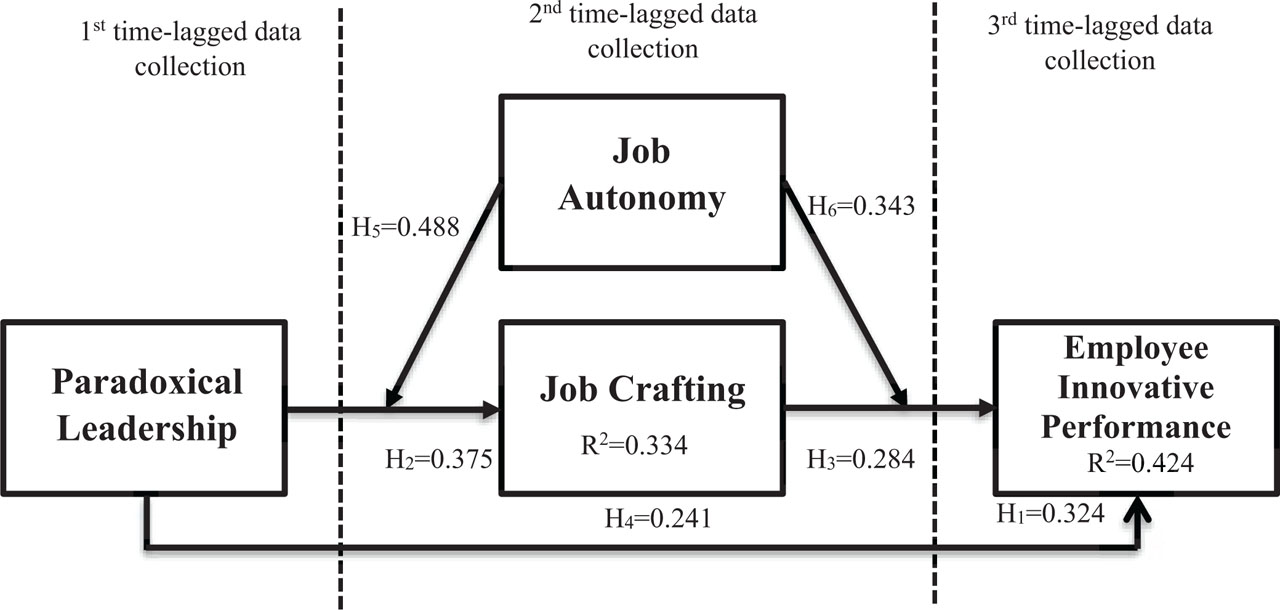
Figure 1.
Conceptual Framework
METHODOLOGY
Sampling and data collection
The foundation of this study is a positive nature and a deductive research approach. In this paradigm, authors explain the relationship between study variables by surveying the data collected and conclude by presenting a proof or disproving a hypothesis. Mejheirkouni, Baxter, and Megheirkouni (2025) point out that research relies on technology for facilitating data analysis. To test a hypothesis, we selected the ICT sector for a survey. Our study sample comprised 326 participants from ICT companies across four regions of Pakistan (Khan & Ullah, 2025). According to Hair et al. (2021) and Sarstedt et al. (2022), a sample size exceeding 300 is adequate for accurate estimation and hypothesis testing in PLS-SEM. In the ICT sector, employees require substantial autonomy and empowerment to adapt their roles and engage in innovative activities (Gohar et al., 2023). Moreover, they face several contradictory and paradoxical situations arising from uncertainty and a competitive environment (Kundi et al., 2023). The sector provides a suitable context for investigating how leaders impact employee behavior under paradoxical and contradictory conditions (Alam & Shah, 2023; Batool, Raziq, Sarwar, et al., 2023).
Data were collected in three waves (T1, T2, T3) with at least 2-week intervals. We solicited research assistance and students at academic conferences who volunteered to recruit their fellows to participate in this survey. It was a challenging task; however, we used our personal references and academic alums to meet them. This initiative minimized social desirability bias, common-method bias/variance, and potential causality concerns through the time-lagged study design recommended by Podsakoff et al. (2003). As our study involves four constructs with multiple dimensions, generating numerous items, it may mitigate potential respondent fatigue and bias, so we opted for a time-lagged design (Hair et al., 2019). At the first wave of data collection (T1), participants rated PXL behavior. In this stage, respondents answered questions about their demographic characteristics. In the first wave, we assigned a unique code to each questionnaire for identification, which facilitated second-stage data collection and comparison. At T1, 574 participants completed the questionnaire and passed the attention check, indicating data reliability. Two weeks later, participants rated their JC and JA characteristics. At T2, 436 participants completed the survey and met the benchmark, which assessed data quality. At T3, participants rated employee innovative performance (EIP). During data scanning, we compared all responses using unique IDs and deleted responses that were missing, outliers, or straight-liners. After data scanning, we obtained 326 valid feedbacks, which were deemed complete and suitable for data analysis. The summary demographic characteristics are reported in Table 1. A convenience sampling technique (CST) was considered. The CST enabled rapid data collection from available and willing responders, yielding valuable insights from professionals working diligently in innovation-driven roles. (Golzar et al., 2022). To minimize sample bias, we used a hybrid data collection method (Alam & Shah, 2023). To efficiently reach the target group, both online (digital platforms) and offline (personal visits) techniques were used to collect data. In addition, we used digital channels such as email and social media, with WhatsApp as a crucial tool given its widespread use (Batool, Raziq, & Sarwar, 2023). We established personal connections with participants through referrals, visited their businesses, and distributed questionnaires before following up. The combination strategy helped us collect data more effectively and ensured thorough input.
Table 1.
Demographic Summary of Participants
| Participants Demographics | Frequency | Percentage |
|---|---|---|
| Gender | ||
| Female | 158 | 48.47 |
| Male | 168 | 51.53 |
| Education | ||
| Intermediate | 108 | 33.13 |
| Graduate | 122 | 37.42 |
| Masters | 96 | 29.45 |
| Age (in years) | ||
| <24 | 58 | 17.79 |
| 25–35 | 106 | 32.52 |
| 36–46 | 86 | 26.38 |
| >46 | 76 | 23.31 |
| Experience (in years) | ||
| <2 | 97 | 29.75 |
| 3 to 6 | 119 | 36.50 |
| 7 to 10 | 64 | 19.63 |
| >11 | 46 | 14.11 |
Pilot testing
Additionally, to ensure the quality and authenticity of our questionnaire, we conducted a pilot study prior to the large-scale survey (Ambad et al., 2021). We conducted a preliminary study with 50 respondents (Afsar et al., 2019). We reviewed questionnaires completed by 25 academic and 25 ICT industry professionals. This initiative enhanced understanding of all observed items and ensured that they were relevant, clear, aligned with the ICT industry, and met academic standards. After that, we analyzed internal consistency measures, including Cronbach's alpha and composite reliability. The value of these tests exceeded 0.7, indicating that all manifest variables were internally consistent (Hair et al., 2019). The convergence and discriminant were assessed using the AVE, Fornell-Larcker criterion, and HTMT tests (Fornell & Larcker, 1981). All results aligned with established threshold values and were favorable for our data set, suggesting that all questionnaires were clear, understandable, and authentic. This pre-tested questionnaire enhanced the face validity of our dataset.
Instruments
All scales were adopted from well-established, authentic, and published studies. All items were scored on a seven-point frequency scale ranging from 1 = strongly disagree to 7 = strongly agree (Sulphey & Jasim, 2022). We measured PXL using a 22-item scale developed by Zhang et al. (2015), which has been used and validated in previous studies (Batool, Raziq, Sarwar, et al., 2023; Devi, 2024; Shao et al., 2017; Zhang et al., 2022). The sample item was: “My supervisor keeps distance from subordinates but does not remain aloof.” EIP was measured using a nine-item scale developed by Janssen and Van Yperen (2004), cited by previous studies (Anderson et al., 2014; Hughes et al., 2018; Yuan & Woodman, 2010). The example item included “Searched out new working methods, techniques, or instruments.” The JC was measured using three dimensions (Strength, Interest, and Development) proposed by Kooij et al. (2017) and Kuijpers et al. (2020), and subsequently validated by Laguía et al. (2024). The sample items included “I organize my work in such a way that it matches my strengths.” JA was measured using three dimensions with nine items, developed by Breaugh (1999) and subsequently used and validated by Alarifi et al. (2024). The sample item was: “I have control over the scheduling of my work.” We included control variables to ensure that respondents' demographic factors did not confound the observed relationships (Kleine et al., 2019). We included employee gender, age, education, and experience. Gender was coded as 1 for male, 2 for female; education access as 1 for intermediate, 2 for graduate, and 3 for master's degree; and age as four levels (1=less than 24, 2=25–35, 3=36–45, 4=46 and above). Likewise, employee experience was assessed on a four-level scale (1=less than 2, 2=3–6, 3=7–10, 4=11 and above).
Analytical strategy
Structural equation modeling via partial least squares (PLS-SEM) in RStudio (PLS-PM, SEMINR) was applied to test the proposed hypothesis relationships. A PLS-SEM is more appropriate when the study relates to model structure and latent constructs, explains variance between latent constructs, and investigates their association based on well-established theories (Byrne, 2013; Hair et al., 2016). In this study, a formative–reflective model was employed in which PXL, JC, and JA were conceptualized as a higher-order formative construct. In contrast, EIP was used as a reflective construct. Therefore, PLS-SEM was the most suitable analytical approach, as this study involves multidimensional variables derived from distinct dimensions. Furthermore, this study examined additional sources of variance and predictor variables that contributed to the outcome variable, as well as theory-driven mechanisms of mediation and moderation. The PLS-SEM is divided into two steps: a measurement model and a structural model (Hair et al., 2020). In the measurement model, we assessed the adequacy of all constructs. We first analyzed factor loading for all manifest variables. Internal consistency was evaluated using composite reliability and Cronbach's alpha. Convergent and discriminant validity were assessed using AVEs, HTMT ratios, and the Fornell-Larcker criterion (Fornell & Larcker, 1981). After analyzing the measurement model, we evaluated the structural model using path analysis and several indices of model goodness. These indices provided a comprehensive assessment of how well the structural model aligned with the data, confirming the model's fit and the strength of hypothesized relationships.
RESULTS
Tests for social desirability and common method bias/variance
In this study, we employed statistical and procedural methods (Chung & Monroe, 2003) to evaluate and minimize social desirability bias, common-method bias (CMB), and common-method variance bias (CMV) (Podsakoff et al., 2003). As a procedural remedy, our survey consisted of CST, and all questionnaires were conveniently incorporated with a brief introduction from the author and the study. In the first wave of data collection, we assigned all questionnaires unique IDs that quickly identified all respondents and traced them back to their identities (Akbulut et al., 2017). At the outset, we informed all participants that they may withdraw from the survey at any time without consequences and that their privacy, anonymity, and confidentiality would be protected (Marampa et al., 2024). As a statistical remedy, we applied Harman's single-factor test to identify issues of CMB and CMV (Podsakoff et al., 2003). The results of this technique indicated that the total variance explained by a single factor was 34.66%, which is below the 50% threshold recommended in previous studies (Podsakoff et al., 2003). We calculated the variance inflation factor to assess multicollinearity in the data. The VIF range was 1.28 to 1.82, which was lower than the ideal value of 5 (Podsakoff et al., 2003). These tests ensured that CMV/CMB did not contaminate the data and that there was no multicollinearity.
Assessment of measurement model
Table 2 presents the measurement model parameter estimates that assess the internal consistency and adequacy of all constructs. We set a cutoff of 0.5 for all manifest variable factor loadings, indicating statistically significant loadings (Hair et al., 2016). The composite reliability and Cronbach's alpha values exceed the ideal value of 0.7 (Hair et al., 2020). Thus, the study's latent variables exhibit internal consistency (reliability). We assessed the average variance extracted (AVE) as a summary measure of convergent validity. Extracted AVEs establish convergent validity, with a minimum value of 0.5 (Fornell & Larcker, 1981). Table 2 shows that all AVE values exceed the ideal value (AVE > 0.5), providing additional support for convergent validity. The mean values ranged from 2.3 to 3.8, with standard deviations of 0.45–0.62, indicating a consistent response pattern across the measured variables. Likewise, discriminant validity is established using the Fornell and Larcker criterion and the heterotrait-monotrait (HTMT) ratio (Farrell & Rudd, 2009). The cutoff value of HTMT was 0.9, and all italicized values were less than a threshold value. Moreover, the underlined bold values of the AVE square root are greater than all correlations among the variables (Fornell & Larcker, 1981). These two measures perfectly established the discriminant validity. We established four goodness-of-fit indices for the model, along with their respective thresholds. Optimal values for all model fit indices indicate that the model provides a strong representation of the data and achieves a good overall fit. The results for discriminant validity and model goodness-of-fit are shown in Table 3.
Table 2.
Loadings, Reliability, and Descriptive Statistics
| Items | Loading | A | CR | AVE | Mean | Std. Dev |
|---|---|---|---|---|---|---|
| Paradoxical Leadership (PXL) | 0.897 | 0.827 | 0.684 | 3.141 | 0.625 | |
| Uniformity vs. Individualization | 0.864 | 0.868 | 0.869 | 0.695 | 2.584 | 0.528 |
| UI1 | 0.754 | |||||
| UI2 | 0.814 | |||||
| UI3 | 0.732 | |||||
| UI4 | 0.795 | |||||
| UI5 | 0.814 | |||||
| Self-centeredness vs. other-centeredness | 0.847 | 0.869 | 0.847 | 0.624 | 0.3841 | 0.574 |
| SO1 | 0.795 | |||||
| SO2 | 0.815 | |||||
| SO3 | 0.807 | |||||
| SO4 | 0.874 | |||||
| SO5 | 0.796 | |||||
| Decision control vs. autonomy | 0.795 | 0.828 | 0.864 | 0.624 | 3.145 | 0.587 |
| CA1 | 0.827 | |||||
| CA2 | 0.787 | |||||
| CA3 | 0.798 | |||||
| CA4 | 0.714 | |||||
| Enforcing requirements vs. flexibility | 0.869 | 0.824 | 0.862 | 0.674 | 3.274 | 0.568 |
| RF1 | 0.822 | |||||
| RF2 | 0.869 | |||||
| RF3 | 0.799 | |||||
| RF4 | 0.854 | |||||
| Maintaining distance vs. closeness | 0.734 | 0.857 | 0.829 | 0.689 | 2.741 | 0.524 |
| DC1 | 0.747 | |||||
| DC2 | 0.758 | |||||
| DC3 | 0.798 | |||||
| DC4 | 0.766 | |||||
| Job Crafting | 0.847 | 0.863 | 0.692 | 2.574 | 0.562 | |
| Task Crafting | 0.857 | 0.857 | 0.867 | 0.624 | 2.361 | 0.587 |
| TC1 | 0.827 | |||||
| TC2 | 0.854 | |||||
| TC3 | 0.862 | |||||
| Relational Crafting | 0.821 | 0.827 | 0.861 | 0.607 | 2.661 | 0.457 |
| RC1 | 0.874 | |||||
| RC2 | 0.865 | |||||
| RC3 | 0.892 | |||||
| Cognitive Crafting | 0.826 | 0.874 | 0.862 | 0.674 | 2.625 | 0.524 |
| CC1 | 0.869 | |||||
| CC2 | 0.847 | |||||
| CC3 | 0.798 | |||||
| Job Autonomy | 0.862 | 0.857 | 0.647 | 2.351 | 0.524 | |
| Method Autonomy | 0.798 | 0.847 | 0.835 | 0.627 | 2.471 | 0.528 |
| MA1 | 0.748 | |||||
| MA2 | 0.875 | |||||
| MA3 | 0.785 | |||||
| Scheduling Autonomy | 0.821 | 0.865 | 0.824 | 0.574 | 2.398 | 0.587 |
| SA1 | 0.82 | |||||
| SA2 | 0.827 | |||||
| SA3 | 0.874 | |||||
| Criteria Autonomy | 0.734 | 0.869 | 0.851 | 0.657 | 2.362 | 0.451 |
| CTA1 | 0.785 | |||||
| CTA2 | 0.748 | |||||
| CTA3 | 0.728 | |||||
| Employee Innovative Performance | 0.857 | 0.827 | 0.684 | 2.351 | 0.627 | |
| EIP1 | 0.847 | |||||
| EIP2 | 0.824 | |||||
| EIP3 | 0.874 | |||||
| EIP4 | 0.844 | |||||
| EIP5 | 0.827 | |||||
| EIP6 | 0.827 | |||||
| EIP7 | 0.796 | |||||
| EIP8 | 0.874 | |||||
| EIP9 | 0.867 |
Evaluation of structural model with hypothesis testing
To effectively meet the research objectives, test the hypothesized relationships, and present the findings clearly, researchers focus on analyzing the structural model (Zhang et al., 2021). The impact of PXL on EIP in the first path and assess the ability of our predictor variable to explain incremental variance. In this direct relationship, the R2 is 0.424, indicating that PXL explains 42% of the variance in the outcome variable. Additionally, PXL has a positive effect on EIP, as evidenced by a positive and significant beta coefficient (B=0.324, P<0.005). Thus, the results provide initial support for H1. The second direct path proposes a link between PXL and JC, and a positive, significant relationship was found (B = 0.324, P < 0.001), supporting H2. The third direct relationship between JC and EIP was investigated, and a positive and significant association (B = 0.284, P < 0.001) was found, supporting H3. The entire structural path model was also evaluated, including a mediating relationship among PXL, JC, and EIP. We followed Hayes's (2017) guidelines. We used the bootstrapping approach to assess the statistical significance of the indirect effect of PXL on EIP via JC, a powerful statistical tool for evaluating intervening-variable effects. The results from 5000 bootstrap samples indicate that the indirect effect of PXL on EIP via JB was 0.241, with a significant p-value (p < 0.002). It suggested that the indirect effect of PXL on EIP via JC was substantial, thereby supporting H4. Finally, H5 and H6 reported two interaction effects: the first interaction between PXL and JA on JC, and the second interaction between JC and JA on EIP. The results shown in Table 4 show that the interaction effect of PXL on JA was more substantial and positive for high JA (B=0.488, P < 0.005). However, the second interaction effect of JC on EIP was more pronounced and positive for employees with high JA (B = 0.343, P < 0.006). Therefore, H5 and H6 are also supported. All direct, indirect, and moderating results are reported in Table 4, Figure 2 and Figure 3.
Table 4.
Path Analysis Estimations
| Variables | Hypothesis | Estimates | VIF | P Value | Status |
|---|---|---|---|---|---|
| PXL → EIP | H1 | 0.324 | 1.743 | 0.003 | Accept |
| PXL → JC | H2 | 0.375 | 1.828 | 0.001 | Accept |
| JC → EIP | H3 | 0.284 | 1.771 | 0.004 | Accept |
| PXL → JC → EIP | H4 | 0.241 | 1.681 | 0.002 | Accept |
| PXL*JA → JC | H5 | 0.488 | 1.287 | 0.005 | Accept |
| JC*JA → EIP | H6 | 0.343 | 1.352 | 0.006 | Accept |
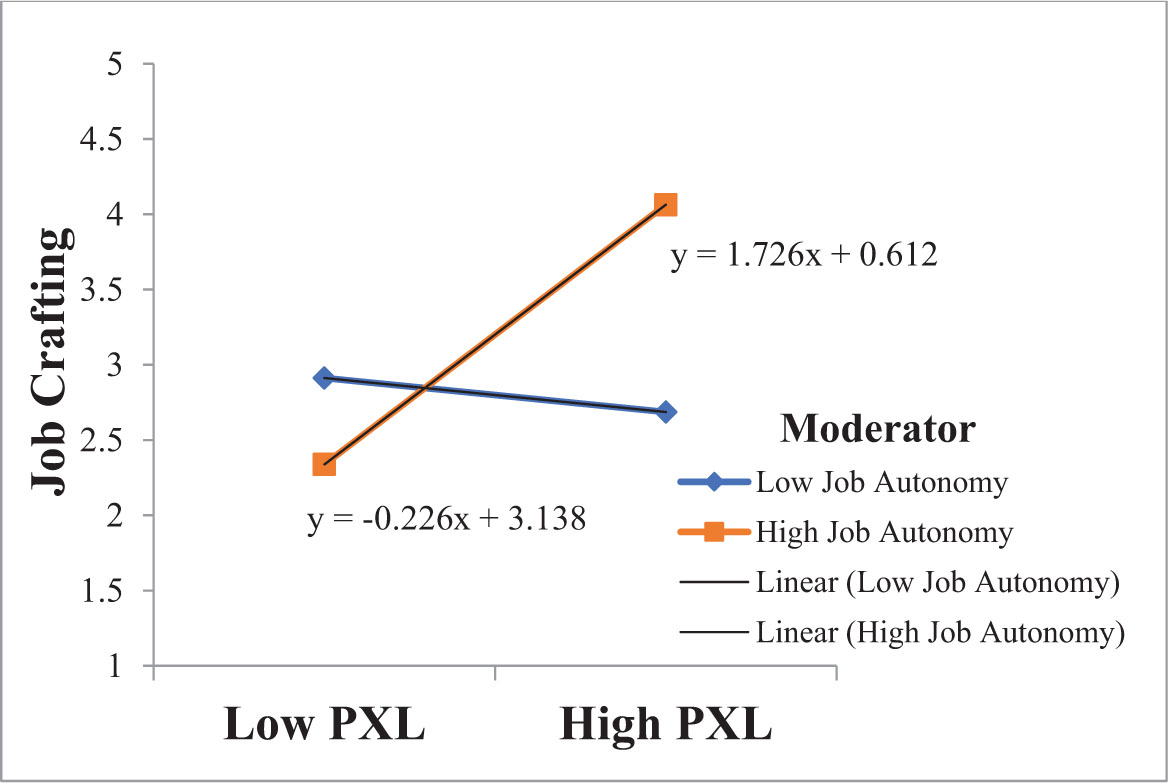
Figure 2.
Interaction Effect One
Note(s): N=326
Source: Own elaboration
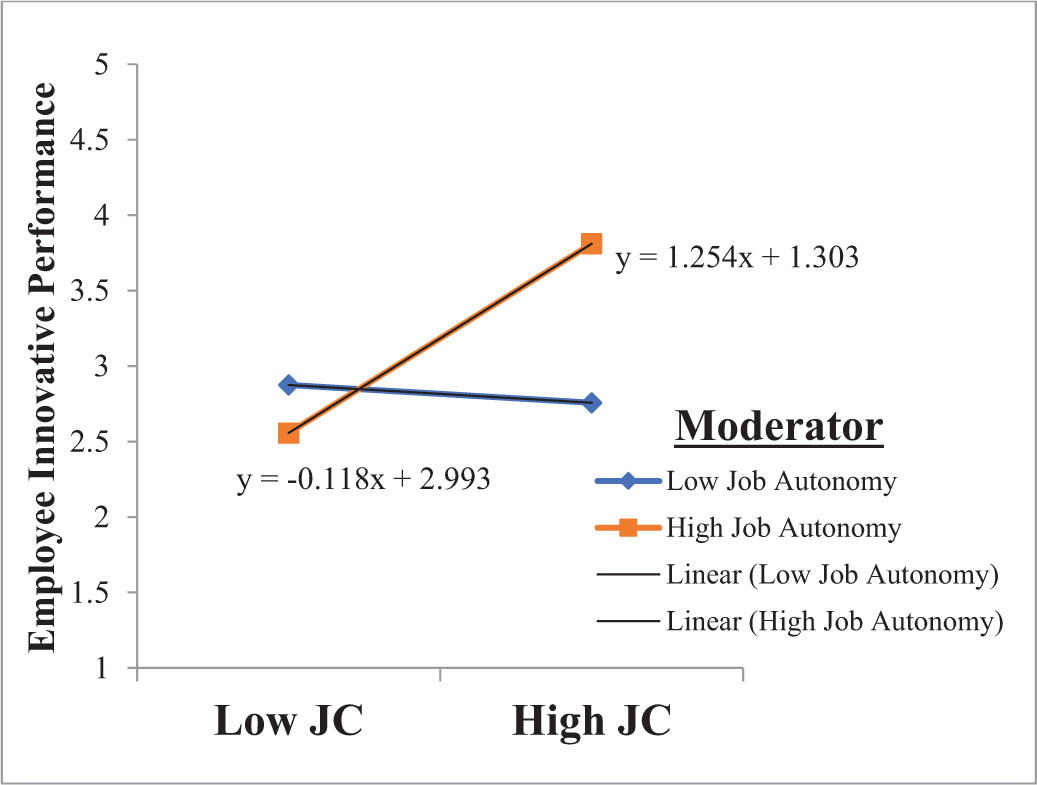
Figure 3.
Interaction Effect Two
DISCUSSION
Integrating the JD-R model as an underpinning theory, we analyzed and tested how PXL impacted EIP through JC in a survey-based time-lagged study. The findings from a three-time-lag survey and SEM analysis demonstrate that PXL positively influences EIP. This is consistent with other research highlighting paradoxical leaders' ability to balance conflicting needs at work to foster innovation (Zhao et al., 2023; Zhang et al., 2023). Paradoxical leaders inspire people to develop creative solutions while preserving operational effectiveness by allowing both control and flexibility simultaneously. Additionally, the study demonstrates that PXL mediates JC's mechanism to improve EIP. As a result of PXL, employees are more likely to proactively reassign their positions to align with their strengths and goals, which is positively associated with their innovation. It is consistent with the findings of Kamil et al. (2024), who asserted that JC enables employees to align their responsibilities with their interests and strengths, thereby fostering workplace innovation. Furthermore, JA acts as a two-way moderator, strengthening the bonds between JC and EIP and between PXL and JC, suggesting that employee autonomy enhances PXL. This demonstrates PXL boundary conditions and implies that workplaces in which individuals are free to make their own judgements are the most conducive to its functioning. Higher autonomy gives employees the flexibility to craft their roles and fully leverage their efforts to drive innovation. This integrated framework highlights the importance of leadership and independence in fostering proactive behaviors and innovation within organizations.
Theoretical implication
The study's findings have profound theoretical implications, as they expand knowledge of PXL and its role in promoting EIP. This study contributes to the PXL literature by demonstrating that leaders who strike a balance between control and autonomy can enhance their EIP. A study highlights that an effective balance between these opposing forces can benefit creativity and innovation (Afsar et al., 2019). Furthermore, this study contributes to the body of knowledge on innovation management by providing empirical evidence on how JA and JC affect workplace performance and creativity. Our study provides valuable insights into the current body of literature on PXL, EIP, JC, and JA. As ICT complexity, uncertainty, and competition increase, authors have shown growing interest in PXL behavior that helps individuals modify job roles, boost autonomy, and enhance EIP. PXL is an emerging, highly relevant leadership topic that addresses complex and contradictory realities (Khan et al., 2025). At the team and individual levels, PXL encourages followers to adapt their job roles to their interests, skill development, and strengths (Kooij et al., 2017). It is also beneficial to boost JC and innovation by granting autonomy, which is essential for EIP (Akhtar & Riaz, 2024). The impact of PXL on enhancing innovation, creativity, and conflict management, both individually and as a team, is also significant (Batool, Raziq, & Sarwar, 2023). This study reinforces the significance of PXL in today's dynamic environment and extends research on its positive impacts on JC and EIP. It also sheds light on key predictors of EIP, offering insights for future studies on leadership styles.
Managerial implication
This study offers insights for organizations seeking to promote innovative thinking through efficient job design and guidance. Leaders in organizations should be trained to strike a balance between authority and adaptability, enabling staff members to take responsibility for their work while remaining aligned with company objectives. HR professionals can use these data to create rules that increase JA, allowing the workers to change positions to optimize their productivity and creativity (Akhtar & Riaz, 2024). Managers can utilize these findings to encourage innovation, uphold performance standards, and strike a balance between empowerment and control. By incorporating strategies that integrate JC and JA into leadership training and development, employees will be better able to translate theoretical knowledge into practical strategies, thereby encouraging creative performance. An organization that values innovation should incorporate structured JC programs that allow employees to actively reinterpret their responsibilities (Batool, Raziq, & Sarwar, 2023). HR professionals should implement regulations that encourage JC, enabling workers to proactively modify their duties and responsibilities to suit their interests and strengths, thereby increasing their capacity for innovation (Devi, 2024). Additionally, workplace design should include task autonomy, allowing workers to try out novel concepts and methods without undue administrative restrictions (Khan & Ullah, 2025). Moreover, companies can create leadership development programs that stress the value of flexibility, motivating managers to foster employees' innovative endeavors while preserving overall strategic coherence. Organizations might put in place feedback mechanisms to analyze how leadership styles influence employees' JC behaviors and EIP to ensure continuous improvement. The study identifies theoretical insights and practical tactics for companies seeking to develop long-lasting, productive employees by examining the relationships among EA, leadership styles, and creativity.
Limitations and future recommendations
Although this study has strengths, it is not without weaknesses. First, the study's time-lagged design allows for future changes in the correlations among EIP, JA, JC, and PXL. Future studies can investigate several vital topics to deepen theoretical understanding and enhance real-world implementation. Initially, longitudinal research is needed to examine how paradoxical leadership influences change over time, particularly in innovative, dynamic industries. Second, employees may overestimate their creative performance or inaccurately interpret PXL behaviors, which could contribute to measurement biases and self-reporting limitations, thereby impairing the accuracy of the measure. Future research could explore whether PXL's impact remains steady or varies with changes in employee standards, organizational culture, leadership, and leadership-AI interaction and integration (see also Megheirkouni, Baxter, Ni, & Jing) 2025). A deeper understanding of the factors that support or undermine the relationship between PXL and EIP can also be gained by investigating the moderating influence of organizational climate, including information-sharing cultures, mental stability, and environments that encourage innovation. Third, the study's exclusive focus on the ICT industry may limit the generalizability of its findings to other sectors, where workplace dynamics and leadership philosophies may vary. To confirm the framework's inclusive claim, future studies could broaden it to include cross-industry contexts. A time-lagged study can also offer insights by examining how PXL affects EIP across various cultural contexts. Since perceptions differ across cultures, future studies may determine whether PXL's impact on JC and innovation differs between collectivist and individualist cultures. Analysing how digital disruption affects paradoxical leadership efficacy is another fascinating area. In light of hybrid and remote work settings, future research may examine how modern communication tools affect JA and workers' capacity to define their roles under PXL. A more thorough grasp of how PXL functions in intricate work contexts can be obtained from methodological standpoints through multilevel analyses that incorporate organizational, team, and personal level aspects. Furthermore, experimental or intervention-based investigations may identify the causal factors underlying the connections among job crafting, innovation, and paradoxical leadership. Future studies might also examine individual differences as potential moderators of workers' responses to PXL, such as personality traits, psychological capacity, or employees' readiness to change. Finally, by examining potential hazards or unexpected effects of paradoxical leadership, such as ambiguity in roles or decision exhaustion, organizations can improve their leadership development initiatives. By tackling these prospective study paths, practitioners and scholars can gain a deeper understanding of how PXL leads to high-performance workplaces and sustained innovation.