Table 1.
Plant parasitic nematodes collected from banana roots and soil in Turi, Kasihan, and Jetis, Yogyakarta Special Region
| Nematode genera | Turi (−7.776651, 110.376525) | Kasihan (−7.813425, 110.324154) | Jetis (−7.931242, 110.344991) | |||
|---|---|---|---|---|---|---|
| Root | Soil | Root | Soil | Root | Soil | |
| Pratylenchus | - | - | 181.3 | 40 | - | - |
| Helicotylenchus | - | 37.3 | 5.3 | - | 480 | 120 |
| Meloidogyne | - | - | 32 | 53.3 | 24 | 24 |
| Tylenchorinchus | - | - | 16 | - | - | - |
| Radopholus | 84 | 10.7 | - | - | - | - |
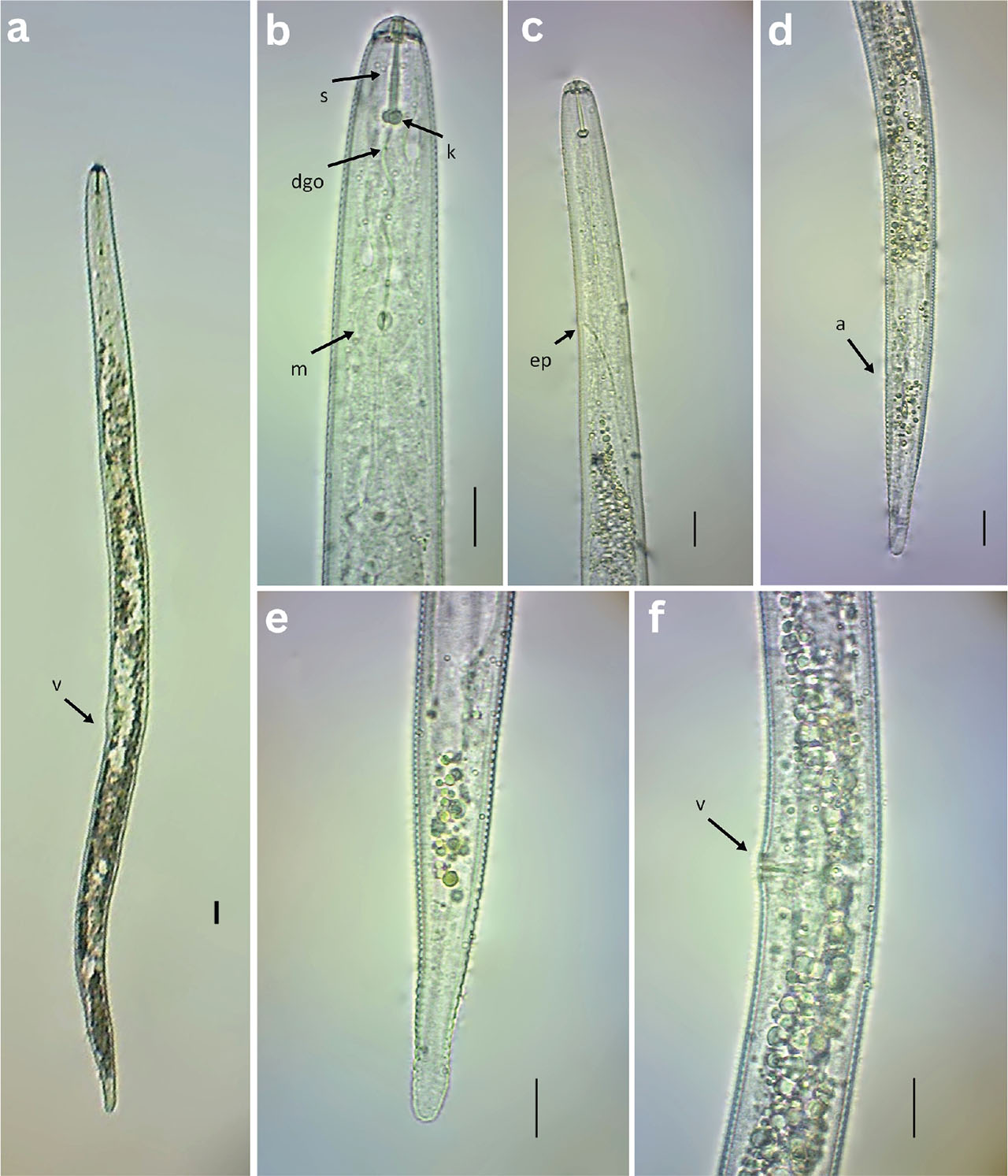
Fig. 1.
Nematode morphology of R. similis. (a) female (v = vulva); (b,c) anterior (s = stylet; k = knob; dgo = dorsal gland opening; m = metacorpus; ep = excretory pore); (d,e) female posterior (a = anus); (f) vulva (v). Magnification: (a) 100x; (b,e,f) 1000x; (c,d) 400x. Scale bar: 10 μm
Table 2.
Morphometry of Radopholus similis females from Turi, Yogyakarta Special Region compared with R. similis from Kerala (Roy et al., 2018), and Netherlands (Xu et al., 2014). Measurement unit = μm, mean ± standard deviation (range).
| Species | R. similis (this study) | R. similis (Roy et al., 2018) | R. similis (Xu et al., 2014) |
|---|---|---|---|
| Location | Yogyakarta, Indonesia | Thiruvan-anthapuram, Kerala | Netherlands |
| Host | Banana (Musa sp.) | Banana (Musa sp.) | Zebra plant (Calathea zebrina) |
| Female | Female | Female | |
| N | 7 | 20 | 20 |
| L | 620.4 ± 34.9 (564.9 – 676.6) | 550.4 ± 44.8 (500 – 660) | 781 ± 31.48 (700 – 842.5 |
| a | 28.7 ± 3.8 (22.5 – 32.6) | 31.7 ± 2.4 (27.3 – 35.0) | 27.9 ± 1.61 (24.4 – 30.6) |
| b | 1.1 ± 0.1 (1 – 1.2) | 5.2 ± 1.0 (4.2 – 6.6) | 6 ± 0.35 (5.3 – 6.6) |
| b' | 5.39 ± 1.19 (3.16 – 6.85) | - | 4.9 ± 0.29 (4.3 – 5.3) |
| c | 10.3 ± 2.7 (7 – 15.5) | 9.4 ± 0.6 (7.8 – 10.2) | 9.1 ± 0.52 (8.4 – 10.5) |
| c' | 4.4 ± 0.7 (3.8 – 5.2) | 3.2 ± 0.3 (2.8 – 3.8) | 4.4 ± 0.28 (3.9 – 4.9) |
| V (%) | 57 ± 0.9 (55.8 – 58.6) | 58 ± 1.3 (56 – 59) | 55.1 ± 1.2 (52.4 – 56.7) |
| Tip lip width | 7.4 ± 0.5 (6.6 – 8) | - | - |
| Base lip width | 8.8 ± 0.6 (8 – 9.8) | - | - |
| Lip height | 3.1 ± 0.1 (3 – 3.3) | 3.3 ± 0.4 (3 – 4) | - |
| S | 18.9 ± 0.6 (18 – 19.9) | 15.8 ± 1.5 (14 – 18) | 18.5 ± 0.71 (17.3 – 19.4) |
| Knob width | 3.8 ± 0.3 (3.2 – 4.2) | 4.3 ± 0.5 (4 – 5) | - |
| Knob height | 2.4 ± 0.4 (1.6 – 2.7) | - | - |
| DGO | 5.4 ± 0.6 (4.5 – 6.4) | 4.4 ± 0.6 (3.5 – 5) | - |
| Anterior distance to EP | 90.2 ± 9.7 (82.5 – 110.1) | 74.3 ± 7.2 (63 – 84) | - |
| Anterior distance to the vulva | 353.8 ± 22.9 (321.7 – 396.7) | - | - |
| Vulva distance to the posterior | 254.2 ± 21.9 (210.6 – 273.9) | - | - |
| Vulva distance to the anus | 210.2 ± 35.7 (175.9 – 279) | - | - |
| t | 63.5 ± 15.2 (43.8 – 91.1) | 58.7 ± 7.3 (46 – 71) | 85.9 ±5.28 (77.5 – 95) |
| W | 22 ± 3 (17.6 – 26.5) | 17.3 ± 2.2 (13 – 21) | - |
| Vulva body width | 21.9 ± 2.7 (18.5 – 26.5) | - | - |
| Anus/cloaca body width | 14.3 ± 1.8 (11.5 – 17.4) | 18.4 ± 3.0 (14 – 23) | - |
[i] Notes: N = number of nematodes; L = body length; a = body length divided by body diameter; b = body length divided by the anterior distance to the anus; b' = body length divided by the anterior distance to the esophagus; c = body length divided by tail length; c'= tail length divided by anus diameter; V = percentage of anterior distance to the vulva divided by body length; c' = percentage of posterior distance to the vulva divided by body length; S = stylet length; DGO = Dorsal Gland Opening; EP = excretory pore; t = tail length; W = widest body diameter.
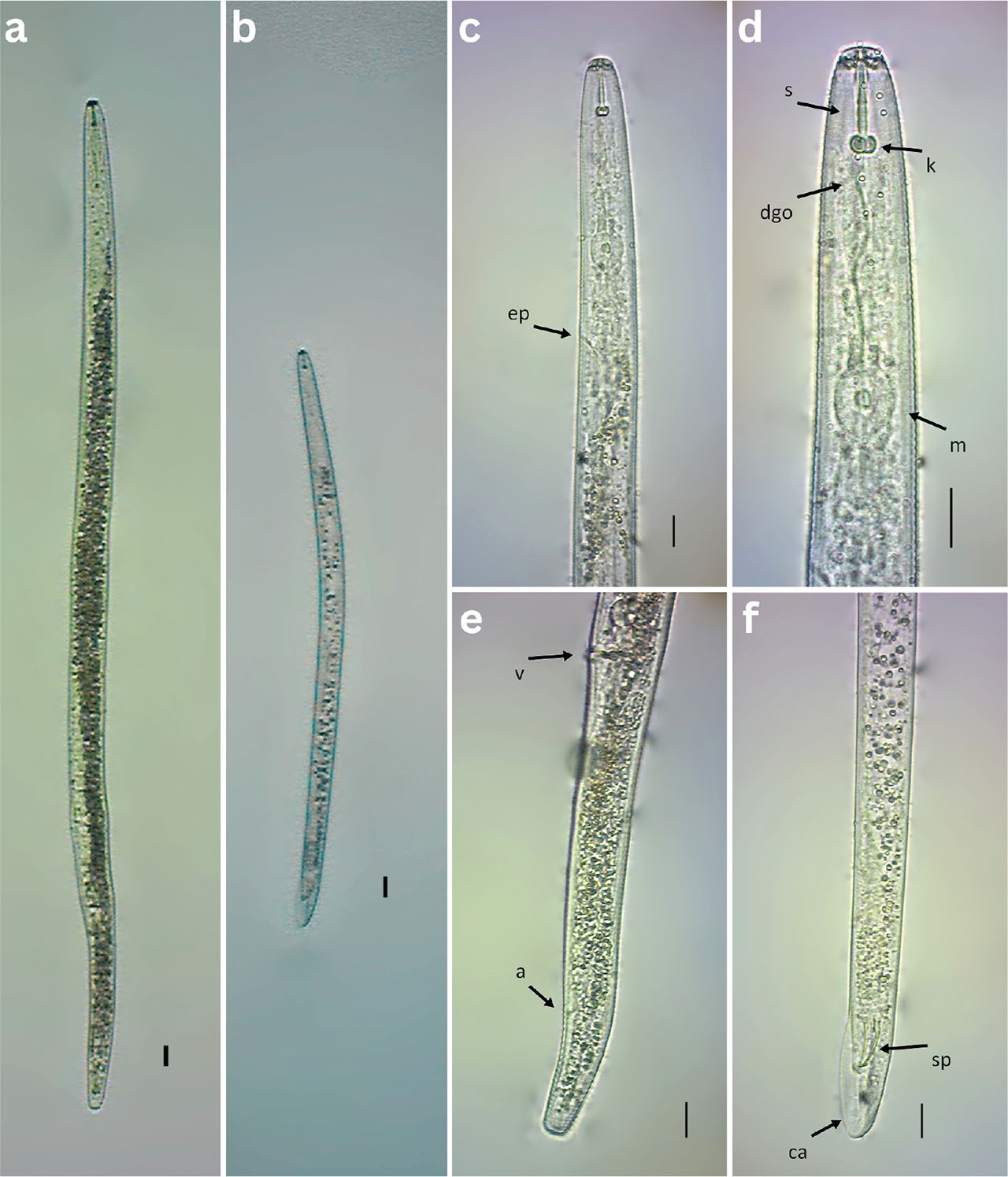
Fig. 2.
Nematode morphology of P. coffeae. (a) female; (b) male; (c,d) anterior (ep = excretory pore; s = stylet; k = knob; dgo = dorsal gland opening; m = metacorpus); (e) female posterior (v = vulva; a = anus); (f) male posterior (sp = spicule, ca = caudal alae). Magnification: (a,b) 100x; (c,e,f) 400x; (d) 1000x. Scale bar: 10 μm
Table 3.
Morphometrics of Pratylenchus coffeae from Kasihan, Yogyakarta Special Region compared with P. coffeae from Malang, Indonesia (Budiman et al., 2019), and Dien Bien, Vietnam (Tuyet et al., 2012). Measurement unit = μm, mean ± standard deviation (range).
| Species | P. coffeae (this study) | P. coffeae (Budiman et al., 2019) | P. coffeae (Tuyet et al., 2012) | |||
|---|---|---|---|---|---|---|
| Location | Yogyakarta, Indonesia | Malang, Indonesia | Dien Bien, Vietnam | |||
| Host | Banana (Musa sp.) | Robusta coffee (Coffea canephora) | Banana (Musa sp.) | |||
| Female | Male | Female | Male | Female | Male | |
| N | 7 | 5 | 26 | 24 | 15 | 15 |
| L | 604 ± 64.2 (507.3 – 731) | 492 ± 45.5 (419.3 – 561.6) | 556.4 ± 47.2 (487.4 – 654.4) | 505.9 ± 39.5 (441.6 – 641) | 605.6 ± 43.9 (519 – 664) | 540.2 ± 22.1 (498.6 – 571.3) |
| a | 26 ± 1.9 (24 – 28.8) | 27.8 ± 2.1 (24.7 – 30.8) | 28.5 ± 3 (23.4 – 34.2) | 32.3 ± 2.5 (27.4 – 39.4) | 26.4 ± 1.9 (21.9 – 29.0) | 29.0 ± 2.1 (24.6 – 32.3) |
| b | 1.05 ± 0.00 (1.04 – 1.06) | 1.05 ± 0 (1.05 – 1.05) | 6.1 ± 0.6 (4.8 – 7.8) | 5.5 ± 0.4 (4.8 – 5.5) | 7.1 ± 0.3 (6.6 – 7.8) | 7.0 ±0.4 (6.3 – 7.7) |
| b' | 5.62 ± 0.73 (4.81 – 6.97) | 5.13 ± 0.75 (4.19 – 6.31) | 4.1 ± 0.4 (3.3 – 5.2) | 3.9 ± 0.3 (3.4 – 4.8) | 4.2 ± 0.3 (3.8 – 4.7) | 4.4 ± 0.3 (3.8 – 5.0) |
| c | 19.9 ± 1.8 (17.4 – 23.7) | 21.6 ± 0.7 (20.6 – 22.7) | 20.1 ± 2.4 (15 – 24.1) | 15.3 ± 2.9 (12.4 – 21.6) | 19.1 ± 1.3 (17.2 – 22.2) | 17.5 ± 1.8 (15.6 – 23.4) |
| c' | 2.4 ± 0.3 (2 – 2.9) | 44.6 ± 5.2 (34.5 – 48.3) | 2.3 ± 0.3 (1.6 – 3) | 2.8 ± 0.4 (2.1 – 3.5) | 2.4 ± 0.4 (1.9 – 3.2) | 2.7 ± 0.4 (2.0 – 3.3) |
| V (%) | 79.6 ± 0.9 (78.2 – 80.6) | - | 81.7 ± 1.2 (79.5 – 83.9) | - | 80.0 ± 1.6 (77.3 – 83.0) | - |
| Tip lip width | 6.2 ± 0.6 (5.4 – 7.1) | 5.1 ± 0.8 (4.2 – 6.3) | - | - | - | - |
| Base lip width | 7.9 ± 0.6 (6.9 – 8.7) | 6.3 ± 0.4 (5.6 – 6.7) | 7.6 ± 0.4 (7 – 8.2) | 6.3 ± 0.3 (5.9 – 6.9) | 7.8 ± 0.5 (6.8 – 8.3) | 62. ± 0.5 (5.6 – 7.1) |
| Lip height | 2.4 ± 0.6 (1.6 – 3.4) | 1.8 ± 0.2 (1.5 – 2) | 2.4 ± 0.3 (2 – 3) | 2 ± 0.2 (1.7 – 2.7) | 2.4 ± 0.3 (2.1 – 3.1) | 1.6 ± 0.2 (1.5 – 2.0) |
| S | 17.8 ± 1.3 (15.2 – 19.5) | 16 ± 0.7 (14.8 – 17) | 16 ± 0.6 (14.6 – 16.7) | 15 ± 0.4 (14.3 – 15.7) | 16.1 ± 0.7 (14.6 – 17.7) | 14.8 ± 0.5 (14.1 – 15.7) |
| Knob width | 4 ± 0.5 (3.4 – 5.1) | 3 ± 0.2 (2.8 – 3.2) | - | - | - | - |
| Knob height | 2.5 ± 0.3 (1.8 – 2.7) | 2 ± 0.2 (1.7 – 2.2) | - | - | - | - |
| DGO | 3.32 ± 0.78 (2.51 – 5.08) | 3.33 ± 0.36 (2.93 – 3.84) | 2.4 ± 0.4 (1.8 – 3.2) | 2.3 ± 0.3 (1.9 – 2.8) | 2.9 ± 2.1 (2.1 – 3.9) | 2.4 ± 0.2 (2.0 – 2.5) |
| Anterior distance to EP | 93.7 ± 5 (86.9 – 102.3) | - | - | - | 89.3 ± 6.4 (76.3 – 98.5) | 80.8 ± 4.5 (72.2 – 88.9) |
| Anterior distance to the vulva | 480.9 ± 53.6 (398.4 – 582.7) | - | 454.5 ± 37.8 (392.9 – 528.6) | - | - | - |
| Anterior distance to anus/cloaca | - | - | - | 40.6 ± 4.4 (32.4 – 52.9) | - | - |
| Vulva distance to the posterior | 123.1 ± 11.8 (108.9 – 148.3) | - | - | - | - | - |
| Vulva distance to the anus | 92.6 ± 9.9 (79.8 – 110.8) | - | 71.9 ± 11 (55.6 – 97.8) | - | 90.5 ± 12.5 (60.6 – 121.2 | |
| t | 30.4 ± 2.8 (27.1 – 36.5) | 22.8 ± 2.1 (19.7 – 26) | 27.9 ± 3.5 (21.1 – 34.4) | 33.9 ± 5.3 (24.8 – 41) | 31.9 ± 3.2 (26.3 – 36.4) | 31.2 ± 3.3 (21.7 – 36.2) |
| W | 23.1 ± 1.5 (20.8 – 25.4) | 17.7 ± 1 (16.4 – 19) | 19.6 ± 2.2 (15.8 – 24.8) | 15.7 ± 0.9 (14.4 – 18.4) | 23.0 ± 2.1 (20.2 – 27.8) | 18.7 ± 1.2 (16.1 – 20.7) |
| Vulva body width | 20 ± 1.4 (17.9 – 22.1) | - | - | - | - | - |
| Anus/cloaca body width | 13 ± 1.8 (9.9 – 15.5) | 11.1 ± 0.9 (10 – 12.2) | 12.5 ± 1.7 (10.5 – 16) | 12 ± 1.1 (10 – 14.6) | - | - |
[i] Notes: same as Table 2.
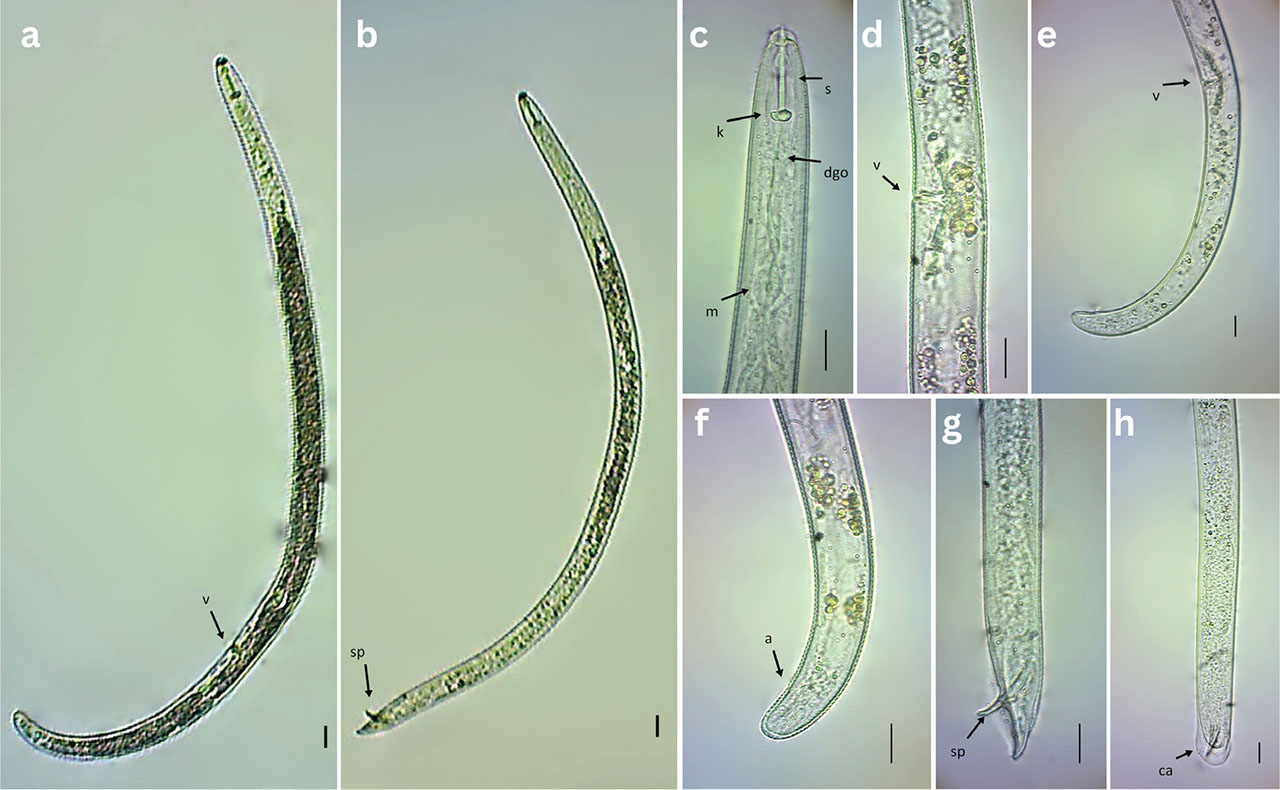
Fig. 3.
Nematode morphology of H. multicinctus. (a) female (v = vulva); (b) male (sp = spicula); (c) anterior (s = stylet; k = knob; dgo = dorsal gland opening; m = metacorpus); (d) vulva (v); (e,f) female posterior (v = vulva; a = anus); (g,h) male posterior (sp = spicule, ca = caudal alae). Magnification: (a,b) 100x; (c,d,f,g) 1000x; (e,h) 400x. Scale bar: 10 μm
Table 4.
Morphometrics of Helicotylenchus multicinctus from the Jetis, Yogyakarta Special Region was compared with populations of H. multicinctus from Greece ((Tzortzakakis et al., 2017). Measurement unit = μm, mean ± standard deviation (range).
| Species | H. multicinctus (this study) | H. multicinctus (Tzortzakakis et al., 2017) | ||
|---|---|---|---|---|
| Location | Yogyakarta, Indonesia | Tertsa, Greece | ||
| Host | Banana (Musa sp.) | Banana (Musa sp.) | ||
| Female | Male | Female | Male | |
| N | 8 | 4 | 4 | - |
| L | 541 ± 71.4 (410.4 – 642) | 494.3 ± 18.8 (467.3 – 516.4) | 570 ± 65.4 (508 – 640) | - |
| a | 23.6 ± 2.3 (19.8 – 27) | 28.5 ± 1.7 (26.8 – 31) | - | - |
| b | 1.03 ± 0.01 (1.02 – 1.05) | 1.03 ± 0 (1.03 – 1.03) | - | - |
| b' | 4.70 ± 0.69 (3.51 – 5.81) | 4.59 ± 0.11 (4.43 – 4.75) | - | - |
| c | 44.8 ± 7.2 (32.7 – 50.8) | 36.9 ± 2.8 (33.4 – 40.4) | - | - |
| c' | 1 ± 0.2 (0.8 – 1.4) | 50.8 ± 2.6 (46.5 – 53.3) | - | - |
| V (%) | 67.9 ± 1.1 (66.2 – 69.1) | - | - | - |
| Tip lip width | 4.3 ± 0.3 (4 – 4.9) | 4 ± 0.5 (3.3 – 4.6) | - | - |
| Base lip width | 7.6 ± 0.5 (7 – 8.4) | 6.4 ± 0.3 (6 – 6.7) | - | - |
| Lip height | 3.7 ± 0.5 (3. – 4.4) | 3.4 ± 0.5 (2.6 – 3.8) | - | - |
| S | 27.5 ± 1.6 (29.3 – 24.3) | 24.5 ± 0.9 (23.5 – 25.8) | 22.3 ± 1.0 (21.0 – 23.0) | - |
| Knob width | 5.4 ± 0.4 (4.9 – 5.9) | 4.3 ± 0.3 (3.8 – 4.7) | - | - |
| Knob height | 2.7 ± 0.4 (1.9 – 3.2) | 2.3 ± 0.2 (2.2 – 2.6) | - | - |
| DGO | 9.6 ± 1.8 (6.2 – 12.1) | 9 ± 0.4 (8.6 – 9.6) | 8.8 ± 0.6 (8.0 – 9.5) | - |
| Anterior distance to EP | 96.5 ± 8.1 (83 – 106.5) | - | 89.3 ± 4.8 (84.0 – 95.0) | - |
| Anterior distance to the vulva | 367 ± 46.2 (281.7 – 429.9) | - | - | - |
| Vulva distance to the posterior | 168.6 ± 29.9 (119.5 – 212.1) | - | - | - |
| Vulva distance to the anus | 156.9 ± 29.7 (108.8 – 200.2) | - | - | - |
| t | 12.2 ± 1.3 (10.6 – 15.4) | 13.5 ± 0.9 (12 – 14.5) | 11.0 ± 0.8 (10.0 – 12.0) | - |
| W | 23 ± 2.9 (18.6 – 26.2) | 17.5 ± 1.4 (15 – 18.8) | - | - |
| Vulva body width | 21 ± 3.4 (16.2 – 26) | - | - | - |
| Anus/cloaca body width | 12.5 ± 1.2 (10.7 – 14) | 9.8 ± 0.7 (8.9 – 10.9) | - | - |
[i] Notes: same as Table 2.
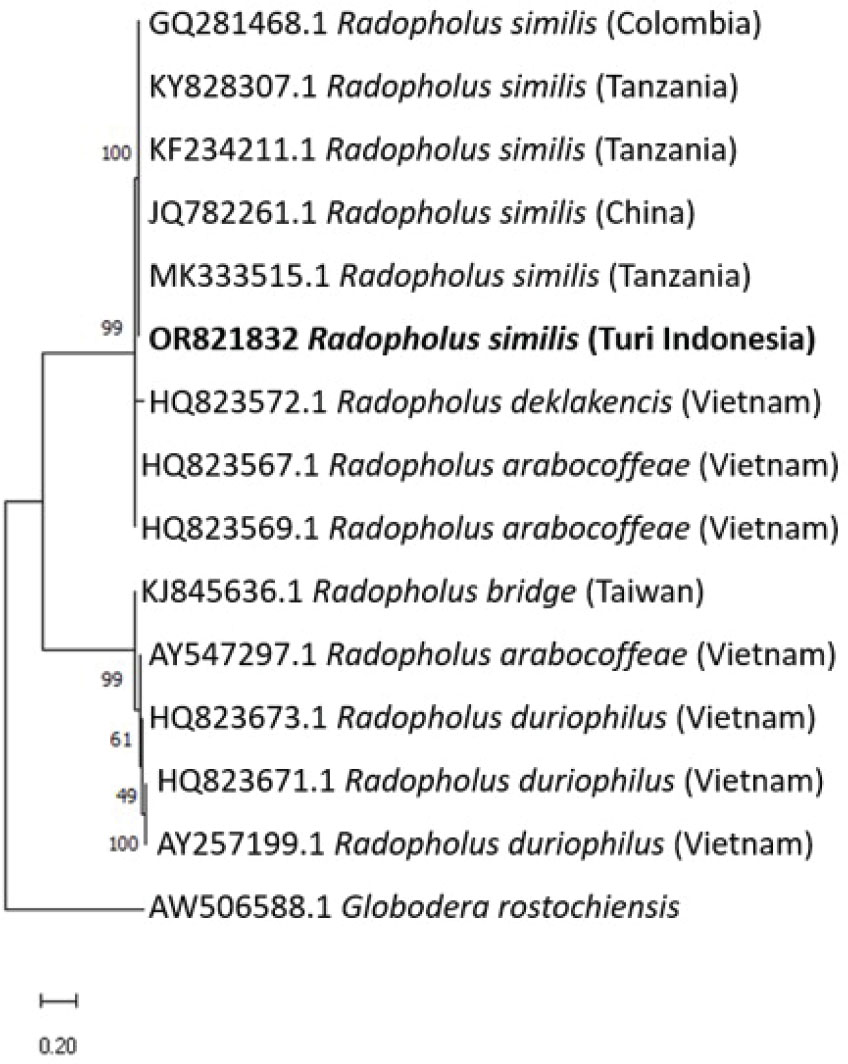
Fig. 4.
Maximum likelihood phylogenetic tree of partial 28S rRNA segments with the Kimura-2 (K2) model from the species R. similis identified in Turi, Yogyakarta, Indonesia. The substitution model is selected based on the lowest Bayesian Information Criterion (BIC) value. The model with the lowest BIC value is considered to best describe the substitution pattern. ML tree was performed in the MEGA XI program
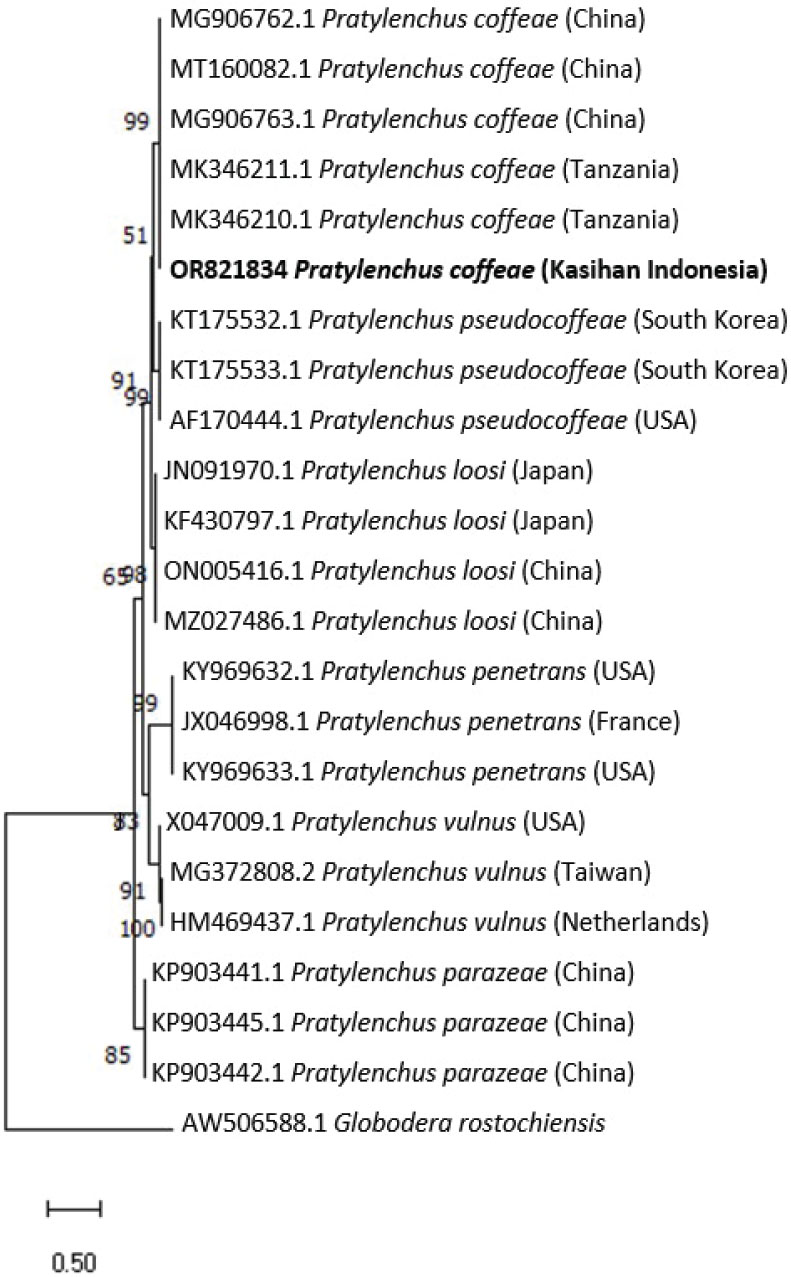
Fig. 5.
Maximum likelihood phylogenetic tree of partial 28S rRNA segments with the Kimura-2 model and Gamma (K2+G) distribution pattern of the P. coffeae species identified in Kasihan, Yogyakarta, Indonesia. The substitution model is selected based on the lowest Bayesian Information Criterion (BIC) value. The model with the lowest BIC value is considered to best describe the substitution pattern. ML tree was performed in the MEGA XI program
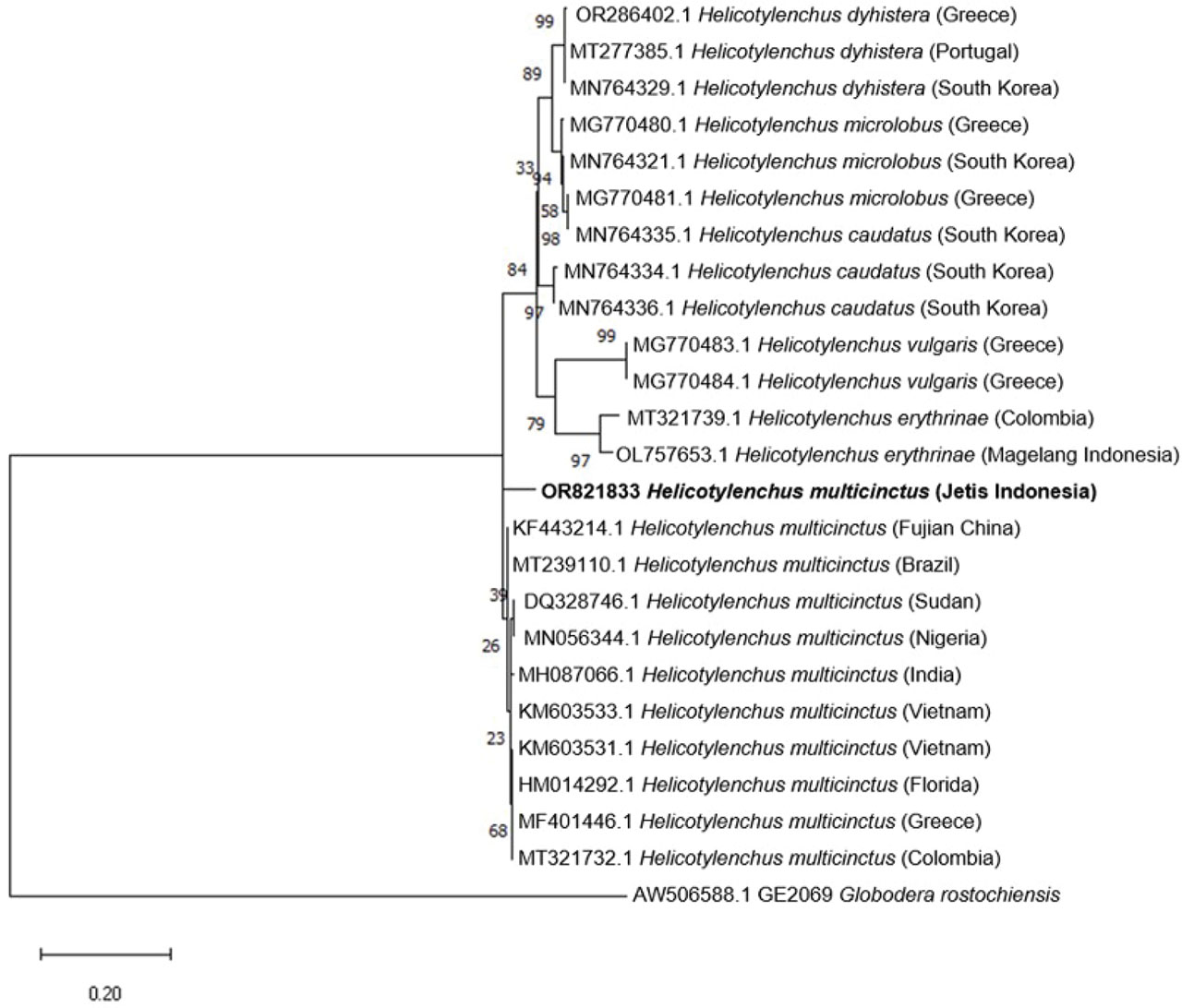
Fig. 6.
Maximum likelihood phylogenetic tree of partial 28S rRNA segments with the Kimura-2 (K2) model from the species H. multicinctus identified in Jetis, Yogyakarta, Indonesia. The substitution model is selected based on the lowest Bayesian Information Criterion (BIC) value. The model with the lowest BIC value is considered to best describe the substitution pattern. ML tree was performed in the MEGA XI program