Introduction
Plant parasitic nematodes (PPNs) are one of the most important pests on banana (Musa sp.) plantations. Damage to the primary roots caused by PPNs leads to the plant's collapse (Gowen et al., 2005), yield losses can reach 60 – 80 % in banana plantations (Sikora et al., 2018; Riascos-Oertiz, 2022). The genera of PPNs that are known to be associated with tropical and subtropical banana plantations are Radopholus, Pratylenchus, Helicotylenchus, Rotylenchulus, Meloidogyne, and Hoplolaimus. From those, the PPNs species with the highest damage to banana plantations are Radopholus similis, Pratylenchus coffeae, and Helicotylenchus multicinctus (Gowen et al., 2005; Quénéhervé et al., 2011).
Managing the population of PPNs tends to be difficult because of limited information regarding this type of pest. Several control steps could be considered, including data collection, monitoring, risk analysis, and epidemiological forecasting, where the main step is identification (de Oliveira, 2011). Nevertheless, identification and diagnosis of R. similis, P. coffeae, and H. multicinctus at the species level tend to be difficult due to their microscopic size, morphological similarities, a limited number of morphological characteristics, and almost the same morphometric size between one species and another. For example, P. pseudocoffeae has similar morphological and morphometric characteristics to P. coffeae, P. gutierrezi, and P. penetrans (Araya et al., 2016). Morphological variations within species with different races could lead to misidentification (Xu et al., 2014). Consequently, the identification method based on molecular technology, such as Polymerase Chain Reaction (PCR) could be an efficient way to identify the nematodes (Bhat et al., 2022).
Based on the description above, this research aimed to provide information regarding the morphological, morphometric, and molecular characteristics of dominant PPN species that are associated with banana plantations in the Special Region of Yogyakarta and the phylogenetic relationship of identified species in the Special Region of Yogyakarta with various other species in different localities.
Material and Methods
Sampling
Sampling was carried out on banana plantations of the Kepok cultivar in Turi (−7.667751, 110.376525), and the Ambon cultivar in Jetis (−7.931242, 110.344991) and Kasihan (−7.813425, 110.324154), Special Region of Yogyakarta. Samples were collected using a purposive sampling method. Plants with wilting symptoms, poor vegetative growth, and blackish lesions on plant roots were the criteria of plant samples. Three samples of roots and soil rhizospheres were collected and then composited for each location.
Nematode extraction and isolation
Nematodes were extracted from banana roots using a blender nematode filter method (van Bezooijen, 2006). A total of 10 g of crushed banana roots (crushed in a blender at about 10000 rpm for 5 seconds, washed on a 38 μm sieve to release the toxic substances from roots for the nematodes) were then placed on each tray, submerged with water, and incubated for 24 hours. Nematodes from soil were extracted using modified Whitehead-tray methods (Whitehead & Hemming, 1965). A total of 100 ml composited soil was placed on each tray, submerged with water, and incubated for 24 hours. The suspension was then filtered on a 38 μm sieve to collect the nematodes. The isolated nematodes were used for identification.
Morphological and morphometric identification
Morphological and morphometric identification of nematode species was done at the Laboratory of Plant Pest, Nematology, Universitas Gadjah Mada. Nematodes were observed using a light microscope (Olympus CX31). Seven females of Radopholus species, seven females and five males of Pratylenchus species, eight females and four males of Helicotylenchus species were observed morphometrically. The number of nematodes varies due to the limited availability of morphometric observations. Morphological species identification was conducted based on the nematode species identification key (Handoo & Golden, 1989; Siddiqi, 1972; Sher, 1968). Morphometric observations were analyzed using Image Raster software and documented in micrometers (μm).
Molecular identification
A single female nematode for each sample was extracted using the commercial kit (Genomic DNA Mini Kit (Tissue), Geneaid) with some modifications (Xin et al., 2021; Morindya et al., 2023). PCR amplification was carried out using universal nematode primers: D2A forward 5′-ACAAGTACCGTGAGGGAAAGTTG-3′ and D3B reverse 5′-TCGGAAGGAACCAGCTACTA-3′ (De Ley et al., 1999). The PCR mastermix consisted of 15 μL (MyTaqTM HS RedMix Bioline, Meridian Bioscience), 3 μL forward primer, 3 μL reverse primer, 6 μL DNA template, and 3 μL dDH2O to reach a total volume of 30 μL. The PCR program includes pre-denaturation at 95°C for 4 minutes, denaturation at 95°C for 30 seconds, and annealing at 50°C for 30 seconds. The denaturation and annealing steps were repeated 35 times, followed by the DNA extension or synthesis step for 30 seconds at 72°C. The final extension was conducted at 72°C for 5 minutes with a final temperature of 4°C. The results of DNA amplification were analyzed on a 2 % agarose gel in 1x TBE buffer with an electrophoresis program setting of 100 V and a time of 25 minutes. After that, the agarose was visualized on a UV transilluminator.
The amplified DNA fragments were sent to the Integrated Research and Testing Laboratory (Laboratorium Pengujian dan Penelitian Terpadu-LPPT), Universitas Gadjah Mada for the nucleotide sequence using the direct sanger sequencing method. The DNA sequence results were then compared with nematode species originating from other locations. Last, phylogenetic tree analysis was performed using the Molecular Evolutionary Genetic Analysis (MEGA) XI software (Tamura et al., 2021). The phylogenetic tree was inferred by using the Maximum Likelihood method and Kimura 2-parameter model (Kimura, 1980) with bootstrap analysis 1000 times.
Ethical Approval and/or Informed Consent
For this study, formal consent is not required.
Results
Plant-parasitic nematode populations
In this study, several PPNs were found in banana plantations in the Special Region of Yogyakarta, including Meloidogyne sp., Pratylenchus sp., Radopholus sp., Helycotylenchus sp., and Tylenchorhyncus sp. The highest PPNs populations in Turi were Radopholus (84 nematodes/10 grams of root) and Helicotylenchus (37.3 nematodes/100 mL of soil). In Kasihan, Pratylenchus had the highest count in root samples (181.3 nematodes/10 grams), while Meloidogyne dominated the soil samples (53.3 nematodes/100 mL). In Jetis, Helicotylenchus recorded the highest population in both root (480 nematodes/10 grams) and soil samples (120 nematodes/100 mL). The populations of PPNs found in this study are shown in Table 1.
Table 1.
Plant parasitic nematodes collected from banana roots and soil in Turi, Kasihan, and Jetis, Yogyakarta Special Region
| Nematode genera | Turi (−7.776651, 110.376525) | Kasihan (−7.813425, 110.324154) | Jetis (−7.931242, 110.344991) | |||
|---|---|---|---|---|---|---|
| Root | Soil | Root | Soil | Root | Soil | |
| Pratylenchus | - | - | 181.3 | 40 | - | - |
| Helicotylenchus | - | 37.3 | 5.3 | - | 480 | 120 |
| Meloidogyne | - | - | 32 | 53.3 | 24 | 24 |
| Tylenchorinchus | - | - | 16 | - | - | - |
| Radopholus | 84 | 10.7 | - | - | - | - |
Morphological and morphometric characteristics
The three dominant population PPNs were identified as R. similis, P. coffeae, and H. multicinctus. Morphological characterizations of three dominant PPNs populations are shown below.
a). Radopholus similis
Based on morphological observations, Radopholus sp., mostly identified in Turi, Sleman, Yogyakarta Special Region leads to the species R. similis (Fig. 1). The esophagus overlaps the intestine on the dorsal side. Female nematodes are rounded and protruding (set off), and the corners of their lips are narrowed. The striae on the cuticle are visible. The stylet is strong and well-developed, equipped with a knob. The metacorpus is round. The tail is elongated with a rounded and narrow tip. The position of the vulva is at 57 % of the body length. On the other hand, male nematodes were not found in the observed population.
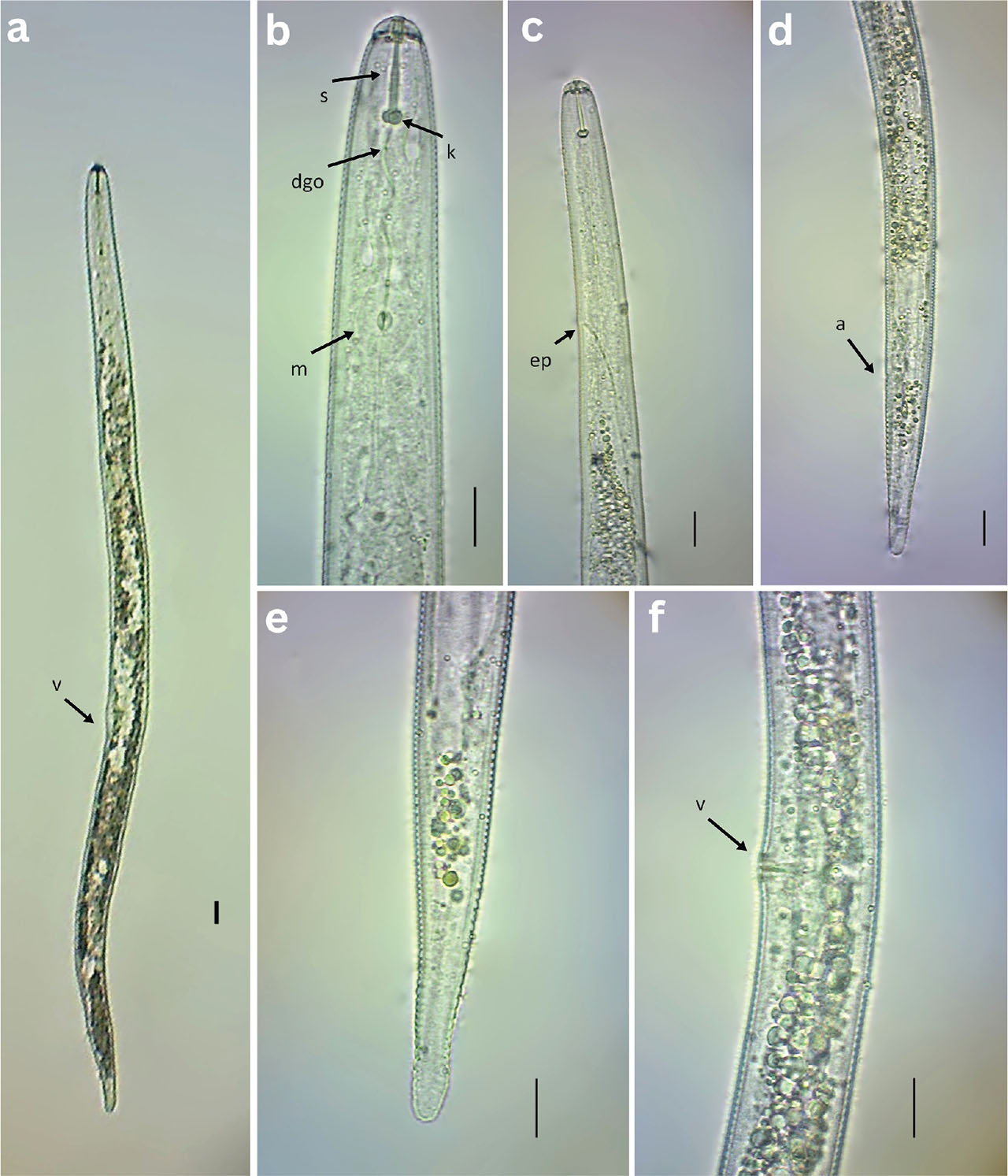
Fig. 1.
Nematode morphology of R. similis. (a) female (v = vulva); (b,c) anterior (s = stylet; k = knob; dgo = dorsal gland opening; m = metacorpus; ep = excretory pore); (d,e) female posterior (a = anus); (f) vulva (v). Magnification: (a) 100x; (b,e,f) 1000x; (c,d) 400x. Scale bar: 10 μm
The morphometry of R. similis is shown in Table 2. The morphometry of R. similis in this study consisted of 7 females. The measurement results on female nematodes showed that body length = 620.4 ± 34.9 (564.9 – 676.6) μm; largest body diameter = 22 ± 3 (17.6 – 26.5) μm; anterior distance to vulva = 353.8 ± 22.9 (321.7 – 396.7) μm; stylet length = 18.9 ± 0.6 (18 – 19.9) μm; DGO = 5.4 ± 0.6 (4.5 – 6.4) μm; and tail length = 63.5 ± 15.2 (43.8 – 91.1) μm.
Table 2.
Morphometry of Radopholus similis females from Turi, Yogyakarta Special Region compared with R. similis from Kerala (Roy et al., 2018), and Netherlands (Xu et al., 2014). Measurement unit = μm, mean ± standard deviation (range).
| Species | R. similis (this study) | R. similis (Roy et al., 2018) | R. similis (Xu et al., 2014) |
|---|---|---|---|
| Location | Yogyakarta, Indonesia | Thiruvan-anthapuram, Kerala | Netherlands |
| Host | Banana (Musa sp.) | Banana (Musa sp.) | Zebra plant (Calathea zebrina) |
| Female | Female | Female | |
| N | 7 | 20 | 20 |
| L | 620.4 ± 34.9 (564.9 – 676.6) | 550.4 ± 44.8 (500 – 660) | 781 ± 31.48 (700 – 842.5 |
| a | 28.7 ± 3.8 (22.5 – 32.6) | 31.7 ± 2.4 (27.3 – 35.0) | 27.9 ± 1.61 (24.4 – 30.6) |
| b | 1.1 ± 0.1 (1 – 1.2) | 5.2 ± 1.0 (4.2 – 6.6) | 6 ± 0.35 (5.3 – 6.6) |
| b' | 5.39 ± 1.19 (3.16 – 6.85) | - | 4.9 ± 0.29 (4.3 – 5.3) |
| c | 10.3 ± 2.7 (7 – 15.5) | 9.4 ± 0.6 (7.8 – 10.2) | 9.1 ± 0.52 (8.4 – 10.5) |
| c' | 4.4 ± 0.7 (3.8 – 5.2) | 3.2 ± 0.3 (2.8 – 3.8) | 4.4 ± 0.28 (3.9 – 4.9) |
| V (%) | 57 ± 0.9 (55.8 – 58.6) | 58 ± 1.3 (56 – 59) | 55.1 ± 1.2 (52.4 – 56.7) |
| Tip lip width | 7.4 ± 0.5 (6.6 – 8) | - | - |
| Base lip width | 8.8 ± 0.6 (8 – 9.8) | - | - |
| Lip height | 3.1 ± 0.1 (3 – 3.3) | 3.3 ± 0.4 (3 – 4) | - |
| S | 18.9 ± 0.6 (18 – 19.9) | 15.8 ± 1.5 (14 – 18) | 18.5 ± 0.71 (17.3 – 19.4) |
| Knob width | 3.8 ± 0.3 (3.2 – 4.2) | 4.3 ± 0.5 (4 – 5) | - |
| Knob height | 2.4 ± 0.4 (1.6 – 2.7) | - | - |
| DGO | 5.4 ± 0.6 (4.5 – 6.4) | 4.4 ± 0.6 (3.5 – 5) | - |
| Anterior distance to EP | 90.2 ± 9.7 (82.5 – 110.1) | 74.3 ± 7.2 (63 – 84) | - |
| Anterior distance to the vulva | 353.8 ± 22.9 (321.7 – 396.7) | - | - |
| Vulva distance to the posterior | 254.2 ± 21.9 (210.6 – 273.9) | - | - |
| Vulva distance to the anus | 210.2 ± 35.7 (175.9 – 279) | - | - |
| t | 63.5 ± 15.2 (43.8 – 91.1) | 58.7 ± 7.3 (46 – 71) | 85.9 ±5.28 (77.5 – 95) |
| W | 22 ± 3 (17.6 – 26.5) | 17.3 ± 2.2 (13 – 21) | - |
| Vulva body width | 21.9 ± 2.7 (18.5 – 26.5) | - | - |
| Anus/cloaca body width | 14.3 ± 1.8 (11.5 – 17.4) | 18.4 ± 3.0 (14 – 23) | - |
[i] Notes: N = number of nematodes; L = body length; a = body length divided by body diameter; b = body length divided by the anterior distance to the anus; b' = body length divided by the anterior distance to the esophagus; c = body length divided by tail length; c'= tail length divided by anus diameter; V = percentage of anterior distance to the vulva divided by body length; c' = percentage of posterior distance to the vulva divided by body length; S = stylet length; DGO = Dorsal Gland Opening; EP = excretory pore; t = tail length; W = widest body diameter.
b). Pratylenchus coffeae
Based on morphological characteristics, the Pratylenchus sp. found in this study is referred to P. coffeae (Fig. 2). The body of P. coffeae has a straight or vermiform shape when inactive (habitus).
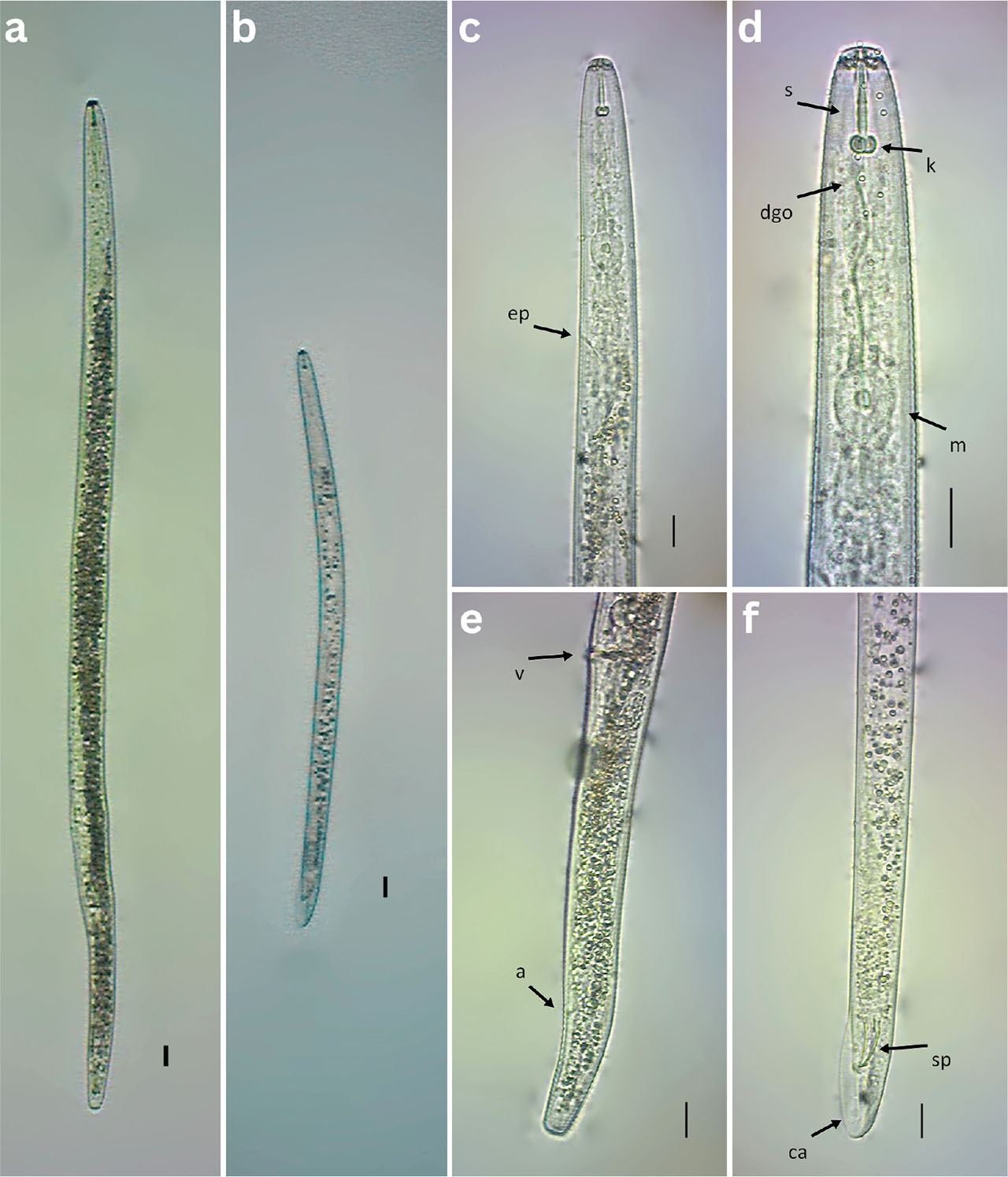
Fig. 2.
Nematode morphology of P. coffeae. (a) female; (b) male; (c,d) anterior (ep = excretory pore; s = stylet; k = knob; dgo = dorsal gland opening; m = metacorpus); (e) female posterior (v = vulva; a = anus); (f) male posterior (sp = spicule, ca = caudal alae). Magnification: (a,b) 100x; (c,e,f) 400x; (d) 1000x. Scale bar: 10 μm
Female nematodes have a clear stylet with a rounded knob. The lips consist of two annulations and are slightly set off from the body. The metacorpus is visible and oval. The basal bulb overlaps the intestine on the ventral side. The vulva is located at 80 % of its body length, with a monodelphic ovary type, namely one ovary protruding anteriorly.
Male nematodes have the same body shape as females. The difference between female and male P. coffeae is in their reproductive organs. The reproductive organs of male nematodes are spicules. The spicule of P. coffeae is slightly curved towards the ventral side. Male nematodes have a bursa that covers the spicules up to the tail tip. The body size of male nematodes is smaller than the body size of females.
The morphometry of P. coffeae from Kasihan consisted of 7 females and 5 males (Table 3). The measurement results on female nematodes showed body length = 604 ± 64.2 (507.3 – 731) μm; largest body diameter = 23.1 ± 1.5 (20.8 – 25.4) μm; anterior distance to vulva = 480.9 ± 53.6 (398.4 – 582.7) μm; stylet length = 17.8 ± 1.3 (15.2 – 19.5) μm; DGO = 3.32 ± 0.78 (2.51 – 5.08) μm; and tail length = 30.4 ± 2.8 (27.1 – 36.5) μm. Based on measurements, the position of the vulva from the anterior is at 79.6 % of the body length. Moreover, measurements on male nematodes are body length = 492 ± 45.5 (419.3 – 561.6) μm; largest body diameter = 17.7 ± 1 (16.4 – 19) μm; stylet length = 16 ± 0.7 (14.8 – 17) μm; DGO = 3.33 ± 0.36 (2.93 – 3.84) μm; and tail length = 22.8 ± 2.1 (19.7 – 26) μm. Overall, the size of female nematodes is larger than that of males.
Table 3.
Morphometrics of Pratylenchus coffeae from Kasihan, Yogyakarta Special Region compared with P. coffeae from Malang, Indonesia (Budiman et al., 2019), and Dien Bien, Vietnam (Tuyet et al., 2012). Measurement unit = μm, mean ± standard deviation (range).
| Species | P. coffeae (this study) | P. coffeae (Budiman et al., 2019) | P. coffeae (Tuyet et al., 2012) | |||
|---|---|---|---|---|---|---|
| Location | Yogyakarta, Indonesia | Malang, Indonesia | Dien Bien, Vietnam | |||
| Host | Banana (Musa sp.) | Robusta coffee (Coffea canephora) | Banana (Musa sp.) | |||
| Female | Male | Female | Male | Female | Male | |
| N | 7 | 5 | 26 | 24 | 15 | 15 |
| L | 604 ± 64.2 (507.3 – 731) | 492 ± 45.5 (419.3 – 561.6) | 556.4 ± 47.2 (487.4 – 654.4) | 505.9 ± 39.5 (441.6 – 641) | 605.6 ± 43.9 (519 – 664) | 540.2 ± 22.1 (498.6 – 571.3) |
| a | 26 ± 1.9 (24 – 28.8) | 27.8 ± 2.1 (24.7 – 30.8) | 28.5 ± 3 (23.4 – 34.2) | 32.3 ± 2.5 (27.4 – 39.4) | 26.4 ± 1.9 (21.9 – 29.0) | 29.0 ± 2.1 (24.6 – 32.3) |
| b | 1.05 ± 0.00 (1.04 – 1.06) | 1.05 ± 0 (1.05 – 1.05) | 6.1 ± 0.6 (4.8 – 7.8) | 5.5 ± 0.4 (4.8 – 5.5) | 7.1 ± 0.3 (6.6 – 7.8) | 7.0 ±0.4 (6.3 – 7.7) |
| b' | 5.62 ± 0.73 (4.81 – 6.97) | 5.13 ± 0.75 (4.19 – 6.31) | 4.1 ± 0.4 (3.3 – 5.2) | 3.9 ± 0.3 (3.4 – 4.8) | 4.2 ± 0.3 (3.8 – 4.7) | 4.4 ± 0.3 (3.8 – 5.0) |
| c | 19.9 ± 1.8 (17.4 – 23.7) | 21.6 ± 0.7 (20.6 – 22.7) | 20.1 ± 2.4 (15 – 24.1) | 15.3 ± 2.9 (12.4 – 21.6) | 19.1 ± 1.3 (17.2 – 22.2) | 17.5 ± 1.8 (15.6 – 23.4) |
| c' | 2.4 ± 0.3 (2 – 2.9) | 44.6 ± 5.2 (34.5 – 48.3) | 2.3 ± 0.3 (1.6 – 3) | 2.8 ± 0.4 (2.1 – 3.5) | 2.4 ± 0.4 (1.9 – 3.2) | 2.7 ± 0.4 (2.0 – 3.3) |
| V (%) | 79.6 ± 0.9 (78.2 – 80.6) | - | 81.7 ± 1.2 (79.5 – 83.9) | - | 80.0 ± 1.6 (77.3 – 83.0) | - |
| Tip lip width | 6.2 ± 0.6 (5.4 – 7.1) | 5.1 ± 0.8 (4.2 – 6.3) | - | - | - | - |
| Base lip width | 7.9 ± 0.6 (6.9 – 8.7) | 6.3 ± 0.4 (5.6 – 6.7) | 7.6 ± 0.4 (7 – 8.2) | 6.3 ± 0.3 (5.9 – 6.9) | 7.8 ± 0.5 (6.8 – 8.3) | 62. ± 0.5 (5.6 – 7.1) |
| Lip height | 2.4 ± 0.6 (1.6 – 3.4) | 1.8 ± 0.2 (1.5 – 2) | 2.4 ± 0.3 (2 – 3) | 2 ± 0.2 (1.7 – 2.7) | 2.4 ± 0.3 (2.1 – 3.1) | 1.6 ± 0.2 (1.5 – 2.0) |
| S | 17.8 ± 1.3 (15.2 – 19.5) | 16 ± 0.7 (14.8 – 17) | 16 ± 0.6 (14.6 – 16.7) | 15 ± 0.4 (14.3 – 15.7) | 16.1 ± 0.7 (14.6 – 17.7) | 14.8 ± 0.5 (14.1 – 15.7) |
| Knob width | 4 ± 0.5 (3.4 – 5.1) | 3 ± 0.2 (2.8 – 3.2) | - | - | - | - |
| Knob height | 2.5 ± 0.3 (1.8 – 2.7) | 2 ± 0.2 (1.7 – 2.2) | - | - | - | - |
| DGO | 3.32 ± 0.78 (2.51 – 5.08) | 3.33 ± 0.36 (2.93 – 3.84) | 2.4 ± 0.4 (1.8 – 3.2) | 2.3 ± 0.3 (1.9 – 2.8) | 2.9 ± 2.1 (2.1 – 3.9) | 2.4 ± 0.2 (2.0 – 2.5) |
| Anterior distance to EP | 93.7 ± 5 (86.9 – 102.3) | - | - | - | 89.3 ± 6.4 (76.3 – 98.5) | 80.8 ± 4.5 (72.2 – 88.9) |
| Anterior distance to the vulva | 480.9 ± 53.6 (398.4 – 582.7) | - | 454.5 ± 37.8 (392.9 – 528.6) | - | - | - |
| Anterior distance to anus/cloaca | - | - | - | 40.6 ± 4.4 (32.4 – 52.9) | - | - |
| Vulva distance to the posterior | 123.1 ± 11.8 (108.9 – 148.3) | - | - | - | - | - |
| Vulva distance to the anus | 92.6 ± 9.9 (79.8 – 110.8) | - | 71.9 ± 11 (55.6 – 97.8) | - | 90.5 ± 12.5 (60.6 – 121.2 | |
| t | 30.4 ± 2.8 (27.1 – 36.5) | 22.8 ± 2.1 (19.7 – 26) | 27.9 ± 3.5 (21.1 – 34.4) | 33.9 ± 5.3 (24.8 – 41) | 31.9 ± 3.2 (26.3 – 36.4) | 31.2 ± 3.3 (21.7 – 36.2) |
| W | 23.1 ± 1.5 (20.8 – 25.4) | 17.7 ± 1 (16.4 – 19) | 19.6 ± 2.2 (15.8 – 24.8) | 15.7 ± 0.9 (14.4 – 18.4) | 23.0 ± 2.1 (20.2 – 27.8) | 18.7 ± 1.2 (16.1 – 20.7) |
| Vulva body width | 20 ± 1.4 (17.9 – 22.1) | - | - | - | - | - |
| Anus/cloaca body width | 13 ± 1.8 (9.9 – 15.5) | 11.1 ± 0.9 (10 – 12.2) | 12.5 ± 1.7 (10.5 – 16) | 12 ± 1.1 (10 – 14.6) | - | - |
[i] Notes: same as Table 2.
c). Helicotylenchus multicinctus
The body of the H. multicinctus forms a spiral when resting or inactive (Fig. 3). Their lips are hemispherical or half-ball-like. The stylet is well developed, with a rounded knob and a concave top; hence, it looks like it is drawn anteriorly. The metacorpus is round to oval. The esophagus overlaps the intestines on all sides. Female nematodes have two ovaries, where the posterior branch is slightly smaller than the anterior branch. The vulva is located at 68 % of the body length. The tail is slightly tapered and curved ventrally. Male nematodes are equipped with a bursa that surrounds the spicules up to the tail.
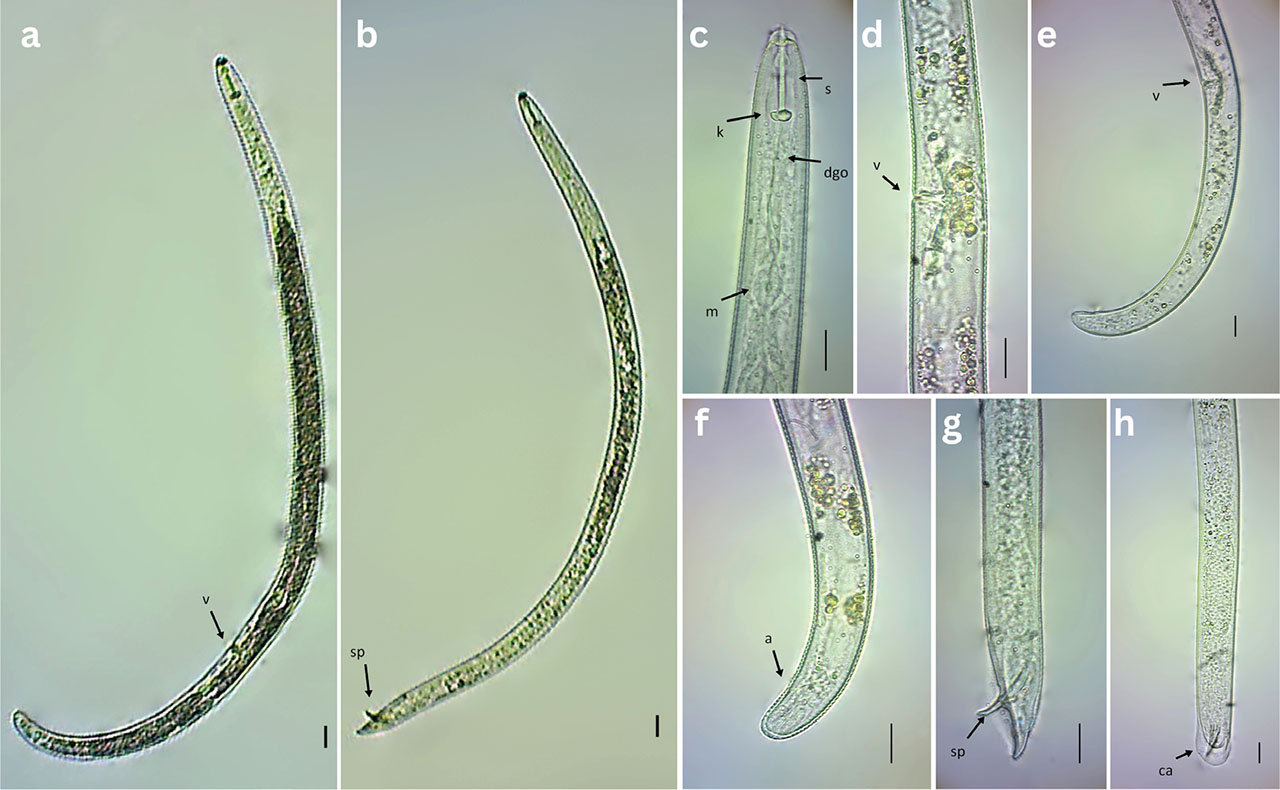
Fig. 3.
Nematode morphology of H. multicinctus. (a) female (v = vulva); (b) male (sp = spicula); (c) anterior (s = stylet; k = knob; dgo = dorsal gland opening; m = metacorpus); (d) vulva (v); (e,f) female posterior (v = vulva; a = anus); (g,h) male posterior (sp = spicule, ca = caudal alae). Magnification: (a,b) 100x; (c,d,f,g) 1000x; (e,h) 400x. Scale bar: 10 μm
The morphometry of H. multicinctus in this study consisted of 8 females and 4 males (Table 4). Female nematodes with body length = 541 ± 71.4 (410.4 – 642) μm; largest body diameter = 23 ± 2.9 (18.6 – 26.2) μm; anterior distance to vulva = 367 ± 46.2 (281.7 – 429.9) μm; stylet length = 27.5 ± 1.6 (29.3 – 24.3) μm; DGO = 9.6 ± 1.8 (6.2 – 12.1) μm; and tail length = 12.2 ± 1.3 (10.6 – 15.4) μm. Based on measurements, the position of the vulva from the anterior is at 67.9 % of the body length. Male nematodes with body length = 494.3 ± 18.8 (467.3 – 516.4) μm; largest body diameter = 17.5 ± 1.4 (15 – 18.8) μm; stylet length = 24.5 ± 0.9 (23.5 – 25.8) μm; DGO = 9 ± 0.4 (8.6 – 9.6) μm; and tail length = 13.5 ± 0.9 (12 – 14.5) μm. The size of female nematodes is larger than that of males.
Table 4.
Morphometrics of Helicotylenchus multicinctus from the Jetis, Yogyakarta Special Region was compared with populations of H. multicinctus from Greece ((Tzortzakakis et al., 2017). Measurement unit = μm, mean ± standard deviation (range).
| Species | H. multicinctus (this study) | H. multicinctus (Tzortzakakis et al., 2017) | ||
|---|---|---|---|---|
| Location | Yogyakarta, Indonesia | Tertsa, Greece | ||
| Host | Banana (Musa sp.) | Banana (Musa sp.) | ||
| Female | Male | Female | Male | |
| N | 8 | 4 | 4 | - |
| L | 541 ± 71.4 (410.4 – 642) | 494.3 ± 18.8 (467.3 – 516.4) | 570 ± 65.4 (508 – 640) | - |
| a | 23.6 ± 2.3 (19.8 – 27) | 28.5 ± 1.7 (26.8 – 31) | - | - |
| b | 1.03 ± 0.01 (1.02 – 1.05) | 1.03 ± 0 (1.03 – 1.03) | - | - |
| b' | 4.70 ± 0.69 (3.51 – 5.81) | 4.59 ± 0.11 (4.43 – 4.75) | - | - |
| c | 44.8 ± 7.2 (32.7 – 50.8) | 36.9 ± 2.8 (33.4 – 40.4) | - | - |
| c' | 1 ± 0.2 (0.8 – 1.4) | 50.8 ± 2.6 (46.5 – 53.3) | - | - |
| V (%) | 67.9 ± 1.1 (66.2 – 69.1) | - | - | - |
| Tip lip width | 4.3 ± 0.3 (4 – 4.9) | 4 ± 0.5 (3.3 – 4.6) | - | - |
| Base lip width | 7.6 ± 0.5 (7 – 8.4) | 6.4 ± 0.3 (6 – 6.7) | - | - |
| Lip height | 3.7 ± 0.5 (3. – 4.4) | 3.4 ± 0.5 (2.6 – 3.8) | - | - |
| S | 27.5 ± 1.6 (29.3 – 24.3) | 24.5 ± 0.9 (23.5 – 25.8) | 22.3 ± 1.0 (21.0 – 23.0) | - |
| Knob width | 5.4 ± 0.4 (4.9 – 5.9) | 4.3 ± 0.3 (3.8 – 4.7) | - | - |
| Knob height | 2.7 ± 0.4 (1.9 – 3.2) | 2.3 ± 0.2 (2.2 – 2.6) | - | - |
| DGO | 9.6 ± 1.8 (6.2 – 12.1) | 9 ± 0.4 (8.6 – 9.6) | 8.8 ± 0.6 (8.0 – 9.5) | - |
| Anterior distance to EP | 96.5 ± 8.1 (83 – 106.5) | - | 89.3 ± 4.8 (84.0 – 95.0) | - |
| Anterior distance to the vulva | 367 ± 46.2 (281.7 – 429.9) | - | - | - |
| Vulva distance to the posterior | 168.6 ± 29.9 (119.5 – 212.1) | - | - | - |
| Vulva distance to the anus | 156.9 ± 29.7 (108.8 – 200.2) | - | - | - |
| t | 12.2 ± 1.3 (10.6 – 15.4) | 13.5 ± 0.9 (12 – 14.5) | 11.0 ± 0.8 (10.0 – 12.0) | - |
| W | 23 ± 2.9 (18.6 – 26.2) | 17.5 ± 1.4 (15 – 18.8) | - | - |
| Vulva body width | 21 ± 3.4 (16.2 – 26) | - | - | - |
| Anus/cloaca body width | 12.5 ± 1.2 (10.7 – 14) | 9.8 ± 0.7 (8.9 – 10.9) | - | - |
[i] Notes: same as Table 2.
Molecular characteristic
The 28S rRNA sequence of R. similis from Turi, Yogyakarta was amplified with a primer pair of D2A (forward) and D3B (reverse) with a length of 557 bp. BLASTN analysis for R. similis from Turi, Yogyakarta showed this species had an identity percentage of 98.74 % with R. similis from Tanzania (MK333515). While the 28S rRNA sequence from P. coffeae from Kasihan, Yogyakarta has 640 bp long. Based on BLASTN, P. coffae from Kasihan has the highest identity percentage of 98.90 % with P. coffeae from China with accession numbers of (MT160082) and (MG906763). In addition, the 28S rRNA sequence from H. multicinctus from Jetis, Yogyakarta has 565 bp long. Based on BLASTN, H. multicinctus in this study has the highest identity percentage of 99.47 % with H. multicinctus from Nigeria (MN056344) and 99.11 % from China (KF443214).
Phylogenetic analysis
Phylogenetic analysis was carried out to determine the relationship between the nematode species found and other species from GenBank. The phylogenetic trees of R. similis, P. coffeae, and H. multicinctus are revealed in Figure 4, Figure 5, and Figure 6, respectively. Using the Globodera rostochiencis species as an outgroup, it was shown that the R. similis from Turi, Yogyakarta (OR821832) isolate was placed in a monophyletic clade with R. similis from Tanzania (MK333515, KY828307, KF234211), China (JQ782261), and Colombia (GQ281468) with a bootstrap value of 100 % (Fig. 4). Furthermore, the Kasihan, Yogyakarta isolate of P. coffeae (OR821834) was placed in one monophyletic clade with P. coffeae from China (MT160082, MG906762, MG906763) and Tanzania (MK346210, MK346211), with a bootstrap value of 99 % (Fig. 5). Additionally, the Jetis, Yogyakarta isolate of H. multicinctus (OR821833) was separated from H. multicinctus populations from Nigeria (MN056344), China (KF443214), Sudan (DQ328746), Vietnam (KM603531, KM603533), Brazil (MT239110), India (MH087066), Florida (HM014292), Greece (MF401446), and Colombia (MT321732) (Fig. 6).
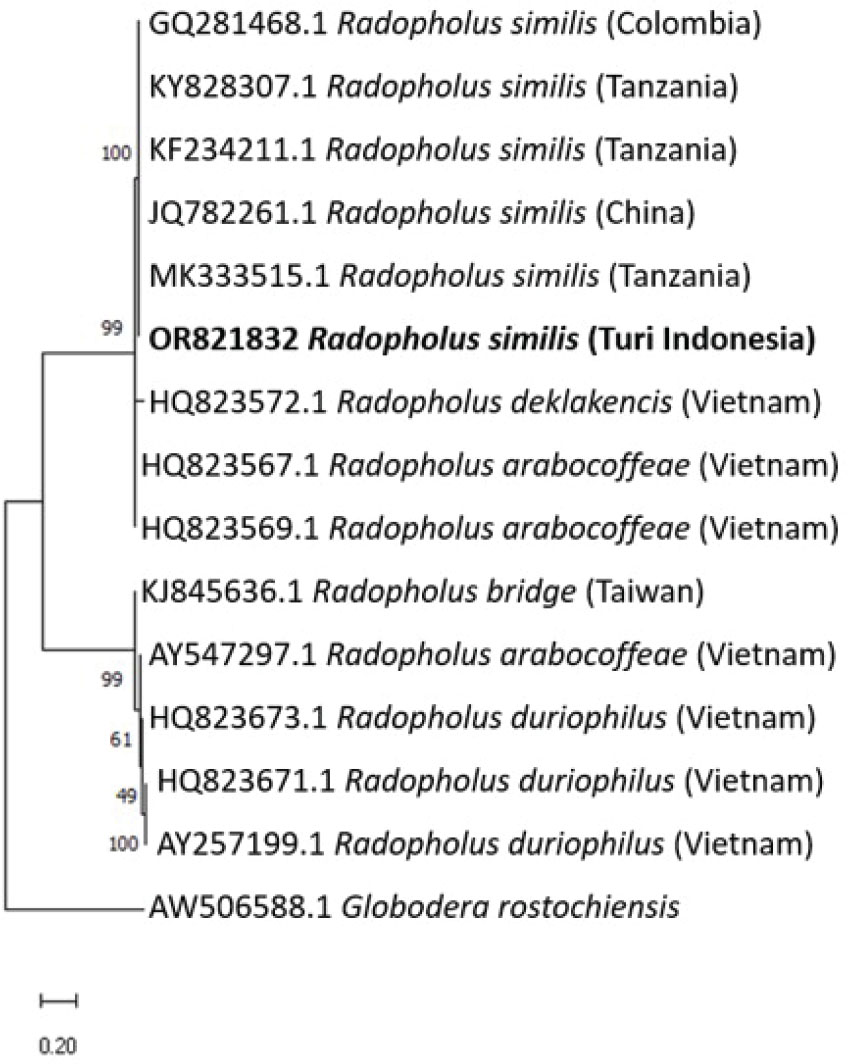
Fig. 4.
Maximum likelihood phylogenetic tree of partial 28S rRNA segments with the Kimura-2 (K2) model from the species R. similis identified in Turi, Yogyakarta, Indonesia. The substitution model is selected based on the lowest Bayesian Information Criterion (BIC) value. The model with the lowest BIC value is considered to best describe the substitution pattern. ML tree was performed in the MEGA XI program
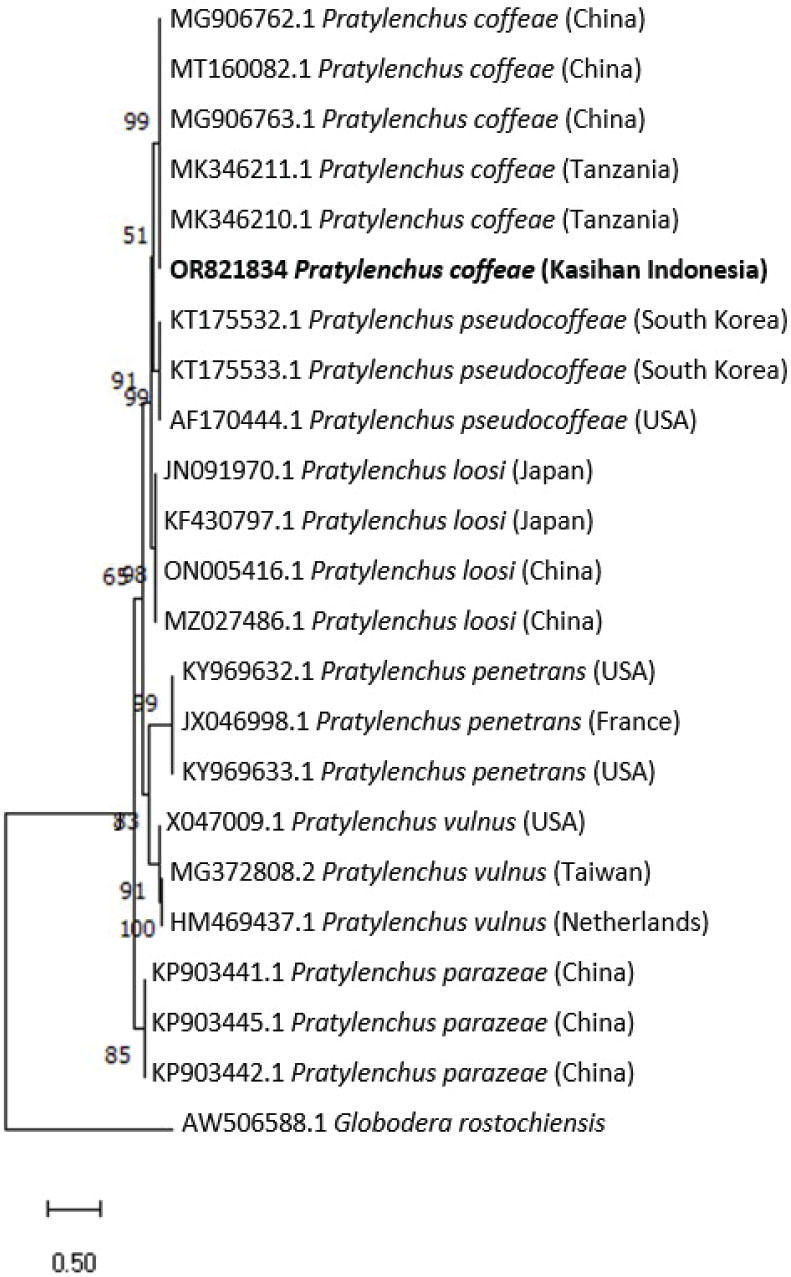
Fig. 5.
Maximum likelihood phylogenetic tree of partial 28S rRNA segments with the Kimura-2 model and Gamma (K2+G) distribution pattern of the P. coffeae species identified in Kasihan, Yogyakarta, Indonesia. The substitution model is selected based on the lowest Bayesian Information Criterion (BIC) value. The model with the lowest BIC value is considered to best describe the substitution pattern. ML tree was performed in the MEGA XI program
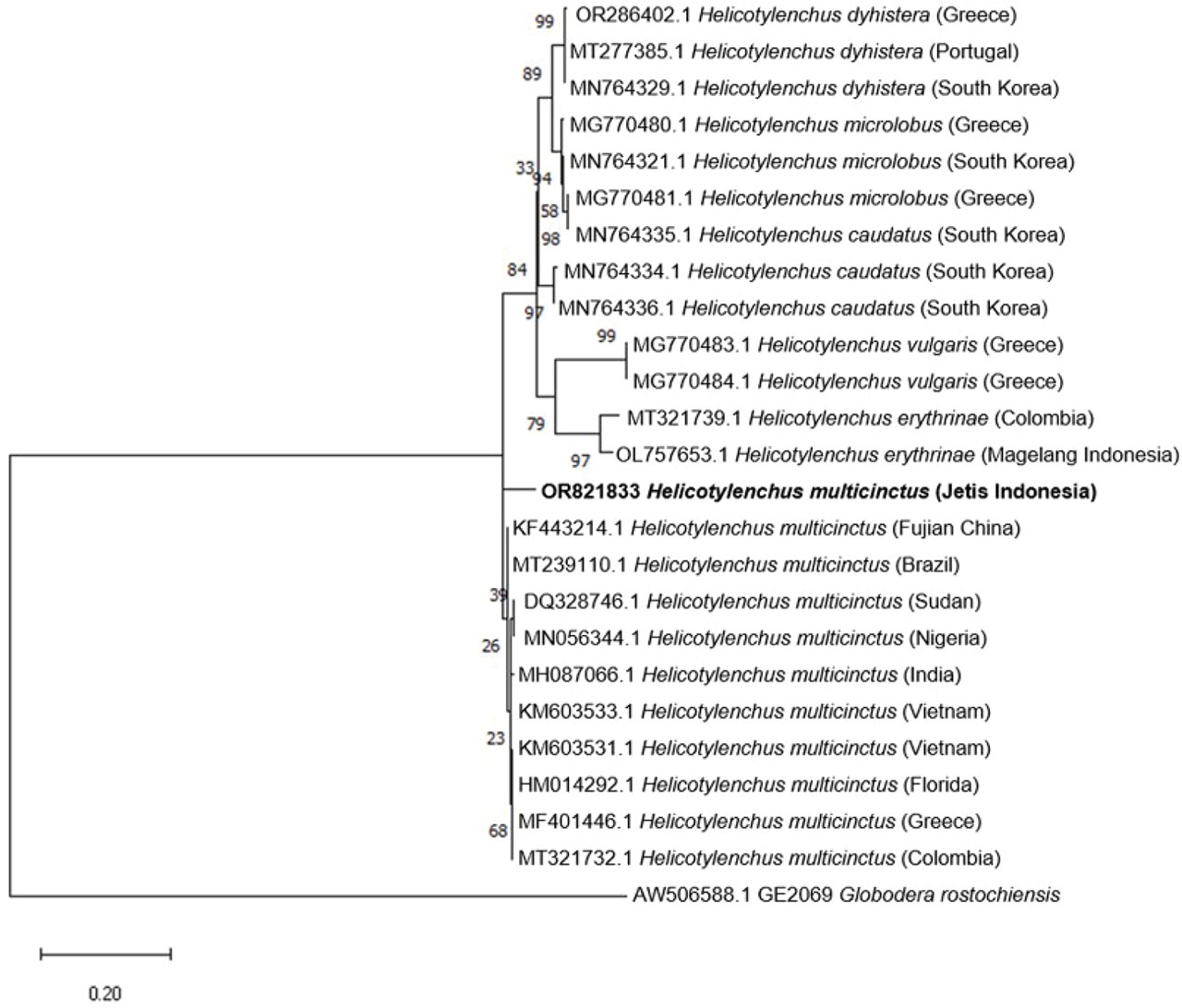
Fig. 6.
Maximum likelihood phylogenetic tree of partial 28S rRNA segments with the Kimura-2 (K2) model from the species H. multicinctus identified in Jetis, Yogyakarta, Indonesia. The substitution model is selected based on the lowest Bayesian Information Criterion (BIC) value. The model with the lowest BIC value is considered to best describe the substitution pattern. ML tree was performed in the MEGA XI program
Discussion
This study provides information on the occurrence of the R. similis, P. coffeae, and H. multicinctus in banana plantations in the Yogyakarta Special Region Province. The symptoms on root plants were difficult to observe for each species due to similar activities of Radopholus and Pratylenchus. De Waele & Elsen (2002) mentioned that both genera migrate inter- and intracellularly in roots that lead to the collapse of cell wall and create cavities and tunnels that necrotic appears as a result. Roy et al., (2014) mentioned that R. similis, H. multicinctus, and P. coffeae were the abundant nematode endoparasites in banana crops in Kerala.
The genus of Radopholus is known as a main serious pest in banana plants which is a migratory endoparasitic nematode that causes long-term damage to roots (Sarah et al., 1996). More than 30 species in this genus are assumed originally from the Indo-Malayan or the Australasia regions (Duncan & Moens, 2006). The measurement of R. similis revealed that the body size of female R. similis in this study is larger than that of R. similis from Kerala (Roy et al., 2018). The intraspecies morphological characteristics of R. similis are varied. In the previous study, the number of head annules of R. similis population in Africa varied between 3, 2 – 5, and 5 (Elbadri et al., 1999). Xu et al. (2014) described the variation of tail shape among R. similis populations from three countries (China, Malaysia, and Singapore) and different hosts. The tail shape of R. similis in this study varied, usually conical, large cylindrical, or having a pointed tip. However, morphological separation of R. similis species from other species such as R. arabocoffeae and R. duriphilus can be observed depending on the lateral field, stylet length, and presence or absence of a rectal sac (Uribe et al., 2010). The morphological characters of P. coffeae population in this study are similar to those described by Budiman et al. (2019) and Tuyet et al. (2012). There are variations of morphological characters and morphometrics of P. coffeae in this population in this study. The measurement of P. coffeae population from Yogyakarta was compared with P. coffeae populations from Malang, Indonesia (Budiman et al., 2019) and Dien Bien, Vietnam (Tuyet et al., 2012). The body size of female P. coffeae is larger than that of female P.coffeae from Malang, Indonesia (Budiman et al., 2019), while the male size is smaller. In contrast, the females and the male size of the P. cofeae population in this study are smaller than the population in Dien Bien (Tuyet et al., 2012). In general, Pratylenchus species in this study were described similarly to Jones & Fosu-Nyarko (2014) who mentioned the body length of genus Pratylenchus is between 0.35 – 0.50 μm, the outer part of the nematode body consists of a cuticle with annulation, hypodermis or epidermis, and somatic muscles. P. coffeae has morphological characteristics, including a short, dense, and hollow stylet, with a well-developed knob for penetration through the cell wall. Through the stylet cavity, the cytoplasmic fluid of plant cells enters the nematode's body (Castillo & Vovlas, 2007).
The measurement of H. multicinctus from Yogyakarta revealed that the body sizes of female and male are smaller than H. multicinctus from Tertsa (Tzortzakakis et al., 2017). Daramola et al. (2020) described the morphological characters of H. multicinctus from Nigeria. The population of H. multicinctus from Nigeria has a lip region hemispherical, slightly offset, with three to five annules. Stylet well developed (21 – 24) μm. Stylet knobs are prominent (5 – 6 μm), wide, appearing anteriorly flattened or concave. The median bulb is round to oval in shape and overlaps the gut ventrally. The vulva is a depressed transverse slit at 67 % of the body length. Phasmids located from one to six annules anterior to the anus level. The tail slightly tapering and curved more dorsally than ventrally, with six to fifteen annules. This description is similar to H. multicinctus in our study.
The D2 and D3 expansion segments of 28S rRNA are frequently sequenced in nematode phylogenetic studies due to the availability of conserved primers that amplify DNA from many taxa. These expansion segments are considered a promising locus for nematode DNA barcoding (De Ley et al., 2005). Subbotin et al. (2007) reported a unique lineage between H. pseudorobustus and H. multicinctus. These two species have very different morphologies in the shape of the tail and stylet knob. However, based on phylogenetic analysis of the D2 and D3 expansion segments, the two species are closely related. A recent study in Indonesia by Maharani et al. (2023) showed that species of H. erythrinae has been identified molecularly by D2 and D3 expansion segment. In the previous study (Duncan et al., 1999), the D2 and D3 expansion segments were used to separate species within the genus Pratylenchus including P. coffeae, P. loosi, P. hippeastri, P. gutierrezi, P. jaehni, P. scribneri, P. agilis, P. hexincisus, P. thornei, P. mediterraneus, P. neglectus, P. brzeskii, P. dunensis, P. penetrans, P. fallax, P. arlingtoni, P. pinguicaudatus, and P. convallariae. For the morphologically similar burrowing nematode R. similis, the D2 and D3 segment sequences of each were identical despite being collected from different locations and pathogenicity on citrus plants.
This study clarified three species of PPNs from banana plantations in the Yogyakarta Special Region (R. similis, P. coffeae, and H. multicinctus). The species H. multicinctus was described for the first time in Indonesia, morphologically and molecularly, particularly in the Yogyakarta Special Region. The results provide information related to these three species for future development in phytopathological and ecological studies, as well as appropriate control techniques.
Conclusions
Based on morphological characters, morphometric and molecular, R. similis, P. coffeae, and H. multicinctus were three species of dominant plant parasitic nematodes that infected banana plantations in the Special Region of Yogyakarta. These results could be the first step for the development of future research on the level of damage and control of banana plant parasitic nematodes.
Notes
Acknowledgement
This study was financially supported by Universitas Gadjah Mada through the Academic Excellence Improvement Program with Number 7725/UN1.P.II/Dit-Lit/PT.01.03/2023.