

1. Introduction
Businesses must be able to distinguish themselves from their competitors by the items they make and cultivate a favorable reputation among consumers for their superior products to stand up to fierce competition. To dominate market share, businesspeople need to be able to design items that are appealing to consumers, hold onto market share, and maintain market share. Currently, many people are taking advantage of developments in information technology used by marketers, businesspeople, and individuals. Because there are lots of benefits to be had if you can continue to take advantage of today's sophisticated information technology. Moreover, if you can provide the business you need, then, of course, a good relationship will be created, and that could be a very appropriate business opportunity (Bris, et al., 2021; Maurya, Agarwal and Srivastava, 2021; McLean, Osei-Frimpong and Barhorst, 2021; Xu, et al., 2021; Zhang, et al., 2021). According to Kotler, Keller and Chernev (2022), digital marketing has dominated various industries, with social media marketing being the most effective strategy for attracting attention and maintaining customer loyalty. Research conducted by Dwivedi, et al. (2021) shows that a human-centric approach to building a brand can create a stronger emotional connection with consumers, while digital anthropology plays an important role in understanding consumers' digital behavior patterns. However, although various studies have proven the effectiveness of these factors, there are still similarities in understanding how brand appeal can act as a mediator in the relationship between the three variables and branding performance.
Performance branding plays a major role in the key to the success of an organization by creating a competitive advantage through brand performance using related service and non-product performance. People can see the differences in products through the branding of each different company. Brands affect yearly sales volume and revenue. They also increase market share and cash flow turnover. Performance branding displays a brand's standing based on consumers' unbiased evaluation of its quality. Therefore, the rate of brand switching decreases with improved brand performance. Brand performance is related to the way a product or service meets consumer needs functionally (Chen, Li and Joo, 2021; Cao, Lin and Zhou, 2022; Eriksson, Näppä and Robertson, 2022; Yu, Wang and Liu, 2022; Liu, Yang and Nie, 2023).
Marketers use social media platforms to establish their brands. Strong social media will help customers see brands as having high value, which will boost branding effectiveness. Brand–customer communication is undergoing a fundamental transformation, thanks to social media interactions. One of the main sources of inspiration for content creation is social interaction. Social media can benefit users by providing a forum for conversation and idea sharing. Social engagement describes users who contribute to brand-related social media platforms to meet like-minded people, interact, and talk with them about a specific product or brand (Maurya, Agarwal and Srivastava, 2021; Piha, Papadas and Davvetas, 2021; Audouin, 2022; Huang, et al., 2022; Zhang, et al., 2022).
A human-centered brand focuses on gaining market share, mind share, and heart share through value-based and market-oriented marketing strategies. When improving the value of the product or service is combined with marketing plans and techniques, the world of marketing may function at its best. Increasing value here means how a company can build a strong brand, provide services that make customers loyal, and carry out processes that suit customer wants and needs. So, marketing value is so important that a company must create value from its products to be able to achieve customer heart share. A brand, as one of the most important parts of increasing value, is a good name that becomes the identity of a person or company (Du and Lin, 2022; Mittal, Gupta and Mottiani, 2022; Guo and Luo, 2023; Li and Wang, 2023; Rahman, et al., 2023). The term "digital anthropology" can be used to describe the effects of the development of digital technologies on certain populations, the application of these tools to anthropological research, or the examination of particular digital technologies. However, this topic can also raise broader questions about the nature of contemporary anthropology itself, both what it means to be human today and how anthropology as a scientific discipline must incorporate worlds that have never existed before and were not possible in the past (Xu, et al., 2021; Zhang, et al., 2021; Siano, Vollero and Bertolini, 2022; Yang, Li and Choe, 2022; Choi and Turut, 2023).
Brand attraction is positively correlated to the success of a brand and depends on the level of brand awareness. Brand attraction refers to a brand’s ability to capture customer interest and encourage purchase decisions. The first thing that must be understood well by businesspeople in building brand attraction is to understand business fundamentals. The product you make must be a solution to basic human needs for a product. For example, people will always look for product X and make repeat purchases if the product has a consistent taste. If a product is never consistent with a taste that satisfies customers, then customers will quickly move on to look for another product (Maroufkhani, et al., 2022; Kim and McDonald-Liu, 2023; Nilashi, et al., 2023; Rius-Ulldemolins and Díaz-Solano, 2023; Salameh, et al., 2023).
Research by McLean, Osei-Frimpong and Barhorst (2021), Niyas and Kavida (2022), Ferraro, Hemsley and Sands (2023), Lee, Ho and Xie (2023), and Knight (2024) found that social media marketing, human-centric brands, and digital anthropology affect performance branding. However, there is a research gap in research from Kim & McDonald-Liu (2023) showing contradictory results that social media marketing, human-centric brands, and digital anthropology do not affect branding performance.
The issue under investigation in this study is the ability of businesses to produce goods that are highly competitive in the commercial market, which will inevitably have an impact on annual sales growth. But the corporation only offers one kind of excellent product that consistently commands the highest sales, allowing it to have an impact on how consumers perceive performance branding. This research adds to our understanding of how human-centered design and social media play a part in creating brand appeal, as well as how these factors affect brand performance. This provides new insight into previous research that may not have explored this relationship in depth. Novelty in the research is brand attraction as an intervening variable because brand attraction will have an impact on increasing branding performance, which is supported by social media marketing, human-centric brands, and digital anthropology. Integration of social media marketing, human-centric brand, and digital anthropology aspects through the mediation approach of Attraction Brand has not been studied much before. The main objective of this study is to identify and analyze how Attraction Brand mediates the relationship between social media marketing, human-centric brands, and digital anthropology on branding performance, so that it can provide new insights into managing a more effective and sustainable digital branding strategy.
2. Literature review
This research uses Branding Theory as the basis for the research. According to Kotler (2017), the definition of branding is the provision of names, terms, signs, symbols, designs, or a combination of these, which are created to identify goods or services or groups of sellers and to differentiate them from competing goods or services. According to Neumeier (2014), branding is any effort or program designed to increase value or avoid commoditization by building a different brand. According to Kotler and Keller (2018), branding is giving brand strength to products and services. However, branding itself is not limited to product differentiation, but is also related to trademarks, visual characteristics, credibility, perception, logos, images, impressions, characters, and also consumers' perceptions of the product.
Branding Theory explains how brands can build identity, image, and appeal in the eyes of consumers. Attraction Brand is a concept rooted in Branding Theory, which emphasizes that the appeal of a brand greatly determines success in attracting customer attention and loyalty (Kapferer, 2012). According to Kotler, Keller and Chernev (2022), Social Media Marketing contributes to Branding Theory by forming brand equity through online consumer interactions. Strong branding on social media creates higher engagement, increases brand appeal, and ultimately impacts branding performance.
Branding Theory emphasizes that a successful brand is a brand that has an emotional connection with its consumers (Aaker, 1996). The human-centric brand approach focuses on personalization and empathy for customer needs, which is in line with the Branding Theory principle that a brand must have values and identities that match the expectations of its consumers to increase brand appeal and performance. Digital anthropology helps us understand how digital consumer behavior develops and how people interact with brands online. Branding Theory emphasizes that understanding consumer behavior is essential in forming an effective marketing strategy (Holt, 2004). Branding Theory explains that brand performance (performance branding) is influenced by various factors, including brand appeal, marketing strategy, and consumer engagement (Kotler, Keller and Chernev, 2022).
2.1. The relationship between social media marketing and performance branding through brand attraction
The mission of Attraction Brand is to support network marketers in creating a brand and implementing an attraction marketing system that will boost revenue and lead generation. Social media offers a means of boosting brand awareness using pertinent and captivating content. A strong content strategy allows brands to reach more people and raise their profile (Kotler, Keller and Chernev, 2022). Social media allows businesses to communicate with customers directly, which can improve rapport and boost engagement. Engaging and responsive content can build loyalty and strengthen brand appeal. So, by utilizing social media effectively, brands can increase their appeal, strengthen their identity, and ultimately improve branding performance. Good brand attraction can create stronger relationships with consumers and drive long-term success in a competitive market (Kotler, Keller and Chernev, 2022). Research results (Maroufkhani, et al., 2022; Kim and McDonald-Liu, 2023; Nilashi, et al., 2023; Rius-Ulldemolins and Díaz-Solano, 2023; Salameh, et al., 2023) show that social media marketing affects performance branding through brand attraction. So, it can be concluded that:
H1: Social media marketing affects brand attraction.
H4: Social media marketing affects performance branding.
H8: Social media marketing influences branding performance through brand attraction.
2.2. The relationship between brand attraction and branding performance
As part of a marketing plan, brand attraction is demon-strating to potential customers how your brand's goods or services may enhance their lives. To do this, comprehend the issues that your ideal client has and offer helpful, free material to address them. This applies to all business kinds, such as network marketing, eCommerce, professional services, and online instruction (Aaker, 1996). Research results (Xu, et al., 2021; Zhang, et al., 2021; Siano, Vollero and Bertolini, 2022; Yang, Li and Choe, 2022; Choi and Turut, 2023) show that human-centric brands influence performance branding. So, it can be concluded that:
H7: Brand attraction influences branding performance.
2.3. The relationship between human-centric brands and performance branding through brand attraction
A human-centric brand is a brand that places humans—namely consumers and stakeholders—at the center of its strategy and operations. The brand strives to understand and meet consumers' emotional and functional needs with a more personal and empathetic approach (Holt, 2004). By focusing on consumer needs and wants, brands can create more relevant and engaging offers. This increases the likelihood that consumers will be interested and engaged with the brand. Brands that prioritize the human aspect tend to create a stronger emotional connection with their audience. This emotional connection can increase a brand's appeal and differentiate it from competitors. A humancentric approach often results in a more personalized and memorable experience for consumers (Holt, 2004). These positive experiences contribute to the perception of the brand as an attractive choice and can increase customer loyalty. By focusing on a humancentric approach, brands can build deeper and more engaging relationships with consumers, which in turn increases brand appeal and overall branding performance (Holt, 2004). Research results (McLean, Osei-Frimpong and Barhorst, 2021; Niyas and Kavida, 2022; Ferraro, Hemsley and Sands, 2023; Lee, Ho and Xie, 2023; Knight, 2024) show that human-centric brands influence brand performance through brand attraction. So, it can be concluded that:
H2: Human-centric brands influence brand attraction.
H5: Human-centric brands influence performance branding.
H9: Human-centric brands influence branding performance through brand attraction.
2.4. The relationship between digital anthropology and performance branding through brand attraction
Digital anthropology is a branch of anthropology that studies human interaction with digital technology and how this technology influences culture, behavior, and identity. In a marketing context, this involves analyzing how consumers use digital platforms, interact with content, and shape their identities online. Digital anthropology provides insight into how consumers behave and interact on digital platforms. Understanding this digital context helps brands create more relevant and engaging experiences and content (Holt, 2004). Digital anthropology helps brands understand the cultural and social context of consumers in the digital world. This allows brands to create content that is resonant and relevant to the audience's background and interests. Insights from digital anthropology can help brands create more authentic and meaningful interactions with consumers on digital platforms. Deeper and more authentic engagement can strengthen the emotional connection between brands and consumers. By leveraging insights from digital anthropology, brands can create more sophisticated and targeted strategies to capture attention and build stronger relationships with their audiences. This can improve branding performance and overall brand appeal (Holt, 2004). Research results (Jain, et al., 2022; Meyer, González and Lopez-Lomelí, 2022; Sokołowska, et al., 2022; Bazi, Filieri and Gorton, 2023; Sakas, et al., 2023) show that Digital Anthropology influences performance branding through brand attraction. So, it can be concluded that:
H3: Digital Anthropology influences brand attraction.
H6: Digital Anthropology influences performance branding.
H10: Digital Anthropology influences branding performance through brand attraction.
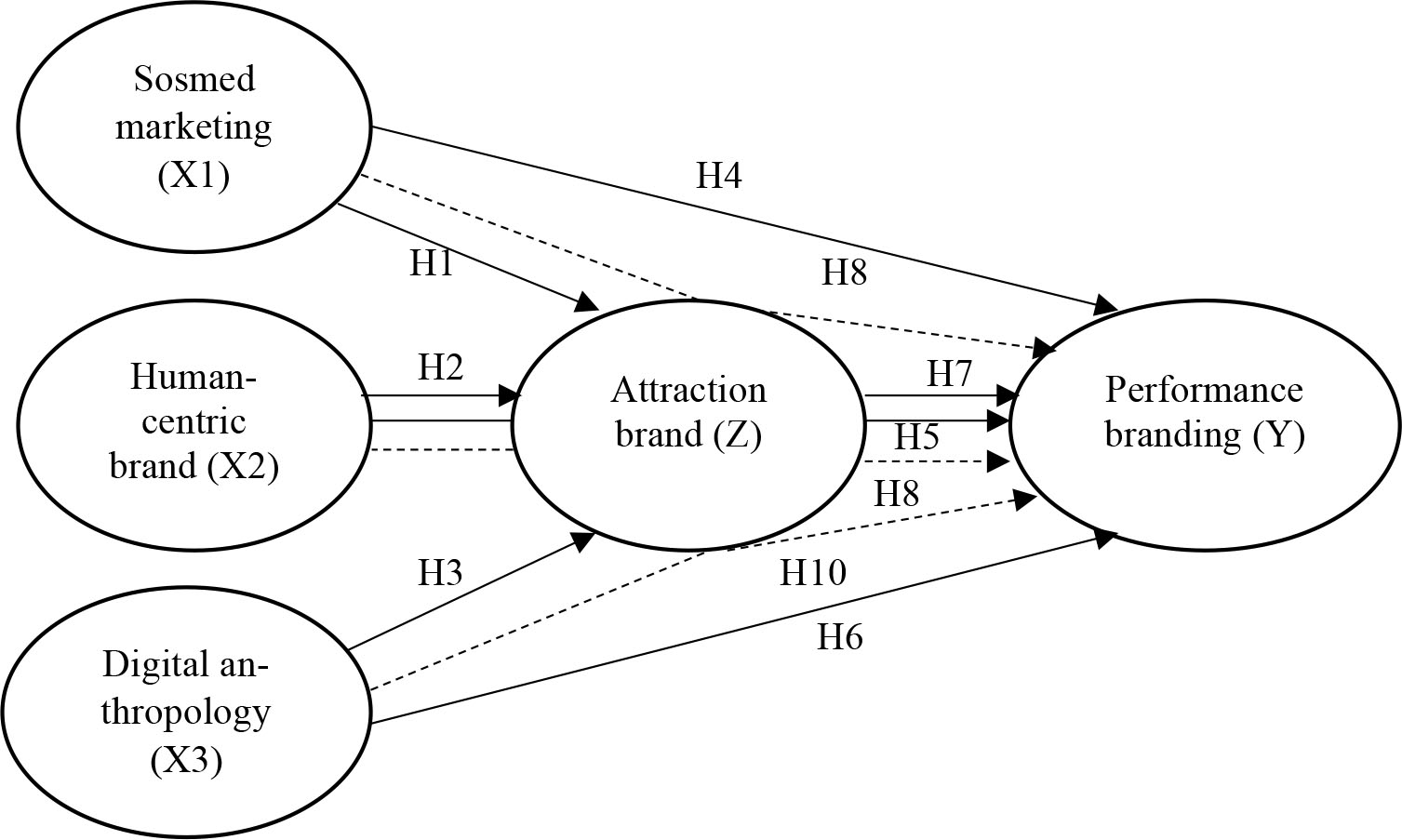
Figure 1.
Conceptual Framework
(Source: Authors’ own research, 2024)
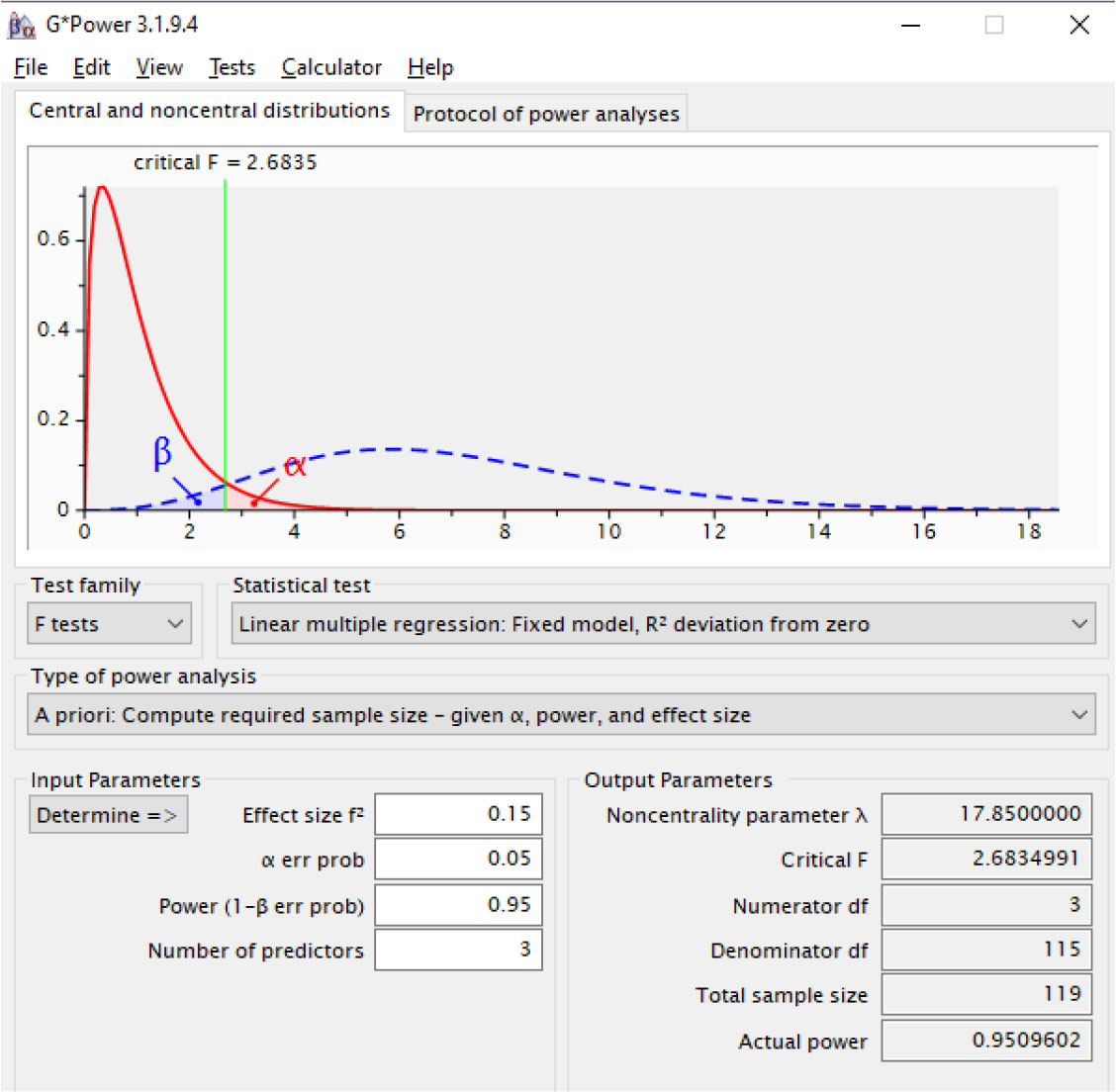
Figure 2.
G*power sample calculation result
(Source: Authors’ own research, 2024)
3. Methodology
The data analysis approach used in this study was structural equation modeling, or SEM analysis. Smart PLS software will be utilized in this project to organize the data. Structural equation modeling, or SEM, is one method for resolving the issues with the regression methodology (Hox and Bechger, 1998; Ghozali, 2014).
SEM is a multivariate data analysis method for analyzing complex relationships among constructs and indicators. To estimate structural equation models, researchers generally draw on two methods: covariance-based SEM (CB-SEM) and partial least squares SEM (PLS-SEM). Whereas CB-SEM is primarily used to confirm theories, PLS represents a causal–predictive approach to SEM that emphasizes prediction in estimating models, whose structures are designed to provide causal explanations. PLS-SEM is also useful for confirming measurement models (Hair, et al., 2021). According to Sudaryono (2017), the usage of SEM is motivated by two factors. Firstly, SEM is capable of estimating various connections between variables. A structural model (the relationship between dependent and independent conceptions) forms this relationship. Second, the pattern of correlations between manifest variables (also known as indicator variables) and latent (unobserved) components can be described using SEM.
The population in this research is all consumers of products with brand attractions in East Java province, Indonesia. This research uses G*power to determine the sample size (Sofyani, 2023). Consumers who are interested in certain products originating from social media content are the sample criteria. A total of 980 questionnaires were distributed across several cities in East Java. From the results of the questionnaire distribution, 500 samples were used that met the research criteria.
Based on the results of sample calculations using G*power, the minimum sample size is 119 respondents. So, the researchers used 500 companies using the proportional random sampling method.
Operational definition of variables
Social media marketing (X1) consists of indicators for content creation, content sharing, connecting, and community building.
Human-centric brand (X2) consists of physical indicators, intellectuality, friendliness, and emotionality.
Digital anthropology (X3) consists of indicators of accessibility, interactivity, entertainment, and credibility.
Brand attraction (Z) consists of indicators of politeness, attractiveness, ability, and consumer admiration.
Performance branding (Y) consists of specific, measurable, achievable, and relevant indicators.
4. Results
Based on the data provided in Table 1, the majority of respondents are in the age range of 21–30 years (49.2%), followed by the 31–40 years group (37.6%), and the least are in the age range of 41–50 years (13.2%). In terms of gender, respondents are more dominated by men (55.2%) than women (44.8%). In terms of last education, most respondents have a high school education level (81.8%), followed by bachelor's degrees (37.6%), while those with elementary school education (6.8%) and junior high school (11.4%) form a smaller percentage. In terms of domicile, respondents are spread across several cities, with the largest number coming from Surabaya City (22.3%), followed by Jember (20.8%) and Malang (14.6%). Meanwhile, other cities such as Sidoarjo (9.8%), Banyuwangi (8.4%), Kediri (8.9%), and Pasuruan (8.6%) have a smaller proportion, while respondents from other cities amount to 6.6%. Overall, these data show that respondents in this study are dominated by the young age group (21–30 years), male, high school educated, and mostly domiciled in the cities of Surabaya and Jember. This provides an overview of the main characteristics of the population that is the object of the study.
Table 1.
Characteristics of Respondents
(Source: Authors’ own research, 2024)
| Category | Mark | Percentage (%) |
|---|---|---|
| Age | 21–30 years | 49.2 |
| 31–40 years | 37.6 | |
| 41–50 years | 13.2 | |
| Gender | Man | 55.2 |
| Woman | 44.8 | |
| Last education | Elementary school | 6.8 |
| Junior high school | 11.4 | |
| Senior high school | 81.8 | |
| Bachelor | 37.6 | |
| Residence | Surabaya City | 22.3 |
| Malang City | 14.6 | |
| Jember City | 20.8 | |
| Sidoarjo City | 9.8 | |
| Banyuwangi City | 8.4 | |
| Kediri City | 8.9 | |
| Pasuruan City | 8.6 | |
| Others | 6.6 | |
| Total | 100% | |
In this study, the researchers determined the threat of CMB by using Harman’s one-factor test. As shown in Table 2, the test results indicated that all items could be classified into five factors, and the first factor explained only 44.875% of the variance, which is well below the 50% threshold. Based on these results, CMB was not considered a normative bias.
Table 2.
Harman's one-factor test
(Source: Authors’ own research, 2024)
| Extraction Sums of Squared Loadings | ||
|---|---|---|
| Total | % of Variance | Cumulative % |
| 12.975 | 44.875 | 44.875 |
Based on the results of descriptive statistics in Table 3, it can be concluded that all variables in this study have a relatively high mean value, ranging from 17.10 to 17.40, with a fairly small standard deviation, indicating that the data is spread relatively evenly around the mean value. Table 3 shows that all variables have a relatively high assessment with relatively small data variations, indicating that respondents provide consistent evaluations of the importance of social media marketing, human-centric brands, and digital anthropology in influencing brand attraction and branding performance.
Table 3.
Statistics Descriptive Result
(Source: Authors’ own research, 2024)
| Variable | n | Min. | Max. | Mean | Std dev |
|---|---|---|---|---|---|
| Social media marketing (X1) | 500 | 11 | 20 | 17.40 | 2.32 |
| Human-centric brand (X2) | 500 | 10 | 20 | 17.35 | 2.30 |
| Digital anthropology (X3) | 500 | 8 | 20 | 17.38 | 2.42 |
| Attraction Brand (Z) | 500 | 8 | 20 | 17.18 | 2.47 |
| Performance branding (Y) | 500 | 7 | 20 | 17.10 | 2.52 |
Table 4 shows that the average variance extracted (AVE) for all constructs has a value of more than 0.7. Thus, in this research model, each research construct has reliable criteria.
Table 4.
Outer Loading and AVE
(Source: Authors’ own research, 2024)
| Variable | Code | Indicator | Outer loading | AVE |
|---|---|---|---|---|
| Sosmed marketing (X1) | X1.1 | Content creation | 0.764 | 0.779 |
| X1.2 | Content sharing | 0.827 | ||
| X1.3 | Connecting | 0.895 | ||
| X1.4 | Community building | 0.772 | ||
| Human-centric brand (X2) | X2.1 | Physical | 0.871 | 0.841 |
| X2.2 | Intellectuality | 0.825 | ||
| X2.3 | Friendliness | 0.803 | ||
| X2.4 | Emotionality | 0.854 | ||
| Digital anthropology (X3) | X3.1 | Accessibility | 0.756 | 0.735 |
| X3.2 | Interactivity | 0.725 | ||
| X3.3 | Entertainment | 0.712 | ||
| X3.4 | Credibility | 0.726 | ||
| Attraction brand (Z) | Z1 | Politeness | 0.731 | 0.742 |
| Z2 | Attractiveness | 0.722 | ||
| Z3 | Ability | 0.737 | ||
| Z4 | Consumer admiration | 0.718 | ||
| Performance branding (Y) | Y1 | Specific | 0.795 | 0.747 |
| Y2 | Measurable | 0.729 | ||
| Y3 | Achievable | 0.742 | ||
| Y4 | Relevant | 0.719 |
Table 5 indicates that both discriminant and convergent validity were met. Furthermore, every construct had a Cronbach's alpha (CA) value greater than 0.6 and every construct's composite reliability (CR) value demonstrated outcomes consistent with the rule of thumb (Fornell and Larcker, 1981). Thus, every construct satisfied the validity and reliability requirements. As a result, testing for theories might be done.
Table 5.
Fornell–Lacker Criterion
(Source: Authors’ own research, 2024)
| Variable | X1 | X2 | X3 | Z | Y | CA | CR |
|---|---|---|---|---|---|---|---|
| X1 | 0.74 | - | - | - | - | 0.842 | 0.894 |
| X2 | 0.68 | 0.93 | - | - | - | 0.937 | 0.955 |
| X3 | 0.69 | 0.91 | 0.93 | - | - | 0.876 | 0.916 |
| Z | 0.71 | 0.89 | 0.86 | 0.86 | - | 0.886 | 0.920 |
| Y | 0.70 | 0.82 | 0.80 | 0.79 | 0.81 | 0.884 | 0.922 |
As shown in Table 6, the results of the multicollinearity test show that the Variance Inflation Factor (VIF) value is below 10. So, it can be said that there is no multicollinearity in each of the research variables (Ghozali, 2021). The model is said to fit if the RMS theta value is <0.12 (Henseler, Ringle and Sarstedt, 2016).
Table 6.
Multicollinearity and Model Fit Test
(Source: Authors’ own research, 2024)
| Variable | Variance Inflation Factor (VIF) | Root Mean Square Theta |
|---|---|---|
| Sosmed marketing (X1) | 2.705 | 0.11 |
| Human-centric brand (X2) | 2.712 | 0.08 |
| Digital anthropology (X3) | 2.606 | 0.07 |
| Attraction brand (Z) | 2.419 | 0.09 |
| Performance branding (Y) | - | 0.10 |
Partial Least Square
The outcomes of data processing can be utilized to address the study hypothesis. The T-statistics and P-values were analyzed during the hypothesis testing phase of this investigation. The study hypothesis can be accepted if the P-values are less than 0.05. The following is a list of the results of the hypothesis testing that this study's internal model produced (Figure 3).
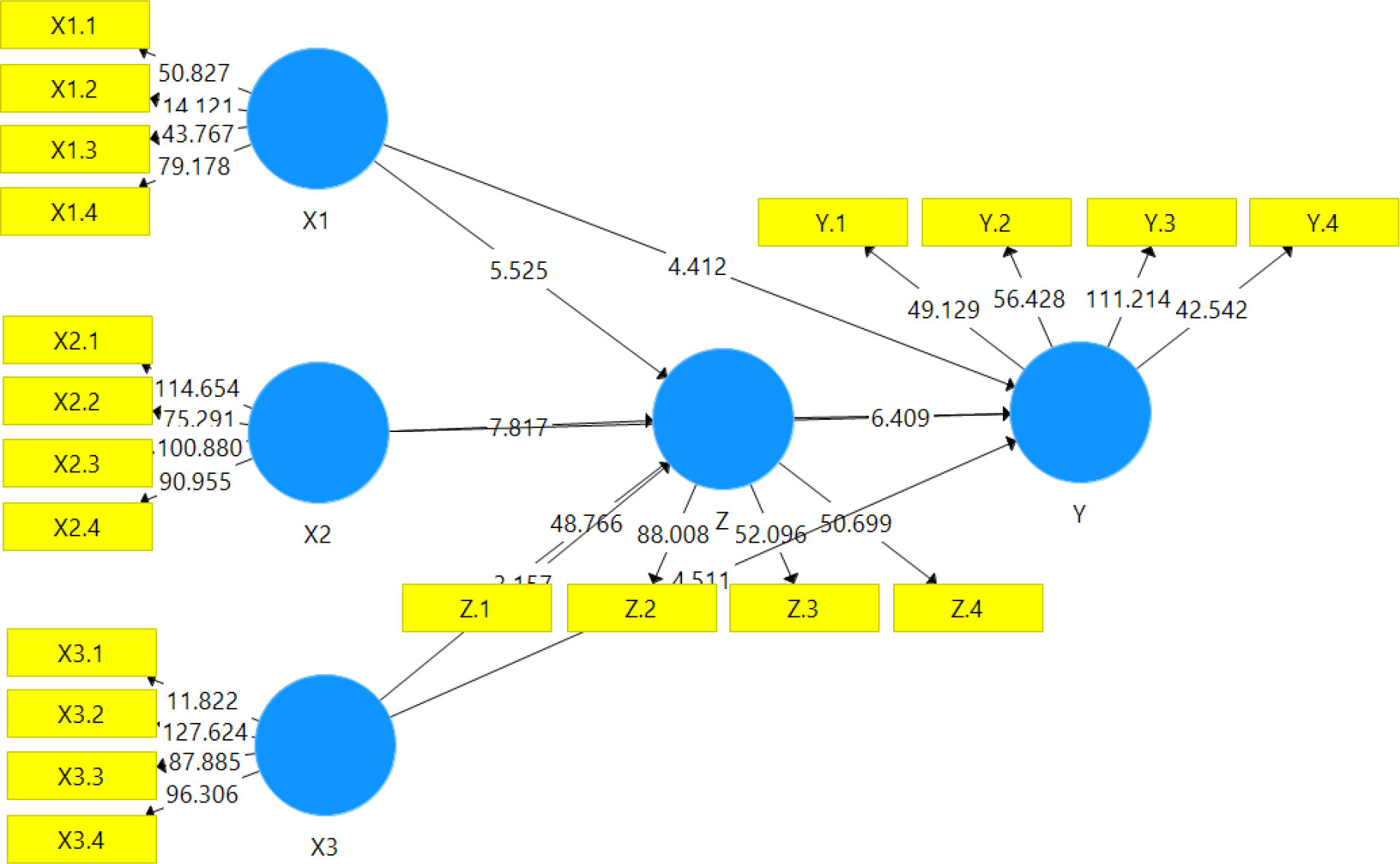
Figure 3.
Partial Least Square Result test
(Source: Authors’ own research, 2024)
The outcomes of the structural model were analyzed using the Partial Least Squares method. The results are presented in Figure 2, which illustrates the direct and indirect relationships among the variables, and are further detailed in Table 7. The hypothesis testing was conducted using t-statistics and p-values, with results summarized below.
Table 7.
Hypothesis Testing
(Source: Authors’ own research, 2024)
| Hypothesis | Variable | Original sample | P-value | Std dev. | Result |
|---|---|---|---|---|---|
| H1 | Social media marketing – attraction brand | 0.244 | 0.000 | 5.587 | Supported |
| H2 | Human-centric brand – attraction brand | 0.469 | 0.000 | 7.697 | Supported |
| H3 | Digital anthropology – attraction brand | 0.211 | 0.002 | 3.116 | Supported |
| H4 | Social media marketing – performance branding | 0.199 | 0.000 | 4.164 | Supported |
| H5 | Human-centric brand – performance branding | 0.073 | 0.021 | 4.126 | Supported |
| H6 | Digital anthropology – performance branding | 0.307 | 0.000 | 4.576 | Supported |
| H7 | Attraction brand – performance branding | 0.360 | 0.000 | 6.460 | Supported |
| H8 | Social media marketing – performance branding through attraction brand | 0.088 | 0.000 | 4.610 | Supported |
| H9 | Human-centric brand – performance branding through attraction brand | 0.168 | 0.000 | 5.125 | Supported |
| H10 | Digital anthropology – performance branding through attraction brand | 0.076 | 0.011 | 2.552 | Supported |
In Table 7, the influence between variables directly and indirectly shows significant results with a p-value less than 0.05 and the direction of the coefficient shows a positive direction.
5. Discussion
5.1. The influence of social media marketing on brand attraction
The study's findings indicate that brand appeal is impacted by social media marketing. Social media allows brands to interact directly with audiences, build closer relationships, and increase brand appeal. Interesting and relevant content can quickly reach many people through sharing, liking, and commenting. Reviews, testimonials, and positive interactions on social media increase consumer trust in brands. Social media allows brands to appear more personal and authentic, thereby increasing emotional appeal to brands. Branding theory (Aaker, 1996; Kotler, Keller and Chernev, 2022) emphasizes that strong brands have high brand equity, which consists of brand awareness, brand image, brand loyalty, and brand association.
Research results (Bris, et al., 2021; Xu, et al., 2023; Azhar, et al., 2024; Calderón-Fajardo, Anaya-Sánchez and Molinillo, 2024; Grosso, Rodriguez-Molina and Castañeda-Garcia, 2024) show that social media marketing influences brand attraction.
5.2. The influence of human-centric brands on brand attraction
The study's findings demonstrate how human-centric brands affect consumers' desire for brands. Brands that understand and reflect the values and emotions of their consumers are more appealing and more likely to gain loyalty. Consumers are more attracted to honest brands that have a strong story and show concern for their customers. Brands that provide a more personal experience create greater appeal (Holt, 2004). Today's consumers prefer brands that have clear social values and goals, such as sustainability or inclusivity. Active interaction with customers creates a sense of community, increases trust, and makes the brand more attractive. According to Aaker (1996), brands that display a human touch are more likely to build brand equity through trust, loyalty, and customer engagement. Aaker (1996) also emphasized that high perceived quality and brand association contribute to brand appeal. Research results (Kenesei, et al., 2022; Moriuchi and Takahashi, 2022; Pillai, et al., 2022; Roh, Seok and Kim, 2022; Tran, Robinson and Paparoidamis, 2022) show that human-centric brands influence brand attraction.
5.3. The influence of digital anthropology on brand attraction
The study's findings indicate that brand attraction is influenced by digital anthropology. By analyzing how consumers interact on digital platforms, brands can tailor more effective communication strategies. Brands can understand consumers’ digital culture, habits, and values and thus offer more personalized experiences. Digital anthropology helps brands create content that is in line with digital norms, language, and trends, making it more engaging (Holt, 2004). Brands that understand digital communities can build stronger relationships with their consumers through meaningful interactions. Digital anthropology enables brands to create more engaging digital experiences. Research results (Abou-Shouk and Soliman, 2021; Bourdin, Halkias and Makri, 2021; Can, Ekinci and Pino, 2021; Liu, Li and Sheng, 2021; Zhao, et al., 2021) show that digital anthropology influences brand attraction.
5.4. The influence of social media marketing on performance branding
The study's findings indicate that performance branding is impacted by social media marketing. Social media allows brands to reach a wider audience at a lower cost than traditional advertising. Social media algorithms help brands target more relevant audiences. Brands that actively engage with customers on social media tend to have higher levels of loyalty (Holt, 2004). Digital communities and user-generated content help strengthen customer relationships with brands. The right social media strategy can drive purchasing decisions through targeted advertising, influencer marketing, and customer recommendations. Social media increases brand salience and brand resonance, which contribute to better brand performance. Consumers who actively engage with social media content tend to have stronger relationships with brands, improving brand performance in the long run. Research results (Chen, Li and Joo, 2021; Cao, Lin and Zhou, 2022; Eriksson, Näppä and Robertson, 2022; Yu, Wang and Liu, 2022; Liu, Yang and Nie, 2023) show that social media marketing affects performance branding.
5.5. The influence of human-centric brands on performance branding
The study's findings demonstrate how performance branding is influenced by human-centric brands. Brands that demonstrate human values and empathy are more likely to gain consumer trust, leading to longterm loyalty. Consumers are more attracted to and engaged with brands that provide human-based experiences, whether through storytelling, personal interactions, or social engagement. Consumers tend to be more emotionally connected to brands that demonstrate values and care for them. Aaker (1996) states that the relationship between consumers and brands resembles a human-to-human relationship, where trust and emotion play a significant role in brand performance. Brand loyalty, brand associations, and customer experiences are all influenced by a humancentric approach. Research results (Maurya, Agarwal and Srivastava, 2021; Piha, Papadas and Davvetas, 2021; Audouin, 2022; Huang, et al., 2022; Zhang, et al., 2022) show that human-centric brands influence performance branding.
5.6. The influence of digital anthropology on performance branding
The findings of the study show the influence of digital ethnography on performance branding. Analyzing user behavior in the digital world helps brands tailor their branding strategies to customer needs and preferences. Brands that understand digital dynamics can create more engaging and meaningful interactions with their audiences. Leverage digital trends to make brands more relevant and relatable to their audiences. Use digital technology to create more personalized, fast, and seamless customer experiences (Holt, 2004). Consumers build their identities and preferences based on digital culture. Brands that understand digital culture can be more effective in creating engagement. Rich, digital-based brand experiences enhance brand appeal and performance in the long run (Holt, 2004). Research results (Du and Lin, 2022; Mittal, Gupta and Mottiani, 2022; Guo and Luo, 2023; Li and Wang, 2023; Rahman, et al., 2023) show that digital anthropology affects performance branding.
5.7. The influence of brand attraction on branding performance
The findings of the study indicate that brand appeal influences branding effectiveness. Attractive brands are more easily recognized and remembered by consumers, increasing visibility and exposure. Visually and emotionally appealing brands drive higher engagement on social media and digital platforms. Consumers are more likely to stay loyal to brands with high appeal and even recommend them to others. Attractive brands tend to have higher conversion rates because they create emotional wants and needs in the minds of consumers. Brands with high appeal create brand salience and brand resonance, which enhance brand performance (Kotler, Keller and Chernev, 2022). High brand appeal increases customers’ positive perceptions of the brand, which impacts loyalty and business performance (Aaker, 1996). Research results (Xu, et al., 2021; Zhang, et al., 2021; Siano, Vollero and Bertolini, 2022; Yang, Li and Choe, 2022; Choi and Turut, 2023) show that human-centric brands influence performance branding.
5.8. The influence of social media marketing on performance branding through brand attraction
The study's findings demonstrate how brand attractiveness drives social media marketing's impact on branding performance. Social media marketing strategies improve brand performance not only directly but also indirectly by strengthening brand appeal in the eyes of consumers. When a brand successfully creates an Attraction Brand through social media – with interesting content, high engagement, and authentic communication – this will strengthen relationships with consumers and ultimately increase brand loyalty, brand advocacy, and business performance (Kotler, Keller and Chernev, 2022). Social media allows brands to build appeal through storytelling, attractive visual design, and direct interaction. Interactions on social media, such as likes, comments, and shares, help create emotional connections with audiences, which strengthen brand appeal. Social media provides a platform to strengthen a unique and attractive brand identity, which ultimately impacts overall branding performance. Brand awareness and brand image built through social media create greater appeal, contributing to improved brand performance (Aaker, 1996). Research results (Maroufkhani, et al., 2022; Kim and McDonald-Liu, 2023; Nilashi, et al., 2023; Rius-Ulldemolins and Díaz-Solano, 2023; Salameh, et al., 2023) show that social media marketing affects performance branding through Attraction Brand.
5.9. The influence of human-centric brands on performance branding through brand attraction
The study's findings demonstrate how brand attractiveness affects branding success for human-centric firms. The human-centric branding approach places humans at the heart of branding strategy, emphasizing values such as sustainability, inclusivity, openness, and meaningful customer experiences. When a brand strengthens its Attraction Brand through this approach, the impact is seen in increased brand awareness, customer engagement, loyalty, and advocacy branding, all of which contribute to better brand performance (Holt, 2004). Consumers are more attracted to brands that care about social values, sustainability, and customer care. Human-centric brands are more trusted by customers because they display transparency and authenticity. Consumers are more likely to recommend brands that align with their values. Brands that put customers at the center of their branding strategy create unique and relevant experiences (Holt, 2004). Research results (McLean, Osei-Frimpong and Barhorst, 2021; Niyas and Kavida, 2022; Ferraro, Hemsley and Sands, 2023; Lee, Ho and Xie, 2023; Knight, 2024) show that human-centric brands influence brand performance through brand attraction.
5.10. The influence of digital anthropology on performance branding through brand attraction
The study's findings demonstrate how brand attractiveness in digital anthropology affects branding performance. Digital anthropology is the study of how humans interact with digital technologies, including social media, e-commerce, online communities, and smart devices. Brands that understand and adapt to their consumers’ digital interaction patterns can create more relevant, engaging, and impactful strategies, thereby increasing brand appeal and performance (Holt, 2004). By analyzing how consumers interact with technology, brands can create strategies that are more engaging and tailored to their needs. A deep understanding of digital consumers allows brands to offer more personalized and engaging experiences. Brands that understand how digital communities operate can create more engaging and relevant campaigns. Digital consumers are increasingly critical of brands, making transparency in communications and data a critical factor in increasing brand appeal. Brands that provide engaging and unique digital experiences will have higher appeal and improve branding performance (Holt, 2004). Research results (Jain, et al., 2022; Meyer, González and Lopez-Lomelí, 2022; Sokołowska, et al., 2022; Bazi, Filieri and Gorton, 2023; Sakas, et al., 2023) show that digital anthropology influences performance branding through brand attraction.
6. Conclusion
The results of this study indicate that several factors – social media marketing, human-centric brand, and digital anthropology – have a positive and significant influence on Attraction Brand and performance branding. In addition, Attraction Brand acts as a mediator that strengthens the impact of the three factors on performance branding. These results indicate that strategies that increase brand attraction effectively can improve brand performance. These findings provide an understanding that to improve overall branding performance, companies must focus on a combination of effective social media marketing, a human-centric approach, and a deep understanding of digital consumer behavior. All these factors work together to improve brand attraction and, ultimately, brand performance. These findings provide insight into how various marketing and branding factors interact and influence brand performance outcomes. Strategies that consider these aspects holistically can improve the effectiveness and success of corporate branding.
This study provides implications that the results of the study support branding theory that emphasizes the importance of attraction and emotional connections in building brand performance. This study strengthens the concept that digital marketing and understanding digital culture are key elements in increasing brand attraction and performance in the digital era. This study also confirms that Attraction Brand is an important mediating factor in modern branding strategies, especially in connecting digital marketing, human-centric branding, and digital anthropology with brand performance. The practical implications of this study are that companies need to optimize social media to build brand attraction and actively increase interaction with consumers. Brands must adopt a human-centric approach by emphasizing transparency, sustainability, and customer care in their branding strategies. The use of data and artificial intelligence in digital anthropology can help us understand consumer behavior more deeply, so that marketing strategies can be more personal and relevant. Attraction Brand must be strengthened before focusing on performance branding. This means that before pursuing profits and customer loyalty, companies need to ensure that their brands are attractive enough to their target audience.
This research has limitations that affect the research results, namely that the criteria in this research are still limited to 500 and the research period spans only 1 year. Suggestions for future researchers are to expand the sample to more consumers, so that the research results can be generalized. The study only examines three elements that influence performance branding, namely social media marketing, humancentric brand, and digital anthropology. Further research should add other variables that are not included in this study. Other factors that may influence performance branding, such as product quality, price, innovation, and customer satisfaction, are not included in this study.