

1. Introduction
In the current era of Industry 5.0, which is developing rapidly, job competition is becoming tighter. The number of jobs available is not proportional to the number of human resources available. This is what encourages people to become more independent and creative in creating new jobs. One of the independent economic activities in Indonesia is micro, small and medium enterprises (MSMEs). MSME are crucial to the expansion of the national economy. However, capital is required for operating a firm to realize the improvement and development of the MSME sector (Feil, et al., 2023).
To achieve equitable development through raising income and employment, the government is supporting the MSME sector through a development policy that aims to improve potential and active engagement in the country’s development process, particularly in economic activities. The goal of small business development is to raise the number of small enterprises and establish more resilient, independent companies so that national economic actors can participate in the economy, boost the competitiveness of domestic entrepreneurs in international markets, and maintain a balance in the allocation of capital across groups and sectors (Mohamed, 2023).
Human resource competency also needs to be considered as a measure of the success and progress of micro, small, and medium enterprises that can create new jobs for the surrounding community. Character development of human resource who can compete with other types of business. Quality improvement for workers in this case can be provided in the form of basic training, character training, and advanced training. In human resource competency, in this case, knowledge, skills, attitudes, and abilities in entrepreneurship (Lin and Xu, 2024).
Problems with internal MSME factors can be reviewed by looking at the quality of human resources, technical aspects of business, and operational capabilities in terms of effectiveness and efficiency, as well as mastery at the level of businesses and marketing strategy. Meanwhile, external factors can be reviewed by looking at the role of government policy in supporting or hindering business, whether the business climate is conducive or not, whether economic conditions are stable or not, and the influence of economic competition (CW Wu, et al., 2024).
Apart from that, the problems faced by MSMEs are also in the form of increasingly tough business competition, which has implications for raw materials that are difficult to obtain, lack of competence or technical production capabilities, lack of ability to manage human resources (HRs), and minimal financial management and accounting capabilities. Most small industries have self-confidence and a high level of independence. Due to limited knowledge, small industries develop rather slowly (Zhang, et al., 2023).
Studies (Agasty, et al., 2023; Ding, et al., 2023; Feng, et al., 2023; Gao, et al., 2023; Gliga and Evers, 2023; Gonzalez-Tamayo, et al., 2023; Mang’ana, et al., 2023; Ortiz-Martínez, et al., 2023; Siraj, et al., 2021) state that the competence of business actors and access to capital as well as the creativity of marketing strategies influence the performance of MSMEs. Studies (Agasty, et al., 2023; Gao, et al., 2023) show that MSMEs led by business actors who have high competence tend to have better performance, in terms of sales, market growth, and profitability. Ding, et al. (2023) and Feng, et al. (2023) found that easier access to capital, whether through bank loans, investors, or other financing institutions, can significantly improve the performance of MSMEs. Siraj, et al. (2021) also revealed that MSMEs that utilize digital marketing or develop value-based marketing strategies are more likely to show improvements in terms of performance and competitiveness. However, there is a research gap from (Zulu, et al., 2023) that shows business actor competence does not affect on MSME performance. The research results (Zulu, et al., 2023) provide a different perspective from many previous studies, which considered the competence of business actors as the main factor influencing the performance of MSMEs. This research shows that MSME performance is influenced not only by entrepreneur competence but also by external factors, effective business models, and the existence of other resources that are more influential in certain contexts. This emphasizes the importance of a more comprehensive and contextual approach in supporting and developing MSMEs.
According to the most recent study, innovative marketing techniques can help small- and medium-sized enterprises (SMEs) become more competent business players and have easier access to financing, which would promote SMEs’ sustainability and growth. As a result, the marketing strategy creativity variable is used as an intervening variable in this study. The research contributes’by creating a framework that MSMEs may use to incorporate innovative marketing techniques into their business operations, improving their capacity and capital availability. The ability of entrepreneurs to compete with other firms will be influenced by the originality of their marketing strategy. They can also become more adept at handling competition by creating innovative products that will improve the performance of MSMEs.
2. Literature review
MSMEs are a group of productive businesses that generally originate from individual or group businesses, as well as businesses that already have legal entities or those that do not yet have legal entities. The Ministry of Cooperatives and MSMEs classifies two types of business groups, namely, first, small businesses with a turnover of less than 1 billion rupiah per year; and second, medium businesses with a turnover of between 1 and 50 billion rupiah per year (Awang Ali, et al., 2023; Pingali, et al., 2023; Wongsansukcharoen and Thaweepaiboonwong, 2023).
This research uses the entrepreneurship theory put forward by Hisrich and Peters (2013) which states that entrepreneurship is the process of creating something different with value by devoting the necessary time and effort, to financial assumptions, personal satisfaction, and independence. The connection between this research and the theory put forward by Hisrich and Peters is that every MSME owner wants his/her business to run well. Business owners also realize that every MSME has competitors. For this reason, MSME owners must always be innovative regarding developments in the business world. MSME owners must also always think about the marketing strategy implemented, including funding sources, so that the planned strategy runs well.
2.1. The Relationship between Business Actor Competence and Marketing Strategy Creativity
Entrepreneurial competency provides benefits for companies to create quality human resources such as special skills, optimal knowledge to increase purchasing power for consumers, and discipline so that efforts are effective in improving the performance of MSMEs. The performance of MSMEs illustrates the extent to which this organization can meet the needs of stakeholders and individual needs. The higher the competence of business actors, the more their mindset will impact in determining appropriate marketing strategy policies. Research results (Costa Meloh, et al., 2023; Karim, et al., 2022; Kilay, et al., 2022) show that the competence of business actors influences the creativity of marketing strategies, so it can be concluded that
H1: Business actor competence influences marketing strategy creativity.
2.2. The Relationship between Business Access and Marketing Strategy Creativity
In the capital aspect, MSMEs generally have several obstacles in accessing capital in formal financial institutions. Of course, if MSMEs have easy access to capital, this will certainly have implications for increasing economic growth. In supporting the continuity of business operations, access to capital is considered an important thing. Various classic problems related to MSMEs include limited access to capital, marketing, and technology faced by the MSME sector. The greater the access to capital that MSMEs have, the greater the marketing strategy steps will be determined because marketing activities require large operational costs. Research results (Gouveia and Costa, 2022; Kamal, et al., 2022; Pawar and Palivela, 2022) show that access to capital influences marketing strategy creativity, so it can be concluded that
H2: Capital access influences marketing strategy creativity.
2.3. The Relationship between Business Actor and MSME Performance
Good entrepreneurial competency can encourage business actors to produce maximum MSME performance. The discovery that there is a mediating role between strategic and ethical competence and SME growth via network competence has added fresh information to the body of research on entrepreneurship and SME performance. The performance outcomes of MSMEs will be impacted by the increased competency of business players. This is because the capability possessed by MSME actors determines their mindset so that competent MSME actors will tend to get optimal MSME performance. Research results (Barykin, et al., 2022; Chang and Kim, 2022; Ma and Cheok, 2022) show that the competence of business actors influences the performance of MSMEs, so it can be concluded that
H3: The competence of business actors influences the performance of MSMEs.
2.4. The Relationship between Capita Access and MSME Performance
The capital aspect is a very important element in building and improving the performance of MSME players. If there is little capital support, the performance of MSMEs themselves will be hampered, whereas with large levels of government support, MSMEs will be more optimal in running their businesses. With the government’s support of capital, MSMEs are expected to be able to increase their business so that the production process will be maximized and will have an impact on the sustainability of their business. The higher the access to capital, the performance of MSMEs will also increase because the capital adequacy of MSMEs will provide broad access to diversify businesses to realize maximum MSME performance. Research results (Iqbal and Suzianti, 2021; Suminah, et al., 2022; Szopik-Depczynska and Cheba, 2021) show that access to capital influences the performance of MSMEs, so it can be concluded that
H4: Access to capital influences the performance of MSMEs.
2.5. The Relationship between Marketing Strategy Creativity and MSME Performance
Efforts to implement strategies appropriately will have an impact on their (entrepreneurs’) ability to compete with other businesses and can increase competence in facing competition by developing product innovation. By consistently maintaining and improving sources of competitive advantage, it is hoped that the sustainability of the business will remain as expected by business actors. The high level of competition that exists should be an opportunity for small businesses and entrepreneurship. The higher creativity of the marketing strategy, of course, provides an appropriate roadmap for MSME performance so that MSME players can achieve the best performance. Results (Abdissa, et al., 2021; Bueechl, et al., 2021; Dewicka-Olszewska, 2021) show that marketing strategy creativity influences MSME performance, so it can be concluded that
H5: Marketing strategy creativity influences MSME performance.
2.6. The Relationship between Business Actor Competence and MSME Performance through Marketing Strategy Creativity
The creativity of marketing strategies triggers consumer interest in a product that will be offered so that this becomes the attractiveness of a product. The creativity of marketing strategies appears in line with the high competence of business actors because competence influences business actors to innovate. The higher competence of business actors will have an impact on the performance results of MSMEs through marketing strategy creativity. The creativity and innovation carried out by a business organization can be a step forward in marketing efforts. This effort can be made through promotions and product introductions which are part of marketing activities. Research results (Geng, et al., 2021; Yamagishi, et al., 2021) show that business actor competence influences MSME performance through marketing strategy creativity, so it can be concluded that
H6: business actor competence influences MSME performance through marketing strategy creativity.
2.7. The Relationship between Capital Access and MSME Performance through Marketing Strategy Creativity
One thing that encourages MSMEs to have high creativity is intense competition in business. The power of creativity must be based on cutting-edge thinking, new ideas, and products that are different from existing products. The role of creativity must be supported by adequate access to capital so that the perspective for bringing innovation to life in the managed business will be able to stand out from competitors. Research results (Davcik, et al., 2021; Z. Wu, et al., 2021) show that access to capital influences MSME performance through marketing strategy creativity, so it can be concluded that
H7: Capital access influences MSME performance through marketing strategy creativity.
3. Methodology
In order to examine the state of an object, a condition, a scenario, or a style of thinking, this study used a quantitative descriptive research design. This study descriptively uses survey methods. The survey approach is utilized to get real information and facts concerning symptoms that are now present. In a survey, this information is collected from the answers of respondents who are used as research objects using a questionnaire (Sugiyono, 2021).
According to Al-Shaikh and Hanaysha (2023), the business actor competency variable in the research is measured by the following indicators:
Responsibilities of MSME actors in carrying out business activities
MSME actors’ background in the industry in which they operate
MSME actors’ capacity to oversee their industry
According to Kuceba, et al., (2023), the variable access to capital in research is measured by the following indicators:
A capital structure that facilitates MSME actors’ commercial endeavors
Utilization of additional capital by MSME actors in the business sector
Business condition after adding capital to MSME players
According to Chang and Kim (2022), the marketing strategy creativity variable in the research is measured by the following indicators:
Products offered to actors are classified as qualified
Price offered to actors by consumer purchasing power
Promotions carried out by MSME players according to market share
Place provided by strategic MSME actors, it is easy to reach
According to Dewicka-Olszewska (2021), MSME performance variables in research are measured by the following indicators:
Sales growth actors in one period
Growth in customers for MSME activities in the current year
Profit growth actors in generating profits
The population in this research is all MSMEs in the Regency Jember. This study uses nonprobability sampling; power analysis is recommended to determine the sample size (Sugiyono, 2021). Based on G*power analysis (Sofyani, 2023), the minimum sample in this study was 77 respondents (Figure 1). G*Power helps determine the sample size necessary to achieve adequate statistical power, thereby detecting significant mediation effects. In mediation research, complex relationships between variables are often involved, so large enough sample sizes are needed to accurately identify these effects. The mediation model involves testing the direct effect of the independent variable (X) on the dependent variable (Y) as well as the indirect effect through the mediating variable (Z). G*Power makes it possible to calculate the required sample size based on the expected effect sizes for these two types of effects, ensuring that mediation analyses can be performed with high precision (Faul, et al., 2007). The sample in the research used the Slovin formula so the sample size was 300 MSMEs in Jember Regency.
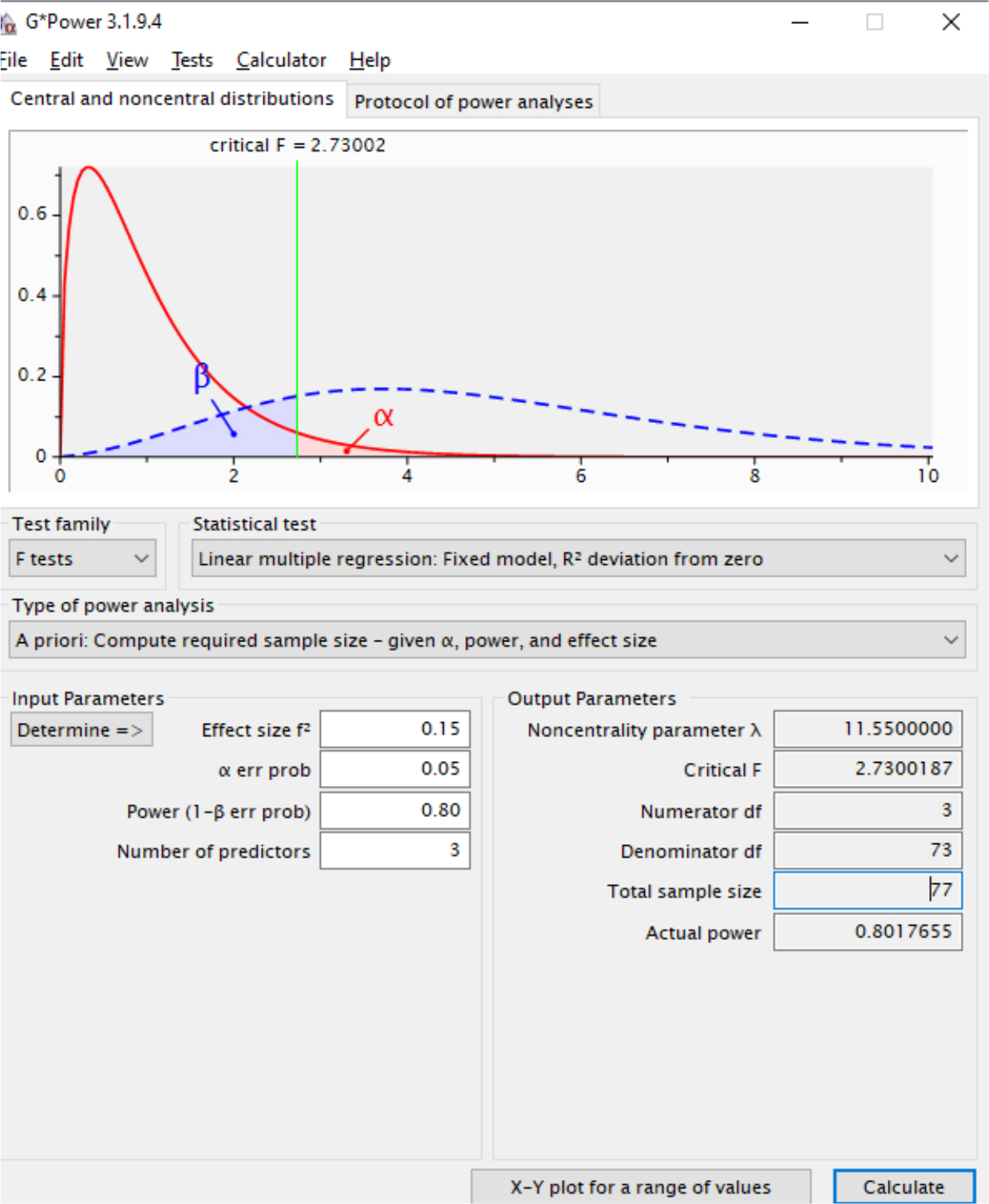
Figure 1.
Minimum Number of Samples Using G*Power
(Source: Authors’ own research)
The data analysis approach used in this study was structural equation modeling (SEM) analysis. For data administration, Amos Software will be utilized. One technique for addressing the shortcomings in the regression approach is SEM (Bahri and Zamzam, 2021). Researchers can evaluate numerous connected dependency relationships at once using SEM, a multivariate analysis technique that incorporates elements of multiple regression and component analysis. Researchers can incorporate unobservable variables that are indirectly measured by indicators using SEM (Hair, et al., 2021).
According to Sudaryono (2017), the usage of SEM is motivated by two factors. First, SEM is capable of estimating various connections between variables. A structural model (the relationship between dependent and independent conceptions) forms this relationship. Second, the pattern of correlations between manifest variables (also known as indicator variables) and latent (unobserved) components can be described using SEM.
4. Results
Based on G*power analysis, the minimum sample required in this study was 77 respondents, while the sample used was 300 respondents. Table 2 shows the number of respondents aged 21-30 years was 146 people (48.6%), aged 31-40 years was 88 people (29.3%), and aged 41-50 years was 66 people (22.1%). Number of male respondents was 176 people (58.6%) and female respondents were 124 people (41.3%). Number of respondents who have education in elementary school is 34 people (11.3%), junior high school 57 people (19.1%), senior high school 121 people (40.3%), and bachelor 88 people (29.3%).
Table 1.
Questionnaire Distribution Results
| Information | Response | |
|---|---|---|
| Frequency | % | |
| Sent | 500 | 100 |
| Accepted | 116 | 23.2 |
| Respondents who did not answer | 78 | 15.6 |
| Incomplete answer | 6 | 0.01 |
| Questionnaire Used | 300 | 60 |
Table 2.
Respondent Characteristics
| Category | Mark | Percentage (%) |
|---|---|---|
| Age | 21-30 years | 48.6 |
| 31-40 years | 29.3 | |
| 41-50 years | 22.1 | |
| Gender | Male | 58.6 |
| Female | 11.4 | |
| Last education | Elementary school | 11.3 |
| Junior high school | 19.1 | |
| Senior high school | 40.3 | |
| Bachelor | 29.3 | |
| Total | 100% | |
Processing descriptive statistical data on research variables comes next, following the analysis of data from 300 MSMEs in Jember Regency. Table 3 lists the outcomes of the descriptive statistical data processing for the research variables.
Table 3.
Descriptive Statistics Results
| Variable | N | Min | Max | Mean | Std. Dev |
|---|---|---|---|---|---|
| Business actor competency (X1) | 300 | 9 | 15 | 13.29 | 1.39 |
| Access to capital (X2) | 300 | 9 | 15 | 13.26 | 1.41 |
| Marketing strategy creativity (Z) | 300 | 12 | 20 | 17.98 | 1.82 |
| MSME performance (Y) | 300 | 9 | 15 | 12.87 | 1.46 |
The business actor competency variable (X1) has an average value of 13.29. The value ranges from 9 to 15, with a standard deviation of 1.39. The capital access variable (X2) has an average (mean) value of 13.26. The maximum value is 15, and the lowest value is 9. The standard deviation is 1.41. The marketing strategy creativity variable (Z) has an average (mean) value of 17.98. The value ranges from a minimum of 12 to a maximum of 20. The standard deviation is 0.042. The MSME performance variable (Y) has an average value (mean) of 12.87. The MSME performance variable (Y) has a lowest value of 9 and a highest value of 15, and 1.46 is the standard deviation. The four variables indicate that the data spread is getting narrower and that the standard deviation number is getting closer to the mean or average value.
All indicators are shown to be substantially correlated with the intrinsic attribute construct (all indicators are legitimate) based on the confirmatory factor analysis (CFA) test findings shown in Table 4. Construct dependability is higher than the suggested threshold of 0.60. As a result, all indicators are deemed trustworthy.
Table 4.
Validity and Reliability Test Results
| Variable | Indicator | Loading | P | Information | Construct Reliability |
|---|---|---|---|---|---|
| Business actor competency (X1) | X1.1 | 0.886 | 0.000 | Valid | 0.871 |
| X1.2 | 0.933 | 0.000 | Valid | ||
| X1.3 | 0.778 | 0.000 | Valid | ||
| Access to capital (X2) | X2.1 | 0.881 | 0.000 | Valid | 0.888 |
| X2.2 | 0.886 | 0.000 | Valid | ||
| X2.3 | 0.653 | 0.000 | Valid | ||
| Marketing strategy creativity (Z) | Z.1 | 0.611 | 0.000 | Valid | 0.811 |
| Z.2 | 0.803 | 0.000 | Valid | ||
| Z.3 | 0.696 | 0.000 | Valid | ||
| Z.4 | 0.822 | 0.000 | Valid | ||
| MSME performance (Y) | Y.1 | 0.825 | 0.000 | Valid | 0.807 |
| Y.2 | 0.690 | 0.000 | Valid | ||
| Y.3 | 0.873 | 0.000 | Valid |
4.1. Validity Test Results and Reliability
All indicators are shown to be substantially correlated with the intrinsic attribute construct (all indicators are legitimate) based on the confirmatory factor analysis (CFA) test findings shown in Table 4. Construct dependability is higher than the suggested threshold of 0.60. As a result, all indicators are deemed trustworthy.
4.2. Normality Test
Based on the findings of the normality tests or assessment of normalcy (CR), which produce a CR value of 1.627, which is located between -1.96 < CR ≤ 1.96 α = 0.05, it may be inferred that the multivariate data are normal. Furthermore, every indicator’s critical ratio value falls within -1.96 < CR ≤ 1.96, suggesting that the univariate data are also normally distributed.
4.3. Multicollinearity Test
The results of the multicollinearity test yielded values of 59,932. Given that this value is far from zero, it can be concluded that there are no problems with multicollinearity or singularity in the data being analyzed.
4.4. Test for Outliers
The greatest Mahalanobis distance value, 44,944, is indicated by the outlier test results. There are no multivariate outliers in the research data, as this value remains below the chi-square table value at df = number of indicators, which is 50,000.
4.5. SEM Results
The results can be used to address the study hypothesis based on the data processing that has been done. T-statistics and P-value values were examined in this study’s hypothesis testing process. If the P-value is less than 0.05, the study hypothesis can be deemed accepted. The outcomes of the hypothesis testing that this study’s inner model enabled are as follows.
The direct and indirect effects of the relationship between the variables can then be ascertained utilizing the findings of the study hypothesis testing model that employs Amos, as seen in Figure 2.
4.6. Results of Testing the Influence Between Variables
Table 5 lists the findings of the Amos test on the direct influence of the link between the variables.
Table 5.
Influence between variables
| Variable | Path Coefficient | CR | Probability | Information |
|---|---|---|---|---|
| Direct influence | - | - | - | - |
| Z←X1 | 0.476 | 6,562 | *** | Significant |
| Z←X2 | 0.524 | 6,606 | *** | Significant |
| Y←X1 | 0.433 | 5,962 | *** | Significant |
| Y←X2 | 0.226 | 2,891 | 0.004 | Significant |
| Y←Z | 0.397 | 4,997 | *** | Significant |
| Indirect influence | - | - | - | - |
| Y←Z←X1 | 0.189 | *** | *** | Significant |
| Y←Z←X2 | 0.208 | *** | *** | Significant |
5. Discussion
5.1. Business Actor Competence to Marketing Strategy Creativity
The results of research hypothesis testing show that business actor competence has a positive and significant effect on marketing strategy creativity. This means that the higher the competency of business actors, the greater the creativity of marketing strategies.
Business actors with high competencies tend to be more focused on analyzing the market for a deep understanding of changes in consumer needs. This also encourages them to create marketing strategies that are more creative and meet the relevance criterion of the target market. Such entrepreneurs engage in effective marketing campaigns that might suit the interest of target groups while having good knowledge of consumer behavior and market trends. The competence of business actors, especially those related to innovation capabilities, encourages them to think outside the box in designing marketing strategies. For example, entrepreneurs with good skills in digital marketing may be more creative in using social media platforms or new technologies to promote their products, which their competitors previously would not have thought of. Business actors who have competence in resource management, both human and financial resources, can allocate resources more effectively to design and implement creative marketing strategies. Competent entrepreneurs know when and how to use marketing budgets for activities that have a positive impact on marketing and business growth. In a highly competitive market, MSMEs in Jember Regency that are led by competent business actors are more likely to look for new and creative ways to market their products, whether through unique offers or marketing methods that are not widely used by competitors. This creativity in marketing strategy allows them to differentiate their products in an increasingly crowded and dynamic market. Based on these findings, MSME entrepreneurs in Jember Regency need to continue and improve their competence, in terms of market knowledge, managerial skills, and the ability to innovate. Training or developing entrepreneurs’ competencies in the fields of marketing, technology, and market trends will be very helpful in increasing the creativity of their marketing strategies.
The research results are in line with the study results of Abdissa, et al. (2021), Agasty, et al. (2023), Al-Shaikh and Hanaysha (2023), which state that business actor competence influences to marketing strategy creativity.
5.2. Access to Capital to Marketing Strategy Creativity
The results of research hypothesis testing show that access to capital has a positive and significant effect on marketing strategy creativity. This means that the higher the access to capital, the more creative the marketing strategy will be.
With better access to capital, MSMEs can allocate larger budgets for marketing activities, allowing them to design and execute more creative campaigns. For example, they can use various digital platforms or social media more interestingly and interactively or even carry out influencer-based marketing, which requires larger funds. Access to capital provides funds for research and development (R&D) for new products or services that meet market needs. When MSMEs have sufficient capital, they can invest in creating innovative products that can be marketed uniquely or adapt existing products with new features that appeal to consumers. In the digital era, marketing via the Internet and social media is very important. Access to capital allows MSMEs to adopt more sophisticated digital technology and marketing software, such as data analysis to understand consumer preferences or automated marketing tools. The use of this technology allows MSMEs to carry out more creative and targeted marketing. Based on these findings, MSMEs in Jember Regency can take advantage of access to capital to strengthen creativity in their marketing. Some practical steps that can be taken are looking for sources of capital that are more easily accessible, allocating funds for digital marketing, and investing in product development and innovation.
The research results are in line with the study results of Awang Ali, et al. (2023), Bahri and Zamzam (2021), and Barykin, et al. (2022), which state that access to capital influences marketing strategy creativity.
5.3. Business Actor Competence to MSME Performance
The results of research hypothesis testing show that business actor competence has a significant positive effect on MSME performance. This means that the higher the competency of business actors, the higher the performance of MSMEs.
Competent business actors have the skills to analyze situations and make more appropriate decisions in terms of financial planning, marketing, and operational management. These good decisions can improve operational efficiency and effectiveness, ultimately contributing to better performance. Entrepreneurs with high competence usually can manage business finances wisely. They are more skilled at planning budgets, managing cash flow, and avoiding waste. Good financial management is important to increase profitability and business continuity. Business actors’ competencies which include innovation and adaptation skills help them to survive amidst rapid market changes. For example, entrepreneurs who can identify market trends and adapt to changes in consumer preferences or technology tend to have better competitiveness, which in turn increases market growth and sales. Based on the results of this research, for MSMEs in the Jember Regency, increasing the competency of business actors is very important to encourage better business performance. Several steps that can be taken include holding business training to improve entrepreneurs’ competence in the managerial, marketing, and financial fields; encouraging entrepreneurs to innovate in their products or services to better suit market needs and existing trends; and providing training on the latest technology and digital marketing to increase competitiveness in the digital era.
Research result is in line with the study results of Bueechl, et al. (2021), Chang and Kim (2022), and Costa Melo, et al. (2023), which states that business actor competence influences MSME performance.
5.4. Access to Capital to MSME Performance
The results of research hypothesis testing show that access to capital has a positive and significant effect on MSME performance. This means that the higher the access to capital, the better the performance of MSMEs.
With better access to capital, therefore, the MSMEs will be able to make the much-needed investments in improved business infrastructure such as equipment, improvements in production facilities, and information technology. Technology investment can improve operational efficiency, speed up production processes, and reduce operational costs, which would increase profitability and competitiveness for MSMEs. Easier access to capital enables MSMEs to invest in product research and development to such an extent that new, more innovative products can be brought to the market or old products can be improved. It is this product innovation that opens up new markets and captures more consumers, which eventually reflects in increased sales and thereby market growth. Access to adequate capital helps MSMEs expand their distribution channels and explore new markets. Sufficient financing also enables MSMEs to increase marketing efforts, study markets through market research to understand what consumers in new markets need, and finance physical or digital expansion that is important for market development. In addition, larger capital endowments may be utilized to enhance the quality of customer service as well as marketing that is more effective. For example, a firm can adopt electronic marketing, advertisement, or other promotion methods that make its products more visible within a competitive environment. This again ensures that there is more customer loyalty and sales, thus the sustainability of the business. Access to capital is among the important factors that enhance the business performance of the MSMEs in the Jember Regency. In taking optimum steps to access capital. One of them is trying to find a reliable source of funding, using technology for efficiency, developing human resource capacity, and diversifying sources of income.
The research results are in line with the study results of Czapla, et al. (2023), Davcik, et al. (2021), and Dewicka-Olszewska (2021), which state that access to capital influences the performance of MSMEs.
5.5. Marketing Strategy to MSME Performance
The results of research hypothesis testing show that marketing strategy has a positive and significant effect on MSME performance. This means that the higher the marketing strategy, the better the performance of MSMEs.
In particular, a good marketing strategy effectively using digital marketing and effective promotions will improve public awareness of MSME products and brands. This can directly affect an increase in sales because more consumers get to know them and confidence is inspired by the products offered. A good marketing strategy enables MSMEs to concentrate their efforts on the right market segments. By understanding the profile and needs of the target market, MSMEs will be able to optimize marketing resources to improve sales conversion and profitability. A mature marketing strategy can help the MSMEs design more targeted and creative marketing campaigns. Effective marketing through social media, sales promotion, or advertisement will attract more customers and increase customer loyalty. Similarly, a rightful campaign can introduce a new product or special offers that will help in increased sales and market growth. In the digital era, marketing through social media, websites, and e-commerce is quite effective. The MSMEs that have a good digital marketing strategy reach a larger number of customers at a lesser cost than any other traditional methods. Technology allows much more precise market segmentation and personalized communication with consumers to improve business sustainability. The present research indicates how MSMEs in the Jember Regency can improve their marketing strategy for improved performance. Some of the pragmatic ways to get there would be to leverage digital platforms-social media and e-commerce-for wider market reach at lower costs; a better comprehension of customer needs and preferences through in-depth market research, thereafter targeting products and promotions to the right market segments; use of more engaging and innovative promotions, such as discounts or product bundling, to forge closer relationships with customers through story-based marketing campaigns; and finally, efficient selection and management of distribution channels will get the products to reach consumers at competitive prices, ensuring fast delivery times. Research result is in line with the study result of Ding, et al. (2023), Feil, et al. (2023), and Feng, et al. (2023), which states that marketing strategy influences MSME performance.
5.6. Business Actor Competence to MSME Performance through Marketing Strategy Creativity
The results of research hypothesis testing show that business actor competence influences MSME performance through marketing strategy creativity. This means that the higher the competency of business actors, the better the MSME performance will be through marketing strategy creativity.
Entrepreneurs who have better skills and knowledge tend to be more creative in designing marketing strategies. They can identify market trends, understand consumer needs, and adapt more effective marketing approaches. This creativity can produce more attractive marketing campaigns, introduce new products that suit market needs, and increase brand awareness and sales. Competent entrepreneurs are better able to identify changes in consumer preferences and rapid market developments. They can respond by designing creative and adaptive marketing strategies, which are critical to maintain the relevance of products and services in the market. Creativity in responding to these changes has an impact on business sustainability and market growth. Competent business actors also tend to be more open to technology and the use of digital marketing. More creativity on how to use social media, ecommerce, and all other platforms of digital marketing can now be done at a cheaper cost in reaching the target audience of MSMEs. With effective digital marketing, market penetration should increase, new customers should come in, and sales should increase. Competent entrepreneurs are usually more skilled at managing their marketing resources more efficiently. They can make better use of their marketing budget, choose the right distribution channels, and optimize more targeted promotions. This efficiency will contribute to increased profitability and business growth. The results of this research imply that entrepreneurs who have high competence are better able to design and implement innovative marketing strategies, which have a direct impact on increasing sales, profitability, market growth, and sustainability of MSME businesses. Therefore, developing the competence of business actors and creativity in marketing strategies is the key to encouraging the performance and success of MSMEs in the Jember Regency. Research results of Gao, et al. (2023), Geng, et al. (2021), and Gliga and Evers (2023) are in line with the research result that states that business actor competence influences MSME performance through marketing strategy creativity.
5.7. Access to Capital to MSME Performance through Marketing Strategy Creativity
The results of research hypothesis testing show that access to capital influences MSME performance through marketing strategy creativity. This means that the higher the access to capital, the better the performance of MSMEs through marketing strategy creativity.
Better access to capital provides MSMEs with sufficient resources to innovate in marketing activities. With greater capital, entrepreneurs can allocate funds for more creative promotions, the use of digital technology, product development, and more efficient distribution channels. For example, they can invest in digital marketing, social media campaigns, or engaging advertising to reach more consumers. With access to capital, MSMEs can conduct market research to find out consumer needs and develop products that are more in line with market demand. Creative marketing, such as creating a story behind a product or uniquely launching a product, can increase competitive advantage and attract consumer attention. This increases sales and market growth. Access to capital also allows MSMEs to be more efficient in managing marketing budgets. MSMEs that have sufficient funds can choose more effective marketing channels and manage more targeted campaigns. Apart from that, they can also carry out promotions more frequently and on a larger scale, which in turn can increase brand awareness and business sustainability. The results of this research imply that sufficient capital allows MSMEs to innovate in marketing, develop products, and increase efficiency and effectiveness in managing their marketing budget. This creative marketing, in turn, will contribute to increasing sales, profitability, market growth, and sustainability of MSME businesses. Therefore, MSMEs in the Jember Regency need to optimize their access to capital, so they can design and implement marketing strategies that are more innovative and have an impact on improving their business performance. The research results are in line with the research results of Gonzalez-Tamayo, et al. (2023), Gouveia and Costa (2022), and Iqbal and Suzianti (2021), which state that access to capital influences MSME performance through marketing strategy creativity.
6. Conclusions
The study’s findings indicate that business actor competence and marketing strategy have a beneficial relationship. Additionally, the study’s findings indicate that marketing strategy is influenced by financial availability. Subsequently, the study’s findings demonstrate that business actor competence has a favorable impact on MSMEs’ performance. The next study’s findings indicate that MSMEs’ performance is impacted by their access to financing. The next study’s findings indicate that MSME performance is influenced by marketing strategy. The final research result is that marketing strategy is proven to play a mediating role in the competence of business actors and access to capital on the performance of MSMEs.
This research shows that the competence of business actors, access to capital, and creativity in marketing strategies have an important role in improving the performance of MSMEs in Jember Regency. MSME players need to develop their competencies and utilize access to capital wisely to create more creative marketing strategies. With the right strategy, MSMEs in Jember Regency can increase their competitiveness, expand their market, and ultimately improve their business performance significantly. Therefore, it is important to support MSMEs through policies that strengthen access to capital and relevant training.
This research’s practical implication is that MSMEs can become more competitive and grow faster by developing their marketing skills through innovative techniques. Additionally, by utilizing innovative marketing techniques to expand MSMEs’ access to cash, investment prospects may rise. Second, MSMEs can perform better overall if a framework for incorporating innovative marketing techniques into their operations is developed. These findings show the importance of creativity in marketing strategy and also provide empirical evidence that supports creative marketing theory. This research also shows that marketing creativity not only functions to attract market attention but also acts as a tool to strengthen business performance.
The limitation of this research is that it only uses two variables to measure MSME performance, namely, business actor competency and access to capital. Suggestions for future researchers are to add variables to measure MSME performance and/or deepen the variables of this research, especially the influence of capital access on MSME performance.