
INTRODUCTION
Brahmi or B. monnieri (L.) Wettst. is a medicinal herb native to India and Nepal, commonly found in moist and waterlogged habitats. It is characterised by succulent, glabrous, creeping stems, simple leaves, and small white to pale purple flowers. The plant is widely recognised as an important source of bioactive compounds, particularly saponin glycosides, such as bacoside A, bacoside B, and jujubogenin, as well as various alkaloids, which contribute to its pharmacological properties (Banerjee et al., 2021; Kumari et al., 2023). Extensive studies have demonstrated its neuroprotective, antioxidant, and cognitive-enhancing effects (Simpson et al., 2015; Mathur et al., 2016; Fatima et al., 2022), with more recent evidence highlighting its role in mitigating neurodegenerative disorders and oxidative stress-related damage (Sekhar et al., 2019; Valotto Neto et al., 2024).
Although bacosides are recognised as the principal bioactive constituents of B. monnieri, phenolic and flavonoid compounds also contribute to its antioxidant properties and are frequently involved in plant responses to environmental stress. Previous studies have demonstrated that phenolic and flavonoid compounds are highly responsive to abiotic elicitation and can serve as useful biochemical indicators for evaluating stress-induced changes in plant tissue cultures (Naik and Al-Khayri, 2016; Isah, 2019). Therefore, total phenolic content (TPC), total flavonoid content (TFC), and antioxidant activity were selected in the present study as representative markers to assess the biochemical responses of B. monnieri callus cultures to heat stress.
Given these therapeutic properties, the demand for B. monnieri-derived compounds has increased substantially. However, conventional extraction from field-grown plants is constrained by environmental variability, slow biomass accumulation, and inconsistent metabolite yields. Plant tissue culture systems, particularly callus cultures, have therefore been proposed as an alternative platform for the controlled and sustainable production of bioactive compounds (Espinosa-Leal et al., 2018; Chandran et al., 2020; Bapat et al., 2023).
One of the most effective approaches to enhance secondary metabolite production in plant tissue culture is the application of elicitors, which stimulate plant defence responses and metabolic pathways. Elicitors can be classified into biotic and abiotic types, including physical factors such as temperature stress (Isah, 2019; Razzaq et al., 2025). Among these, heat stress has gained increasing attention due to its relevance under global climate change scenarios. Heat stress induces the accumulation of reactive oxygen species (ROS), which function not only as damaging agents but also as signalling molecules that regulate stress-responsive pathways and secondary metabolite biosynthesis (Hasanuzzaman et al., 2020; Mittler et al., 2022). Recent studies have further demonstrated that abiotic stresses, including heat, can trigger metabolic reprogramming and enhance the accumulation of phenolic and flavonoid compounds in plant systems (Xu and Fu, 2022; Kan et al., 2023).
Previous studies have demonstrated that various chemical and abiotic elicitors, including methyl jasmonate, salicylic acid, copper sulphate, and NaCl can enhance bacoside production in B. monnieri shoot and suspension cultures (Sharma et al., 2013, 2015; Koul and Mallubhotla, 2020; Kumari et al., 2023; Taratima et al., 2025). However, information regarding the effects of heat stress on growth characteristics, physiological responses, phenolic and flavonoid accumulation, and antioxidant activity in B. monnieri callus cultures remains limited. Based on previous reports that abiotic stresses can stimulate antioxidant defence systems and secondary metabolite biosynthesis in plant tissue cultures, we hypothesised that heat stress would induce oxidative stress and promote the accumulation of antioxidant-related phenolic and flavonoid compounds in B. monnieri callus cultures. Therefore, this study aimed to evaluate the effects of a single heat stress treatment (42°C for 7 days) on growth performance, selected biochemical responses, and secondary metabolite accumulation in B. monnieri callus cultures. This work offers new insights into temperature-induced physiological and biochemical responses, highlighting the potential of heat stress as an abiotic elicitor for enhancing bioactive compound production under controlled culture conditions.
MATERIALS AND METHODS
Plant materials and callus induction
Mature stems of B. monnieri were selected and cut into segments (2–3 cm). Explants were washed twice with a mild detergent and rinsed three times with running tap water before surface sterilisation. Under aseptic conditions, explants were soaked with 70% (v/v) ethanol for 2–3 min, followed by immersion in 0.1% (w/v) mercuric chloride solution containing Tween 20 (five drops) for 20 min with gentle agitation. After sterilisation, explants were rinsed three times with sterile distilled water (5 min each) to remove residual mercuric chloride and placed on sterile Petri dishes. Both ends of the explants were trimmed to remove damaged tissues using a sterile scalpel. All procedures involving mercuric chloride were conducted in accordance with institutional laboratory safety guidelines, and waste solutions were disposed of through established hazardous chemical waste management procedures. Stem and leaf explants were separated, and leaf explants were cultured on Murashige and Skoog (1962) or MS medium supplemented with 2 mg · L−1 2,4-dichlorophenoxyacetic acid for callus induction. Cultures were maintained at 25 ± °C under a 16 hr photoperiod with a light intensity of 40 μmol · m−2 · s−1 for 2–4 weeks before further experiments.
Heat stress treatment
Callus cultures were subjected to heat stress to evaluate growth performance, selected biochemical responses, and the accumulation of phenolic and flavonoid compounds. Two experimental conditions were established: cultures maintained at 25°C (control) and those exposed to 42°C (heat stress). A single heat-stress treatment (42°C for 7 days) was evaluated to investigate the physiological and biochemical responses of B. monnieri callus cultures under in vitro conditions. The selected heat-stress regime was adapted from previous studies in plant callus cultures that used elevated-temperature treatments to investigate heat-stress responses (Taratima et al., 2022). Each treatment consisted of five replicates, with four explants per replicate. Following the treatment period, growth parameters, survival rate, and culture response were recorded. In addition, TPC, TFC, and antioxidant activity were analysed to evaluate biochemical responses to heat stress.
Growth performance
Callus growth was evaluated based on morphological and biomass parameters. Survival percentage was calculated as the percentage of explants remaining viable after the treatment period. Response percentage was calculated as the percentage of explants producing callus after culture under the specified conditions. Callus size was measured in terms of width and length, considering only the callus tissue. Callus colour, texture, and degree of aggregation were also recorded. Fresh weight (FW) of callus samples was measured and recorded. Samples were then wrapped in aluminium foil and dried in a hot-air oven at 50°C for 5 days to obtain a constant weight. Dry weight (DW) was subsequently measured and recorded.
Malondialdehyde content
Malondialdehyde (MDA) content was determined following the method of Heath and Packer (1968). Briefly, 1 g of callus tissue was homogenised in 10 mL of 0.1% (w/v) trichloroacetic acid (TCA) and centrifuged at 14000 rpm for 5 min. A 2 mL aliquot of the supernatant was mixed with 9 mL of 0.5% (w/v) thiobarbituric acid (TBA) in TCA and incubated at 95°C for 25 min. The reaction was terminated by cooling the mixture on ice for 10 min. The absorbance of the supernatant was measured at 532 and 600 nm using 20% TCA as a blank. MDA content was calculated as Eq. (1):
where Vf is the final volume, Ve is the volume of TCA, Va is the solvent volume, and FW is the fresh weight of the sample.Electrolyte leakage percentage
Electrolyte leakage (EL) was determined as described by Dionisio-Sese and Tobita (1998). Two callus pieces were placed in test tubes containing 10 mL of deionised water and incubated at room temperature in the dark for 24 hr. The initial electrical conductivity (EC1) was then measured. Subsequently, the samples were autoclaved at 121°C for 15 min and cooled to room temperature before measuring the final electrical conductivity (EC2). EL leakage was calculated as Eq. (2):
Crude extract preparation
Callus samples cultured at 25 and 42°C were dried in a hot-air oven at 50°C for 5–10 days or until completely dry. The dried samples were ground into a fine powder, and their DW was recorded. Extraction was performed using ultrasonic-assisted extraction (sonication) for 30 min in methanol, at a ratio of 0.5 g dry sample to 10 mL solvent. The extraction was repeated three times. The combined extracts were concentrated using a vacuum evaporator (speed vacuum) at 50°C for 5 hr, followed by freeze-drying to obtain a viscous crude extract. The extract was weighed to determine the percentage yield and stored at –20°C until further analysis, including TPC, TFC, and antioxidant activity.
Total phenolic content
TPC was determined using the Folin–Ciocalteu colourimetric assay, with gallic acid as the standard, following a modified method of Mwamatope et al. (2020). Briefly, 20 μL of callus extract was mixed with 100 μL of 10% (v/v) Folin–Ciocalteu reagent, followed by the addition of 80 μL of 7% (w/v) sodium carbonate (Na2CO3). The reaction mixture was prepared in triplicate and incubated in the dark for 30 min. Absorbance was measured at 760 nm using a UV-visible microplate reader. TPC was expressed as milligrams of gallic acid equivalents per gram of extract DW (mg GAE · g−1 extract).
Total flavonoid content
TFC was determined using the aluminium chloride colourimetric method, following a modified procedure of Pekal and Pyrzynska (2014). Briefly, 100 μL of callus extract (4 mg · mL−1) was mixed with 20 μL of 5% (w/v) sodium nitrite (NaNO2), 35 μL of 10% (w/v) aluminium chloride (AlCl3), and 50 μL of deionised water. The reaction mixture was prepared in triplicate and incubated in the dark for 30 min. Absorbance was measured at 430 nm using a microplate reader. TFC was expressed as milligrams of quercetin equivalents per gram of extract DW (mg QE · g−1 extract).
DPPH radical scavenging activity
Antioxidant activity was evaluated using the 2,2-diphenyl-1-picrylhydrazyl (DPPH) radical scavenging assay, following a modified method of Mwamatope et al. (2020). Callus extracts at concentrations ranging from 20 g · mL−1 to 2560 μg · mL−1 were prepared. An aliquot of 100 μL of each extract was added to a 96-well microplate, followed by 100 μL of 0.2 mM DPPH solution. The reaction mixtures were prepared in triplicate, mixed thoroughly, and incubated in the dark for 30 min. Absorbance was measured at 517 nm using a microplate reader. Methanol and deionised water were used as negative controls, while ascorbic acid served as a positive control. The percentage of DPPH radical scavenging activity was calculated as Eq. (3):
where Asample is the absorbance of the extract and Acontrol is the absorbance of the negative control.The relationship between percentage inhibition and extract concentration was used to determine the IC50 value (50% inhibition concentration, μg · mL−1), which was compared with that of ascorbic acid.
Statistical analysis
All experiments were conducted using five independent biological replicates. Statistical analysis was performed using an independent samples t-test to compare means between the two temperature treatments (25 and 42°C) at a significance level of p < 0.05. Results are presented as mean ± standard deviation (SD). All analyses were carried out using IBM SPSS Statistics version 23. Multivariate analysis was performed using MetaboAnalyst 6.0.
RESULTS
Growth, phenolic and flavonoid contents, and antioxidant activity
Heat stress (42°C) and control conditions (25°C) were evaluated for their effects on growth, biochemical responses, phenolic and flavonoid contents, and antioxidant activity of B. monnieri callus cultures. No significant differences were observed in survival rate or response percentage, as both treatments exhibited 100% viability. In terms of growth, calli cultured at 42°C showed significantly greater length (11.26 ± 0.28 mm) and width (8.47 ± 0.19 mm) compared to those at 25°C (9.71 ± 0.43 mm and 7.26 ± 0.29 mm, respectively) (p < 0.05) (Table 1 and Figure 1). FW and MDA content did not differ significantly between treatments (p > 0.05). In contrast, DW was significantly higher in calli cultured at 42°C than in those cultured at 25°C (p = 0.012). EL showed an increasing trend from 60.22 ± 5.16% at 25°C to 72.91 ± 2.13% at 42°C; however, the difference was not statistically significant (p = 0.053).
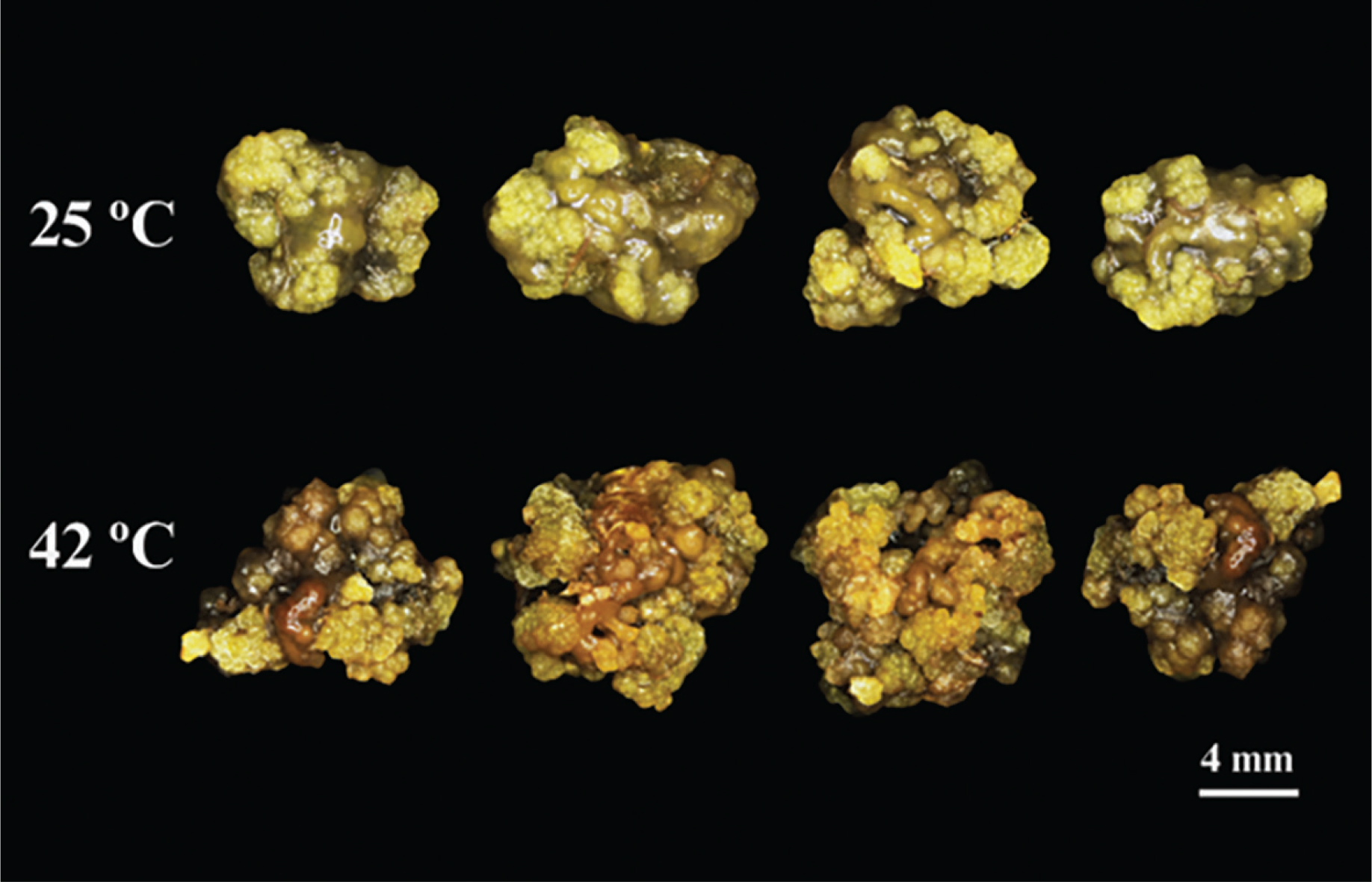
Figure 1.
Effects of heat stress (25 and 42°C) on growth, physiological, biochemical, and antioxidant-related parameters of B. monnieri callus cultures. Values are presented as mean ± SD from five independent biological replicates (n = 5). Differences between treatments were evaluated using an independent samples t-test, and statistical significance was considered at p < 0.05. SD, standard deviation.
Table 1.
Growth performance, biochemical traits, phenolic and flavonoid contents, and antioxidant activity of B. monnieri callus cultures under different temperature conditions (25 and 42°C).
| Characteristics | Temperatures | p-value | |
|---|---|---|---|
| 25°C | 42°C | ||
| Survival percentage (%) | 100.00 ± 0.00* | 100.00 ± 0.00 | NA |
| Response percentage (%) | 100.00 ± 0.00 | 100.00 ± 0.00 | NA |
| Callus length (mm) | 9.71 ± 0.43 | 11.26 ± 0.28 | 0.017 |
| Callus width (mm) | 7.26 ± 0.29 | 8.47 ± 0.19 | 0.009 |
| FW (g) | 0.11 ± 0.01 | 0.11 ± 0.00 | 0.933 |
| DW (g) | 0.01 ± 0.00 | 0.01 ± 0.00 | 0.012 |
| MDA (μmol · g−1 FW) | 0.04 ± 0.00 | 0.04 ± 0.00 | 0.621 |
| EL (%) | 60.22 ± 5.16 | 72.91 ± 2.13 | 0.053 |
| TPC (mg GAE · g−1 extract) | 38.87 ± 1.26 | 55.72 ± 2.25 | 0.001 |
| TFC (mg QE · g−1 extract) | 118.25 ± 1.83 | 150.75 ± 2.78 | 0.001 |
| IC50 by DPPH (μg · mL−1) | 145.70 ± 0.46 | 79.16 ± 2.99 | 0.001 |
Stress indicators revealed a significant increase in EL from 60.22 ± 5.16% at 25°C to 72.91 ± 2.13% at 42C, indicating enhanced membrane damage under elevated temperature (Table 1). Regarding bioactive compounds and antioxidant activity, TPC and TFC were significantly increased at 42°C (55.72 ± 2.25 and 150.75 ± 2.78 mg · g 1 extract, respectively) compared to 25°C (38.87 ± 1.26 and 118.25 ± 1.83 mg · g 1 extract, respectively). In addition, the IC50 value from the DPPH assay was significantly reduced under heat stress (79.16 ± 2.99 μg · mL−1) relative to the control (145.70 ± 0.46 μg · mL−1), indicating enhanced antioxidant capacity. Overall, exposure to high temperature (42°C) promoted certain aspects of callus growth and increased the accumulation of antioxidant compounds, although it also induced partial cellular damage.
Multivariate analyses
Partial least squares discriminant analysis (PLS-DA) was performed as an exploratory multivariate approach to visualise overall variation among samples cultured under different temperature conditions. The score plot showed a tendency for samples from the 25°C (T25) and 42°C (T42) treatments to separate along Component 1, which explained 68.8% of the variance, whereas Component 2 accounted for 12.5% (Figure 2). Variables such as TPC, TFC, DW, and EL were associated with the positive side of Component 1, where most T42 samples were located. In contrast, FW, MDA, and IC50 values tended to be associated with the negative side of Component 1.
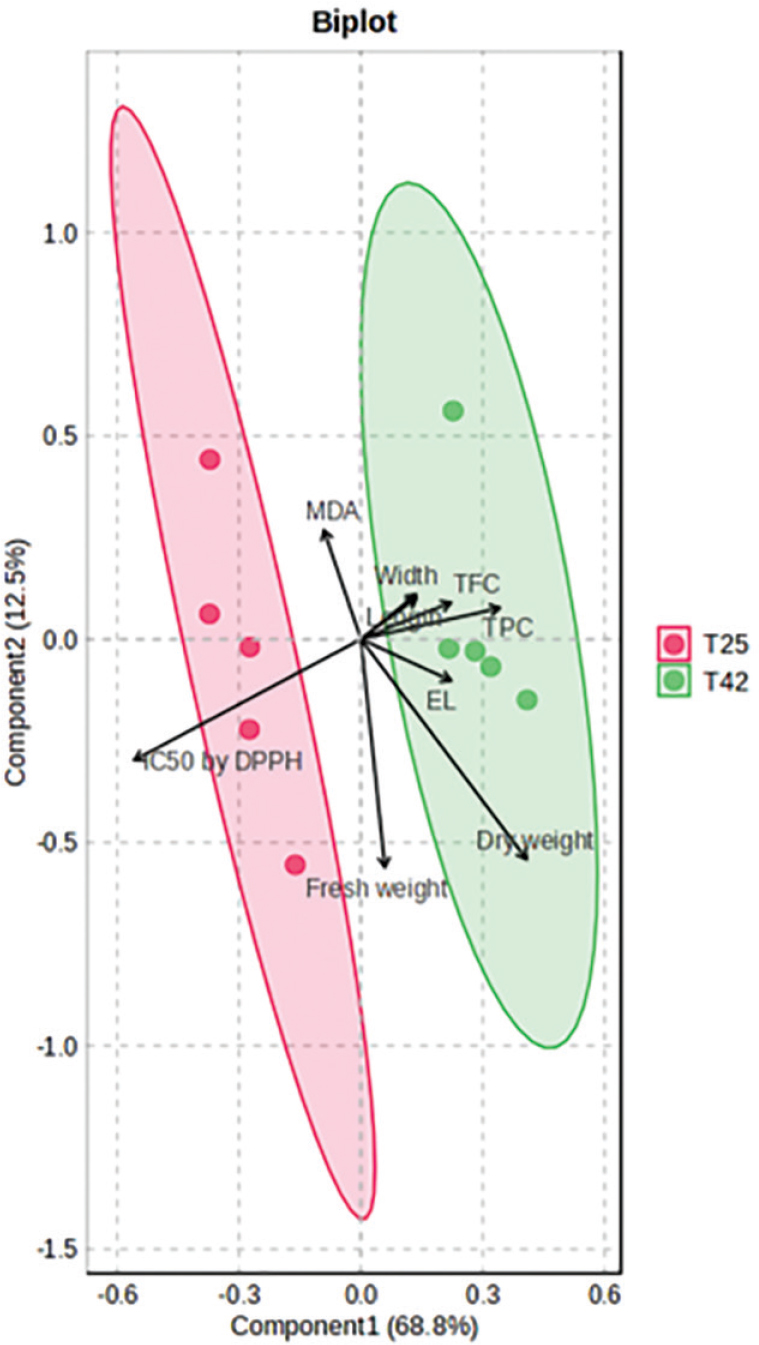
Figure 2.
PLS-DA biplot showing the distribution of B. monnieri callus samples cultured under control (25°C; T25) and heat-stress (42°C; T42) conditions based on growth, physiological, biochemical, and antioxidant-related parameters. Each point represents an independent biological replicate (n = 5 per treatment). The plot was generated as an exploratory multivariate analysis to visualise treatment-associated variation among measured traits. EL, electrolyte leakage; MDA, malondialdehyde; PLS-DA, partial least squares discriminant analysis; TFC, total flavonoid content; TPC, total phenolic content.
Variable importance in projection (VIP) scores was used to explore variables potentially associated with the observed separation between treatments. Among the measured parameters, IC50 values, DW, and TPC exhibited the highest VIP scores, suggesting that these variables contributed most strongly to the variation observed in the dataset (Figure 3). However, given the relatively small sample size and the inclusion of only two treatment groups, the PLS-DA results should be interpreted as exploratory rather than predictive.
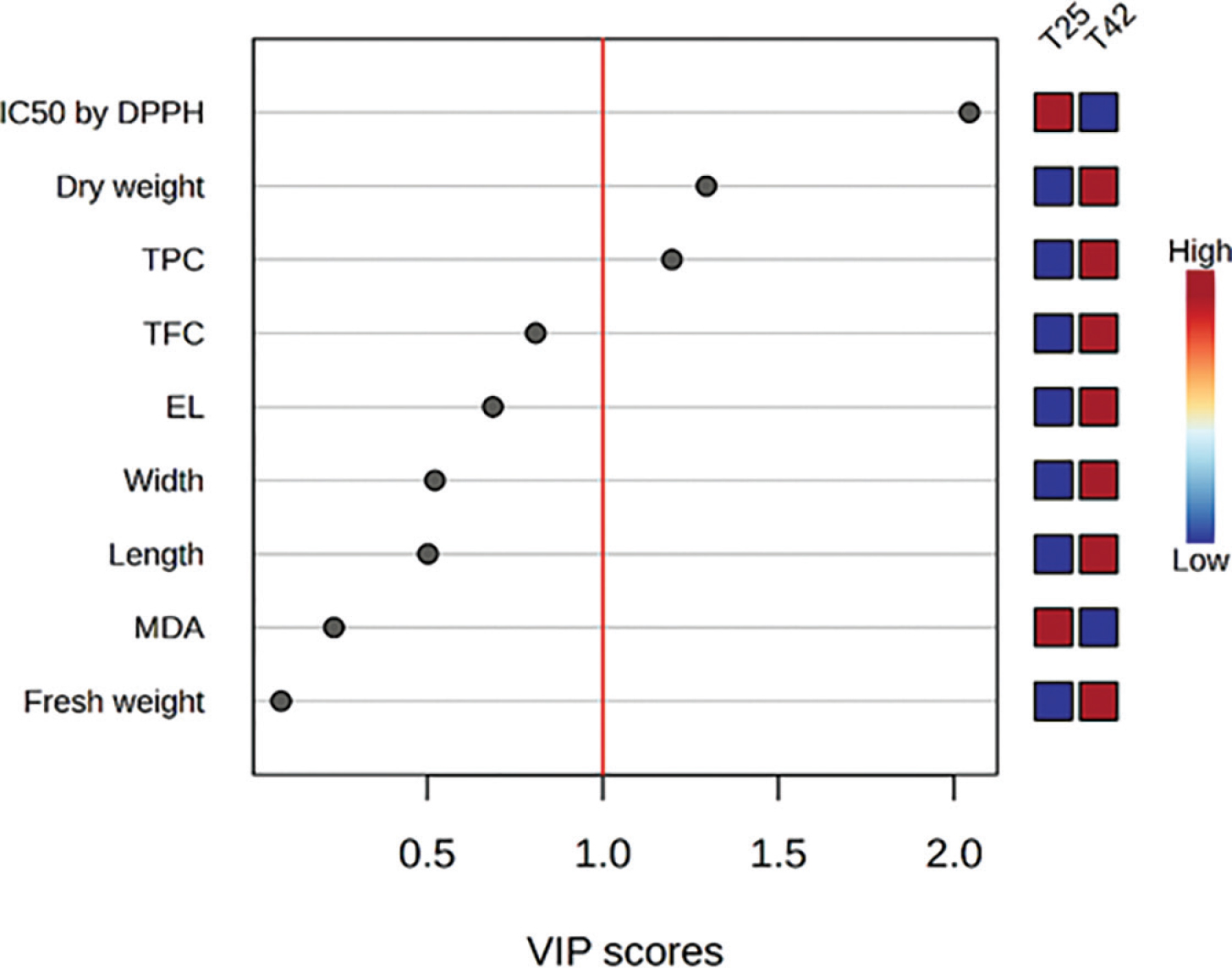
Figure 3.
VIP scores derived from the PLS-DA model. Variables with higher VIP scores contributed more strongly to the separation between callus cultures grown at 25°C (T25) and 42°C (T42). IC50 by DPPH, concentration required to inhibit 50% of DPPH radicals; DPPH, 2,2-diphenyl-1-picrylhydrazyl; EL, electrolyte leakage; MDA, malondialdehyde; PLS-DA, partial least squares discriminant analysis; TFC, total flavonoid content; TPC, total phenolic content; VIP, variable importance in projection.
The accompanying heatmap further illustrated the variation of key variables across treatments. The T42 group showed higher levels of antioxidant-related parameters (TPC and TFC) and DW, whereas the IC50 value of DPPH was lower, consistent with enhanced antioxidant capacity under heat stress. Overall, the VIP analysis suggested that biochemical traits, particularly antioxidant-related parameters (IC50 and TPC), together with DW, were among the variables most strongly associated with the observed separation between treatments.
Hierarchical clustering analysis combined with heatmap visualisation was performed to evaluate variation patterns in growth, physiological, and biochemical traits of callus cultures at 25°C (T25) and 42°C (T42). The clustering pattern generally grouped samples according to temperature treatment (Figure 4), suggesting differences in the measured physiological and biochemical parameters between treatments. The heatmap indicated that the T42 group tended to exhibit higher values for TPC, TFC, and DW, whereas lower IC50 values were generally associated with this treatment. FW, EL, callus length, callus width, and MDA content showed greater variability among biological replicates and did not display consistent treatment-related trends. Row clustering showed that TPC and TFC were grouped, suggesting a close association between these variables. In contrast, IC50 values were clustered separately from TPC and TFC, consistent with an inverse relationship between antioxidant capacity and phenolic accumulation.
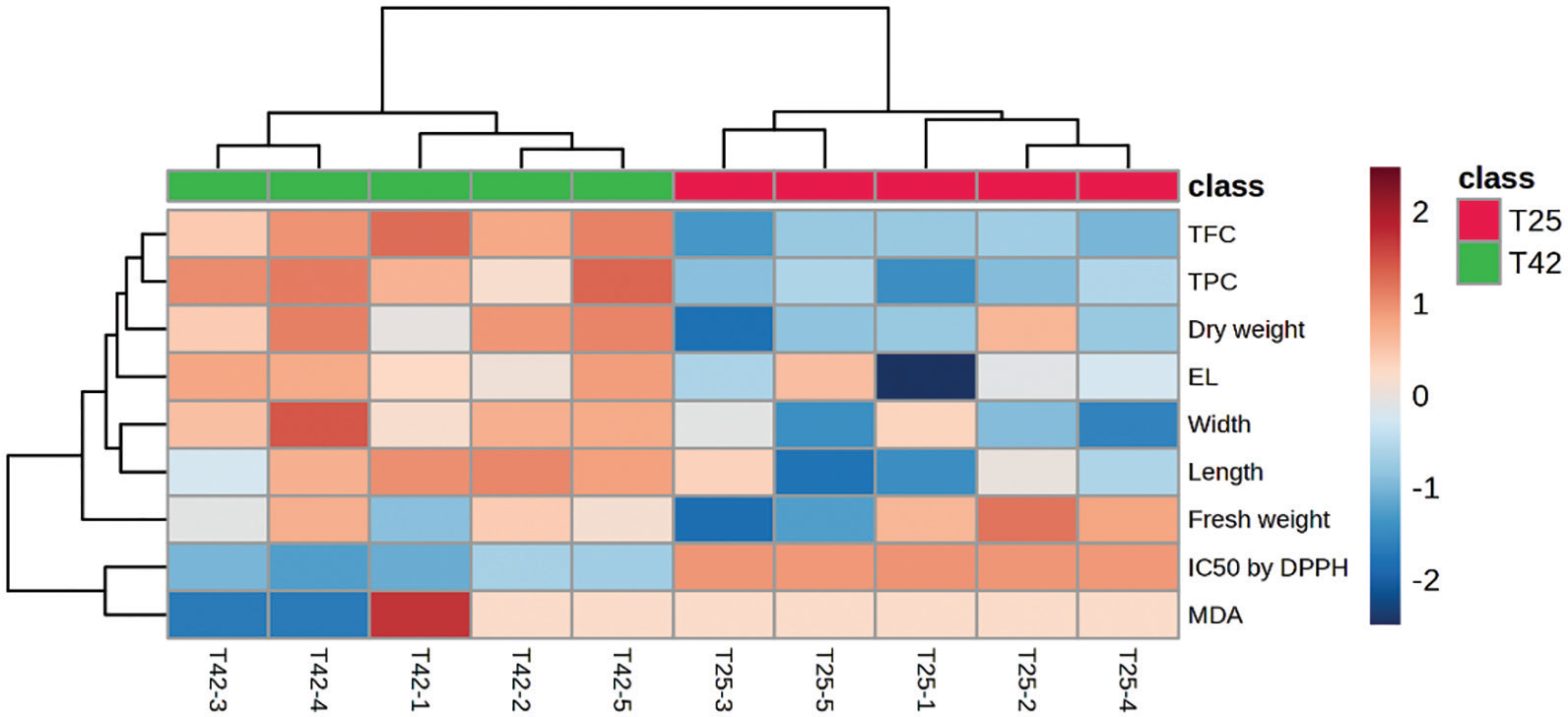
Figure 4.
Hierarchical clustering heatmap illustrating variation patterns of growth, physiological, biochemical, and antioxidant-related parameters in B. monnieri callus cultures cultured at 25°C (T25) and 42°C (T42). Data were standardised using row-wise scaling before clustering. Red and blue colours indicate relatively high and low values, respectively. Each column represents an independent biological replicate (n = 5). IC50 by DPPH, concentration required to inhibit 50% of DPPH radicals; DPPH, 2,2-diphenyl-1-picrylhydrazyl; EL, electrolyte leakage; MDA, malondialdehyde; TFC, total flavonoid content; TPC, total phenolic content.
DISCUSSION
Heat stress is a critical environmental factor that significantly affects plant physiological and biochemical processes, particularly through the induction of oxidative stress associated with the accumulation of ROS (Hasanuzzaman et al., 2020; Medina et al., 2021; Mittler et al., 2022). In the present study, MDA concentrations varied among biological replicates of B. monnieri callus cultures exposed to 42°C, indicating variability in oxidative stress responses among callus cultures. However, the absence of a statistically significant difference between treatments suggests that heat stress-induced lipid peroxidation remained relatively moderate under the conditions tested. Recent studies have demonstrated that elevated temperatures disrupt key physiological and molecular processes, leading to increased ROS production and alterations in cellular metabolism (Kan et al., 2023; Mondal et al., 2023). However, beyond their damaging effects on cellular structures, ROS also function as important signalling molecules that regulate stress-responsive gene expression. Previous studies have suggested that ROS-mediated signalling pathways may activate heat shock proteins (HSPs) and heat shock transcription factors (HSFs), which contribute to thermotolerance in plants (Ohama et al., 2017; Mittler et al., 2022). Therefore, the variation in MDA levels observed in this study may reflect differences in oxidative stress responses among individual callus cultures exposed to elevated temperature. The observed variation in MDA suggests alterations in cellular redox homoeostasis, particularly in callus tissue, which is relatively undifferentiated and may possess less developed defence systems or exhibit rapid and intense stress responses. This may contribute to differences in ROS accumulation and stress responsiveness compared with more differentiated tissues, consistent with previous findings on ROS-mediated regulation in plant cells (Hasanuzzaman et al., 2020). Furthermore, heat-induced ROS accumulation is often associated with disruptions in essential metabolic processes, including photosynthesis and cellular respiration, which are major sources of ROS generation in chloroplasts and mitochondria (Noctor et al., 2018). Such disturbances may contribute to the physiological and biochemical responses observed in this study. Taken together, the variation in MDA content observed under heat stress suggests differential oxidative stress responses among callus cultures and highlights the complex nature of ROS-mediated stress regulation. This dual role highlights the complex function of ROS in plant systems, acting not only as damaging agents but also as key regulators of adaptive responses to environmental stress.
An increase in EL is widely recognised as a key indicator of membrane integrity loss resulting from oxidative damage under stress conditions (Hasanuzzaman et al., 2020). ROS can induce lipid peroxidation and alter membrane fluidity, leading to the leakage of ions and intracellular solutes. In the present study, EL values varied among biological replicates, suggesting heterogeneous membrane responses to heat stress in callus cultures. Although EL tended to be higher under heat stress, the difference between treatments was not statistically significant (p = 0.053). Compared with more organised tissues such as stems, callus–being an undifferentiated tissue–likely possesses lower membrane stability and a reduced capacity to maintain cellular homoeostasis, rendering it more sensitive to oxidative stress. In response to oxidative stress, plants activate both enzymatic antioxidant systems, including superoxide dismutase, catalase, and peroxidase, and non-enzymatic defence mechanisms, particularly the accumulation of phenolic and flavonoid compounds. These metabolites are primarily synthesised via the phenylpropanoid pathway, a central metabolic route for the production of plant secondary metabolites (Sharma et al., 2019). The phenylpropanoid pathway originates from phenylalanine and involves key enzymes such as phenylalanine ammonia-lyase (PAL), chalcone synthase (CHS), and chalcone isomerase (CHI). Previous studies have reported that the activities and expression of these enzymes may be influenced by ROS signalling and stress-responsive transcription factors under stress conditions. Consistent with previous reports describing stress-induced phenylpropanoid responses, the present study observed significant increases in TPC and TFC in callus cultures under heat stress. This finding indicates that callus cultures possess a flexible biochemical response that may facilitate adaptation to heat-stress conditions. Such responses agree with previous reports indicating that environmental stress can act as an elicitor to enhance secondary metabolite production in plant tissue culture systems (Naik and Al-Khayri, 2016), as well as modulate metabolic pathways to promote the accumulation of bioactive compounds (Razzaq et al., 2025). Although heat stress enhanced the accumulation of phenolic and flavonoid compounds and improved antioxidant capacity, these beneficial responses may have been accompanied by a degree of cellular stress. The tendency towards higher EL under heat-stress conditions suggests that membrane stability may have been partially affected, even though the increase was not statistically significant. This observation highlights a potential trade-off between stress-induced stimulation of antioxidant-related metabolites and the maintenance of cellular integrity.
Similar responses have been reported in plant tissue cultures, where moderate stress can stimulate secondary metabolite accumulation while simultaneously imposing physiological costs on membrane stability and cellular function.
With respect to antioxidant capacity, the observed reduction in IC50 values from the DPPH assay indicates an enhanced free radical scavenging ability under heat stress. This decrease is negatively correlated with the increased levels of TPC and TFC, highlighting the central role of these compounds in antioxidant defence. Phenolic and flavonoid compounds are known to act as electron or hydrogen donors, thereby neutralising free radicals and inhibiting oxidative chain reactions (Sharma et al., 2020; Zhao et al., 2021). In addition, phenolics may function as metal chelators, further reducing ROS generation within biological systems. When considered alongside multivariate analyses (PLS-DA and VIP scores), which highlighted IC50, TPC, and DW as variables contributing most strongly to treatment separation, the results suggest that heat stress induces substantial biochemical and physiological adjustments in B. monnieri callus cultures. The strong contribution of antioxidant-related traits to treatment discrimination highlights the importance of metabolic responses under elevated temperature conditions. This observation is consistent with current trends in plant stress physiology and metabolomics, which emphasise the critical role of secondary metabolism in enhancing stress tolerance (Petrov and Gechev, 2023). Collectively, the results suggest that exposure to heat stress (42°C for 7 days) can stimulate biochemical responses in B. monnieri callus cultures, particularly the accumulation of phenolic and flavonoid compounds and the enhancement of antioxidant capacity. However, additional studies are required to determine whether heat stress also affects the accumulation of other major bioactive constituents, including bacosides. These findings indicate the potential of heat stress as an abiotic elicitor under the conditions tested, although additional studies using multiple temperature levels and exposure durations are required to determine optimal elicitation conditions. In addition, because measurements were conducted at a single sampling time point without a post-stress recovery phase, the temporal dynamics of oxidative stress responses and metabolite accumulation could not be assessed. Future studies incorporating time-course analyses and recovery treatments would provide a more comprehensive understanding of heat-stress adaptation in B. monnieri callus cultures. Our findings are in agreement with recent studies suggesting that heat stress can induce coordinated cellular and metabolic adjustments through the regulation of signalling networks and metabolic pathways in plants (Angon et al., 2024).
CONCLUSIONS
Exposure to a single heat-stress treatment (42°C for 7 days) influenced several physiological and biochemical characteristics of B. monnieri callus cultures. Heat-treated calli exhibited significantly higher phenolic and flavonoid contents along with enhanced antioxidant activity, whereas MDA and EL responses varied among biological replicates. Multivariate analyses identified antioxidant-related parameters, particularly IC50 and TPC, along with DW, as important variables contributing to treatment discrimination. These findings suggest that heat stress may promote biochemical adjustments associated with antioxidant-related parameters under the conditions tested. However, the effects of heat stress on major B. monnieri bioactive constituents, such as bacosides, were not evaluated in the present study. Furthermore, because only a single temperature (42°C) and exposure duration (7 days) were examined, the optimal conditions for heat-stress elicitation remain unclear. Future studies incorporating a wider range of temperature regimes, exposure periods, and complementary experimental systems will be valuable for clarifying tissue-specific responses and elucidating the molecular mechanisms underlying heat-stress-induced metabolic changes in B. monnieri.
ACKNOWLEDGMENTS
We are appreciative of the facilities support provided by the Biology Department, Faculty of Science, Khon Kaen University, Thailand.
Notes
[3] Contributed by AUTHOR CONTRIBUTIONS
P.L. and W.T. – conceptualisation. P.L., W.Y., P.M. and W.T. – methodology and visualisation. A.T. and W.Y. – software. P.L., N.K., P.M. and W.T. – validation. W.Y., P.M. and W.T. – formal analysis. A.T., W.Y., P.M. and W.T. – investigation. W.T. – resources. P.L., N.K., A.T., W.Y., P.M. and W.T. – data curation. W.T. – supervision. W.T. – project administrator. P.L. and W.T. – writing – original draft preparation.
[4] Conflicts of interest CONFLICT OF INTEREST
The authors declare that they have no conflict of interest.