
INTRODUCTION
Blueberries (Vaccinium corymbosum L.) are a high-value horticultural crop widely appreciated for their nutritional composition and bioactive properties. Under appropriate postharvest conditions, including controlled or modified atmosphere storage, blueberries can maintain acceptable quality for several weeks; however, their physicochemical attributes remain highly sensitive to cultivar, maturity stage, and storage conditions. Their increasing consumption has been largely attributed to their distinctive phenolic profile, particularly their high content of anthocyanins and other flavonoids, which contribute to both fruit quality and potential health-related properties (Johnson and Arjmandi, 2013; Johnson et al., 2015; Mendes-Ferreira et al., 2019; Parra-Palma et al., 2025).
Blueberries are a source of essential micronutrients, including selenium, zinc, and iron, as well as vitamins C, B-complex, E, and A. In addition, they contain soluble sugars such as glucose and fructose, dietary fibres with prebiotic potential (approximately 3%–3.5% of fresh weight [FW]), and exhibit a low caloric value (Michalska and Łysiak, 2015; Akšić et al., 2019; Miller et al., 2019; Silva et al., 2020). Phenolic compounds, which are secondary metabolites involved in plant defence mechanisms such as protection against ultraviolet radiation and plant–microbe interactions, represent a significant fraction of the blueberry phytochemical profile (Beckman, 2000; Giacalone et al., 2011; Gündeşli et al., 2019). These compounds include flavonoids, phenolic acids, and anthocyanins, collectively accounting for approximately 0.3%–0.5% of fresh fruit weight, depending on cultivar, growing conditions, and analytical methodology (Michalska and Łysiak, 2015; Miller et al., 2019; Parra-Palma et al., 2025).
The antioxidant capacity of blueberries has been extensively associated with their anthocyanin content, although additional phenolic subclasses and enzymatic antioxidant systems also contribute to the overall redox balance of the fruit (Basu et al., 2010; Bornsek et al., 2012; Gupta-Elera et al., 2012; Del Bo′ et al., 2013; Aliman et al., 2020). Numerous studies have reported biological activities associated with blueberry-derived compounds, including antioxidant, anti-inflammatory, and metabolic modulatory effects (Golovinskaia and Wang, 2021). However, it is important to note that much of the available evidence is based on in vitro assays, animal models, or short-term dietary interventions, rather than large-scale clinical trials. Consequently, reported health-related effects should be interpreted as indicative of biological potential rather than as clinically proven outcomes (Del Bo′ et al., 2013; Lang et al., 2019; Hwang et al., 2020; Kalt et al., 2020).
Importantly, the chemical composition of blueberries is highly variable and depends on multiple factors, including cultivar, growing environment, agronomic management, ripeness at harvest, and postharvest handling. Such variability has a direct impact on fruit quality attributes and antioxidant profiles (Lohachoompol et al., 2004; Skrovankova et al., 2015; Bujor et al., 2016). As global production and diversification of blueberry-derived food products continue to expand, a cultivar-oriented understanding of phenolic composition and antioxidant behaviour becomes increasingly relevant.
Therefore, this study aimed to evaluate cultivar-associated variation in phenolic composition and antioxidant capacity of blueberries obtained from commercial production systems. Specifically, we evaluated total phenolics, flavonoids, anthocyanins, colorimetric parameters, antioxidant enzyme activities, and total antioxidant capacity, providing integrative insights relevant for cultivar selection, fruit quality assessment, and functional horticultural applications.
MATERIALS AND METHODS
Plant material
Ripe fruit samples from 10 blueberries, namely 'Drapper', 'Suzi Blue', 'Legacy', 'Duke', 'Topshelf", 'Ventura', 'Star', 'Blue Ribbon', 'Brigitta', and 'O’Neal' were obtained from an export packing facility, sourcing produce from commercial orchards located in the Maule Region of Chile, during the standard harvesting period in January 2024. This form, blueberries were obtained from a commercial fruit packing facility located in the Maule Region (Chile), which processes fruits from multiple commercial orchards operating under standard regional agronomic practices. Although detailed orchard-specific information (e.g. soil characteristics, fertilisation regimes, or irrigation management) was not available, all fruits were harvested at commercial maturity and subjected to uniform postharvest handling prior to analysis. After collection, the berries were transported to the Multidisciplinary Agroindustry Research Laboratory at the Universidad Autónoma de Chile, where they were analysed in physiological parameters, and after this, immediately stored at –80°C for further analysis.
Physiological parameters
To measure fruit skin colour, 30 undamaged fresh fruits were selected. A Nix Pro 2 Colour Sensor (Nix Sensor Ltd., Hamilton, ON, Canada) was used to assess colour, with results expressed on the Hunter scale (L*, a*, b*). The Nix Colour converter tool was utilised to generate a schematic representation of the CIELab colour system (accessed on 10 March 2024, at https://www.nixsensor.com/free-color-converter/?srsltid=AfmBOorHLm8zrHuK1KSPOWgitS6ZV8nezD7Zzr3AvdWGkOwN5K4jTg2n). Colour changes were quantified as E* using the following formula (see Eq. (1)):
where ΔL, Δa*, and Δb* represent the differences between the initial and final values of L*, a*, and b*, respectively, and the determination of colour change (Figure S1).Berry weight (gram) and size (equatorial length, in millimetre) were also assessed; for these analyses, 25 fresh fruits of each cultivar were used. The pH, soluble solid content (SSC), and titratable acidity (TA) were measured using juice extracted from 2 g of frozen tissue (from a pool of 10 fruits) and realising three technical replicates. The tissue was ground with liquid nitrogen, homogenised in 5 mL of distilled water, and filtered through Miracloth. pH was measured using a pH meter (model pH 20, HANNA Instruments, Woonsocket, RI, USA). SSC was determined with a hand-held, temperature-compensated refractometer (Atago, Tokyo, Japan) and expressed as °Brix. For these analyses, 10 fresh fruits of each cultivar were used. TA was calculated by diluting the remaining juice in distilled water (1:10, v/v) and titrating an aliquot of 13 mL with 20 mM NaOH to pH 8.2 using a digital burette (Jencons, London, UK); TA was expressed as grams of citric acid per 100 g of FW for these analyses, 25 fresh fruits of each cultivar were used. TA and SSC results were presented as the SSC/TA ratio, following the methods described by Ramos et al. (2018) and Castro et al. (2023).
Total phenolic, flavonoid, and anthocyanin content
Total phenolics, flavonoids and anthocyanin were analysed in the fruits. The tissues were homogenised using a mortar and pestle in a 1% HCl solution in methanol (250 mL per 50 g of tissue). The extracts were then stirred for 1.5 hr at room temperature, centrifuged at 4200 g, and the supernatant was collected. Three independent extractions were performed on 10 g of fruit tissue. The resulting extracts were used to quantify total phenolic, flavonoid, and anthocyanin content following the methodology of Parra-Palma et al. (2020).
The total phenolic content was determined using the Singleton method (1999), which involves the oxidation of a dilute extract with the Folin–Ciocalteau reagent, followed by the neutralisation with sodium carbonate. The absorbance of the resulting blue colour was measured at 700 nm after 30 min using a Multiskan SkyHigh Microplate Spectrophotometer (Thermo Fisher Scientific). Quantification was based on a gallic acid standard curve; with results expressed as grams of gallic acid equivalents per kilogram of fruit (g · kg−1 GAE). Data represent the mean ± SE of three biological replicates, each with two technical replicates.
The total flavonoid content was determined using the aluminium chloride colorimetric method, as described by Chang et al. (2002). A calibration curve was prepared using quercetin as the reference standard, dissolved in an 80% ethanol solution and diluted to 25, 50, and 100 mg · L−1. Each diluted solution (0.5 mL) was mixed with 1.5 mL of 95% ethanol, 0.1 mL of 10% aluminium chloride, 0.1 mL of 1 M potassium acetate, and 2.8 mL of distilled water, then incubated for 30 min at room temperature. The absorbance of the methanol extract (0.5 mL) was measured at 415 nm using a Multiskan SkyHigh Microplate Spectrophotometer (Thermo Fisher Scientific, Waltham, MA, USA). Results were expressed as grams of quercetin equivalents per kilogram of fruit (g · kg−1 QE) and represent the mean ± SE of three biological replicates, with two technical replicates each.
The anthocyanin concentration in the extract was determined using the pH differential method described by Lee et al. (2008). A sample (0.15 mL) was mixed separately with 0.75 mL of potassium chloride solution (KCl, 0.025 M, pH 1.0) and sodium acetate (CH3CO2Na * 3H2O, 0.4 M, pH 4.5). After a 50-minute incubation at room temperature, absorbance values were measured at 524 nm and 700 nm. Anthocyanin content was expressed as grams of cyanidin 3-glucoside equivalents per kilogram of fruit (g · kg−1 Cy3G) using the formula A = (A524 nm – A700 nm)pH 1.0 – (A524 nm – A700 nm)pH 4.5, with a molar extinction coefficient of 26900.
Antioxidant enzymatic assays
Antioxidant enzymatic activity was measured in the fruits. Briefly, 500 mg of mature fruit (FW) was ground in liquid nitrogen, and the resulting powder was transferred to tubes containing pre-chilled 50 mmol · L−1 phosphate buffer (pH 7.8, with 1% Polyvinylpyrrolidone (PVP)). The mixture was then centrifuged at 4°C and 10000 rpm for 20 min. Five milliliters of the supernatant were transferred to new tubes for the assays of superoxide dismutase (SOD), catalase (CAT), peroxidase (POD), and ascorbate peroxidase (APX) activity, following the methodology described by Erdogan et al. (2016). All determinations were performed in biological triplicates.
Total antioxidant capacity of the fruits
The ferric reducing antioxidant power (FRAP) assay was conducted following the methodology described by Parra-Palma et al. (2025). This assay evaluated the antioxidant capacity of the samples by mixing the methanol extract with a ferric-tripyridyltriazine (Fe3+-TPTZ) complex. Antioxidants in the extract reduce the complex to form a blue-coloured ferrous tripyridyltriazine (Fe2+-TPTZ) complex, which is measured spectrophotometrically. The FRAP values obtained indicate the reducing power and antioxidant capacity of the extracts.
Statistical analysis
Statistical analyses were performed to compare biochemical and antioxidant profiles among cultivars as marketed under commercial conditions, rather than to isolate genetic effects or genotype × environment interactions. One-way analysis of variance (ANOVA) was used to determine enzymatic activity, total phenolic and flavonoid content, anthocyanin levels, and fruit quality parameters. Normality and homoscedasticity of the data were verified prior to the ANOVA test. Tukey’s Honestly Significant Difference (HSD) multiple comparisons analysis was conducted to assess significant differences between cultivars. Data normality was assessed using the Shapiro–Wilk test, and homoscedasticity was evaluated using Levene’s test. All analyses were conducted using a significance level of α = 0.05. All analyses were performed using GraphPad Prism 10 (GraphPad Software Inc. San Diego, CA, USA).
RESULTS
Total phenolic, flavonoids, and anthocyanins content
Total phenolic, flavonoid, and anthocyanin contents were quantified using spectrophotometric techniques, regarding the accumulation of total phenolic compounds (TPC), significant differences were found among the 10 blueberry cultivars analysed (Figure 1).
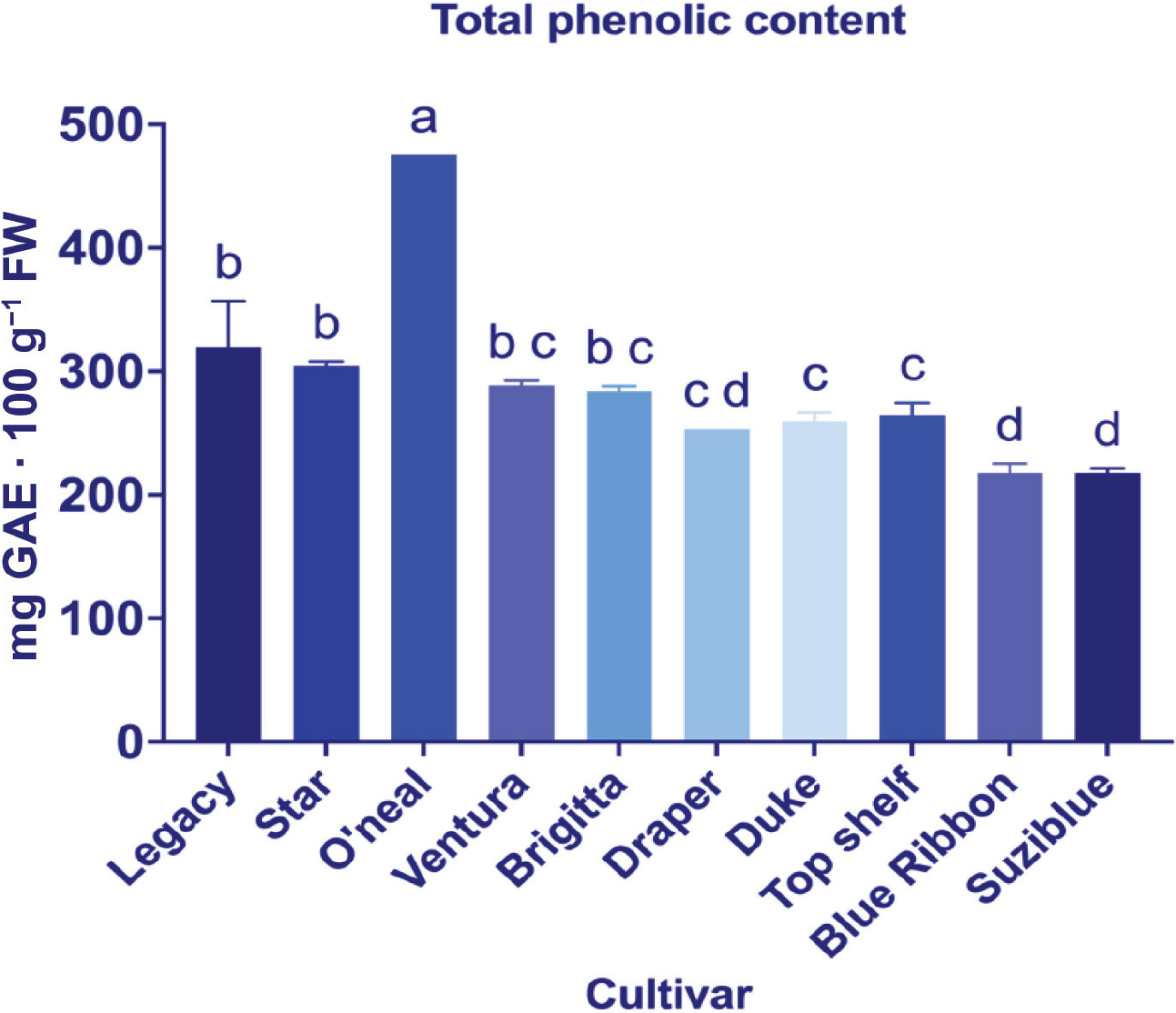
Figure 1.
Total phenolic content. Data correspond to mean ± SE of three biological replicates of the ripe fruit state. Different letters indicate significant differences among samples (p ≤ 0.05; ANOVA).
O’Neal showed the highest concentration, reaching approximately 475 mg of GAE per 100 g of FW. 'Legacy', 'Star', 'Ventura', and 'Briggitta' also exhibited high levels, ranging from 284 mg GAE to 319 mg GAE · 100 g−1 FW, with no significant differences among them (p ≤ 0.05). Intermediate values were observed in 'Draper', 'Duke' and 'Top Shelf" (253–264 mg GAE · 100 g−1 FW), while 'Suzi Blue' and 'Blue Ribbon' had the lowest phenolic contents, below 220 mg GAE · 100 g−1 FW.
Similarly, total flavonoid content showed a similar trend that was observed in total phenolic (Figure 2). 'O’Neal' again presented the highest value, with 82 mg of QE per 100 g FW. 'Legacy' and 'Ventura' followed with approximately 44 mg QE · 100 g−1 FW (p ≤ 0.05). 'Star', 'Draper', and 'Blue Ribbon' displayed moderate levels (30.8–36.5 mg QE · 100 g−1 FW), while 'Brigitta', 'Duke', and 'Top Shelf' ranged between 25.1 and 28.9 mg QE · 100 g−1 FW. 'Suzi Blue' showed the lowest flavonoid concentration (21.3 mg QE · 100 g−1 FW).
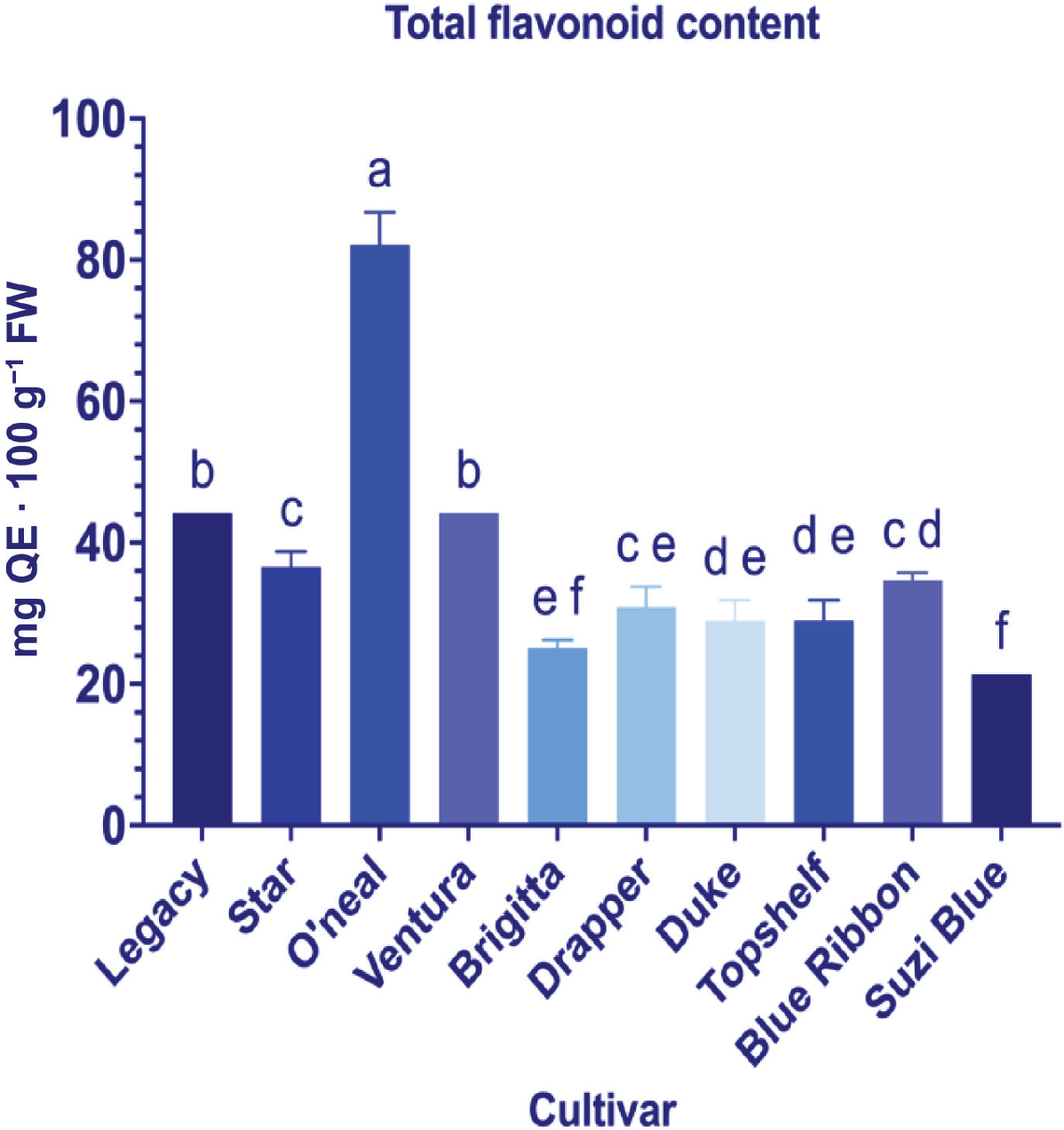
Figure 2.
Total flavonoid content. Data correspond to mean ± SE of three biological replicates of the ripe fruit state. Different letters indicate significant differences among samples (p ≤ 0.05; ANOVA).
Consistently, total anthocyanins quantification using the pH differential method (Figure 3) revealed 'O’Neal' as the top-performing cultivar, with 78.5 mg of cyanidin-3-O-glucoside equivalents (Cy-3-O-gluE) per 100 g FW. 'Legacy' and 'Ventura' followed closely (75.0 and 75.7 mg · 100 g−1 FW, respectively; p ≤ 0.05). 'Duke' and 'Blue Ribbon' had slightly lower levels (69.4–70.8 mg · 100 g−1 FW), while 'Draper' and 'Top Shelf' ranged between 56.9 and 57.5 mg · 100 g−1 FW. 'Star', 'Brigitta', and 'Suzi Blue' recorded the lowest anthocyanin contents (44.9–52.7 mg · 100 g−1 FW).
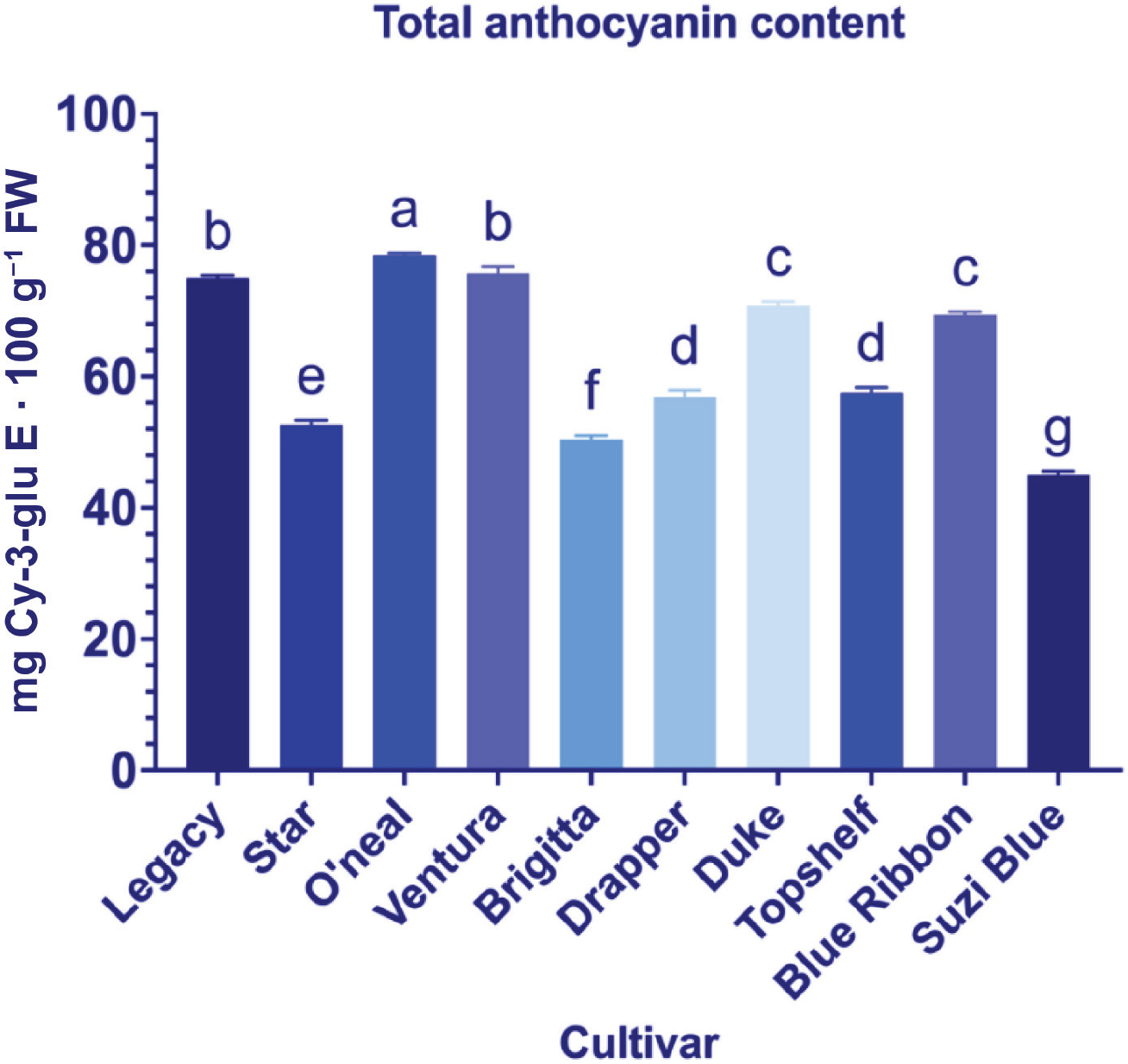
Figure 3.
Total anthocyanin content. Data correspond to mean ± SE of three biological replicates of the ripe fruit state. Different letters indicate significant differences among samples (p ≤ 0.05; ANOVA).
Antioxidant capacity
FRAP assay results (Figure 4) were consistent with the accumulation of phenolic compounds. 'O’Neal' and 'Legacy' exhibited the highest antioxidant capacities (808.9 and 808.4 mg trolox equivalents [TE] per 100 g FW, respectively), followed by 'Ventura' (762.2 mg TE · 100 g−1 FW). 'Star' and 'Blue Ribbon' showed moderately high activity (664.8–685.5 mg TE · 100 g−1 FW), and 'Draper' presented intermediate values (620.4 mg TE · 100 g−1 FW). 'Top Shelf', 'Duke', and 'Suzi Blue' ranged from 509.1 to 566.4 mg TE · 100 g−1 FW. 'Brigitta' showed the lowest antioxidant capacity (437.9 mg TE · 100 g−1 FW).
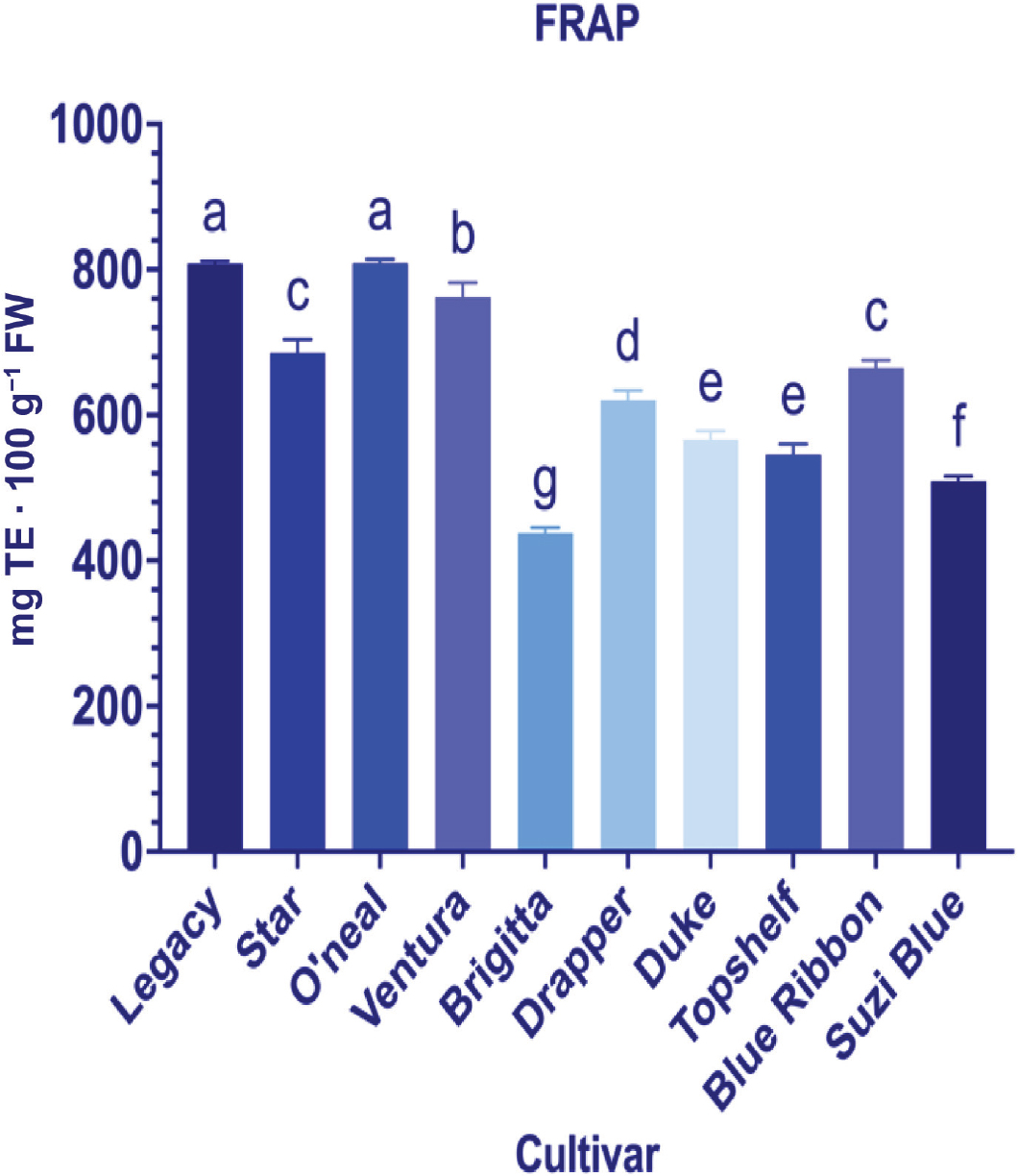
Figure 4.
Antioxidant capacity. Free radical scavenging activity by FRAP was estimated in the ripe stage of fruit. Data correspond to mean ± SE of three biological replicates. Different letters indicate significant differences among developmental stages [p ≤ 0.05; ANOVA]. FRAP, ferric reducing antioxidant power.
Antioxidant enzyme activities
The activity of key antioxidant enzymes—including APX, CAT, POD, and SOD—was quantified in all 10 blueberry cultivars and expressed as units per gram of FW (U · g−1 FW) (Figure 5).
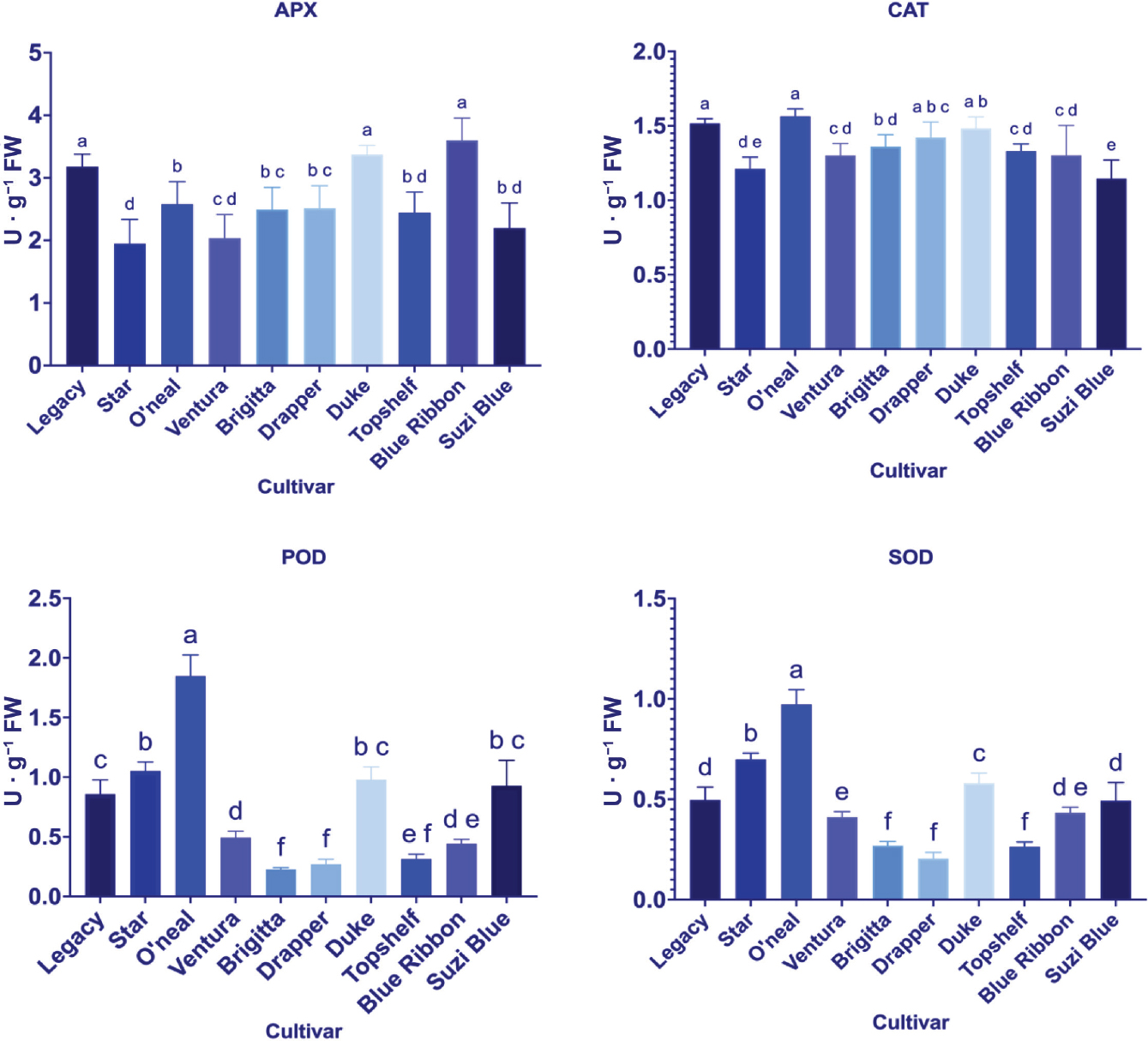
Figure 5.
Antioxidant enzyme activities (CAT, POD, SOD, and APX) in different blueberry cultivars. Different letters indicate significant differences (p ≤ 0.05; ANOVA). Bars represent means ± SE from three independent experiments. APX, ascorbate peroxidase; CAT, catalase; POD, peroxidase; SOD, superoxide dismutase.
The highest APX activities were observed in 'Blue Ribbon', 'Duke', and 'Legacy' (3.6, 3.4 and 3.2 U · g−1 FW, respectively), with no significant differences among them (p ≤ 0.05). Intermediate activity levels were found in 'O’Neal' (2.6 U · g−1 FW), 'Brigitta' (2.5 U · g−1 FW), and 'Draper' (2.5 U · g−1 FW), while the lowest APX activities were recorded in 'Top Shelf' and 'Suzi Blue' (both 2.2 U · g−1 FW), 'Ventura' (2.0 U · g−1 FW), and 'Star' (1.9 U · g−1 FW).
CAT activity remained relatively uniform across most cultivars. 'O’Neal', 'Duke', 'Legacy' and 'Drapper' showed the highest levels (1.4–1.6 U · g−1 FW). Moderate values were observed in 'Brigitta', 'Ventura', 'Top Shelf', and 'Blue Ribbon' (1.3–1.4 U · g−1 FW), whereas 'Star' and 'Suzi Blue' displayed the lowest CAT activities (1.2 and 1.1 U · g−1 FW, respectively).
'O’Neal' exhibited the highest POD activity (1.8 U · g−1 FW), markedly greater than the rest of the cultivars. 'Star' (1.05 U · g−1 FW), 'Duke' (0.98 U · g−1 FW), 'Suzi Blue' (0.93 U · g−1 FW), and 'Legacy' (0.86 U · g−1 FW) followed with moderate levels. 'Ventura' (0.5 U · g−1 FW), 'Blue Ribbon' (0.44 U · g−1 FW), 'Top Shelf' and 'Draper' (0.3 U · g−1 FW), and 'Brigitta' (0.2 U · g−1 FW) exhibited the lowest POD activities.
SOD activity was highest in 'O’Neal' (0.97 U · g−1 FW), followed by 'Star' (0.7 U · g−1 FW) and 'Duke' (0.58 U · g−1 FW). 'Legacy' (0.50 U · g−1 FW), 'Suzi Blue' (0.49 U · g−1 FW), and 'Blue Ribbon' (0.43 U · g−1 FW) showed moderate activity. The lowest SOD levels were recorded in 'Ventura' (0.40 U · g−1 FW), 'Brigitta' and 'Top Shelf' (0.3 U · g−1 FW), and 'Draper' (0.2 U · g−1 FW).
Colorimetric characterization (CIELab parameters)
The colour attributes of blueberry skin from the 10 cultivars were evaluated using the CIELab colour space (Table 1). The L* value (lightness) ranged from 3.4 ('Ventura') to 7.2 ('Top Shelf'), indicating that 'Top Shelf' and 'Brigitta' (L* = 7.0) were the lightest cultivars, while 'Ventura' and 'Suzi Blue' (L* = 3.7) exhibited the darkest appearance.
Table 1.
Colour readings of the 10 blueberry fruits peel.
| Cultivar | a* | b* | L* | C*ab | h°ab | ΔE | ||||||
|---|---|---|---|---|---|---|---|---|---|---|---|---|
| Mean | SD | Mean | SD | Mean | SD | Mean | SD | Mean | SD | Mean | SD | |
| 'O’Neal' | 1.16 | ±0.57 | –1.13 | ±0.40 | 4.59 | ± 1.34 | 1.68 | ±0.48 | 315.06 | ± 16.70 | - | - |
| 'Drapper' | 2.43 | ±0.92 | –0.57 | ±0.56 | 6.91 | ±0.97 | 2.52 | ± 1.01 | 348.52 | ±7.67 | 2.45 | ±0.89 |
| 'Suzi' | 1.39 | ±0.72 | –1.31 | ±0.30 | 3.72 | ±0.51 | 2.00 | ±0.45 | 313.63 | ± 16.67 | 1.55 | ±0.24 |
| "Legacy' | 2.87 | ±2.04 | –0.43 | ±0.25 | 6.77 | ± 1.67 | 2.92 | ±2.02 | 349.39 | ±7.75 | 2.80 | ± 1.90 |
| 'Star' | 1.65 | ±0.97 | –0.99 | ±0.33 | 4.28 | ±0.74 | 2.01 | ±0.83 | 322.98 | ±20.67 | 1.37 | ±0.32 |
| 'Top shelf' | 4.17 | ± 1.04 | –0.4 | ±0.44 | 7.17 | ± 1.17 | 4.20 | ± 1.06 | 354.83 | ±5.32 | 3.67 | ± 1.07 |
| 'Ventura' | 1.01 | ±0.11 | –1.48 | ±0.06 | 3.44 | ±0.02 | 1.79 | ±0.08 | 304.11 | ±3.13 | 1.66 | ±0.04 |
| 'Duke' | 1.61 | ±0.71 | –0.98 | ±0.31 | 6.00 | ±2.09 | 1.97 | ±0.46 | 324.68 | ± 20.62 | 2.13 | ± 1.00 |
| 'Blue ribbon' | 1.64 | ±0.84 | –1.03 | ±0.62 | 4.15 | ± 1.01 | 2.08 | ±0.47 | 324.19 | ±25.01 | 1.47 | ±0.15 |
| 'Briggita' | 4.87 | ± 1.54 | –0.77 | ±0.76 | 7.00 | ± 1.32 | 5.01 | ± 1.32 | 348.62 | ± 14.00 | 4.08 | ± 1.73 |
In the a* axis (green to red component), 'Brigitta' (4.87) and 'Top Shelf' (4.17) showed the highest positive values, indicating a slight reddish hue, whereas 'Ventura' (1.01) and 'O’Neal' (1.16) had the lowest, suggesting a less intense colouration along the red axis. The b* parameter (blue to yellow axis) was negative in most samples, indicating dominance of bluish tones, with 'Ventura' (−1.48) and 'Suzi Blue' (−1.31) being the most blue-shifted cultivars.
Chroma (Cab), which describes colour intensity, was highest in 'Brigitta' (5.01), followed by 'Top Shelf' (4.20), both showing more saturated colour compared to other cultivars. The hue angle (h°ab) ranged widely, from 304°('Ventnra') to 355°('Top Shelf'), confirming colour differences in tone, with 'Top Shelf' tending towards the red-yellow spectrum and 'Ventura' towards blue-violet.
Colour difference (ΔE), calculated using 'O’Neal' as the reference, revealed the greatest perceptible differences in 'Brigitta' (ΔE = 4.08) and 'Top Shelf' (ΔE = 3.67), both falling within the range of colour changes visible through medium-quality filters (3 < ΔE < 6). 'Legacy', 'Draper', and 'Duke' exhibited Δ E values between 2.1 and 2.8, corresponding to colour changes detectable with high-quality filters. Conversely, 'Star', 'Suzi Blue', 'Blue Ribbon', and 'Ventura' showed ΔE values between 1.3 and 1.6, which correspond to small and subtle colour differences not easily perceived without instrumental support (0.2 < ΔE < 2). No cultivar exhibited ΔE values exceeding 6, indicating that none differed from 'O’Neal' in a way that would be perceived as a distinct or entirely different colour.
Correlation analysis
A hierarchical clustering heatmap was used to analyse the correlation between biochemical and antioxidant parameters across 10 blueberry (Vaccinium spp.) cultivars (Figure 6A).
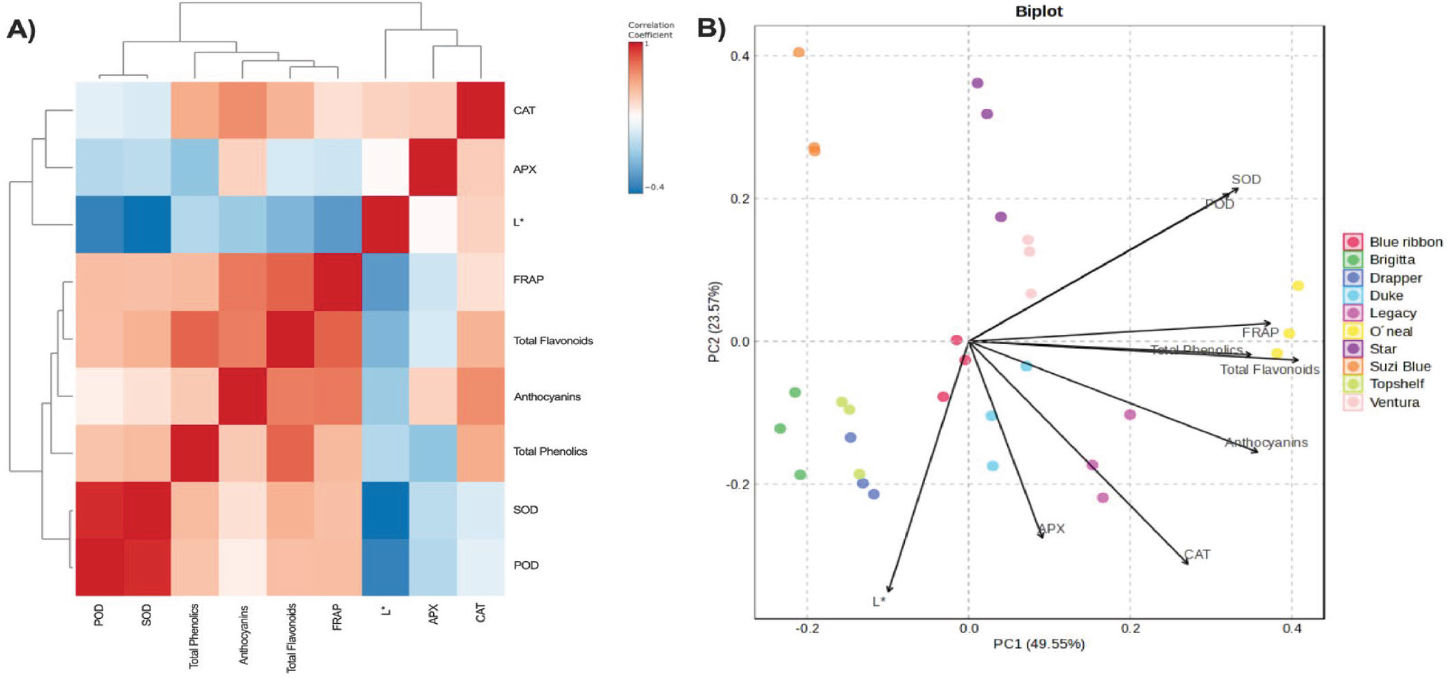
Figure 6.
Correlation analysis. (A) Hierarchical clustering heatmap showing Pearson correlation coefficients among biochemical and antioxidant traits in 10 blueberry (Vaccinium spp.) cultivars. (B) biplot derived from PCA. Variables include enzymatic antioxidant activities (POD, SOD, CAT, APX), total phenolics, total flavonoids, anthocyanins, antioxidant capacity (FRAP), and fruit color lightness (L). Red indicates positive correlations and blue indicates negative correlations, with color intensity corresponding to the strength of the relationship. Clustering reveals distinct groups of traits that co-vary, reflecting different antioxidant strategies among cultivars. APX, ascorbate peroxidase; CAT, catalase; PCA, principal component analysis; POD, peroxidase; SOD, superoxide dismutase.
The results revealed distinct clusters, highlighting strong positive correlations between enzymatic antioxidants (POD and SOD), which were also associated with higher phenolic content (Figure 6A). A separate cluster of non-enzymatic antioxidants (anthocyanins and flavonoids) showed strong positive correlations with each other and with FRAP, indicating that darkly pigmented fruits contribute significantly to total antioxidant capacity (Figure 6A). Interestingly, CAT and APX were positively correlated with L* values but negatively correlated with anthocyanins and FRAP, suggesting that lighter-coloured fruits may rely more on enzymatic antioxidant systems rather than phenolic compounds (Figure 6A).
The positive correlation observed between total phenolic content and FRAP values is consistent with the well-established contribution of non-enzymatic antioxidants to the overall reducing capacity of fruit tissues. Interestingly, certain cultivars exhibiting high phenolic levels did not display proportionally elevated antioxidant enzyme activities, suggesting that phenolic compounds may partially compensate for lower enzymatic antioxidant capacity under the evaluated conditions. This functional complementarity between enzymatic and non-enzymatic antioxidant systems has been previously reported in fruit crops and may reflect cultivar-specific metabolic strategies for maintaining redox homoeostasis. However, elucidating the relative contribution and regulatory interplay of these systems would require targetted experiments under controlled conditions, which were beyond the scope of the present study.
The biplot derived from principal component analysis (PCA) provides an integrative visualisation of the relationships among blueberry cultivars and key biochemical and antioxidant traits (Figure 6B). Principal component 1 (PC1) explains 49.55% of the total variance and is mainly associated with non-enzymatic antioxidant traits such as FRAP, total phenolics, total flavonoids, and anthocyanins, which cluster directionally together and positively contribute to PC1. Cultivars such as 'Star', 'Topshelf', and 'Suzi Blue' show strong associations with these traits, suggesting their superior accumulation of antioxidant metabolites (Figure 6B). In contrast, principal component 2 (PC2), which explains 23.57% of the variance, is more influenced by enzymatic antioxidant activity, particularly SOD and POD, indicating their role in distinguishing cultivars like 'Ventura' and 'Legacy'. Enzymes like CAT and APX contribute less to PC1 and align with cultivars on the lower right quadrant, indicating a different oxidative stress response strategy. The colour parameter L* is oriented in the opposite direction to anthocyanins and phenolic compounds, reinforcing the negative correlation between fruit lightness and pigment accumulation. This PCA biplot confirms that cultivars differ markedly in their antioxidant strategies: some rely on enzymatic defences, while others accumulate high levels of phenolic antioxidants, reflecting underlying genetic and metabolic diversity relevant to breeding for nutraceutical quality and stress resilience (Figure 6B).
DISCUSSION
The quantification of TPC, flavonoids (TFC), and anthocyanins (TAC) in 10 blueberry cultivars revealed marked variability, suggesting cultivar-associated differences in the accumulation of antioxidant secondary metabolites under commercial production conditions (Yan et al., 2023; Balbontín et al., 2024; Araniti et al., 2025). Given the lack of integrative evaluations of both enzymatic and non-enzymatic antioxidant systems across blueberry cultivars - either through phenolic accumulation or enzymatic activity - under standardised growing conditions, although the chromatographic techniques such as HPLC provide detailed identification of individual phenolic compounds, the analytical approach adopted in this study was designed to enable comparative screening of antioxidant-related traits across multiple cultivars under commercial conditions.
Among the analysed cultivars, 'O’Neal' presented the highest TPC, reaching 475.3 ± 10.6 mg GAE · 100 g−1 FW (mean ± SE), exceeding the typical values reported for other Vaccinium species (77.26–215.12 mg GAE · 100 g−1 FW) (Okan et al., 2018). 'Legacy', 'Star', 'Ventura', and 'Briggitta' also exhibited elevated TPC levels (220–284 mg GAE · 100 g−1 FW), while 'Draper', 'Duke', and 'Topshelf' showed intermediate values. 'Suzi Blue' and 'Blue Ribbon' consistently had the lowest TPC, below 250 mg GAE · 100 g−1 FW. These findings align with previous reports of significant inter-cultivar variability in phenolic content (Bhatt and Debnath, 2021; Rossi et al., 2022) and support the concept of genotype-driven phenolic accumulation.
The TFC reveals substantial differences among cultivars (Chang et al., 2002). As observed for TPC, these variations are consistent with literature showing up to a 2.66-fold difference in TFC among blueberry genotypes (Gupta et al., 2015; Rossi et al., 2022). In a global context, values between 30.44 and 91.69 mg QE · 100 g−1 FW have been reported in Turkish cultivars (Okan et al., 2018), reflecting the influence of geographic, climatic, and agronomic conditions - as reflected in our data. Blueberries are particularly rich in anthocyanins and flavonol glycosides such as quercetin, which contribute significantly to their antioxidant potential (Cho et al., 2005). Compared to other berries, blueberries demonstrate superior flavonoid levels, often exceeding those found in strawberries, raspberries, and blackberries (Narváez and Hernández-Carrión, 2022).
Anthocyanins, like TPC and TFC, were quantified using the pH differential method, and as with TPC and TFC, significant inter-cultivar differences were observed. 'O’Neal' had the highest TAC, with 78.5 mg cyanidin-3-O-glucoside equivalents (C3GE) 100 g−1 FW, followed by 'Ventura' and 'Legacy' (~75 mg C3GE · 100 g−1 FW), 'Duke' and 'Blue Ribbon' recorded intermediate values (~70 mg C3GE · 100 g−1 FW), whereas 'Draper' and 'Top Shelf' had slightly lower contents (~57 mg C3GE · 100 g−1 FW). 'Star', 'Brigitta', and 'Suzi Blue' showed the lowest values (44.9–52.7 mg C3GE · 100 g−1 FW). These results are consistent with more comprehensive studies of Vaccinium species, where TAC values range widely from 71.7 to over 530 mg · 100 g−1 FW depending on genotype and environmental conditions (Veberic et al., 2015; Wang et al., 2022).
Across all three compound groups - TPC, TFC, and TAC - the cultivars 'O’Neal', 'Ventura', and 'Legacy' consistently showed high levels of quality, flavor, and specific market-driven characteristics, underscoring their potential as candidates for breeding programmes and functional food development. Notably, the predominant presence of malvidin glycosides in blueberries contrasts with the cyanidin-rich profiles of other berries such as blackberries and raspberries (Corona et al., 2011; Veberic et al., 2015).
In this study, the CIELab colorimetric analysis effectively discriminated objective differences in colour attributes among blueberry cultivars, revealing significant variability in L*, a*, b*, Cab, and h°ab parameters, and is consistent with previous research highlighting its superiority in objectivity and reproducibility over subjective visual assessments (Pathare et al., 2013; Dutta and Nath, 2023). For instance, 'Top Shelf' and 'Brigitta' exhibited the highest lightness (L* > 7) and colour intensity (Cab > 4), while 'Ventura' and 'Suzi Blue' showed darker and more bluish tones (L* < 4; b* < –1.3). These variations within the CIELab space reflect not only phenotypic differences but also potential disparities in anthocyanin content (Fotirić Akšić et al., 2019; Avula et al., 2023). Additionally, the calculated ΔE values, using 'O’Neal' as a reference, revealed that 'Brigitta' and 'Top Shelf' had the most perceptible colour differences (ΔE > 3), which fall within the range of medium perceptibility, supporting the relevance of this method for quality differentiation and cultivar selection.
Fruit colour parameters (CIELab) provided useful phenotypic descriptors; however, their relationship with anthocyanin content was not always linear. In particular, the cultivar 'Suzi Blue' exhibited low L* and b* values, indicative of darker fruit colouration, despite relatively low total anthocyanin content. This apparent discrepancy may be attributed to differences in anthocyanin composition, co-pigmentation effects, vacuolar pH, or the contribution of other phenolic compounds influencing light absorption and scattering. Similar observations have been reported in other berry species, where colour intensity does not necessarily reflect total anthocyanin concentration. Further studies combining anthocyanin profiling and microstructural analyses would be required to clarify these relationships.
Taken together, these observations highlight the complexity of antioxidant regulation and colour development in blueberries and suggest that integrated biochemical and structural approaches will be necessary to fully elucidate cultivar-specific traits in future studies.
In other hand, APX activity differed among blueberry cultivars, with 'Blue Ribbon', 'Duke', and 'Legacy' showing the highest levels (3.2–3.6 U · g−1 FW), while 'Star', 'Ventura', and 'Suzi Blue' exhibited the lowest (≤2.2 U · g−1 FW). As a key enzyme in the ascorbate–glutathione cycle, APX detoxifies hydrogen peroxide (H2O2) and contributes to redox homoeostasis in fruit tissues, particularly during ripening and postharvest stages (Li, 2023; Corpas et al., 2024). The higher APX activity observed in certain cultivars may reflect an enhanced antioxidant capacity, potentially associated with improved stress tolerance and fruit quality.
Complementing the activity of APX, CAT also contributes to the detoxification of hydrogen peroxide in blueberry tissues. In this study, CAT activity remained relatively uniform among cultivars, with 'O’Neal', 'Duke', 'Legacy', and 'Draper' showing the highest values (1.4–1.6 U · g−1 FW), while 'Star' and 'Suzi Blue' exhibited the lowest (1.1–1.2 U · g−1 FW). In blueberries and other berries, catalase contributes to maintaining cellular homoeostasis during fruit development and postharvest stages, supporting fruit quality and shelf life (Remberg et al., 2006). Additionally, its synergistic action with phenolic compounds enhances the total antioxidant capacity of the fruit, reinforcing its health-promoting properties (Skrovankova et al., 2015).
Following the antioxidant roles of APX and CAT, POD also contributes to hydrogen peroxide detoxification and plays key roles in fruit development and quality. In this study, 'O’Neal' exhibited the highest POD activity (1.8 U · g−1 FW), significantly surpassing other cultivars. Moderate activity was found in 'Star', 'Duke', 'Suzi Blue', and 'Legacy' (0.86–1.05 U · g−1 FW), while 'Ventura', 'Blue Ribbon', 'Top Shelf', 'Draper', and 'Brigitta' showed the lowest values (0.2–0.5 U · g−1 FW). Peroxidases are heat-stable enzymes involved in oxidative reactions affecting ripening, flavour, and shelf life. In blueberries, POD activity increases during development and contributes to the antioxidant defence by decomposing H2O2, supporting both stress tolerance and postharvest quality (Miesle et al., 1991). However, due to their thermal stability, residual POD activity can also impact flavour and colour during processing, highlighting the need to balance its beneficial and undesirable effects in fruit handling and transformation (Burnette, 1977; Freitas et al., 2008).
In line with the coordinated action of other antioxidant enzymes, SOD catalyses the dismutation of superoxide radicals into oxygen and hydrogen peroxide, representing the first line of defence against reactive oxygen species. In this study, 'O’Neal' exhibited the highest SOD activity (0.97 U · g−1 FW), followed by 'Star' (0.7 U · g−1 FW) and 'Duke' (0.58 U · g−1 FW), while 'Draper' showed the lowest (0.2 U · g−1 FW). In berries, including blueberries, SOD plays a key role in mitigating oxidative stress, which is supported by their rich content of bioactive compounds such as anthocyanins and flavonoids that enhance antioxidant capacity (Skrovankova et al., 2015; Nemzer et al., 2020). Postharvest treatments like ozonation have been shown to induce SOD activity and improve fruit quality during storage (Piechowiak et al., 2020).
From a practical perspective, cultivar-associated differences in phenolic composition and antioxidant capacity may have direct implications for postharvest performance and processing suitability. Cultivars exhibiting higher total phenolic content and antioxidant capacity have been associated with enhanced oxidative stability, which may contribute to improved resistance to postharvest deterioration and quality loss during cold storage. Conversely, cultivars with lower phenolic levels may be more susceptible to oxidative stress but could offer advantages in terms of milder flavour profiles or reduced astringency, which are desirable for certain fresh-market or processed products.
In addition, specific biochemical profiles may influence the suitability of cultivars for different industrial applications. For instance, cultivars with elevated anthocyanin content and high FRAP values may be particularly well suited for juice, puree, or functional food formulations, where colour intensity and antioxidant claims are key quality attributes. In contrast, cultivars with balanced phenolic profiles and lower enzymatic browning potential may be preferable for drying or minimally processed products, where colour stability and texture retention are critical.
CONCLUSIONS
This study demonstrates substantial biochemical diversity among 10 commercial blueberry cultivars, as evidenced by significant variation in phenolic compounds, flavonoids, anthocyanins, antioxidant capacity, and antioxidant enzyme activities. The consistent performance of cultivars such as 'O’Neal', 'Ventura', and 'Legacy' across multiple antioxidant-related parameters highlights their potential relevance for cultivar selection and value-oriented breeding strategies. Importantly, the observed differences should be interpreted as cultivar-associated biochemical phenotypes expressed under commercial production and postharvest conditions, rather than as strictly genotype-determined traits, given the multifactorial nature of fruit biochemistry. From an applied perspective, the comparative profiling presented here provides a useful framework for aligning cultivar-specific antioxidant traits with horticultural, postharvest, and processing objectives. Future research integrating genetic, biochemical, environmental, and postharvest performance data will be essential to better elucidate the regulatory mechanisms underlying phytochemical accumulation and to support the development of high-value blueberry cultivars for fresh consumption and functional food applications.
Notes
[1] Contributed by AUTHOR CONTRIBUTIONS
C.P.-P., and L.M.Q. designed the experiments. N.N., C.V.-R., S.F., C.P.P., and P.R. performed the experiments. P.R., C.P.-P., and L.M.-Q. analysed the data. C.V.-R., C.P.-P., and L.M.-Q. wrote the first manuscript version. C.P.-P., P.R., and L.M.-Q. reviewed the manuscript, and all authors accepted the final version of the manuscript. N.N. and C.V.-R. contributed equally to this work.
[2] Conflicts of interest CONFLICT OF INTEREST
The authors declare that the research was conducted in the absence of any commercial or financial relationships that could be construed as a potential conflict of interest.
Supplementary Figure
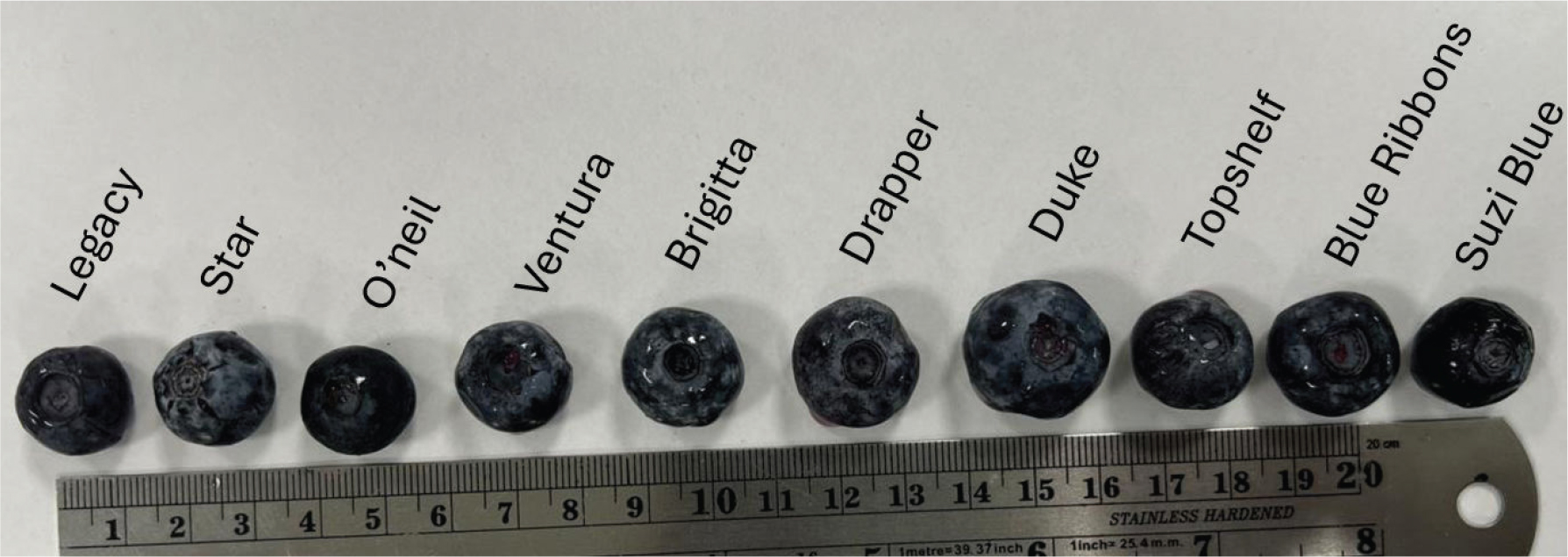
Figure S1.
Different blueberry varieties as a visual reference.