
INTRODUCTION
Medicinal plants are crucial not only in traditional therapies but also in modern medicine (Houghton, 1995; Hosseinzadeh et al., 2015; Marrelli, 2021). In traditional medicine, they are extensively utilised for the treatment and prevention of various diseases (Petrovska, 2012; Sofowora et al., 2013). In modern medical research, medicinal plants serve as a vital source for the discovery and development of new medicines (Silveira Rabelo and Caldeira Costa, 2018; Ahad et al., 2021; Akram et al., 2021). In recent years, with the growing demand for natural medicines, an increasing number of medicinal plants are being developed into natural pharmaceutical formulations (Ahirwar, 2023). Therefore, ensuring a stable supply of medicinal plants is essential for the sustainable development of healthcare services and the pharmaceutical industry (Theodoridis et al., 2023). To achieve this, growers should implement scientifically sound cultivation practices to enhance yields while maintaining high-quality standards. Furthermore, active constituents, such as flavonoids, chlorogenic acid, tannins, terpenes and alkaloids, are critical determinants of medicinal plant efficacy (Oladeji, 2016; Roy et al., 2022). The quality of medicinal plants is primarily determined by the concentration and diversity of these active constituents (Kumar et al., 2008; Stuper-Szablewska et al., 2022). Therefore, during the cultivation process, it is imperative to monitor and promote the accumulation of these active constituents to ensure both yield improvement and quality enhancement.
γ-Aminobutyric acid (GABA) is a non-protein amino acid ubiquitously present in plants, animals and microorganisms (Ramos-Ruiz et al., 2018). It serves not only as an essential component in metabolic pathways but also plays a pivotal role in modulating various physiological functions (Ramos-Ruiz et al., 2019). In plants, the synthesis and metabolism of GABA are closely linked to environmental stress responses. Numerous studies have shown that GABA can enhance plant survival under stress, improve leaf viability, mitigate chlorophyll degradation and promote overall plant growth (Guo et al., 2023; Jin et al., 2023; Zarbakhsh and Shahsavar, 2023; Hu et al., 2024; Kabała and Janicka, 2024). Based on these findings, the use of exogenous GABA as a plant regulator to enhance the stress resistance of plants has garnered considerable attention. However, it remains unclear whether exogenous GABA application during the cultivation of medicinal plants can enhance their yield and quality.
Supplying adequate nutrients is a common strategy to enhance the yield of medicinal plants (Ahmadi et al., 2020; Shahrajabian et al., 2022). Optimising the supply of nutrients can improve the growth rate and final yield (Naik et al., 2011; Murthy et al., 2014). However, it is important to note that an increase in yield does not necessarily equate to a concurrent improvement in quality. The quality of medicinal plants is directly correlated with the concentration of their active constituents, which can be influenced by various factors (Ncube et al., 2012; Tafreshi et al., 2025). Research has shown that nutrient condition are critical determinants of medicinal plant quality (Lv et al., 2024; Miransari et al., 2025). Excessive nutrient application may promote excessive vegetative growth, increasing biomass but potentially reducing the accumulation of active constituents. Therefore, in practical cultivation, it is essential to ensure that methods to enhance yield do not compromise the quality of medicinal plants.
Additionally, there may be complex interactions between nutrients and plant regulators, such as GABA, which can jointly influence plant growth and quality (Ncube et al., 2012). When exogenous GABA is applied to medicinal plants, it may interact with soil nutrients, affecting nutrient uptake and utilisation and thereby influencing the synthesis of active constituents. Consequently, while providing sufficient nutrients is an effective means to increase the yield of medicinal plants, careful evaluation of its impact on plant quality is necessary. Exploring the potential interactions between nutrients and other regulators can help achieve scientific cultivation practices that benefit both the yield and quality of medicinal plants.
To investigate the potential effect of GABA and nutrients on the growth and quality of medicinal plants, we conducted a greenhouse experiment using Glechoma longituba, a common medicinal plant species. We cultivated single fragments of G. longituba in pots and provided different concentrations of GABA and nutrients. Specifically, we tested the following hypotheses: (1) exogenous GABA can promote the growth and quality of G. longituba and (2) nutrients can enhance the positive effects of GABA on the growth and quality of G. longituba.
MATERIALS AND METHODS
Plant species
G. longituba (Nakai) Kupr., a perennial prostrate herb, belongs to the Lamiaceae family (Chu et al., 2006; Zhang and He, 2008). This species can reproduce speedily through the production of asexual offspring (Chu et al., 2006; Zhang et al., 2023). It is frequently observed in forests, along roadsides, and near streams and is widely distributed across China, with the exception of the northwest region and Inner Mongolia Autonomous Region (Zhang et al., 2007; Zhang and He, 2008, 2009). The dried herb of G. longituba is commonly utilised in traditional Chinese medicine, with a rich history of application spanning thousands of years (Shan et al., 2013; Zhou et al., 2021). It contains various bioactive constituents, including numerous flavonoid compounds and chlorogenic acid (Yuan et al., 2023; Wang et al., 2024a). These active constituents exhibit a wide range of pharmacological activities, such as prevention of nephrolithiasis, anti-inflammatory, analgesic, anticomplement, antimicrobial, antioxidant, depigmenting, anticancer and antiviral activities, which significantly contribute to human health (Liang et al., 2016; Zhou et al., 2021; Zhang et al., 2024). However, the accumulation of these valuable compounds exhibits considerable variability, influenced by multiple intrinsic and extrinsic factors. Studies have shown that the concentrations of active constituents differ significantly across plant parts, developmental stages and harvesting periods (Yang et al., 2021). Moreover, cultivation conditions, particularly the availability of nutrients, play a crucial role in determining both biomass yield and metabolic composition (Jin et al., 2018; Sile et al., 2022). Although previous studies have emphasised the significance of these influencing factors, strategies aimed at actively and consistently regulating the biosynthesis of bioactive compounds during cultivation, particularly through the application of regulators, such as GABA, remain largely underexplored in G. longituba.
The plant materials used in this study were purchased from commercial supplier in Shanghai, China. The plants were cultivated in a greenhouse (36°34′N, 114°29′E) at Handan University in Handan City, Hebei Province, China, for several weeks prior to the commencement of the experiment.
Experimental design
This experiment involved four levels of GABA concentration treatments (0, 2, 10 and 50 mL · L−1) fully crossed with four levels of nutrient concentration treatments (0, 1, 5 and 10 mL · L−1), resulting in a total of 16 treatment combinations. On 30 April 2024, 80 ramets, each bearing a pair of fully expanded leaves and containing a new bud in each leaf axil, were cut from the stock plants. A single ramet was planted in the centre of each pot (20 cm in diameter and 14 cm in depth) filled with a 1:1 (by volume) mixture of river sand and vermiculite (particle size 1–2 mm). GABA (C4H9NO2, 99.0% purity; Kexuan Biochemical Co., Ltd., Shandong, China) and nutrients (supplied by concentrated nutrient solution; N ≥ 30 g · L−1, P2O5 ≥ 14 g · L−1, K2O ≥ 16 g · L−1, F e ≥ 0.14 g · L−1, Mn ≥ 0.06 g · L−1; Miracle-Gro, The ScottsMiracle-Gro Company, Marysville, Ohio, USA) were dissolved in 50 mL of tap water according to the different concentrations configured for each treatment and then injected into the soil every 14 days starting from 9 May 2024. Each of 16 treatments was replicated five times, making a total of 80 experimental units. All pots were randomly placed on a bench in the same greenhouse in which the plants were initially cultivated.
The experiment ended on 4 July 2024 and lasted for 66 days. During the experiment, the mean temperature in the greenhouse was 27.9°C, and the mean air humidity was 47.1% (values recorded every 2 hr using a temperature logger). Adequate soil moisture was maintained by daily watering to ensure it did not become a limiting factor for plant growth.
Measurements and data analysis
At harvest, we counted the number of nodes of G. longituba in each pot. The plants were separated into shoots (comprising leaves and stolons) and root parts. Subsequently, they were dried at 70°C until a constant weight was achieved, after which their dry mass was measured. The dried shoots were then stored as samples for the measurement of physiological indicators. We calculated the root-shoot ratio by dividing the root mass by the shoot mass. The content of chlorogenic acid, total flavonoids, soluble sugar and soluble protein were quantified using colourimetric methods based on standard curves. The concentration of each constituent in the sample was calculated using the following formula: w = (x × v1)/(m × v2), where x represents the target constituent content per assay tube derived from the standard curve (mg), v1 is the total volume of the extract (mL), v2 is the volume of extract used for the assay (mL) and m represents the sample dry mass. Chlorogenic acid: as described by Oteef (2022), ultrasonic extraction was carried out using 60% ethanol. Colour development was achieved with FeCl3, and absorbance was measured at 755 nm. Total flavonoids: following the method of Liu et al. (2021), ultrasonic extraction was performed, followed by sequential addition of NaNO2, Al(NO3)3 and NaOH for colour development. Absorbance was measured at 510 nm. Soluble sugar: according to Gao (2006), extraction was conducted using a boiling water bath. Colour development was carried out using anthrone-sulphuric acid reagent, and absorbance was measured at 625 nm. Soluble protein: as outlined by Gao (2006), ultrasonic extraction was employed. Coomassie Brilliant Blue G-250 (The Chemre Chemical Reagent Co., Ltd., Tianjin, China) was added for colour development, and absorbance was recorded at 595 nm.
We employed the two-way analysis of variance (ANOVA) to test the effects of GABA concentration, nutrient concentration and their interactions on total mass, shoot mass, root mass, main stem length, number of nodes, root-shoot ratio and the contents of chlorogenic acid, total flavonoids, soluble sugar and protein in the shoots of G. longituba. Prior to analysis, all data were checked for homoscedasticity and transformed as necessary to improve normality and homoscedasticity of variance (specific transformation methods are detailed in the tables). Figures show untransformed data. Three replicates were lost due to operational miss during the experiment: one from the 0 mL · L−1 nutrients × 2 mL · L−1 GABA treatment, one from the 0 mL · L−1 nutrients × 50 mL · L−1 GABA treatment and one from the 10 mL · L−1 nutrients × 50 mL · L−1 GABA treatment. Additionally, in one replicate of the 1 mL · L−1 nutrients × 0 mL · L−1 GABA treatment, soluble sugar content measurements could not be obtained due to insufficient sample amount; therefore, these replicates were excluded from the data analyses. All analyses were performed using SPSS 22.0 (IBM, Inc., Armonk, NY, USA).
RESULTS
Effects of GABA and nutrients on dry biomass and morphology of G. longituba
GABA treatment significantly affected total dry mass, shoot dry mass, node number and root-shoot ratio (Table 1). Nutrient treatment significantly affected total dry mass, shoot dry mass, root dry mass and node number (Table 1). In general, increased GABA concentration led to increases in total dry mass, shoot dry mass and node number but decreased root-shoot ratio (Figure 1A, Figure 1B, Figure 2A, Figure 2B). Increased nutrient level increased the total dry mass, shoot dry mass, root dry mass and node number (Figure 1; Figure 2A). There was no interaction between GABA and nutrient treatments on any biomass and morphology measurement of G. longituba (Table 1).
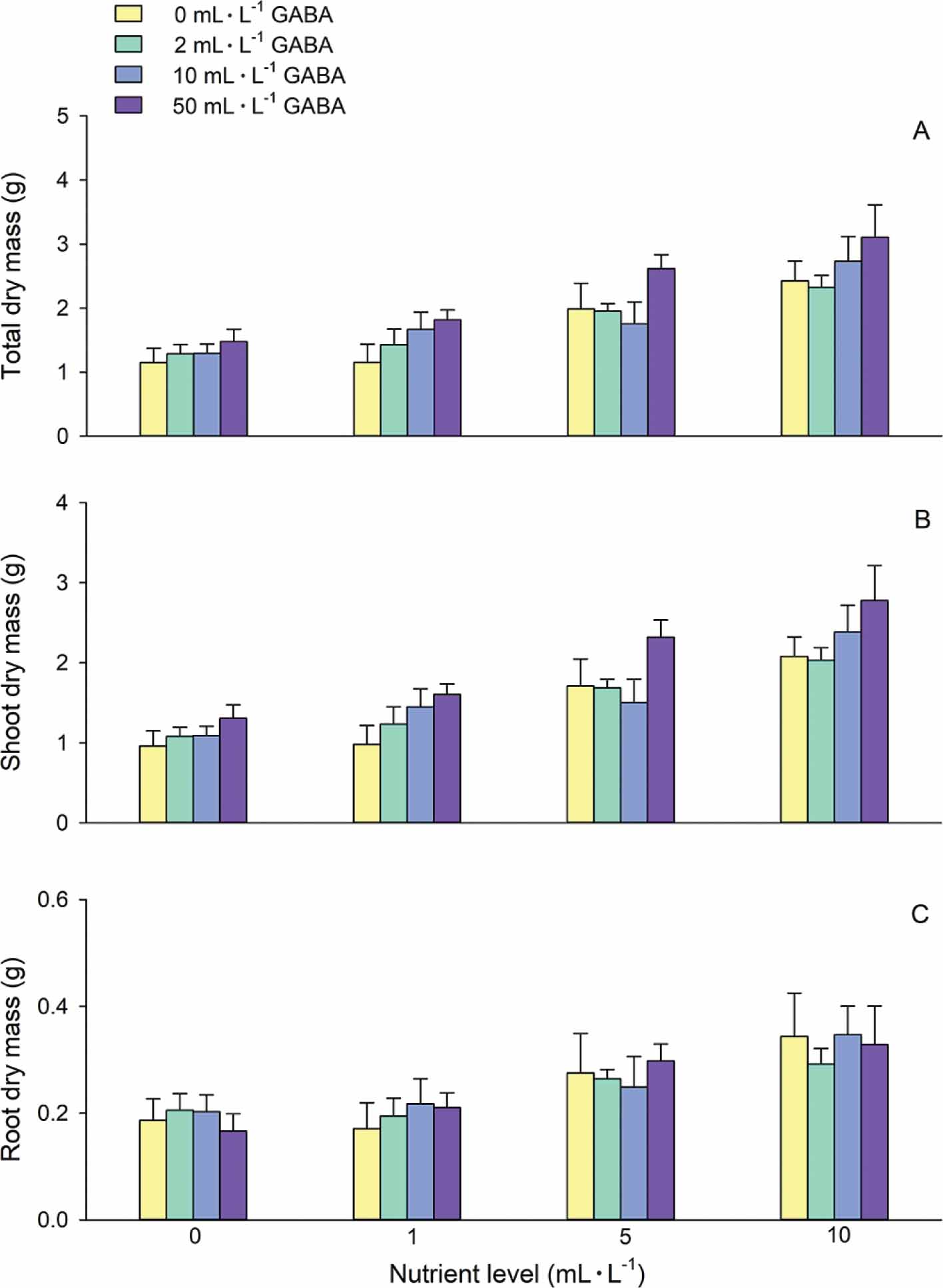
Figure 1.
Effects of GABA and nutrients on total dry mass (A), shoot dry mass (B) and root dry mass (C) of Glechoma longituba. Bars and vertical lines are means and standard error.
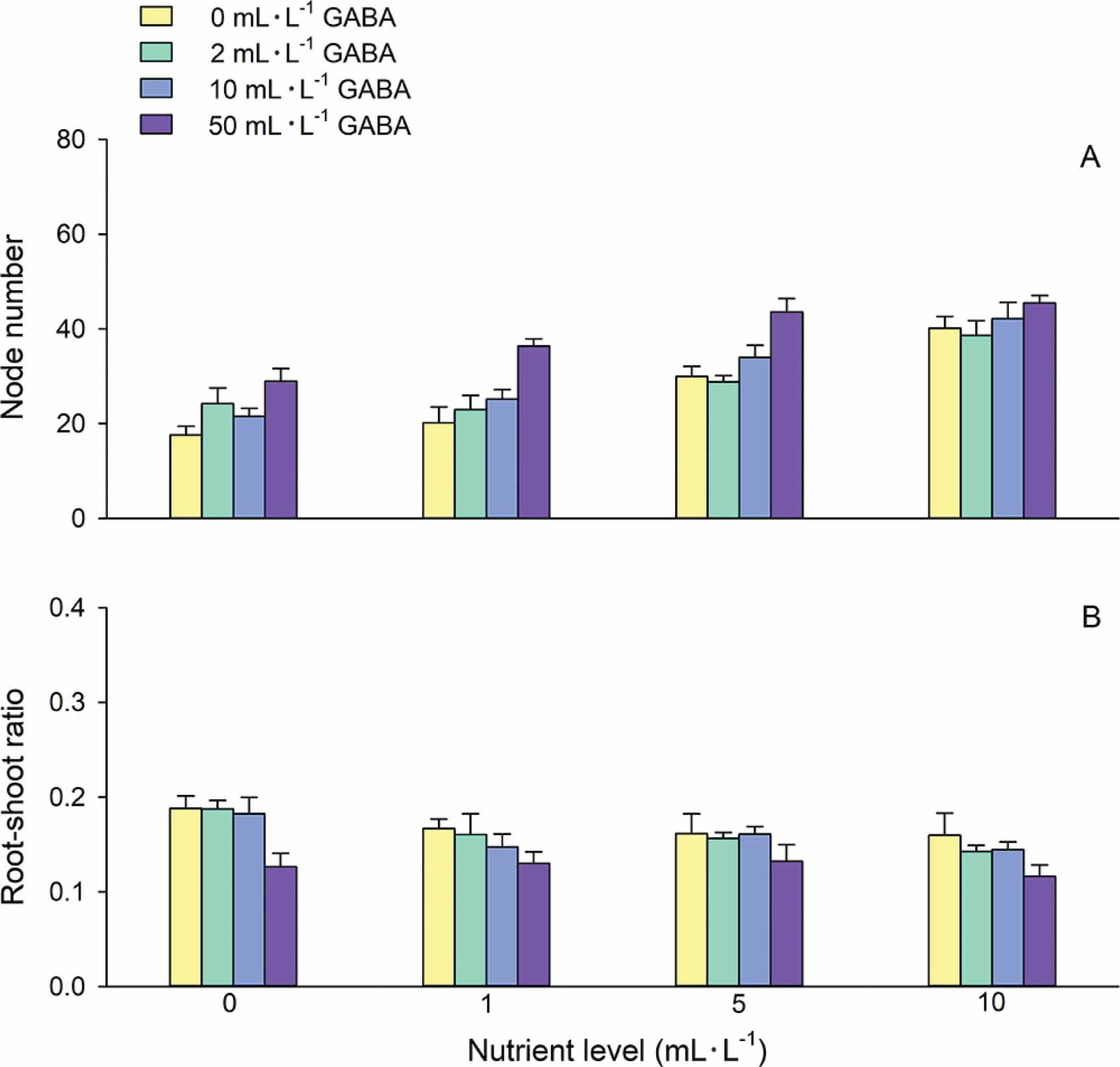
Figure 2.
Effects of GABA and nutrients on node number (A) and root-shoot ratio (B) of Glechoma longituba. Bars and vertical lines are means and standard error.
Table 1.
ANOVA results for the effects of GABA and nutrients on total dry mass, shoot dry mass, root dry mass, node number and root-shoot ratio of Glechoma longituba in all treatments.
| Variable | GABA (G) | Nutrient (N) | G × N | |||
|---|---|---|---|---|---|---|
| F3,61 | p | F3,61 | p | F3,61 | p | |
| Total dry massa | 3.417 | 0.023 | 17.811 | <0.001 | 0.444 | 0.906 |
| Shoot dry massa | 4.475 | 0.007 | 19.616 | <0.001 | 0.468 | 0.890 |
| Root dry massa | 0.129 | 0.942 | 7.299 | <0.001 | 0.278 | 0.978 |
| Node number | 15.914 | <0.001 | 42.325 | <0.001 | 1.051 | 0.412 |
| Root-shoot ratioa | 6.484 | 0.001 | 2.593 | 0.061 | 0.312 | 0.968 |
Effects of GABA and nutrient level on the main active constituents and nutrition in G. longituba
GABA treatment and nutrient treatment significantly affected the contents of chlorogenic acid and the total flavonoids in the shoots of G. longituba (Table 2). The interaction of GABA and nutrients significantly affected the content of total flavonoids (Table 2). Overall, as GABA concentration and nutrient concentration increased, the contents of chlorogenic acid and total flavonoids in the shoots of G. longituba decreased (Figure 3). Increased nutrient levels weakened the response of total flavonoids to GABA (Figure 3B).
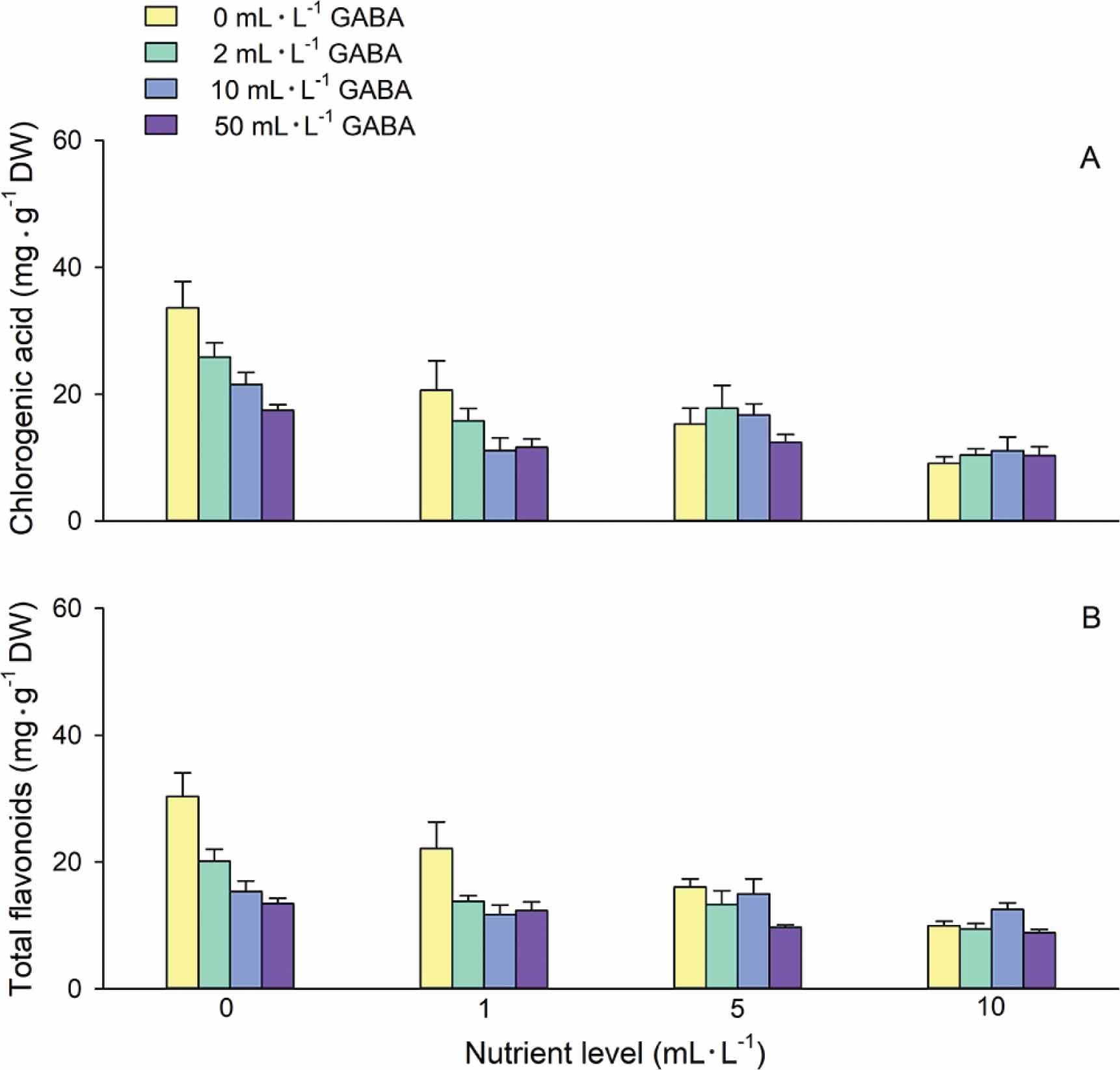
Figure 3.
Effects of GABA and nutrients on the content of chlorogenic acid (A) and total flavonoids (B) in the shoots of Glechoma longituba. Bars and vertical lines are means and standard error.
Table 2.
ANOVA results for the effects of GABA and nutrients on contents of chlorogenic acid and total flavonoids in the shoots of Glechoma longituba in all treatments.
| Variable | GABA (G) | Nutrient (N) | G × N | |||
|---|---|---|---|---|---|---|
| F3,61 | p | F3,61 | p | F9,61 | p | |
| Chlorogenic acid | 25.724 | <0.001 | 3.667 | 0.017 | 1.694 | 0.110 |
| Total flavonoids | 20.302 | <0.001 | 12.917 | <0.001 | 2.964 | 0.005 |
Nutrient treatment significantly affected soluble sugar content in the shoots of G. longituba (Table 3). In general, increased nutrient concentration led to higher soluble sugar content (Figure 4A). Neither GABA treatment nor the interaction between GABA and nutrient treatments affected soluble sugar or protein content (Table 3, Figure 4A, Figure 4B).
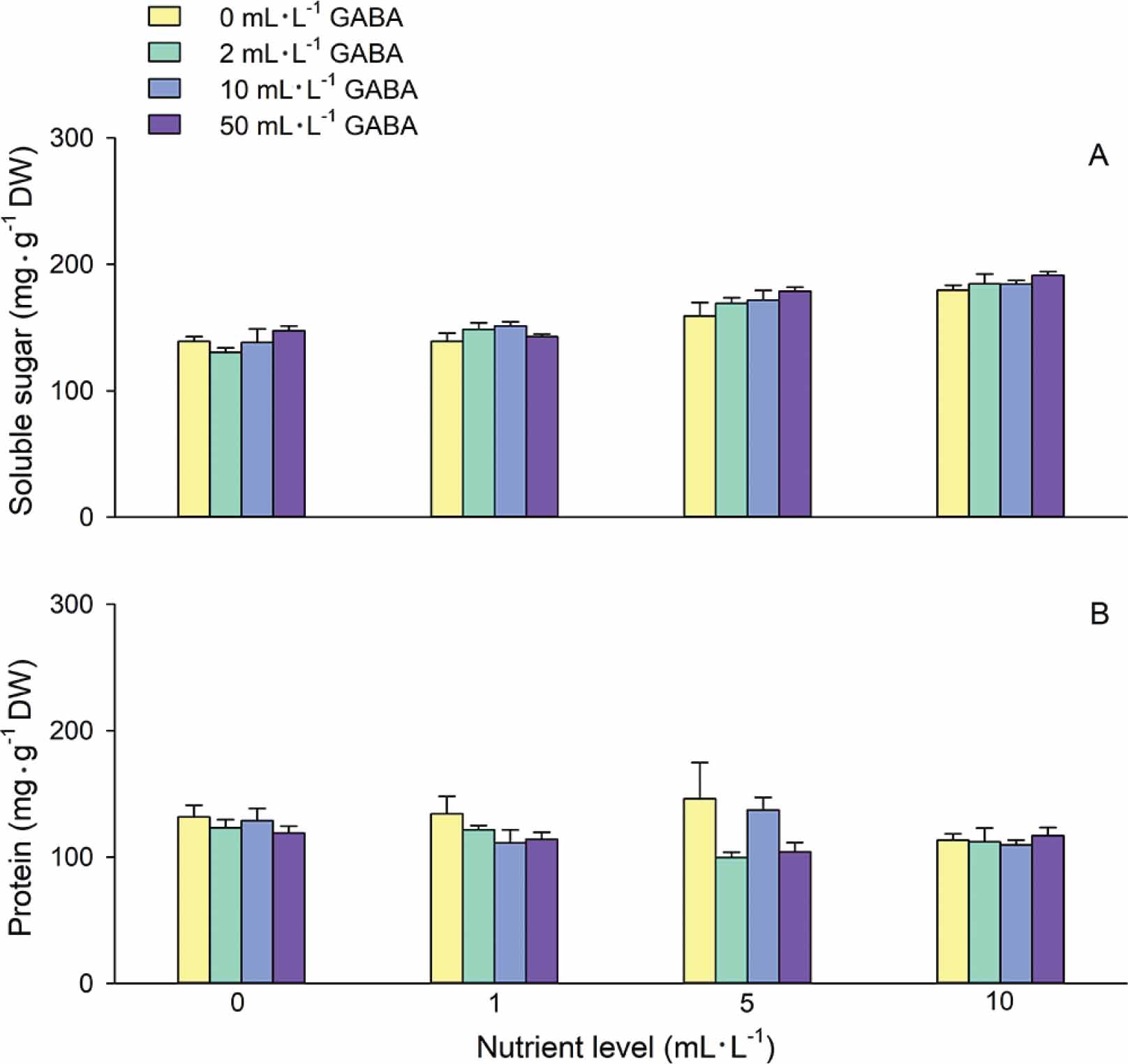
Figure 4.
Effects of GABA and nutrients on the content of soluble sugar (A) and protein (B) in the shoots of Glechoma longituba. Bars and vertical lines are means and standard error.
Table 3.
ANOVA results for the effects of GABA and nutrients on contents of soluble sugar and protein in the shoots of Glechoma longituba in all treatments.
| Variable | GABA (G) | Nutrient (N) | G × N | |||
|---|---|---|---|---|---|---|
| F3,60 | p | F3,60 | p | F9,60 | p | |
| Soluble sugar | 2.362 | 0.080 | 50.749 | <0.001 | 0.779 | 0.636 |
| F3,61 | P | F3,61 | P | F9,61 | P | |
| Protein | 2.352 | 0.081 | 0.922 | 0.436 | 1.197 | 0.313 |
DISCUSSION
Response of plants growth and morphology to GABA and nutrient treatments
As predicted, the findings demonstrate that exogenous GABA can, in fact, promote the growth of G. longituba, as evidenced by significant increases in total biomass and node number. GABA is an important free amino acid in plant tissues that plays an essential role in various stages of plant growth and development (Shelp et al., 2012; Yang et al., 2023). Exogenous GABA has been commonly used to enhance plant tolerance to environmental stresses, such as salinity stress and nutrient deficiency (Guo et al., 2020; Li et al., 2020). However, it remains unclear whether exogenous GABA can enhance the growth and physiological performance of plants. In this study, increased concentration of GABA significantly increased the total mass and node number of G. longituba. This suggests that addition of exogenous GABA can effectively promote the growth of G. longituba, potentially by stimulating cell division, elongation and differentiation, ultimately leading to increased biomass accumulation and vegetative reproduction through the formation of new offspring ramets via node differentiation, which was previously stated for other plants (Jalil et al., 2019; Jin et al., 2023; Liu et al., 2024). Additionally, GABA modulated biomass allocation, potentially enhancing yield in this species by promoting the accumulation of biomass in leaves and stolons. Increased nutrient level also increased biomass and node number of G. longituba as predicted and reported previously (Zhang et al., 2023). These results indicate that both exogenous GABA and nutrients have positive effects on the growth of G. longituba independently; however, increased nutrient levels did not enhance the positive effects of exogenous GABA on G. longituba growth.
Response of plant quality to GABA and nutrient treatment
The results did not support the second hypothesis that nutrients would enhance the positive effects of GABA on quality. Instead, both factors independently and additively reduced the content of key active constituents. Neither increasing GABA concentrations nor enhancing nutrient levels raised the content of chlorogenic acid and total flavonoids, which are the main active constituents in G. longituba, as expected. Conversely, increased GABA and nutrient concentrations even reduced the content of these compounds. Although previous studies have shown that exogenous GABA can significantly increase the content of such active constituents in some plants (Gu et al., 2022; Wang et al., 2024b), this effect appears to be species-specific. For example, Xie et al. (2019) demonstrated that GABA addition at concentrations of 1 mg · g−1 and 10 mg · g−1 significantly increased flavonoid content in poplar. Critically, in this study, we found no synergistic benefit between GABA and nutrients for quality enhancement in G. longituba; their effects were solely additive for growth promotion, leading to a more pronounced dilution of secondary metabolites. The concurrent decrease in phenolic compound concentration and increase in tissue dry mass under both GABA and high nutrient treatments strongly supports a dilution effect, wherein the synthesis of these secondary metabolites fails to keep pace with the accelerated growth rate and biomass accumulation induced by these treatments.
Regarding the main nutrition in G. longituba, increasing GABA did not significantly affect their levels. However, increasing nutrient concentration levels in soil resulted in a significant increase in soluble sugar content without influencing protein accumulation. The effects of GABA on the accumulation of plant nutrition have been inconsistent in previous studies. For instance, exogenous addition of GABA, especially in 40 mmol concentration, significantly increased total soluble carbohydrate, glucose and fructose contents in the leaves of pomegranate plants (Zarbakhsh and Shahsavar, 2023). In contrast, the protein contents of GABA-treated carrot plants did not significantly differ from untreated plants (Bashir et al., 2021). These results suggest that the effects of GABA on plant nutrition accumulation may vary depending on the plant species and the concentration of GABA applied. The positive effect of nutrient addition on soluble sugar content may be attributed to enhanced photosynthesis and the promotion of soluble sugar accumulation in plants. Overall, this experiment demonstrated that the addition of GABA and nutrients significantly enhanced the dry biomass of plants, but at the cost of reduced quality. Therefore, when applying GABA as a growth regulator in the cultivation of G. longituba, careful consideration must be given to this trade-off, as GABA application intensifies the yield-quality dilemma associated with high-nutrient fertilisation.
CONCLUSION
Exogenous GABA significantly enhances the dry biomass and node number of G. longituba. However, increased nutrient levels do not strengthen the positive effects of GABA on quality; instead, they exacerbate its negative influence on the accumulation of chlorogenic acid and flavonoids, likely due to a biomass dilution effect. Therefore, the application of GABA as a growth regulator in the cultivation of G. longituba should be carefully reconsidered, as it appears to reinforce the classic trade-off between yield and quality. Future research should explore strategies to counteract this dilution effect, such as using lower GABA concentrations, adjusting application timings, or combining GABA use with other practices that may stimulate secondary metabolite pathways.
Notes
[9] Contributed by AUTHORS CONTRIBUTIONS
R.Z. contributed to investigation, methodology, formal analysis, writing – original draft and writing – review and editing. Z.Y.X. and B.N.Z. contributed to investigation, methodology, supervision and writing – original draft. M.J.J. contributed to investigation, methodology and writing – review and editing. X.R.C., J.N.L., X.X.W., J.Y.L. and Y.H.W. performed the investigation and methodology. C.S. helped in supervision, conceptualisation, methodology, formal analysis, writing – original draft, and writing – review and editing.
[10] Conflicts of interest CONFLICT OF INTEREST
The authors declare that they have no known competing financial interests or personal relationships that could have appeared to influence the work reported in this study.