
Introduction
In recent years, the food, pharmaceutical and cosmetic industries have shown a growing interest in phytochemicals derived from medicinal and aromatic plants. The growth, yield and phytochemical composition of these plants vary considerably depending on environmental conditions, cultivation methods and nutrient availability (Aboutalebi et al., 2013; Mandal et al., 2023). Basil (Ocimum basilicum L.) is one of the most important aromatic plants. The Ocimum genus belongs to the Lamiaceae family and is native to South Asia, with a wide distribution in tropical and subtropical regions of the Americas, Africa, Asia and southern Europe. It is rich in bioactive metabolites and is used in traditional recipes, food preparations, as flavouring agents, fresh-market herbs for culinary and ornamental purposes, traditional medicines in many countries and to produce phytochemicals for medicinal purposes (Kolega et al., 2020; Zahran et al., 2020). Consumer demand has grown steadily in recent years for high-quality basil. This trend extends to basil-derived products as well, with customers seeking high-quality basil and related products. One of the most important factors affecting the quantity and quality of medicinal plants is the management of growing conditions. To produce vegetable crops and aromatic or medicinal plants, hydroponic systems are a highly suitable choice as they reduce damage or loss during plant growth, improve yield and thus have an economic advantage (Nicola et al., 2005; Giurgiu et al., 2014). Basil is an economically interesting crop traditionally grown in the field, but to increase yields and extend the growing season, farmers are turning to greenhouses; recently, soilless culture systems (SCSs) have been introduced (Kiferle et al., 2013).
The adoption of SCS strategies offers promising agricultural developments, particularly in areas characterised by water scarcity and poor soil health, providing environmentally friendly approaches to safe food production (Sambo et al., 2019; Kolega et al., 2020).
Hydroponic growing systems provide precise environmental control, reducing the need for chemical treatments for soil and plant protection, while optimising nutrient delivery to increase crop productivity and quality (Rouphael et al., 2012; Sambo et al., 2019). The concentration of the nutrient solution plays a key role in the success of growing SCS crops. Therefore, hydroponic systems, as one of the most important techniques in agriculture, facilitate nutrient management and improve production. In addition, this innovative agronomic technique has significant potential for environmentally friendly agriculture while helping to address global food security challenges (Nicola et al., 2005; Sambo et al., 2019). SCSs are based on a hydroponic nutrient solution (HNS), the concentration and composition of which are important aspects for the plant production (Luna et al., 2013; Nicola et al., 2016). Too high nutrient concentrations induce osmotic stress, ion toxicity and nutrient imbalance, whereas too low concentrations generally lead to nutrient deficiencies (Fallovo et al., 2009; Sangeetha and Periyathambi, 2024). Crop productivity and quality depend on the ability of the HNS to maintain proper nutrient concentrations, ensuring efficient uptake while avoiding nutrient deficiencies. Because SCS are highly productive in short crop cycles and suitable for high plant densities, they are often used to produce high-value crops (Pignata et al., 2017; Fontana and Nicola, 2020). Moreover, SCS controls input use to minimise environmental pollution (Sambo et al., 2019). There are numerous SCSs available, such as floating systems, nutrient film technique (NFT) systems, aeroponic systems, pot systems and other derivatives (Fallovo et al., 2009; Pignata et al., 2016). The New Growing System (NGS®) is an SCS similar to NFT based on the recirculation in a closed-cycle system of the HNS through a multichannel film (Nicola et al., 2021). The multilevel system was developed to favour the aeration of the HNS and to avoid the bung effect due to root growth (Pignata et al., 2016; Nicola et al., 2021). In these types of SCS, depending on growing conditions and crop requirements, HNS can be pumped into the system intermittently (Iglesias et al., 2014; Nicola et al., 2021). As with other SCSs, plant nutrition can be better controlled in NGS® in protected cultivation than in traditional open-field cultivation systems; substrate contamination can also be reduced. Owing to the intrinsic structure of the NGS® and the possibility of recovering drainage and water, the system leads to water savings of up to 90% in comparison with conventional systems (Pignata et al., 2017; Nicola et al., 2021; Hazrati et al., 2024a, 2024b). In addition, NGS® allows plants to regrow and saves time for root growth and plant adaptation, resulting in increased yields and reduced costs (Nicola et al., 2021). NGS® and HNS influence postharvest quality characteristics (Hazrati et al., 2024a). Other factors such as light intensity, available water, length of the growing season and nutrient concentrations also affect element accumulation in plant tissues. Mineral elements have been reported to accumulate in plants grown in hydroponic systems (Aboutalebi et al., 2013; Hazrati et al., 2024a). However, a major challenge in growing leafy vegetables, such as basil, is their tendency to accumulate excessive levels of nitrate (NO3−) in their plant tissues, with concentrations often exceeding 2500 mg NO3− · kg−1. The amount of NO3− accumulation depends on several factors such as the concentration of NO3− and other nutrients, agricultural management, cultivation system, harvest time and post-harvest management (Vanegas et al., 2016). The nutrient solution was found to significantly affect the qualitative and quantitative traits of lettuce (Seo et al., 2009; Luna et al., 2013; Vanegas et al., 2016) and basil (Aboutalebi et al., 2013) grown in SCS. The qualitative and quantitative analyses of phytochemicals composition in basil leaves may depend primarily on the genetic traits (Skrypnik et al., 2019). Apart from the genetic characteristics, the growing conditions have a fundamental influence on the phytochemical profile of basil and other plant species (Scagel and Lee, 2012; Kolega et al., 2020).
Essential oils (EOs) consist of diverse volatile chemical components, including terpenes, phenolics and alcohols, synthesised by plants (Binello et al., 2014; Mohamed and Alotaibi, 2023). Basil EOs contain a wide range of compounds, with the major components being phenylpropanoids (methyl chavicol, methyl cinnamate, eugenol and methyl eugenol) and terpenes (linalool, geraniol, geranial, camphor and neral) (Hussain et al., 2008; Milenković et al., 2019). However, basil EO varies greatly depending on the plant growing conditions, plant age, agronomic techniques, the type of fertiliser applied and the extraction method (Hussain et al., 2008; Binello et al., 2014; Pennisi et al., 2019; Kolega et al., 2020). Management factors such as cultural systems, harvest time, irrigation and fertilisers have a major impact on the quality and quantity of the products. The concentration and type of mineral nutrients have been identified as one of the main factors influencing the biosynthesis of secondary metabolites. For aromatic herbs such as basil, determining precise nutrient management strategies requires a comprehensive assessment that considers both agronomic productivity and the resulting EO composition and bioactive properties. The application of HNS to basil grown in SCS has not been extensively studied to investigate how ion concentration can affect the quality and EO composition. Several previous studies have investigated the effects of fertilisation rates on basil plant growth. These studies generally demonstrated a positive impact on yield, with increased fertilisation leading to higher crop production (Sifola and Barbieri, 2006; Zheljazkov et al., 2008; Olfati et al., 2012; Kiferle et al., 2013; Cruz et al., 2020; Dasgan et al., 2022; Song et al., 2024). However, the enhanced yield was not consistently accompanied by improved quality in the final product. While higher fertilisation boosted plant growth and biomass accumulation, the effects on EO composition, aroma profiles and other quality parameters were variable, indicating a potential trade-off between yield and quality in basil cultivation under different nutrient regimes. Nutrient deficiency can affect plant growth, resulting in developmental problems and reduced crop yield (Saha et al., 2016; Burducea et al., 2018; Cruz et al., 2020; Song et al., 2024).
Although studies have shown that SCS can affect both the yield and product quality of herbs (Miceli et al., 2003; Akoumianaki-Ioannidou et al., 2015; Kolega et al., 2020), the effect of HNS and cultural practices on the quality of aromatic plants is highly variable. This study investigates the impact of HNS concentration on basil production, phytochemical parameters, safety and EO profile in a closed-cycle hydroponic system. Limited literature is available on this topic (Walters and Currey, 2018; Solis-Toapanta et al., 2020; Dasgan et al., 2022). Optimising the nutrient solution concentration is crucial for maximising basil yield and quality. This study aims to evaluate the effects of different concentrations and compositions of HNS, as well as the influence of two harvest strategies on basil yield, quality, microbial contamination and EO profile in the NGS® system.
MATERIALS AND METHODS
Plant material and growing conditions
The experiment was conducted at the DISAFA ‘Agricultural and livestock experiment station Tetto Frati’ (44°53′11.67″ N; 7°41′7.00″ E—231 m a.s.l. Carmagnola, TO, Italy) in an automatically controlled greenhouse from February 26 to May 26. The greenhouse maintained consistent environmental conditions, including heating, ventilation and seasonal shading for the experiments, and recorded maximum and minimum temperatures and relative humidity throughout the growing cycle (Figure 1). The plant material used was a commercial basil (O. basilicum L. 'Superbo'; S.A.I.S. S.p. A., Cesena, FC, Italy) sown in January 30 in peat press cubes (33 mm × 33 mm × 33 mm) prepared with a specific commercial peat-based horticultural medium (Brill 5; Gebr. Brill Substrate GmbH & Co. KG, Georgsdorf, Niedersachsen, Germany) by a local nursery (Azienda Agricola Vivaistica Ricca Sebastiano, Carignano, TO, Italy). When the plants reached the transplanting growth stage (February 26), they were moved into the experimental greenhouse in a lab-scale pilot plant based on the NGS® technology (LSPP-NGS®) (Nicola et al., 2021). The experiment consisted of growing basil plants in the LSPP-NGS® and four nutrient solution treatments, created by combining two levels of nitrogen (N) (6 mmol ⋅L−1 (N6) and 12 mmol ⋅L−1 (N12) and two levels of phosphorus (P) and potassium (K) (constant K-P and doubled, with the levels of 2 and 6 mmol ⋅L−1 [P2K6] and 4 and 12 mmol ⋅L−1 [P4K12]) (Table 1). High-purity salts (≥98%) were combined with characterised tap water to formulate HNS. The NGS® cultivation protocol utilised a nutrient solution containing macroelements, such as (NH4) H2PO4, (NH4)2SO4, K2SO4, KH2PO4, Ca(OH)2, MgSO4 and 7H2O NH4NO3−, and microelements (Oligogreen 30 mg ⋅L−1, with the following composition: Fe EDTA: 2%, Mn EDTA: 4%, Zn EDTA: 3%, Cu EDTA: 1%, B: 0.05% and Mo: 0.05% and Kelagreen 10 mg ⋅L−1 with the following composition: Fe 11%, Mn 13%, Zn 14% and Cu 14%, supplied by Green Has Italia S.p.a., Canale d’Alba, CN, Italy) were added to the HNS. The HNS maintained an N-NO3−/N-NH4+ ratio of 40:60. The pH, EC and temperature were measured using a Waterproof CyberScan PC 650 multiparameter metre (Eutech Instruments Pte Ltd., Singapore, Singapore), equipped with a submersible pH electrode (ECFC7252203B, Thermo Fisher Scientific Inc., Waltham, MA, USA) and an EC/temperature probe (CONSEN9203J, Thermo Fisher Scientific Inc., Waltham, MA, USA). The pH of the HNS was continuously monitored and kept close to 5.5, while the EC was maintained between 2000 μS ⋅cm−1 and 2500 μS ⋅cm−1 using an acidic or basic solution to neutralise the salts. The dissolved oxygen was measured usi ng an oximeter (YSI 550A; YSI, Inc., Yellow Springs, OH, USA) and maintained by pumps close to ca. 7 ppm and 9 ppm throughout the growing cycle. A total of 360 plants (about 40 per m2) were used.
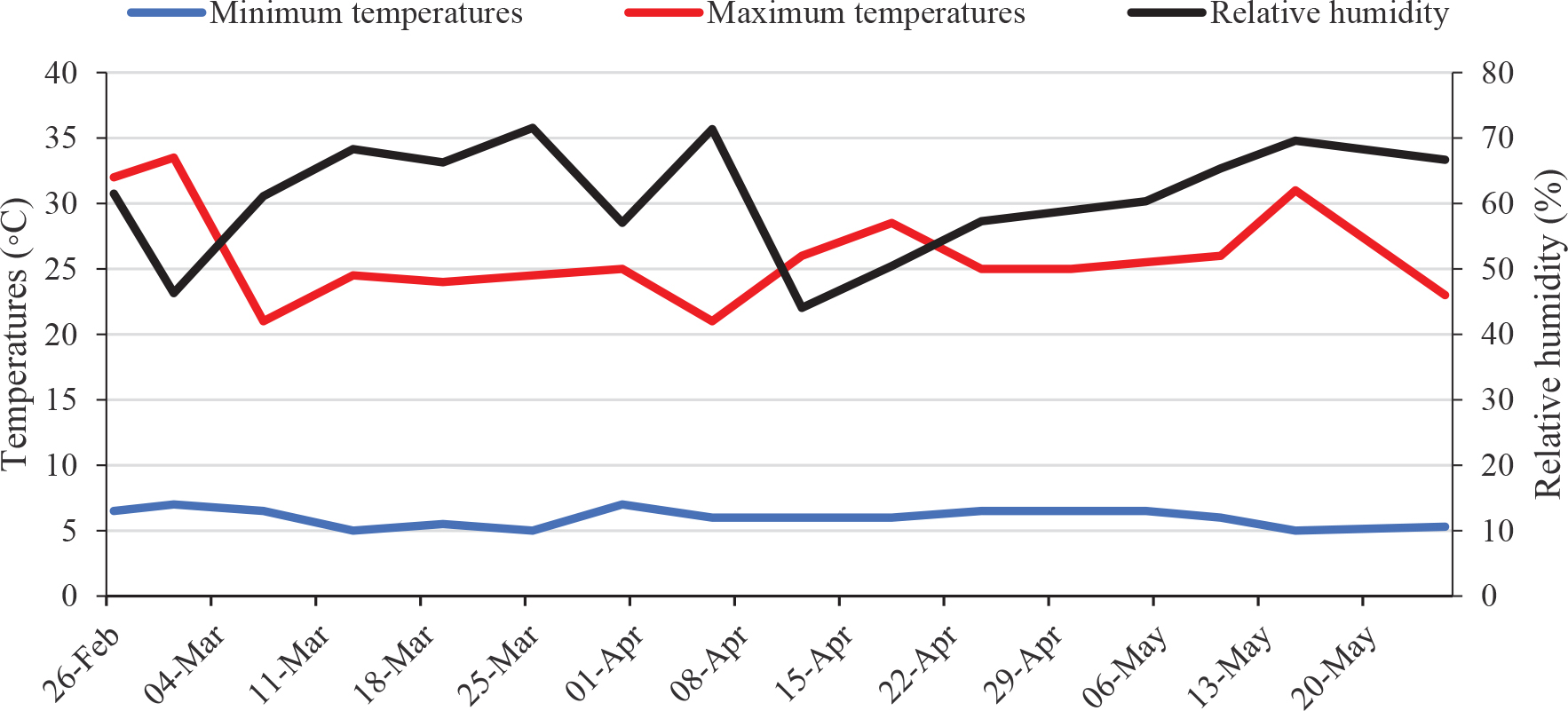
Figure 1.
Maximum and minimum temperatures and relative humidity recorded in the experimental greenhouse during the trial.
Table 1.
Composition of the HNSs used in the experiment (mmol ⋅L−1).
| N6P2K6 | N12P2K6 | N6P4K12 | N12P4K12 | |
|---|---|---|---|---|
| N | 6.0 | 12.0 | 6.0 | 12.0 |
| P | 2.0 | 2.0 | 4.0 | 4.0 |
| K | 6.0 | 6.0 | 12.0 | 12.0 |
| Ca | 2.5 | 2.5 | 2.5 | 2.5 |
| Mg | 2.0 | 2.0 | 2.0 | 2.0 |
Basil plants grown in the NGS® system were harvested twice during the experimental period (first harvest and regrowth harvest (second harvest)). When the plants reached an appropriate stage of development, the aerial parts were cut at 5 cm above the growing surface using sterilised scissors. The first harvest was conducted 48 days after transplanting, and the second harvest was carried out 41 days after the first harvest. Both harvests were carried out early in the morning to avoid the hottest hours of the day. After harvesting, the raw material was immediately taken to the postharvest laboratory for analysis.
Raw material analysis
Growth parameters, including leaf fresh yield per m2 (g · m−2), leaf fresh weight (LFW) per plant (g · plant−1) and leaf daily growth (LDG) rate (g · plant−1 · day−1), were assessed. The dry matter (DM) content (%) was measured after drying leaf samples at 40°C to a consistent weight.
Tissue ion and salt content
Nitrate (NO3−), phosphate (PO43−) and calcium carbonate (CaCO3) contents were quantified using a Merck Reflectoquant RQflex2© refractometric kit (Merck KGaA, Darmstadt, Germany) according to the manufacturer protocol. Tissue samples (10.0 g) were homogenised with 10.0 mL of sterile distilled water using a stomacher for 2 min at standard speed, followed by filtration. The extract was used for refractometric determination. The results were expressed as mg · kg−1 fresh weight (FW) for NO3−and mg · g−1 FW for PO43− and CaCO3.
Microbial analysis
The plate count agar substrate was used to determine the total bacterial count (TBC), while yeast and mould counts (YC and MC) were determined using Yeast Extract Glucose Chloramphenicol Agar. Fresh tissue samples (25.0 g) were homogenised with 225.0 mL of Ringer’s buffer for 2 min, serially diluted and plated on respective selective media. TBC enumeration was performed after incubation at 30°C for 48 hr. For quantification of yeasts and moulds, plates were stored at 30°C for 5 days. Results were expressed as colony-forming units (CFU) · g−1 FW (Abadias et al., 2008; Nicola et al., 2016).
Essential oil isolation and determination
Microwave-assisted hydrodistillation was performed using a NEOS-GRMW apparatus (Milestone Srl, Sorisole, BG, Italy). Specific equipment and software, a video camera and an infrared pyrometer were used. The extractive conditions were chosen based on a series of preliminary tests aimed at optimising yields and limiting the formation of degradation products. The plant samples were contained in a beaker with a perforated polypropylene lid that was connected to an external condensation unit via a glass connector. The latter was connected to a chiller, with the circulating fluid maintained at around 5–6°C. An aliquot of the dried material was placed in a Pyrex® glass beaker and microwaved. Dried aerial parts were previously rewetted under slight steam flow using a commercial domestic device (‘Vaporetto Polti-Italy’) equipped with a flow regulator (calculated swelling: 2 mL · g−1). Each distillation lasted 45 min, including 20 min of steam to rehydrate the plant. The extraction time began when the first drop of liquid fell from the cooling apparatus into the measuring burette and continued further for 20 min (Binello et al., 2014).
Gas chromatography-mass spectrometry (GC-MS) analyses were performed using an Agilent 6850 gas chromatograph (Agilent, Santa Clara, CA, USA), connected to an Agilent 5973N Mass Selective Detector. The installed capillary column was a 30-m-long HP 5-MS (5% phenyl methyl siloxane, i.d. 0.25 mm and film thickness 0.25 μm). Inlet: split mode with a 1:20 ratio; injector temperature 250°C and gas carrier: helium at a constant flow of 1.2 mL · min−1. Oven parameters: initial temperature 50°C; rate 3°C · min−1 up to 80°C and rate 10°C · min−1 up to 300°C, held for 10 min. The mass spectrometric parameters were as follows: MS quad 150°C; MS source 230°C; acquisition mode: scan; resulting EM voltage: 1612 and mass range: 50–800. The identification of the compounds was made based on MS spectra matched with Wiley7n and NIST11 libraries.
Sampling size and statistical analysis
A randomised complete block design (RCBD) in time was used as the statistical experimental design, with a four HNS combination of two levels of N (N6; N12) × two levels of P and K (P2K6; P4K12). Three replications for each treatment were evaluated and each treatment contained 30 plants per replication. Harvest data were submitted to analysis of variance (ANOVA) using the Statistical Analysis System (SAS) software (version 9.2, SAS Institute Inc., Cary, NC, USA). Statistical analysis using the SAS software’s UNIVARIATE procedure confirmed that the data met the requirements for ANOVA, with residuals following normal distribution patterns. When ANOVA was significant, the least significant difference (LSD) test was used with p-values <0.05.
RESULTS AND DISCUSSION
Biometric parameters
Basil plants grown in NGS® were harvested twice during the experimental period (Table 2), with the measured parameters behaving differently between the HNS and harvest times. N, P and K are limiting factors for plant growth and crop production. Inadequate fertiliser application consistently results in nutrient-deficient growing environments and limited crop yield (Pasley et al., 2019). However, excessive fertiliser application during the planting process can lead to rapid development and high yields, resulting in a low efficiency of the fertiliser (Fang et al., 2023).
Table 2.
Influence of harvest time (first and second) and HNSs on the growth parameters of basil cultivated in NGS®.
| Nutrient solutions | First harvest | |||
|---|---|---|---|---|
| Yield (g · m−2) | LFW (g · plant−1) | LDG (g · plant−1 · day−1) | DM (%) | |
| N6 P2K6 | 639.33 ± 15.56 b | 15.98 ± 0.39 b | 0.333 ± 0.01 b | 10.93 ± 0.21 b |
| N12 P2K6 | 1123.91 ± 73.23 a | 28.10 ± 1.06 a | 0.308 ± 0.01 b | 10.42 ± 0.25 b |
| N6 P4K12 | 591.93 ± 21.02 b | 14.80 ± 0.53 b | 0.585 ± 0.02 a | 10.41 ± 0.12 b |
| N12 P4K12 | 590.91 ± 14.39 b | 14.77 ± 0.36 b | 0.308 ± 0.01 b | 12.49 ± 0.25 a |
| Second harvest | ||||
| N6 P2K6 | 519.85 ± 13.32 a | 13.00 ± 0.33 a | 0.317 ± 0.00 a | 10.57 ± 0.14 b |
| N12 P2K6 | 81.00 ± 18.86 c | 2.03 ± 0.43 c | 0.049 ± 0.00 c | 13.99 ± 0.60 a |
| N6 P4K12 | 240.09 ± 8.82 b | 6.00 ± 0.25 b | 0.146 ± 0.01 b | 10.56 ± 0.26 b |
| Significance | ||||
| Nutrient solution | NS | NS | *** | ** |
| Harvest time | *** | *** | *** | *** |
| Harvest time × nutrient solution | * | *** | *** | *** |
1 N6: 6 mmol · L−1; N12: 12 mmol · L−1; P2: 2 mmol · L−1; P4: 4 mmol · L−1; K6: 6 mmol · L−1 and K12: 12 mmol · L−1. Values are means of three replicates. Means followed by different letters in the same column for the same factor are significantly different (p ≤ 0.05) according to the LSD test. Asterisks indicate significant differences at *p ≤ 0.05, **p ≤ 0.01 and ***p ≤ *0.001. Values are the mean of replicates ± SE.
Our results indicate that both the growth and yield of basil were affected by HNS at the two harvest times. A significant interaction between HNS and harvest time was found for yield, LFW, LDG and DM. Regardless of the HNS used, LFW, LDG and basil plants grown in NGS® yielded more in the first harvest than the second harvest (Table 2). In the first harvest, the maximum yield (1123.91 g · m−2) and LFW (28.10 g · plant−1) were obtained from the N12P2K6 treatment, whereas the minimum yield (590.91 g · m−2) and LFW (14.77 g · plant−1) were obtained from the N12P4K12 treatment, which had no significant difference with the N6P4K12 and N6P2K6 treatments. In the second harvest, the maximum yield (519.85 g · m−2) and LFW (13.00 g · plant−1) were related to the N6P2K6 treatment. The highest LDG in the first harvest (0.585 g · plant−1 · day−1) and the second harvest (0.317 g · plant−1 · day−1) was obtained from the N6P4K12 and N6P2K6 treatments, respectively.
The second harvest was not possible for basil grown in the N12P4K12 treatment, where the plants either did not reach a suitable harvest stage or collapsed. This was probably due to the salt and osmotic stresses caused by the high ion concentration of the HNS itself.
Regarding DM, in the first harvest, the maximum percentage was found for basil grown in the N12P4K12 (12.49%) treatment, whereas the minimum percentage was related to the N6P4K12 (10.41%) treatment. In the second harvest, the maximum and minimum DM percentages were found with the N12P2K6 (13.99%) and N6P4K12 (10.56%) treatments, respectively (Table 2).
An inverse relationship was observed between HNS concentration, yield and LFW and between yield, LFW and DM percentage. The total LFW increased with increasing N concentration but decreased with increasing P and K concentrations. In the second harvest, with increasing HNS concentration, all plants grown in the N12P4K12 treatment, the most concentrated solution, could not be harvested. The highest LFW was obtained using N6P2K6, the less concentrated solution.
Nutrient toxicity could be responsible for the loss of fresh yield. The results obtained in the present experiment are in line with those found by Suh et al. (1999) who reported that the best results in terms of sweet basil growth and yield were obtained when half-strength nutrient solution (N:9, P:1, K:5.5 mmol · L−1) was applied as compared to full-strength (N:18, P:2, K:11 mmol · L−1), double-strength and triple-strength solutions. It was also reported that NO3− was more effective than NH4+ for basil growth. Similarly, Olfati et al. (2012) found that basil does not require high levels of nutrients, especially in hydroponic systems. Similar results to those found in the present experiment have been reported for lettuce grown in NGS®, where the application of concentrated HNS reduced the FW and maximum yield was obtained from plants grown with the less concentrated HNS (Luna et al., 2013). The positive impact of higher N levels on LFW in the first harvest could be attributed to the essential role of N in chlorophyll synthesis, enzyme activity, protein production and several other biochemical processes, which tend to promote an increase in leaf length and width (Perchlik and Tegeder, 2018). The increase in basil yield due to N application has been reported by several authors (Arabaci and Bayram, 2004; Sifola and Barbieri, 2006; Baker, 2008). This study demonstrated a significant increase in basil yield in the NGS® system, particularly during the first harvest, in response to N application. Previous research has shown that basil cultivated in SCSs typically outperforms conventional seedbed cultivation in terms of yield (Akoumianaki-Ioannidou et al., 2015; Nicola et al., 2023). Increased N levels significantly enhanced plant yield at the first harvest, potentially due to the favourable effect of N in promoting rapid meristematic activity for the development of additional tissues and organs.
The results showed that an increase in P and K concentrations reduced the LFW of basil plants. The higher yield in the first harvest compared with the second harvest could be due to reduced stress conditions and the longer growth period. Similar results were found in mint by Souza et al. (2014) who stated that P toxicity reduced nutrient uptake. In the first harvest, yield increased due to high nutrient concentration, but in the second harvest, yield decreased due to nutrient toxicity. From the results of the present experiment, it can be concluded that HNS should be diluted to the minimum concentration after the first harvest to achieve the desired yield. The nutrient requirements of plants vary throughout their growth stages, and several studies have shown that changes in HNS can significantly affect plant growth and yield characteristics (Adel Mahmoodabad et al., 2014; Ryu et al., 2023). The deficiency of P and K could also reduce the DM of basil, consistent with previous findings by Deroles (2008) and Song et al. (2024). The observed increase in DM during the second harvest may be attributed to the accumulation of NO3−, PO43− and CaCO3 in plant tissues at this harvest, in addition to earlier harvest stages.
Tissue ion content
To investigate the potential impact of HNS on the uptake of mineral nutrients at different harvest times, we assessed the concentrations of NO3−, PO43− and CaCO3 in the aerial parts of basil during the cultivation period and at the first and second harvest stages. The effect of HNS and harvest time on NO3− accumulation in the aerial parts of basil was significant (Table 3).
Table 3.
Influence of harvest time (first and second) and HNSs on the nutrient content of basil cultivated in NGS®.
| Nutrient solutions | First harvest | ||
|---|---|---|---|
| NO3− | CaCO3 | PO43− | |
| (mg · g−1 FW) | (mg · kg−1 FW) | ||
| N6 P2K6 | 86.67 ± 6.96 c | 0.84 ± 0.08 a | 0.95 ± 0.06 a |
| N12 P2K6 | 562.67 ± 16.22 a | 0.60 ± 0.08 a | 0.56 ± 0.10 b |
| N6 P4K12 | 57.33 ± 6.66 c | 0.59 ± 0.22 a | 0.74 ± 0.15 ab |
| N12 P4K12 | 274.67 ± 19.64 b | 0.67 ± 0.06 a | 0.91 ± 0.10 ab |
| Second harvest | |||
| N6 P2K6 | 552 ± 30.61 b | 0.49 ± 0.08 b | 0.71 ± 0.05 b |
| N12 P2K6 | 2272 ± 196.01 a | 1.34 ± 0.27 a | 1.03 ± 0.05 a |
| N6 P4K12 | 588 ± 42.11 b | 0.26 ± 0.03 b | 0.81 ± 0.13 ab |
| Significance | |||
| Nutrient solution | *** | *** | * |
| Harvest time | ** | NS | * |
| Harvest time × nutrient solution | ** | ** | *** |
1 N6: 6 mmol · L−1; N12: 12 mmol · L−1; P2: 2 mmol · L−1; P4: 4 mmol · L−1; K6: 6 mmol · L−1 and K12: 12 mmol · L−1. Values are means of three replicates. Means followed by different letters in the same column for the same factor are significantly different (p ≤ 0.05) according to the LSD test. Asterisks indicate significant differences at *p ≤ 0.05, **p ≤ 0.01 and ***p ≤ 0.001; Values are the mean of replicates ± SE.
The highest NO3− content in the first harvest was related to N12P2K6, which was 379% higher than the lowest content observed in basil grown in N6P4K12. In the second harvest, the NO3− content in basil grown in N12P2K6 was 311% higher than that grown in N6P2K6, representing the highest and lowest levels, respectively (Table 3). No significant differences were observed between the N6P4K12 and N6P2K6 treatments in either harvest. This might be because NO3− accumulation would increase with decreasing yield in the second harvest. The maximum NO3− accumulation was observed in those treatments in which the maximum N and minimum P and K were applied. In addition, with increasing N in N12P2K6, not only did the yield not improve but the NO3− content significantly increased.
NO3− accumulation in plants is influenced by several environmental factors, such as light, temperature, CO2, nutrient solution composition, especially N amount and source, and plant age (Bian et al., 2020). In leafy herbs, the NO3− content has been shown to be dependent on the nutrient solution concentration (Dasgan et al., 2022; Hazrati et al., 2024a). Our results showed that the optimal application of fertiliser containing N6P2K6 and N6 P4K12 had a clear advantage over other treatments in terms of NO3− accumulation, indicating that NO3− accumulation is directly influenced by the N concentration in the nutrient solution. Excessive accumulation of NO3− in vegetables is a common issue that poses a potential threat to human health. Nutrient concentration strongly influences the accumulation of NO3−. Therefore, it is of utmost importance to identify and develop sustainable, innovative and cost-effective approaches to increase vegetable production while reducing NO3− concentration. Controlled environmental conditions, optimal fertiliser/nutrient element management, harvest time (Bian et al., 2020; Fontana and Nicola, 2020) and the cultivation system used (Nicola et al., 2007) play crucial roles in producing vegetables with low NO3− concentrations. However, vegetables and herbs, especially leafy plants, can accumulate extremely high NO3− concentrations (usually NO3− levels ≥700 mg · kg−1) during cultivation (Xu et al., 2012). Optimising the ratio of NO3−/NH4+ in the HNS can effectively manage NO3− accumulation in plant tissues. Recent studies have shown that decreasing the NO3−/NH4+ ratio and high ion nutrition in the HNS can cause the development of toxicity symptoms in many herbaceous plants, as well as inhibiting NO3− uptake, leaf growth, shoot height and biomass, while significantly decreasing the concentration of several macronutrients (Sambo et al., 2019). Several studies have successfully used a low NO3−/NH4+ ratio to minimise NO3− accumulation in the leaves (Fontana et al., 2006; Nicola et al., 2023; Hazrati et al., 2024a). In this study, a lower NO3−/NH4+ ratio was employed to reduce NO3− accumulation in basil leaves. The resulting NO3− levels observed were below the limits set by European Union regulations and lower than those reported in most studies on basil grown in soil and SCS (Rouphael et al., 2018; Dasgan et al., 2022; Consentino et al., 2023).
In this study, during the first harvest, the NO3− concentration was less than this threshold in all treatments. However, in the second harvest, the NO3− concentration increased significantly, particularly with increasing N concentration. Our experiment demonstrated that the concentration of the nutrient solution and the time of harvest significantly affected the NO3− concentration. The N6P2K6 treatment increased yield while maintaining a lower NO3− concentration in the second harvest compared with other treatments with higher N concentrations.
The nutrient solutions had different effects on PO43− accumulation depending on the harvest time (Table 3). In the first harvest, basil grown with N6P2K6 in the HNS accumulated 66.7% more PO43− than plants treated with N6P4K12, representing the maximum and minimum levels of accumulation, respectively (Table 3). There was a positive and significant correlation between DM percentage and PO43− accumulation in the first harvest. However, in the second harvest, the maximum PO43− accumulation and DM percentage were observed in the N12P2K6 treatment. Conversely, the lowest values were found in the N6P2K6 treatment, where the lowest concentration of HNS was applied. This suggests that higher concentrations of nutrients in the solution, particularly N, may enhance PO43− uptake in the later stages of plant growth. Previous studies have reported that high levels of NH4+ can increase PO43− uptake in plants (Jing et al., 2010; Bi et al., 2024). This may explain the higher PO43− accumulation in the N12P2K6 treatment during the second harvest, as the higher N concentration in this solution is likely to contain a higher proportion of NH4+, which facilitates phosphate uptake by altering the pH of the rhizosphere and increasing the activity of enzymes involved in P uptake (Jing et al., 2010). Adequate N is essential for root growth and development. More extensive and robust root systems can absorb more P from the solution (López-Arredondo et al., 2014). Therefore, a higher N concentration in the nutrient solution can lead to increased uptake and accumulation of P ions in plants.
Table 3 shows that the CaCO3 content of basil tissues was influenced by both HNS and harvest time. HNS had a similar effect on CaCO3 content in the first and second harvests. In the first harvest, maximum and minimum CaCO3 accumulation was observed in the N6P2K6 and N6P4K12 treatments, respectively. However, in the second harvest, maximum and minimum values were observed in the N12P2K6 and N6P4K12 treatments, respectively (Table 3). The increase in CaCO3 accumulation in the N12P2K6 treatment could be due to higher LFW but lower DM, indicating a direct relationship between CaCO3 content and LFW. CaCO3 uptake appears to be directly related to high N concentrations, whereas it is inversely related to high K and P concentrations. In general, the accumulation of NO3−, PO43− and CaCO3 was higher in the second harvest than in the first harvest. The decrease in CaCO3 content with increasing P and K concentrations is the result of complex interactions between nutrient solution chemistry and plant physiological processes. Previous research has shown that K deficiency not only affects Ca-sensing mechanism, but also significantly increases Ca uptake in basil plants, with the absence of K significantly increasing the plant’s intracellular Ca uptake rate (Wang et al., 2018; Song et al., 2024). When plants absorb P and K from the nutrient solution, they often release hydrogen ions (H+) into the solution. This exchange process can slightly lower the pH of the solution, thus increasing its acidity. Increased acidity can promote the dissolution of CaCO3 (Sardans and Peñuelas, 2021), thereby reducing its accumulation in plant tissues.
Microbiological analysis
According to the results, HNS and harvest time had a significant effect on the number of MC and YC, but no differences in TBC during storage were observed between HNS and harvest time (Table 4). The results showed that in the first harvest, the minimum (1.65 × 101 CFU · g−1 FW) and maximum (2.59 × 101 CFU · g−1 FW) TBCs were related to N6P2K6 and N6P4K12, respectively. However, in the second harvest, the minimum and maximum TBCs were observed in N6P4K12 (5.87 × 101 CFU · g−1 FW) and N12P2K6 (1.13 × 10² CFU · g−1 FW), respectively. This could be due to higher K concentration in N6P4K12, which improves disease resistance (Cao et al., 2007; Wang et al., 2013). In the case of MC, the highest contamination was observed in N12P4K12 (2.22 × 101 CFU · g−1 FW) and N6P2K6 (2.77 × 10³ CFU · g−1 FW) in the first and second harvests, respectively. On the contrary, N12P2K6 (1.41 × 101 CFU · g−1 FW) and N6P4K12 (8.80 × 10² CFU · g−1 FW) showed the minimum MC in the first and second harvests, respectively (Table 4). In general, fungal activity increased significantly in all the HNS treatments in the second harvest. For YC, there were significant differences between the treatments. However, in the first harvest, the maximum contamination was found in N6P2K6 (0.11 × 101 CFU · g−1 FW), and among the other three treatments, no difference was observed, whereas in the second harvest, the minimum and maximum YC levels were related to N6P4K12 (2.13 × 101 CFU · g−1 FW) and N6P2K6 (1.40 × 10² CFU · g−1 FW), respectively (Table 4). Considering the use of basil in the food and pharmaceutical industries, these plants must have low microbial contamination and be free from pathogenic germs. In addition, in Europe, they must comply with the legal requirements set out in Commission Regulation (EC) No. 2073/2005. Typically, microbial contamination is lower in SCS than in traditional culture system (TCS). Previous research on this topic has reported that postharvest microbial contamination is lower in NFT (Scuderi et al., 2011; Zhan et al., 2022) and NGS® (Selma et al., 2012). In this study, less microbial contamination was found, especially in the first harvest. Similar results were found by Selma et al. (2012) who compared NGS® and SCS. In this study, NGS® significantly reduced microbial contamination, especially in the first harvest. Cultivation of crops in controlled environments (NGS® system) is therefore considered a safer cultivation technology than conventional farming or other SCS. These systems demonstrate reduced microbial contamination compared to other systems (Nicola et al., 2018). In NGS®, microbial contamination was generally higher in the second harvest than in the first harvest, even though in no case did it reach more than 103 CFU · g−1 FW. In addition, more MC was observed in the second harvest. This study identified SCS as the most effective system for minimising microbial contamination. Our results also showed that the NGS® system can significantly reduce microbial contamination in basil. Growing basil using the NGS® system allows farmers to produce a cleaner and more hygienically safe product compared to the older SCS and traditional soil-based methods.
Table 4.
Influence of harvest time (first and second) and HNSs on the microbial contamination of basil cultivated in NGS®.
| Nutrient solutions | First harvest | ||
|---|---|---|---|
| TBC | MC | TYC | |
| (CFU · g−1 FW) | |||
| N6 P2K6 | 1.65 × 101 ± 0.93 a | 1.60 × 101 ± 0.23 bc | 0.11 × 101 ± 0.09 a |
| N12 P2K6 | 1.89 × 101 ± 0.93a | 1.41 × 101 ± 0.53 c | 3.0 × 10⁻¹ ± 0.03 b |
| N6 P4K12 | 2.59 × 101 ± 2.84 a | 1.84 × 101 ± 1.85 b | 3.0 × 10⁻¹ ± 0.02 b |
| N12 P4K12 | 2.24 × 101 ± 2.43 a | 2.22 × 101 ± 0.37 a | 3.0 × 10⁻¹ ± 0.02 b |
| Second harvest | |||
| N6 P2K6 | 8.13 × 101 ± 9.61 a | 2.77 × 10³ ± 288.05 a | 1.40 × 10² ± 16.74 a |
| N12 P2K6 | 1.13 × 10² ± 19.64 a | 1.19 × 10³ ± 141.63 b | 7.07 × 101 ± 14.66 a |
| N6 P4K12 | 5.87 × 101 ± 2.66 a | 8.80 × 10² ± 87.17 b | 2.13 × 101 ± 1.33 b |
| Significance | |||
| Nutrient solution | NS | ** | *** |
| Harvest time | NS | ** | ** |
| Harvest time × nutrient solution | NS | * | * |
1 N6: 6 mmol · L−1; N12: 12 mmol · L−1; P2: 2 mmol · L−1; P4: 4 mmol · L−1; K6: 6 mmol · L−1 and K12: 12 mmol · L−1. Values are means of three replicates. Means followed by different letters in the same column for the same factor are significantly different (p ≤ 0.05) according to the LSD test. Asterisks indicate significant differences at *p ≤ 0.05, **p ≤ 0.01 and ***p ≤ 0.001. Values are the mean of replicates ± SE.
Essential oil compositions
Thirty-four compounds were detected in basil EO under different treatments in NGS® (data not shown; 12 major important compounds are presented in Table 5). The remaining 22 components were microcomponents, and their concentration in the EO was <0.5%. Linalool, eugenol, eucalyptol, (E)-α-bergamotene and α-cadinol were found to be the main components under different treatments. According to these results, HNS and harvest time had a significant effect on some EO compounds. For instance, the maximum (14.91%) and minimum (8.29%) eucalyptol percentages were obtained from the first harvest with the N6P4K12 and N12P2K6 treatments. The amount of this monoterpenoid decreased significantly during the second harvest. An increase in the N concentration of HNS led to a decrease in the content of this compound, whereas an increase in the K concentration led to an increase in its content. Studies have shown that an increase in K concentration has a positive effect on the eucalyptol content (Zheljazkov et al., 2008). N application altered the proportions of linalool, eucalyptol, eugenol and bornyl acetate in the EO composition of basil. In basil, foliar application of N decreased the eucalyptol content (Zheljazkov et al., 2008).
Table 5.
Influence of harvest time (first and second) and HNSs on the EOs composition of basil cultivated in NGS®.
| Compounds (%) | ||||||||||||
|---|---|---|---|---|---|---|---|---|---|---|---|---|
| First harvest | ||||||||||||
| Nutrient solutions | Eucalyptol | Linalool | Camphor | Borneol | α-Terpineol | Bornyl acetate | Eugenol | β-Elemene | (E)-α-Bergamotene | Germacrene-D | γ-Cadinene | α-Cadinol |
| N6P2K6 | 10.58 ± 1.14 b | 35.77 ± 3.52 a | 0.82 ± 0.01 a | - | 1.17 ±0.00 a | 4.39 ± 0.51 b | 5.41 ± 1.44 ab | 0.40 ± 0.10 a | 25.72 ± 0.30 b | 3.70 ± 0.48 a | 4.35 ± 0.19 a | 7.69 ± 0.57 c |
| N12P2K6 | 8.29 ± 0.10 b | 22.57 ±6.02 ab | 0.43 ± 0.02 b | - | 1.01 ±0.26 a | 4.11 ± 1.08 b | 3.00 ± 0.84 ab | 0.50 ±0.20 a | 31.53 ± 2.61 ab | 5.61 ± 1.04 a | 6.74 ± 2.12 a | 16.22 ±0.26 a |
| N6P4K12 | 14.91 ± 1.49 a | 32.43 ± 1.71 a | 0.93 ±0.16 a | 0.22 ± 0.01 | 1.47 ±0.28 a | 4.52 ± 0.18 b | 6.39 ± 0.81 a | 0.80 ± 0.04 a | 23.54 ± 2.70 b | 3.75 ± 0.40 a | 3.92 ±0.38 a | 7.12 ± 0.96 c |
| N12P4K12 | 10.18 ± 021 b | 14.32 ± 3.57 b | 0.45 ± 0.05 b | - | O.87± 0.13 a | 7.73 ± 0.60 a | 1.73 ± 0.27 b | 0.37 ± 0.07 a | 41.99 ± 5.45 a | 4.32 ± 0.27 a | 6.74 ± 1.20 a | 11.29 ± 1.23 b |
| Second harvest | ||||||||||||
| N6P2K6 | - | 12.31 ± 1.92 b | 0.07 ± 0.07 b | 0.56 ± 0.07 b | 2.25 ± 0.63 b | 1.25 ±0.22 a | 35.86 ± 3.93 b | 0.24 ± 0.24 | 16.17 ± 0.77 a | 3.13 ±0.08 a | 5.50 ±0.18 a | 22.72 ± 8.52 a |
| N6P4K12 | 1.75 ± 0.24 | 33.91 ± 10.25 a | 1.25 ±0.62 a | 1.76 ± 0.70 a | 5.89 ± 1.87 a | 0.36 ± 0.36 b | 49.08 ±9.89 a | - | 1.38 ± 1.28 b | 0.25 ± 0.25 b | 0.40 ± 0.25 b | 3.89 ± 3.06 b |
| Cultivated in soil (%) | 2.38 | 24.68 | 0.56 | 2.48 | 1.81 | 1.57 | 15.19 | 1.11 | 1.06 | 1.56 | 2.39 | 9.88 |
In both harvests, the linalool compound reacted differently to the application of HNS in the NGS system. The results showed that the maximum (35.77%) and minimum (14.32%) linalool content was observed in the N6P2K6 and N12P4K12 treatments, respectively, during the first harvest. Notably, treatments with the lowest N application (N6P2K6 and N6P4K12) yielded the maximum linalool percentages. During the second harvest, the maximum and minimum linalool content was observed in the N6P4K12 (33.91%) and N6P2K6 (12.31%) treatments, respectively. Compared with the first harvest, the linalool content in the N6P2K6 treatment decreased by 65%.
In a study on basil, Zheljazkov et al. (2008) reported that the linalool content decreased with an increasing rate of macronutrients, especially N, which had a negative effect on the concentration of linalool. In another study by Garlet et al. (2013), the effects of K on linalool synthesis in Mentha gracilis were observed, where increasing K concentrations in the nutrient solution decreased the linalool and pulegone levels. These data suggest that changes in the harvest time and HNS can alter the biosynthesis of individual EO components such as linalool. Furthermore, the significant interaction between N and K rates and harvest time highlights the critical importance of nutrient balance in HNS, particularly for basil EO composition. N is a key element involved in EO synthesis in basil plants (Zheljazkov et al., 2008). An increase in the percentage of linalool due to an increase in N was reported by Daneshian et al. (2009) during the second harvest of basil.
(E)-α-Bergamotene was one of the dominant compounds, and its content was influenced by both HNS and harvesting time. Its maximum (41.99%) and minimum (23.54%) percentages were obtained from the N12P4K12 and N6P4K12 treatments, respectively, during the first harvest. The relative amount of (E)- α-bergamotene increased with increasing N and K concentrations in the HNS. However, in the second harvest, its value decreased significantly compared with the first one. When comparing the same treatment mentioned above, an inverse relationship was observed between the relative abundances of (E)-α-bergamotene and linalool compounds.
The eugenol content was influenced by both HNS and harvesting time. During the first harvest, the maximum (6.39%) and minimum (1.73%) percentages were observed in the N6P4K12 and N12P4K12 treatments, respectively. A reduction in eugenol percentage due to an increase in N application in the first harvest has also been reported by Daneshian et al. (2009). In this study, the percentage of eugenol decreased with increasing N, P and K concentrations in the HNS. The harvest time seemed to promote its biosynthesis, as in the second harvest eugenol was the dominant compound in most treatments. Compared to the first harvest, its percentage increased by 85% and 87% in the N6P2K6 and N6P4K12 treatments, respectively.
Another important and dominant compound of basil EO was α-cadinol, which was strongly influenced by HNS and harvest time. As shown in Table 5, its highest (16.22%) and lowest (7.12%) amounts were observed in the N12P2K6 and N6P4K12 treatments, respectively, during the first harvest. However, in the second harvest, the amount of a-cadinol increased significantly in the N6P2K6 treatment and decreased in the N6P4K12 treatment compared with the first harvest. According to the results, with an increase in N content in both the harvests, the content of α-cadinol increased significantly. Conversely, as the P and K concentrations increased, the content of α-cadinol decreased.
The maximum β-elemene content was obtained in the first harvest in the N6P4K12 treatment. Still during the first harvest, a low amount of borneol was detected when the basil plants were grown in N6P4K12, while with the other treatments this terpene derivative was not detected. The highest a-terpineol concentration was observed in the N6P4K12 treatment, while the lowest was found in N12P4K12. The highest bornyl acetate concentration was related to N12P4K12. The N12P2K6 treatment resulted in higher levels of germacrene-D, α-cadinol and γ-cadinene in the first harvest. Conversely, the N6P2K6 treatment resulted in the lowest germacrene-D percentage, whereas N6P4K12 was associated with the lowest α-cadinol and γ-cadinene values.
At the second harvest, no plants were harvested from the N12P2K6 and N12P4K12 treatments. Maximum concentrations of eucalyptol, linalool, camphor, borneol, α-terpineol and eugenol were observed after N6P4K12 treatment, whereas higher values were detected in the N6P2K6 treatment for bornyl acetate, β-elemene, (E)-α-bergamotene. germacrene-D, γ-cadinene and α-cadinol. Generally, eugenol, linalool and (E)-α-bergamotene have found to be the main compounds in basil EO, and their amounts depend on the applied rates of N, K and harvest time.
The composition of EOs can be influenced by various factors, including genetics, physiological stages, morphological characteristics, phenological stages and edaphoclimatic variations, among which mineral nutrition in the solution and plant metabolism play crucial roles (El Gendy et al., 2015; Hazrati et al., 2024b). Variations in nutrient solution directly influence EO composition by modulating enzymatic processes and metabolic pathways. Monoterpene synthesis involves complex phosphorylation mechanism and ATP-mediated biochemical transformation. Thus, P deficiency reduces phosphorylation rates, consequently decreasing monoterpene production (Silva et al., 2021). The application of fertilisers may increase EO constituents, potentially due to the enhanced availability of essential nutrients. Consequently, this could result in an improved photosynthetic rate, which affects the formation of precursor compounds to determine EO quality. In addition, essential nutrients influence trichome formation, specialised secretory structures and essential oil pathways (Salehi et al., 2019; Chiyaneh et al., 2022).The results and literature review indicated that the EO components in NGS® are higher in concentration than those in soil culture (Table 5). Similar findings have been reported by other researchers for mint and basil (Akoumianaki-Ioannidou et al., 2015). An increase in EO component percentages under hydroponic systems has been reported by other authors (Fernandes et al., 2004). In addition, the results indicated that an increase in HNS concentration leads to a reduction in the percentage of dominant EO components in basil plants. The obtained results can serve as a guide for allocating appropriate HNS concentrations and determining the optimal harvesting time for basil cultivated in this system to obtain maximum yields of certain metabolites or desired mixtures in the EO composition.
CONCLUSIONS
This study investigated the effects of different N, P and K concentrations on basil growth, yield, safety and EO profile in NGS® at two harvests. The research showed that NGS® offers significant advantages for basil cultivation, allowing precise control of plant nutrition to manage yield and quality characteristics. Notably, NGS® showed low microbial contamination, particularly in the first harvest, making it safer than traditional soil-based methods. Yield and DM were higher in the first harvest, with maximum values achieved at higher nutrient concentrations. Conversely, the second harvest achieved maximum values at lower ion concentrations. NO3− accumulation in basil tissues increased with higher N concentrations in the nutrient solution, especially in the second harvest. The N6P2K6 treatment provided a good balance between yield and lower NO3− levels, particularly in the second harvest. EO composition was significantly affected by concentration of the nutrient solution and harvest time, with linalool and (E)-α-bergamotene dominating in the first harvest and eugenol and linalool in the second harvest. In particular, the N6P2K6 treatment led to an increase in linalool, a key aromatic compound in basil. NGS® showed potential for producing high-quality basil with minimal microbial contamination and maximum yield. Optimal nutrient solutions had higher N concentrations in the first harvest and lower ion concentrations in the second harvest. Comparison of growth period, yield, nutrient accumulation, microbial contamination and EO composition between the first and second harvests may help to determine the optimum harvest time for NGS®-grown basil, as these parameters varied significantly. These results suggest that careful management of nutrient solutions and harvesting timing in NGS® can tailor basil production to specific yield, quality and EO composition goals, offering a promising method for controlled, high-quality basil cultivation.
Notes
[11] Contributed by AUTHOR CONTRIBUTIONS
S.H., G.P., M.C., A.B., G.C. and S.N – methodology. S.H., G.P. and S.N – validation. S.H., G.P., M.C, A.B., G.C., M.D. and S.N – formal analysis. S.H., G.P., M.C., A.B., G.C., M.D. and S.N – investigation. S.H., G.P., M.C, A.B., G.C. and S.N – data curation. S.H., G.P., M.C. and S.N – writing – original draft preparation. S.H., G.P., A.B., G.C., M.D. and S.N – writing – review and editing. S.N. – resources and project administration.
[12] Conflicts of interest CONFLICT OF INTEREST
The authors declare no conflict of interest.
Abbreviations
- CaCO3
calcium carbonate
- CFU
colony-forming units
- DM
dry matter
- EOs
essential oils
- FW
fresh weight
- HNS
hydroponic nutrient solution
- LDG
leaf daily growth
- LFW
leaf fresh weight
- LSPP
lab-scale pilot plant
- MC
mould count
- N
nitrogen
- NFT
nutrient film technique
- NGS®
New Growing System
- NO3−
nitrate
- K
potassium
- P
phosphorus
- PO43−
phosphate
- SCS
soilless culture systems
- TBC
total bacterial count
- YC
yeast count