
Introduction
For centuries, forests have played a key role in human life – as a source of raw materials, a recreational space, a refuge for biodiversity and a stabilising element of the climate (Ciesielski et al. 2024). Contemporary challenges, such as climate change, urbanisation pressures and growing social expectations regarding forest management and environmental protection, mean that the profession of forester today requires a broader and more diversified set of competences than ever before (Aznar-Sánchez et al. 2018). In this context, academic education is of particular importance, as it not only prepares students for their profession, but also shapes their perception of the economic, social and ecological functions of forests.
The research concept was based on the integration of forestry and the social sciences. The concept of forest multifunctionality and ecosystem services as well as theories of social capital and the professional role were used, which enabled a multidimensional analysis of the opinions and expectations of forestry students. This approach treated future foresters not only as professionals responsible for forest management, but also as social actors functioning in a complex field of ecological, economic and social relations (Kaliszewski et al. 2023).
Contemporary forestry is increasingly viewed through the lens of multifunctionality – forests serve economic, protective and social functions simultaneously, representing a departure from the traditional, production-oriented model of forest management. In practice, however, the coexistence of these functions leads to tensions and conflicts of interest between forest users (Trogisch et al. 2017). The concept of ecosystem services allows for the classification of the benefits provided by forests to humans – including provisioning services (e.g. timber production), regulating and supporting services (climate protection, water retention, biodiversity conservation) and cultural services, including recreational, educational and health functions (Szast et al. 2025).
Foresters operate under conditions of competing social expectations – they are obliged to carry out economic tasks, protect nature and address societal demands. This leads to role conflicts, decision-making overload and a sense of a perceived lack of clear operational guidelines (Turowski 2001; Kahn et al. 1964; Singh et al. 2019). The analysis of the impact of forestry studies on students’ competences and attitudes was placed within the theoretical framework of social capital developed by Pierre Bourdieu and Robert Putnam. Bourdieu conceptualizes social capital as a resource comprising specialist knowledge, cognitive competences and the ability to interpret and argue positions in a specific social field (Bourdieu 1986; Bourdieu and Wacquant 2001). Putnam, on the other hand, defines social capital as networks of relationships, trust and norms of cooperation, distinguishing between bonding capital (within similar groups) and bridging capital (connecting different groups), which is important in interactions with local communities and stakeholders (Putnam 2000).
Forestry studies are therefore a space for professional socialisation, where not only ecological and silvicultural knowledge is shaped, but also civic attitudes, social sensitivity and the ability to function under conditions of conflicting interests. In this sense, they constitute an investment in the human capital of future forestry professionals.
The article presents an analysis of three questions included in the survey questionnaire.
Aim and Methodology
Aim of the Study
The aim of this article was to analyse the material collected as part of a cross-sectional study conducted between October 2023 and October 2025 among first-year full-time and part-time forestry students. The collected material was divided into two articles: the first concerned the perception of the forestry profession, while present article focuses on the role of academic education in shaping professional competences and anticipated challenges in professional practice, as seen through the eyes of students.
The main research question was formulated as follows: How do forestry students perceive the importance of the forest functions and the role of academic education in shaping their professional competences and preparing them for professional practice in forestry, and what potential difficulties do they identify in the context of practising professional practice?
The following research hypothesis was adopted: Students perceive their studies as a key determinant in shaping their professional competences and awareness of the multifunctional role of forests, paying particular attention to their social and protective functions, while pointing to potential difficulties resulting from environmental, social and organisational challenges.
Research Design
The article presents an analysis of three questions included in the survey questionnaire. The study was quantitative in nature and was conducted using a survey research design as a repeated cross-sectional study (von Elm et al. 2007) to monitor successive cohorts of students. The measurements were carried out three times – in October 2023, 2024 and 2025 – among successive cohorts of first-year forestry students at the Faculty of Forestry of the University of Agriculture in Krakow (each cohort comprised different individuals), which made it possible to compare the profiles of the cohorts in the context of the hanges in the perception of the forestry profession over time. The following cohorts were identified:
– 2023/2024 (n = 188),
– 2024/2025 (n = 162),
– 2025/2026 (n = 158).
The sample was selected using a purposive sampling strategy, with students repeating the first year excluded from the study. The study was voluntary, and respondents were informed about anonymity and the possibility of withdrawal. An identical questionnaire was used each year.
Research Tool and Data Analysis
The research tool consisted of a survey questionnaire including three analytical questions concerning forest functions, professional competences and anticipated professional difficulties in forestry practice.
The first question was designed as a ten-point numerical scale (1–10), where 1 meant ‘unimportant’ and 10 meant ‘very important’: What is the importance of the various functions of the forest?
The second question employed a five-point Likert scale to assess the assessment of the impact of studies on professional preparation: Please assess the extent to which studying forestry can influence your future professional practice in forestry (from ‘very significant influence’ to ‘no influence’).
The third question was a closed, single-choice question: What potential difficulties do you see in your future professional practice in forestry?
Thus, two different measurement techniques were used in the study: a numerical scale with an extended range of responses (1–10) and a five-point Likert scale.
The results were processed using Microsoft Excel, and the results were documented in Microsoft Word. Frequency distributions and basic descriptive statistics were calculated. Due to the homogeneity of the sample and the nature of the study, no inferential statistical analyses or analyses of relationships between variables were conducted. The purposeful selection of the sample limits the external validity of the findings, but the data obtained provide a basis for further comparative analyses and may support the improvement of forestry education programmes by identifying changes in the perception of the forestry profession between cohorts
Characteristics of the Research Sample
This section presents the basic socio-demographic characteristics of the analysed sample. Particular attention was paid to gender structure and place of residence, as these variables may influence perceptions of forest functions, forestry education and anticipated professional challenges.
Table 1 shows the gender structure of respondents in three survey waves. Men constituted the majority of the sample (64.8%), women accounted for 32.3%, and no response was recorded for 3.0% of respondents. The gender distribution reflects the structural characteristics of the forestry programme under investigation, with a noticeable gradual decline in the proportion of women from 11.2% in the 2023 cohort to 10.2% in the 2025 cohort.
Table 1.
Structure of respondents by gender in three waves of the survey, N-508
| 2023 | 2024 | 2025 | Total | |||||
|---|---|---|---|---|---|---|---|---|
| N | % | N | % | N | % | N | % | |
| Female | 57 | 11.2% | 55 | 10.8% | 52 | 10.2% | 163 | 32.3% |
| Male | 130 | 25.6% | 101 | 19.9% | 98 | 19.3% | 329 | 64.8% |
| No response | 1 | 0.2% | 6 | 1.2% | 8 | 1.6% | 15 | 3.0% |
| Total | 188 | 37.0% | 162 | 31.9% | 158 | 31.1% | 508 | 100.0% |
Data on the place of origin of respondents are shown in Table 2. The data indicate that most students came from rural areas, with the proportion of those from urban areas steadily increasing between 2023 and 2025, from 11.4% to 15.0%.
Results
Assessment of Forest Functions
The first question was evaluative and was designed as a ten-point numerical scale (1–10), where 1 denoted ‘unimportant’ and 10 denoted ‘very important’: What is the importance of specific forest functions? Descriptive statistics for the entire sample are presented in Figure 1.
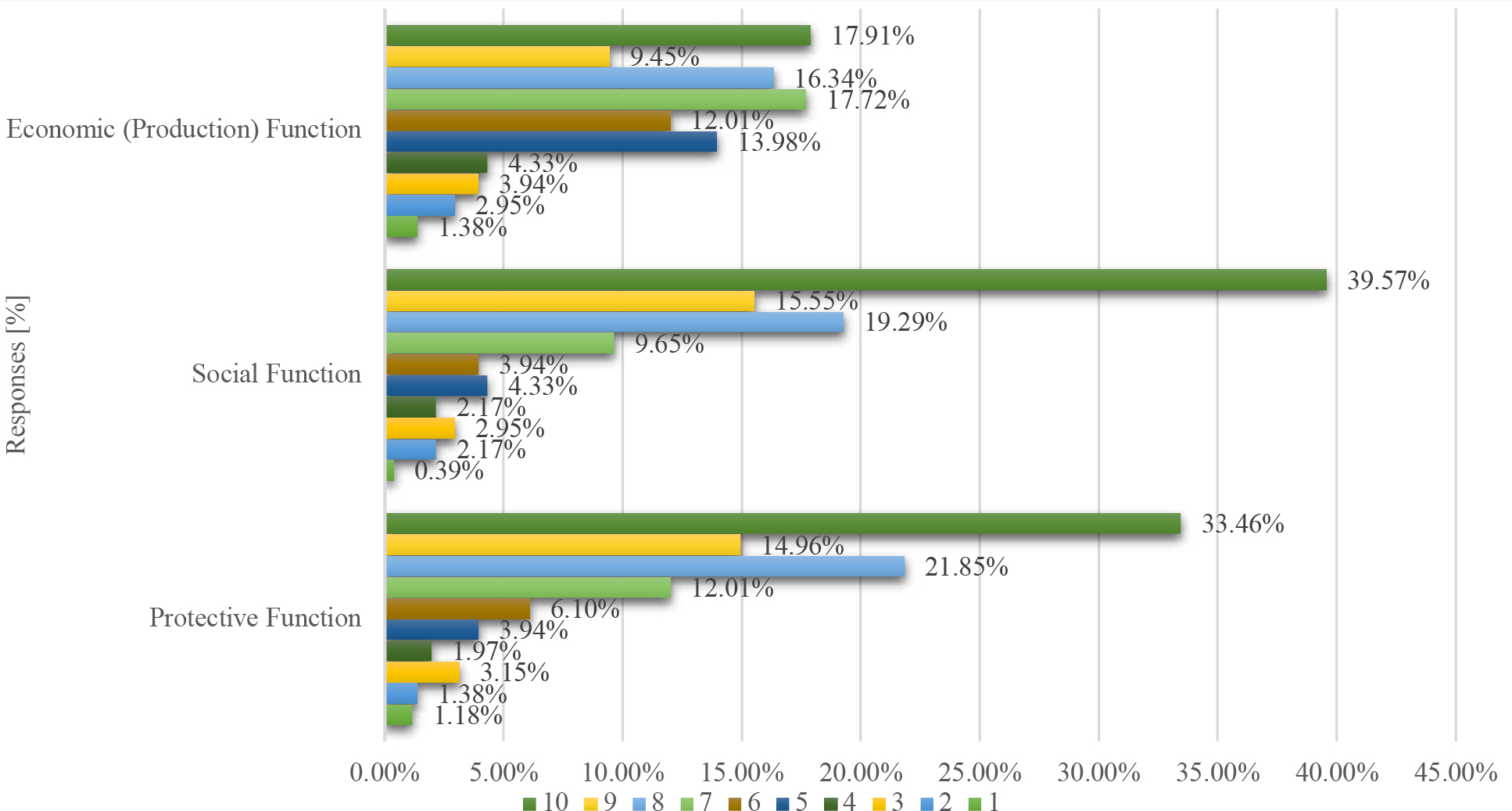
Figure 1.
Assessment of the importance of individual forest functions (scale 1–10)
An analysis of responses concerning the economic function of forests indicates that this function was generally perceived as important, although differences were observed between women and men as well as between urban and rural respondents. High ratings predominated across all analysed groups. Respondents from rural areas and male respondents more frequently selected ratings within the range 8–10, whereas low ratings (1–5) occurred relatively rarely. Descriptive statistics are presented in Table 3. The highest rating (10) was assigned by 17.91% of respondents, while ratings 7 and 8 accounted for 17.72% and 16.34% of responses, respectively. Ratings 5 and 6 together represented 25.99% of responses. Low ratings (1–3) accounted for 8.27% of responses and were more frequent than in the case of the social and protective functions. A comparison of mean values for 2023–2025 indicates a slight decline in the assessment of the economic function among the surveyed students. In 2023, this function received the highest mean value (M = 8.32). The average decreased to 7.86 in 2024 and slightly increased to 7.95 in 2025. The median and mode values remained high throughout the analysed period (8 and 10, respectively).
Table 3.
Assessment of the importance of individual forest functions (scale 1–10)
| Economic function | |||
|---|---|---|---|
| 2023 | 2024 | 2025 | |
| Arithmetic mean | 8.32 | 7.86 | 7.95 |
| Median | 9.00 | 8.00 | 8.00 |
| Mode | 10.00 | 8.00 | 10.00 |
| Standard deviation | 2.02 | 2.15 | 2.08 |
| Protective function | |||
| Arithmetic mean | 8.18 | 8.16 | 8.42 |
| Median | 9.00 | 9.00 | 9.00 |
| Mode | 10.00 | 10.00 | 10.00 |
| Standard deviation | 2.11 | 2.17 | 1.97 |
| Social function | |||
| Arithmetic mean | 6.80 | 6.92 | 7.23 |
| Median | 7.00 | 7.00 | 7.00 |
| Mode | 7.00 | 7.00 | 10.00 |
| Standard deviation | 2.25 | 2.33 | 2.16 |
The social function of forests was rated as important, although the distribution of responses was slightly more dispersed than in the case of the economic and protective functions. Differences in perception were also observed between women and men as well as between urban and rural respondents. Among women, middle-range ratings predominated in urban areas, whereas respondents from rural areas more frequently selected higher categories of importance, particularly ratings 7 and 8. Similar tendencies were observed among men. In urban areas, ratings 7, 6 and 10 were selected most frequently, while among rural respondents the highest categories of the scale, especially ratings 10 and 7, occurred more often. Low ratings (1–4) remained relatively infrequent across all analysed groups. Overall, the social function received predominantly high ratings within the analysed sample. The highest rating (10) was assigned by 39.57% of respondents, while ratings 9 and 8 accounted for 15.55% and 19.29% of responses, respectively. In total, more than 70% of responses were concentrated within the upper part of the scale (8–10), whereas low ratings (1–3) accounted for only 5.51% of responses.
The protective function of forests was assessed as highly important, with observable differences between women and men as well as between urban and rural respondents. Differences between urban and rural respondents were also visible in the assessment of the protective function. Among women, higher categories of importance were selected more frequently in rural areas than in urban areas, particularly rating 10. A similar pattern was observed among men, where responses in the range 8–10 clearly predominated, especially among respondents originating from rural areas. Low ratings (1–5) occurred only sporadically across all analysed groups. The distribution of responses concerning the protective function was concentrated within the upper categories of the scale. The highest rating (10) was assigned by 33.46% of respondents, while ratings 9 and 8 accounted for 14.96% and 21.85% of responses, respectively. In total, 70.27% of respondents assessed the protective function within the highest categories of importance (8–10), whereas low ratings (1–3) represented only 5.71% of responses. An analysis of descriptive statistics for 2023–2025 indicates a gradual increase in the assessment of the protective function over the analysed period. The arithmetic mean increased from 8.18 in 2023 to 8.42 in 2025, while the median and mode values remained stable at high levels throughout the study period. In 2025, the highest mean value, the modal value of 10, and the lowest standard deviation were recorded within the analysed period.
Influence of Forestry Studies on Professional Competences
Having assessed the importance of selected forest functions, respondents were subsequently asked to evaluate the perceived impact of forestry studies on their future professional activity. The second question used a five-point Likert scale ranging from “very significant influence” to “no influence”.
An analysis of respondents’ statements regarding the impact of forestry studies on future professional activity revealed a differentiated distribution of responses (Fig. 2). The cognitive and competence-related dimensions of education received the highest ratings, whereas reflective and critical dimensions were assessed less positively. The strongest emphasis was placed on the impact of studies on deepening knowledge about nature and forest ecosystems and increasing competences related to the functioning of forests in Poland. In both cases, more than 80% of respondents declared a very large or large impact (83.08% and 86.22%, respectively), while responses denying the importance of studies accounted for only a marginal proportion. The results also reveal differences according to gender and place of residence, with higher evaluations generally reported by respondents from rural areas. Differences were observed between women and men as well as between urban and rural respondents. Higher categories of impact were more frequently selected by respondents from rural areas, particularly among men. In the rural male group, 15.94% of respondents declared a very large impact of studies on knowledge concerning forest ecosystems, while 16.93% indicated a large impact. In the corresponding urban group, the percentages were lower (11.42% and 10.63%, respectively). Similar tendencies were observed among women. Analysis of data from 2023–2025 indicates that the assessment of the impact of forestry studies on competences related to the functioning of forests in Poland remained relatively stable throughout the analysed period. The arithmetic mean amounted to 4.31 in 2023 and 4.30 in 2024, while in 2025 it slightly decreased to 4.20. The impact of studies on the development of independent decision-making and engagement in the protection of local forests and nature was also assessed positively, with the majority of responses concentrated within the “large” and “very large” impact categories. Higher ratings were more frequently observed among respondents from rural areas, particularly among men. In the rural male group, 19.29% of respondents selected the category “large impact”, while in urban areas the corresponding percentage was lower. Mean values for the development of independent decision-making remained relatively stable in 2023–2024 (3.36 and 3.32, respectively), whereas in 2025 the arithmetic mean increased to 3.48. The median and mode values also increased from 3 to 4.
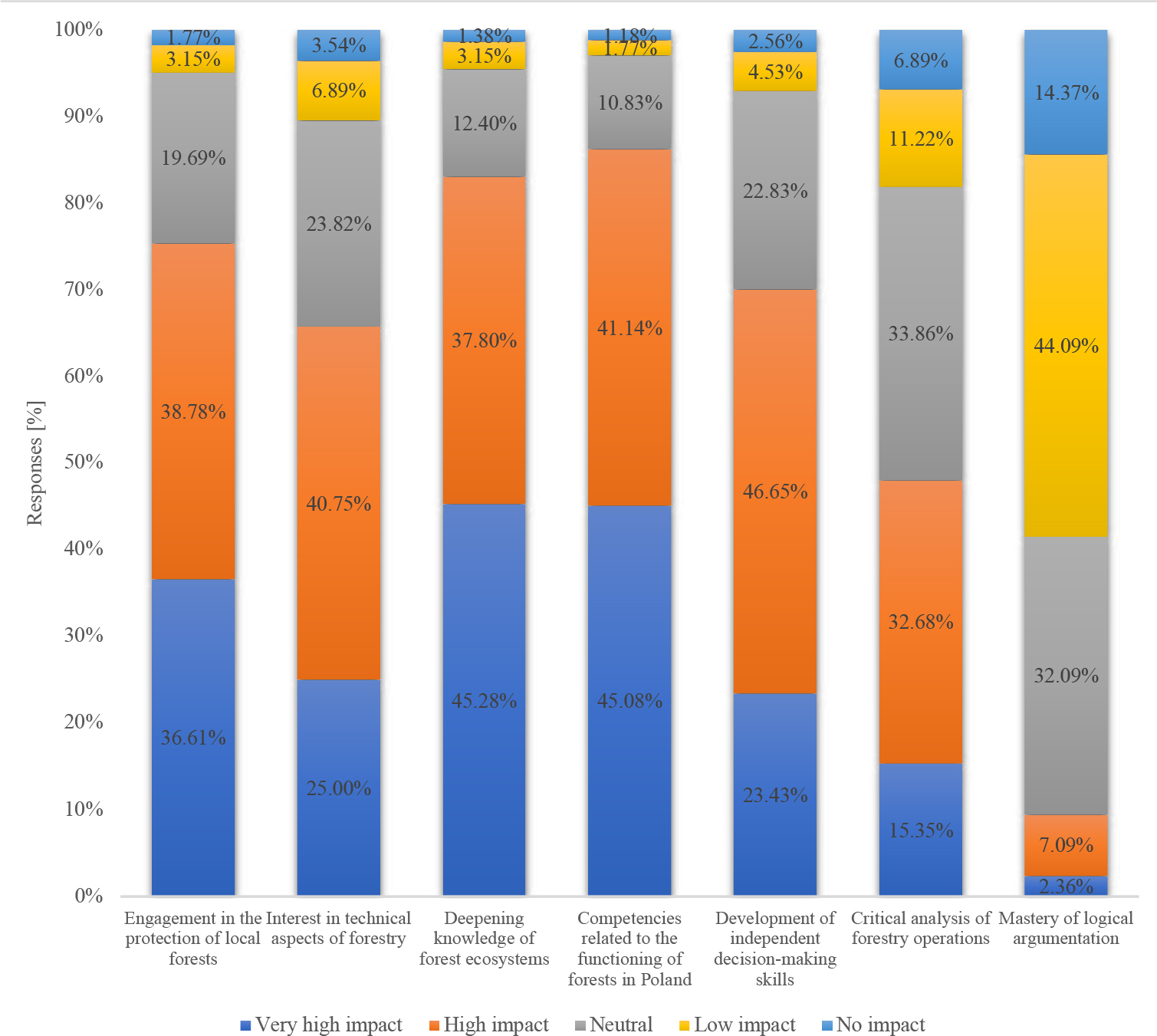
Figure 2.
Degree of influence of forestry studies on future professional work
Respondents assessed the impact of forestry studies on the development of critical thinking towards forestry operations less positively than competence-related dimensions. In urban areas, 6.69% of respondents declared a very large impact and 15.16% a large impact. In rural areas, higher categories of impact were selected more frequently, with 17.52% indicating a large impact and 8.66% a very large impact. Neutral responses accounted for a noticeable proportion of responses in both urban and rural groups. For the development of critical thinking, the arithmetic mean remained comparable in 2023 and 2024 (3.36 and 3.32, respectively), while in 2025 it increased to 3.48. The median and mode values changed from 3 to 4, whereas the standard deviation remained relatively stable throughout the analysed period.
The lowest proportion of high ratings concerned the perceived impact of forestry education on the development of logical reasoning and argumentation competences. The most frequent responses were “small impact” (44.09%) and “neutral” (32.09%), whereas “very large impact” accounted for only 2.36% of responses. Differences between urban and rural respondents remained visible, with higher ratings more frequently selected by respondents from rural areas, particularly among men. In terms of the development of logical reasoning and argumentation competences, the arithmetic mean decreased from 3.76 in 2023 to 3.52 in 2024 and remained stable in 2025 (3.53). The median and mode values remained unchanged (4.00), whereas the standard deviation increased slightly during the analysed period.
When assessing the impact of forestry education on stimulating interest in technical and engineering aspects of forestry, respondents most frequently selected the categories “large impact” and “very large impact”. Among women from rural areas, 8.86% indicated a large impact and 6.50% a very large impact. Among men from rural areas, the corresponding percentages amounted to 16.14% and 8.07%, respectively. Responses indicating small or no impact accounted for a smaller share of responses. The analysis of the variable concerning the perceived impact of forestry education on engagement in the protection of local forests and nature also revealed variation according to gender and place of residence. In urban areas, the most frequently selected responses were “very large impact” (15.75%) and “large impact” (13.98%). In rural areas, higher proportions were observed in both categories: “large impact” accounted for 24.80% and “very large impact” for 20.87% of responses. Neutral responses accounted for 7.68% in urban areas and 12.01% in rural areas, whereas responses indicating small or no impact represented only a minor proportion. The arithmetic mean for this variable amounted to 3.74 in 2023, 3.69 in 2024 and 3.88 in 2025. The median and mode values remained stable at 4.00 throughout the analysed period, while the standard deviation ranged from 0.98 to 1.05.
The mean value decreased from 4.14 in 2023 to 3.95 in 2024 and increased to 4.06 in 2025 with respect to the perceived impact of education on involvement in local forest issues. The median for all years remained constant at 4.00 across all analysed years. The mode changed from 5 in 2023 to 4 in 2024–2025. Variations in standard deviation across the analysed period reflect changes in the dispersion of responses.
Anticipated Professional Difficulties in Forestry
After assessing both the importance of forest functions and the perceived educational value of forestry studies, respondents were asked about potential challenges they may encounter in their future professional careers. The final question focused on anticipated barriers and difficulties associated with entering and functioning within the forestry sector.
Figure 3 presents responses to the question concerning perceived potential difficulties in future professional work in forestry. As in the previous questions, 508 respondents participated in the study, including 164 women (32.28%), 329 men (64.76%), and 15 individuals who did not indicate their gender (2.95%). The analysis was stratified by gender and place of residence.
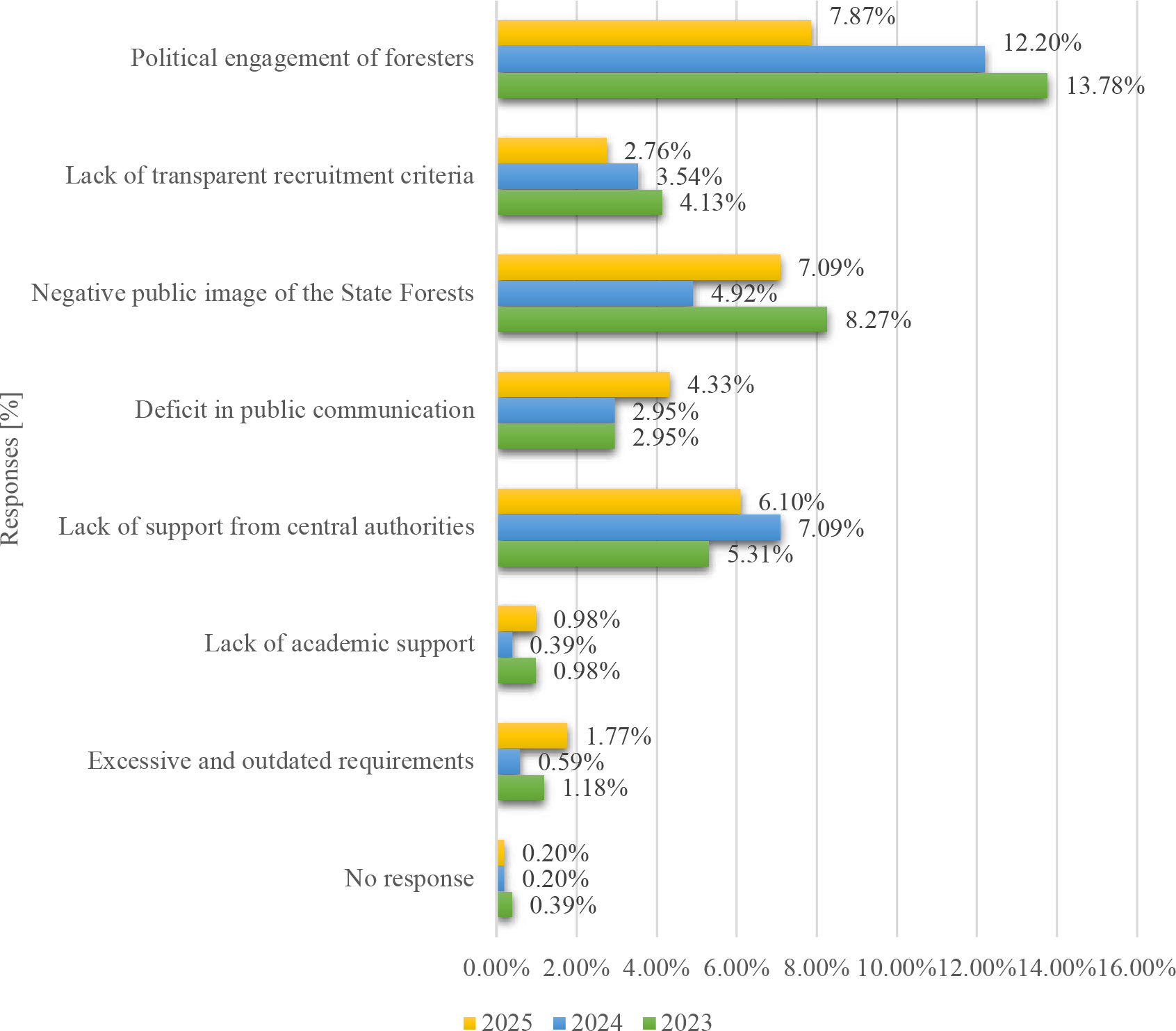
Figure 3.
Potential difficulties associated with future work in forestry
Among students from urban areas, the most frequently indicated difficulty concerned the political involvement of foresters (68 respondents; 13.39%; 41 men and 26 women). Other frequently identified barriers included the lack of employment criteria (47 respondents; 34 men and 9 women) and the lack of support from central authorities (36 respondents; 28 men and 5 women). The perceived negative image of the State Forests was indicated by 17 respondents (8 men and 9 women). Less frequently mentioned were limited public transport access (16 respondents), excessive or outdated formal requirements (7 respondents), and lack of academic support (3 respondents). Two respondents (1.38%) did not provide an answer.
Among students from rural areas, the most frequently indicated difficulty likewise concerned the political involvement of foresters (104 respondents; 20.47%; 59 men and 43 women). The lack of support from central authorities was indicated by 58 respondents (35 men and 22 women), while the lack of employment criteria was declared by 56 respondents (41 men and 15 women). A perceived negative public image of the State Forests was reported by 36 respondents (25 men and 11 women). Limited public transport access was indicated by 36 respondents, while a lack of academic support and excessive or outdated formal requirements were indicated by 9 and 11 respondents, respectively. No response was recorded in two cases (2.17%).
Discussion
The findings of the present study, considered alongside the relevant body of literature, underscore a set of structural challenges currently confronting both forestry practice and forestry education. To facilitate interpretation, the discussion is organised around three thematic areas corresponding to the research questions: (1) perceptions of forest functions, (2) the role of forestry education in shaping professional competences, and (3) anticipated professional challenges in forestry.
Perception of Forest Functions
Barker (2025) identifies pervasive uncertainty – encompassing ecological, economic, and institutional dimensions – as a defining condition of contemporary forestry. Within this context, a central task of forestry education is to equip future professionals with the competencies required to operate under conditions of systemic uncertainty, dynamic policy environments, and evolving societal expectations. The analysis of the data presented in Figure 1 and Table 3 demonstrates that students assigned importance to all three principal forest functions – economic (production-oriented), social, and protective (environmental) – while differentiating their relative significance. This differentiation reflects an internal hierarchy of values rather than a negation of any single function. As noted by Zibtseva (2023), forests were historically conceptualised primarily as a fundamental source of subsistence and economic livelihood. Contemporary societal expectations towards the forestry sector, however, have undergone substantial transformation. Increasing attention is now directed towards climate change mitigation, biodiversity conservation, and the broader provision of ecosystem services. This shift is consistent with the growing prominence of multifunctional forest management paradigms within both policy and academic discourse. Empirical evidence from the present study (Fig. 1) indicates that the social function of forests received the highest evaluation among respondents. A total of 39.57% assigned it the maximum score (10), while more than 55% located it within the two highest categories of the scale (9-10). The protective function likewise achieved high valuation: nearly 70% of respondents rated it within the 8-10 range, including 33.46% assigning the maximum score. These results suggest a strong recognition among students of the non-production dimensions of forest management. Although the economic function was also assessed positively (median = 8; mode = 10), it occupied a comparatively lower position relative to the social and protective functions. Temporal analysis reveals a gradual decrease in the mean rating from 8.32 (2023) to 7.86 (2024), followed by a slight increase in 2025 (7.95). While the magnitude of these changes remains moderate, the observed pattern may reflect a relative recalibration in the perceived role of production-oriented functions within the broader framework of forest multifunctionality. Such an interpretation should, however, be approached with analytical caution unless supported by additional longitudinal or qualitative evidence.
Barker’s (2025) analysis highlights the growing importance of interdisciplinarity in forestry education and the need to more robustly integrate the social dimension into the training of future forestry professionals. Contemporary discourse increasingly moves beyond a narrow, production-oriented conceptualisation of forests towards a multifunctional framework in which social, protective (environmental), and cultural dimensions are considered co-equal with economic functions. Within this perspective, forests are understood as complex socio-ecological systems, requiring the reconciliation of diverse stakeholder interests and value orientations within forest governance processes. These observations correspond closely with the findings of the present study. The assessment of the three principal forest functions indicates that respondents do not confine the value of forests to their economic or provisioning role but recognise their multidimensional character. In particular, the elevated valuation of social and protective functions reflects a shift consistent with the literature advocating a redefinition of forestry towards more sustainability-oriented and socially responsive management models.
Empirical evidence from Poland further supports this interpretation. A study conducted in 2020 that respondents assigned the highest importance to regulating and cultural ecosystem services, while provisioning services were evaluated comparatively lower (Janeczko et al. 2023). In terms of the classical forest function framework, this corresponds to a prioritisation of the protective function (regulating services, e.g. climate regulation and biodiversity conservation) and the social function (cultural services, including recreation, heritage values, and landscape amenities), with the economic function – associated with provisioning services – occupying a relatively less prominent position (Janeczko et al. 2023).
Sobol and Skubała (2021) demonstrated a clear differentiation in the perception of urban forest functions depending on the respondents’ field of study. The protective (ecological) function was generally well recognised, particularly with respect to biodiversity conservation, climate regulation, and environmental quality. The social function was perceived primarily through a recreational lens, whereas the economic function occupied a comparatively marginal position. Overall, their findings indicate an asymmetry in the perception of forest multifunctionality, characterised by a stronger recognition of ecological and social functions than economic ones. These observations correspond closely with the results of the present study, in which respondents also assigned the highest importance to the social and protective functions of forests. Further research (Torkar et al. 2019) demonstrated that respondents assigned the highest importance to regulating and supporting ecosystem services, such as biodiversity conservation and climate regulation, while provisioning services – including the supply of raw materials – were evaluated comparatively lower. Cultural ecosystem services, particularly those related to recreation and direct contact with nature, were also considered significant. Importantly, the authors showed that higher levels of ecological knowledge and more frequent contact with forests were positively associated with greater recognition of the importance of protective and social functions. Himes et al. (2023) present findings from a global survey conducted among forestry professionals across multiple world regions. Respondents indicated that in the context of accelerating climate change, increasing disturbance regimes (including wildfires, droughts, and pest outbreaks), and growing societal pressures, the importance of the protective function of forests is rising. The protective function is no longer treated as supplementary to the production function; rather, it is increasingly perceived as one of the principal pillars of contemporary forest resource management.
Forestry Education and Professional Competences
The results presented in Figure 2 and Table 4 indicate that forestry studies are perceived as having a strong influence on the development of technical and disciplinary competencies. In contrast, their contribution to the development of critical thinking and argumentation skills was assessed less favourably. In the context of increasing societal scrutiny and media attention directed at forest management practices, this discrepancy may constitute a significant competency gap within forestry education. Sample et al. (2015), drawing on a nationwide survey of forestry employers conducted in 2013 in the United States, identified a pronounced dichotomy between the high level of technical preparation of forestry graduates and the insufficient development of social and communication competencies. Deficiencies were particularly evident in areas such as conflict management, stakeholder engagement, and functioning within the complex socio-political context of natural resource governance. Although educational programmes were aligned with the accreditation standards of the Society of American Foresters (SAF), employers consistently emphasised shortcomings related to the “human dimension” of forestry practice. The findings of the present study are consistent with these observations. A visible imbalance emerges between the development of technical competencies and the cultivation of interpersonal and social skills, which are increasingly critical in professional practice (Fig. 2). This asymmetry is particularly relevant in light of the evolving governance landscape of forestry, where decision-making processes are embedded in contested public arenas and require effective communication across diverse stakeholder groups. Furthermore, the global study by Himes et al. (2023), encompassing respondents from 61 countries across all forested continents, underscores the central importance of social and political factors in strategies aimed at adapting forests to environmental change. Their results suggest that adaptive forest management cannot be understood solely in biophysical or silvicultural terms but must be situated within broader institutional and societal frameworks. The results presented by Himes et al. (2023) indicate that perceptions of the role of social factors in forest management differ according to a country’s level of economic development. Respondents from high-income countries more frequently perceived social factors as having a neutral influence on forest management, whereas respondents from low- and middle-income countries more often anticipated either positive or negative impacts.
Table 4.
Degree of influence of forestry studies on future professional work
| Development of correct argumentation skills | |||
|---|---|---|---|
| 2023 | 2024 | 2025 | |
| Arithmetic mean | 3.76 | 3.52 | 3.53 |
| Median | 4.00 | 4.00 | 4.00 |
| Mode | 4.00 | 4.00 | 4.00 |
| Standard deviation | 0.83 | 0.93 | 0.93 |
| Increased critical thinking about the negative tasks of foresters | |||
| Arithmetic mean | 3.36 | 3.32 | 3.48 |
| Median | 3.00 | 3.00 | 4.00 |
| Mode | 3.00 | 3.00 | 4.00 |
| Standard deviation | 1.10 | 1.10 | 1.05 |
| Independence in decision-making | |||
| Arithmetic mean | 3.36 | 3.32 | 3.48 |
| Median | 3.00 | 3.00 | 4.00 |
| Mode | 3.00 | 3.00 | 4.00 |
| Standard deviation | 1.10 | 1.10 | 1.05 |
| Increased competence in the field of forest management in Poland | |||
| Arithmetic mean | 4.31 | 4.30 | 4.20 |
| Median | 4.00 | 4.00 | 4.00 |
| Mode | 5.00 | 5.00 | 5.00 |
| Standard deviation | 0.76 | 0.77 | 0.91 |
| Stimulating interest in getting involved in local forests, nature and forest ecosystems in my place of origin | |||
| Arithmetic mean | 3.74 | 3.69 | 3.88 |
| Median | 4.00 | 4.00 | 4.00 |
| Mode | 4.00 | 4.00 | 4.00 |
| Standard deviation | 0.98 | 1.05 | 1.00 |
| Increasing competence in the functioning of forests in Poland | |||
| Arithmetic mean | 4.31 | 4.30 | 4.20 |
| Median | 4.00 | 4.00 | 4.00 |
| Mode | 5.00 | 5.00 | 5.00 |
| Standard deviation | 0.76 | 0.77 | 0.91 |
| Increasing competence in the field of forestry in Poland | |||
| Arithmetic mean | 4.31 | 4.30 | 4.20 |
| Median | 4.00 | 4.00 | 4.00 |
| Mode | 5.00 | 5.00 | 5.00 |
| Standard deviation | 0.76 | 0.77 | 0.91 |
According to Worldometer (n.d.), Poland is classified as a high-income economy. This broader socio-economic context may partly explain why forestry students perceive future professional challenges primarily in institutional and social rather than economic terms. Despite the relatively favourable economic position of the country and stable employment prospects for forestry graduates, respondents still identified a number of institutional and social challenges associated with future professional practice. Sobol and Skubała (2021) argue that decision-making processes in forest management remain relatively distant from local communities. The authors emphasise that a governance-oriented approach should serve to “bridge the gaps between public authorities and citizens’ knowledge, values and needs,” highlighting the complexity and tensions inherent in stakeholder engagement processes. These observations correspond with the findings of the present study, in which forestry students pointed to a negative public image of forest institutions, deficiencies in public communication, and a lack of systemic support mechanisms. Such perceptions suggest the existence of a communication gap and indicate the need to strengthen dialogue, transparency, and participatory practices in forest governance (Sobol and Skubała 2021). Similarly, Arévalo et al. (2012) demonstrated that forestry students in Brazil, China, and Finland perceive forestry education primarily as a source of practical competencies related to their future professional roles. Highly valued competencies included environmental protection, forest resource assessment, and forest management planning, alongside general skills such as teamwork and the ability to apply knowledge in novel situations. These findings suggest that forestry programmes effectively combine disciplinary expertise with transferable professional skills. In a study conducted in California, Kelly and Brown (2019) reported that both students and employers identified professional competencies – particularly ethics, professionalism, and communication – as essential for future employment. At the same time, land management–related competencies were identified as an area in which students felt less adequately prepared, indicating a need for curricular strengthening in this domain. Bal et al. (2020) found that the choice to pursue forestry studies is influenced both by the professional image of forestry – working in close contact with nature, in field conditions, and with tangible environmental impact – and by expectations regarding the acquisition of both specialist and general competencies, including communication, problem-solving, and adaptability to social and climatic change. These conclusions are further supported by Wilenius et al. (2024), who argue that contemporary forestry education is undergoing a phase of transformation characterised by an increasing emphasis on analytical, decision-making, and reflective competencies, as well as communication and social skills. The authors stress the necessity of integrating ecological, social, and economic knowledge, together with fostering environmental responsibility and the capacity to make decisions under conditions of uncertainty and conflicting interests. In this evolving context, the contemporary forester operates not solely as a technical specialist but as a resource manager functioning within a complex social arena at the intersection of public, private, and environmental interests. Empirical evidence indicates that insufficient development of social competencies may confine graduates to predominantly technical roles, whereas leadership positions require negotiation skills, stakeholder engagement, and collaborative capacity. Given the increasing multifunctionality of forests and the growing tensions between forest management and societal expectations, the integration of technical and social competencies emerges as a prerequisite for educating foresters capable of operating effectively within contemporary society (Sobol and Skubała 2021; Arévalo et al. 2012; Kelly and Brown 2019; Bal et al. 2020; Wilenius et al. 2024).
Anticipated Professional Challenges in Forestry
The analysis of the results presented in Figure 3 indicates that the most frequently identified challenge in the future professional practice of foresters was political involvement, followed by a lack of support from central authorities, unclear recruitment criteria, and a negative public image of forest institutions. The response structure suggests that prospective foresters perceive their future challenges primarily in systemic and institutional rather than technical or ecological terms. These findings are consistent with the RECOFTC (The Center for People and Forests) (2021) report, which demonstrated that young people pursuing forestry education identify the misalignment between education and labour market realities, employment uncertainty, and limited transparency of career pathways as significant barriers to professional development. Structural constraints were also highlighted, including insufficient educational resources, weak integration of academic programmes with professional practice, and social factors such as gender inequalities affecting access to stable employment. When juxtaposed with the present findings, these results suggest that the perception of forestry as a profession embedded in socio-political and organisational tensions is not context-specific but reflects broader transformations within the global forest sector. Beyond biophysical and technical dimensions, institutional, communicative, and structural factors increasingly shape professional practice. Similarly, Himes et al. (2023), in their study conducted in Bosnia and Herzegovina, reported that future forest professionals recognised growing challenges not only in technical domains but also in socio-political contexts. Barriers to the implementation of adaptive practices, communication difficulties with stakeholders, and limited acceptance of more transformative approaches aimed at strengthening protective and social forest functions were identified as key constraints. Zibtseva (2023), examining students’ motivation to work in forestry, found that limited economic attractiveness (particularly remuneration) and a weak institutional image constituted significant deterrents. Students framed core challenges in systemic terms—political interference, insufficient institutional support, opaque recruitment procedures, and reputational issues – indicating that economic and socio-institutional barriers influence both educational decisions and subsequent professional trajectories in Poland and Ukraine. At the same time, aggregated data from the Polish ELA monitoring system (Kierunki-studiow.info, n.d.) for second-cycle forestry programmes (2014–2023) indicate a relatively stable and favourable labour market situation for graduates. The risk of unemployment within the first year after graduation remained low (3–5%), decreasing further to 3.2–3.8% in 2021–2023, suggesting efficient labour market absorption and employment stability. This juxtaposition reveals a notable tension between objectively favourable employment indicators and subjectively perceived systemic insecurity. Himes et al. (2023) further demonstrated that forestry professionals across different regions identify political pressure and conflicts of interest as important factors influencing professional practice. Decision-making in forest management was described as shaped not only by scientific evidence but also by political priorities, administrative agendas, and societal expectations, generating tensions between evidence-based approaches and political demands. These findings imply that forestry education should extend beyond technical training to include competencies related to political literacy, negotiation, and stakeholder communication. Research by Bal et al. (2020) similarly documented a shift in the perceived professional profile of the forester. The traditional model – focused primarily on timber production and technical forest management – has been increasingly replaced by a more interdisciplinary vision encompassing climate change, biodiversity conservation, and social conflict management. Students emphasised the need for communication skills, stakeholder collaboration, and the ability to operate within politically and socially contested environments, indicating an expanded understanding of professional identity. Finally, Giurca and Winkel (2018) highlighted systemic governance constraints affecting the forest sector, including fragmented responsibilities, unclear strategic priorities, and inter-ministerial tensions. They emphasised the need for stronger policy coordination and coherent long-term strategies to reduce decision-making uncertainty and enhance sectoral stability. Overall, the convergence of these findings underscores that contemporary forestry operates within a complex socio-political landscape. Consequently, preparing future foresters requires not only ecological and technical expertise but also institutional awareness, strategic competence, and the capacity to function effectively in environments characterised by political pressure, public scrutiny, and competing interests.
In summary, the contemporary forester functions not only as a technical specialist but also as a resource manager operating within a complex social environment at the intersection of public, private, and environmental interests. The results indicate that insufficient development of social competencies may limit graduates to predominantly technical roles, whereas managerial and strategic positions require leadership skills and the ability to cooperate with diverse stakeholder groups. In the context of increasing forest multifunctionality and ongoing tensions between forest management and societal expectations, the integration of technical and social competencies appears to be an important condition for educating foresters prepared to function effectively within contemporary society (RECOFTC 2021; Himes et al. 2023; Bal et al. 2020; Giurca and Winkel 2018; Zibtseva 2023; Kierunki-studiow.info, n.d.).
Conclusion
The collected empirical data confirm that within the surveyed population of forestry students, a multifunctional perception of the forest has become increasingly consolidated. A clear rise in the perceived importance of social and protective functions was observed, accompanied by a gradual weakening of the dominance of the economic (production-oriented) function. Forestry studies were evaluated as effective in transmitting disciplinary knowledge, yet less effective in fostering argumentation skills and critical thinking. Between 2023 and 2025, a shift in the professional identity of future foresters became apparent – from a predominantly technical-administrative model toward a more reflective and socially aware professional profile, recognising both the ecological and socio-political complexity of contemporary forestry. From a sociological perspective, these findings indicate a gradual paradigmatic shift from a modernisation-oriented model centred on production primacy toward a more post-material and ecologically reflective orientation. Within this framework, the forest is increasingly perceived as a common good with social, cultural, and normative significance, embedded in social consciousness and everyday practices. At the same time, a considerable proportion of neutral attitudes was recorded, suggesting differentiated educational experiences and uneven development of pro-environmental competencies, particularly regarding the social function of forests as spaces of psycho-physical regeneration and social capital formation. The data also point to a growing internalisation of environmental protection norms and a strengthening of ecological awareness. Nevertheless, students’ evaluations of forest functions remained internally diversified, which may reflect an ongoing transformation of ecological consciousness among the younger generation – from a paradigm of the “forest as a source of raw materials” toward a more integrated model in which protective, social, and ecological functions gain prominence relative to the traditionally dominant economic function.
From a sociological perspective, forestry education effectively reproduces expert and professional capital; however, it appears less effective in preparing future foresters for socially mediating roles and dialogical engagement. This reveals a structural tension between the traditional model of specialised, discipline-oriented training and contemporary expectations toward foresters as professionals operating at the interface of scientific expertise, societal interests, and public deliberation. The limited development of argumentation and critical reasoning competencies may increase susceptibility to ideologically framed conflicts and constrain the capacity for evidence-based communication. The empirical findings indicate that among future foresters there is an emerging space for critical reassessment of the role of forest management, which may contribute to a gradual redefinition of both managerial practices and the professional image of the forester. A gradual reconfiguration of value hierarchies was observed. The previously accentuated dichotomy between “forest as an economic resource” and “forest as an ecosystem” became less pronounced, while the perception of the forest as a common environmental good gained salience. This tendency was most evident in 2025, when the highest mean values, the highest modal response, and the lowest dispersion were recorded, suggesting increasing consolidation of this evaluative orientation within the surveyed cohort.