
Introduction
Root exudation (mostly located at the root tips) belongs to one of the strategies of how the plant may affect the soil environment (Kaiser et al. 2002; Vives-Peris et al. 2020). The root tip gets in contact with the soil environment and reacts to various chemical, biological and physical stimuli. In addition to dissolved mineral substances, the soil solution also contains many soluble organic compounds (dissolved organic carbon – fraction smaller than 0.45 µm), which get here mainly via the plant exudation, microbial activity and such mediated decomposition of soil organic matter (Herbert and Bertsch 1995). Organic plant exudates can be divided into primary metabolites (sugars, polysaccharides, and organic and amino acids) and secondary metabolites (terpenes, phenolics, alkaloids, etc.), enzymes (Wen et al. 2007a), defence substances (Baetz and Martinoia 2014), proteins (Wen et al. 2007b), and extracellular DNA (Wen et al. 2009). The most important chemical groups of root exudates are summarised in Figure 1 (Vives-Peris et al. 2020).
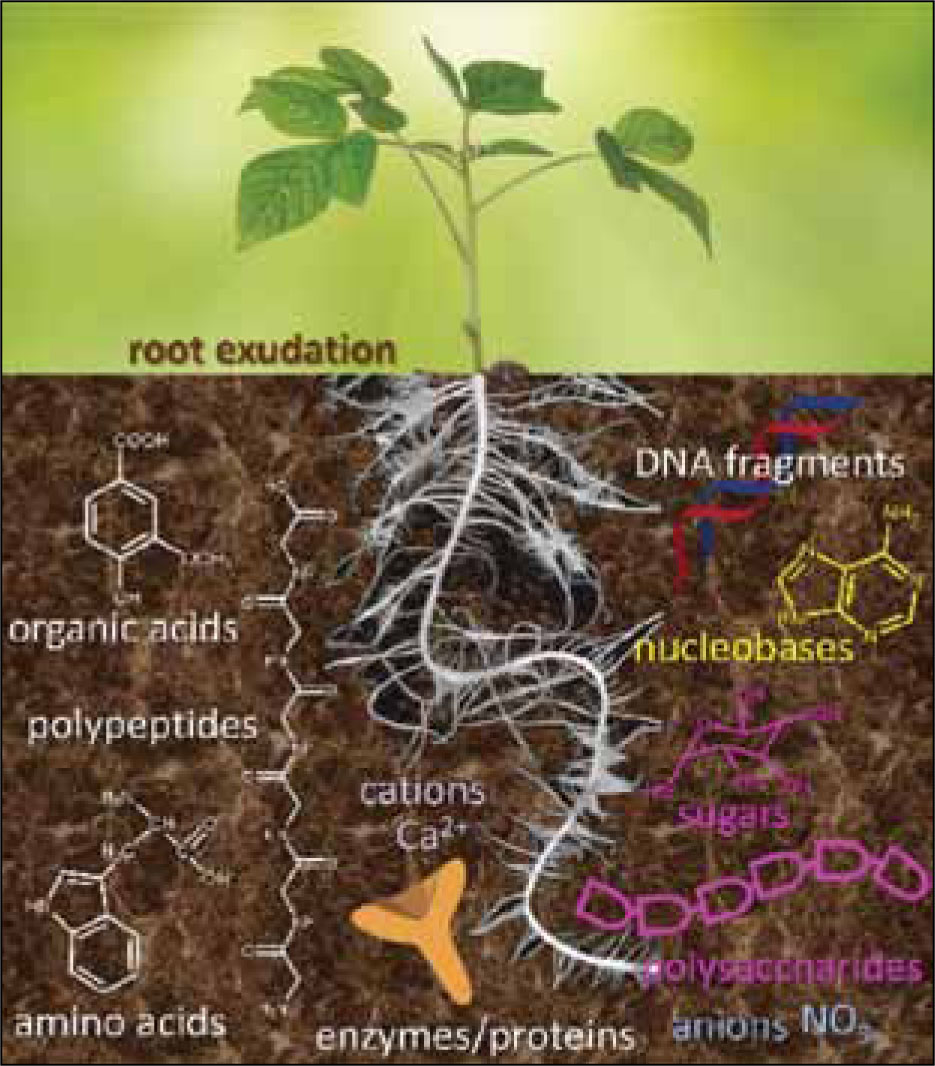
Figure 1.
Overview of the most important chemical groups of root exudates (not scaled)
Root exudation is frequently associated with the mobilisation of soil nutrients based on the exudation of low-molecular-weight organic acids (LMWOAs) into the rhizosphere or with the exudation of chemicals supporting rhizosphere symbiosis with soil microorganisms or fungi and last but not least chemicals affecting soil environment as a strategy of interspecific competition (Bergmann et al. 2020; Canarini et al. 2019; Sanon et al. 2009; Vives-Peris et al. 2020). LMWOAs are a relatively large group of compounds containing the carboxylic group (−COOH) that has a maximum molecular weight of 300 g/mol (Herbert and Bertsch 1995). Their character and therefore the behaviour in the soil (environment) are strongly affected by other functional parts of the molecule. LMWOAs can create chelates with nutrient/hazardous elements (Adeleke et al. 2017; Jaklová Dytrtová et al. 2012) and in this way can mobilise (dissolve) the elements and potentially influence their bioavailability. Consequently, also plant interactions with microorganisms play a crucial role (Canarini et al. 2019; Sasse et al. 2018). Root exudation can be understood as a process that drives organic metabolites to the root and ensures their exudation to the soil. Once the exudate is in the apoplast, its release into the soil environment is driven by diffusion (controlled by the concentration gradient). It seems that microorganisms play a role in the adjustment of the concentration gradient. Microorganisms can consume the plant exudates and thus maintain a high concentration gradient (Figure 2. Illustration of the transport of organic acids through the last plasma membrane (the apoplastic transport) and its control by the concentration gradient). In this manner, the diffusion would regulate the flux of exudates into the soil. However, this mechanism works only in the absence of any physical obstacle, which can differentiate the distance from the meristem to the differentiation zone (Somssich et al. 2016).
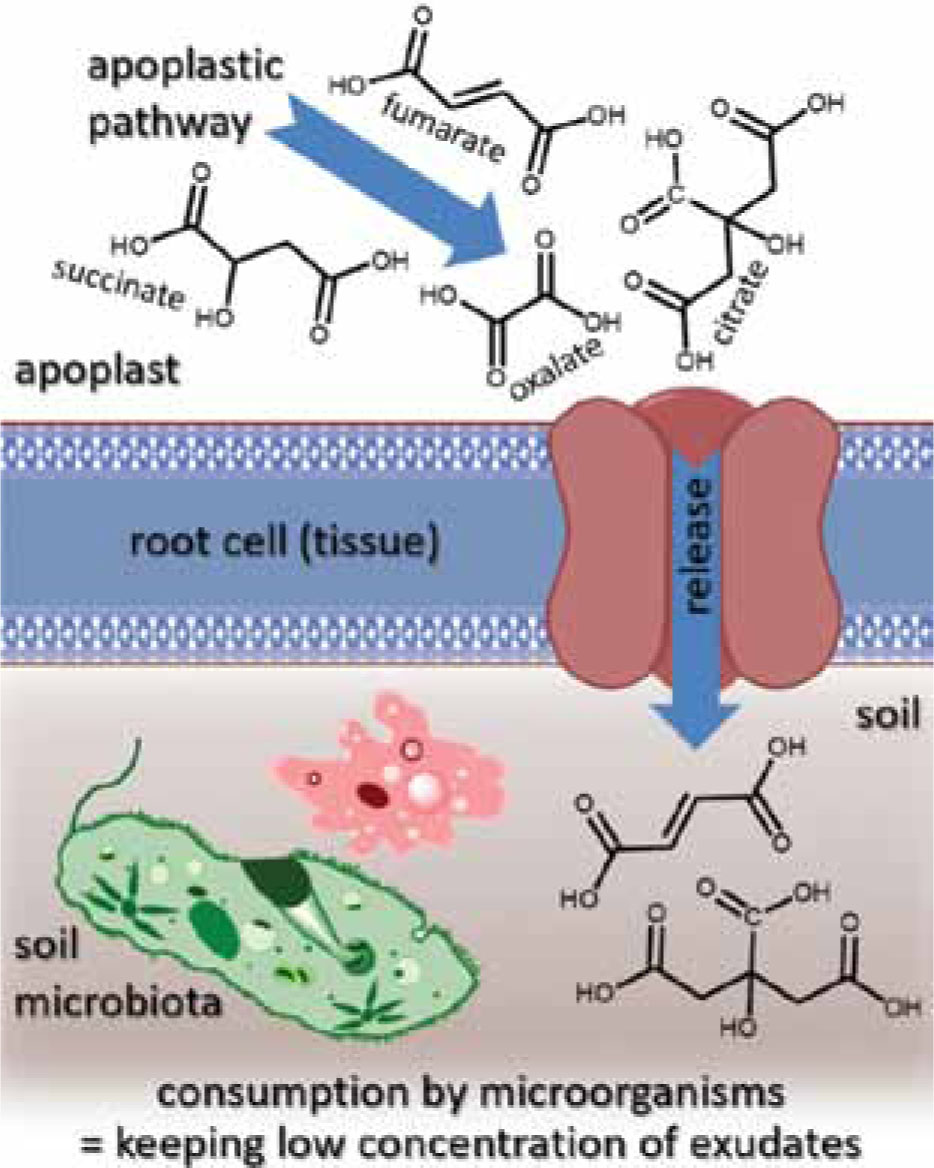
Figure 2.
Illustration of the transport of organic acids through the last plasma membrane (the apoplastic transport) and its control by the concentration gradient
In particular, the smallest aliphatic molecules, whose production and importance within the soil and plant are indisputable (Jones 1998), have been mentioned above. In this study, we focus on LMWOAs, which contain a benzene ring in the molecule and at least one hydroxyl (−OH) group (Fig. 3), that is, phenolic acids.
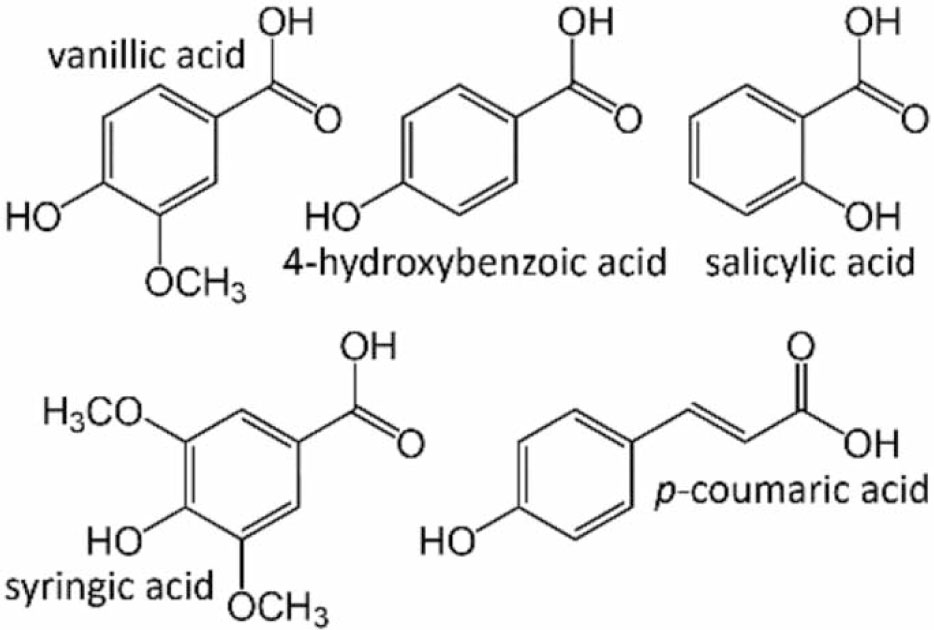
Figure 3.
Chemical structures of phenolic acids detected and analysed in our study
These compounds are probably mostly produced by plant roots (as a secondary metabolite) and soil microorganisms, and they affect the regulation of root growth (Strobel 2001). These structures are expected to be effective antioxidants. Their OH groups make them reactive, and the benzene ring allows the delocalisation of accepted free electrons, and consequently, free-electron radicals can be quenched. The LMWOAs with the aromatic ring may differ in their effects on plants and microorganisms. It appears that the plant is able to adjust the activity of symbiotic microorganisms in this way depending on the current conditions (e.g., drought) and the nutrient needs of the plant (de Vries et al. 2019; Oppenheimer-Shaanan et al. 2022).
Namely, salicylic acid plays a decisive role in the mechanisms of tolerance against abiotic stress that controls the main plant metabolic processes (Khan et al. 2015). In some deciduous trees, it increases tolerance to salinity and hazardous elements by protecting membrane integrity (Drzewiecka et al. 2019; Rao et al. 2019). Salicylic acid also participates in growth, development, photo-synthesis, transpiration, ion uptake and transport (Vlot et al. 2009); therefore, it is also classified as a phytohormone.
There is a very limited amount of information on the precise action of LMWOAs with aromatic rings and a hydroxyl group. From the chemical structure, a high reactivity and antioxidant capacity can be estimated. On the other hand, it was described (Jaklová Dytrtová et al. 2018) that the presence of metal cations (copper, iron and others) can change the antioxidant properties of some compounds to pro-oxidant. In soils, copper and iron are present in a wide range of concentrations and forms. Therefore, some interactions can be expected. It is disputable whether the high content of these LMWOAs with redox properties is advantageous for plants. In the presence of copper or iron cations, they can destroy root cell structures via the production of free radicals in the Fenton (Haber-Weiss) reaction.
For forest tree species, at least those that grow in Europe, the information on phenolic acids is even less than for crops. Therefore, we selected five species of deciduous forest trees to focus on this issue from a European perspective. At lower elevations of European temperate forests, English oak (Quercus robur) is typically the dominant tree species, whereas the wild service tree (Sorbus torminalis) is a representative of admixed (associated) trees in the species composition. At the mid to higher elevations of European temperate forests, European beech (Fagus sylvatica) is typically the dominant or co-dominant species, and sycamore maple (Acer pseudoplatanus) is mainly the admixed (associated) tree in the species composition. In addition to the four native European trees listed above, we also included the non-native North American species black locust (Robinia pseudoacacia) in our study. Back locust is considered an invasive tree species in many countries in Europe and elsewhere in the world (Richardson and Rejmánek 2011; Vítková et al. 2017), possibly (Bartha et al. 2008; Nasir et al. 2005) capable of allelopathically influencing neighbouring trees in forest stands through its metabolites.
This study aimed to monitor the contents of selected low-molecular-weight organic acids with potentially redox properties in soil solution sampled from different tree species (Robinia pseudoacacia, Quercus robur, Sorbus torminalis, Fagus sylvatica and Acer pseudoplatanus). We expect that the phenolic compounds found in the soil solution collected from Robinia pseudoacatia will differ in their composition and concentration from other cultivated species.
Material and methods
Pot experiment
The trees were grown from seeds on the growth substrate composed of fertilised peat, conifer bark compost and trace elements in a greenhouse from March 10 (2021; Prague, Czech Republic). On June 21, the seedlings were transplanted in triplicates into 1 L pots and moved to the vegetation hall (temperature equal to outdoors, i.e., in temperate summer conditions, under controlled precipitation and shading). In the vegetation hall, the control (soil substrate without plants) was also installed in three replicates. The trees were watered with demineralised water to avoid increasing the number of minerals from the tap water. The scheme of the experiment is depicted in Figure 4.
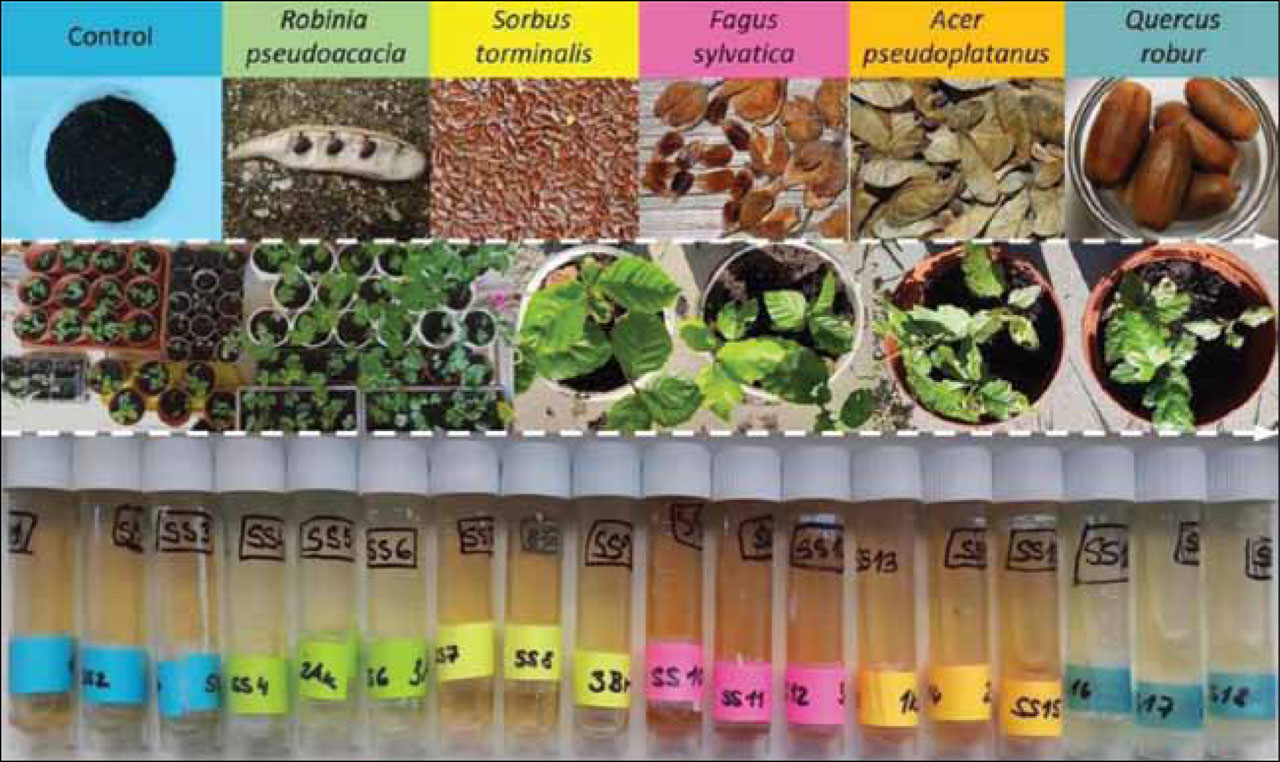
Figure 4.
Basic scheme of the experiment from each seed through all seedlings in small and experimental pots (chronologically in the central row) to the soil solution
Selected pedochemical parameters of the growth substrate are described in Tables 1–3. The pseudototal content of selected elements in the substrate was determined after decomposition of the dried, ground (<2 mm) and homogenised sample in Aqua regia heated in a microwave-assisted wet digestion system Ethos 1 (MLS GmbH, Germany) for 33 min at 210 °C. For the water-soluble and bioavailable fractions, the samples were extracted in 1:10 mixtures with demineralised water and appropriate CAT agent (0.01 mol/L CaCl2 and 0.002 mol/L DTPA, according to EN 13651:2001 standard (Committee for European Standardization)), respectively, for 1 hour and filtered. All these fractions of selected elements were determined using optical emission spectrometry with inductively coupled plasma (Agilent 720, Agilent Technologies Inc., USA), and only the fractions of potassium were (for higher precision) determined using flame atomic absorption spectrometry (Varian 280FS, Varian, Australia). The content of mineral nitrogen (ammonia and nitrate form) was determined in the extract of 0.01 mol/L CaCl2 using the method based on Kjeldahl on VAPODEST 50s device (Gerhardt, Germany), using Devarda’s alloy for N-NH4 form. The amount of oxidisable carbon was determined based on its oxidation using potassium dichromate in an acidic environment of sulphuric acid, followed by the determination of the amount of reduced Cr3+ spectrophotometrically (Lambda 25 UV/Vis, PerkinElmer, USA). Humic substances and their ratios were determined using the methodology mentioned in Sedlář et al. (2023).
Table 1.
Active and exchangeable pH and electrical conductance (κ) of the substrate (1:10 (w/v); mean ± st. dev., n = 3)
| pH(H2O) | pH(KCl) | κ (mS/cm) |
|---|---|---|
| 5.17±0.00 | 4.65±0.00 | 0.955±0.005 |
Table 2.
Total, bioavailable (CAT) and water-soluble fractions of selected elements in the substrate (mg/kg dry wt.; mean ± st. dev., n = 3)
| Fraction | K | Ca | Mg | P | Zn | Fe | Mn | Cu |
|---|---|---|---|---|---|---|---|---|
| Total | 2321±48 | 9655±103 | 1748±42 | 872±11 | 74.1±2.8 | 2089±25 | 462.5±8.6 | 6.03±0.21 |
| CAT | 1272±4 | – | 717±6 | 585±19 | 82.5±3.7 | 508±14 | 407.4±6.7 | 2.02±0.42 |
| H2O | 808±8 | 225±6 | 93±3 | 572±5 | 0.952±0.007 | 6.14±0.00 | 7.15±0.04 | 0.188±0.026 |
Table 3.
Content of mineral nitrogen forms, total organic carbon (TOC) and humic substances (HS), the degree of polymerisation (DP) and the humification index (HI) of the dry substrate (mean ± st. dev.; n = 3)
| N-NH4 (mg/kg) | N-NO3 (mg/kg) | TOC (% C) | HS (% C) | DP (HA : FA) | HI (HA : TOC) |
|---|---|---|---|---|---|
| 1421.5±2.6 | 36.6±5.2 | 13.4±0.3 | 6.14±0.03 | 1.80±0.06 | 0.231 |
The substrate can be characterised as moderately acidic with an adequate soil reaction to grow seedlings of forest trees. The content of selected nutrients in the substrate, namely, P, Ca and Mg, is also on an adequate to a luxurious level. The content of potentially hazardous Mn and Cu is low and that of Zn is at a well-acceptable level (Kopinga and Van den Burg 1995; Landis et al. 1989; Šrámek et al. 2004).
Sampling and analysis of phenolic acids
The soil solution was sampled from the pots with a growing seedling of Robinia pseudoacacia (RP), Acer pseudoplatanus (AP), Quercus robur (QR), Fagus sylvatica (FS), Sorbus torminalis (ST), and control (soil substrate only). On September 22 (at the end of the growing season before the leaves began to senesce), the soil solutions were obtained from each pot (one pot – one sample) after 24-hour saturation of the substrate with deionised water to 100% water holding capacity, sucked off using a 0.22 µm suction filter. The soil solutions were immediately frozen at −20°C and delivered for analysis. Exactly 5 mL of soil solution was lyophilised (Christ Beta 1–8 LOplus, Martin Christ Gefriertrocknungsanlagen GmbH, Osterode am Harz, Germany) and remained solid was dissolved in 500 μL of milli-Q water where the content of phenolic compounds was analysed.
LCMS analysis of the exudates was performed on Nexera X2 UHPLC (Shimadzu Handels GmbH) coupled with an MS-8050 (Shimadzu Handels GmbH). Chromatographic separation was performed on a UHPLC Acquity BEH C18 (50 × 2.1 mm; 1.7 μm particle size) column (Waters Corp., Milford, MA, USA) that was kept at 40 °C. The mobile phase consisted of 15 mmol/L formic acid in water, pH 3 (adjusted with NH4OH) (component A) and acetonitrile (component B). Totally, 32 analytes were separated using a binary gradient starting at 5% B for 0.7 min, 5–15% B for the next 1.3 min, 15% B isocratic for 1 min, 15–30% B for 1.5 min, 30% B isocratic for 1.5 min, 30–70% B for next 1.5 min, 70–100% B for 0.1 min, 100% isocratic for 0.5 min, back to 5% B within 0.1 min, and equilibration for 3.8 min. The flow rate was 0.4 mL/min, and the injection volume was 2 μL.
All analytes were analysed in an electrospray negative ionisation mode (ESI−) using a multiple reaction monitoring (MRM) mode for their identification and quantification (Jakl et al. 2021). Standard solutions of 32 target compounds (2,3-dihydroxybenzoic acid, 3-hydroxybenzoic acid, 4-hydroxybenzoic acid, 5-hydroxy-ferulic acid, apigenin, caffeic acid, catechin, chlorogenic acid, chrysin, ferulic acid, galangin, gallic acid, hesperidin, kaempferol, luteolin, methyl p-coumarate, morin, myricetin, naringenin, naringin, p-coumaric acid, pinocembrin, quercetin, quercitrin, rosmarinic acid, rutin, salicylic acid, salicylic acid 2-O-β-D-glucoside, sinapic acid, syringic acid, trans-cinnamic acid and vanillic acid), purchased from Sigma-Aldrich (Czech Republic), were firstly prepared in methanol at 1 mmol/L concentration. All solutions were gradually diluted in the mobile phase to working concentrations ranging from 0.01 to 50 μmol/L. Quantification was performed by isotope diluting method with p-coumaric acid-d6 and salicylic acid-d4 (Toronto Research Chemicals, Canada) as internal standards.
Statistical analysis
The results of the analyses performed in three replicates and two technical repeats were statistically processed by one-way ANOVA (Tukey method), t-test, and MANOVA using the statistical software TIBCO Statistica (v.14; Statistica.pro) and by Pearson Product-Moment Correlation using SigmaPlot (v.12.5; Systat Software Inc.). The differences were considered statistically significant at P ≤ 0.05.
Results
In detectable amounts (LOD ~ µmol/kg lyophilisate), five phenolic acids were found: 4-hydroxybenzoic acid, vanillic acid, syringic acid, p-coumaric acid and salicylic acid (Fig. 5). The others (listed in the experimental section) have not been found in detectable amounts.
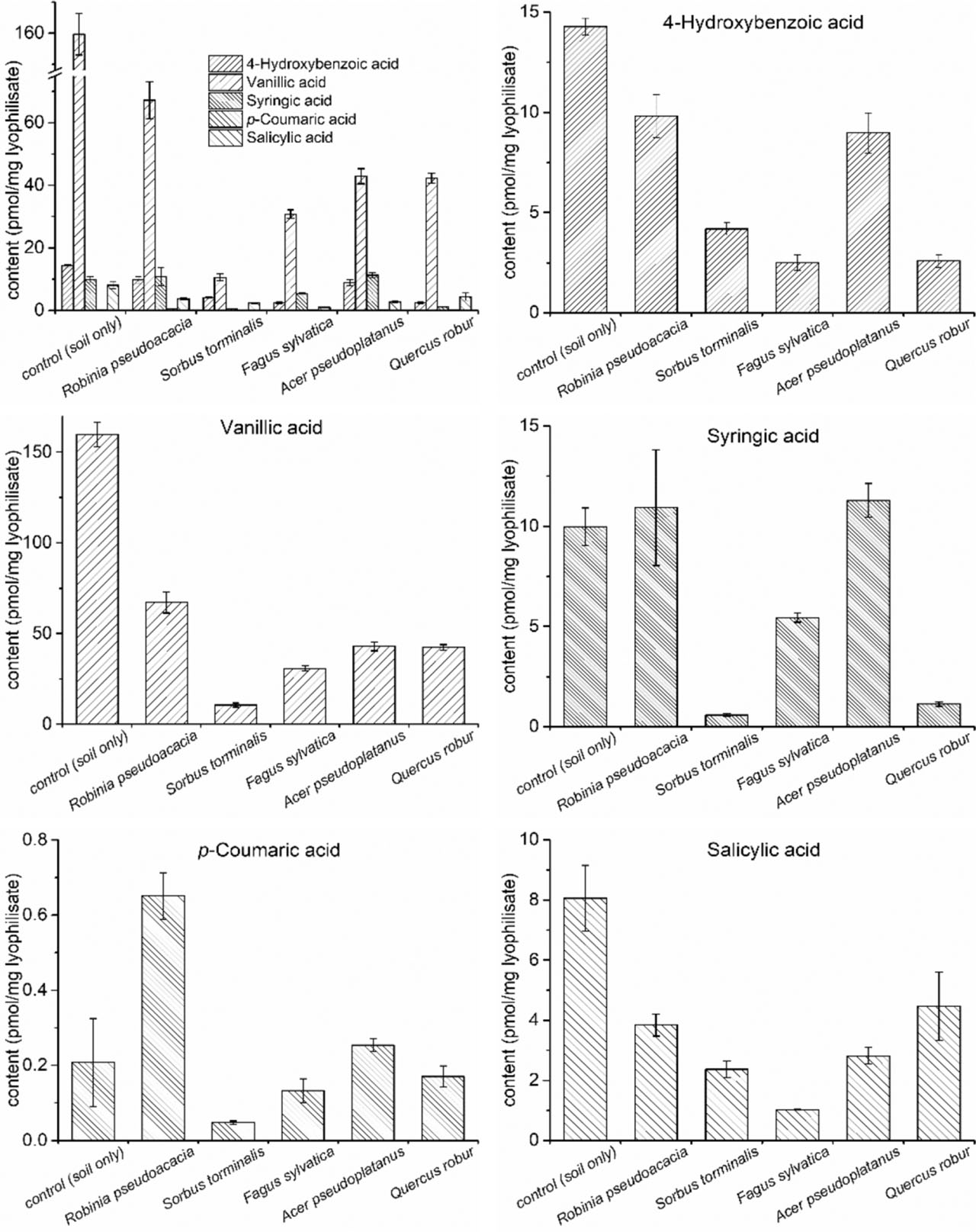
Figure 5.
Content of selected phenolic acids in the soil solution of focused trees (n = 3, mean ± st. dev.)
Vanillic acid was found in the soil solution from its highest content in the control, followed by (RP) > (AP) = (QR) > (FS), (ST). The highest 4-hydroxybenzoic acid content was also found in the control soil solution, further followed by RP = AP > ST > FS = QR. The content of syringic acid was similar in the control, RP and FS followed by a very low content recorded in the QR and ST treatments. Furthermore, the salicylic acid content was highest in the control, further followed by QR = RP > AP = ST > FS treatments. p-Coumaric acid was highest in RP followed by AP = control > QR = FS > ST.
Discussion
The low contents (mostly available or water-soluble) of nutrients lead to increased plant exudation (Tato et al. 2021). However, the growth substrate was prepared to have optimum chemistry that would prevent nutritional and physiological stresses, as documented in Tables 1–3. Therefore, in our experiment, the exudation stimulated by low nutrition was not expected. Additionally, other conditions (humidity, light and temperature) were set to be optimal. The aim was to record the typical contents of phenolic acid under each tree seedling. The number of individual phenolic acids that were detected varied from units (p-coumaric acid) to higher tens of pmol (vanillic acid) in 1 mg of the lyophilised soil solution. These findings reflect the no-stress situation for the one-year-old seedlings – the baseline.
In the lyophilised soil solutions, only 4-hydroxybenzoic acid, vanillic acid, syringic acid, p-coumaric acid and salicylic acid were found in detectable amounts. In the control, the concentrations of vanillic acid, 4-hydroxybenzoic acid and salicylic acid were significantly higher than those in the variants of the cultivated trees (Tab. SI1). This finding supports the assumption that nutrient stress-induced exudation was not expected due to sufficient nutrient balance in the soil substrate.
Vanillic acid belongs to one of the curcumin metabolites and is known for its antioxidant effect (Sharma et al. 2022). Its content was the highest among the assessed acids in all treatments, including the control. In the control, the content also reached the highest value among the compared treatments. In the soil solution taken from the seedlings, its content was 3 times (RP) to 15 times (ST) lower than that in the control. From this point of view, it could be suggested that its occurrence was mainly caused by microbial activity related to the degradation of biomass (lignin as a part of the substrate). Therefore, it is expected that vanillic acid created from biomass decomposition can be in the pots with tree seedlings converted (and spread) to a variety of C4 dicarboxylic acids, such as succinic, malic, maleic and fumaric acid, whose individual concentrations were below our detection limit (Vega-Aguilar et al. 2020).
4-Hydroxybenzoic acid is a phenolic derivative of benzoic acid with a potential antioxidant (anti-inflammatory) effect (Taofiq et al. 2017). It is slightly soluble in water and more soluble in polar organic solvents. Its isomer (2-hydroxybenzoic acid) is known as salicylic acid. Salicylic acid is known for its protective antifungal/anti-inflammatory effect (Bi et al. 2022). Both acids occurred in the studied soil solutions in a similar ratio. The 4-hydroxybenzoic acid content was roughly twice as high as salicylic acid, and this is the case for variants except for QR. Research results (Pizzeghello et al. 2006) have confirmed the positive effect of this acid on root growth. Its presence in the soil solution of beech (FS) seedlings was significantly lower compared to the others (Tab. SI1). Beech belongs to slow-growing trees and its roots develop more slowly. It is therefore possible to infer a lower support for their growth due to a lower production of this acid by symbiotic microorganisms.
p-Coumaric acid is known to have a strong anti-oxidant effect (Kannan et al. 2013). It is well known to suppress Fusarium oxysporum (Were et al. 2022). It also seems that this phenolic compound is produced in the case of elevated oxidative stress. p-Coumaric acid is also exuded concerning higher content of copper (Achary et al. 2012) or other metals. The highest content of p-coumaric acid was detected in the soil solution sampled from RP. Its concentration is several times higher than that in the control and other trees (3x on average). p-Coumaric acid is reported in the literature as a substance with allelopathic effects on plants (Blum 1996; Han Kyaw et al. 2022; Lima et al. 2013). Therefore, we suggest that p-coumaric acid may play a role in the influence of the soil environment and may be related to the reported ability of RP to suppress its competitors. In an older publication (Inderjit and Mallik 1997), p-coumaric acid was shown to reduce soil organic matter and increase microbial activity. RP is a leguminous tree known to be capable of using symbiotic microorganisms (Rhizobium) to fix atmospheric nitrogen and alter the soil to increase mineral nitrogen forms and thus promote its growth (Medina-Villar et al. 2016). From this, it would be possible to conclude that this phenolic substance is purposefully produced to support symbiotic bacteria and also to mediate the release of nutrients from the soil. However, the data to support these hypotheses are non-significant; therefore, further research is needed.
Syringic acid is known to have antioxidant, antimicrobial and anti-inflammatory properties (Cheemanapalli et al. 2018). It can be found as a significant part of the phenolic exudates of tree species (Bi et al. 2022). In addition, the presence of syringic acid in the substrate indicates the presence of S-lignin (Zhao et al. 2022). Furthermore, syringic acid is demethylated to 3-O-methyl gallic acid, which is transformed into 2-pyranone-4,6-dicarboxylic acid and further converted to acetyl-CoA (Kasai et al. 2007). In the end, it enters the Krebs cycle and is metabolised into CO2 and H2O. The highest content of syringic acid (approx. 10 pmol/mg) can be found in the control, RP and AP soil solution. Therefore, it seems that its presence might refer to lignin degradation as well as to intense exudation by RP and AP. Its presence in the FA soil solution is twice as and in ST and QR ten times lower than in the control/RP/AP. From this result, it seems that the content of syringic acid refers to the species and may be species-specific.
Statistical analysis shows (Tab. SI2) that some of these organic acids are interdependent regardless of the tree species. Strong positive correlations between the acids were found:
4-hydroxybenzoic vs. vanillic acid (0.842) and 4-hydroxybenzoic vs. syringic acid (0.783), indicating a significant relationship where both variables increase together. Even a very strong positive correlation between vanillic and salicylic acid (0.881) was observed, indicating a very close linear relationship with high dependency. This fundamental finding of the closed model system implies that to fingerprint individual trees, mainly the concentrations and ratios of 4-hydroxybenzoic vs. p-coumaric acid and syringic vs. p-coumaric acid need to be jointly assessed. When our measured values of acid concentrations from all species are statistically compared (MANOVA), they are highly significantly different among the tree species (Tab. SI3). The determined amounts of phenolic substances represent their total amount in the soil solution. It is very difficult to distinguish the origin of these exudates; it is not possible to determine which part is formed by microbial exudation, which by decomposition of organic matter, and which is the origin of seedling root exudation. Unfortunately, even the introduction of the control variant (i.e., the soil without plants) will not help to resolve what proportion of the given exudate is of plant origin. It is known (Siqueira et al. 1991) that (as in our control variant increased) 4-hydroxybenzoic acid and vanillic acid (and many others) can originate in soil from lignin degradation, and salicylic acid derivatives (and many others) can originate from the activity of soil fungi. In other cases, the abundance is the result of interactions between soil microorganisms and the plants, which influence the degradation of soil organic matter in their specific way. Increased exudation is known to increase the rate of decomposition of organic matter by enhancing its microbial access, thereby causing net carbon loss (Keiluweit et al. 2015). As a result of the transformation of soil organic matter into stable cyclic carbonaceous substances, part of the original carbonaceous substances is transformed into CO2, and thus, the soil is depleted of carbon (Liang et al. 2023). From this point of view, a higher amount of exudates found in the soil solution should correspond to an overall lower organic carbon content.
As for the distribution of root exudates within the entire rhizosphere, it can be said that it is non-homogeneous. In studies dealing with a more detailed description of exudation and mechanisms in a particular system, this distribution needs to be precisely mapped and/or mathematically modelled (Luster et al. 2009). Various rhizobox designs (with the ability to separate soil at different distances from the roots) are used for these purposes, and a controlled carbon dioxide isotope atmosphere is used to determine fluxes, with the soil subsequently determined for molecules containing isotopic carbon. It appears that as the distance from the roots increases in the order of millimetres, the amount of exudates decreases rapidly and follows the laws of diffusion (Kuzyakov et al. 2003). However, in our study, we focused on the fingerprint of exudates present in the (bulk) soil solution, which can be a readily available parameter in classifying different tree species and their exudative impact. These fingerprints are based on the proportions of the individual phenolic substances found.
Based on the results (Fig. 6), it can be assumed that RP creates an environment for a higher concentration of phenolic acids in the substrate than the other species. In the soil solution from RP, vanillic and p-coumaric acid were present in significantly higher concentrations than from all other tested tree species. As well as 4-hydroxybenzoic acid in the soil solution from RP is present in a significantly higher concentration than that from ST, FS and QR. Syringic acid is also higher in the soil solution from RP than that from ST, FS and QR. In contrast, the presence of salicylic acid in the soil solution of RP is on a level similar to that of QR, ST and AP.
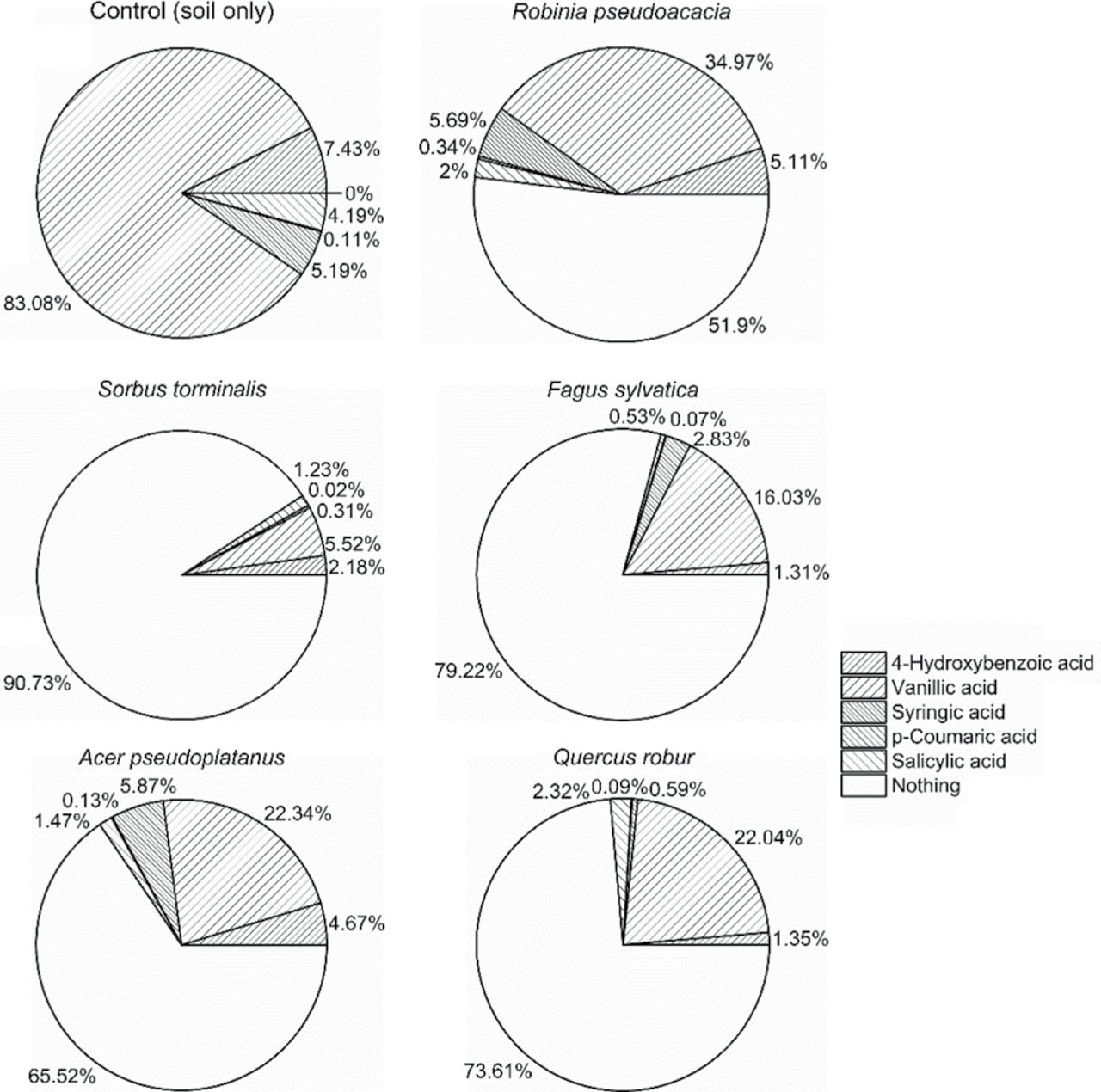
Figure 6.
Relative content of phenolic acids detected in the soil solution of each tree compared to their sum in the control (100%)
Overall, the total abundance of individual exudates depends on the specific interplay between the microorganisms and the plant; the microbial populations present in the soil are very important. If there is a high multiplication of root bacteria, there could be a significant increase in the exudation of several phenolic compounds that were not detected in our case. This phenomenon of microbial initiation has been observed, for example, in the rhizosphere of Cupressus after rapid bacterial inoculation (Oppenheimer-Shaanan et al. 2022). By exposing plants to abiotic stress (drought), the pattern of exudates can change fundamentally, as well as depending on the specific bacterial (pathogen) population. We did not change the representation of individual strains, and we assumed that the horticultural substrate used was homogeneous enough to ensure the same input conditions for all variants.
In this study, a targeted analysis of 32 compounds in soil solution samples was performed, but only six of them were present in detectable amounts. It was also surprising that all these phenolic substances were present in both, the control and in all variants with seedlings, as we expected the interspecific variation in the representation of individual exudates to be higher. There are several explanations for this phenomenon besides the targeted strategies of plants to control the activity of microorganisms. First, increased exudation is commonly associated with the acceleration of soil organic matter depletion (Zwetsloot et al. 2018). Once the organomineral complex has decomposed (over a longer period), the nutrient acceptability increases and energy-intensive exudation is no longer needed. Due to the fact that the substrate we used contained a high proportion of peat and stabilised humus, no significant loss of organic matter was observed in the containers over a period of 4 months. However, soil mineralisation clearly occurs more in the long term in temperate deciduous trees than that in conifers (Malý et al. 2014). Second, the already mentioned priming effect (Keiluweit et al. 2015) can promote microbial activity to such an extent that palatable low-molecular-weight organic matter is rapidly degraded via biotic pathways (Kumar et al. 2024). Furthermore, the loss of carbon from the soil depends very strongly on the climate (temperature and humidity conditions) which also a key role in the representation and quantity of individual exudates (de Vries et al. 2019).
Primarily, we expected that the exudates of the phenolic compounds found in the soil solution collected from Robinia pseudoacacia would differ both in the representation of the phenolic compounds and in their concentrations from the other soil solutions collected from the other tested tree species. Only half of the hypothesis was confirmed. Five of the same phenolic compounds were found in all soil solutions tested (starting with the control variant through all tree species). However, differences in concentrations were found between the different woody species, with the soil solution from Robinia differing significantly from the others, as evident from both the phenolic compound fingerprints (Fig. 6) and the statistical analysis.
Conclusions
The purpose of the study was to find out whether individual six-month-old seedlings of five different tree species (Robinia pseudoacacia, Quercus robur, Sorbus torminalis, Fagus sylvatica and Acer pseudoplatanus) would differ in the content of phenolic low-molecular-weight organic acids in the soil solution. Among the acids above the detection limit (vanillic, 4-benzoic, syringic, p-coumaric and salicylic), vanillic acid had the highest concentration of all. As for the treatment comparison, the highest content of vanillic, 4-hydroxybenzoic and salicylic acids was found in the control (soil substrate without seedlings). However, at least some portion of vanillic acid is related to the degradation of biomass (e.g., wood chips) contained in the soil substrate. The presence of these substances in the control variant therefore refers to microbial degradation processes. The highest content of p-coumaric acid was found in Robinia pseudoacacia.
Differences in the contents of phenolic acids in the tree seedling soil solutions after half a year of growth were expressed as fingerprints. Soil solutions from Sorbus torminalis, followed by Fagus sylvatica and Quercus robur, show their relatively low content in our list of tested trees. In the soil solution from Acer pseudoplatanus, more phenolic acids than those from the aforementioned trees were found. On the contrary, the soil solution sampled from Robinia pseudoacacia contained their highest content among the tested trees. This may correspond to the fact that it is a resistant species capable of surviving in soils poor in available nutrients. Additionally, it may contribute to the fact that Robinia pseudoacatia tends to reduce the species diversity of both the undergrowth and intermingled tree species.
Acknowledgement
This work was supported by the project no. QK22020045 (Potential of geographically non-native species in the forestry sector of the Czech Republic) and no. RO0423 funded by the Ministry of Agriculture of the Czech Republic, the project no. CZ.02.1.01/0.0/0.0/16_019/0000827 (Plants as a tool for sustainable global development) within the Operational Programme Research, Development and Education (OP RDE) managed by the Ministry of Education, Youth and Sports, and by the project no. MHMP 789027/2020 (Reproduction potential of black locust derived from its seed bank) funded by the Capital City of Prague.
Notes
Supporting Information
Table SI.1.
Tukey’s HSD test for 4-hydroxybenzoic acid among tree species indicating whether the values are statistically different at the significance level of α ≤ 0.05
| Group 1 | Group 2 | p-value | Reject | Group 1 | Group 2 | p-value | Reject |
|---|---|---|---|---|---|---|---|
| 1 | 2 | 3 | 4 | 5 | 6 | 7 | 8 |
| s4-hydroxybenzoic acid | p-coumaric acid | ||||||
| AP | FS | 0.0000 | true | AP | FS | 0.3396 | false |
| aP | QR | 0.0000 | true | AP | QR | 0.6966 | false |
| aP | RP | 0.7967 | false | AP | RP | 0.0002 | true |
| aP | ST | 0.0001 | true | AP | ST | 0.0331 | true |
| aP | control | 0.0000 | true | AP | control | 0.9609 | false |
| fS | QR | 1.0000 | false | FS | QR | 0.9827 | false |
| fS | RP | 0.0000 | true | FS | RP | 0.0000 | true |
| fS | ST | 0.1973 | false | FS | ST | 0.6792 | false |
| fS | control | 0.0000 | true | FS | control | 0.7731 | false |
| qR | RP | 0.0000 | true | QR | RP | 0.0000 | true |
| qR | ST | 0.2274 | false | QR | ST | 0.3260 | false |
| qR | control | 0.0000 | true | QR | control | 0.9845 | false |
| rP | ST | 0.0000 | true | RP | ST | 0.0000 | true |
| rP | control | 0.0003 | true | RP | control | 0.0001 | true |
| sT | control | 0.0000 | true | ST | control | 0.1253 | false |
| vanillic acid | Salicylic acid | ||||||
| AP | FS | 0.0749 | false | AP | FS | 0.1614 | false |
| aP | QR | 1.0000 | false | AP | QR | 0.2248 | false |
| aP | RP | 0.0005 | true | AP | RP | 0.6738 | false |
| aP | ST | 0.0000 | true | AP | ST | 0.9833 | false |
| aP | control | 0.0000 | true | AP | control | 0.0001 | true |
| fS | QR | 0.0951 | false | FS | QR | 0.0030 | true |
| fS | RP | 0.0000 | true | FS | RP | 0.0136 | true |
| fS | ST | 0.0024 | true | FS | ST | 0.4073 | false |
| fS | control | 0.0000 | true | FS | control | 0.0000 | true |
| qR | RP | 0.0004 | true | QR | RP | 0.9335 | false |
| qR | ST | 0.0000 | true | QR | ST | 0.0800 | false |
| qR | control | 0.0000 | true | QR | control | 0.0021 | true |
| rP | ST | 0.0000 | true | RP | ST | 0.3240 | false |
| rP | control | 0.0000 | true | RP | control | 0.0005 | true |
| sT | control | 0.0000 | true | ST | control | 0.0000 | true |
| Syringic acid | |||||||
| AP | FS | 0.0069 | true | ||||
| AP | QR | 0.0001 | true | ||||
| AP | RP | 0.9997 | false | ||||
| AP | ST | 0.0000 | true | ||||
| AP | control | 0.9031 | false | ||||
| FS | QR | 0.0509 | false | ||||
| FS | RP | 0.0110 | true | ||||
| FS | ST | 0.0251 | true | ||||
| FS | control | 0.0384 | true | ||||
| QR | RP | 0.0001 | true | ||||
| QR | ST | 0.9979 | false | ||||
| QR | control | 0.0002 | true | ||||
| RP | ST | 0.0000 | true | ||||
| RP | control | 0.9727 | false | ||||
| ST | control | 0.0001 | true | ||||