
1. INTRODUCTION
Residual stresses are self-equilibrating stresses retained in a material after the removal of external mechanical or thermal loads, and they strongly influence dimensional stability, fatigue life, and structural integrity in machined components (Zhang et al., 2022). In aerospace structures, drilling is one of the most common machining operations used for assembly and fastening, and the residual stresses generated around drilled holes can significantly affect crack initiation and fatigue performance. Aluminum alloy Al2024-T351 is widely used in such applications because of its high strength-to-weight ratio and good fatigue resistance; however, drilling of this alloy produces localized plastic deformation and frictional heating at the tool-workpiece interface, which lead to residual stress formation around the hole wall (Aamir et al., 2020; Liang et al., 2018). These stresses arise from the combined effects of chip formation, indentation beneath the chisel edge, and thermal expansion and contraction during machining (El-Axir et al., 2017; Paul et al., 2005).
Among the drilling parameters that govern these residual stresses, feed rate and rotational speed are generally considered the most influential. Increasing feed rate increases undeformed chip thickness, thrust force, and plastic deformation, which usually raises tensile residual stress near the hole edge (Matsumura et al., 2024; Qi et al., 2014; Savio & Jose, 2018). In contrast, increasing rotational speed can reduce tensile residual stress through thermal softening and improved material flow, although its effect is often weaker than that of feed rate (Rasti et al., 2018; Sujan Kumar & Deivanathan, 2021; Sun et al., 2016). Previous studies have often combined residual-stress analysis with force, temperature, or numerical simulation, but uncertainties in constitutive assumptions, contact conditions, and thermal boundary definitions can limit the accuracy of numerical predictions. Therefore, further work is needed to compare experimental measurements and numerical simulation directly for the isolated effects of rotational speed and feed rate on drilling-induced residual stress in aerospace aluminum alloys.
In this study, the effects of rotational speed and feed rate on drilling-induced residual stress in Al2024-T351 under dry drilling conditions are investigated experimentally and numerically. Residual hoop stresses near the hole entrance are measured using surface-mounted strain gauges and evaluated under plane-stress assumptions. In parallel, a coupled thermo-mechanical finite element model is developed in Abaqus/Explicit to simulate the drilling process and predict the residual stress response. The objective is to assess the ability of the numerical model to reproduce the experimentally observed trends and to clarify the relative influence of rotational speed and feed rate on residual stress formation.
2. EXPERIMENTAL METHODOLOGY
2.1. Material and Specimen Preparation
The material investigated in this study was aerospace-grade aluminum alloy Al2024-T351, which is widely used in structural aircraft applications due to its high strength-to-weight ratio and good fatigue resistance. The alloy was supplied in plate form and its chemical composition was verified using spectrometric analysis, confirming compliance with European Aluminum Association (EAA) specifications for Al2024-T351 as shown in Table 1. Rectangular specimens with dimensions 53 mm × 53 mm × 6 mm were sectioned from the plate using a band saw to minimize thermal and mechanical distortion. Prior to drilling, specimen surfaces were mechanically polished using progressively finer abrasive papers to remove surface irregularities and ensure uniform strain-gauge bonding conditions near the drilling location.
2.2. Drilling Setup and Tooling
Drilling experiments were conducted on a floor-standing drill press under dry cutting conditions, with no coolant or lubrication applied. The workpieces were rigidly clamped using a custom fixture to prevent movement during drilling and to ensure repeatable boundary conditions (Figure 1).
Dry drilling was adopted throughout to isolate the effects of rotational speed and feed rate; wet drilling was excluded accordingly. This avoided variability introduced by coolant application and maintained consistent thermal and contact boundary conditions for experiment-to-model comparison. The conclusions are therefore limited to dry-drilling conditions.
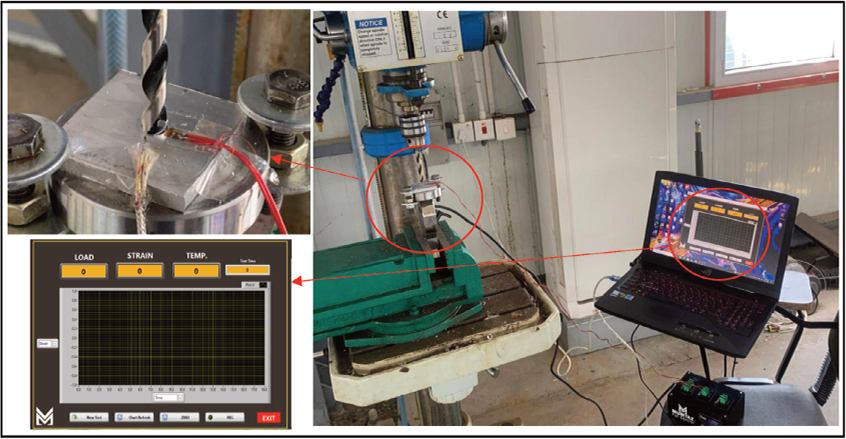
Figure 1.
The drilling machine setup.
A 135° split-point high-speed steel (HSS) twist drill with a nominal diameter of 8 mm was used for all experiments. Tool overhang was kept to a minimum to reduce vibration and tool deflection, and the drill was inspected before each test to ensure the absence of noticeable wear or edge damage.
2.3. Experimental Design and Drilling Parameters
The experimental program was designed to evaluate the effect of rotational speed and feed rate on drilling-induced residual stress. Rotational speed was varied at three levels: 375 rpm, 710 rpm, and 1250 rpm, while feed rate was varied at 0.12 mm/rev, 0.18 mm/rev, and 0.30 mm/rev, covering the stable operating range of the drill under dry conditions. Each drilling test was performed in a single continuous pass to avoid intermittent loading effects. The spindle speed and feed rate were verified prior to each run, and identical drilling conditions were maintained for all specimens to ensure consistent comparison of residual stress results.
2.4. Residual Stress Measurement Technique
Residual stresses were measured using surface-mounted metallic foil strain gauges positioned near the drilled hole on the entry face of each specimen. The strain gauge was installed at a fixed radial distance from the hole edge and aligned to capture radial strain induced by drilling, following standard strain gauge installation practices to minimize bonding and alignment errors. After drilling and thermal stabilization, the residual strain was recorded under unloaded conditions. Assuming a traction free surface and plane stress conditions at the specimen surface, the radial residual stress component was considered negligible (σr ≈ 0), allowing the hoop (circumferential) residual stress σθ to be calculated directly from the measured radial strain εᵣ as shown in Eqn. 1 (Ugural, 2003).
The residual hoop stress was determined using linear elastic relations based on the elastic modulus and Poisson’s ratio of Al2024-T351.
2.5. Data Acquisition and Repeatability
Strain signals were acquired using a calibrated data acquisition system synchronized across all measurements to ensure consistent sampling during and after drilling. Prior to each drilling test, baseline strain readings were recorded to eliminate offset and thermal drift effects. All drilling tests were performed under identical environmental conditions, and repeated measurements confirmed the repeatability of the residual stress trends observed in this study. The final drilled specimens are shown in Figure 2.
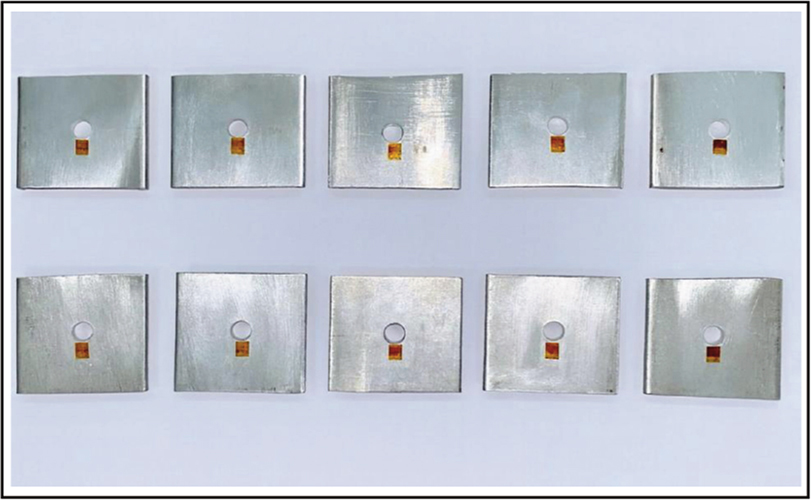
Figure 2.
Al2024-T351 specimens.
3. NUMERICAL MODELING AND SIMULATION
3.1. Model Description and Geometry
A three-dimensional finite element model of the drilling process was developed using Abaqus/Explicit to simulate residual stress generation during drilling of Al2024-T351. The workpiece geometry was modeled as a rectangular plate with dimensions matching the experimental specimens (53 × 53 × 6 mm) as shown in Figure 3, while the drill was modeled as a rigid body with a nominal diameter of 8 mm and a 135° split-point geometry as shown in Figure 4. Modeling the drill as rigid significantly reduced computational cost while maintaining sufficient accuracy for residual stress prediction.
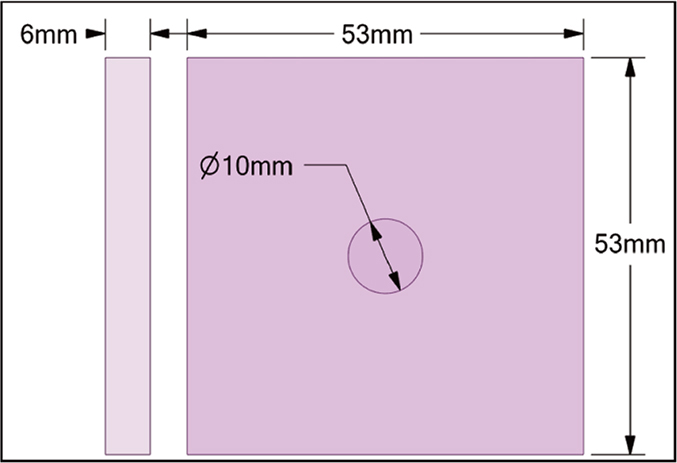
Figure 3.
Dimensions of Al2024-T351 plate.

Figure 4.
Geometry and dimensions of the drill bit used in this investigation.
3.2. Material Modeling
The Al2024-T351 workpiece was modeled as a thermo-elasto-plastic material with isotropic hardening. Its elastic response, plastic properties, and thermal properties were assigned according to the material data summarized in Table 2. Plastic deformation was described using the von Mises yield criterion together with isotropic hardening based on the adopted true stress-strain response of the alloy. To account for thermo-mechanical effects during drilling, temperature-dependent thermal properties were included in the model so that the influence of heat generation on material response and residual stress development could be represented. In addition, the Johnson-Cook damage parameters used in the Abaqus material definition are listed separately in Table 3.
Table 2.
Material Properties Used for Defining the Al2024-T351 Workpiece in the FE Model.
| Property | Value |
|---|---|
| Elastic modulus E | 73 GPa |
| Poisson’s ratio ν | 0.33 |
| Yield strength σy | 369 MPa |
| Density ρ | 2770 kg/m3 |
| Thermal conductivity k | 121W/m·K |
| Specific heat capacity cp | 875 J/kg·K |
| Thermal expansion coefficient α | 24.7 × 10⁻⁶ K−1 |
[i] Source: Aslam et al. (2020)
Table 3.
Johnson-Cook Damage Parameters Used in the Abaqus Material Definition.
| Parameter | Value |
|---|---|
| d1 | 0.31 |
| d2 | 0.045 |
| d3 | −1.7 |
| d4 | 0.005 |
| d5 | 0 |
| Melting temperature k | 775 |
| Transition temperature | 0 |
| Reference strain rate | 1 |
[i] Source: Aslam et al. (2020)
3.3. Modeling Assumptions Regarding Strain-Rate Effects
A strain-rate-sensitive constitutive law was not adopted because the objective was to characterize the relative influence of rotational speed and feed rate on the final residual hoop stress, rather than to resolve the full high-rate material response during chip formation. The adopted thermo-elasto-plastic formulation provided stable numerical performance and captured the experimentally observed trends with acceptable agreement. Nevertheless, the absence of explicit strain-rate dependence may contribute to the discrepancy between numerical and experimental results, particularly at higher feed rates where deformation rates and localized plasticity become more severe.
3.4. Boundary Conditions and Loading
The bottom surface of the workpiece was fully constrained in all translational degrees of freedom to replicate the experimental clamping conditions, while lateral surfaces were left unconstrained. The drill was prescribed rotational velocities of 375, 710, and 1250 rpm and axial feeds of 0.12, 0.18, and 0.30 mm/rev, matching the experimental conditions. The initial temperature of the workpiece and tool was set to ambient temperature. Drilling was simulated under dry cutting conditions, consistent with the experimental setup.
3.5. Contact and Thermal Modeling
Surface-to-surface penalty contact was defined between the drill and the workpiece with a constant Coulomb friction coefficient of 0.30. Thermo-mechanical coupling was included so that friction and plastic deformation contributed to heat generation, while convective heat transfer was applied on the exposed workpiece surfaces. Chip formation was not explicitly modeled because element deletion/material separation was disabled to avoid numerical instability and excessive computational cost. This simplification was considered acceptable because the model was developed to predict the final near-hole residual stress field rather than chip morphology.
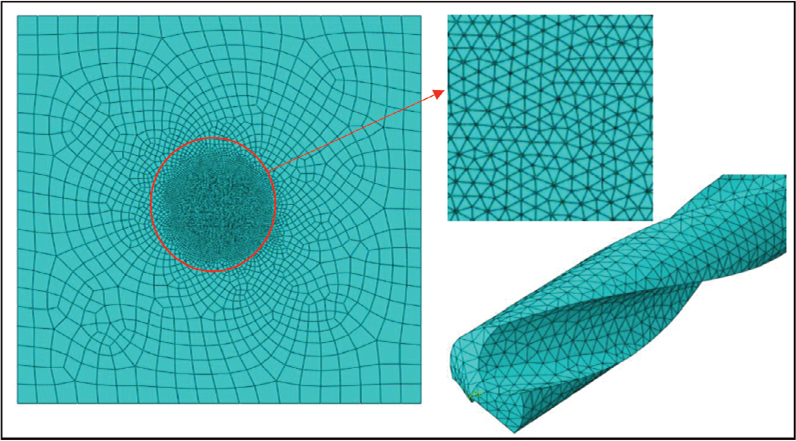
Figure 5.
Mesh generation in drill bit and workpiece.
3.6. Meshing and Solution Strategy
The workpiece was meshed using thermo-mechanically coupled three-dimensional solid elements, with strong local refinement in the drilling zone to capture the steep stress and temperature gradients near the hole wall. The plate was discretized mainly with C3D8T elements, while C3D6T elements were used in the central drilling region to improve mesh conformity. The rigid drill surface was modeled using R3D3 elements. A graded mesh strategy was adopted, with the finest mesh concentrated near the tool-workpiece contact and the hole entrance, and a coarser mesh used away from this region to reduce computational cost. To assess mesh sensitivity in the hole-adjacent region, four progressively refined meshes were examined, corresponding to 100, 120, 150, and 170 elements in the refined region. The predicted residual hoop stress showed only minor variation beyond this level, confirming mesh stability; the 170-element configuration was therefore adopted for all simulations. The complete model contained about 119,427 nodes and 161,340 workpiece elements, as shown in Figure 5.
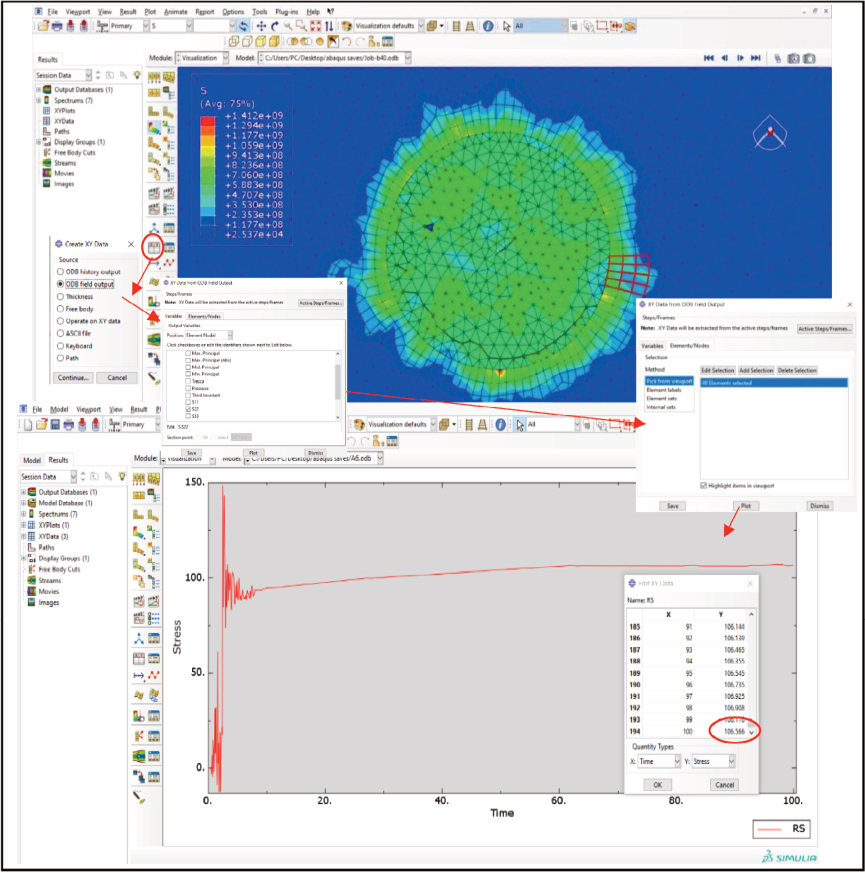
Figure 6.
Residual stress extraction procedure showing S22 history at gauge-representative elements (Case: Group A, 375 rpm, 0.12 mm/rev).
3.7. Residual Stress Extraction and Validation Approach
Residual stresses were extracted from the finite element model after the two analysis steps: the drilling step, which simulated cutting until full penetration, and the subsequent relaxation step, which allowed the thermo-mechanical response to stabilize after tool withdrawal. The residual hoop stress was obtained from the S22 component, which corresponds to the circumferential direction and matches the strain-gauge orientation. To ensure direct comparison with the experiment, a gauge-representative region was defined on the entry surface around the hole at the same radial location as the experimental strain gauge, with a footprint matching the gauge measurement area. The S22 values of the selected elements were then monitored as a stress-time history during the relaxation step, as shown in Figure 6. Once the kinetic energy had decayed and the response became stable, the final constant value was taken as the numerical residual hoop stress. The numerical results were compared with experimental measurements in terms of trend consistency and percentage deviation.
4. RESULTS AND DISCUSSION
4.1. Effect of Rotational Speed on Residual Stress
Figure 7 compares experimentally measured and numerically predicted residual hoop stresses as a function of rotational speed for Al2024-T351 under dry drilling conditions. Both results show a consistent decreasing trend in tensile residual stress with increasing rotational speed. Experimentally, increasing rotational speed from 375 rpm to 1250 rpm at a feed rate of 0.12 mm/rev reduced residual stress from approximately 95.7 MPa to 76.9 MPa, corresponding to a reduction of about 20%. The Abaqus model predicts a similar trend, with residual stress decreasing from approximately 109.2 MPa to 61.3 MPa over the same speed range. The reduction in residual stress with increasing rotational speed in both approaches is attributed to enhanced thermal softening in the cutting zone, which reduces material flow stress and facilitates stress redistribution during drilling. Quantitatively, the numerical model overpredicts residual stress at lower speeds and underpredicts it at higher speeds. These differences are most likely due to simplified assumptions in the numerical model, including constant friction conditions and idealized thermal boundary definitions. Nevertheless, the numerical results successfully capture the experimental sensitivity of residual stress to rotational speed.
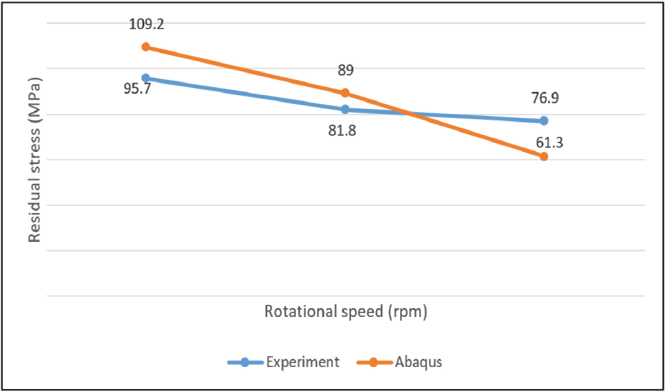
Figure 7.
Comparison of experimental and Abaqus-predicted residual stress at different spindle speeds for Group A.
4.2. Effect of Feed Rate on Residual Stress
Figure 8 presents the variation of residual hoop stress with feed rate obtained experimentally and numerically at a constant rotational speed of 375 rpm. In both cases, residual stress increases monotonically with increasing feed rate. Experimentally, increasing feed rate from 0.12 mm/rev to 0.30 mm/rev increased tensile residual stress from approximately 95.7 MPa to 121.3 MPa, representing an increase of nearly 27%. The Abaqus model predicts a steeper increase, with residual stress rising from approximately 109.2 MPa to 196.7 MPa. The strong feed-rate sensitivity observed in both results reflects the dominant mechanical contribution of feed rate to residual stress formation. Higher feed rates increase undeformed chip thickness and plastic strain accumulation beneath the cutting lips and chisel edge. The larger magnitude predicted by the numerical model is attributed to the absence of stress-relief mechanisms such as microstructural recovery and localized material relaxation, which occur in real machining but are not explicitly modeled. Despite this, the numerical model correctly identifies feed rate as the most influential parameter governing residual stress.
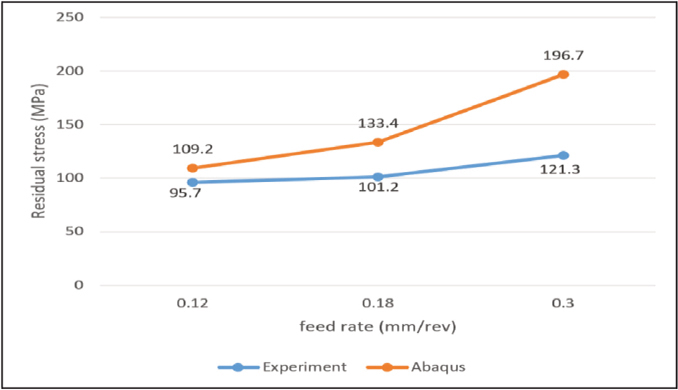
Figure 8.
Comparison of experimental and Abaqus-predicted residual stress at different feed rates for Group A.
4.3. Experimental–Numerical Correlation
A direct comparison of experimental and numerical results demonstrates consistent trend agreement for both rotational speed and feed rate. Quantitatively, the numerical predictions generally exceed experimental values by approximately 10–40%, particularly at higher feed rates. These discrepancies arise from idealized modeling assumptions, including rigid tool representation, constant friction coefficient, and simplified thermal conditions. Nevertheless, the consistent trend agreement and correct relative sensitivity to drilling parameters confirm that the developed numerical model provides a reliable representation of residual stress evolution during drilling and is suitable for comparative analysis and process optimization.
5. CONCLUSIONS
This study presented a combined experimental and numerical investigation of drilling-induced residual stresses in Al2024-T351 under dry cutting conditions, with particular focus on the effects of rotational speed and feed rate. Based on the results obtained, the following conclusions can be drawn:
Drilling of Al2024-T351 generates tensile residual hoop stresses near the hole entrance, with experimentally measured values in the range of approximately 80–120 MPa, depending on the applied drilling parameters.
Increasing rotational speed from 375 rpm to 1250 rpm resulted in a reduction of tensile residual stress by approximately 20% in the experimental measurements, indicating that higher speeds promote stress reduction through thermal softening and improved material flow. The numerical model captured this decreasing trend with rotational speed.
Increasing feed rate from 0.12 mm/rev to 0.30 mm/rev led to a significant increase in tensile residual stress of nearly 27% experimentally. Both experimental and numerical results confirmed that feed rate is the dominant parameter governing residual stress formation during drilling.
The finite element model developed in Abaqus reproduced the experimental trends for both rotational speed and feed rate, although it generally overpredicted residual stress magnitude, particularly at higher feed rates, due to simplified modeling assumptions.
Within the investigated dry-drilling conditions and tested parameter range, lower feed rates and higher rotational speeds were associated with lower tensile residual hoop stresses.