
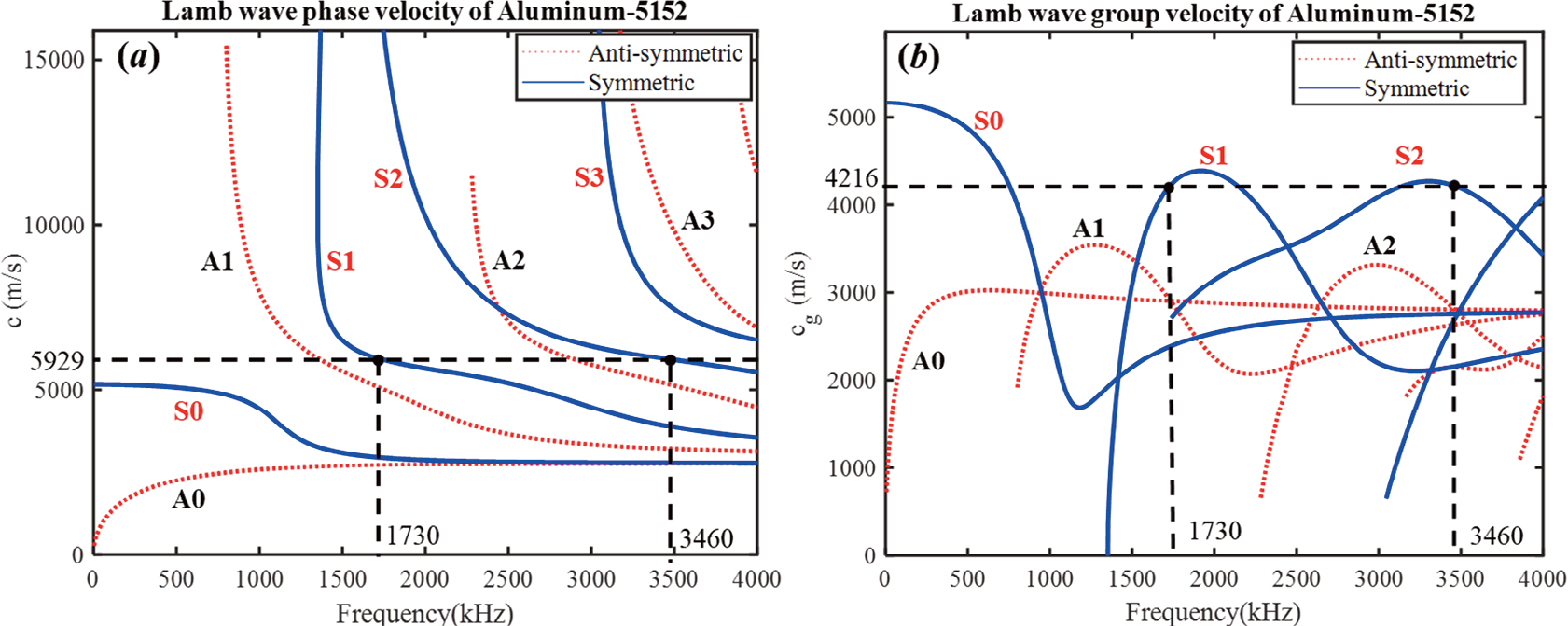
Figure 1.
Dispersion curves of (a) phase velocity and (b) group velocity for Aluminum-5152 with 2 mm thickness.
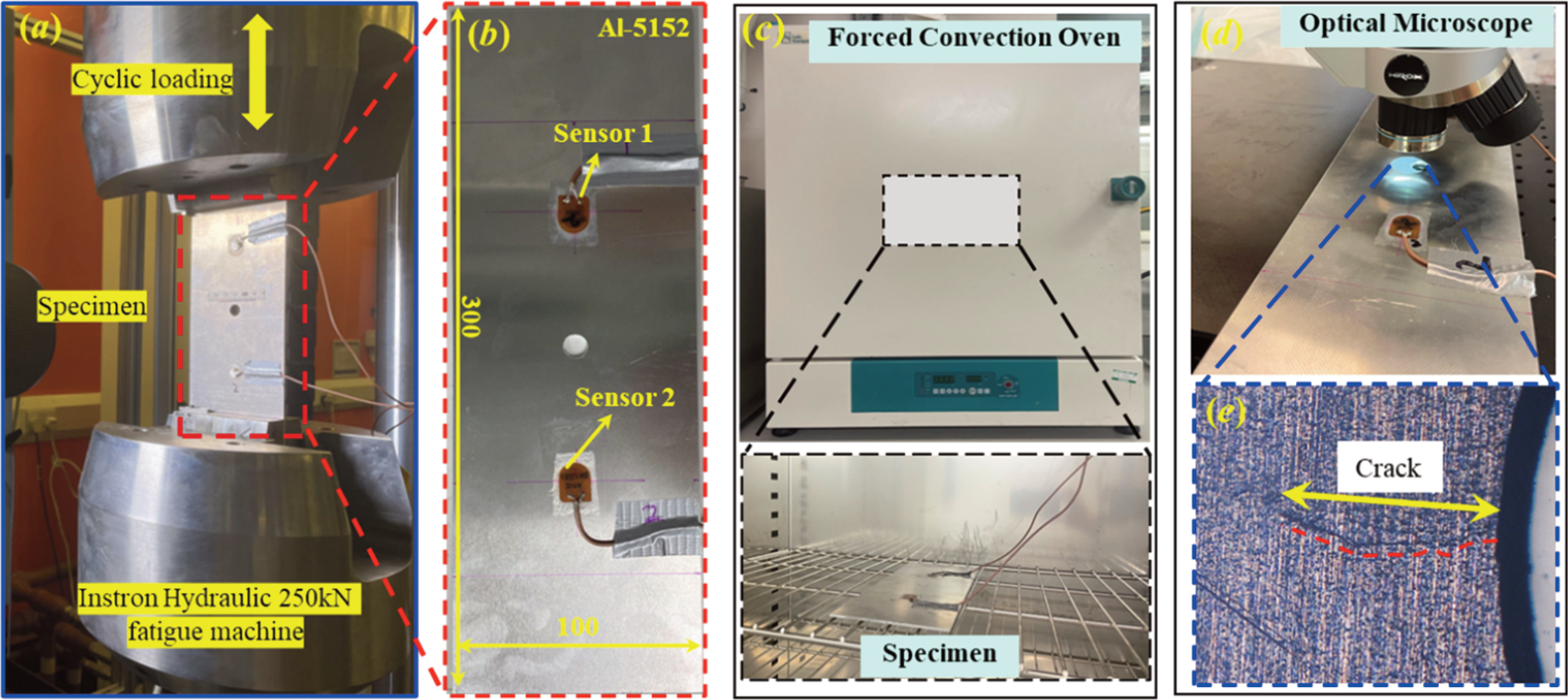
Figure 2.
The experiment setup and facilities, (a) the fatigue machine to produce crack (b) the cracked Aluminium plate (c) The forced convection oven to control temperature (d) the optical microscope for the crack inspection.
Table 1.
Fatigue test details on different specimens under different temperatures.
| Stage of fatigue test | T1 | T2 | T3 | Working temperature |
|---|---|---|---|---|
| 1 | 0k | 0k | 0k | 20-40° |
| 2 | 100k | 100k | 100k | |
| 3 | 200k | 200k | 200k | |
| 4 | 300k | 300k | 300k | |
| 5 | 320k | 350k | 400k | |
| 6 | 340k | 370k | 420k | |
| 7 | 360k | 440k |
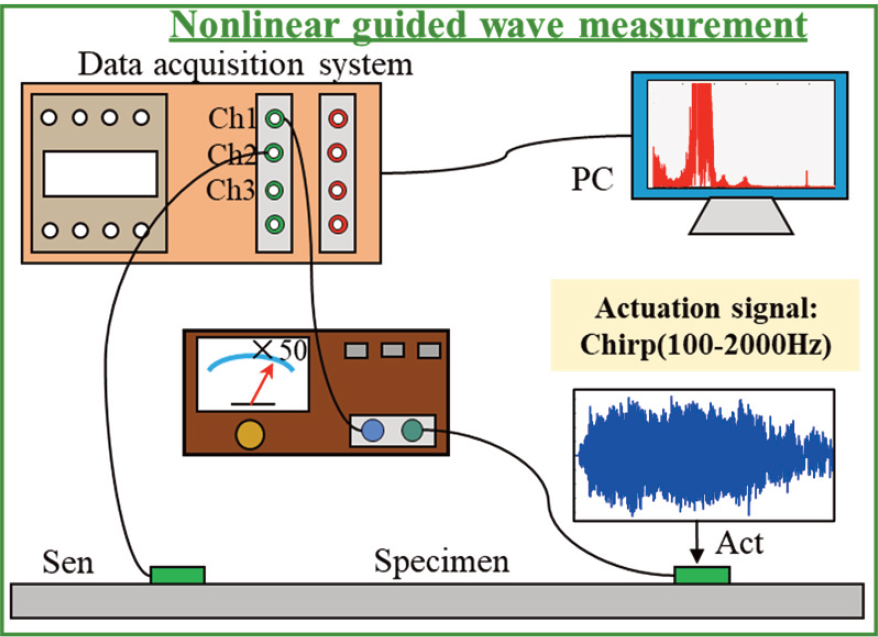
Figure 3.
The signal acquisition system of the nonlinear guided wave-based method.
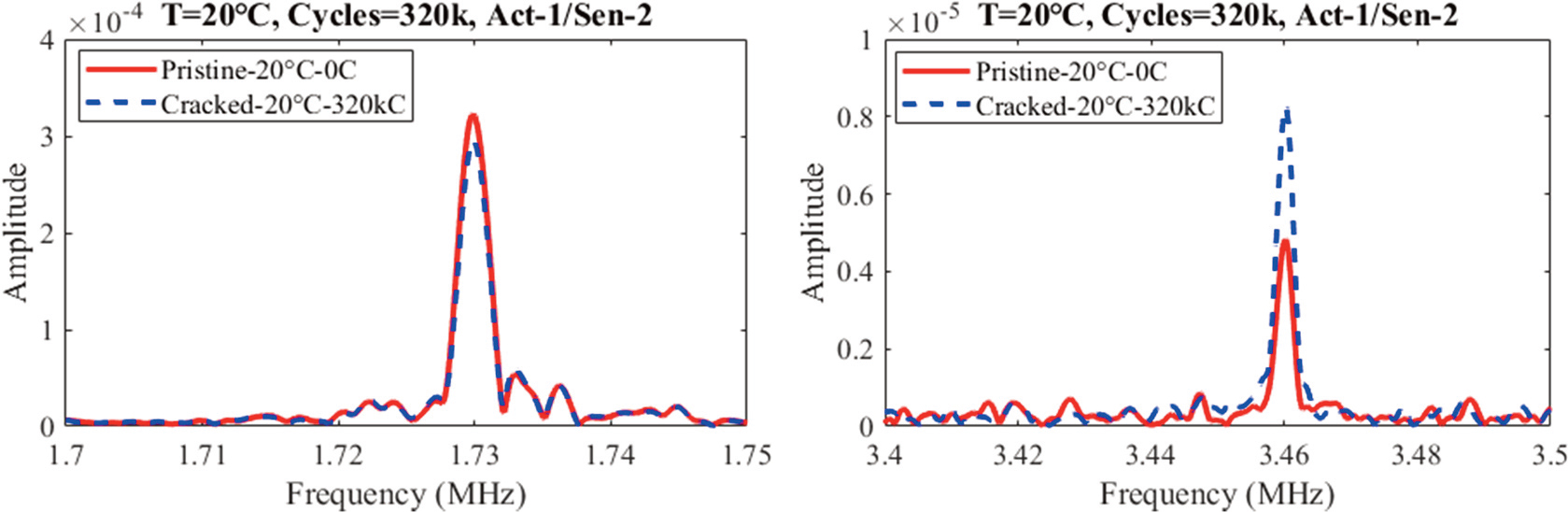
Figure 4.
The amplitude of the (d) fundamental frequency and (e) second harmonic before the fatigue test and after 320k cycles.
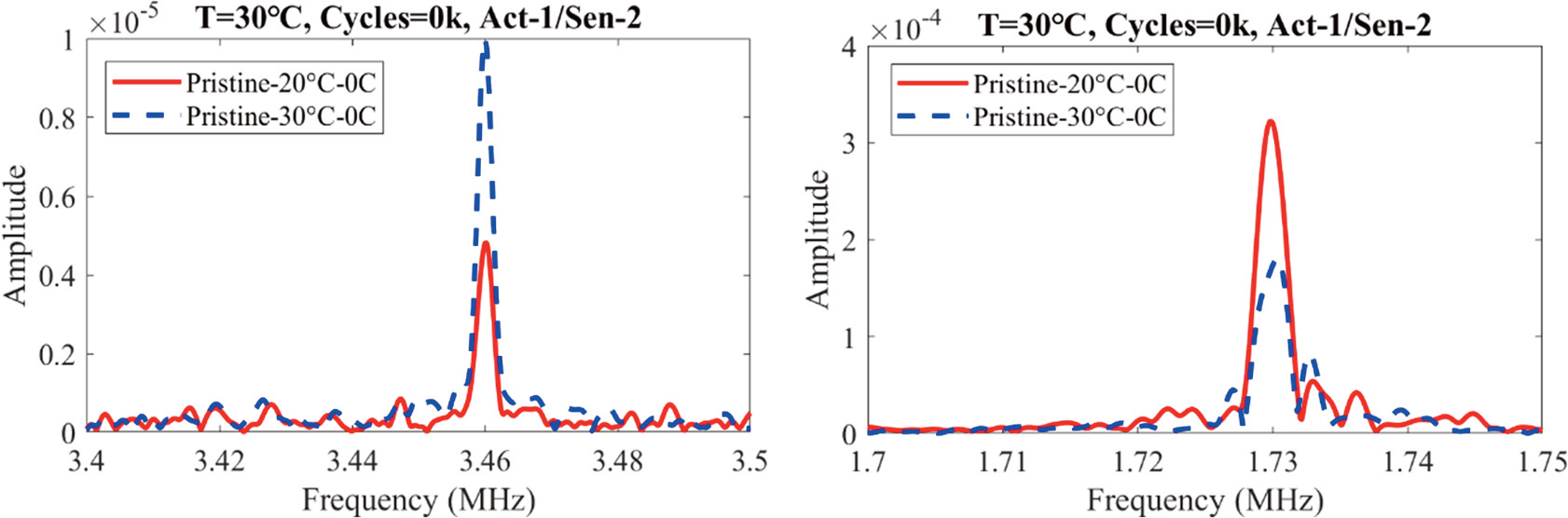
Figure 5.
The crack effect on the fundamental and second harmonic frequency.
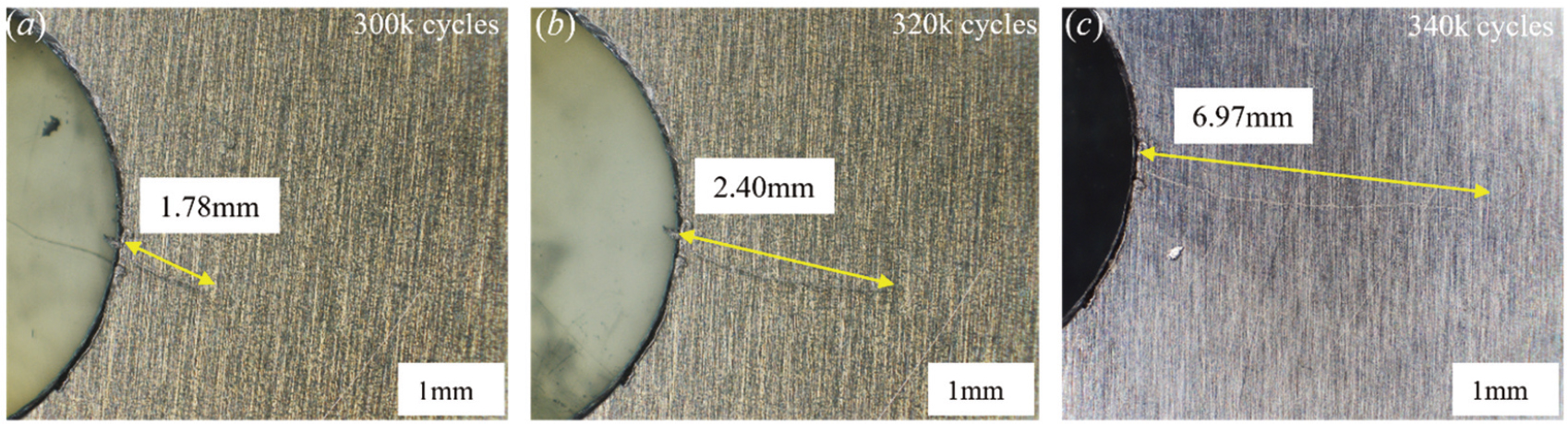
Figure 6.
Optical microscope images of fatigue crack ar at: (a) 300k cycles, (b) 320k cycles, (c) 340k cycles.
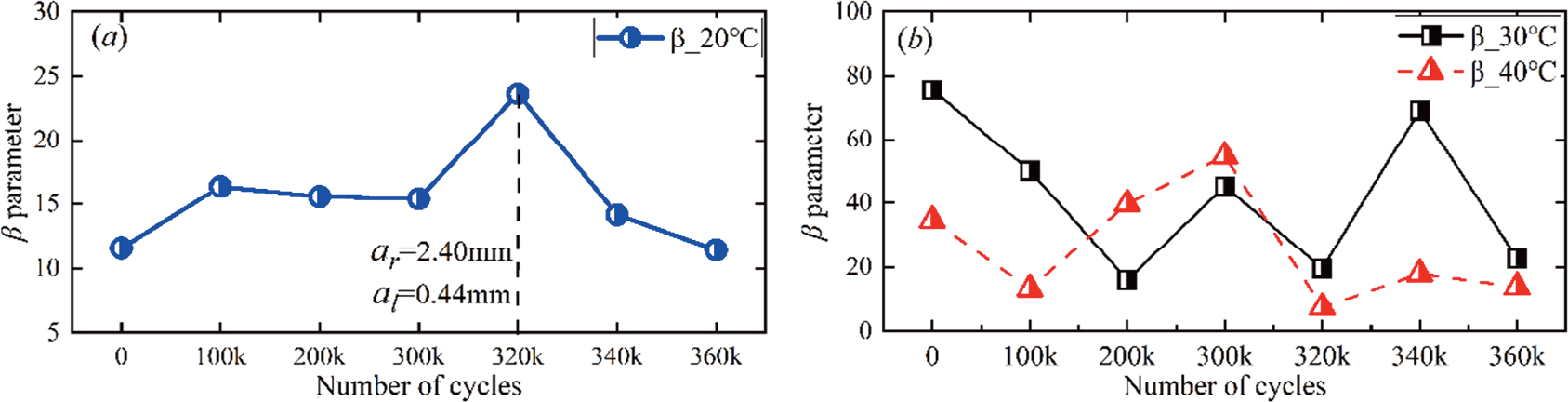
Figure 7.
(a) The second harmonic parameters versus fatigue cycles under 20° environments. (b) The second harmonic parameters versus fatigue cycles under 30° and 40° environments.
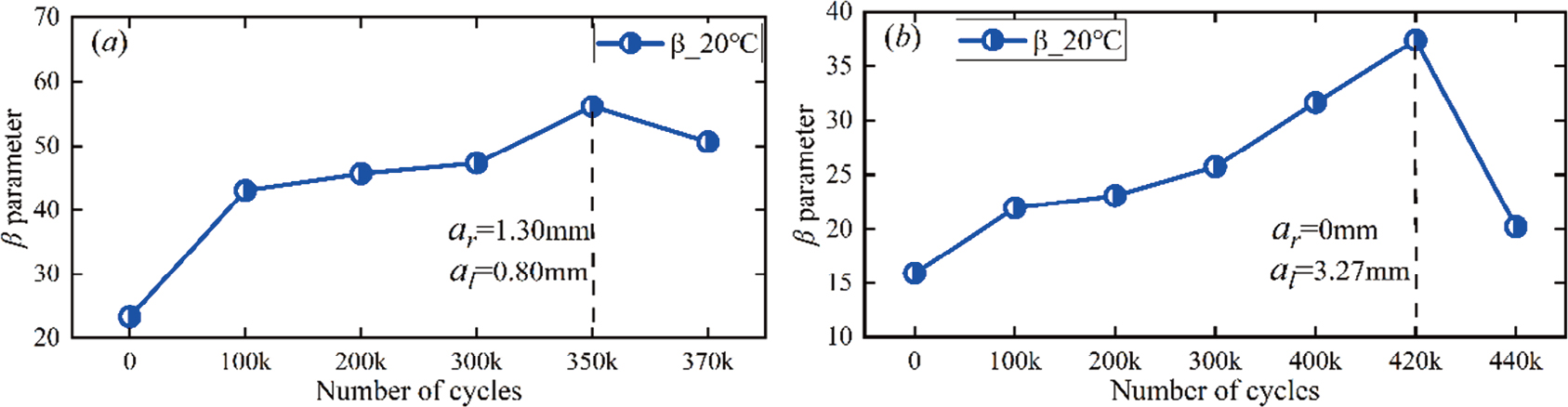
Figure 8.
(a) The second harmonic parameters versus fatigue cycles were obtained by specimens (a) T2, and (b)T3.
Table 2.
Crack length of different fatigue stage on specimens T1, T2, and T3.
| Specimens | T1(mm) | T2(mm) | T3(mm) | ||||||
|---|---|---|---|---|---|---|---|---|---|
| Num of stage | cycles | al | ar | cycles | al | ar | cycles | al | ar |
| 1 | 0k | 0 | 0 | 0k | 0 | 0 | 0k | 0 | 0 |
| 2 | 100k | 0 | 0 | 100k | 0 | 0 | 100k | 0 | 0 |
| 3 | 200k | 0 | 0 | 200k | 0 | 0 | 200k | 0 | 0 |
| 4 | 300k | 0.42 | 1.78 | 300k | 0 | 0 | 300k | 0 | 0 |
| 5 | 320k | 0.44 | 2.4 | 350k | 0.8 | 1.3 | 400k | 0.6 | 0 |
| 6 | 340k | 2.11 | 6.97 | 370k | 1.93 | 3.90 | 420k | 3.27 | 0 |
| 7 | 360k | 4.05 | 11.4 | 440k | 6.71 | 1.4 | |||