
Various efforts have been discussed to revise teaching and learning practices in order to enhance graduation rates for undergraduate students in STEM fields and reduce their rates of major attrition in the United States (Graham et al., 2013). Ives et al. (2024) reviewed high-impact practice as implemented in 38 undergraduate programs funded by the National Science Foundation and focusing on improving Science, Technology, Engineering, and Mathematics (STEM) education in the United States. Many programs provided opportunities for undergraduate research and internships as part of high-impact practices to enhance STEM undergraduate students’ hands-on skills and connections to their future career goals. To effectively implement similar high-impact practices based on the diverse needs of students, faculty and staff members may need to have more agentic roles in making changes to their undergraduate programs.
Researchers are often interested in understanding how individuals or groups can contribute to organizational change initiatives. Previously, top-down management and leadership of higher-level administrators were emphasized in organizational change, but greater importance has been placed on supporting the agentic roles of group members in the process (Conger & Pearce, 2012). In higher education, change-making can also occur from the bottom up, such as in small departmental working groups (Reinholz & Apkarian, 2018). Bottom-up approaches that involve a small number of people can create an environment where faculty and staff have the potential to play primary roles in a discussion network for making curriculum or instructional changes to support students’ academic engagement. In higher education, more emphasis has been put on the agentic roles of department members to make changes to undergraduate programs because individuals can discuss problems and solutions unique to their department context and engage in various roles or connect other department members to each other (Roy et al., 2007).
Change agents’ efforts are crucial in facilitating institutional changes from initiation to execution. According to the definitions by Heyden et al. (2017), “change initiation entails the ‘spark’ for change through activities such as identifying, articulating, and outlining an opportunity for change”, while “change execution is about realizing change plans through activities such as day-to-day adjustments, rolling out initiatives, aligning activities with stated objectives, translating overarching goals into periodic milestones” (p. 962). In understanding the change process from change initiation to change execution for improving undergraduate education, less focus has been placed on studying how a small group of department members could show individual differences in their development as change agents in a broader within-department discussion network in which they are embedded. Furthermore, individuals’ reflections on their involvement in change efforts have rarely been examined in relation to their patterns of connections within the discussion network (e.g., Quardokus & Henderson, 2015; Swindell et al., 2024).
1. Departmental action team
Departmental Action Team (DAT) model, which has been applied in the U.S. higher education context, suggests setting up a small group of department members, which includes faculty, staff, and students, and facilitating their work process to support agentic roles of DAT members in making changes to their programs to support academic success of undergraduate students (Ngai et al., 2020a). In the typical composition of a DAT, diverse groups of department members are included because “departments are composed of people with individual goals, agency, needs, and identities” (Reinholz & Apkarian, 2018, p. 4). However, within departments, hierarchies and power relationships exist between members, often defined by the culture of tenure and promotion systems, which can impact group dynamics. The DAT model specifically aims to eliminate hierarchical structures within the working group dynamics (Reinholz et al., 2017).
To make changes in undergraduate education, a DAT uses a facilitated team-based model to identify challenges and set goals, convene monthly meetings, and support collaboration with departmental and institutional stakeholders (Reinholz et al., 2017). In the DAT model, a research team facilitates the DAT group process by providing the DAT with expertise in institutional change and education research, coordinating logistics, connecting the team with campus resources, collecting institutional data to inform DAT decision-making, and providing outside perspectives (Ngai et al., 2020a). Facilitators also support the DATs by providing education on change processes, helping DAT members to communicate effectively, distributing tasks, and helping make decisions. The ultimate goals of facilitating the DAT are to support the members in creating sustainable improvements to education in their department and to develop their capacity as change agents (Reinholz et al., 2017). Given that DAT members are an important initiating point in the change process, understanding their characteristics in a broader discussion network among department members across different roles pertaining to undergraduate education is essential for understanding each change agent more closely.
2. Within-department discussion network
In the context of applying the DAT model, Ngai et al. (2020b) suggested the necessity of measuring discussion networks between department members because it can help researchers “understand the relative status of DAT participants as influential in the department, which is related to their ability to act as change agents who influence undergraduate education” (p. 4). Ngai et al. (2020b) visualized an example of department members’ discussion network and described who seemed to be less central. Nevertheless, for researchers who want to utilize the discussion network questionnaire for their studies, there has been a need to empirically elaborate on how to analyze this kind of discussion network data with multiple social network indices in addition to visualization.
The group dynamics within DATs and their interactions with department members can be better understood by examining the network of discussions about curricular and instructional improvement for student success because they show where change agents are located in the structure (Kezar, 2014). Despite having a similar job title, DAT members may have different characteristics in the structure of a broader within-department discussion network. In an organization or a workgroup setting, identifying central members is helpful to strategize “how to reallocate informational domains or decision-making rights so that the group as a whole is more effective” along with considering other members on the periphery for “crafting ways to engage these people” (Cross et al., 2002, p. 27).
Furthermore, an individual’s position within a network is crucial for understanding their social capital. If an individual is connected to people in different groups who are not directly connected to each other, they gain more value from the structure, because they can “see early, see more broadly, and translate information across groups” (Burt, 2004, p. 354). Given that the disposition to making changes in undergraduate education needs to expand within their department, some DAT members may contribute to it by mediating between two other department members who are not directly connected. The basic concept of broker refers to “an actor who facilitates transactions or resource flows” (Gould & Fernandez, 1989, p. 91), and they can be favorable in terms of breadth (“bridge relations across groups give brokers access to more diverse information”), timing (“are early to learn about activities in other groups are often the person introducing to one group information from another”), and arbitrage (“have an advantage in translating opinion and behavior familiar from one group into the dialect of a target group”) (Burt & Soda, 2021, p. 1702).
As DAT members, some may bring their historical characteristics, but others may be developed through their experiences. Tasselli et al. (2015) highlighted that individuals and networks are coevolving rather than unidirectional. In this view, overall patterns in social networks can shape individual characteristics, and variations in individual characteristics can also influence the network structure through altering network positions. However, there has been a lack of empirical work on the development and impact of the DAT model on the broader network of department members over time. Examining the structure of departmental discussion networks across multiple years, along with attribute data such as job titles or DAT involvement, can help identify who has the potential to be more engaged in education change initiatives among faculty and staff members and utilize their structural roles in facilitating DAT.
Within-department discussion networks can be more meaningfully understood with DAT members’ reflections on their individual learning and team efforts. For instance, Reinholz et al. (2019b) interviewed five faculty participants (four instructors) in a DAT that ran for two years with an outcome of making new positions in the department, and the participants described the DAT as an opportunity to continue their ongoing efforts for student success. However, less is known about whether each DAT member might have similar or different development in their structural roles in connecting department members during the period or how their qualitative descriptions could provide more nuances to understand DAT experiences by being combined with social network data in making changes for undergraduate programs.
3. Current study
This study focuses on one DAT within an engineering department at a large public urban university in the U.S beginning in 2023. The composition of the DAT included two instructional (non-tenure-track) faculty, one tenure-track faculty, a departmental staff member, and two undergraduate students majoring in that department. The DAT was supported by a facilitator, a principal investigator, and two graduate assistants who took minutes and wrote field notes during each DAT meeting for approximately two semesters as part of the project. Early in the DAT meetings, the team focused on various sources of data and information regarding factors that influence academic progress and student experiences in the program. As a result of this initial self-study of the department, the DAT focused on designing a lab space for students to work on projects, such as team competitions or senior design, to support their skill development, and developing student community-building events. These events include workshops and seminars on topics such as career pathways within the discipline. However, the project faced challenges finding the necessary space with the departure of a DAT leader from the university. Overall, the group lost momentum, which led to a project pause and unclear path forward.
The purpose of this study was to examine the structural roles of DAT members within their broader departmental discussion network and connect their post-DAT interview data using one empirical case of a STEM department. The following research questions guided our investigation:
RQ1: To what extent are DAT members directly connected with others within the departmental discussion network to make changes in undergraduate programs?
RQ2: What types of brokerage roles may DAT members have within the departmental discussion network?
RQ3: How are the structural roles of DAT members in the discussion network related to their individual learning, the culture of the DAT, and broader relationships with the department?
4. Method
4.1. Participants
This study was a part of a larger project on faculty development and change initiatives in Science, Technology, Engineering, and Mathematics (STEM) departments at a large, public, urban research university in the midwestern United States. We focused on one engineering department case that was facilitated in a year-long project of the Departmental Action Team (DAT). While the DAT had six members (two instructional faculty members, one staff member, one tenure-system faculty member, and two undergraduate students), we used a department-wide survey to understand where DAT members may be positioned in the within-department discussion network for making changes in undergraduate programs over time.
5. Procedures and measures
The research team sent an email to all members of the department involved in instruction, including DAT members, at three time points asking them to complete a survey: prior to the start of the DAT (Year 1), at the end of team facilitation (Year 2), and one year after the end of facilitation (Year 3). We received a broad list of faculty, staff, and graduate assistants related to the department’s undergraduate education programs from university human resources each year, and their voluntary survey participation might be mostly driven by familiarity with the Departmental Action Team project, with a 20% average response rate. Secondary use of de-identified data from the project was approved by the university’s Institutional Review Board.
Survey questions came from the Departmental Education and Leadership Transformation Assessment (DELTA; Ngai et al., 2020b), which was initially applied in conjunction with DAT implementation. To measure the within-department discussion network, participants were asked to list the names of those with whom they discussed making changes to undergraduate education (i.e., “I discuss making changes about undergraduate education in the department with the following department members [list full names]”). No restriction was imposed on the number of names. Given that DAT’s work on identifying barriers or facilitators to undergraduate student success, Ngai et al. (2020b) chose to use the broad term of “undergraduate education.” Thus, the DELTA begins with questions about instructor collegiality and the department chair’s support for teaching in undergraduate programs. Although these two factors were not the focus of this study, they likely prompted respondents to frame the within-department discussion network responses in terms of undergraduate teaching context.
The four DAT members (Instructional Faculty 1 and 2, Staff 1, Tenure Faculty 1) also participated in a post-DAT semi-structured interview conducted about three months after the end of one-year facilitation. Individual interviews between a research team member and a DAT member were conducted on Zoom. The purpose of post-DAT interviews with volunteering DAT members was to help understand where the DAT process is and where it would like to be regarding change initiatives. Along with the information on their structural roles based on within-department discussion network data, we focused on connecting how the four DAT members responded to questions about individual learning, DAT culture, and their relationship with their department. The following interview questions were selected for analysis:
Did you learn things from the DAT experience that increased your ability to create effective change? What did you learn?
What was the culture like on the DAT? Did it have any unique features, compared to other groups you have worked within?
Did the DAT group that continued maintain the culture that it had developed? What was maintained?
Do you think the DAT was able to make any changes in the department?
Do you think department members value the work of the DAT?
How do they show they value it?
Do you think this value is widespread, or just in pockets of the department? Which pockets?
6. Analytical approach
To answer the first and second research questions, social network analysis was conducted on data within-department discussion networks collected at the three time points using Ucinet (Borgatti et al., 2002). The discussion data were collected in nodelist formats, consisting of survey respondents (ego) listing other department members (alters). Ego is “a term used to refer to whichever node is currently under discussion,” and alters refers to “any nodes connected to ego” (Borgatti et al., 2024, p. 312). When specific alters were not named (e.g., “no one” and “a lot of faculty”) but the ego’s role was related to undergraduate education, the ego was retained, while their alter responses were treated as missing in the nodelists. A post hoc comparison of the analytical approach revealed slight changes in some values (e.g., normalized degree centrality scores increased due to smaller network sizes) when removing some nodes without ties and saying “no one”, but the overall interpretation did not change. Although nonrespondents to the discussion network question were not logged as egos, they were included in the analysis if others named them. Some egos without ties and having roles unrelated to teaching (e.g., graduate research assistant and research faculty) were excluded.
We then transformed the cleaned nodelists into asymmetric matrices, keeping the direction of ties based on reported nodes to infer the mechanisms by which DAT members might either report more about their outreach or become more prominent to others across time. Furthermore, analyzing directionality allowed for a close application of the original brokerage concepts. In this study, we focused on four faculty and staff DAT members because the two undergraduate DAT members were not identified in the broader department discussion network.
The first research question focuses on understanding how DAT members are directly linked with others in the within-department discussion network to make changes in undergraduate programs. To answer this question, we examined DAT members’ degree centrality (the number of ties a node has), distinguishing between outgoing (out-degree) and incoming (in-degree) ties for asymmetric data (Borgatti et al., 2024). Because of different network sizes over time, we reported normalized degree centrality scores. We also examined the index of qualitative variation (IQV) as “a description of the dispersion of the population over a number of nominal categories” (Agresti & Agresti, 1978, p. 204) to understand the levels of diverse alter composition regarding department roles, which ranges from 0 to 1. In calculating DAT members’ IQV, we defined their ego network in Ucinet to include both outgoing and incoming ties.
The second research question focuses on the brokerage roles of DAT members. Brokerage is “a relation in which one actor mediates the flow of resources or information between two other actors who are not directly linked” (Fernandez & Gould, 1994, p. 1457). Brokers may assume five different roles: (1) Coordinators mediate the flow between two nodes that belong to the same group (a → a → a), (2) Gatekeepers mediate the flow between one node that belongs to a different group and another node that belongs to the same group as the gatekeeper (b → a → a), (3) Representatives mediate the flow between one node from the same group and another node that belongs to a different group (a → a → b), (4) Consultants mediate the flow between two nodes from a different group (b → a → b), and (5) Liaisons mediate two nodes with all three nodes belonging to different groups (b → a → c) (Borgatti et al., 2002; Gould & Fernandez, 1989). Relative brokerage scores are calculated by dividing observed brokerage values by randomization expected values given group sizes (Borgatti et al., 2002).
To answer the third research question, the interview responses of four DAT members were initially analyzed using a general inductive approach aiming to find “themes or categories most relevant to research objectives identified” (Thomas, 2006, p. 241). The initial analysis was conducted without any information about their characteristics in the within-department discussion network for making changes in undergraduate education. Next, the four DAT members’ structural roles in the discussion network were connected to how they elaborated on each question, reflecting on their personal learning, DAT group culture, and broader relations with the Department, respectively, to understand individual similarities and differences more closely. Any discrepancies in the interpretation of similarities and differences were discussed and resolved to ensure the accuracy of the results.
7. Results
7.1. DAT members in within-department discussion network
7.1.1. Degree centrality and alter composition
Figure 1 shows three-year discussion networks within the department. The four DAT members (three faculty and one staff) appeared in the discussion network consistently, except for one missing point. In Year 1, before the DAT project, the discussion network had 25 nodes with different roles (1 staff, Director of Undergraduate Studies [DUS] and Associate DUS, 2 student assistants, Head, 5 instructional faculty, and 14 tenure system faculty). After the year-long DAT facilitation, the Year 2 discussion network had 22 nodes, including 2 staff, DUS and Associate DUS, 3 student assistants, Head, 4 instructional faculty, and 10 tenure-system faculty. One year after the end of facilitation, the Year 3 discussion network had 16 nodes, including 2 staff, DUS and Associate DUS, 3 student assistants, Head, 4 instructional faculty, and 4 tenure-system faculty.
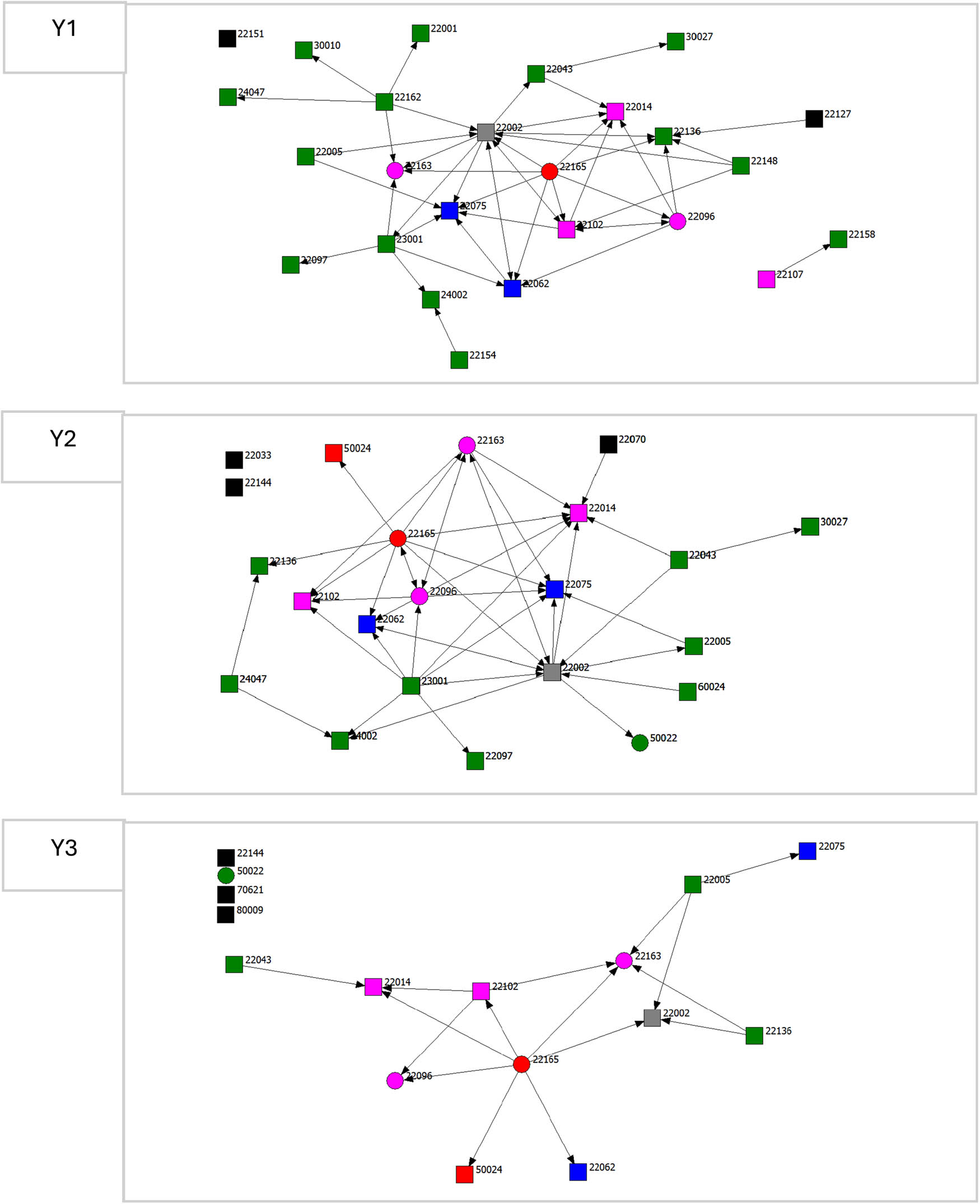
Figure 1
Within-Department Discussion Networks in Year 1-Year 3. Note: Red, Staff; Blue, Director/Associate Director of Undergraduate Studies; Black, Graduate Assistant; Gray, Department Head; Pink, Instructional Faculty; Green, Tenure System Faculty. Circles represent the DAT members of this department.
Table 1 summarizes degree centrality scores of four DAT members and their survey participation status. In general, two instructional faculty DAT members were more engaged in terms of both out-degree and in-degree centrality. Overall, there was an increase in the direct ties after the DAT facilitation. Instructional Faculty 2 had higher in-degree centrality than others, which means being more frequently named by other department members. In Year 3, Instructional Faculty 2’s outgoing ties could not be specified because of a broad answer (“…almost all instructors…”) as beginning a new DUS role in the department. For the Year 3 discussion network, we retained the previous DUS who played the role longitudinally in the department. Staff 1 had higher out-degree centrality than other DAT members, meaning that they reported more discussion partners, but low in-degree centrality, rarely being named as a discussion partner. Tenure Faculty 1 had low centrality scores across time.
Table 1
DAT members’ data information and degree centrality.
| DAT member | Job | Appeared in the network | Answered survey | Out-degree centrality | In-degree centrality | ||||||||
|---|---|---|---|---|---|---|---|---|---|---|---|---|---|
| Y1 | Y2 | Y3 | Y1 | Y2 | Y3 | Y1 | Y2 | Y3 | Y1 | Y2 | Y3 | ||
| 22096 | Instructional faculty | X | X | X | X | X | 0.17 | 0.29 | 0.00 | 0.08 | 0.14 | 0.13 | |
| 22163 | Instructional faculty | X | X | X | X | X | 0.00 | 0.24 | 0.00 | 0.17 | 0.14 | 0.27 | |
| 22165 | Staff | X | X | X | X | X | X | 0.33 | 0.43 | 0.47 | 0.00 | 0.05 | 0.00 |
| 50022 | Tenure-system faculty | X | X | X | 0.00 | 0.00 | 0.05 | 0.00 | |||||
Note. Normalized degree centrality scores were reported to account for the different network sizes over time.
Figures 2–4 present three main DAT members’ ego networks across time. On average, they had similarly high IQV scores, showing their diverse alter composition with different roles. After the one-year DAT facilitation, instructional faculty members had more nodes with different roles in their ego network. While both Instructional Faculty 1 and 2 were more connected with faculty members, Instructional Faculty 2 kept having connections with the department head. Staff 1 also connected across time with department members holding different roles, more frequently with instructional faculty members. Tenure Faculty 1 maintained very low centrality scores across time, which was too simple to be visualized and interpreted for alter composition.
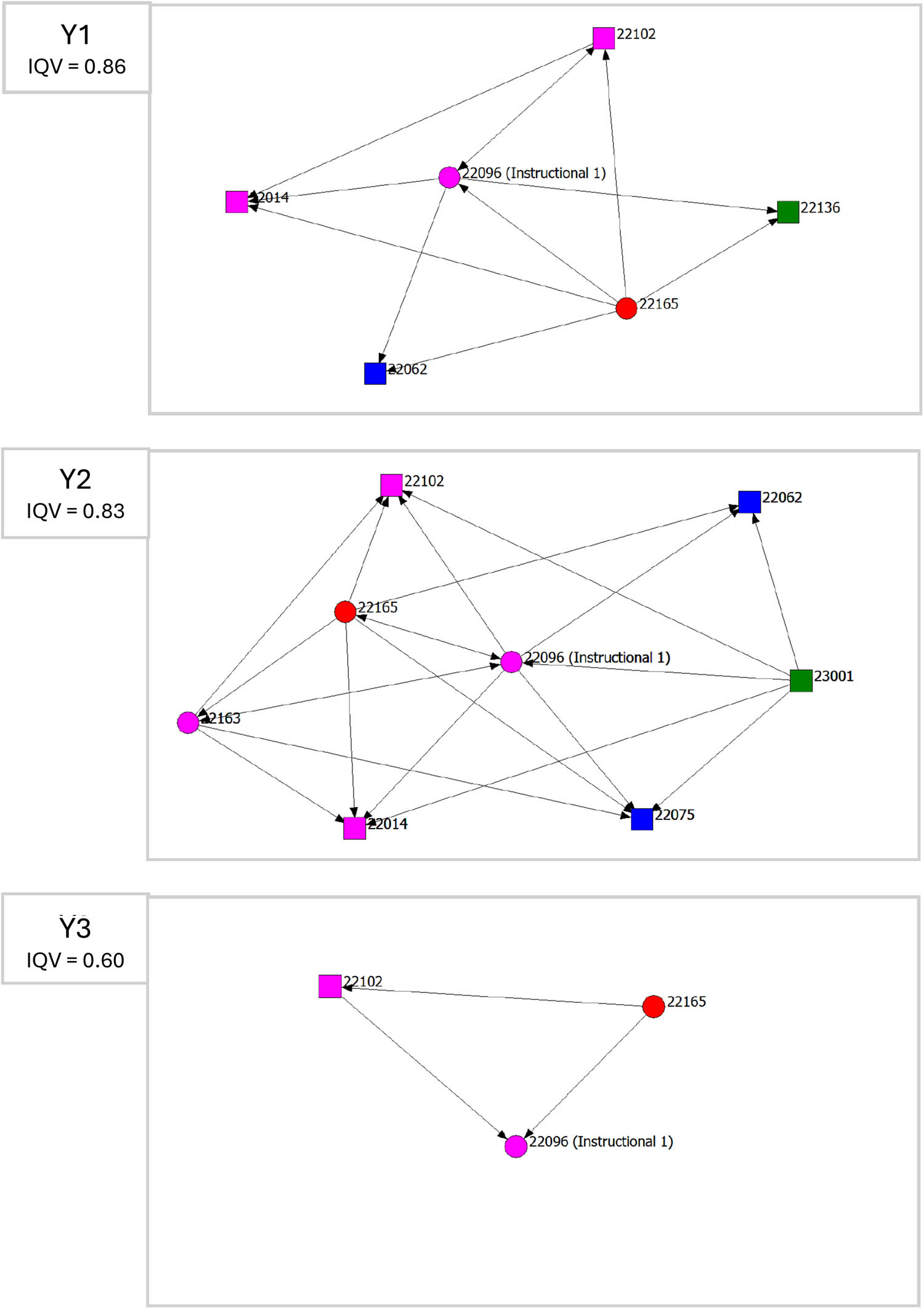
Figure 2
Instructional Faculty 1’s Discussion Networks in Year 1-Year 3. Note. Red, Staff; Blue, Director/Associate Director of Undergraduate Studies; Black, Graduate Assistant; Gray, Department Head; Pink, Instructional Faculty; Green, Tenure System Faculty. Circles represent the DAT members of this department.
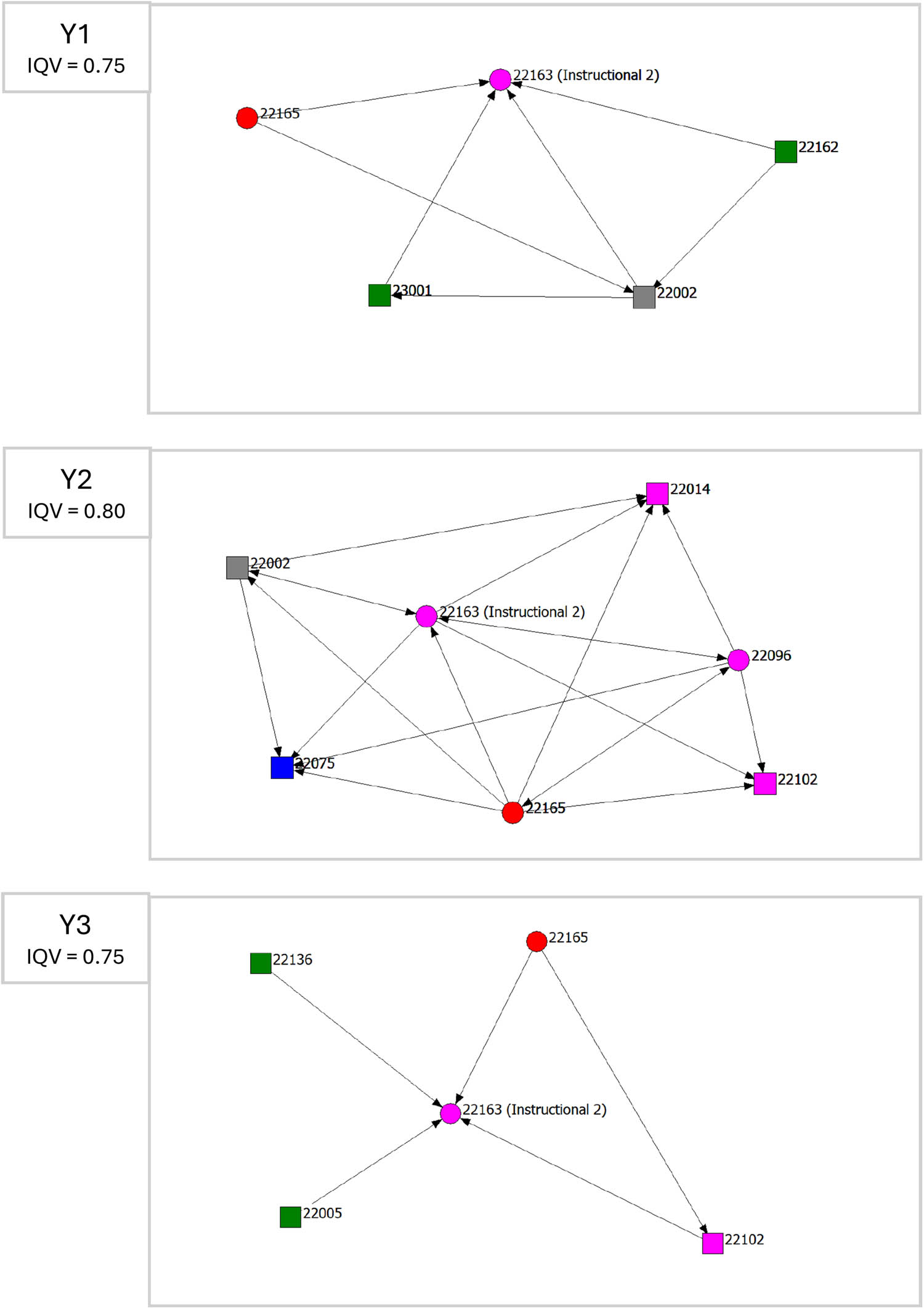
Figure 3
Instructional Faculty 2’s Discussion Networks in Year 1-Year 3. Note. Red, Staff; Blue, Director/Associate Director of Undergraduate Studies; Black, Graduate Assistant; Gray, Department Head; Pink, Instructional Faculty; Green, Tenure System Faculty. Circles represent the DAT members of this department.
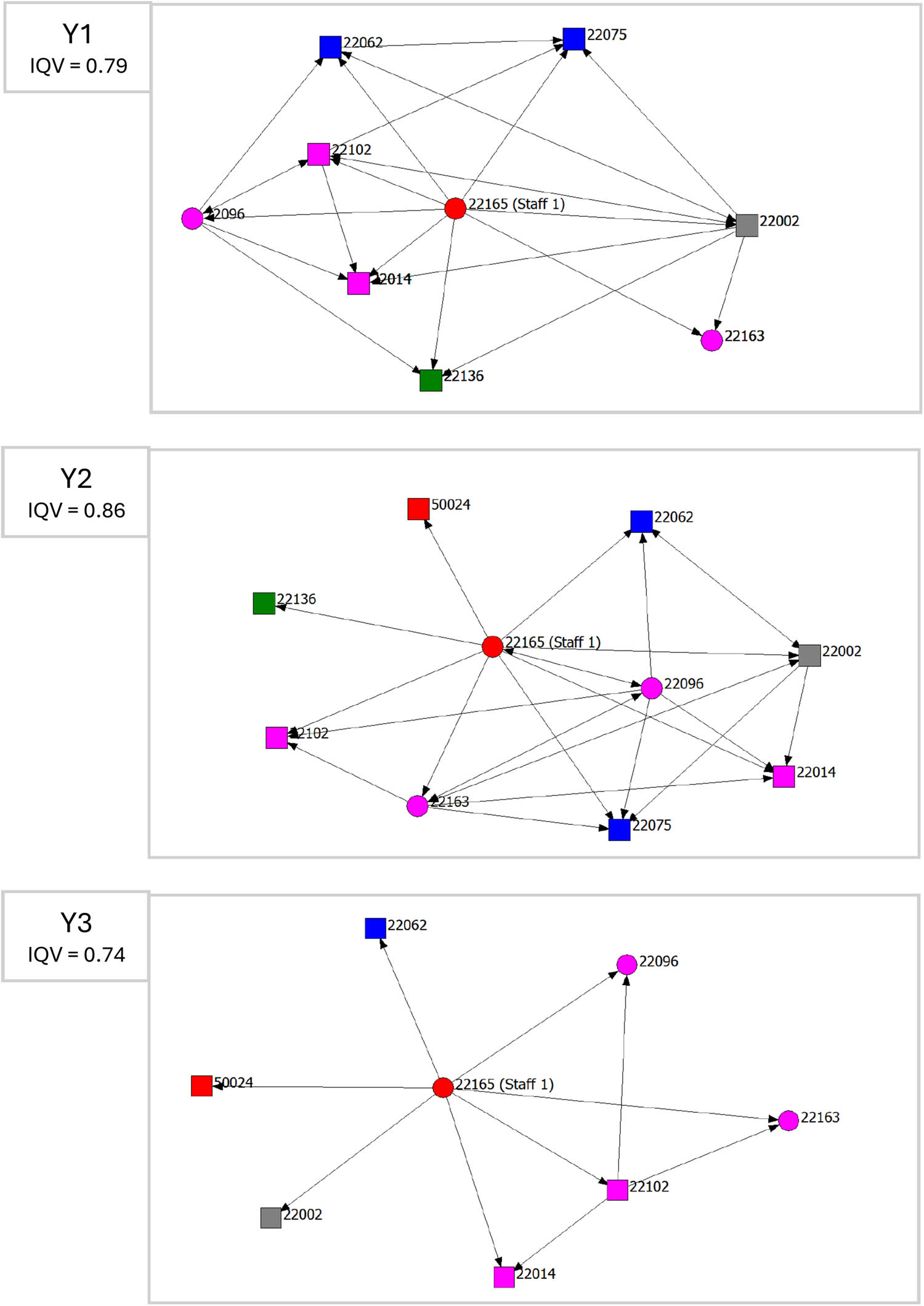
Figure 4
Staff 1’s Discussion Networks in Year 1-Year 3. Note. Red, Staff; Blue, Director/Associate Director of Undergraduate Studies; Black, Graduate Assistant; Gray, Department Head; Pink, Instructional Faculty; Green, Tenure System Faculty. Circles represent the DAT members of this department.
7.1.2. G&F brokerage roles
DAT members’ relative brokerage scores were reported in Table 2. Instructional faculty also played more noticeable roles. Instructional Faculty 1 showed more diverse positions than other DAT members. At baseline, Instructional Faculty 1’s position could connect instructional faculty with other roles. After the end of DAT facilitation (Year 2), Instructional Faculty 1 Instructional Faculty 1 had a brokerage role as Liaison when all nodes belonged to different types of roles.
Table 2
DAT Members’ Brokerage roles and relative scores.
| 22096 – Instructional Faculty 1 | 22163 – Instructional Faculty 2 | 22165 – Staff 1 | 50022 – Tenure Faculty 1 | |||||||||
|---|---|---|---|---|---|---|---|---|---|---|---|---|
| Y1 | Y2 | Y3 | Y1 | Y2 | Y3 | Y1 | Y2 | Y3 | Y1 | Y2 | Y3 | |
| Coordinator (a → a → a) | 0.00 | 0.00 | 0.00 | 0.00 | 0.00 | 0.00 | 0.00 | 0.00 | 0.00 | 0.00 | 0.00 | |
| Gatekeeper (b → a → a) | 0.00 | 1.55 | 0.00 | 0.00 | 4.13 | 0.00 | 0.00 | 2.07 | 0.00 | 0.00 | 0.00 | |
| Representative (a → a → b) | 5.53 | 3.10 | 0.00 | 0.00 | 2.07 | 0.00 | 0.00 | 0.00 | 0.00 | 0.00 | 0.00 | |
| Consultant (b → a → b) | 0.00 | 0.00 | 0.00 | 0.00 | 0.00 | 0.00 | 0.00 | 0.00 | 0.00 | 0.00 | 0.00 | |
| Liaison (b → a → c) | 0.00 | 0.58 | 0.00 | 0.00 | 0.00 | 0.00 | 0.00 | 1.53 | 0.00 | 0.00 | 0.00 | |
Note. Brokerage roles are highlighted in bold, and matching letters indicate the same job classification. Tenure Faculty 1 did not appear in the Year 1 discussion network.
Staff 1 also had brokerage score as Liaison connecting instructional faculty with an administrator or tenure system faculty. Although Staff 1 named more discussion partners to discuss undergraduate education change, the absence of incoming ties resulted in a lack of measurable brokerage scores in Year 3. Tenure Faculty 1 had limited information with zero brokerage scores in Year 2 and Year 3 (no tie; “I have not discussed it with anyone”).
7.2. Post-DAT reflection about individual, team, and department
Below, the interview responses about individual learning, DAT culture, and relationships with their department were described for each DAT member, along with their characteristics identified from the discussion networks for making changes in undergraduate education. We also summarized the four DAT members’ key responses in Table 3.
Table 3
Summary of four DAT members’ interview responses after one-year facilitation.
| 22096 – Instructional Faculty 1 | 22163 – Instructional Faculty 2 | 22165 – Staff 1 | 50022 – Tenure Faculty 1 | |
|---|---|---|---|---|
| Learning from DAT experience | Providing a leadership opportunity in the department | Demonstrating the importance of collaboration with diverse roles in groups/projects | Evolving focus from administrative support for student graduation to enhancing education for career readiness | Having limited power to make changes as an individual but acknowledging the value of DAT proposal |
| Culture of DAT | Collaborative but limited to a small group without high-profile faculty in the department | Collaborative in the process of DAT facilitation and friendly comparing with other community | Caring about undergraduate education but limited to a small group without much authority | Friendly and easy to express opinions and talk in the meeting |
| DAT’s changes in the department | Not making anything impactful yet (e.g., a request for space but no change; collecting limited data to gather information from alumni network) | In progress, but collecting data for guiding undergraduate students to find internships or jobs more effectively | In progress, with identifying issues in curriculum and at least taking steps to find a way for proactively engaging with alumni | Too soon to expect change, but initiating activities to help students succeed in their future career in industry |
| Department members’ value of DAT work | Not widespread, and loosely supported | Not widespread, but very supportive (e.g., helping expand data collection to alumni network) | Not widespread, and more supported by younger faculty open to changes despite less power | Perceiving support for the DAT throughout the department |
7.2.1. Instructional faculty 1 – Individually expanding but not satisfied
At the time of the post-DAT interview, Instructional Faculty 1 had more direct ties in Year 2 compared to baseline. Despite no outgoing ties, Instructional Faculty 1 was named from other nodes in Year 3 after one year from the end of DAT facilitation. Likewise, Instructional Faculty 1 had more diverse brokerage roles in Year 2, but this pattern did not persist. Nevertheless, these characteristics captured from the Year 2 discussion network data were aligned with Instructional Faculty 1’s view of the DAT as providing a leadership opportunity for them in the department, when asked about individual learning acquired by being on the DAT.
It gave me a little bit of leadership opportunity, which was nice and gave me some. I’d say, opportunity to take leadership role, because frankly, just no, nobody was and so I had to, and which I don’t mind doing, but I think that was like something I gained in personally from working in the group is just getting to be in a position to, to take a leadership role among other faculty, which was good, because I’m a junior […] so those opportunities don’t come around very often outside of the classroom.
The DAT model was integral in providing them with faculty improvement opportunities. However, despite being a central member and heavily involved in the DAT, Instructional Faculty 1 had reservations about the level of commitment displayed by colleagues. In defining DAT culture, Instructional Faculty 1 responded that there was a high rate of turnover on the DAT, with people quitting, and was also unsure about other DAT members wanting to continue working on the DAT after facilitation. Instructional Faculty 1 also viewed the DAT as being limited in what they could accomplish due to multiple DAT members quitting, as stated in the following response:
We had a lot of turnover on our DAT. So the majority of the contributing members were non tenure or tenure track faculty or staff, which I think kind of gave a culture of some what feeling like we didn’t have a whole lot that we would be able to do. Nevertheless, you know, from a more personal culture, I’d say four of us who work together really closely […] But I think there was a sentiment of not knowing what we might be able to actually achieve given the makeup of our team.
When asked about the relationship between the DAT and their department, Instructional Faculty 1 said they do not think that other faculty in their department are interested in getting involved in the DAT project and only loosely support it. Instructional Faculty 1 also perceived challenges in institutionalizing DAT goals because the DAT had not accomplished a lot besides surface-level achievements. The following response highlights how the DAT model is largely dependent on broader department culture in terms of the implementation of student initiatives.
We had a discrete request for space, which, you know, we’ve tried to do that. There has been to date no change, even no information about whether that’ll happen or not. We otherwise largely have come up with issues associated with like, undergraduate students and employment and brought those up to the department. If I’m honest, I don’t think anyone really cared. And I think, except for four people in the room, like, truly cared […] but nobody’s actually like invested in fixing it.
7.2.2. DAT instructional faculty 2 – enjoying working as a group and optimistic about DAT
Instructional Faculty 2 consistently was named by others as a discussion partner across time, even one year after the end of DAT facilitation. After one year of DAT experience (Year 2), Instructional Faculty 2 showed the potential to develop a more effective discussion network for undergraduate education change by connecting instructional faculty, who are historically more involved in undergraduate teaching, with other department roles. Along with these characteristics, Instructional Faculty 2 showed more optimistic views about DAT given that it teaches the importance of collaboration in groups/projects and could use the lessons with other department members.
Usually, we have self-driven motions, in terms of changing any existing or problematic issues from this undergraduate curriculum […] And I won’t say we don’t need to, but normally we don’t have to work as a group. So just the individual work efforts, proposals pushing this. Now for the DAT level, most of the problems we saw is definitely not going to be manageable by one person. And that’s actually the main reason I mentioned just now, to say we want to involve more roles, including the fully established tenure track professors. However, the collaborations among teaching faculties, even the student organization leaders, staff members, which make things much, much easier than I expect. And I definitely want to expand this experience and copy this experience in my other working groups.
Instructional Faculty 2’s response highlights how their experience on the DAT has impacted their approach to working with groups, specifically wanting to incorporate people of different roles and perspectives to work in collaboration with each other. Notably, Instructional Faculty 2 wants to replicate the incorporation of diverse perspectives into other working groups. Along with the emphasis on group work, Instructional Faculty 2 spoke highly of DAT’s culture and was optimistic about its future because of their positive working relationship despite a smaller number of meetings.
Furthermore, Instructional Faculty 2 perceived broader support for the DAT project among department members, compared to other DAT members. Instructional Faculty 2 viewed their DAT work process as an evolving step, even if there wasn’t a clear final outcome of change in their department. Assistance from the department in collecting data from alumni was highlighted as demonstrating their supportive role in achieving DAT goals.
We actually removed a couple of less than feasible goals from the last time, and then we finalized a couple to make it happen. So including the career path, dialogue, this is part of our concentration areas, and also how to guide students getting a better idea earlier, of where to go, how to find internship, how to find a job, this is kind of unique to our relatively newer, major and program, and also the multidisciplinary and people are talking about it, even the employer are not aware of the exact skill sets they are asking. And then making the educators even harder to deliver and teach multiple skills from many different majors.
7.2.3. Staff 1 – Active administrative role, focusing on student-oriented changes
Over the three years, one staff member in the DAT consistently had frequent outgoing ties for undergraduate education changes. However, these active efforts did not necessarily match with incoming ties as being named as a discussion partner. Still, Staff 1 had two brokerage roles as a Liaison intermixing different roles as well as connecting staff with other roles, based on the Year 2 discussion network. As a staff member managing undergraduate education, Staff 1’s reflection on individual learning from DAT experiences was focused on changes for students and viewed the DAT as expanding their conceptualization of what enhancing education is for their students.
I only see [students] from admission to graduate, like, my goal is just to get them graduated. And then I think through DAT more and more how important it is to kind of realize what their education here means for their future. And, you know, just not taking for granted that just because they graduated there. They’re fine, you know? Because, I know that that’s not universally true, but I think it took a lot of conversations about what they learned here and what they can use, how they can use, what they’ve learned here to go out and do something where they succeed and flourish and do well in a job or career.
Staff 1 also commented that the culture of the DAT was good, but it was self-selecting, so it was only clinical or instructional faculty who were interested in improving undergraduate education, which often do not have the same level of power in the department as the research-focused faculty. Staff 1’s following response echoes the response from Instructional Faculty 1, notably that instructional faculty are heavily involved in student change initiatives and tenure-track faculty are less involved. Likewise, it was attributed to the DAT’s limited impact on the lack of involvement of tenure-track faculty.
I think it’s probably a universal issue within a lot of academic departments where the people who can help improve things, some are less committed to undergraduate education. And then the people who do care about undergraduate education are the people who would be involved anyway. So the DAT is like self-selecting in the sense that like, the people who care would obviously be involved in something like this, but they also don’t have as much authority or like ability to enact change, because that usually falls on a lot of the longtime tenured faculty who are focused on their research or their labs and not as much focused on undergraduate education.
Staff 1 also pointed out that there are pockets of support for the DAT within the department, but it is primarily centered among instructional faculty. The following response highlights how power imbalances between faculty members create barriers where instructional faculty who have student-centric ideas struggle to implement their ideas.
[…] probably pockets. You know, the faculty who’ve been here a long time and are sort of set in their ways and don’t love change, I think they’re the hardest group to move along, but they’re also the ones with more of the power. If they want something, then it’s more likely to get done. And if they don’t care, then it’s harder to make something happen. So, but otherwise, I think we have improved, just the minds of some of maybe the younger faculty who are still more committed to wanting things to improve, and I’d like to think we’ve helped with that.
7.2.4. Tenure faculty 1 – Peripheral as perceived from self and broader within-department network
Despite their absence in Year 1, Tenure Faculty 1 remained peripheral within the department discussion network and did not show certain possibilities for mediating between different roles. In reflecting on learning from DAT experiences, Tenure Faculty 1 acknowledged a lack of power but expressed some lessons learned from DAT experiences:
I don’t think that my power is in administration. So I don’t think that I can make a change. But I’m sure that the proposal that we made to the department based on the discussion we’ve had in DAT was very useful. And it was supported fully. So from that perspective, yes, I felt that we could do something. And that helps us in sort of, in designing that thought, and also hopefully in execution of that plan.
Although Tenure Faculty 1 provided a basic description about a good DAT culture, a lack of active engagement as a tenure system faculty member was observed. It was expressed that there has been support for the DAT throughout the department in regard to identifying the exact needs of companies that are [department] related and then strengthening students for those needs.
8. Discussion
Ngai et al. (2020a) listed two main goals of the DAT Framework: (1) “supporting departmental change” and (2) “supporting DAT members in becoming better change agents” (p. 1). Although making noticeable changes at the department level takes time, the process can be better understood through an analysis of DAT members’ participation and self-reflections. In this study, we utilized both discussion network data and interview responses. An important strength of this approach is that the discussion network data were also collected from other members of the department, not just the DAT members, which might be limited by size yet still improve node presence on discussion networks and enable DAT member characterization despite incomplete self-reports. Furthermore, interview data from DAT members can help find more nuances of DAT members’ experiences and their development as change agents.
First, capturing an individual’s degree centrality in a discussion network over time enables DAT researchers to capture overall involvement and influence in the trajectories. Instructional faculty were more connected with others for the development of undergraduate education relative to tenure system faculty. In higher education, instructional faculty members often have a position emphasizing teaching in undergraduate education with high enrollment (e.g., Miller & Struve, 2020). Regarding the relationship between pedagogical innovation and discussion network for teaching, Blumenschein and Hannisdal (2024) suggested that “most innovative teachers, who are the most central and influential actors with respect to teaching innovations, should be a focal point for change agents seeking to effect meaningful transformation” (p. 2838). Nevertheless, instructional faculty DAT members perceived a lack of authority or power to enact changes based on their post-DAT reflections. Given that instructional faculty historically reported a lack of inclusion in undergraduate education improvement efforts (e.g., Kezar, 2013), the DAT model needs to provide additional guidance on how to leverage authority and resources to ensure their plans for undergraduate students and the department are impactful. Facilitators can help DATs to strategize longitudinal communication plans with stakeholders (Ngai et al., 2020a) and develop a proactive approach to build a shared understanding of what is achievable.
We also found that the staff DAT member was rarely named as a discussion partner. This might happen due to a lack of reciprocity, missing data in measuring within-department networks, or different definitions of discussion. Staff can be grassroots leaders by “being collective, adopting novel strategies and tactics, and navigating institutional structures” (Kezar et al., 2011, p. 132). The DAT we focused on in this study had one staff member who did perceive having connections with department members and developed a more expansive view of undergraduate success from joining the project. Still, the staff DAT member perceived a lack of authority to enact changes, which might be relevant to the absence of senior tenure-system faculty member(s) in DAT and their ego network. Although instructional faculty and staff are vital to DAT formation given their commitment to undergraduate education, future facilitation needs to consider ensuring participation of senior tenure-track faculty who can provide institutional knowledge and authority necessary to implement solutions. Alternatively, inviting instructional faculty with historical close connections among department stakeholders or tenure system faculty can also be an effective strategy to foster team efficacy.
Next, this study empirically showed that alter composition and brokerage roles can provide information to capture the existence or absence of cross-role ties. Having diverse membership in alter composition enables change agents to consider different experiences and opinions in making educational changes (Quardokus Fisher et al., 2019). Triangulating the network results with post-DAT interview data was helpful to add nuance to individual differences among DAT members, even those with similar job titles. Instructional Faculty 1, who showed diverse broker roles, led the implementation of DAT’s strategies for improving undergraduate student academic success. However, Instructional Faculty 1’s perceived lack of full support from the department and departure from the university eventually impacted the DAT implementation. When led by certain key connectors, DAT could be confronted with limitations of losing momentum whenever these individuals are temporarily or permanently absent. In terms of DAT facilitation, the results highlight the necessity of plans for team member retention and continuity strategies following a one-year facilitation period from the research team. For instance, Ngai et al. (2020a) suggested that DAT member(s) can take on internal facilitation roles. Analysis of DAT members’ structural roles in discussion network data and post-DAT interview reflections can also inform evidence-based decisions for finding a potential facilitator or an alternative team leader. In particular, the Liaison brokerage score can provide insights into cross-role collaborations, which is especially beneficial in a departmental context where roles and responsibilities are strictly divided. Another facilitation approach is to encourage within-group leadership and power to be more distributed among DAT members, so that missing a certain DAT member does not influence the team’s success significantly.
Comparatively, Instructional Faculty 2 described positive views on DAT as a collaborative opportunity and willingness to apply these learning points to other broader change initiatives. Instructional Faculty 2 had positions connecting instructional faculty and other roles after one-year DAT experience. During the Year 3 survey collection, Instructional Faculty 2 was appointed as a key administrator in the undergraduate education program. Even though this change cannot be solely attributed to DAT experiences, it highlights how the DAT model can be a valuable opportunity for participating members to develop their group work skills and professional growth within their department. Given that undergraduate courses are often taught and managed by instructional faculty, connecting instructional faculty with other roles can be an important indicator for leading the development of undergraduate programs. Furthermore, Instructional Faculty 2 had ties with the department head from the baseline and after one-year DAT facilitation, which might indicate potential to take the key administrator role in undergraduate education as instructional faculty and work with department leadership. Despite unspecified outgoing ties in Year 3, the new job title could enable Instructional Faculty 2 to engage in more diverse roles and result in increased scores as Liaison over time.
Lastly, identifying DAT members’ structural roles in the discussion network can provide facilitators with background on each member and empirical evidence for adjustment. Although we did not utilize the discussion network findings for DAT facilitation, we recommend that future researchers share their findings with facilitators, if possible, so that facilitators relocate time on activities for building connections among DAT members. In addition, discussion network data can be helpful for facilitators to understand each DAT member more comprehensively by observing both discussions within a smaller group setting and in a broader department context and support their unique development as change agents contributing to cross-role communication in the department.
8.1. Limitations
Several limitations and related future research should be noted. To start, one of the strengths of the Departmental Action Team model is that it can be applied to various departments with different goals and group dynamics. While this study enabled us to examine how structural roles of DAT members develop over time, it is limited in that the focus is on one engineering department from a single institution (Reinholz et al., 2019a). We recommend utilizing more diverse analytical approaches for different types of departments, including change initiatives in non-STEM disciplines or other undergraduate programs.
Second, there were some changes in the survey data over time, including a decrease in the number of respondents. Future research needs to attempt to maintain or even increase participation to collect more representative data. One potential strategy is to go through different recruitment processes, such as having a representative attend in-person department meetings each year to advertise the survey. With less missing data, researchers may further examine how the number of new, lost, or maintained ties changes over time. As another measurement recommendation, asking follow-up questions about discussion topics can be beneficial to capture priorities in improving undergraduate programs.
Finally, the participants’ reflections on their DAT experience may change over time in relation to their characteristics in discussion networks. Although discussion network findings were not considered in conducting the post-DAT interviews, future research may consider incorporating additional reflections about how the DAT members perceive their changing roles within the departmental discussion network. Furthermore, conducting post-DAT interviews with non-DAT department members can be helpful to incorporate departmental perception of DAT’s impact on undergraduate program changes.
9. Conclusion
Research on DAT models has emphasized the role of group values, team formation, and group facilitation processes. However, few studies examined group dynamics and DAT members’ reflections on their experiences together. Using within-department discussion network data, this study identified important but limited roles of instructional faculty and staff members to effect change in the larger context of the department to support undergraduate student success. Although working in a DAT was helpful for individual learning, the four faculty and staff members’ interview data after one year of facilitation confirmed a lack of value and power to enact changes. We hope this study promotes diverse analytical approaches to advance the DAT model to build evidence-based and proactive guidance for facilitating group dynamics and empowering participants’ agency for improving undergraduate education.
Funding information
This work was supported by the National Science Foundation under Grant [#2122652]. Any opinions, findings, or conclusions expressed in this article are those of the authors and do not necessarily represent the views of the agency.
Author contributions
Jaeyun Han – Conceptualization, Formal Analysis, Investigation, Writing original draft, Writing – review & editing. Fructoso Basaldua – Formal Analysis, Writing original draft, Writing – review & editing. Mikayla Strasser – Writing original draft, Writing – review & editing. Susan P. Farruggia – Investigation, Writing original draft, Writing review & editing, Funding acquisition. Carmen M. Lilley – Writing original draft, Writing – review & editing, Funding acquisition. Mike Stieff – Investigation, Writing original draft, Writing – review & editing, Funding acquisition.
Conflict of interests
No potential conflict of interest was reported by the authors.
Declarations
A portion of this manuscript is presented as a poster at the 2026 American Educational Research Association (AERA) Annual Meeting.
Ethics approval and consent to participate
The university’s Institutional Review Board approved a secondary use of de-identified data [STUDY2023-0323].