

1. Introduction
Over the past decade, the development of eco-efficient and sustainable construction materials has become a major research priority. Concrete production consumes large amounts of natural resources and water, contributing to environmental degradation and high carbon emissions (Scrivener et al., 2018). In addition, curing efficiency and quality are strongly influenced by climatic conditions, and internal curing has been proposed as an effective approach to mitigate self-desiccation and cracking, particularly in hot and arid environments (Nguyen et al., 2021; Yahiaoui et al., 2017). Internal curing techniques using lightweight aggregates (LWA) or superabsorbent polymers (SAP) have been widely recognized as promising strategies to improve hydration efficiency, reduce autogenous shrinkage, and promote sustainable concrete systems (Bentz, 2007; Castro et al., 2011)
Autogenous shrinkage occurs when hydration reactions cause internal moisture loss in concrete, leading to volume reduction, microcracking, and reduced durability. To mitigate this phenomenon, internal curing provides additional water for hydration through reservoir materials that gradually release moisture (Danish & Mosaberpanah, 2022). This process maintains internal saturation, lowers shrinkage, and enhances durability. Research has shown that internal curing also improves strength, decreases permeability, and prolongs service life (Fawzi & Al-Awadi, 2017; Schlitter et al., 2010).
The most common internal curing agents are superabsorbent polymers (SAPs) and saturated lightweight aggregates (LWAs) (Bentz & Weiss, 2011; Karim, 2025). LWAs are available in two forms: man-made (expanded shale, expanded clay) and natural (pumice). When preconditioned, they can absorb 10–30% of their mass in water and release it during hydration, effectively mitigating shrinkage (Castro et al., 2011).
Recently, Water Absorbent Polymer Balls (WAPBs) have been introduced. Unlike powdered SAPs, they are spherical and easier to handle, with the ability to absorb and release large amounts of water. WAPBs can hold up to 100 times their weight in pure water, improving internal moisture availability in the cementitious matrix (Ikram & Ammar, 2017).
Studies indicate that LWA can reduce shrinkage by 20–30%, though often accompanied by a 5–15% reduction in 28-day compressive strength. SAPs also reduce shrinkage but present similar trade-offs (Najaf et al., 2025; Palma e Silva et al., 2025). Recent studies have shown that superabsorbent polymers (SAPs) enhance concrete performance by increasing microstructural density, leading to strength gains of up to 25% and improved durability, as evidenced by higher electrical resistivity under different curing conditions (Venkateswarlu et al., 2021). (Karim, 2022) reported that saturated lightweight pumice aggregates enhanced mortar properties while reducing both autogenous and drying shrinkage. Furthermore, (Lyu et al., 2024) showed that combining LWAs and SAPs in ultra-high-performance concrete was highly effective, with LWAs achieving shrinkage reductions up to 88.8%.
Nevertheless, systematic investigations on the application of WAPBs in conventional concrete, especially in combination with pumice aggregates, remain limited. Accordingly, this study investigated the effectiveness of water-absorbing polymer balls (WAPB), lightweight pumice aggregate (LWA), and their hybrid use on autogenous shrinkage, compressive strength, and dry bulk density of concrete.
2. Methodology
2.1. Research Design
This research is an experimental study conducted on concrete mixtures to investigate the effectiveness of internal curing in reducing autogenous shrinkage. Internal curing was achieved by using water-absorbing polymer balls (WAPB), pre-wetted lightweight pumice aggregate (LWA), and a hybrid combination of both. These internal curing agents provide additional internal water during cement hydration, helping to maintain internal relative humidity and reduce capillary stresses associated with self-desiccation.
2.2. Materials and Procedures
Ordinary Portland cement OPC, (CEM I/42.5 R) complying with (Iraqi Standard Specification No. 5, 2019) was used as the main binder. Natural sand (Zone II) and crushed normal-weight coarse aggregate with a nominal maximum size of 12.5 mm, both conforming to (Iraqi Standard Specification No. 45, 1984), were used. Pumice lightweight aggregate (LWA) with a maximum size of 12.5 mm was adopted as an internal curing aggregate; it was pre-wetted before mixing and had a water absorption of approximately 30%. Tap water complying with (Iraqi Standard Specification No. 1703, 2018) was used for mixing and pre-wetting. A high-range water-reducing admixture (ViscoCrete-180 GS) satisfying (ASTM C494/C494M, 2019), was used to achieve the required workability. Water-absorbing polymer balls (WAPB) were used as an internal curing agent are shown in Figure 1, the polymer spheres were soaked in water for 24 h prior to mixing and incorporated at 10% of cement mass in the WAPB mixture and 5% of cement mass in the hybrid mixture (Ikram & Ammar, 2017).
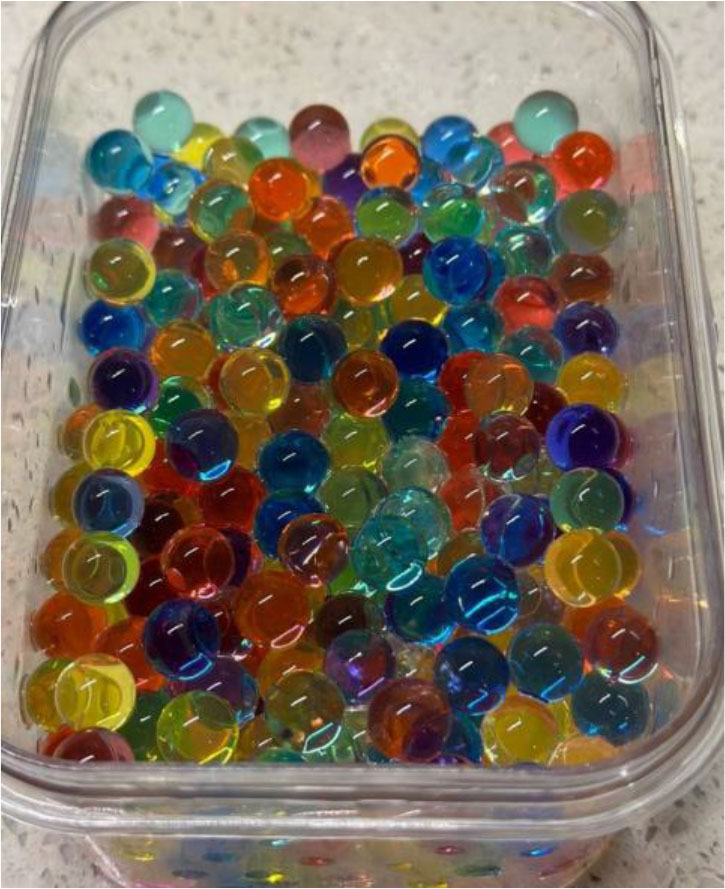
Figure 1:
Water absorption polymer balls (WAPB) in concrete mixes
The concrete mixtures were designed according to (ACI Committee 211.1, 2009), for a desired compressive strength of 35 MPa, a target slump of 75–100 mm was used for both conventional concrete and structural lightweight concrete according to (ACI 211.2-98, 2004), the mix proportions are shown in Table 1.
Table 1:
Details of mix design
| Mix symbol | Cement [kg/m3] | Fine aggregate [kg/m3] | Coarse aggregate [kg/m3] | Pumice [kg/m3] | Water [L/m3] | SP [%] | Water absorption polymer balls [%] |
|---|---|---|---|---|---|---|---|
| Rw | 460 | 730 | 875 | - | 173 | 0.6 | - |
| Rair | 460 | 730 | 875 | - | 173 | 0.6 | - |
| WAPB | 460 | 730 | 875 | - | 173 | 0.6 | 10 |
| 50% LWA | 460 | 730 | 437.5 | 180 | 173 | 0.6 | - |
| Hybrid | 460 | 730 | 656.3 | 90.15 | 173 | 0.6 | 5 |
| LWAw | 452 | 705 | - | 415 | 152 | 0.6 | - |
| LWAair | 452 | 705 | - | 415 | 152 | 0.6 | - |
Mix nominations: Rw (reference, water cured), Rair (reference, air cured), WAPB (10% of cement, air cured), 50% LWA (50% pumice replacement, air cured), Hybrid (25% pumice + 5% WAPB, air cured), LWAw (lightweight agg. mixture, water cured), LWAair (lightweight agg. mixture, air cured).
The selected pumice lightweight aggregate replacement ratios were chosen to represent partial and full internal curing scenarios. A 50% replacement level was adopted as an intermediate option to balance shrinkage reduction with acceptable mechanical performance, while full replacement was used to investigate the maximum potential of lightweight aggregate for internal curing. It is expected that increasing lightweight aggregate content would reduce density and autogenous shrinkage due to higher water-storage capacity, while leading to a reduction in compressive strength because of the porous nature of pumice aggregate.
The dry bulk density test was conducted on cubic specimens with dimensions of 100 × 100 × 100 mm in accordance with (ASTM C642, 2013). For each mixture, three samples were tested at the age of 28 days after water curing, and the average values were reported.
The compressive strength was measured on 100 × 100 × 100 mm cubes, using the same specimen type shown in Figure 2, following (EN 12390-4, 2000) Three specimens were tested for each mixture at the ages of 7, 28, 60, and 90 days, and the average value was taken as the representative compressive strength.
The autogenous shrinkage test was performed using a modified procedure adapted from (Al-Saad, 2013; Al-Rhimy, 2018). An I-shaped mold Figure 3 with a 3 mm central groove created by a thin steel plate was used. After initial setting, the plate was removed to permit free deformation. Two pairs of demec points were installed as shown in Figure 4, one pair located 100 mm from each side of the groove, and another at 200 mm. The 100 mm gauge length was measured between the points positioned at 100 and 200 mm from the groove, while the 200 mm gauge spanned directly across the groove, between the two points located 100 mm on either side. Measurements were taken once per day from the first day up to 7 days using a mechanical extensometer. All specimens were tightly sealed with nylon sheets to prevent external moisture loss. The 200 mm gauge reflected the higher free strain above the groove, whereas the 100 mm gauge captured the lower restrained strain.
In this study, the reference mixture was subjected to both water curing and air curing to provide a baseline for conventional external curing and to allow comparison with internally cured mixtures. In contrast, all mixtures incorporating internal curing agents (WAPB, LWA, and hybrid systems) were air-cured only. This approach was adopted to isolate and evaluate the effectiveness of internal curing without the influence of external water supply. Accordingly, differences in performance between the reference and internally cured mixtures under air curing conditions can be attributed primarily to the internal curing action.
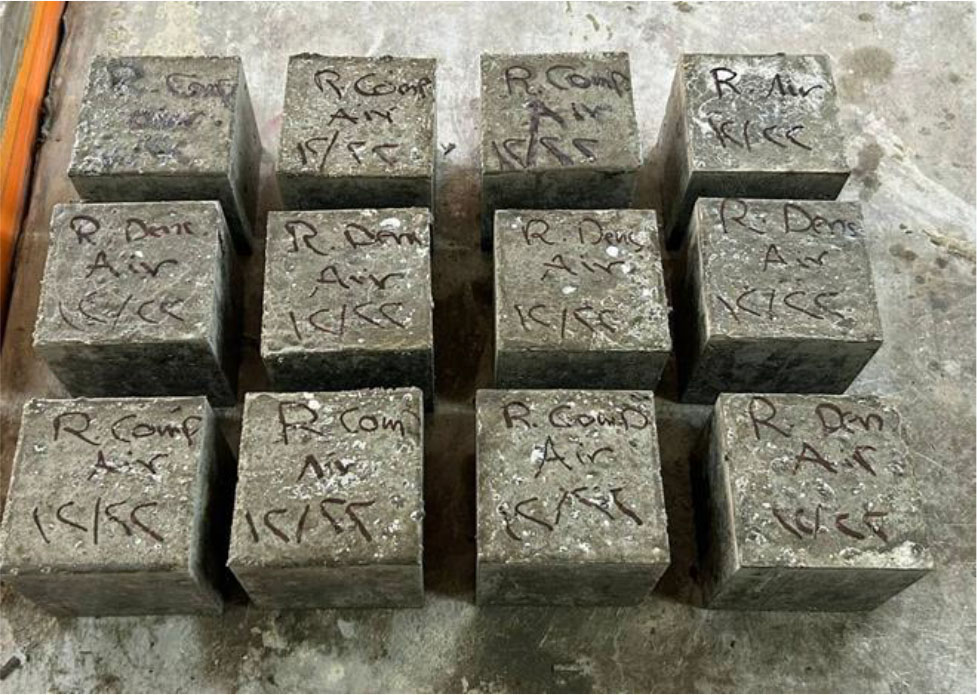
Figure 2:
Cube specimens
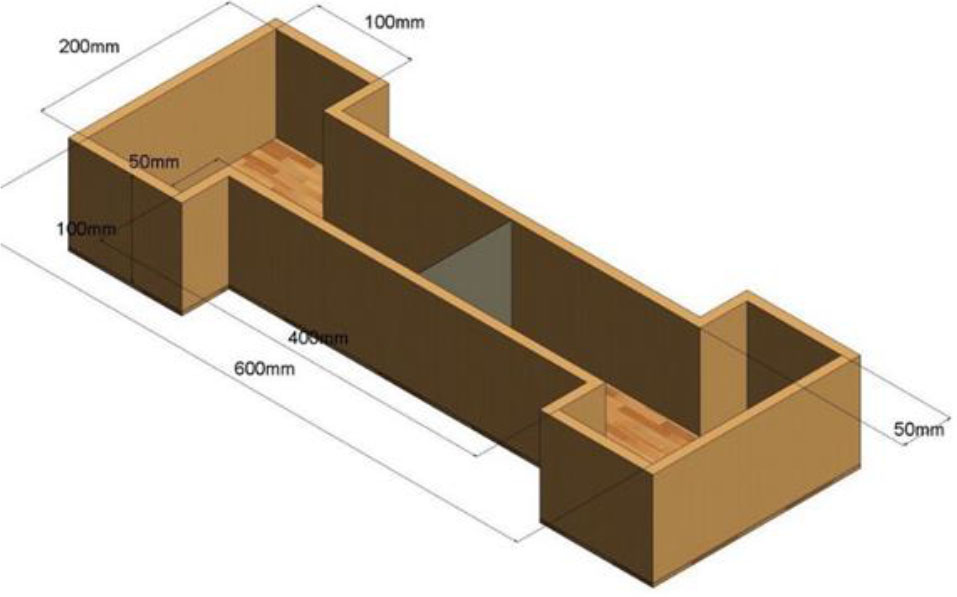
Figure 3:
I shape mold
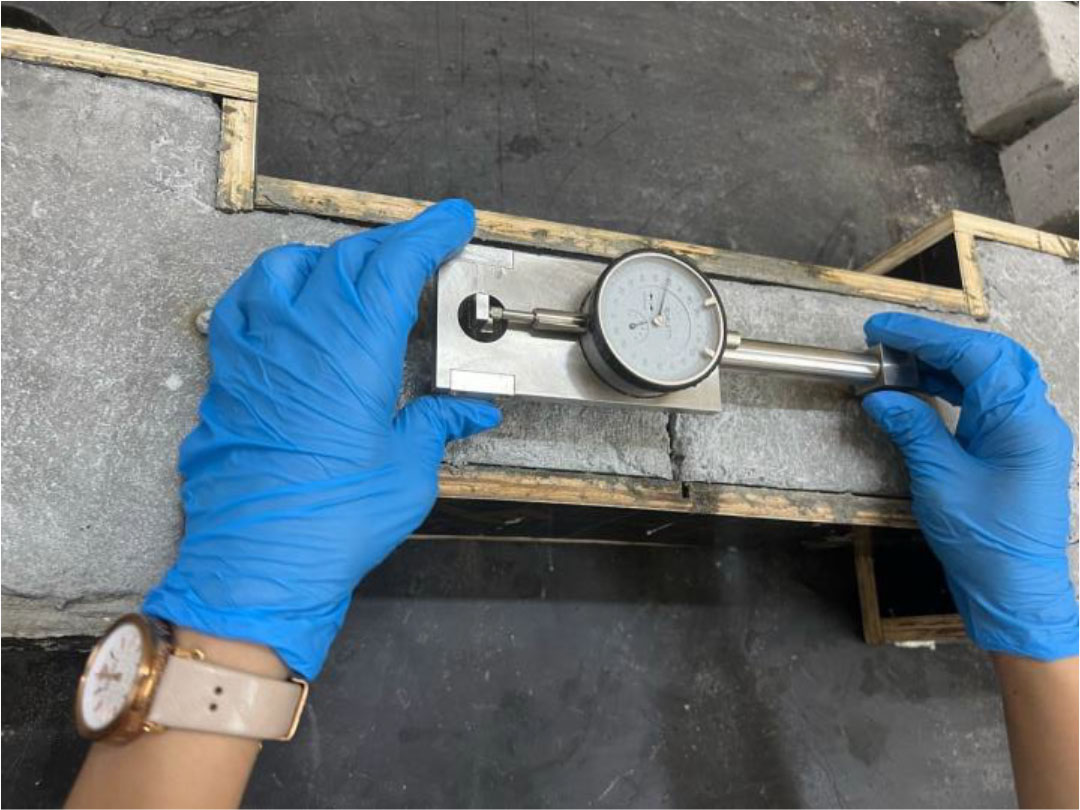
Figure 4:
I-shaped specimen with central groove and Demec points, showing the autogenous shrinkage test setup using a mechanical extensometer
2.3. Data Collection
Material test data and property information were obtained from either in-house laboratory measurements or manufacturer supplied specifications. All sampling and experimental testing were performed by the authors in the Civil Engineering Department laboratories at the University of Baghdad.
3. Results
3.1. Dry bulk density test
Table 2 and Figure 5 show that adding WAPB reduced the dry bulk density from 2504 to 2300 kg/m3. Replacing 50% of the natural coarse aggregate with pre-wetted pumice LWA further decreased the density to 2017 kg/m3. The full LWA mixtures (LWAw and LWAair) also exhibited lower dry bulk density than the reference, confirming the weight-reduction effect of pumice lightweight aggregate. The hybrid mixture (25% pumice + 5% WAPB) achieved an intermediate density of 2049 kg/m3, Moreover, the full LWA mixtures exhibited the lowest dry bulk density values, with LWAw and LWAair recording 1783 and 1712 kg/m3 at 28 days, respectively.
Table 2:
Result of dry bulk density
| Mix symbol | Dry bulk density at 28 [d] [kg/m3] |
|---|---|
| Rw | 2510 |
| Rair | 2504 |
| WAPB | 2300 |
| 50% LWA | 2017 |
| Hybrid | 2049 |
| LWAw | 1783 |
| LWAair | 1712 |
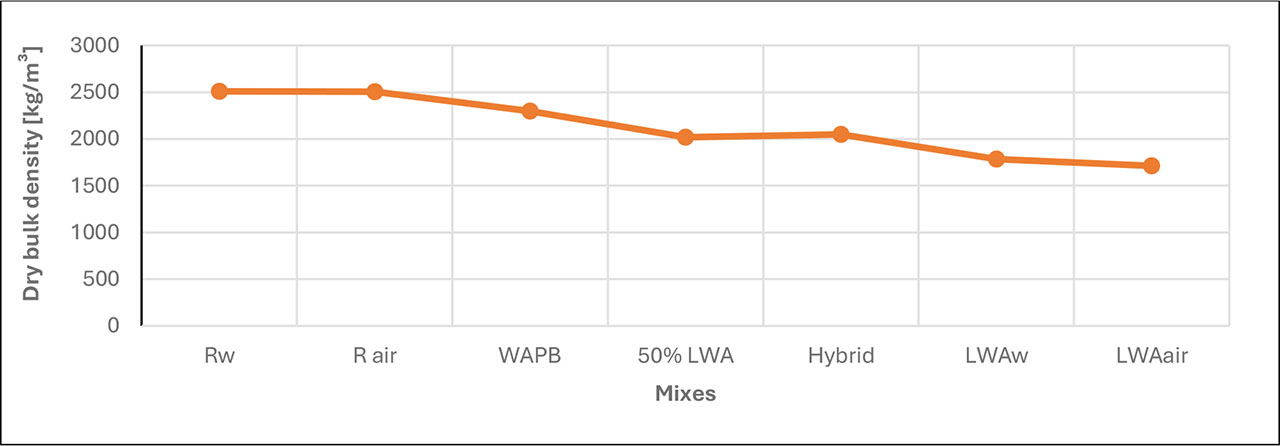
Figure 5:
Relationship between dry bulk density and mixes at 28 [d]
3.2. Compressive strength
Table 3 and Figure 6 shows that the water-cured reference mix (Rw) achieved the highest compressive strength at all ages, increasing from 46.3 MPa (7 d) to 55 MPa (90 d), while the air-cured reference (Rair) remained lower (44–47.7 MPa). Incorporating internal curing materials reduced strength compared with Rw. At 28 days, WAPB reached 32.1 MPa (≈36.8% lower than Rw), whereas the 50% LWA and Hybrid mixes achieved 21.0 and 27.7 MPa (≈58.7% and 45.5% lower than Rw), respectively. The full lightweight mixes recorded the lowest strengths, with LWAw = 18.88 MPa and LWAair = 17.23 MPa at 28 days. By 90 days, WAPB increased to 40 MPa, while 50%LWA and Hybrid reached 34.8 and 35.7 MPa, respectively; however, LWAw and LWAair remained comparatively low (22 and 20.5 MPa).
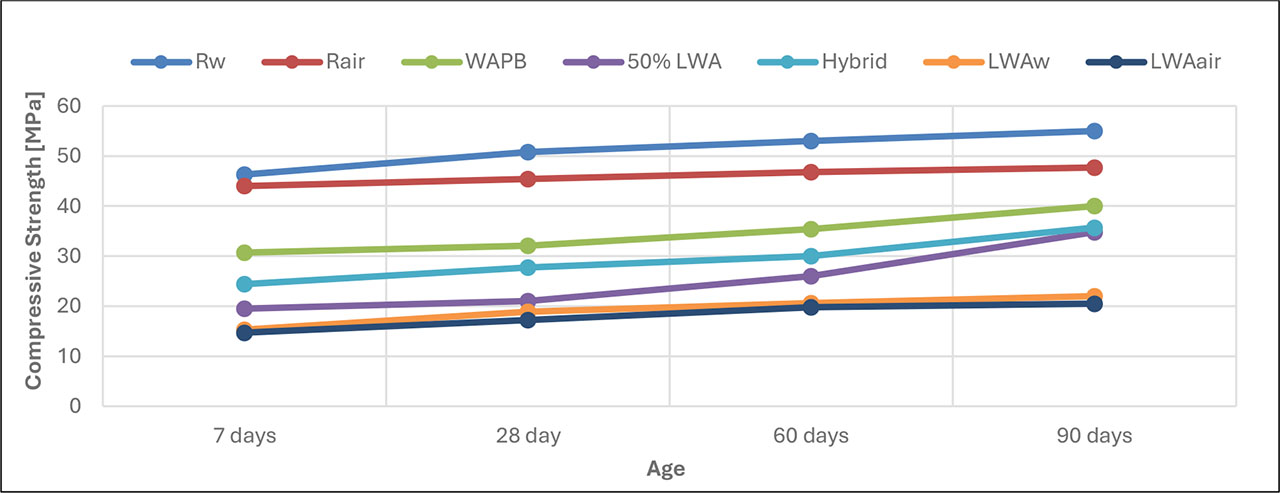
Figure 6:
Compressive strength development of different mixes with time
3.3. Autogenous Shrinkage
Autogenous shrinkage in low water-to-cement ratio concrete is governed by self-desiccation and capillary stress development during hydration. Internal curing mitigates this mechanism by supplying additional internal water. In the present study, both pre-wetted lightweight aggregate (LWA) and water-absorbing polymer balls (WAPB) acted as internal water reservoirs with different efficiencies.
As shown in Fig. 7, the 100 mm gauge consistently exhibited positive strain corresponding to restrained autogenous shrinkage, whereas the 200 mm gauge recorded negative strain associated with groove opening. At 7 days, the reference mix showed the highest deformation magnitude (≈240 με at 200 mm and ≈190 με at 100 mm). Internal curing reduced the deformation magnitude by approximately 21–40% at 200 mm and 8–34% at 100 mm.
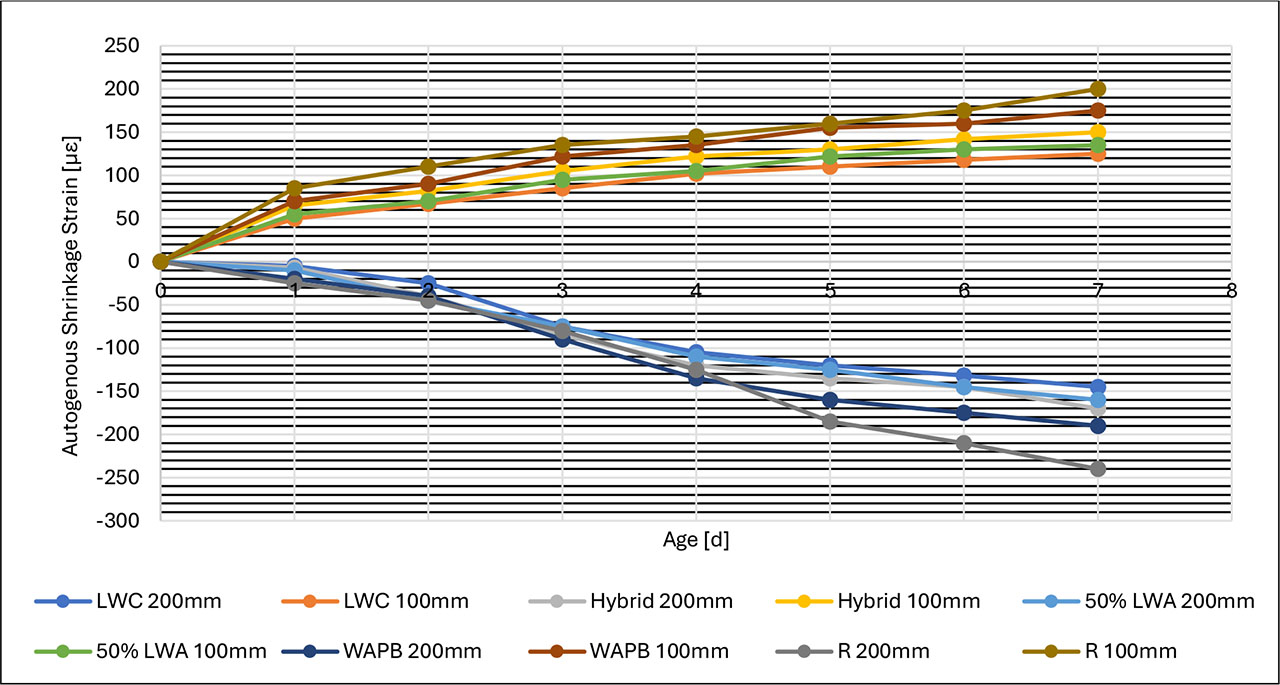
Figure 7:
Autogenous deformation of all mixtures up to 7 days at 100 mm (shrinkage) and 200 mm (groove opening) gauge locations
4. Discussion
The decrease in dry bulk density with WAPB is mainly related to additional porosity caused by voids after water release, while the larger reduction with pumice replacement reflects its low specific gravity and highly porous structure (Abbas & Abbas, 2022; Zheng et al., 2021). Consistently, compressive strength dropped in mixtures containing WAPB and/or pumice due to increased porosity and a weaker aggregate/ITZ, with pumice showing the highest strength penalty (Ahmed, 2017; Zhang et al., 2016). Despite this, the hybrid mixture still achieved 27.7 MPa at 28 days, indicating that a balanced performance can be obtained compared with the full LWA mixtures (18.88 MPa for LWA) (Hachim & Fawzi, 2012).
For autogenous shrinkage, the 100 mm gauge represents a more restrained region away from the groove, where autogenous shrinkage develops directly due to self-desiccation. In contrast, the 200 mm gauge is influenced by groove-opening behaviour and stress redistribution, resulting in an apparent expansion or reduced net shrinkage. This distinction remained consistent throughout the monitoring period (0–7 days). The opposite deformation responses at the two-gauge locations are attributed to spatial restraint effects imposed by the specimen geometry. Internal curing reduced the magnitude of autogenous deformation by alleviating self-desiccation, with pre-wetted lightweight aggregate providing the highest efficiency, followed by the hybrid system, while WAPB alone showed limited mitigation. These findings are consistent with previous studies reporting that internal curing mitigates autogenous shrinkage severity without fundamentally altering the governing deformation mechanism (Al-Mulla et al., 2020; Gawad & Fawzi, 2021; Najaf et al., 2025).
The reduction in compressive strength observed in mixtures with high lightweight aggregate content is mainly attributed to the porous nature and lower stiffness of pumice aggregate (Abd-Al-Ghafoor & Harba, 2024; Saud & Habra, 2025). Although the full LWA mixture exhibited lower compressive strength compared to the reference concrete, it still falls within the range of structural lightweight concrete. However, its use may be more appropriate for structural elements where reduced self-weight and shrinkage control are prioritized over high strength. In contrast, the hybrid and 50% LWA mixtures provide a more balanced performance, combining adequate compressive strength with effective shrinkage mitigation, making them more suitable for general structural applications.
5. Conclusion
The present study evaluated the effectiveness of water-absorbing polymer balls (WAPB), lightweight pumice aggregate (LWA), and a hybrid system on autogenous shrinkage and mechanical properties of concrete. Autogenous deformation measurements from 0 to 7 days showed consistent but opposite responses at the two-gauge locations, governed by spatial restraint conditions rather than time-dependent behaviour.
All internal curing systems reduced autogenous shrinkage compared with the reference mixture, with effectiveness ranked as full LWA > 50% LWA ≈ hybrid > WAPB. Increased internal curing efficiency was accompanied by reductions in compressive strength and dry bulk density due to higher porosity.
Full LWA achieved the highest shrinkage mitigation; however, its lower strength limits its use to structural lightweight concrete applications where reduced self-weight and shrinkage control are prioritized. In contrast, the hybrid and 50% LWA mixtures offered a balanced performance, combining effective shrinkage reduction with adequate mechanical properties. Overall, the hybrid internal curing system represents a practical and sustainable approach for mitigating autogenous shrinkage in low water-to-cement ratio concretes.
Acknowledgements
This work was supported by the Civil Engineering Department, College of Engineering, University of Baghdad.
Notes
[1] Contributed by Author Contributions
S.Q. Conceptualization, Methodology, Experimental investigation, Data curation, Analysis, Writing – original draft. I.F. Supervision, Methodology review, Validation, Writing – review & editing.