
Table 1.
The results of physicochemical measurements for tested beers with functional additives.
| Beer variant | Real extract [%] | Alcohol [% V/V] | pH | Color (EBC) |
|---|---|---|---|---|
| PA* | 3.23±0.04 a | 4.94±0.10 b | 4.37±0.03 cd | 14.33±0.38 b |
| PAT | 3.48±0.09 b | 4.74±0.12 a | 4.33±0.04 bc | 15.37±0.98 ab |
| PAG | 3.25±0.08 a | 4.75±0.07 a | 4.30±0.01 ab | 16.63±1.06 c |
| PAL | 3.29±0.09 a | 4.61±0.05 a | 4.33±0.02 bc | 16.83±0.58 c |
| PAMR | 3.34±0.08 ab | 4.70±0.10 a | 4.26±0.05 a | 13.87±1.16 ab |
| PAM | 3.33±0.14 ab | 4.74±0.06 a | 4.39±0.04 d | 12.57±0.67 a |
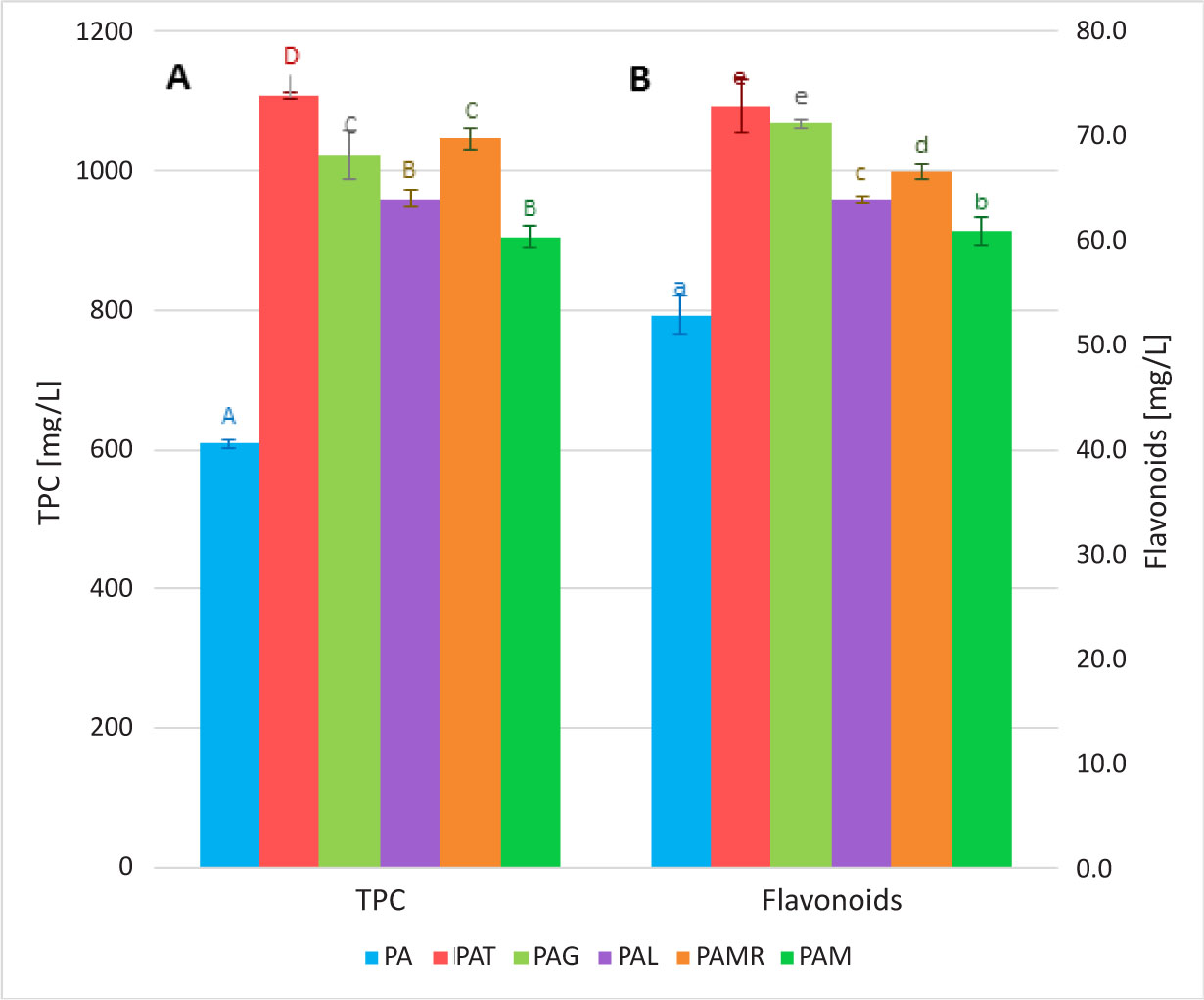
Figure 1.
(A) Total polyphenol content (TPC) and (B) flavonoids in analyzed beer variants. A, B…, a, b…– means sharing the same letter in column are not significantly different (p<0.05). Abbreviations – see Table 1.
Table 2.
Coloring of beers according to the EBC (Rum, 2005).
| EBC | Color | Description | Beer example |
|---|---|---|---|
| 1–4 | Straw, light yellow, light gold | Pale lager | |
| 5–8 | Yellow, gold | Pilsner | |
| 9–20 | Dark gold, dark yellow, amber | Wheat | |
| 21–35 | Light brown, brown, copper | Pale ale | |
| 36–60 | Brown | Bock | |
| > 60 | Dark brown, black | Stout |
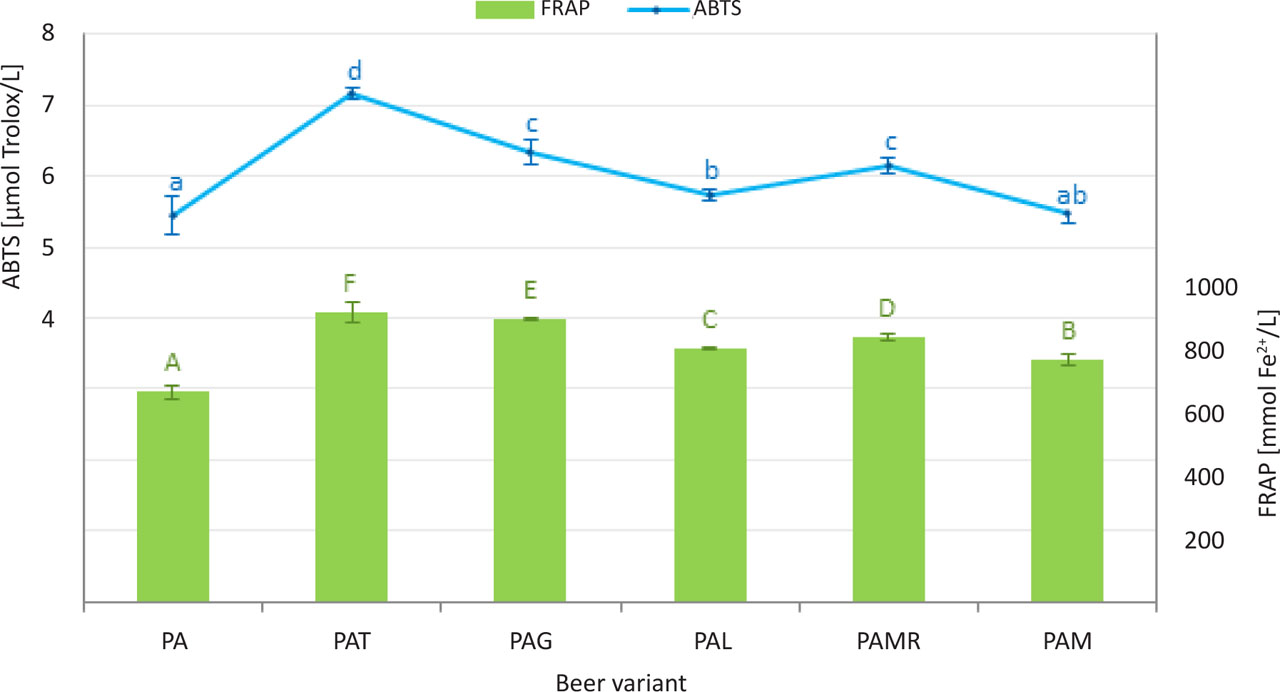
Figure 2.
Antioxidant activity FRAP and ABTS•+ cation radical of analyzed beer variants: PA – Pale Ale (control), PAT – Pale Ale with thyme, PAG – Pale Ale with ginger, PAL – Pale Ale with lavender, PAMR – Pale Ale with marjoram, PAM – Pale Ale with mint. A, B…, a, b… — means sharing the same letter in column are not significantly different (p<0.05)
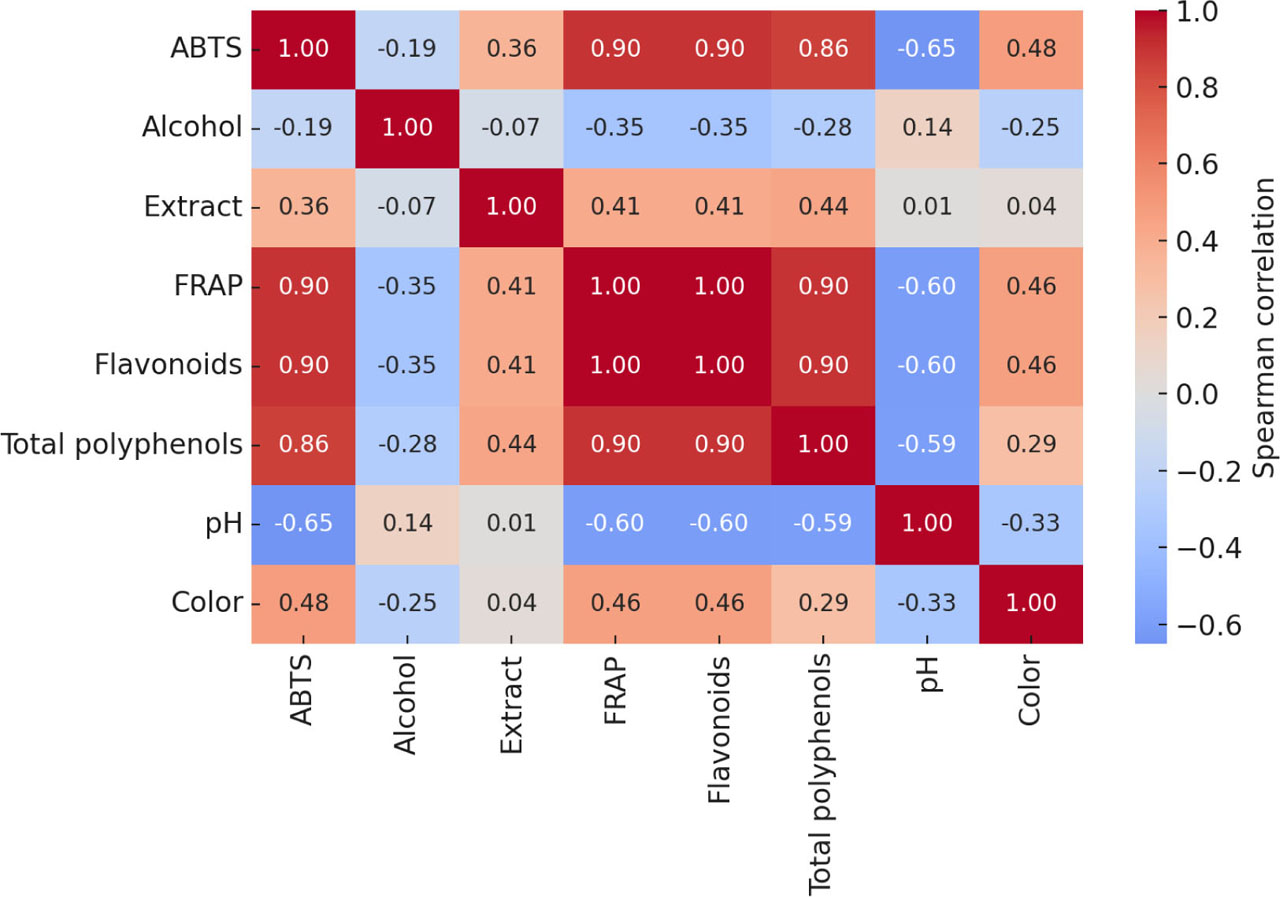
Figure 3.
Spearman rank correlation matrix between antioxidant activity (ABTS, FRAP), phenolic compounds (flavonoids, total polyphenols), physicochemical parameters (pH, alcohol, real extract), and color (EBC). Significant positive correlations were observed between radical cation ABTS•+, FRAP, flavonoids and total polyphenols, while pH showed a negative correlation with antioxidant parameters
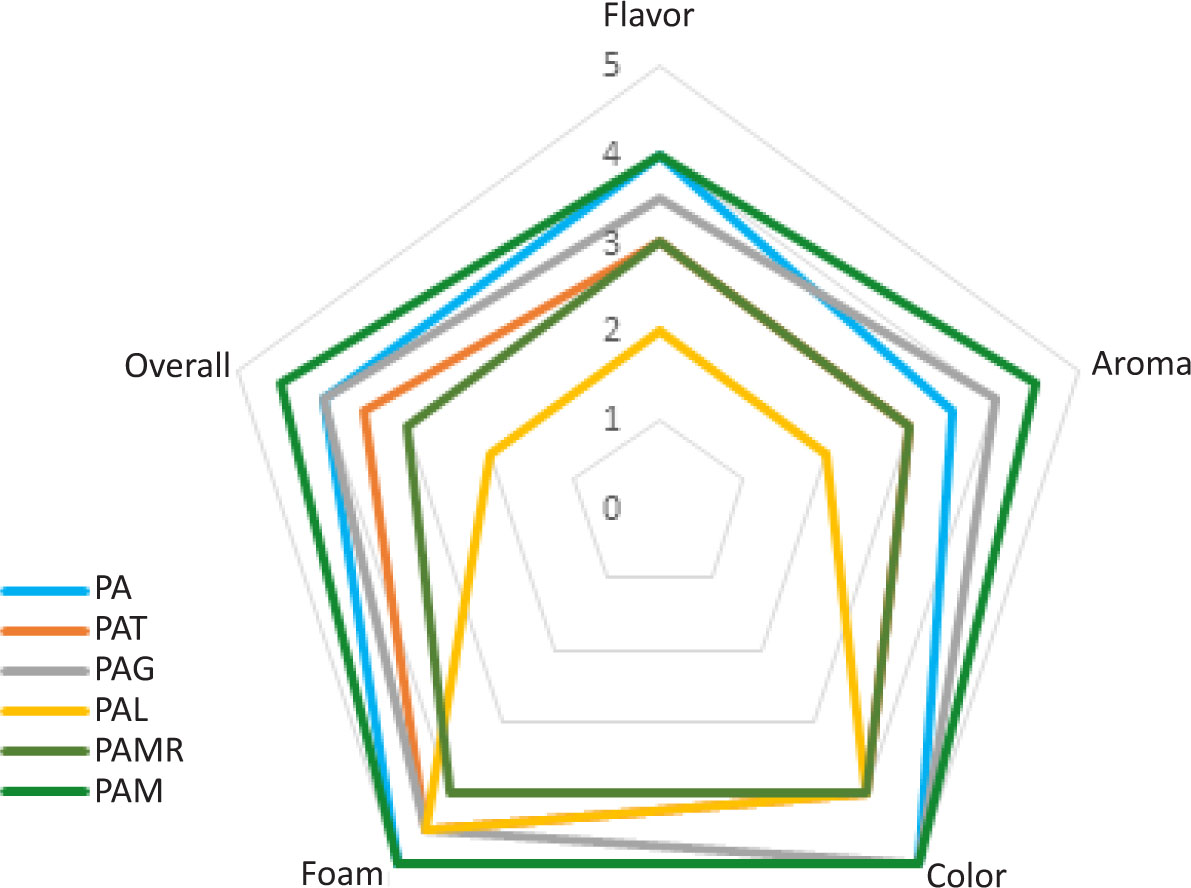
Figure 4.
Sensory evaluation of examined beers: PA – Pale Ale (control), PAT – Pale Ale with thyme, PAG – Pale Ale with ginger, PAL – Pale Ale with lavender, PAMR – Pale Ale with marjoram, PAM – Pale Ale with mint. Rating scale: 1 – lowest desirability, 5 – highest desirability
Table 3.
Results of sensory evaluation of examined beers.
| Beer variant# | Flavor | Aroma | Color | Foam (density/color) |
|---|---|---|---|---|
| PA | Bitter, slightly hoppy | Hoppy, malty | Pale golden | Thick, white |
| PAT | Astringent, herbal, slightly bitter | Distinctly herbal, thyme | Pale amber | Medium, creamy |
| PAG | Spicy, slightly sweet, herbal | Spicy, fresh ginger | Golden | Fine, white |
| PAL | Bitter, slightly floral | Floral, lavender | Pale golden | Medium, whitish |
| PAMR | Herbal, slightly astringent | Herbal, dried herbs | Honey-like | Low, creamy |
| PAM | Fresh, cooling, slightly sweet | Minty, intense | Pale golden | Thick, white |
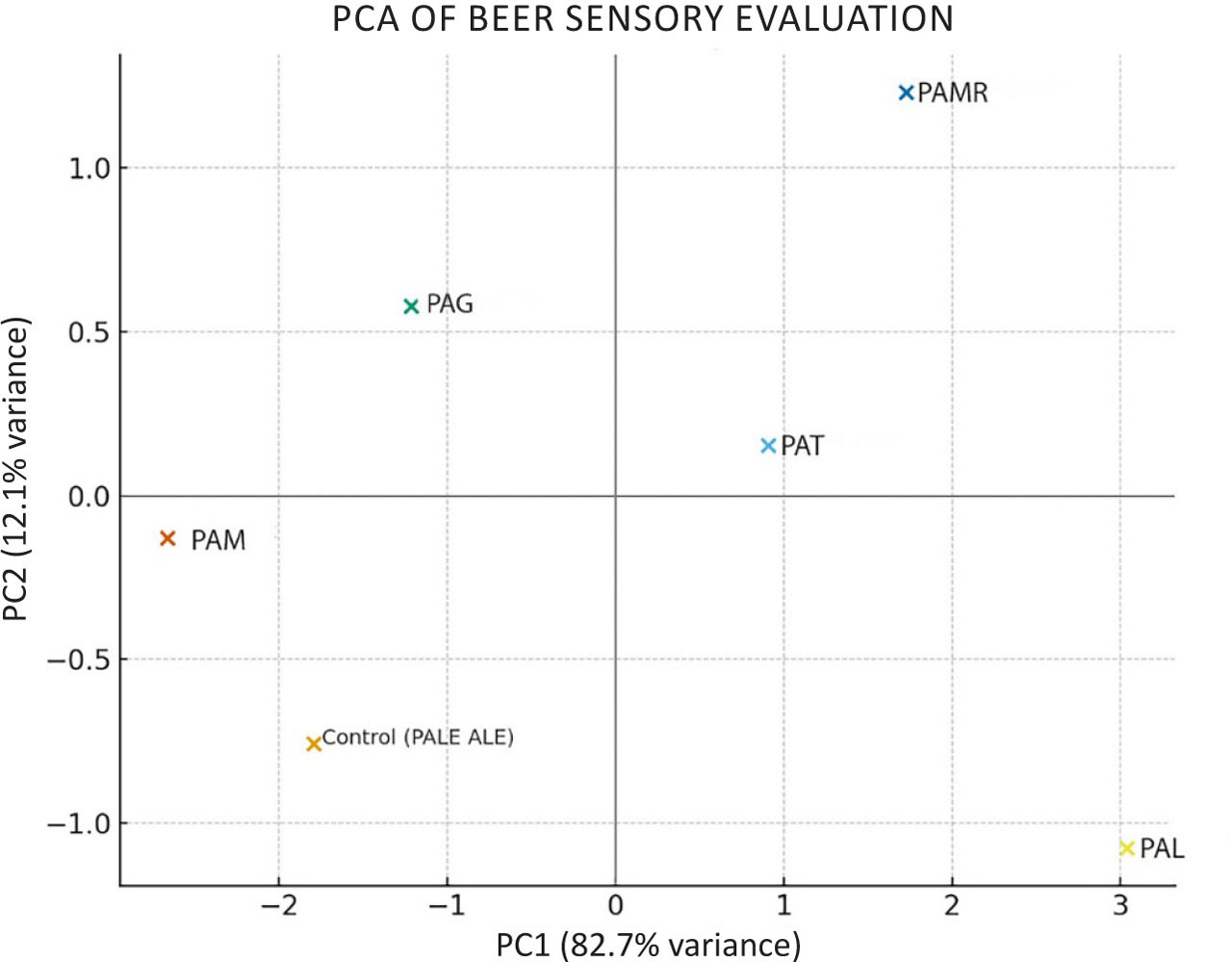
Figure 5.
Principal component analysis (PCA) in sensory evaluation of examined beers.