
1. Introduction
Across Europe, and in the Czech Republic, there is a growing concern surrounding the diets and health of children. Rising rates of overweight and obesity signal significant health risks, transforming healthy eating from personal advice into a pressing public health priority (Balasundaram and Daley, 2025; Dědina, Sanova, and Kadeřávková 2014; Løes and Nölting, 2011). Schools play an important part in shaping what children eat, since the habits they form during these years ohen stick with the children into adulthood (He et al., 2012; Menor-Rodriguez et al., 2022). People see school meals not just as a way to feed kids each day, but also as a chance to promote health and sustainability (Oostindjer et al., 2017; Pastorino et al., 2024).
The introduction of locally produced foods into school meal programs offers a lot of advantages to public health, especially for school-aged children. The inclusion of fresh, seasoned, and culturally appropriate local foods enhances nutritional quality and reduces reliance on processed foods. Local foods, especially fruits and vegetables, are ohen harvested at peak ripeness and consumed shortly aher, preserving their mineral and vitamin content (Chandra Yadav and Sinha, 2022). Most prospective studies found a strong negative correlation between eating organic food and cardiometabolic risk factors such as obesity, diabetes mellitus, hypertension, and hyperlipidemia (Poulia et al., 2025; Rahman et al., 2024; Thaise de Oliveira Faoro et al., 2024). In the Czech Republic, about 75% of children eat lunch in school canteens daily (Buglioni et al., 2022). But even though school canteens are widely used, the overall setup has not changed much over the years. Existing rules like Decree No. 107/2005 Coll. mostly focus on making sure that school meals have enough calories, although this does not cover the quality of the food, where it comes from, or how it is prepared (Severová et al., 2021; Won et al., 2020). Because of this gap, many school kitchens tend to rely more on processed foods. This is quite worrying since some studies suggest that Czech school meals only provide about 29% of what children need nutritionally each day. This points to broader issues, not just with the quality of the food, but also with how school meal budgets are managed (Buglioni et al., 2022). On top of this, the environmental impact is ohen ignored, and not much attention is paid to where the food comes from or how it is produced.
There is a growing movement to improve school meals by including more local and organic foods since they are more friendly to the environment and have better nutritional value (Ala-Karvia et al., 2022; Løes and Nölting, 2011). Countries like Italy and Denmark have managed to include over 50% of organic food in their school meals without significantly driving up costs. For instance, Austria includes organic food in about 10% of school meals, while the UK's “Food for Life” program requires the meals to contain at least 30% organic ingredients. In France, initiatives like “Eat Bio in Public Catering” have expanded organic offerings in schools (Doležalová et al., 2016; Nielsen et al., 2009). In contrast, progress in the Czech Republic has been slower. Programs like “Organic Food to Schools” and “Organic Schools” have struggled to gain momentum. More recently, efforts like “It's on Our Plate and We Care,” led by the Czech Ministry of Health along with Slow Food Prague and other partners, are trying to raise the bar for school meal quality (Perignon et al., 2022). But tight budgets and procurement policies that focus mostly on keeping the costs low formed a significant barrier on adopting sustainable food option. In addition, unreliable supply chains for organic food further hinder progress (Severová et al., 2021). The Czech Ministry of Agriculture reported that about 45%–50% of apples consumed in the Czech Republic are imported, raising concerns about transportation emissions and higher pesticide content in them. Organic apple cultivation remains limited due to low demand and limited market access for local producers (Delate et al., 2008; Jin et al., 2022). Incorporating more organic apples into school meals could help local farmers and give children healthier choices.
One of the main barriers to including organic foods in school meals is their perceived cost. While many parents generally want organic meals for their kids, the cost remains a significant concern (Jones et al., 2023; Nanayakkara et al., 2024).
Although several programs have aimed to improve school meal quality, there is limited peer-reviewed evaluation of their impact on children's health outcomes. There is a lack of studies in the Czech context assessing the changes in nutritional status and dietary behaviors that resulted from these programs. Parental acceptance and attitudes toward organic school meals remain understudied despite evidence reported from other countries (Kutman et al., 2025). The program reports suggest challenges like inconsistent supply and higher costs.
The cost implication of replacing 5% local and imported conventional apples with organically grown apples was calculated in response to the proposal by the Czech Ministry of Health to incorporate 5% organic ingredients into school meals by 2028. This is part of “It's on Our Plate and We Care” initiative. This analysis will support policymakers in understanding the financial feasibility of scaling up organic procurement in public catering.
The objective of this study is to look into how practical and affordable it would be to replace imported apples with local organic ones in Czech school meals. It explores how supply chains work and compare prices. In the end, it aims to find a way to create a win-win solution that benefits the environment, the school children, and the local organic farmers.
2. Methodology
2.1. Data Sources and Samples
A combination of primary and secondary data was used in this study to assess the cost implications of replacing imported conventional apples with locally produced conventional and organic apples in Czech school meals. The primary dataset (price data) was obtained from 35 local conventional apple farmers, 10 certified local organic apple farmers, and 15 importers of conventional apples. The consumption and preference data were obtained from 112 Czech school canteens, which provided information on the following: daily apple portion sizes by age group, current meal prices, and procurement behaviors and constraints. The data obtained were complemented with a literature search to source relevant data on apple pricing trends, organic food adoption in school meal systems, and sustainable procurement practices in Europe. These secondary data served as contextual support and validation for findings.
2.2. Calculation Template and Price Determination
To model the cost implications, we established a standardized cost calculation template as shown in Table 1. This table highlights the key parameters and data sources used to assess the cost implication of replacing imported apples with locally grown conventional and organic apples in Czech school meals. It contains baseline information from school canteen records, including daily meal weight, apple portion size by age group, and current meal cost. Apple prices were obtained from farmers, importers, and school canteens. The price varied depending on the production process. Generally, three scenarios were modeled, which included full replacement, partial replacement (5%), and mixed replacement, with corresponding recalculation of apple and total meal costs. The financial impact of each replacement scenario is measured by the percentage change in meal cost.
Table 1.
Overview of key parameters, data sources, and formulas used to model the cost implications of replacing imported apples with locally grown conventional and organic apples in Czech school meals.
Tabelle 1. Übersicht über die wichtigsten Parameter, Datenquellen und Formeln, die zur Modellierung der Kostenauswirkungen des Ersatzes importierter Äpfel durch lokal angebaute konventionelle und biologische Äpfel in tschechischen Schulmahlzeiten verwendet werden.
| Parameter | Formula/source | Description |
|---|---|---|
| Daily meal weight (g) | From school canteen data | Total weight of food served per child per day |
| Meal cost per portion (CZK) and Euro equivalent | From school canteen data | Base cost before substitution |
| Apple portion per meal (g) | From school canteen data | Standardized by age group (32.5 or 40 g) |
| Apple unit prices (CZK/kg) and (€/kg) equivalent | Farmer, importer, and school canteen data | Different by source and production method |
| Share of organic/local apples (%) | Scenario dependent | Fixed at 5% of total meal weight or full replacement |
| New apple cost per meal (CZK) and Euro equivalent | Weight × price | Split into conventional and organic portions |
| Total new meal cost (CZK) and Euro equivalent | Original meal cost + apple cost | Reflects the impact of substitution |
| % Change in meal cost | (New – original)/original × 100 | Indicates cost feasibility |
2.3. Replacement Models
We developed several replacement models and/or scenarios to replicate the practical pathways for integrating local and organic apples into school meals. These replacement models include the following:
Full replacement model: In this scenario, the imported conventional apples were fully replaced with either local conventional apples or local organic apples.
Partial replacement model (5% of the total meal weight): In this scenario, 5% of the total meal weight (473 g for ages 7–10 and 538 g for ages 11–14) was replaced with local organic apples. This scenario allowed for maintaining original apple portion sizes, combining local organic apples with imported or local conventional apples to maintain flavor and acceptance and encouraging gradual policy implementation. Mixed replacement scenario: The imported conventional apples were replaced by a combination of local organic apples and local conventional apples in this scenario.
2.4. Meal Cost Parameters by Age Group
The meal cost parameters were obtained from school canteens, as shown in Table 2. The baseline meal characteristics of Czech schoolchildren aged 7–10 and 11–14 are presented in this table. These include the total meal weight, standard apple portion size, and the corresponding base meal prices in Czech koruna (CZK) and Euros.
Table 2.
Baseline meal characteristics for Czech schoolchildren aged 7–10 and 11–14 years
Tabelle 2. Grundlegende Mahlzeitenmerkmale für tschechische Schulkinder im Alter von 7–10 und 11–14 Jahren
| Age group | Meal weight (g) | Apple portion (g) | Base meal price (CZK) | Base meal price (€) |
|---|---|---|---|---|
| 7–10 years | 473 | 32.5 | 35 | 1.4 |
| 11–14 years | 538 | 40.0 | 38 | 1.52 |
Figure 1 is a methodological framework that illustrates the different replacement scenarios modeled to assess the financial implications of substituting imported apples with locally grown conventional and organic apples in Czech school meals. It also highlights the different data sources and price modeling.
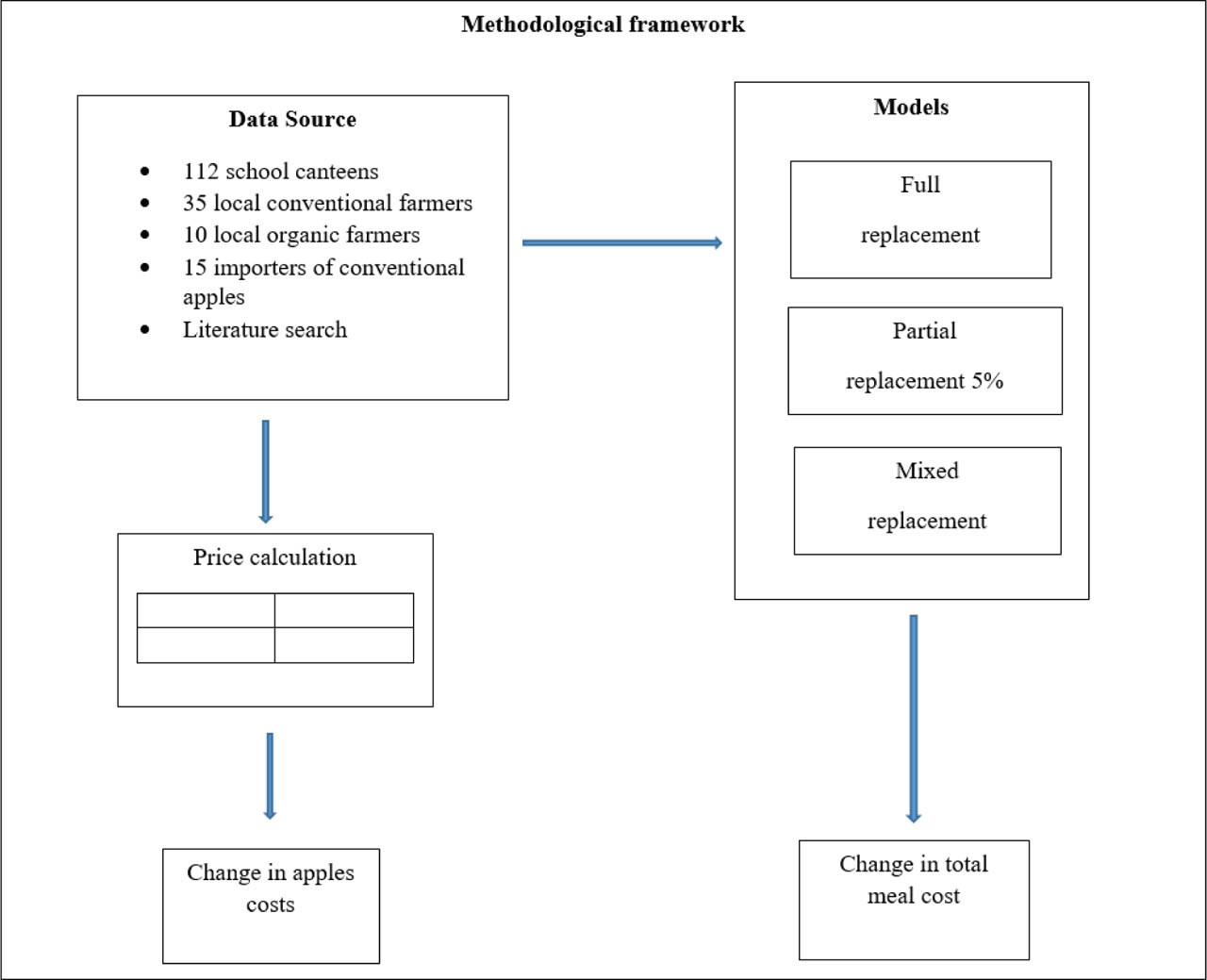
Figure 1.
Methodological framework for data collection, price modeling, and replacement models
Abbildung 1. Methodischer Rahmen für Datenerhebung, Preismodellierung und Ersatzmodelle
Note: The price of imported conventional apples is 22 CZK/kg (0.88 €/kg), the price of local conventional apples is 32 CZK/kg (1.28 €/kg), while the price of local organic apples is 40 CZK/kg, which shows a price difference of +10 CZK/kg (+0.4 €) and +18 CZK/kg (+0.72 €), respectively. For children aged 7–10, the standardized apple portion per meal is 32.5 g, while the standardized apple portion per meal for children aged 11–14 is 40 g.
3. Results
The cost implications of replacing imported conventional apples with local alternatives are presented in Figure 2. For children aged 7–10 years, replacing imported conventional apples with local conventional apples increased the meal price from 35.00 CZK to 35.33 CZK (+0.93%), and replacing them with local organic apples increased it to 35.59 CZK (+1.67%). For children aged 11–14 years, the substitution increased meal costs from 38.00 CZK to 38.40 CZK (+1.05%) for local conventional apples and to 38.72 CZK (+1.89%) for local organic apples. These modest rises suggest that introducing local apples, even organic ones, has a negligible effect on overall school meal costs.
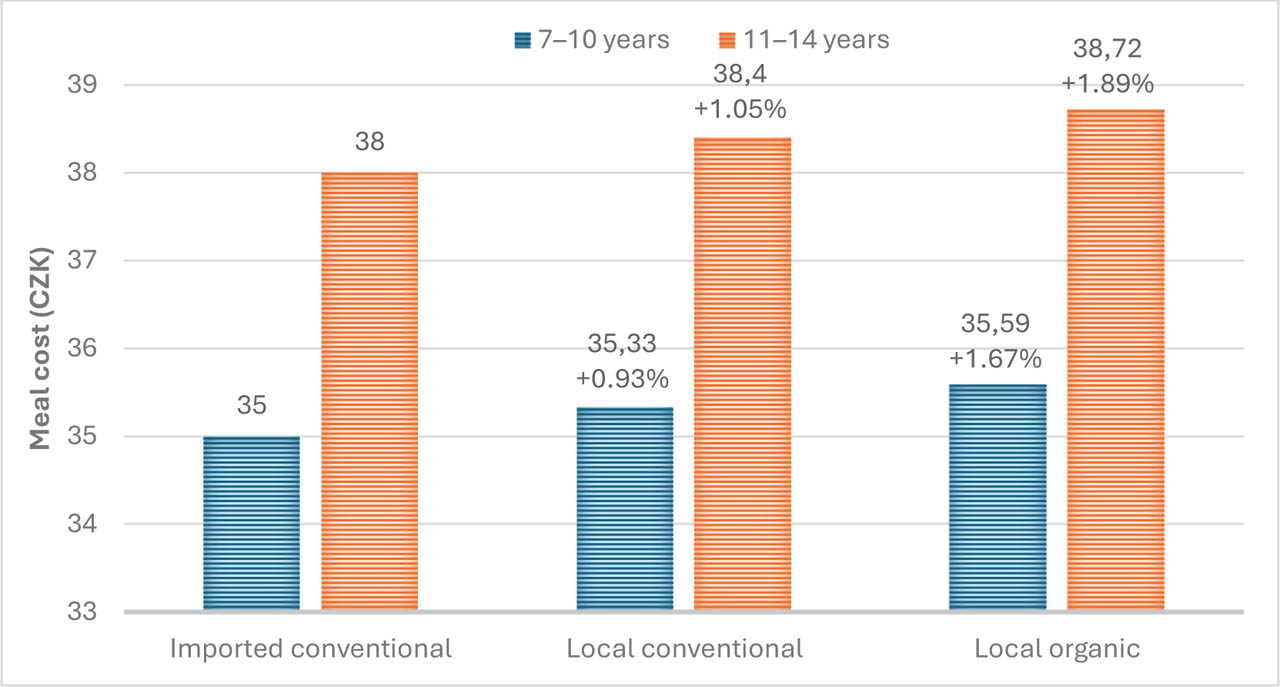
Figure 2.
Cost impact of replacing imported conventional apples with local apples in Czech school meals
Abbildung 2. Kostenauswirkungen des Ersatzes importierter konventioneller Äpfel durch lokale Äpfel in tschechischen Schulmahlzeiten
To better illustrate the source of these differences, Figure 3 shows the apple cost per portion under different sourcing scenarios. For ages 7–10, the cost of apples rose from 0.715 CZK (imported conventional) to 1.040 CZK (local conventional) and 1.300 CZK (local organic). For ages 11–14, the apple cost increased from 0.880 CZK (imported conventional) to 1.280 CZK (local conventional) and 1.600 CZK (local organic). While the apple component alone shows substantial variation, apples make up a minor amount of the entire meal, which explains why the overall cost increase per portion remains limited.
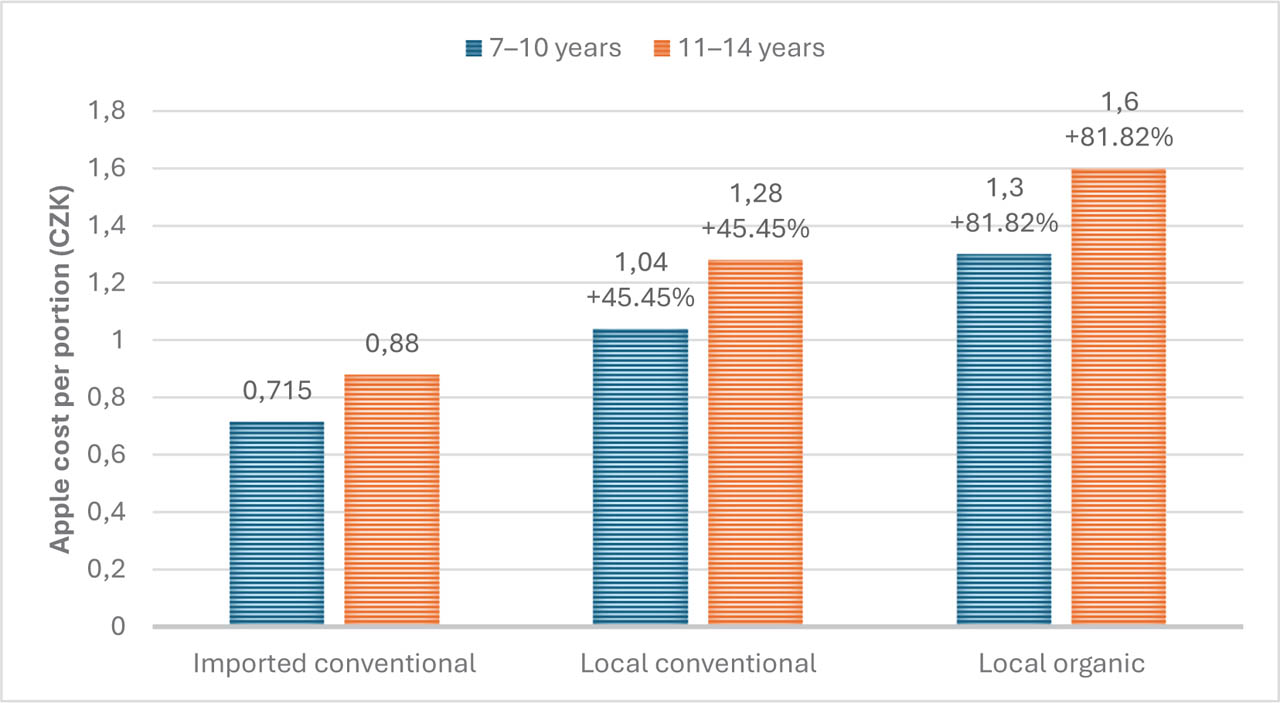
Figure 3.
Apple cost per meal portion under different sourcing scenarios in Czech school meals
Abbildung 3. Apfelkosten pro Mahlzeitportion unter verschiedenen Beschaffungsszenarien in tschechischen Schulmahlzeiten
The cost implications of introducing 5% local organic apples into Czech school meals for children aged 7–10 were analyzed and are shown in Table 3. The standard school meal portion weighs 473 g for this age category. The 5% target corresponds to 23.65 g of food per meal portion. By replacing this quantity with local organic apples, the total fruit serving is preserved without altering the meal composition, while retaining 8.85 g of imported conventional apples from the original 32.5 g apple portion. The gradual substitution of local organic option preserves some familiar conventional apples, possibly retaining taste approval.
Table 3.
Cost and quantity impact of replacing imported conventional apples with 5% local organic apples in Czech school meals (age 7–10)
Tabelle 3. Kosten- und Mengenauswirkungen des Ersatzes importierter konventioneller Äpfel durch 5 % lokale Bio-Äpfel in tschechischen Schulmahlzeiten (Alter 7–10)
| Parameter | Value/formula | Result | Euro (€) equivalent |
|---|---|---|---|
| Total weight of daily meal | - | 473 g | - |
| Meal price per portion | - | 35 CZK | 1.4 € |
| Current apple quantity (conventional) | - | 32.5 g (0.0325 kg) | - |
| Price of imported conventional apples | - | 22 CZK/kg | 0.88 €/kg |
| Price of local organic apples | - | 40 CZK/kg | 1.6 €/kg |
| Required organic share of meal | - | 5% | - |
| 5% of 473 g (organic inclusion target) | 473 × 0.05 | 23.65 g | - |
| Organic apple portion | Targeted for 5% share | 23.65 g (0.02365 kg) | - |
| Remaining conventional apple portion | 32.5–23.65 g | 8.85 g (0.00885 kg) | - |
| Original apple cost per meal | 0.0325 kg × 22 CZK/kg | 0.715 CZK | 0.028 € |
| New local organic apple cost per meal | 0.02365 kg × 40 CZK/kg | 0.946 CZK | 0.038 € |
| New imported conventional apple cost per meal | 0.00885 kg × 22 CZK/kg | 0.1947 CZK | 0.0078 € |
| Total apple cost aher change | 0.946 + 0.1947 CZK | 1.1407 CZK | 0.046 € |
| Increase in apple cost per meal | 1.1407 – 0.715 CZK | 0.4257 CZK | 0.017 € |
| New total meal price | 35 + 0.4257 CZK | 35.43 CZK | 1.42 € |
| Percentage increase in total meal price | (0.4257/35)× 100 | 1.22% | - |
Since each child receives 32.5 g apple per meal portion, the cost analysis reveals that the partial substitution (5%) increases the apple price per meal from 0.715 CZK to 1.1407 CZK. This translates to an increase of 0.4257 CZK per meal. In addition, the total daily meal cost rises from 35 CZK to 35. 43 CZK, reflecting a 1.22% increase in the total meal price. The cost and quantity implications of replacing local conventional apples in the meal portion with 5% local organic share in Czech school meals for children aged 7–10 were analyzed in this scenario (Table 4). The standard school meal portion for children within this age category is 473 g. The 5% target corresponds to 23.65 g of food per meal portion. By replacing this quantity with local organic apples, the total fruit serving is preserved without altering the meal composition, while retaining 8.85 g of imported conventional apples from the original 32.5 g apple portion. The gradual substitution of local organic options preserves some familiar conventional apples, possibly retaining taste acceptance.
Table 4.
Cost and quantity impact of replacing local conventional apples with 5% local organic apples in Czech school meals (age 7–10)
Tabelle 4. Kosten- und Mengenauswirkungen des Ersatzes lokaler konventioneller Äpfel durch 5 % lokale Bio-Äpfel in tschechischen Schulmahlzeiten (Alter 7–10)
| Parameter | Value/formula | Result | Euro (€) equivalent |
|---|---|---|---|
| Total weight of daily meal | - | 473 g | - |
| Meal price per portion | - | 35 CZK | 1.4 € |
| Current apple quantity (conventional) | - | 32.5 g (0.0325 kg) | - |
| Price of local conventional apples | - | 32 CZK/kg | 1.28 € |
| Price of local organic apples | - | 40 CZK/kg | 1.6 € |
| Required organic share of meal | - | 5% | - |
| 5% of 473 g (organic inclusion target) | 473 × 0.05 | 23.65 g | - |
| Local organic apple portion | Targeted for 5% share | 23.65 g (0.02365 kg) | - |
| Remaining local conventional apple portion | 32.5–23.65 g | 8.85 g (0.00885 kg) | - |
| Original apple cost per meal | 0.0325 kg × 32 CZK/kg | 1.04 CZK | 0.042 € |
| New local organic apple cost per meal | 0.02365 × 40 | 0.946 CZK | 0.038 € |
| New local conventional apple cost per meal | 0.00885 × 32 | 0.2832 CZK | 0.0113 € |
| Total apple cost aher change | (0.02365 × 40) + (0.00885 × 32) | 1.2292 CZK | 0.049 € |
| Increase in apple cost per meal | 1.2292 – 1.04 CZK | 0.1892 CZK | 0.0076 € |
| New total meal price | 35 + 0.1892 CZK | 35.1892 CZK | 1.41 € |
| Percentage increase in total meal price | (0.1892/35)× 100 | 0.54% | - |
Given that each child receives 32.5 g of apple per meal portion, the partial replacement (5%) raises the price of apple from 1.04 CZK to 1.2292 CZK per meal. This results in an increase of 0.1892 CZK per meal, raising the overall meal cost from 35 CZK to 35.1892 CZK, reflecting a 0.54% increase in total meal price.
This minimal rise in cost demonstrates that switching to local, organic apples based on partial substitution strategies is a viable way to shih toward sustainable school meal programs. A 0.54% rise in total meal cost is modest and allows the meal providers to meet the organic inclusion targets without a significant financial burden.
Table 5 analyzes the cost implications of substituting imported conventional apples with a combination of local organic and local conventional apples in Czech school meals. This evaluation is based on a standard total meal weight of 473 g and a daily apple portion of 32.5 g per meal. The 5% target corresponds to 23.65 g of organic food per meal portion. By replacing this quantity with local organic apples, the total fruit serving is preserved without altering the meal composition, while the remaining 8.85 g was substituted with local conventional apples to preserve the full apple portion.
Table 5.
Cost and quantity impact of replacing imported apples with local organic and conventional apples in Czech school meals (age 7–10)
Tabelle 5. Kosten- und Mengenauswirkungen des Ersatzes importierter Äpfel durch lokale Bio- und konventionelle Äpfel in tschechischen Schulmahlzeiten (Alter 7–10)
| Parameter | Value/formula | Result | Euro (€) equivalent |
|---|---|---|---|
| Daily meal weight | - | 473 g | - |
| Daily apple portion per person | - | 32.5 g | - |
| Local organic apples in this scenario | - | 23.65 g (0.02365 kg) | - |
| Local conventional apples in this scenario | - | 8.85 g (0.00885 kg) | - |
| Original cost (100% imported apples) | 0.0325 × 22 CZK/kg | 0.715 CZK | 0.029 € |
| New cost (local organic + local conventional) | 0.02365 × 40 + 0.00885 × 32 | 1.2292 CZK | 0.049 € |
| Cost increase per meal | 1.2292 – 0.715 | 0.5142 CZK | 0.021 € |
| New total meal price | 35 + 0.5142 CZK | 35.5142 CZK | 1.421 € |
| % increase in meal price | (0.5142/35)× 100 | 1.47% | - |
The original apple component was completely imported conventional apples priced at 22 CZK/kg, corresponding to 0.715 CZK per meal. With this scenario comprising 23.65 g of local organic apples at 40 CZK/kg and 8.85 g of local conventional apples at 32 CZK/kg, the overall cost of the meal increases by 1.47%, from 35 CZK to 35.5142 CZK, translating to a 0.5142 CZK cost increase.
This substitution model strikes a compromise between financial limitations and public procurement objectives. Partial inclusion strategies provide a pragmatic, cost-effective compromise for transitioning from imported to local sourcing. A 1.47% rise in total meal cost is modest and allows the meal providers to meet the local inclusion targets without a significant financial burden. This strategy supports multiple sustainability goals such as reducing food miles, lowering carbon footprint, gradual fulfillment of organic procurement targets, and supporting regional agriculture.
Table 6 analyzes the financial and quantity changes when replacing a portion of imported conventional apples in school meals with a small percentage (5%) of local organic apples in the Czech Republic for children aged 11–14. It focuses on the apples' portion within the meal and the resulting cost impact on the total meal price. The table explores a hypothetical modification of the school meal composition to increase the share of local organic apples while reducing the amount of imported conventional apples. The main goal is to understand how introducing 5% local organic apples by weight affects the quantity of apples served, the cost of apples per meal, the overall meal price, and the economic feasibility of incorporating local organic produce into school meals. This is important because increasing the local organic share aligns with health, sustainability, and local economic development goals. Introduction of 5% local organic apples increases the apple costs by 55% (from 0.88 CZK to 1.36 CZK). However, since apples are only a small part of the total meal cost, the overall meal price rises modestly (1.27%). This suggests that increasing local organic produce in school meals is financially feasible without causing major cost shocks. The trade-off is justified if local organic apples improve nutritional quality, reduce pesticide exposure, and support local farmers. The 5% target corresponds to 26.9 g of organic apples, which is about two-thirds of the original apple portion (40 g). The partial substitution keeps some familiar conventional apples, potentially maintaining taste acceptance while introducing local organic options gradually. This stepwise approach could help schools, students, and suppliers adjust to the new product mix. Economically, purchasing local organic apples supports local agriculture, potentially improving regional economic development. It may also reduce the carbon footprint due to less transportation. However, supply consistency and quality must be ensured to maintain school meal standards.
Table 6.
Cost and quantity impact of replacing imported conventional apples with 5% local organic apples in Czech school meals (age 11–14)
Tabelle 6. Kosten- und Mengenauswirkungen des Ersatzes importierter konventioneller Äpfel durch 5 % lokale Bio-Äpfel in tschechischen Schulmahlzeiten (Alter 11–14)
| Parameter | Value/formula | Result | Euro (€) equivalent |
|---|---|---|---|
| Total weight of daily meal | - | 538 g | - |
| Meal price per portion | - | 38 CZK | 1.52 € |
| Current apple quantity (conventional) | - | 40 g | - |
| Price of imported conventional apples | - | 22 CZK/kg | 0.88 € |
| Price of local organic apples | - | 40 CZK/kg | 1.6 € |
| Required organic share of meal | - | 5% | - |
| 5% of 538 g (organic inclusion target) | 538 × 0.05 | 26.9 g | - |
| Local organic apple portion | Targeted for 5% share | 26.9 g (0.0269 kg) | - |
| Remaining local conventional apple portion | 40–26.9 g | 13.1 g (0.0131 kg) | - |
| Original apple cost per meal | 0.04 kg × 22 CZK/kg | 0.88 CZK | 0.035 € |
| New local organic apple cost per meal | 0.0269 kg × 40 CZK | 1.076 CZK | 0.043 € |
| New imported conventional apple cost per meal | 0.0131 kg × 22 CZK | 0.2882 CZK | 0.012 € |
| Total apple cost aher change | (0.0269 × 40) + (0.0131 × 22) | 1.3642 CZK | 0.055 € |
| Increase in apple cost per meal | 1.3642 – 0.88 CZK | 0.4842 CZK | 0.019 € |
| New total meal price | 38 + 0.4842 CZK | 38.4842 CZK | 1.539 € |
| Percentage increase in total meal price | (0.4842/38)× 100 | 1.27% | - |
Table 7 presents the quantitative and economic effects of using organic apples in Czech school meals for children aged 11–14. The aim is to replace a small percentage (5% by weight) of the current conventional apple serving with organic apples. The impact of this change will be calculated in terms of how many apples are served (organic vs. conventional), how much each meal costs, and how much the meal costs overall. To prepare budgets and promote better, sustainable food options in schools, it is important to understand the practical and budgetary ramifications of incorporating organic apples into school meals. Each meal weighs 538 g in total for 38 CZK per meal. The meal currently includes 40 g of conventional local apples. This is part of the overall 538 g meal. Organic apples cost 40 CZK/kg, which is more expensive by 8 CZK/kg than conventional apples. This is expected due to their farming methods and certification.
Table 7.
Cost and quantity impact of replacing local conventional apples with 5% local organic apples in Czech school meals (age 11–14)
Tabelle 7. Kosten- und Mengenauswirkungen des Ersatzes lokaler konventioneller Äpfel durch 5 % lokale Bio-Äpfel in tschechischen Schulmahlzeiten (Alter 11–14)
| Parameter | Value/formula | Result | Euro (€) equivalent |
|---|---|---|---|
| Total weight of daily meal | - | 538 g | - |
| Meal price per portion | - | 38 CZK | 1.52 € |
| Current apple quantity (conventional) | - | 40 g | - |
| Price of local conventional apples | - | 32 CZK | 1.28 € |
| Price of local organic apples | - | 40 CZK | 1.6 € |
| Required organic share of meal | - | 5% | - |
| 5% of 538 g (organic inclusion target) | 538 × 0.05 | 26.9 g | - |
| Local organic apple portion | Targeted for 5% share | 26.9 g (0.0269 kg) | - |
| Remaining local conventional apple portion | 40–26.9 g | 13.1 g (0.0131 kg) | - |
| Original apple cost per meal | 0.04 kg × 32 CZK/kg | 1.28 CZK | 0.051 € |
| New local organic apple cost per meal | 0.0269 kg × 40 CZK | 1.076 CZK | 0.043 € |
| New local conventional apple cost per meal | 0.0131 kg × 32 CZK | 0.4192 CZK | 0.017 € |
| Total apple cost aher change | 0.0269 × 40 + 0.0131 × 32 | 1.4952 CZK | 0.0598 € |
| Increase in apple cost per meal | 1.4952 – 1.28 | 0.2152 CZK | 0.009 € |
| New total meal price | 38 + 0.2152 CZK | 38.2152 CZK | 1.529 € |
| Percentage increase in total meal price | (0.2152/38)× 100 | 0.57% | - |
The table reveals that introducing organic apples to represent 5% of the meal weight increases apple costs modestly, by about 17% (from 1.28 CZK to 1.495 CZK per meal on apples alone), but because apples are only a portion of the meal, the total meal cost increases by only 0.57%. This suggests that small inclusions of organic produce in school meals are financially feasible without causing a significant increase in total meal cost. The approach balances cost and nutritional or ethical goals by incrementally increasing the organic content, which could improve the health and environmental impact of school meals. For policymakers or school food planners, this is useful data showing that gradual introduction of organic ingredients is affordable.
The analyses of the cost and quantity implications of substituting imported apples in school meals with a mix of local organic and local conventional apples for children aged 11– 14 in the Czech Republic are presented in Table 8. The primary goal is to assess the financial impact of supporting local agriculture and potentially healthier apple options (organic and conventional) in school nutrition. Each student receives 40 g of apples as part of a 538 g daily meal, which makes up about 7.4% of the overall meal weight. So, in the new mix, 26.9 g of the apples are organic, while 13.1 g are conventional. This shows that shihing to local apples increases the total cost of the meal by a modest 1.62%, or around 0.62 CZK per meal. It can be deduced that the cost increase per student is very minimal (0.6152 CZK), which, even when scaled across hundreds or thousands of students, remains a manageable increase in school budgets. A 1.62% increase in meal cost is relatively low and could be offset through minor efficiency adjustments or subsidies.
Table 8.
Cost and quantity impact of replacing imported apples with local organic and conventional apples in Czech school meals (age 11–14)
Tabelle 8. Kosten- und Mengenauswirkungen des Ersatzes importierter Äpfel durch lokale Bio- und konventionelle Äpfel in tschechischen Schulmahlzeiten (11–14 Jahre)
| Parameter | Value/formula | Result | Euro (€) equivalent |
|---|---|---|---|
| Daily meal weight | - | 538 g | - |
| Daily apple portion per person | - | 40 g | - |
| Local organic apples in this scenario | - | 26.9 g (0.0269 kg) | - |
| Local conventional apples in this scenario | - | 13.1 g (0.0131 kg) | - |
| Original cost (100% imported apples) | 0.04 × 22 CZK/kg | 0.88 CZK | 0.035 € |
| New cost (local organic + local conventional) | 0.0269 × 40 + 0.0131 × 32 | 1.4952 CZK | 0.0598 € |
| Cost increase per meal | 1.4952 – 0.88 | 0.6152 CZK | 0.025 € |
| New total meal price | 38 + 0.6152 | 38.6152 CZK | 1.545 € |
| % increase in meal price | (0.6152/38)× 100 | 1.62% | - |
It is worth noting that switching to local apples, especially organic apples, supports local farmers and reduces the carbon footprint associated with apple transportation. It also encourages organic agriculture, which is more environmentally friendly. Local and especially organic apples are perceived to be fresher, possibly nutrient rich, and pesticide free, which invariably improves the quality of food served in schools, promoting long-term health benefits.
4. Discussion
The shih toward more sustainable and healthier food systems in Czech public schools, as indicated by the replacement of imported conventional apples with local apples, presents both challenges and opportunities. The findings of this study provide evidence that it is economically possible to integrate locally grown and organic apples into Czech school meal systems with a slight cost increase per meal portion. Even in the most expensive scenario, where imported conventional apples were completely replaced by local organic apples, the overall cost increase was limited to 1.89% for children aged 11–14. Such marginal increase challenges the prevalent belief that organic and local food options are costly for public institutions (Doležalová et al., 2016; Løes and Nölting, 2011; Nielsen et al., 2009).
School meal reform has gained notable attention across Europe, promoting healthier diets, local food economies, and environmental sustainability (Ala-Karvia et al., 2022; Løes and Nölting, 2011; Perignon et al., 2022). According to Dědina et al. (2014), the widespread use of school meal systems makes it powerful intervention tools. However, Czech school meals still lack stricter regulations for quality and provenance (Václavík, 2024). The integration of local and organic apples provides a low-risk starting point for changing this paradigm.
Although local organic apples are more expensive (up to 18 CZK/kg higher) than the imported conventional varieties, their impact on the total meal cost is moderated by the small proportion of fruit in meals. For example, even a 5% organic share by weight raised the meal costs by just 0.57%–1.27%, depending on the age group and the apple source. This support (Ala-Karvia et al., 2022; Doležalová et al., 2016; Rantala et al., 2021) who reported that the partial inclusion of organic foods can be affordable if managed and scaled appropriately.
Substituting imported apples with the locally grown ones has a significant benefit to the environment. This reduces food miles and transportation-related carbon emissions, a major source of emissions from the food systems (Buglioni et al., 2022; Psota, 2010; Rockström et al., 2017). Particularly, organic apples are grown without synthetic inputs, reducing ecological externalities and promoting biodiversity (Lososová et al., 2014; Samnegård et al., 2019). The body of literature has linked production of organic apples to reduced nitrate leaching, higher soil quality, and healthier orchard ecosystems (Li et al., 2024; Tóth et al., 2024; Zhao et al., 2020).
Local procurement plays a vital role in supporting rural livelihoods and strengthens regional food systems (Marsden et al., 2000; Molin et al., 2024; Pixová and Plank, 2024; Stein et al., 2024; Varecha et al., 2025). These are very crucial in post-industrial landscapes such as the Czech Republic. Despite favorable weather for apple production in the Czech Republic, local and organic varieties have struggled due to poor demands (Doležalová et al., 2016). Farmers can achieve stable market by incorporating more local produce into public procurement channel (Morgan and Sonnino, 2008; Sonnino and Marsden, 2006).
The gradual increase indicated in this study, specifically the inclusion of only 5% organic apples, is a very successful strategy. It reduces the environmental effects and preserves the nutritional value, while also easing the logistical challenges associated with abrupt supply chain changes (Doležalová et al., 2016; Løes and Nölting, 2011). Gradual inclusion supports farmer transition, allows for institutional adaptation, and enables policymakers to evaluate outcomes over time (Markiewicz-Keszycka et al., 2025; Michelsen, 2001; Shakoor et al., 2024).
Contrary to wider beliefs, the parental opposition to price increases may be exaggerated. Studies have shown that Czech parents support healthier school food, particularly when price increases are slight (Buglioni et al., 2022; Dědina et al., 2014). Similarly, good practice examples in Denmark and Italy show that consumer education and visibility of health/environmental benefits enhance public support for organic integration (Aweke, 2025; Cicia et al., 2009).
However, policy and procurement frameworks remain a critical impediment. Procurement laws ohen favor the lowest bidder, rather than emphasizing food origin, quality, or ecological value (Leão et al., 2023; Morgan and Sonnino, 2007). Institutional change may require updating the procurement criteria to include sustainability metrics and training for canteen managers and suppliers (Perignon et al., 2022; Schneider and Wallenburg, 2012). The Czech Republic can pick up from initiatives that use multi-criteria procurement methods like France's “Eat Bio in Public Catering” or the UK's “Food for Life” standard (Nielsen et al., 2009). From a nutrition perspective, school meals play a significant role in shaping children's eating habits. Early exposure to organic and minimally processed foods may enhance long-term dietary choices (Mazzocchi et al., 2021). This is particularly significant in the Czech context, where childhood obesity and diet-related diseases are rising (Sigmund et al., 2023). This study suggests that the integration of organic and locally grown apples in Czech schools is completely feasible and sustainable. A little adjustment can yield measurable benefits to local economic development, nutrition, and sustainability. The findings provide a useful information for decision makers seeking to reform public food procurement in accordance with health and environmental goals.
5. Conclusion
The results of this study show that the integration of locally grown and organic apples into Czech school meals is economically feasible as well as environmentally beneficial. Cost increases remain relatively small (0.54%–1.89%) across difference substitution scenarios and age group, even when imported conventional apples are fully replaced with local organic alternatives. These minimal price increases are not likely to impose significant financial burdens on school budgets or parental contributions, given the limited amount of apples in school meals.
Aside financial benefits, transitioning to organic and locally grown apples offers a pathway toward healthier diets and lower environmental effects and improves local food systems. The results support a stepwise transformation approach, such as beginning with 5% organic inclusion, which facilitates institutional adaptation, eases supply chain constraints, and encourages involvement of farmers in sustainable agriculture.
Organic apple production in the Czech Republic has been steadily increasing, although the actual production in tons is not known. The information gathered from the organic apple farmers during the survey reveals that a greater percentage of the organic apples are sold as conventional because most people are not willing to pay more for them. Introducing organic apples into school meal systems will ameliorate this loss for farmers. Regional short supply chains and existing producer cooperatives can ensure reliable delivery, particularly when combined with seasonal menu planning.
This study shows that, despite public concerns about high costs and low acceptability, local procurement and organic inclusion can be achievable with careful planning. The information provided here offers practical insights for procurement agencies, school administrators, and policymakers who want to improve food quality, promote sustainability, and support local economies without compromising affordability.
Future research should assess the long-term nutritional impacts, logistical feasibility, and broader sustainability outcomes of including more local and organic food components in school meal systems.
Acknowledgment
This paper is a result of the project NAZV QL24020332 – FOODLOC, supported by the Czech Ministry of Agriculture.