
1. Introduction
One of the most significant grain legumes consumed by humans is the common bean (Phaseolus vulgaris L.). In many nations around the world, particularly in developing Latin American economies, it serves as one of the primary sources of protein and other nutrients like vitamins, minerals, unsaturated fatty acids, and dietary fiber (Celmeli et al., 2018). Kosovo has a long tradition of cultivating common beans, resulting in the development and preservation of numerous local landraces. Common bean seeds have a protein concentration (PC) of 20%–25% (Aliu et al., 2014). Globally, water deficits reduce bean yields by more than 60%, with average yields dropping to approximately 0.9 t ha−1 (Moliehi et al., 2017). This situation is becoming more complex due to the effect of climate change on precipitation patterns, which affects the availability of water in agricultural systems, as well as the incidence of intense rainfall events such as storms that destroy crops and jeopardize food security in many regions of the planet (Kumar et al., 2018). A period of below-normal precipitation that restricts plant productivity in a natural or agricultural setting is known as a drought spell. Drought has a negative impact on several vital biological processes of plants and in different stages of their life cycle, especially during germination when they are more vulnerable and their establishment, subsequent development, and yield are defined. This type of abiotic stress influences various morphological and physiologic parameters such as germination percentage (Channaoui et al., 2017), length of vegetative organs, dry and fresh mass, vigor (Rezende et al., 2017), chlorophyll content, and photosynthetic activity (Mujtaba et al., 2016), among others. Plants exhibit a wide range of adaptive responses to water deficit, including morphological, physiologic, and biochemical modifications. These include reduced stomatal conductance (Duan and Cai, 2012), synthesis of osmotically active compounds such as soluble sugars and amino acids that modulate tissue osmotic potential (Queiroz and Cazetta, 2016), and induction of antioxidant defense mechanisms (Hellal et al., 2018). As defined by Ashraf and Iram (2005), drought tolerance refers to the plant's ability to sustain yield under moderate water stress, rather than the capacity to survive prolonged and severe drought. Leaf temperature usually deviates from ambient air temperature due to transpiration cooling. Thus, in studies evaluating the physiologic impact of vapor pressure deficit (VPD) from the plants' perspective, researchers frequently utilize leaf-level VPD, which is calculated based on leaf temperature (Grossiord et al., 2020). Plant and ecosystem responses to increasing VPD are complex, involving both increases and decreases in water consumption and transport rates, influenced by VPD magnitude and interacting environmental factors such as soil moisture (Whitehead and Jarvis, 1981; Benyon et al., 2001). It is ohen challenging to isolate the effects of VPD on vegetation from co-varying factors such as radiation, temperature, and atmospheric CO2 concentrations, as most empirical studies investigate these variables in combination. Under high VPD conditions, plants typically close their stomata to minimize water loss and avoid excessive xylem tension, which in turn reduces photosynthesis (Running, 1976). The common bean (Phaseolus vulgaris L.), a C3 species, utilizes the enzyme ribulose-1,5-bisphosphate carboxylase/oxygenase (RUBISCO) to fix CO2 into 3-phosphoglycerate (Lobato et al., 2010). Chlorophylls a and b are key photosynthetic pigments that primarily absorb light through photosystem II in the antenna complex, initiating electron transport (Taiz and Zeiger, 2010). In conditions of elevated VPD, regulating stomatal conductance to reduce transpiration can conserve water and improve transpiration efficiency, contributing to sustained plant growth during subsequent drought stress. Stomatal conductance (gs), typically measured in mol H2O m−2 s−1, tends to decrease sharply with rising VPD. Species specific stomatal responses to daily VPD fluctuations can significantly impact CO2 assimilation (CA). For instance, in Zea mays L.) in some results from (Cunningham, 2004) showed that decreased by 9.4%, 13.6%, 21.0%, 29.4%, and 36.6% was under increasing VPD levels, Particularly, when VPD exceeds 2 kPa, it is essential to assume that intercellular airspaces remain saturated with water vapor for accurate calculation of gas exchange parameters such as gs (Cernusak et al., 2013). This assumption enables the estimation of vapor pressure from leaf temperature (Gaastra, 1959) and is critical for determining intercellular CO2 concentration (Ci). Intrinsic water use efficiency (iWUE = A/gs) serves as an indicator of the balance between carbon assimilation and water loss. The response of photosynthesis to increasing VPD depends both on stomatal sensitivity and on how water use efficiency (WUE) varies under such conditions. At low to moderate VPD, iWUE may increase due to reductions in gs without corresponding declines in A. However, under high VPD, photosynthesis is eventually constrained by both stomatal and non-stomatal limitations, including decreased mesophyll conductance and declining soil water availability (Flexas et al., 2012). Given the genetic diversity in drought tolerance among common bean genotypes, considerable efforts have been made to identify tolerant lines at different developmental stages. One widely adopted approach involves evaluating seed germination and emergence under simulated drought conditions using polyethylene glycol (PEG), which restricts water uptake and affects various physiologic processes (Mujtaba et al., 2016). PEG is commonly used in in vitro systems, such as Petri dish assays, to induce osmotic stress and maintain constant water potential throughout experiments. Several studies have utilized PEG as a reliable drought stress inducer for screening drought-tolerant germplasm (Turkan et al., 2005). Due to its relatively inert nature and ability to mimic water deficit, PEG is considered superior to other compounds for inducing artificial drought stress (Kaur et al., 1998; Ashraf and Iram, 2005). The objective of this study was to evaluate the effects of PEG 6000-induced drought stress in soil on the morphological and photosynthetic traits of common bean seedlings.
2. Material and methods
2.1. Plant material and growth conditions
The study included five common bean genotypes originating from various locations and regions of Kosovo (Table 1). Five seeds of each genotype were sown in pots which contained 1 kg of compost. The pots were placed in controlled environment chambers with a 12-h photoperiod and day/night temperatures of 25/19 °C, maintaining 75% relative humidity. The experiment was conducted in a randomized complete block design with three replications. The compost characteristics were as follows: pH (CaCl2) = 5.7, salt concentration (KCl) = 0.8 g L−1, mineral nitrogen (NH4+ + NO3−) = 128 mg L−1 CaCl2 extract, phosphorus (P2O5) = 158 mg L−1 CAL (Calcium-Acetate-Lactate) extract, and potassium (K2O) = 201 mg L−1 CAL extract. Water stress was induced using PEG 6000, a non-ionic, water-soluble polymer. Three treatments (T) were applied by dissolving PEG in distilled water at concentrations of 0% (control), T1 (10%), and T2 (15%) (w/v), respectively. The experiment was conducted at the Laboratory of Plant Breeding, Department of Crop Science, Faculty of Agriculture and Veterinary, University of Pristina. Several morphological (Table 2) and physiologic parameters were measured to assess the effects of the treatments.
Table 1.
Common bean genotypes used in this study
Tabelle 1. In dieser Studie verwendete Genotypen der Gartenbohne
| Common Bean | Location | Region | Coordinates |
|---|---|---|---|
| G1 | Likovc | Skenderaj | 42.6639°N 20.7535°E |
| G2 | Arllat | Drenas | 42.5475°N 20.7980°E |
| G3 | Dobroshec | Drenas | 42.5463°N 20.7882°E |
| G4 | Tupec | Prizren | 42.2031°N 20.6850°E |
| G5 | Landovica | Prizren | 42.2593°N 20.6811°E |
Table 2.
Description of the measured morphological parameters
Tabelle 2. Beschreibung der gemessenen morphologischen Parameter
| Traits | Description/Method |
|---|---|
| ShL | Maximum fresh shoot length (cm), measured from the base of the stem to the top of the plant |
| ShFW | Shoot fresh weight (g) |
| ShDW | Shoot dry weight (g) aher drying for 48 h at 70 ± 5 °C |
| RL | Maximum fresh root length (cm), measured from the node where it divides from the stem to the top of the main root |
| RFW | Root fresh weight (g) |
| RDW | Root dry weight (g) aher drying for 48 h at 70 ± 5 °C |
| PC | Protein concentration in %, determined by the Kjeldahl method (digestion of organic matter with sulfuric acid in the presence of a catalyst, rendering the reaction product alkaline, then distillation and titration of the liberated ammonia, calculation of the nitrogen content, and multiplication of the result by the conventional factor 6.25 to obtain the crude PC) |
2.2. Chlorophyll (a, b, and total) and carotenoid analysis
To extract the pigments, 60–80 mg of freshly harvested leaves were ground in 80/20% (v/v) acetone/water containing 0.5% (w/v) MgCO3, and the mixture was incubated at room temperature in the dark for 24 h. Photosynthetic pigments were extracted from each sample in triplicate. Chlorophyll and carotenoid concentrations were determined by measuring the absorbance at 663, 644, and 452.5 nm, corresponding to the maximal absorption of chlorophyll a (Chl a), chlorophyll b (Chl b), and carotenoids, respectively. A SECOMAM Anthelie Advanced 5 ultraviolet–visible spectrophotometer was used to measure absorbance and calculate pigment concentrations using extinction coefficients. Pigment concentrations were calculated in milligrams per gram of dry leaf weight (mg g−1 DW) following the equations and absorption coefficients described by Lichtenthaler (1986), Aliu et al. (2013), and Jakupi et al. (2022):
Chl a (mg g−1 DW) = [10.3 (OD663) − 0.918 (OD644)] × V × 100/FW × DW
Chl b (mg g−1 DW) = [19.7 (OD644) − 3.87 (OD663)] × V × 100/FW × DW
Carotenoids (mg g−1 DW) = [4.75 (OD452.5) − 0.226 (Chl a+ Chl b)] × V × 100/FW × DW
2.3. Measurements of physiologic parameters
The experimental design consisted of five genotypes (G) × three treatments (T) × three replications, totaling 45 pots. Each pot contained five plants, resulting in 225 plants evaluated in total. Measurements were conducted between 9:00 AM and 11:00 AM. Photosynthetic CA rate (CA; mol CO2 m−2 s−1), stomatal conductance (gs; mol H2O m−2 s−1), intercellular CO2 concentration (Ci; μmol CO2 mmol−1 H2O), transpiration rate (E; mmol H2O m−2 s−1), VPD (kPa), and WUE (μmol CO2 per mmol H2O) were determined using a CIRAS-4 portable photosynthesis system (PP Systems, Boston North Technology Park, USA). For each treatment, five plants were randomly selected for measurements. All measurements were conducted on fully expanded leaves under controlled environmental conditions: photosynthetically active radiation of 1100 μmol m−2 s−1, CO2 concentration of 400 μmol mol−1, temperature of 25 °C, relative humidity of 60%, and a flow rate of 600 μmol s−1. A 2 × 3 cm clamp-on leaf cuvette was used for gas exchange measurements.
2.4. Statistical analyses
To assess the significance of treatment effects, analysis of variance (ANOVA) was performed using International Business Machine Statistical Package for the Social Sciences Statistics 2019 version 26 at a significance level of P < 0.05. When ANOVA indicated significant differences, Tukey's post hoc test was applied for multiple comparisons. Principal component analysis (PCA) and correlation heatmaps were prepared using Python version 3.10.12. Data manipulation and numerical operations were carried out with NumPy (v1.26.4), while data processing and analysis utilized the Pandas library (v2.2.2). Visualization and plotting were performed using Matplotlib (v3.8.0) and Seaborn (v0.13.2). PCA computations were executed with the scikit-learn library (v1.5.2).
3. Results and discussion
Root length (RL) increased by 1.1 cm compared to the control under 10% PEG treatment, suggesting that mild drought stress promotes root elongation as an adaptive mechanism, whereas RL decreased to 7.20 cm under 15% PEG, indicating growth inhibition under severe stress (Table 3). Genotype G1 exhibited high variability in RL, while G3 maintained consistent measurements across treatments (Figure 1). Shoot length (ShL) at 10% PEG increased in genotypes G1 (+2.33 cm), G4 (+16 cm), and G5 (+2 cm). However, all genotypes showed significant reductions at 15% PEG (Table 3, Figure 1). These findings align with Torres-Hernández et al. (2022), who reported RL reductions with increasing PEG concentrations, and support genotypic variability as noted by Moliehi et al. (2017). Root fresh weight (RFW) significantly increased in G1 (+0.27 g) and G5 (+0.10 g) under 10% PEG but decreased sharply at 15% PEG, resulting in an overall 38% reduction compared to controls (Table 3, Figure 1). This is consistent with decreased water absorption due to osmotic stress (Hegarty, 1978). Shoot fresh weight (ShFW) increased from 3.69 to 4.24 g under 10% PEG, with genotypes G1, G5, and particularly G4 (+2.06 g) exhibiting significant gains. However, ShFW decreased to 3.26 g at 15% PEG, indicating drought-induced shoot growth inhibition (Table 3, Figure 1). Root dry weight (RDW) followed a similar pattern: increased under 10% PEG in G1 and G5, likely due to enhanced root biomass allocation (Renton and Poot, 2014), but decreased to 0.07 g at 15% PEG (Table 3, Figure 1). Shoot dry weight (ShDW) showed a modest increase at 10% PEG (0.58 vs. 0.53 g control), possibly due to improved WUE (Sucre and Suárez, 2011), but declined by 30% at 15% PEG to 0.37 g. Significant increases were observed in G4 (+0.11 g) and G5 (+0.03 g) under 10% PEG (Table 3, Figure 1). Overall, moderate drought stress (10% PEG) stimulated adaptive growth responses, whereas severe stress (15% PEG) severely limited root and shoot development; yet genotypes showed gradual differences, emphasizing the role of genotype in drought tolerance. Except for genotypes G4 and G5, both 10% and 15% PEG treatments caused a reduction in photosynthetic pigments chlorophyll a and b compared to the control. G4 under 10% PEG exhibited higher chlorophyll a (1.97 mg g−1 FW) and b (0.63 mg g−1 FW) than the control (1.39 and 0.42 mg g−1 FW), and with 15% PEG, both G4 and G5 maintained higher pigment levels than the control (Table 3, Figure 2). Increased PEG concentration is linked to stress-induced pigment degradation, negatively affecting plant health and photosynthetic efficiency (Xudong et al., 2021). Consistent with Fikret et al. (2010), control plants without drought stress showed stable chlorophyll content. PC was higher in G4 and G5 with 10% PEG (5.11% and 4.60%, respectively) compared to the control (Table 3). Torres-Hernández et al. (2022) reported distinct effects of PEG on protein levels in aerial and root tissues, with aerial parts showing higher sensitivity at low PEG concentrations. Intercellular CO2 concentration (Ci) varied by genotype and stress level. G1 exhibited the highest Ci in control (34.30 μmol mol−1), while G2 and G3 showed increased Ci under 10% and 15% PEG treatments, respectively (Figure 2). These patterns align with photosynthetic pigment levels, indicating that drought stress limits CO2 diffusion due to stomatal closure, which is a typical drought response reducing photosynthesis (Tominaga et al., 2018; Zhao et al., 2001; Ribeiro et al., 2004). Stomatal conductance (gs) decreased significantly under PEG stress, with control averaging 112.87 mol m−2 s−1 and 10% and 15% PEG treatments averaging 49.79 and 54.40 mol m−2 s−1, respectively (Table 3, Figure 3). Genotypes G1 and G3 showed significant gs changes, while others varied without statistical significance. The decline in Ci is directly associated with stomatal closure to conserve water, limiting CO2 uptake and photosynthesis (Rosales et al., 2013). Photosynthetic CA rate dropped from 5.02 μmol m−2 s−1 (control) to 3.57 and 2.79 μmol m−2 s−1 with 10% and 15% PEG (Table 3), indicating stomatal and non-stomatal (biochemical) constraints. Initially, stomatal closure with 10% PEG reduces Ci and inhibits photosynthesis, while with 15% PEG, it further declines, suggesting damage to photosynthetic machinery. Transpiration rate (E) and gs declined accordingly, reflecting water-saving strategies under stress (Devi and Reddy, 2018). From our results the treatment on 10% PEG, for values of E and gs suggested attempts to balance photosynthesis and water loss (Table 3, Figure 3). VPD ranged from 0.95 to 0.98 kPa across treatments, with the highest value obtained at 15% PEG, indicating increased drought severity and water demand (Table 2).
Table 3.
Overall means for morpho-physiologic traits of common bean affected by PEG treatments
Tabelle 3. Gesamtmittelwerte für morphophysiologische Merkmale der Gartenbohne, beeinflusst durch PEG-Behandlungen
| Traits | Abbreviation | Unit | Control | 10% PEG | 15% PEG |
|---|---|---|---|---|---|
| Root length | RL | cm | 9.36b | 10.46a | 7.20c |
| Shoot length | ShL | cm | 54.87b | 57.6a | 44.87c |
| Root fresh weight | RFW | g | 0.61a | 0.58b | 0.38c |
| Shoot fresh weight | ShFW | g | 3.69b | 4.24a | 3.26c |
| Root dry weight | RDW | g | 0.11b | 0.14a | 0.07c |
| Shoot dry weight | ShDW | g | 0.53b | 0.58a | 0.37c |
| Intercellular CO2 concentration | Ci | μmol mol−1 H2O | 282.50a | 262.26b | 256.90c |
| Stomatal conductance | gs | mol m−2 s−1 | 122.70a | 49.79c | 54.40b |
| Vapor pressure deficit | VPD | kPa | 0.96c | 0.95b | 0.98a |
| Photosynthetic CO2 assimilation | A | μmol m−2 s−1 | 5.02a | 3.57b | 2.79c |
| Transpiration rate | E | mmol H2O m−2 s−1 | 1.18a | 0.48c | 0.54b |
| Water use efficiency | WUE | μmol CO2/mmol H2O | 6.11c | 7.76a | 7.71b |
| Chlorophyll a | Chl a | mg g−1 FW | 1.42a | 1.30b | 0.90c |
| Chlorophyll b | Chl b | mg g−1 FW | 0.66a | 0.57b | 0.41c |
| Carotenoids | Carot | mg g−1 FW | 1.46a | 1.35b | 0.94c |
| Protein concentration | PC | % | 4.44a | 4.24b | 3.52c |

Figure 1.
Plant growth traits (RL, RFW, RDW, ShL, ShFW, ShDW) of common bean affected by PEG treatment and genotype
Abbildung 1. Pflanzenwachstumsmerkmale (RL, RFW, RDW, ShL, ShFW, ShDW) der Gartenbohne in Abhängigkeit der PEG-Behandlung und des Genotyps
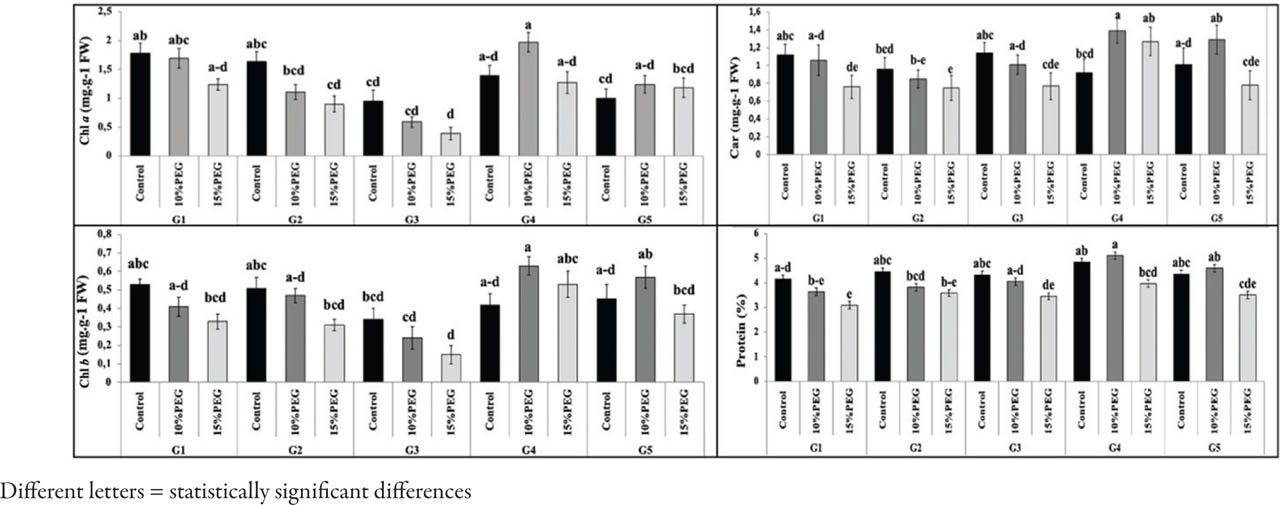
Figure 2.
Photosynthetic pigments and protein concentration of common beans affected by PEG treatment
Abbildung 2. Beeinflussung der photosynthetischen Pigmente und der Proteinkonzentration von Gartenbohnen durch PEG-Behandlung
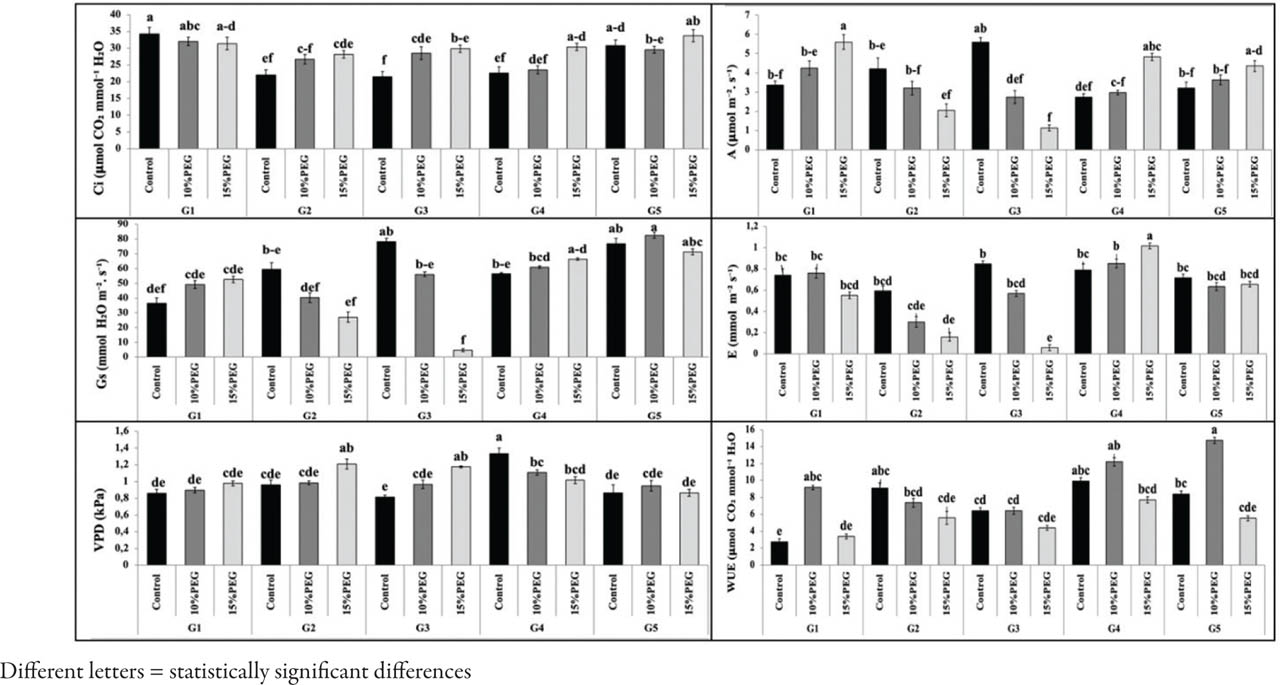
Figure 3.
Photosynthetic parameters of common beans affected by PEG treatment and genotype
Abbildung 3. Photosyntheseparameter von Gartenbohnen in Abhängigkeit der PEG-Behandlung und des Genotyps
This triggers stomatal closure to prevent excessive water loss, limiting CO2 uptake and photosynthesis (Sinclair et al., 2005; Mencuccini et al., 2000). WUE peaked under PEG stress, especially at 10% PEG (7.76 μmol CO2 mmol−1 H2O), reflecting improved efficiency under limited water availability (Table 3, Figure 3). Genotypes G1 and G5 showed highest WUE under PEG treatments, indicating activation of osmotic and stomatal regulatory mechanisms to maintain photosynthetic activity and minimize water loss (Builes et al., 2011). Results under drought stress induced by PEG and control of traits, for morphological (shoot and root) physiologic, and photosynthetic pigments show correlations as shown in Figure 4. Strong positive correlations were found between photosynthetic pigments, especially between carotenoids and Chl a (r = 0.88**), Chl b (r = 0.93**), and for Chl a and Chl b (r = 0.91**), respectively. ShFW and ShDW also showed a substantial positive correlation (r = 0.86**), suggesting that biomass build up above ground occurs proportionately in both normal and stressed conditions. As drought stress affects growth rates, it may somewhat lessen the strength of this link. In barley and wheat, selection was also conducted using correlations between morphological and germination traits (Thabet et al., 2018; Ahmed et al., 2019). Photosynthetic rate (PR) and stomatal conductance (gs) showed a positive correlation (r = 0.55), suggesting a direct relationship between stomatal opening and CA. In addition, there was a strong negative correlation (r = −0.95**) between gs and internal CO2 concentration (Ci), indicating that internal CO2 is rapidly consumed for photosynthesis at low Ci values as stomatal conductance decreases. Hongal et al. (2023) found a similar association of the parameters. Water use efficient showed a moderately negative connection with PR (r = −0.41*) and a negative correlation with transpiration rate (E) (r = −0.60*). The correlation between RL and RDW was negligible (r = −0.09), suggesting that longer roots do not necessarily translate into higher biomass accumulation under drought. Furthermore, the r values of around −0.11 indicated weak or insignificant relationships between photosynthetic pigments (Chl a, Chl b, and carotenoids) and stomatal conductance (gs). Zhou et al. (2017) emphasize the complexity of defense responses at the biochemical level, suggesting that pigment maintenance can be controlled independently of stomatal behavior during extreme drought stress. Figure 5 presents the relationships among morpho-physiologic traits under control and PEG-induced drought stress conditions, analyzed via PCA. Together, the first two principal components (PC1 and PC2) accounted for 53.66% of the total variation, explaining 31.24% and 22.42% of the variance, respectively. It is evident from the PCA biplot that the traits under study were grouped differently in different positions. On the positive side of PC1, there was a strong clustering of photosynthetic pigments (Chl a, Chl b, and carotenoids), PC, ShFW, ShDW, and RFW. These results clearly suggest that photosynthetic capability and biomass accumulation are strongly correlated. Our results are in line with another study (Zahedi et al., 2025) that demonstrated the close relationship between biomass and pigment synthesis in response to drought stress. RL and ShL both made favorable contributions to PC1, which means that structural characteristics have a differential impact on plant adaptation by enhancing the capacity to seek water, particularly in situations where water is short. PR, stomatal conductance (gs), transpiration (E), and internal CO2 concentration (CI), which are all correlated with gas exchange, clustered in the top leh quadrant and contributed more to PC2. The PC1 and PC2 axes showed the opposite orientations of WUE and VPD, suggesting a substantial negative correlation with the majority of other parameters. Faloye et al. (2024) suggest that some plants in this case common bean avoid drought that prioritizes reducing water loss, this distribution understands that common bean with high WUE may show limited biomass growth and pigment production.
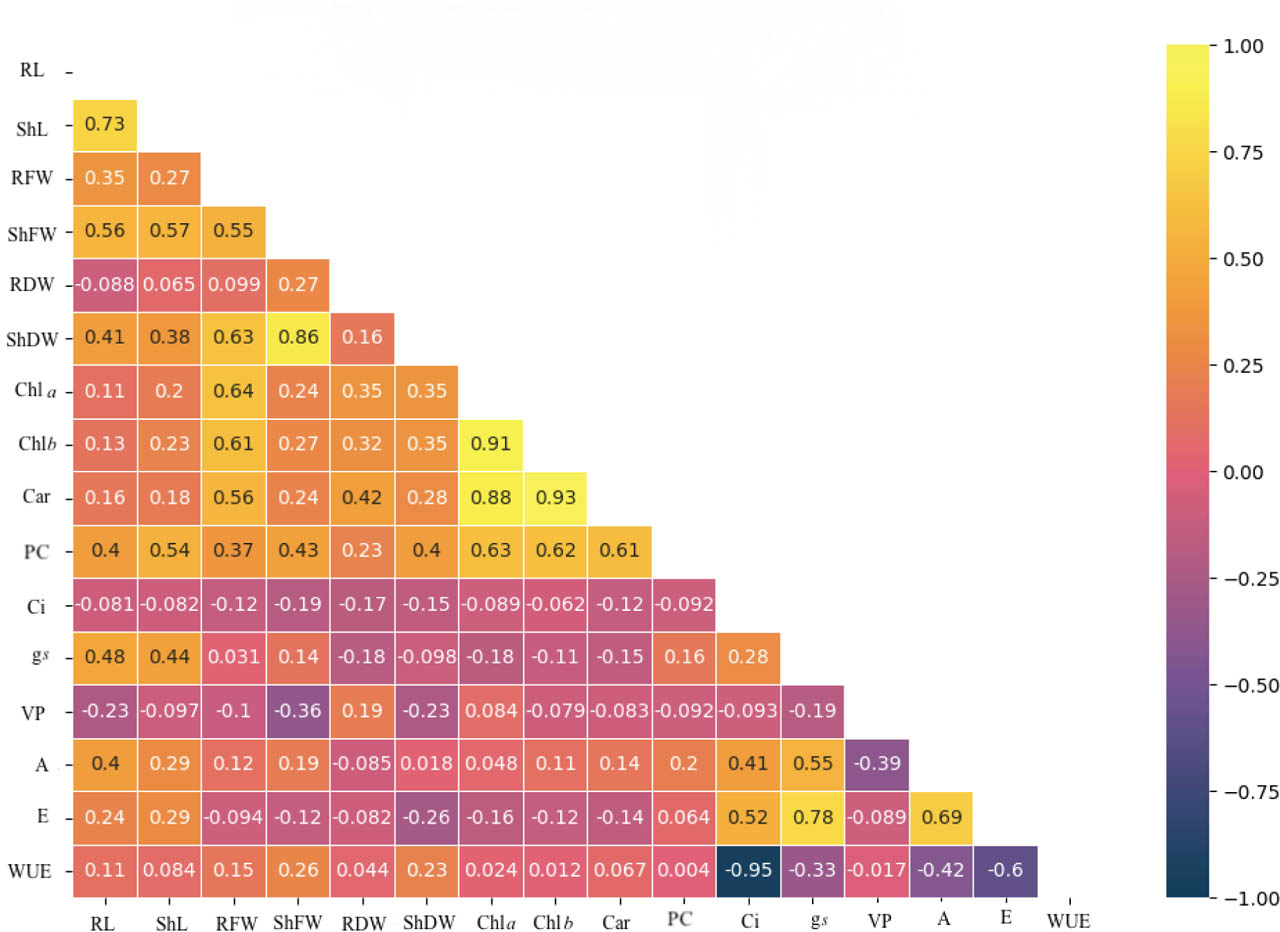
Figure 4.
Correlation coefficients of morpho-physiologic traits of common bean across drought stress conditions (trait abbreviations are defined in Table 2)
Abbildung 4. Korrelationskoeffizienten morphophysiologischer Merkmale der Gartenbohne unter verschiedenen Dürrestressbedingungen (Merkmalsabkürzungen sind in Tabelle 2 definiert)
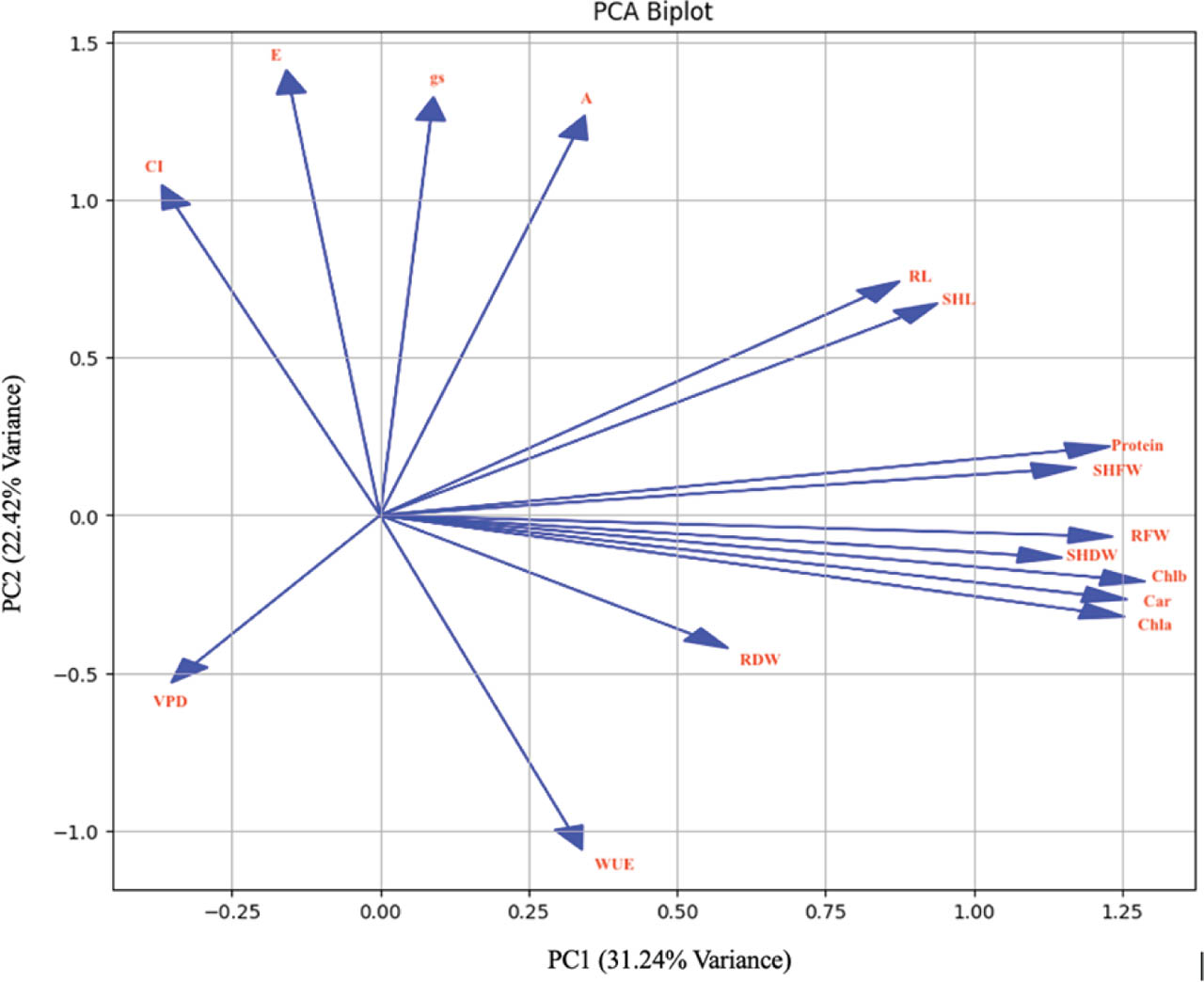
Figure 5.
PCA for morpho-physiologic parameters of common bean across drought stress conditions (trait abbreviations are defined in Table 2)
Abbildung 5. PCA für morphophysiologische Parameter der Gartenbohne unter Trockenstressbedingungen (Merkmalsabkürzungen sind in Tabelle 2 definiert)
4. Conclusions
The present study demonstrates that moderate drought stress, induced by 10% PEG, stimulated adaptive morphological and physiologic responses in common bean genotypes, notably enhancing root elongation, shoot growth, and biomass accumulation in five genotypes. In contrast, severe drought stress under 15% PEG significantly impaired growth parameters, photosynthetic pigment content, and gas exchange characteristics, highlighting the detrimental impact of intensified osmotic stress. Genotypic variation plays a critical role in drought tolerance, with G4 and G5 maintaining higher chlorophyll and protein levels and better photosynthetic performance under stress. Correlation analyses and PCA further elucidate the complex interplay between morphological traits, photosynthetic capacity, and WUE, revealing trade-offs between biomass production and water conservation strategies. These findings provide valuable insights into the physiologic mechanisms underpinning drought tolerance in common bean and identify promising genotypes for breeding programs aimed at improving resilience to water deficit conditions.