
Table 1.
Summary of indications for PPI therapy with key treatment benefits and recommended duration. Own work based on the compiled literature.
| Clinical Indication | Main Objective and Benefit of Therapy | Recommended Duration / Dosage |
|---|---|---|
| Severe forms of GERD (Esophagitis grades C and D according to the Los Angeles classification) | Prevention of painful recurrence of erosive lesions, ulcers, bleeding, and peptic strictures of the esophagus. | Often indefinite therapy; aiming for the lowest effective dose to control symptoms. |
| Barrett’s esophagus | Effective reflux control, chemopreventive effect – reduction in the risk of progression to high-grade dysplasia (HGD) and esophageal adenocarcinoma (EAC). | Long-term and indefinite therapy; typically once-daily dosing (intensification considered if symptoms are uncontrolled). |
| Hypersecretory states (e.g., Zollinger-Ellison syndrome) | Normalization of pathological hydrochloric acid production; healing of multiple ulcers, and suppression of secretory diarrhea. | Lifelong therapy; required doses are significantly higher than standard, individually tailored. |
| Gastroprotection (NSAIDs / Anticoagulants) | Protection of the gastric and duodenal mucosa, and reduction of the risk of upper gastrointestinal bleeding by approx. 33%. | Therapy continued as long as the exposure to mucosal-damaging drugs persists in high-risk patients. |
Table 2.
Multi-organ profile of potential complications and adverse effects associated with long-term use of proton pump inhibitors (PPIs). Own work based on the compiled literature.
| System / Organ | Main Complication | Pathophysiological Mechanism | Clinical Management |
|---|---|---|---|
| Electrolyte and vitamin balance | Deficiencies in vitamin B12, iron, magnesium, and calcium | Iatrogenic hypochlorhydria; impaired release from dietary proteins, impaired ion reduction, and blockade of TRPM6/7 channels | Periodic monitoring of serum levels; in the case of calcium, use of calcium citrate instead of calcium carbonate |
| Skeletal system | Osteoporosis, low-energy fractures | Secondary hyperparathyroidism (induced by hypocalcemia), direct cellular effect on osteoclasts | No routine DEXA scan for every patient; screening indicated in the presence of additional risk factors |
| Gastrointestinal tract (microbiome) | C. difficile infections, SIBO syndrome | Loss of the gastric bactericidal barrier, facilitated migration and colonization of pathogens | Special caution in hospitalized patients and those receiving antibiotic therapy |
| Excretory system (kidneys) | Acute interstitial nephritis (AIN), CKD | Asymptomatic idiosyncratic (immunological) reaction leading to organ fibrosis | Routine, periodic monitoring of serum creatinine levels and calculation of eGFR |
| Gastric mucosa | Fundic gland polyps (FGP) | Trophic effect of hypergastrinemia on parietal and ECL cells | Lesions are mostly benign, requiring only endoscopic surveillance |
| Drug-drug interactions | Decreased efficacy of clopidogrel, levothyroxine, and antifungal agents | Inhibition of the hepatic CYP2C19 isoenzyme or impaired drug solubility due to elevated gastric pH | Selection of PPIs with weaker affinity for CYP2C19 (e.g., pantoprazole); monitoring of TSH levels |
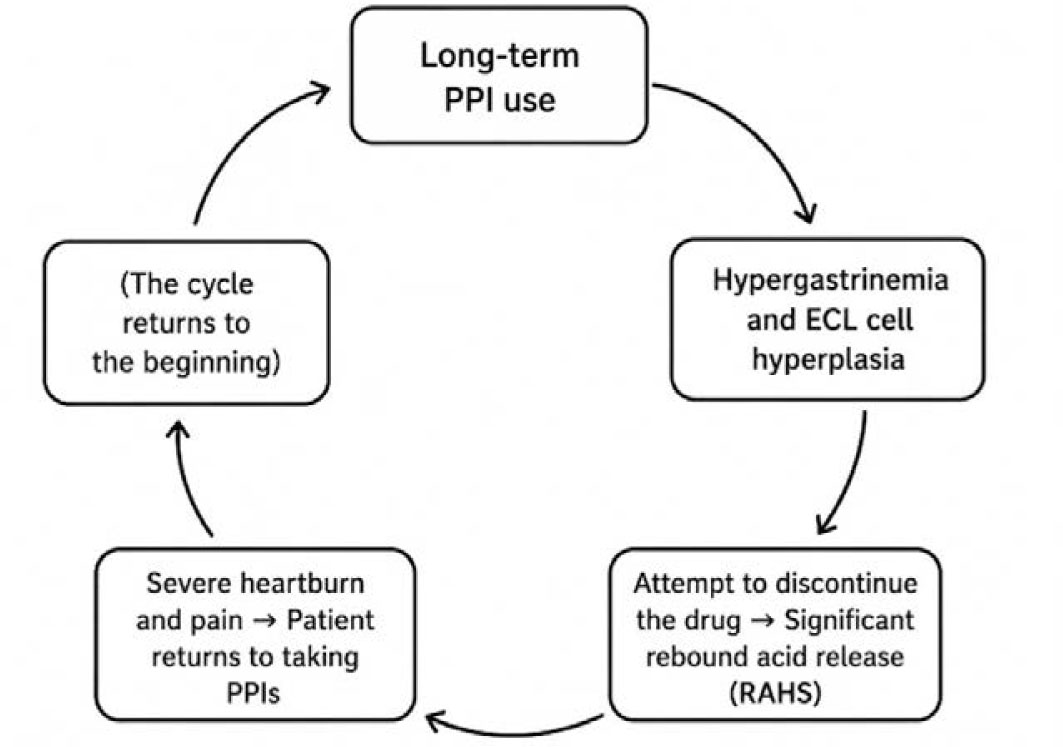
Figure 1.
Pathophysiological and clinical scheme of the “vicious cycle” of chronic proton pump inhibitor use induced by rebound acid hypersecretion (RAHS). Own work based on the compiled literature.
Table 3.
Patient qualification criteria for therapy continuation or a trial of de-escalation. Own work based on current guidelines from the American Gastroenterological Association[27–28].
| Absolute Indications for Long-Term PPI Therapy | Clinical Scenarios Justifying a Deprescribing Trial |
|---|---|
| Barrett’s esophagus | Non-erosive reflux disease (NERD) or mild esophagitis (grade A or B according to the Los Angeles classification) |
| Severe reflux esophagitis (grade C or D according to the Los Angeles classification) | Status post successful Helicobacter pylori eradication |
| History of upper gastrointestinal bleeding due to peptic ulcer disease | Completed treatment for an uncomplicated peptic ulcer |
| Eosinophilic esophagitis | Discontinuation of NSAID therapy (if PPI was used only for gastroprotection) |
| Gastric acid hypersecretory states (e.g., Zollinger-Ellison syndrome) | Functional dyspepsia (no abnormalities on endoscopic examination) |
| Chronic and uninterrupted NSAID therapy in patients at high risk of gastrointestinal bleeding | No documented indications for therapy (PPI initiated empirically without a full diagnostic workup) |
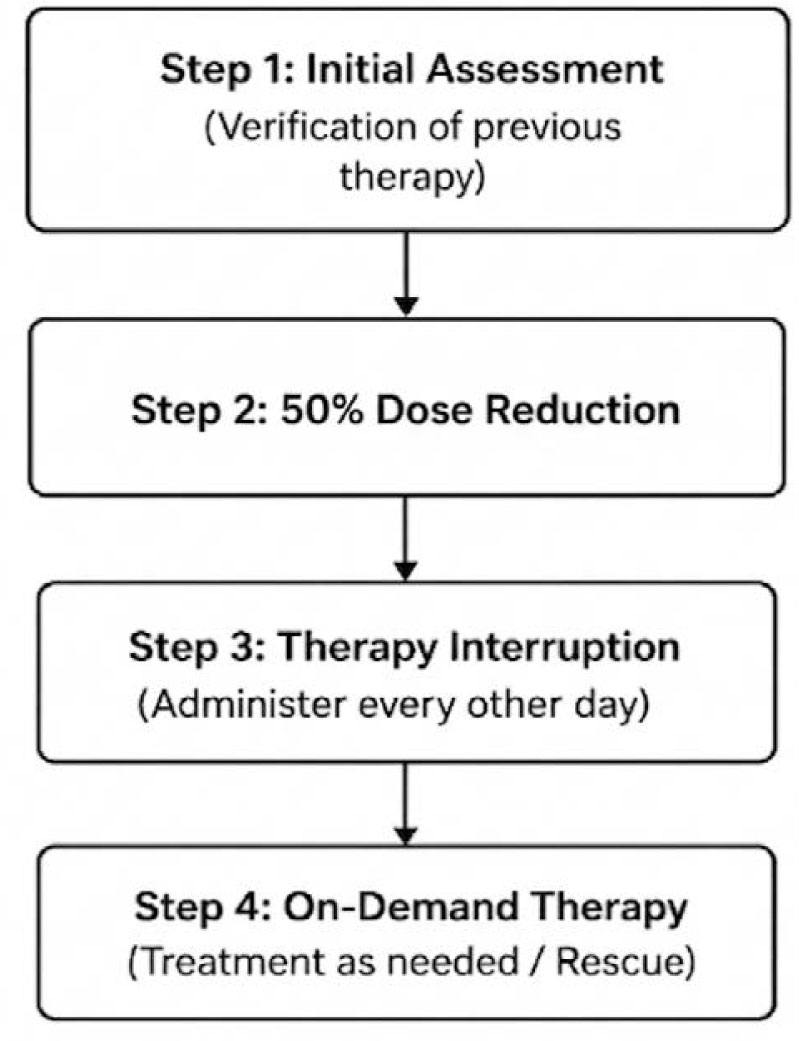
Figure 2.
Algorithm for safe de-escalation and deprescribing of chronic proton pump inhibitor (PPI) therapy. Own work based on the guidelines [27–28].