
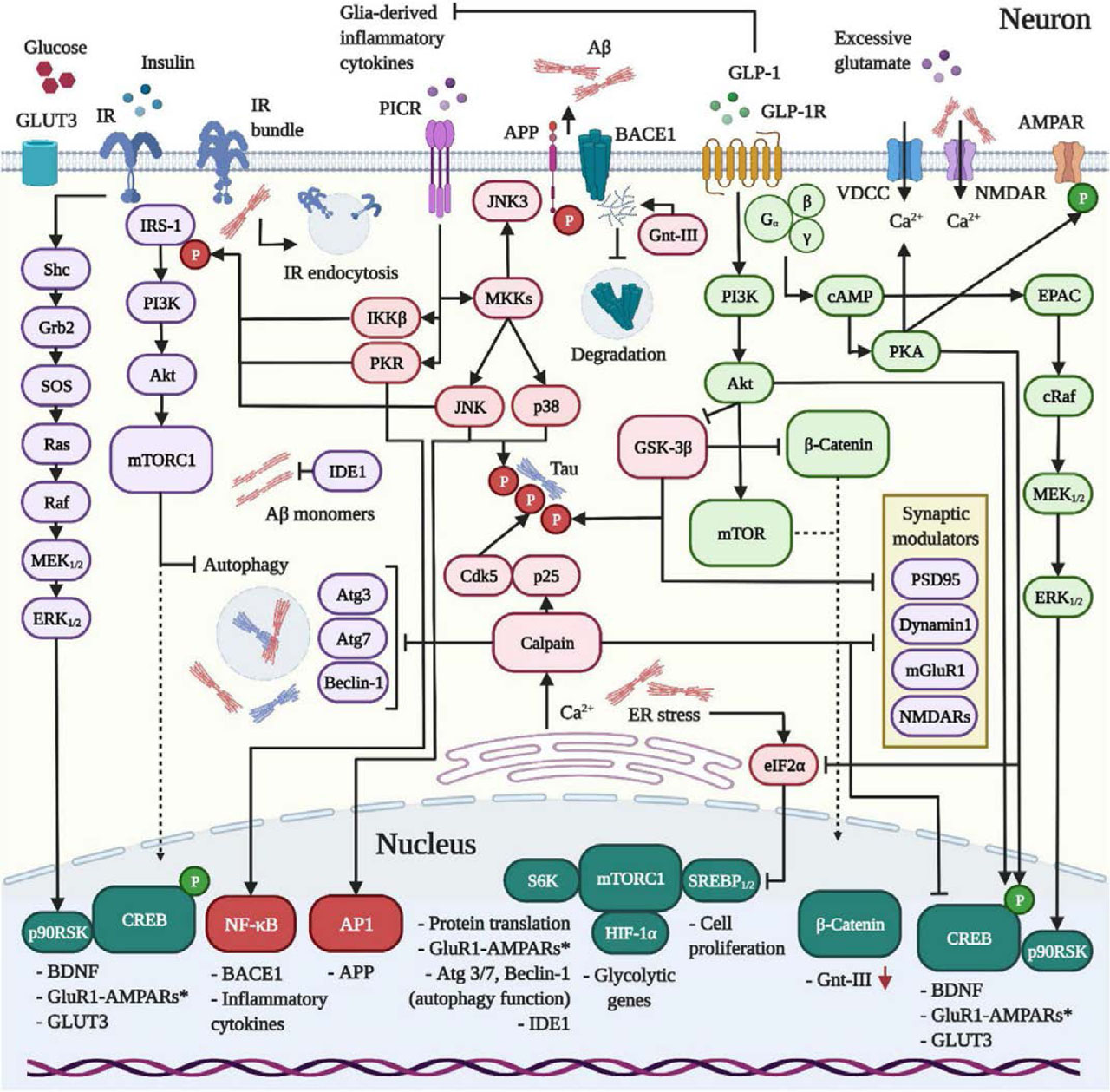
Figure 1.
Intracellular neuroprotective signaling pathways of GLP-1 RAs. Reprinted from Frontiers in Neuroscience (2022), DOI: 10.3389/fnins.2022.970925, under the Creative Commons Attribution License (CC BY).
Table 1.
Summary of key clinical trials, systematic reviews, and meta-analyses on GLP-1 RAs in neurodegenerative diseases (2015–2026).
| Author & Year | Study Type | Study Population / Cohort Size | Intervention | Main Findings | Limitations |
|---|---|---|---|---|---|
| Nørgaard et al. (2022) [1] | Pooled RCTs & nationwide registry cohort |
| GLP-1 RAs (liraglutide, semaglutide) vs. placebo/other antidiabetics | Association with up to a 63% reduction in dementia risk (RR = 0.37) in diabetic populations. | Cohort limited to patients with type 2 diabetes; potential healthy-user bias; observational design. |
| Yeh et al. (2025) [13] | Propensity score-matched cohort study & meta-analysis |
| GLP-1 RAs vs. SGLT2 inhibitors | GLP-1 RAs associated with ~30% lower risk of PD onset (HR = 0.70). However, SGLT2i showed a 20% stronger protective profile. | Retrospective design; potential residual confounding; no direct head-to-head clinical trial validation. |
| Messak et al. (2025) [4] | Systematic review & meta-analysis of RCTs |
| Various GLP-1 RAs (exenatide, lixisenatide, etc.) vs. placebo | Heterogeneous motor outcomes; high rate of gastrointestinal attrition and risk of mild-to-moderate dehydration. | Small sample sizes in individual trials; short follow-up periods; high dropout rates due to adverse events. |
| Zhang et al. (2025) [16] | Systematic review & meta-analysis of RCTs |
| Short-acting (e.g., exenatide) vs. long-acting GLP-1 RAs | Statistically significant motor improvement only for short-acting formulations (MD = −2.93 on MDS-UPDRS Part III). | High study heterogeneity; limited long-term data on the durability of the observed motor benefits. |
| O’Mara et al. (2026) [24] | Meta-analysis of double-blind RCTs |
| GLP-1 RAs vs. placebo | Cognitive stabilization, preservation of cortical volume, and metabolic protection rather than cognitive reversal. | Phase II exploratory nature of included trials; small sample sizes (N<100 per trial); short study duration (12–18 months). |
| Badran & Gbreel (2025) [18] | Systematic review & meta-analysis |
| GLP-1 RAs vs. placebo | Confirmed significant risk of muscle mass loss (sarcopenia), worsening of frailty, and acute gallbladder events. | Limited active reporting of sarcopenia across older trial designs; inconsistent monitoring of body composition. |