
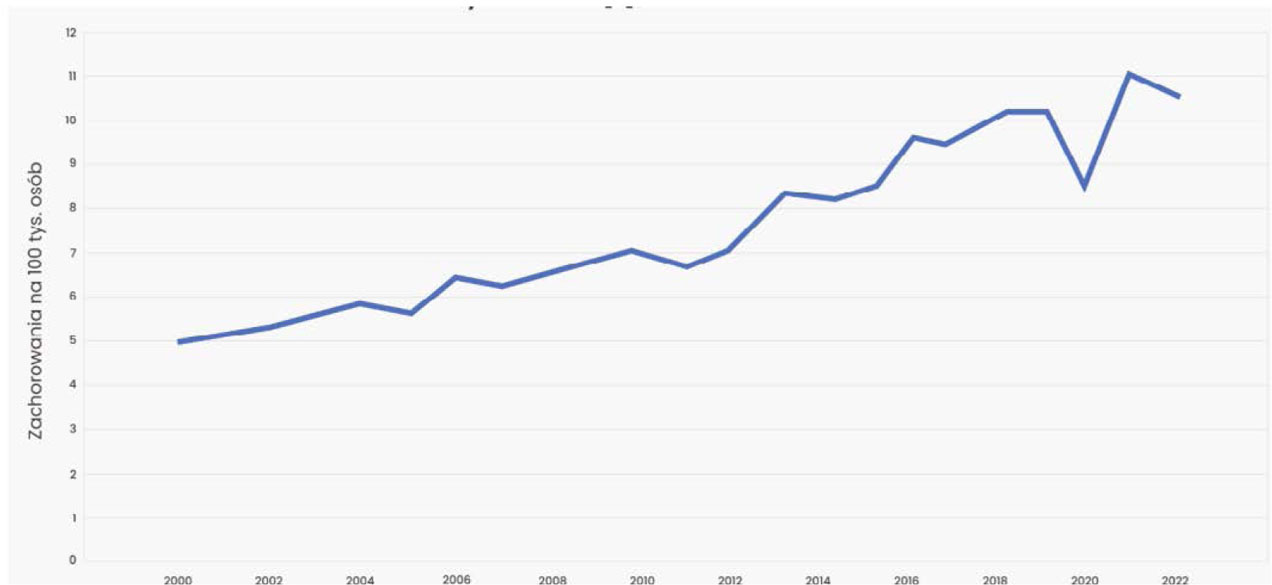
Fig 1.
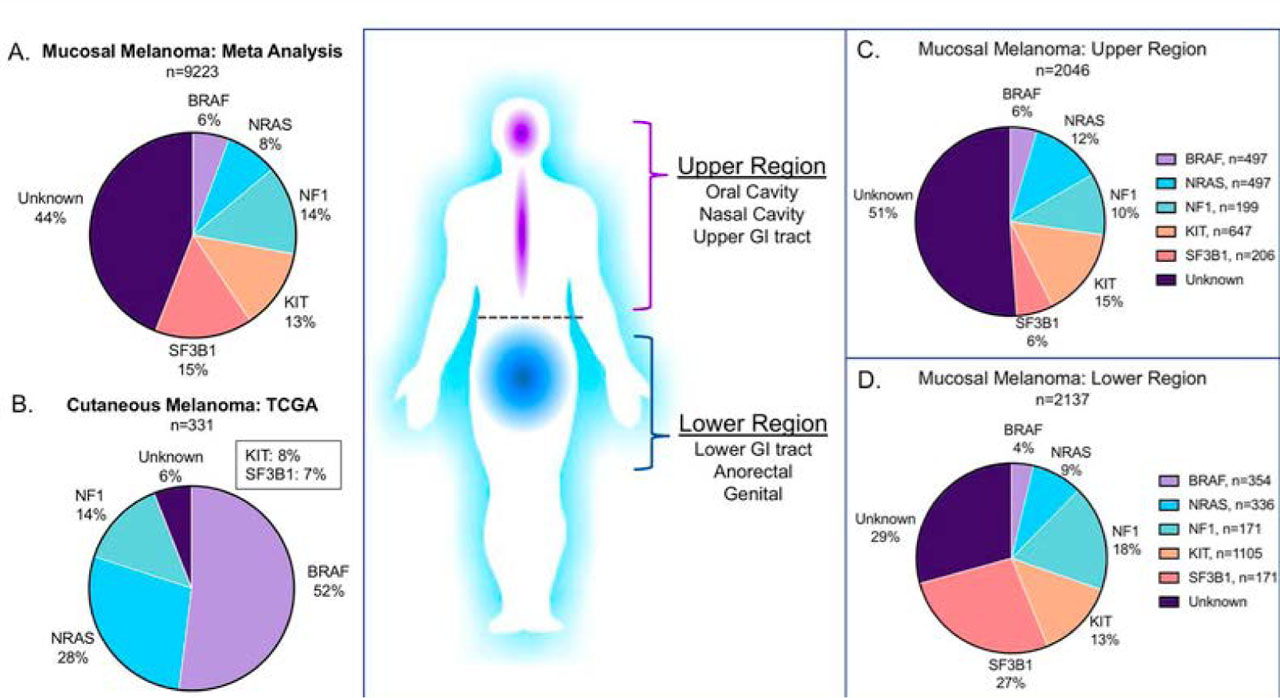
Fig 2.
Comparison of mutation frequencies in cutaneous and mucosal melanoma [12].

Fig. 3
Distribution of mucosal melanomas and mutation frequency depending on location [2].
Tab. 1
Summary of targeted therapies in the treatment of cutaneous melanoma [10].
| Mutation | Targeted therapy |
|---|---|
| PD-1/PD-L1/anty-CLTA-4/LAG-3 | Niwolumab, pembrolizumab, atezolizumab, ipilimumab, relatlimab, T-VEC |
| BRAF V600 | BRAF+MEK inhibitors (vemurafenib + cobimetinib, dabrafenib + trametinib, encorafenib + binimetinib) |
| c-KIT | Tyrosine kinase inhibitors (imatinib, nilotinib) |
Tab. 2
Evolution of management strategies in the event of detecting metastases in the sentinel lymph node in patients with melanoma [16].
| Comparative criterion | Historical paradigm (Radical) | Current guidelines (Selective paradigm) |
|---|---|---|
| Therapeutic strategy | Completion lymph node dissection (CLND) – routine performance of complete lymph node dissection. | Active oncological surveillance – using serial ultrasonographic diagnostics. |
| Indications | Obligatory after confirming the presence of tumor cells in the sentinel lymph node. | Selective; observation preferred in patients without clinical and radiological signs of progression in the regional lymphatic basin. |
| Clinical rationale | Striving for maximal regional control and the elimination of subclinical neoplastic foci. | Results of multicenter studies demonstrating a lack of benefit in overall survival following CLND. |
| Impact on overall survival | Lack of statistically significant improvement in the overall survival rate. | Equivalent overall survival rates compared to the group subjected to CLND. |
| Regional control | Marginally higher rate of locoregional control. | Acceptable regional control; in case of progression on ultrasound examination – salvage lymphadenectomy is performed. |
| Complications and quality of life | High rate of complications: lymphedemas, neurological dysfunctions, neuropathies, limited mobility (e.g., of the shoulder girdle). | Significant reduction in postoperative complications; significant improvement in the patient’s quality of life. |
Tab. 3
Clinical and Pathologic Features of Cutaneous and Mucosal Melanomas [5].
| Cutaneous Melanoma | Mucosal Melanoma | ||
|---|---|---|---|
| Proportion of all melanomas | 90% | < 2% | |
| Demographics | Median age at diagnosis | 55 y | 67 y |
| Male:female ratio | 60:40 | 35:65 | |
| Race | |||
| White | 94% | 85% | |
| Black | < 1% | 7% | |
| Epidemiology | Incidence over time | Rising | Stable |
| Risk factors | Ultraviolet radiation | Unknown | |
| Pathology | Multifocality | < 5% | 20% |
| Amelanotic | < 10% | Up to 40% | |
| Clinical outcomes | Advanced stage at diagnosis | < 30% | > 50% |
| 5-Year overall survival rate | 81% | 25% | |