
1. INTRODUCTION
The relativistic effect of the geodetic precession, first considered by Willem de Sitter in 1916 (De Sitter, 1916), is a secular change in the direction of the axis of rotation of a celestial body as a result of a parallel transfer of the angular momentum vector of the body along its orbit in curved space–time.
In our previous investigation (Pashkevich and Vershkov, 2020), the main effects of the relativistic rotation for the inner satellites of Jupiter (J14, J5, J15, and J16) were studied. As results, foregoing study showed that the values of the geodetic precession can be significant not only for objects orbiting around super-massive central relativistic bodies, but also for bodies with a short distance to the central body, for example, close satellites of giant planets.
Contemporary development of cosmonautics, especially in the implementation of projects such as “Gravity Probe B” (Everitt et al. 2011) for giant planets, will make it possible, after a few years, to obtain from observations the magnitude of the geodetic precession of their inner satellites. For example, it is necessary to launch a similar artificial satellite into the orbit of one of these satellites. The range of the obtained (Pashkevich and Vershkov, 2020) theoretical values of the geodetic precession of the inner satellites of Jupiter varies from −13″.37255 per year to −52″.95725 per year. Thus, theoretically, within 1 year after the implementation of such a project, it will allow testing the general theory of relativity. Then, the artificial satellite can be transferred to the orbit of the next inner satellite of Jupiter and the experiment is repeated.
Thus, a more detailed study of the relativistic effects in the rotation of the planets and their satellites in the Solar System becomes relevant and interesting.
Modeling the orbital–rotational dynamics of bodies of exoplanetary systems is best done using a planetary system with well-known parameters of the motion of its bodies. New research methods have made it possible to obtain high-precision long-term ephemerides of the orbital–rotational motion of many bodies in the Solar System, thus the Solar System is a good model for studying the rotational dynamics of exoplanetary systems. Based on studies of the Solar System bodies with well-known parameters of motion, it is possible to reveal patterns in the distribution and influence of relativistic effects on the orbital–rotational dynamics of exoplanetary systems’ bodies.
In this article, the geodetic precession values for Mars satellites in Euler angles are taken from our previous study (Pashkevich and Vershkov, 2019), and the geodetic precession values for the inner satellites of Jupiter are taken from our previous study (Pashkevich and Vershkov, 2020).
The main aims of this research are:
– to improve the geodetic precession values for the Sun, and the Solar System planets in the Euler angles relative to their proper coordinate systems and in the absolute value of the geodetic rotation angular velocity vector;
– to improve the geodetic precession values for the Moon in the perturbing terms of the physical libration relative to her proper coordinate systems and in the absolute value of the geodetic rotation angular velocity vector;
– to calculate, for the first time, the values of the geodetic precession for the Sun, all the Solar System planets, the Moon, and Mars satellites in their rotational elements;
– to obtain new additional and corrected values of the relativistic influence of Martian satellites (M1 and M2) on Mars;
– to calculate, for the first time, the values of the geodetic precession for the other planetary satellites with known quantities of the rotational elements (Galilean moons of Jupiter: J1–J4, satellites of Saturn: S1–S6, S8–S18, satellites of Uranus: U1–U15, and satellites of Neptune: N1, N3–N8) in the Euler angles relative to their proper coordinate systems and in their rotational elements.
The structure of this article is as follows:
– Abstract;
– Section 1 Introduction;
– Section 2 describes the mathematical model of the problem and the applied method Pashkevich (2016) (subsections A, B, C) for studying relativistic effect of the geodetic rotation of any bodies of the Solar System with long-time ephemeris;
– Section 3 is devoted to the study of the geodetic precession of the Sun and the planets of the Solar System. A detailed description of the novelty and improvement of the results of this article in comparison with the previous ones is given;
– Section 4 is devoted to the study of the geodetic precession of the Solar System planetary satellites with known quantities of their rotational elements. A detailed description of the novelty and improvement of the results of this article in comparison with the previous ones is given;
– Subsection 4.1 Geodetic precession of the Earth satellite (the Moon);
– Subsection 4.2 Geodetic precession of Mars satellites;
– Subsection 4.3 Geodetic precession of Jupiter’s satellites;
– Subsection 4.4 Geodetic precession of Saturn’s satellites;
– Subsection 4.5 Geodetic precession of Uranus satellites;
– Subsection 4.6 Geodetic precession of Neptune’s satellites;
– Conclusions;
– Appendix contains tables;
– Acknowledgments; and
– References.
2. MATHEMATICAL MODEL
In this investigation, we studied the most significant relativistic effect in rotational motion for the Sun, all planets and their satellites in the Solar System with known rotation parameters (Archinal et al. 2011, 2018). This effect is geodetic precession, which is the systematic or secular effect of the studied body’s geodetic rotation.
The method for studying the geodetic rotation of any Solar System bodies using long-time ephemeris will be applied (Pashkevich, 2016):
The problem of the geodetic (relativistic) rotation of the Solar System bodies is studied with respect to the proper coordinate systems of the bodies.
The values of the velocities of the geodetic rotation of the Solar System bodies are determined by using the ephemeris.
The most essential terms of the geodetic precession are found by means of the least-squares method.
A. The problem of geodetic (relativistic) rotation of the investigated bodies was studied with respect to their proper coordinate system (Archinal et al. 2011, 2018)1. Calculations were made of the geodetic precession velocities of each body under study using data on the positions, velocities, and orbital elements of the bodies of the Solar System from the ephemeris at all time intervals of their existence (Appendix: Table 1).
B. For the Sun, the Moon, and planets of the Solar System, the fundamental ephemeris JPL DE431/LE431 (Folkner et al. 2014) was used. For other satellites of planets with known rotation parameters (Archinal et al. 2011, 2018), data samples were formed from the ephemeris of the satellites of Mars, Jupiter, Saturn, Uranus, and Neptune Horizons On-Line Ephemeris System (Giorgini et al. 1996). The rotation parameters for the Earth and the Moon were taken from the article by Archinal et al. (2011), and for other studied bodies, from the article by Archinal et al. (2018).
The expressions for the velocities of the geodetic rotation of bodies in the Solar System for the parameters of their orientation (α0, δ0, W) (see Figure 1) relative to the standard Earth equator of epoch J2000 (International Celestial Reference Frame - ICRF) (Ma et al., 1998) and the vernal equinox (for the epoch J2000.0) have been obtained (Pashkevich and Vershkov, 2020):
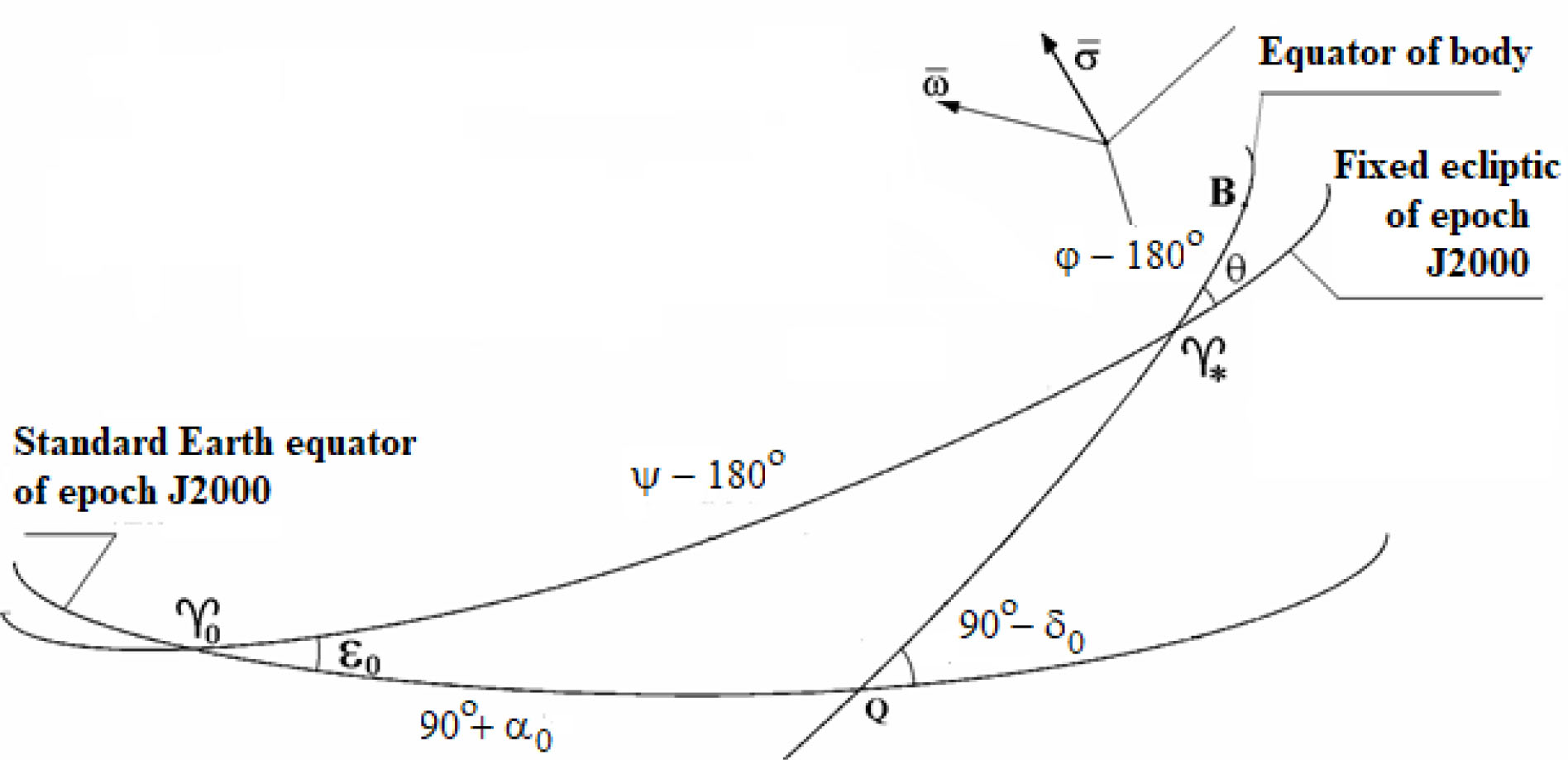
Figure 1.
Triangle used to define the direction of the angular velocity vector of the geodetic rotation for any body of the Solar System
Here α0 is the right ascension of the north pole of rotation of the body; δ0 is the declination of the north pole of rotation of the body; angle W = QB specifies the location of the prime meridian of the body2, which is measured along the equator of the body in an easterly direction with respect to the north pole of body from the node Q (located at the right ascension 90° + α0) of the equator of the body on the standard Earth equator of epoch J2000 to the point B, where the prime meridian crosses the equator of the body (see Figure 1) (recommended values of the constants in the expressions for α0, δ0 and W are given by Archinal et al. (2011, 2018)); are the differences between the relativistic and Newtonian angles of rotation of the investigated body, respectively; the dot denotes differentiation with respect to time; σ1,σ2,σ3 are reduced (Pashkevich, 2016) components of the angular velocity vector of the geodetic rotation of the body under study
from the geocentric reference frame of epoch J2000 (the reference frame of DE431/LE431 ephemeris (Folkner et al. 2014)) to the body-centric reference frames (Figure 1), given by Archinal et al. (2011, 2018); c is the velocity of light; G is the gravitational constant; mj is the mass of a perturbing body j; and are the vectors of the barycentric position and velocity of the investigated body, respectively; and are the vectors of the barycentric position and velocity of the perturbing bodies j, respectively. The symbol × means a vector product; the subscript j correspond to the perturbing bodies (the Moon, the planets, dwarf planet Pluto and the Sun, excluding the body under study from this set).As can be seen from equation (2), the geodetic rotation of a body under study depends only on the masses of the disturbing bodies and on the distance to them and does not depend on the mass of the body itself. Therefore, the magnitude of the vector of the geodetic rotation of the body under study essentially depends on the proximity of the satellite to the central body , the mass of which is dominant M = mj=M and around which the body rotates. It is the main property of the formula for the angular velocity vector of the geodetic rotation of a body under study.
In order to eliminate the singularity cos−1 δ0 in the expressions (1) were obtained expressions in the perturbing terms of the physical libration for the geodetic values of the velocity of rotation of the body by a combination of the elements of rotation:
In this investigation, the expressions (3) are used to study the geodetic rotation of the Earth, for which cos δ0 = 0 at epoch J2000. These expressions are an analog to the expressions of the velocities of the geodetic rotation for the perturbing terms of the physical libration of the Moon (4), which are a combination of the Euler angles.
The expressions of the geodetic rotation velocities are defined in the perturbing terms of the physical librations (τ, ρ, σ3) for the Moon (4) and in Euler angles (ψ, θ, φ) (see Figure 1) for others Solar System bodies (5) as follows (Pashkevich, 2016):
Here, τ, ρ, and σ are the perturbing terms of the physical librations of the Moon in the longitude, inclination, and node longitude, respectively; I is a constant angle of the inclination of the lunar equator to the fixed ecliptic J2000 (I ~ 1° 32′); ψ is the longitude of the descending node of epoch J2000 of the body equator; θ is the inclination of the body equator to the fixed ecliptic J2000; φ is the proper rotation angle of the body between the descending node of epoch J2000 and point B, where the prime meridian crosses the equator of body (see Figure 1) (or for the case when the equator of the body figure coincides with the equator of the body rotation: between the descending node of epoch J2000 and the principal axis of the minimum moment of inertia); , and are the differences between the relativistic and Newtonian angles of rotation of the investigated body, respectively; and the dot means time differentiation.
C. The geodetic precession velocities for each of the investigated Solar System bodies are determined over various time spans with different time spacing (Appendix: Table 1) by means of the least-squares method. The expressions for the secular terms of the body’s geodetic rotation velocities can be represented as a polynomial in the degree of time:
where are the coefficients of the secular terms; ; t is the time from standard epoch, which is JD 2451545.0, that is, 2000 January 1, 12 hours TDB (Archinal et al. 2011, 2018) (in Appendix: Table 1, the time spans and steps for the studies of the geodetic precession of the bodies are presented); and N is the degree of the approximating polynomial. As a result of calculations by the least-squares method, the value of the degree of the approximating polynomial is obtained, which provides the best approximation of the geodetic rotation N = 2.After analytical integration (6), the expressions for the secular terms of the body’s geodetic rotation are obtained:
where x = ψ, θ, φ, α0, δ0, W; and are the coefficients of the secular terms.The absolute value of the angular velocity vector of the geodetic rotation of the body under study is presented by the following expression:
Here, σX, σY, σZ are the components of the geocentric vector of the angular velocity of the geodetic rotation of a body (Pashkevich, 2016); as defined above, σ1, σ2, σ3 are reduced (Pashkevich, 2016) components of the body-centric vector of the angular velocity of the geodetic rotation of a body. Equality (8) is true, because the magnitude of the vector does not depend on the coordinate system in which its projections are considered.
The absolute value of the geodetic rotation velocity vector for the Solar System bodies in the parameters of their orientation is presented by the following expression:
3. THE SUN AND ITS PLANETS
In our previous investigation (Eroshkin, and Pashkevich, 2007), the absolute geodetic precession magnitudes of the angular velocity vector (8) for the Sun, the Moon and the Solar System planets were calculated by using DE404/LE404 ephemeris (Standish and Newhall, 1996). In this research, the geodetic precession magnitudes for these bodies have been improved (Appendix: Table 2) by using more accurate DE431/LE431 ephemeris (Folkner et al. 2014). These values of the angular velocity vector of the geodetic rotation (2) for these bodies are calculated directly (8) by using the components of the geocentric vector of the angular velocity of the geodetic rotation of a body σX, σY, σZ without their reduction from the geocentric reference frame to the body-centric reference frames, as given by Archinal et al. (2011, 2018).
In the research of Klioner et al. (2009), the magnitude of the geodetic precession was obtained only for some Solar System bodies (Mercury, Venus, the Earth, the Moon and Mars). Comparison of the magnitude of the geodetic precession of our studies with those of Klioner et al. (2009) showed that the results obtained for the same bodies in our research have the same order of magnitude (Appendix: Table 2).
In our previous study (Pashkevich and Vershkov, 2019), the geodetic precession values in Euler angles for the Sun, the Moon, and the Solar System planets were calculated by using values of the rotation elements (Seidelmann et al. 2005). In this investigation, the geodetic precession values in Euler angles for these bodies have been improved (Appendix: Table 2a) by using updated values of the rotation elements (Archinal et al. 2011, 2018).
Geodetic precession of the Sun and the planets of the Solar System in Euler angles (Figure 2, left side) ranges from −870.28 μas per thousand years (for the Sun) to –425″.61 per thousand years (for Mercury) (Appendix: Table 2a).
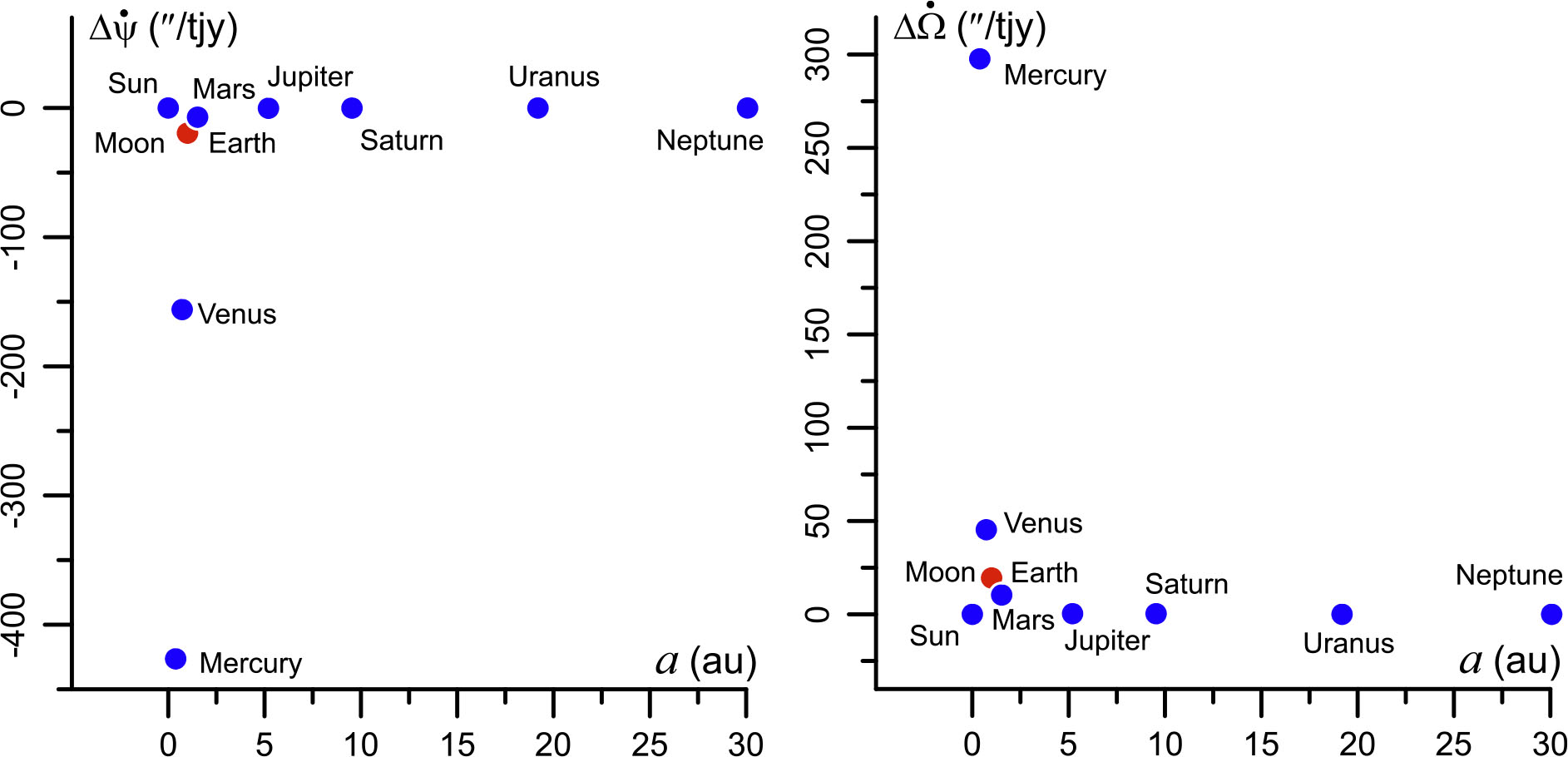
Figure 2.
Geodetic precession velocity for the Sun, the Moon, and the planets of the Solar System in the longitude of the descending node (left side) and in the absolute value of the velocity vector of the geodetic rotation of the parameters of their orientation (right side) (a is the length of the planetary orbit’s semi-major axis)
The values of geodetic precession for the Earth and the Moon are very close (Appendix: Table 2a). Therefore, in Figure 2, the point for the Moon overlaps with the point for the Earth (point of the red color). This is due to the large distance of the Moon from the Earth; as a result, the Sun has a greater influence on the Earth (comparable to its influence on the Moon) than the Moon. Thus, if we exclude the influence of the Moon on the Earth, then the value of its geodetic precession will be the same as for the Earth with the influence of the Moon – 19″.19 per thousand years (Appendix: Table 2a). It is also possible to evaluate the quantity of the influence of the Moon on the geodetic rotation of the Earth; if we exclude the influence of the Sun on the Earth, then the value of its geodetic precession will be −0″.005 per thousand years (Appendix: Table 2a).
In this study (subsection 4.1), the quantity of the inverse influence of the Earth on the geodetic rotation of the Moon, which is −0″.30 per thousand years, was also calculated (Appendix: Table 3).
As a result of this study, the secular terms of the geodetic rotation of the planets and the Sun (Figure 2, right side) in the elements of their rotation were calculated for the first time (Appendix: Table 2b).
Appendix: Table 2, 2a, 2b and Figure 2 show that all planets of the Solar System are characterized by a decrease in their absolute value of the geodetic rotation with an increase in their distance from the central body, which confirms the main property of equation (2) for the longitude of the descending node and for the absolute value of the vector of the geodetic rotation of the parameters of their orientation.
4. SATELLITES OF PLANETS
The study (Pashkevich and Vershkov, 2020) of the rotational dynamics of the inner satellites of Jupiter (Metis (J16), Adrastea (J15), Amalthea (J5), and Thebe (J14)) showed that the quantity of the relativistic geodetic rotation can be significant not only for relativistic objects, but, under certain conditions, also for ordinary satellites of planets, such as close satellites of giant planets. For all satellites of the planets of the Solar System (except for the satellites listed above, whose geodetic precession values were obtained in our previous studies), the secular terms of their geodetic rotation have been determined here for the first time.
In this research, the values of the secular terms of the geodetic rotation for the satellites of planets were first determined in the Euler angles relative to their proper coordinate systems (Appendix: Table 3 and Figures 3–7, left side) and in their rotational elements (Appendix: Table 3a and Figures 3–7, right side).
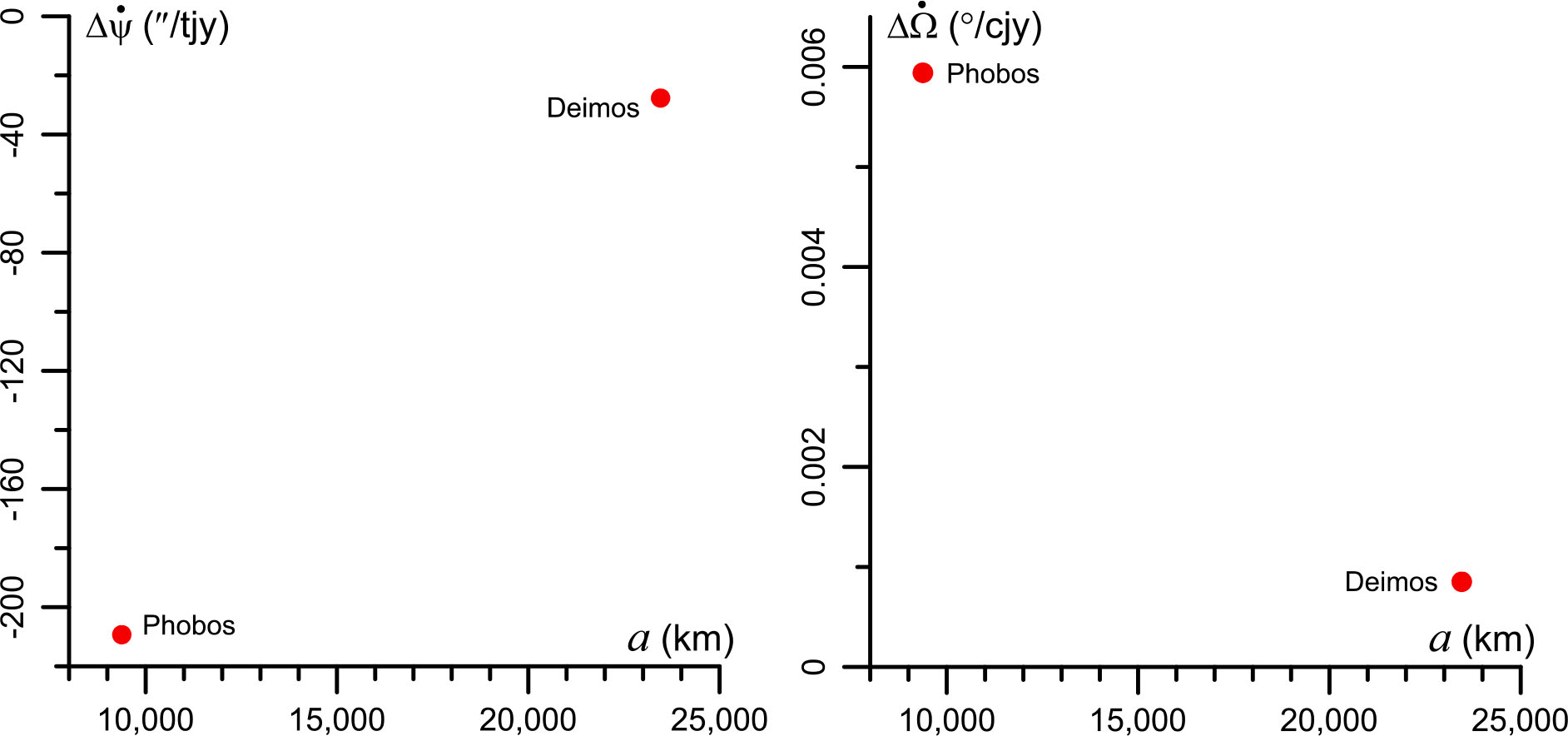
Figure 3.
Geodetic precession velocity of the satellites of Mars in the longitude of the descending node (left side) and in the absolute value of the velocity vector of the geodetic rotation of the parameters of their orientation (right side) (a is the length of the satellite orbit’s semi-major axis)
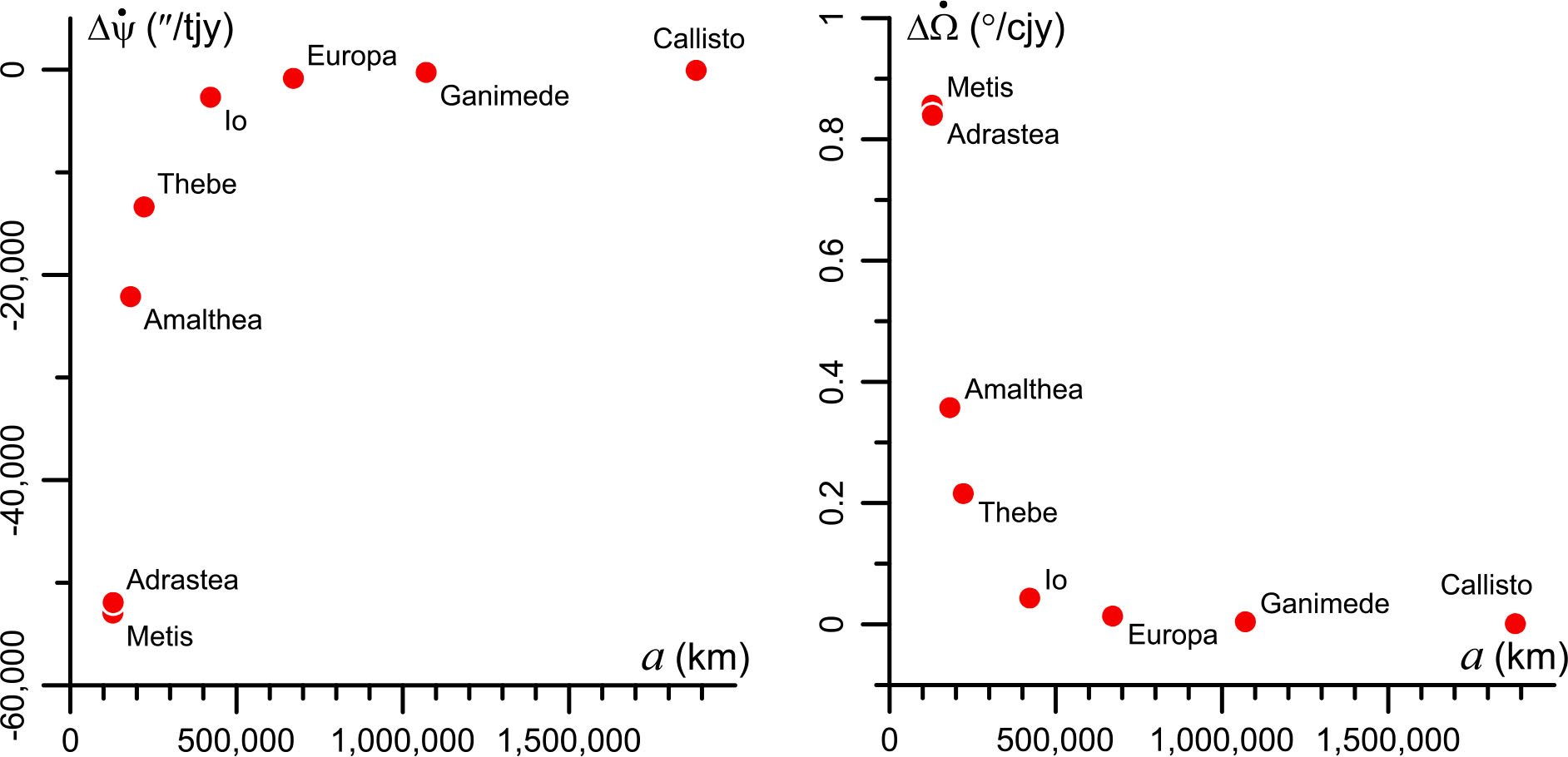
Figure 4.
Geodetic precession velocity of the satellites of Jupiter in the longitude of the descending node (left side) and in the absolute value of the velocity vector of the geodetic rotation of the parameters of their orientation (right side) (a is the length of the satellite orbit’s semi-major axis)
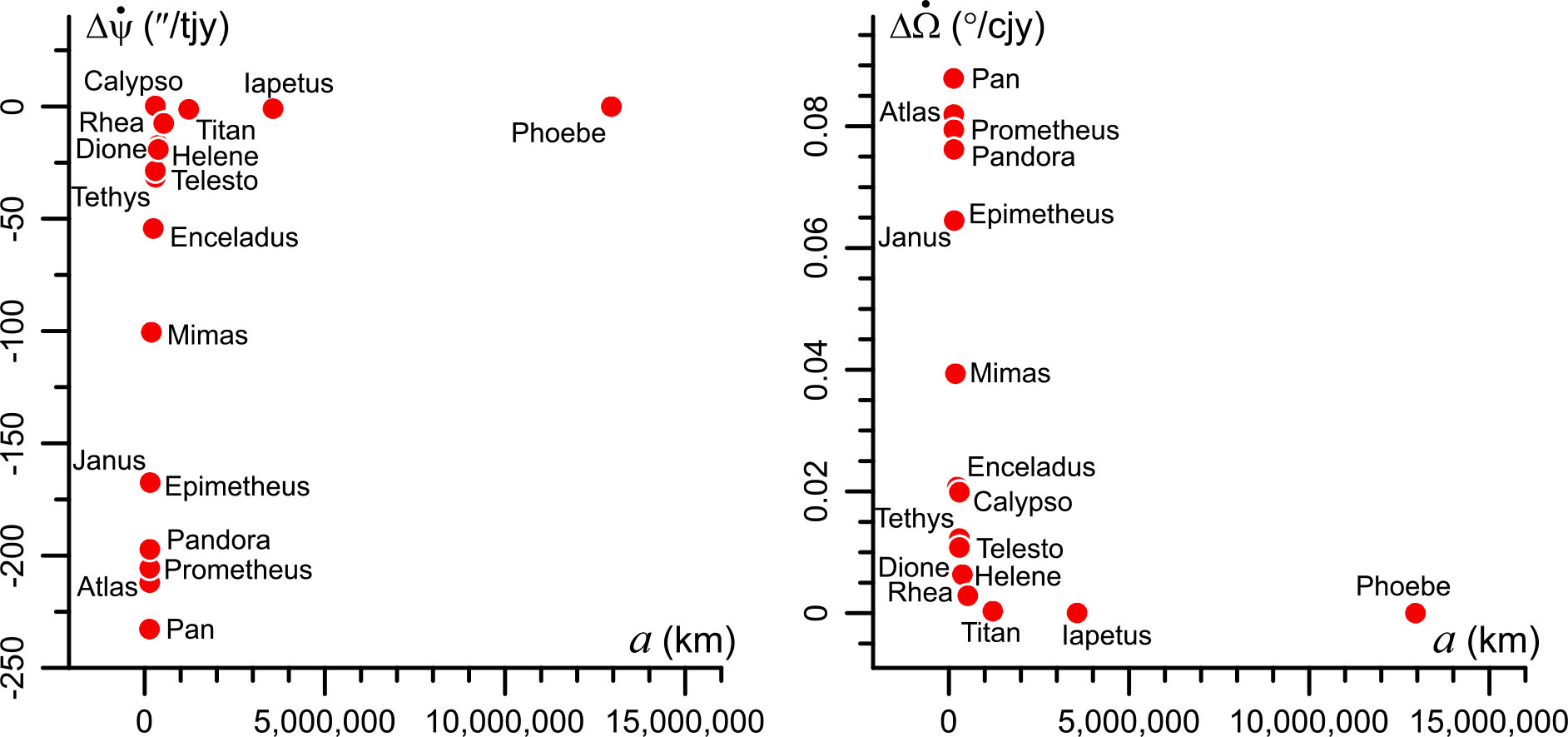
Figure 5.
Geodetic precession velocity of the satellites of Saturn in the longitude of the descending node (left side) and in the absolute value of the velocity vector of the geodetic rotation of the parameters of their orientation (right side) (a is the length of the satellite orbit’s semi-major axis)
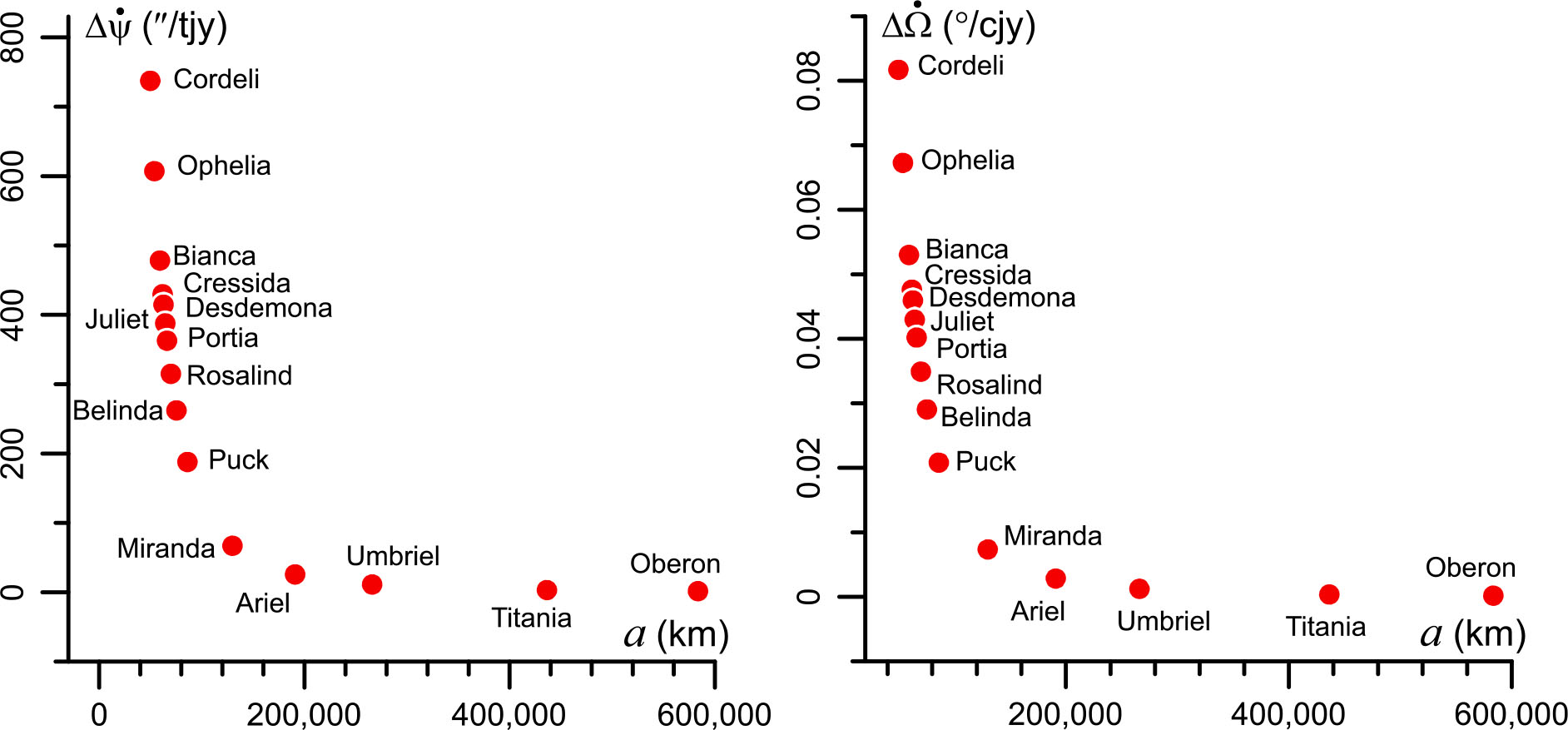
Figure 6.
Geodetic precession velocity of the satellites of Uranus in the longitude of the descending node (left side) and in the absolute value of the velocity vector of the geodetic rotation of the parameters of their orientation (right side) (a is the length of the satellite orbit’s semi-major axis)
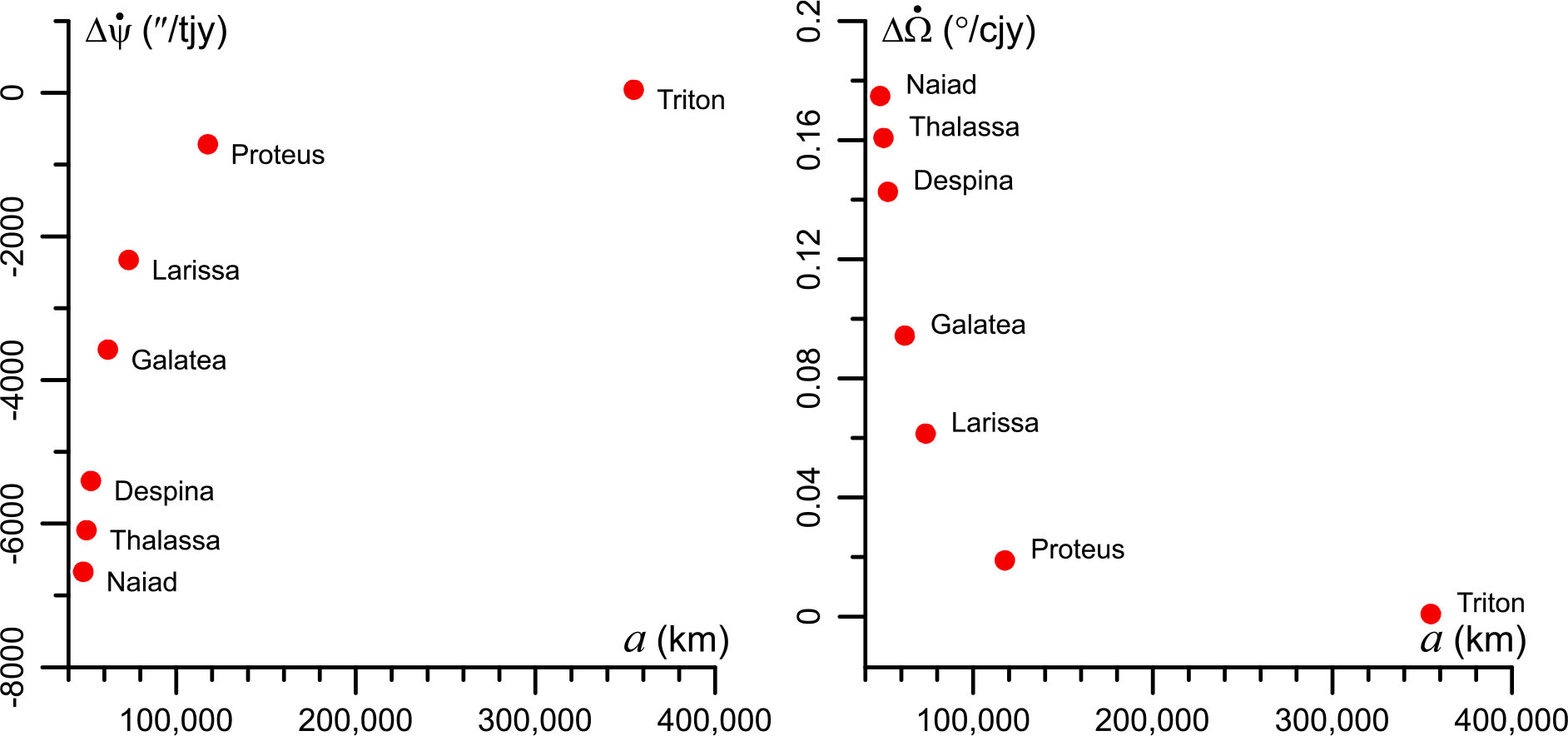
Figure 7.
Geodetic precession velocity of the satellites of Neptune in the longitude of the descending node (left side) and in the absolute value of the velocity vector of the geodetic rotation of the parameters of their orientation (right side) (a is the length of the satellite orbit’s semi-major axis)
4.1. Geodetic precession of the Earth satellite (the Moon)
Geodetic precession of the Moon is −19″.49 per thousand years (Appendix: Tables 2a, 3).
The value of the geodetic precession of the Moon (E1) is close to the value of the geodetic precession of the Earth (Figure 2, left side) (−19″.19 per thousand years; Appendix: Table 2a). This is due to the large distance of the Moon from the Earth; as a result, the Sun has a greater influence on the Moon (comparable to its influence on the Earth) than the Earth. Thus, if we exclude the influence of the Earth on the Moon, then the value of its geodetic precession will be the same as for the Earth, that is, −19″.19 per thousand years (Appendix: Table 3). It is also possible to evaluate the quantity of the influence of the Earth on the geodetic rotation of the Moon; if we exclude the influence of the Sun on the Moon, then the value of its geodetic precession will be −0″.30 per thousand years (Appendix: Table 3).
In this study (Section 3), the quantity of the inverse influence of the Moon on the geodetic rotation of the Earth was also calculated, which was −0″.005 per thousand years (Appendix: Table 2a).
4.2. Geodetic precession of Mars satellites
Geodetic precession of the satellites of Mars (Pashkevich and Vershkov, 2019) ranges from −27″.68 per thousand years (for Deimos) to −209″.31 per thousand years (for Phobos) (Figure 3, left side and Appendix: Table 3).
In the Mars satellite system, the values Δψ and ΔΩ of the geodetic precession of its satellites Phobos (M1) and Deimos (M2) (Figure 3) exceed the corresponding values of the geodetic precession of Mars and the Earth (Figure 2), and additionally, the value of the geodetic precession of Phobos exceeds the value of the geodetic precession of Venus. This is because due to their close distance, Mars has a greater influence on their geodetic rotation than the Sun.
Here, for completeness, we present the values obtained in our previous studies and in this investigation. We also investigated the mutual relativistic influence of Martian satellites on each other (Pashkevich and Vershkov, 2019) and on Mars (in this study, we obtained additional values for the relativistic influence on Mars separately related to Phobos and separately related to Deimos, as well as new corrected values for the relativistic influence on Mars from both Martian satellites):
– the change in the geodetic rotation of Deimos due to the relativistic influence of Phobos is equal to −0.22 μas per thousand years in the longitude of the node, −9.3× 10⁻⁶ μas per thousand years in the inclination, and 0.12 μas per thousand years in the proper rotation angle (Pashkevich and Vershkov, 2019);
– the change in the geodetic rotation of Phobos due to the relativistic influence of Deimos is equal to −5.3×10⁻² μas per thousand years in the longitude of the node, 6.2×10⁻⁶ μas per thousand years in the inclination, and 2.9×10⁻² μas per thousand years in the proper rotation angle (Pashkevich and Vershkov, 2019);
– the change in the geodetic rotation of Mars due to the relativistic influence of Phobos is equal to −4.48 μas per thousand years in the longitude of the node, −9.0×10⁻⁴ μas per thousand years in the inclination, and 2.50 μas per thousand years in the proper rotation angle;
– the change in the geodetic rotation of Mars due to the relativistic influence of Deimos is equal to −6.2×10⁻² μas per thousand years in the longitude of the node, 3.5×10⁻⁵ μas per thousand years in the inclination, and 3.4×10⁻² μas per thousand years in the proper rotation angle; and
– the change in the geodetic rotation of Mars due to relativistic influence of Phobos and Deimos is equal to −4.54 μas per thousand years in the longitude of the node, −8.6× 10⁻⁴ μas per thousand years in the inclination, and 2.54 μas per thousand years in the proper rotation angle.
4.3. Geodetic precession of Jupiter’s satellites
Geodetic precession of Jupiter’s moons runs from −64″.00 per thousand years (for Callisto) to −52,957″.25 per thousand years (for Metis) (Figure 4, left side and Appendix: Table 3).
It is found that there are objects in the Solar System with significant geodetic rotation comparable to their main rotation (Archinal et al. 2018). The values of geodetic precession of the inner satellites of Jupiter (Metis (J16), Adrastea (J15), Amalthea (J5), and Thebe (J14)) (Pashkevich and Vershkov, 2020) turned out to be comparable to the values of their precession (Appendix: Table 3a, red color) (Archinal et al. 2018). These values are, on average, 105 times higher than the value of geodetic precession of Jupiter itself (Figure 2, left side and Appendix: Table 2a) and 100 times higher than the value of geodetic precession of the Mercury, which is the closest planet to the Sun in the Solar System (Figure 2, left side and Appendix: Table 2a).
The next of the studied satellites in terms of distance from Jupiter is the group of Jupiter’s Galilean moons (Io (J1), Europa (J2), Ganymede (J3), and Calisto (J4)). Studies have shown that Io (J1) and Europa (J2) have geodetic precession values that are 6 and 2 times higher, respectively, than the geodetic precession value for Mercury (Figure 2, left side and Appendix: Table 2a), and the geodetic precession value for Ganymede (J3) is 1.7 times higher than that for Venus (Figure 2, left side and Appendix: Table 2a). The value of the geodetic precession of Calisto (J4) is 3 times greater than that of the Earth (Figure 2, left side and Appendix: Table 2a).
4.4. Geodetic precession of Saturn’s satellites
Geodetic precession of Saturn’s moons runs from −0″.02 per thousand years (for Phoebe) to −232″.74 per thousand years (for Pan) (Figure 5, left side and Appendix: Table 3).
In the satellite system of Saturn, the geodetic precession values of the group of inner satellites closest to it (Pan (S18), Atlas (S15), Prometheus (S16), Pandora (S17), Epimetheus (S11), and Janus (S10)) exceed the geodetic precession value of Venus (Appendix: Table 2a). For the satellites of this group and Mimas (S1), the geodetic precession values turned out to be comparable to their precession values (Appendix: Table 3a in red color).
The geodetic precession values of the next largest satellite group (Mimas (S1)–Telesto (13)) exceed the geodetic precession value of the Earth (Appendix: Table 2a).
The moons of Saturn Telesto (S13) and Calypso (S14) have close orbits and synchronously rotate relative to each other. Consequently, the theoretically predicted values of their geodetic precession should be close. As follows from the main property of equation (2), this value should be slightly less than the geodetic precession of Telesto (−28″.61 per thousand years; Appendix: Table 3) and much more than that of Dione (−17″.25 per thousand years; Appendix: Table 3), between the orbits of which the orbit of Calypso is located. However, the obtained value of the geodetic precession of Calypso (S14), that is, 0″.28 per thousand years (Figure 5, left side), is two orders of magnitude less in absolute value than that of Telesto (S13) and has the opposite sign compared to similar values of other satellites of Saturn (Appendix: Table 3). The discovered feature of the geodetic rotation for this satellite is probably related to the inaccuracy of its rotation parameters (Archinal et al. 2018)4 and their incompatibility with the used ephemeris (Giorgini et al. 1996).
Indeed, as the experiment showed, if we replace the polar rotation parameters of Calypso (α0 and δ0) (Archinal et al. 2018) with the corresponding polar rotation parameters of Telesto (still using the coordinates and velocities for Calypso from the ephemerides; Giorgini et al. 1996) to calculate the quantity of the Calypso geodetic precession, then the resulting geodetic precession value is in good agreement with the predicted theory (Appendix: Table 4 bold red color)5. Although the authors do not exclude another reason of the discovered feature of the geodetic rotation for this satellite, which may not yet be studied.
The values of the geodetic precessions of the moons of Saturn Dione (S4) and Helena (S12) are comparable in magnitude with the geodetic precession of the Earth (Figure 2, left side and Appendix: Table 2a) and the satellite of Rhea (S5) with the geodetic precession of Mars (Figure 2, left side and Appendix: Table 2a). For Titan (S6) and Iapetus (S8), the values of these quantities exceed those of Jupiter, and for Phoebe (S9), they are less than that of Saturn, but greater than that of Uranus (Figure 2, left side and Appendix: Table 2a).
4.5. Geodetic precession of Uranus satellites
Geodetic precession of Uranus satellites ranges from 1″.57 per thousand years (for Oberon) to 737″.38 per thousand years (for Cordeli) (Figure 6, left side and Appendix: Table 3).
A distinctive feature in the system of Uranus satellites is the positive value of geodetic precession of all satellites under study (Ariel (U1), Umbriel (U2), Titania (U3), Oberon (U4), Miranda (U5), Cordelia (U6), Ophelia (U7), Bianca (U8), Cressida (U9), Desdemona (U10), Juliet (U11), Portia (U12), Rosalind (U13), Belinda (U14) and Puck (U15)) (Appendix: Table 3). This feature is due to their reverse rotation.
4.6. Geodetic precession of Neptune’s satellites
Geodetic precession of Neptune’s moons runs from 43″.45 per thousand years (for Triton) to −6670″.30 per thousand years (for Naiad) (Figure 7, left side and Appendix: Table 3).
In the system of the investigated satellites of Neptune (Triton (N1), Naiad (N3), Thalassa (N4), Despina (N5), Galatea (N6), Larisa (N7), Proteus (N8)), Triton is the most interesting. This satellite, like the satellites of Uranus, has a positive value of the geodetic precession and reverse rotation (Appendix: Table 3). The value of the geodetic precession of other satellites of Neptune turned out to be on average an order of magnitude higher than the value of the geodetic precession of Mercury, which is the closest planet to the Sun in the Solar System (Figure 2, left side and Appendix: Table 2a). This is due to the greater influence of Neptune on them as the central body than the influence on Mercury from the more massive central body of the Sun.
The obtained analytical expressions for the parameters of the geodetic rotation of all satellites of the planets of the Solar System can be used to numerically study their rotation in the relativistic approximation.
Appendix: Tables 2–3a and Figures 3–7, right side show that the absolute value of the geodetic rotation of the central body is always less than that of its satellites.
5. CONCLUSIONS
The theoretical investigations of the relativistic effects in the rotational motions for the Sun, all planets of the Solar System, and their satellites with known quantities of their rotational elements (E1, M1, M2, J1–J5, J14–J16, S1–S6, S8–S18, U1–U15, N1, N3–N8) were carried out.
As a result, the most significant secular terms of the geodetic rotation have been improved
– for the Sun and the Solar System planets, in the Euler angles relative to their proper coordinate systems and in the absolute value of the geodetic rotation angular velocity vector and
– for the Moon (E1) in the perturbing terms of the physical libration relative to her proper coordinate systems and in the absolute value of the geodetic rotation angular velocity vector.
The values of the geodetic precession were first calculated
– for the Sun, all the Solar System planets, the Moon (E1), and satellites of Mars (M1, M2) in their rotational elements and
– for Galilean moons of Jupiter (J1–J4), satellites of Saturn (S1–S6, S8–S18), satellites of Uranus (U1–U15), and satellites of Neptune (N1, N3–N8), in the Euler angles relative to their proper coordinate systems and in their rotational elements.
The values of geodetic rotation were determined
– for the Earth and for the Moon (E1) without taking into account the perturbations from the Sun;
– for the Earth without taking into account the perturbations from the Moon (E1); and
– for the Moon (E1) without taking into account the perturbations from the Earth.
Additional values were determined for the relativistic influence on Mars separately related to Phobos (M1) and separately related to Deimos (M2), as well as new corrected values for the relativistic influence on Mars from both Martian satellites.
The largest values of the geodetic rotation of bodies in the Solar System were found in Jovian satellites system (Appendix: Tables 2, 3, and 3a). Further, in decreasing order, these values were found in the satellite systems of Saturn, Neptune, Uranus, and Mars, for Mercury, for Venus, for the Moon, for the Earth, for Mars, for Jupiter, for Saturn, for Uranus, for Neptune, and for the Sun (Appendix: Table 2). First of all, these are the inner satellites of Jupiter: Metis (J16), Adrastea (J15), Amalthea (J5), and Thebe (J14) and satellites of Saturn: Pan (S18), Atlas (S15), Prometheus (S16), Pandora (S17), Epimetheus (S11), Janus (S10), and Mimas (S1), whose values of geodetic precession are comparable to the values of their precession (Appendix: Table 3a, red color).
Such an arrangement of the geodetic precession values of the angular velocity vector differs somewhat from the location of the geodetic precession values in the longitudes of the descending nodes of the bodies under study. Thus, the largest values of geodetic precession in longitude of the descending node (Appendix: Tables 2a and 3) were found in the satellite system of Jupiter, then, in descending order of these values, follow the satellites of the Neptune system, the satellites of the Uranus system, the planet of Mercury, the Saturn satellite system, the Mars satellite system, the planet of Venus, the Moon, and the planets of the Earth, Mars, Jupiter, Saturn, Uranus, Neptune and the Sun.
For all studied objects of the Solar System, a characteristic pattern has been revealed:
1) a decrease in their absolute value of the geodetic precession with an increase in their distance from the central body (it is the main property of the formula for the angular velocity vector of the geodetic rotation of a body under study, which confirms for the longitude of the descending node and for the absolute value of the vector of the geodetic rotation of the parameters of their orientation) and
2) an absolute value of the geodetic rotation of the central body is always less than that of its satellites.
The obtained analytical values for the geodetic precession for the Sun, all the Solar System planets and their satellites can be used to numerically study their rotation in the relativistic approximation and as an estimate of the influence of relativistic effects on the orbital–rotational dynamics of bodies of exoplanetary systems.
The results of this study can also be used to test the general theory of relativity in the implementation of space projects like “Gravity Probe B” (Everitt et al. 2011).
In the future, it is planned to expand our studies of the relativistic effect of geodetic rotation for other bodies of the Solar System (dwarf planets and asteroids). Also, our studies will be expanded for all investigated bodies of the Solar System to obtain the values of the most significant periodic terms of their geodetic nutation.
Acknowledgments
The reported study was funded by RFBR according to the research project 19-02-00811 (for sections 1, 4, 5) and Grant of the Ministry of Science and Higher Education of the Russian Federation “Exoplanets”, scientific project 075-15-2020-780 (for sections 1, 2, 3, 5).
Appendices
APPENDIX
Table 1.
The time spans and steps for the studies of the geodetic precession of the bodies
| Satellites | Time span (years) | Spacing |
|---|---|---|
| The Earth | ||
| The Moon (E1) | 2000 (from AD1000 01 Jan. to AD3000 01 Jan.) | 1 day 00 h 00 min |
| Mars | ||
| Phobos (M1) Deimos (M2) | 900 (from AD1600 01 Jan. to AD2499 14 Oct.) | 09 h 30 min |
| Jupiter | ||
| Metis (J16) Adrastea (J15) | 400 (from AD1799 19 Dec. to AD2200 13 Jan.) | 42 min |
| Amalthea (J5) | 1000 (from AD1600 07 Feb. to AD2599 06 Dec.) | 01 h 00 min |
| Thebe (J14) | 400 (from AD1799 19 Dec. to AD2200 13 Jan.) | 01 h 30 min |
| Io (J1) Europa (J2) Ganimede (J3) Callisto (J4) | 1000 (from AD1600 07 Feb. to AD2599 07 Dec.) | 04 h 15 min |
| Saturn | ||
| Pan (S18) Atlas (S15) | 100 (from AD1949 27 Dec. to AD2050 09 Jan.) | 01 h 20 min |
| Prometheus (S16) | 100 (from AD1949 27 Dec. to AD2050 09 Jan.) | 01 h 00 min |
| Pandora (S17) | 100 (from AD1949 27 Dec. to AD2050 09 Jan.) | 01 h 20 min |
| Epimetheus (S11) Janus (S10) | 100 (from AD1949 27 Dec. to AD2050 09 Jan.) | 01 h 40 min |
| Mimas (S1) | 300 (from AD1849 29 Dec. to AD2150 07 Jan.) | 02 h 00 min |
| Enceladus (S2) | 300 (from AD1849 29 Dec. to AD2150 07 Jan.) | 03 h 00 min |
| Tethys (S3) Telesto (S13) Calypso (S14) | 300 (from AD1849 29 Dec. to AD2150 07 Jan.) | 04 h 30 min |
| Dione (S4) Helene (S12) | 300 (from AD1849 29 Dec. to AD2150 07 Jan.) | 06 h 30 min |
| Rhea (S5) | 300 (from AD1849 29 Dec. to AD2150 07 Jan.) | 10 h 50 min |
| Titan (S6) | 300 (from AD1849 29 Dec. to AD2150 07 Jan.) | 1 day 14 h 20 min |
| Iapetus (S8) | 300 (from AD1849 29 Dec. to AD2150 07 Jan.) | 7 days 22 h 00 min |
| Phoebe (S9) | 300 (from AD1849 29 Dec. to AD2150 07 Jan.) | 5 days 10 h 00 min |
| Uranus | ||
| Cordelia (U6) | 80 (from AD1980 02 Jan. to AD2059 31 Dec.) | 48 min |
| Ophelia (U7) | 80 (from AD1980 02 Jan. to AD2059 31 Dec.) | 50 min |
| Bianca (U8) | 80 (from AD1980 02 Jan. to AD2059 31 Dec.) | 01 h 00 min |
| Cressida (U9) Desdemona (U10) | 80 (from AD1980 02 Jan. to AD2059 31 Dec.) | 01 h 05 min |
| Juliet (U11) Portia (U12) | 80 (from AD1980 02 Jan. to AD2059 31 Dec.) | 01 h 10 min |
| Rosalind (U13) | 80 (from AD1980 02 Jan. to AD2059 31 Dec.) | 01 h 20 min |
| Belinda (U14) | 80 (from AD1980 02 Jan. to AD2059 31 Dec.) | 01 h 30 min |
| Puck (U15) | 80 (from AD1980 02 Jan. to AD2059 31 Dec.) | 01 h 50 min |
| Miranda (U5) | 1000 (from AD1599 08 Dec. to AD2600 12 Jan.) | 03 h 20 min |
| Ariel (U1) | 1000 (from AD1599 08 Dec. to AD2600 12 Jan.) | 06 h 00 min |
| Umbriel (U2) | 1000 (from AD1599 08 Dec. to AD2600 12 Jan.) | 10 h 00 min |
| Titania (U3) | 1000 (from AD1599 08 Dec. to AD2600 12 Jan.) | 20 h 00 min |
| Oberon (U4) | 1000 (from AD1599 08 Dec. to AD2600 12 Jan.) | 1 day 07 h 40 min |
| Neptune | ||
| Naiad (N3) | 100 (from AD1950 02 Jan. to AD2049 30 Dec.) | 42 min |
| Thalassa (N4) | 100 (from AD1950 02 Jan. to AD2049 30 Dec.) | 45 min |
| Despina (N5) | 100 (from AD1950 02 Jan. to AD2049 30 Dec.) | 48 min |
| Galatea (N6) | 100 (from AD1950 02 Jan. to AD2049 30 Dec.) | 01 h 00 min |
| Larissa (N7) | 100 (from AD1950 02 Jan. to AD2049 30 Dec.) | 01 h 20 min |
| Proteus (N8) | 100 (from AD1950 02 Jan. to AD2049 30 Dec.) | 02 h 40 min |
| Triton (N1) | 1000 (from AD1599 04 Dec. to AD2599 31 Dec.) | 13 h 20 min |
| The bodies | Time span (years) | Spacing |
| The Sun and the planets | 2000 (from AD1000 01 Jan. to AD3000 01 Jan.) | 1 day 00 h 00 min |
Table 2.
Magnitudes of the geodetic precession for the Sun, the Solar System planets and for each planet system, its satellite with the largest geodetic precession, calculated for the angular velocity vector of the geodetic rotation of the body under study
| Name | Eroshkin and Pashkevich (2007) | Klioner et al. (2009) | In this paper | a (au) |
|---|---|---|---|---|
| “ per century | “ per century | “ per century | ||
| The Sun | 0.0001 | 0.0000692 | 0 | |
| Mercury | 21.4905 | 21.43 | 21.4902924 | 0.387098 |
| Venus | 4.3124 | 4.32 | 4.3123523 | 0.723330 |
| The Earth | 1.9199 | 1.92 | 1.9198805 | 1.000001 |
| The Moon (E1) | 1.9495 | 1.95 | 1.9494951 | |
| Mars | 0.6756 | 0.68 | 0.6754500 | 1.523679 |
| Phobos (M1) | 30.6419590 | |||
| Jupiter | 0.0312 | 0.0311851 | 5.202603 | |
| Metis (J16) | 2653.6443645 | |||
| Saturn | 0.0069 | 0.0068507 | 9.554910 | |
| Pan (S18) | 390.9201274 | |||
| Uranus | 0.0012 | 0.0011949 | 19.218446 | |
| Cordelia (U6) | 276.4934392 | |||
| Neptune | 0.0004 | 0.0003876 | 30.110387 | |
| Naiad (N3) | 381.1538211 |
1 1 astronomical unit (au) = 149,597,870.7 km
(taken from Horizons On-Line Ephemeris System; Giorgini et al. 1996); a is the length of the planetary orbit’s semi-major axis.
Table 2a.
Secular terms of the geodetic rotation for the Sun and the Solar System planets, calculated for the Euler angles, and for the Moon, calculated for the perturbing terms of the physical libration
| The Sun | Mercury a (au) = 0.387098 | Venus a (au) = 0.723330 | The Moon a (km) = 384400 | |||||
|---|---|---|---|---|---|---|---|---|
| Δψ (μas) | Δψ (μas) | Δψ (μas) | Δτ (μas) | |||||
| t | −870.2788 | −425,606,984.4341 | −155,952,178.4711 | −19,494,198.9139 | ||||
| t2 | 1.3770 | −33,155.9302 | −687,024.3196 | −77.7041 | ||||
| Δθ (μas) | Δθ (μas) | Δθ (μas) | Δρ (μas) | |||||
| t | −1.8970 | −43,920.9632 | −740,253.4678 | −413.2193 | ||||
| t2 | 0.0809 | 504.4556 | 60,179.7955 | −1436.3972 | ||||
| Δφ (μas) | Δφ (μas) | Δφ (μas) | Δ(Iσ) (μas) | |||||
| t | 179.6136 | 213,919,825.1563 | 112,930,676.1063 | 511,726.8500 | ||||
| t2 | −1.3915 | −3798.8818 | 687,231.8895 | −14,383.0938 | ||||
| The Earth6 a (au) = 1.000001 | without the Moon7 | without the Sun8 | Mars a (au) = 1.523679 | |||||
| Δψ (μas) | Δψ (μas) | Δψ (μas) | Δψ (μas) | |||||
| t | −19,199,865.4438 | −19,194,966.2971 | −5289.2214 | −7,125,692.1811 | ||||
| t2 | 49,150.8059 | 49,136.4217 | 11.7867 | 10,109.0014 | ||||
| Δθ (μas) | Δθ (μas) | Δθ (μas) | Δθ (μas) | |||||
| t | −4127.7653 | −4127.7520 | −9.5398 | 127,569.2300 | ||||
| t2 | −1878.6778 | −1878.5492 | −0.2078 | −1098.6657 | ||||
| Δφ (μas) | Δφ (μas) | Δφ (μas) | Δφ (μas) | |||||
| t | 1174.6090 | 1172.9236 | −1.3267 | 414,234.7545 | ||||
| t2 | −53,414.8819 | −53,399.9048 | −12.2192 | −11,846.4356 | ||||
| Jupiter a (au) = 5.202603 | Saturn a (au) = 9.554910 | Uranus a (au) = 19.218446 | Neptune a (au) = 30.110387 | |||||
| Δψ (μas) | Δψ (μas) | Δψ (μas) | Δψ (μas) | |||||
| t | −212,778.4891 | −67,171.5760 | −11,949.3883 | −3902.8771 | ||||
| t2 | 3097.9909 | −54.6002 | −21.3019 | 4.3541 | ||||
| Δθ (μas) | Δθ (μas) | Δθ (μas) | Δθ (μas) | |||||
| t | −5974.5301 | −2892.9323 | −161.0625 | −118.6838 | ||||
| t2 | 133.7664 | −27.8319 | 1.4159 | 0.1154 | ||||
| Δφ (μas) | Δφ (μas) | Δφ (μas) | Δφ (μas) | |||||
| t | −99,066.0037 | −1440.3592 | 10.3345 | 32.9359 | ||||
| t2 | −3118.0679 | 137.5508 | −1.0611 | 0.7553 | ||||
Table 2b.
The rotational elements of the Sun and its planets and their secular terms of the geodetic rotation
| Name, a (au) | Archinal et al. (2018) | Present paper | T | T2 | |
|---|---|---|---|---|---|
| The Sun | α0 (°) | 286.13 | Δα0 (″) | 1×10⁻⁵ | −3×10⁻¹⁰ |
| 0 | δ0 (°) | 63.87 | Δδ0 (″) | 1×10⁻⁵ | −2×10⁻⁹ |
| W(°) | 84.176+14.1844000d | ΔW (″) | −0.0001 | 1×10–11 | |
| Mercury | α0 (°) | 281.0103−0.0328T | Δα0 (″) | 8.5439 | 0.0015 |
| 0.387098 | δ0 (°) | 61.4155−0.0049T | Δδ0 (″) | 3.2367 | −0.0047 |
| W(°) | 329.5988+6.1385108d | ΔW (″) | −28.3505 | −0.0018 | |
| Venus | α0 (°) | 272.76 | Δα0 (″) | 0.2342 | 0.0016 |
| 0.723330 | δ0 (°) | 67.16 | Δδ0 (″) | 0.3331 | −0.0001 |
| W(°) | 160.20−1.4813688d | ΔW (″) | −4.5144 | −0.0014 | |
| Name | Archinal et al. (2011)9 | Present paper | T | T2 | |
| The Earth | α0 (°) | 0.00–0.641T | cos δ0Δα0 (″) | 0.0426 | −3×10⁻⁵ |
| 1.000001 | δ0 (°) | 90.00–0.557T | Δδ0 (″) | 0.7622 | −0.0002 |
| W(°) | 190.147+360.9856235d | Δα0+ ΔW0 (″) | −1.7614 | 0.0001 | |
| Name | Archinal et al. (2018) | Present paper | T | T2 | |
| Mars | α0 (°) | 317.269202–0.10927547T | Δα0 (″) | 0.3972 | −0.0001 |
| 1.523679 | δ0 (°) | 54.432516–0.05827105T | Δδ0 (″) | 0.1991 | −0.0002 |
| W(°) | 176.049863+350.891982443297d | ΔW (″) | −0.9273 | 0.0001 | |
| Jupiter | α0 (°) | 268.056595–0.006499T | Δα0 (″) | 0.0023 | −4×10⁻⁶ |
| 5.202603 | δ0 (°) | 64.495303+0.002413T | Δδ0 (″) | 0.0003 | −1×10⁻⁶ |
| W(°) | 284.95+870.5360000d | ΔW (″) | −0.0332 | 3×10⁻⁶ | |
| Saturn | α0 (°) | 40.589–0.036T | Δα0 (″) | 0.0199 | −1×10⁻⁵ |
| 9.554910 | δ0 (°) | 83.537–0.004T | Δδ0 (″) | 0.0023 | 1×10⁻⁶ |
| W(°) | 38.90+810.7939024d | ΔW (″) | −0.0258 | 1×10⁻⁵ | |
| Uranus | α0 (°) | 257.311 | Δα0 (″) | 0.0012 | 2×10⁻⁷ |
| 19.218446 | δ0 (°) | −15.175 | Δδ0 (″) | −0.0001 | −3×10⁻⁸ |
| W(°) | 203.81–501.1600928d | ΔW (″) | 0.0002 | 2×10⁻⁸ | |
| Neptune | α0 (°) | 299.36 | Δα0 (″) | 0.0002 | −1×10⁻⁸ |
| 30.110387 | δ0 (°) | 43.46 | Δδ0 (″) | 0.0001 | 2×10⁻⁸ |
| 30.110387 | W(°) | 249.978+541.1397757d | ΔW (″) | −0.0005 | 1×10⁻⁷ |
1 a is the length of the satellite orbit’s semi-major axis;
1 au = 149,597,870.7 km (from Horizons On-Line Ephemeris System; Giorgini et al. 1996);
T is the time in Julian centuries years;
d is the time in days from standard epoch is JD 2451545.0, that is, 2000 January 1, 12 h TDB.
Table 3.
Secular terms of the geodetic rotation for the satellites of the Solar System planets, calculated for the Euler angles (part 1/4)
| The Earth | |||||||
| Name | Δτ (″) | Δρ (″) | Δ(Iσ) (″) | a (km) | |||
| t | t2 | t | t2 | t | t2 | ||
| The Moon (E1)10 | −19.4942 | −0.0001 | −0.0004 | −0.0014 | 0.5117 | −0.0144 | 384,400 |
| without the Earth11 | −19.1932 | −3×10⁻⁵ | −0.0005 | −0.0014 | 0.5171 | −0.0144 | 149,597,870 |
| without the Sun12 | −0.3014 | −4×10⁻⁵ | 3×10⁻⁵ | −0.0001 | −0.0054 | −1×10⁻⁵ | 384,400 |
| Mars | |||||||
| Name | Δψ (″) | Δθ (″) | Δφ (″) | a (km) | |||
| t | t2 | t | t2 | t | t2 | ||
| Phobos (M1)13 | −209.3145 | 0.0411 | 0.1096 | −0.0800 | 113.6015 | −0.0202 | 9376 |
| Deimos (M2) 13 | −27.6800 | 0.0145 | 0.1189 | −0.0057 | 11.8433 | −0.0124 | 23,458 |
| Jupiter | |||||||
| Name | Δψ (″) | Δθ (″) | Δφ (″) | a (km) | |||
| t | t2 | t | t2 | t | t2 | ||
| Metis (J16) 14 | −52,957.2516 | −20.0929 | −0.4232 | −3.9838 | 26,460.9380 | 19.8859 | 128,000 |
| Adrastea (J15) 14 | −51,932.8456 | −19.7509 | −0.4151 | −3.9067 | 25,949.0709 | 19.5347 | 129,000 |
| Amalthea (J5) 14 | −22,118.2274 | −0.7460 | −0.0923 | 4.7351 | 11,055.1784 | 0.5755 | 181,400 |
| Thebe (J14) 14 | −13,372.5500 | −2.8287 | −2.4703 | 37.7619 | 6693.8317 | 2.8902 | 221,900 |
| Io (J1) | −2682.6602 | −0.2122 | −0.1196 | −0.1392 | 1342.6373 | 0.2016 | 421,800 |
Table 3.
Secular terms of the geodetic rotation for the satellites of the Solar System planets, calculated for the Euler angles (part 2/4)
| Jupiter (continue) | |||||||
| Name | Δψ (″) | Δθ (″) | Δφ (″) | a (km) | |||
| t | t2 | t | t2 | t | t2 | ||
| Europa (J2) | −840.1721 | 0.0710 | −0.0242 | −0.0184 | 420.3792 | −0.0663 | 671,100 |
| Ganimede (J3) | −261.5694 | −0.0066 | −0.0112 | −0.0131 | 130.7141 | 0.0084 | 1,070,400 |
| Callisto (J4) | −63.9972 | 0.0399 | −0.0102 | −0.0022 | 31.8543 | −0.0360 | 1,882,700 |
| Saturn | |||||||
| Name | Δψ (″) | Δθ (″) | Δφ (″) | a (km) | |||
| t | t2 | t | t2 | t | t2 | ||
| Pan (S18) | −232.7364 | −1.9587 | −657.4148 | −3.6720 | −3639.3938 | 2.4248 | 133,585 |
| Atlas (S15) | −212.0393 | −1.8264 | −608.6535 | −3.4048 | −3378.7169 | 2.1959 | 137,774 |
| Prometheus S16) | −205.5740 | −1.8422 | −590.0954 | −3.3490 | −3275.6980 | 2.1078 | 139,429 |
| Pandora (S17) | −197.1983 | −1.6079 | −566.0443 | −3.1597 | −3142.2080 | 2.2945 | 141,810 |
| Epimetheus (S11) | −167.4579 | −1.7650 | −479.4434 | −2.3182 | −2660.0806 | 2.2733 | 151,422 |
| Janus (S10) | −167.8324 | −1.8772 | −479.5517 | −2.6082 | −2659.7131 | 2.0168 | 151,472 |
| Mimas (S1) | −100.5028 | −1.0302 | −285.8875 | −1.9636 | −1600.2855 | 1.2301 | 185,539 |
| Enceladus (S2) | −54.3148 | −0.4696 | −154.5777 | −0.9223 | −857.7077 | 0.5695 | 238,042 |
| Tethys (S3) | −31.5081 | −0.8095 | −90.1979 | −0.9998 | −503.0932 | 0.8855 | 294,672 |
| Telesto (S13) | −28.6117 | −0.4386 | −80.2283 | −0.9827 | −507.3979 | 0.5456 | 294,720 |
| Calypso (S14)15 | 0.2767 | 0.9812 | −84.1557 | −0.6733 | −532.3406 | −0.7741 | 294,721 |
Table 3.
Secular terms of the geodetic rotation for the satellites of the Solar System planets, calculated for the Euler angles (part 3/4)
| Saturn (continue) | |||||||
| Name | Δψ (″) | Δθ (″) | Δφ (″) | a (km) | |||
| t | t2 | t | t2 | t | t2 | ||
| Dione (S4) | −17.2533 | −0.1941 | −48.8066 | −0.3387 | −270.7718 | 0.2360 | 377,415 |
| Helene (S12) | −19.1048 | −0.3180 | −49.2847 | −0.3515 | −269.0649 | 0.3216 | 377,444 |
| Rhea (S5) | −7.4990 | −0.0869 | −21.2180 | −0.2158 | −117.4761 | 0.1224 | 527,068 |
| Titan (S6) | −1.2430 | −0.3765 | −2.6297 | −0.2605 | −14.1293 | 0.3897 | 1,221,865 |
| Iapetus (S8) | −0.9239 | −0.6512 | −0.3113 | 0.0624 | −0.1668 | 0.6569 | 3,560,854 |
| Phoebe (S9) | −0.0214 | −0.0148 | 0.0005 | 0.0104 | −0.0046 | 0.0181 | 12,947,918 |
| Uranus16 | |||||||
| Name | Δψ (″) | Δθ (″) | Δφ (″) | a (km) | |||
| t | t2 | t | t2 | t | t2 | ||
| Cordelia (U6) | 737.3755 | −5.7294 | −0.0321 | −4.5750 | −2743.4732 | −0.2103 | 49,800 |
| Ophelia (U7) | 607.0945 | −3.4941 | −0.0225 | −3.1162 | −2258.9890 | −0.3097 | 53,800 |
| Bianca (U8) | 478.2575 | −3.0865 | −0.0291 | −2.1307 | −1779.4917 | −0.1653 | 59,200 |
| Cressida (U9) | 429.6241 | −2.5533 | −0.0104 | −2.3131 | −1598.6213 | −0.2149 | 61,800 |
| Desdemona (U10) | 414.5513 | −2.0570 | −0.0060 | −1.5043 | −1542.6289 | −0.2530 | 62,700 |
| Juliet (U11) | 387.6458 | −2.2473 | −0.0075 | −1.8160 | −1442.4253 | −0.1466 | 64,400 |
| Portia (U12) | 362.6995 | −2.2701 | 0.0121 | −2.2402 | −1349.5799 | −0.1988 | 66,100 |
| Rosalind (U13) | 314.9000 | 0.0858 | 0.0312 | −2.2876 | −1172.0590 | −0.3380 | 69,900 |
| Belinda (U14) | 262.1423 | −1.4551 | 0.0062 | −1.2547 | −975.4948 | −0.1107 | 75,300 |
Table 3.
Secular terms of the geodetic rotation for the satellites of the Solar System planets, calculated for the Euler angles (part 4/4)
| Uranus (continue) | |||||||
| Name | Δψ (″) | Δθ (″) | Δφ (″) | a (km) | |||
| t | t2 | t | t2 | t | t2 | ||
| Puck (U15) | 187.8308 | −4.1306 | −0.0069 | −0.4330 | −698.6046 | −0.0686 | 86,000 |
| Miranda (U5) | 67.0376 | 0.3657 | −0.4716 | −0.0004 | −249.4464 | 0.0003 | 129,900 |
| Ariel (U1) | 25.7442 | 0.0158 | −0.2705 | −0.0105 | −95.1556 | −0.0012 | 190,900 |
| Umbriel (U2) | 11.2105 | −0.0032 | −0.0603 | −0.0418 | −41.5373 | 0.0025 | 266,000 |
| Titania (U3) | 3.2515 | 0.0270 | −0.0165 | −0.0204 | −12.0532 | −0.0030 | 436,300 |
| Oberon (U4) | 1.5706 | −0.0019 | −0.0084 | −0.0129 | −5.8282 | 0.0000 | 583,500 |
| Neptune | |||||||
| Name | Δψ (″) | Δθ (″) | Δφ (″) | a (km) | |||
| t | t2 | t | t2 | t | t2 | ||
| Naiad (N3) | −6670.3047 | −14.7325 | −5.1794 | −55.2350 | 3809.5037 | 64.7022 | 48,227 |
| Thalassa (N4) | −6092.0806 | −8.2229 | −4.2733 | −17.4608 | 3467.5926 | 58.1521 | 50,074 |
| Despina (N5) | −5405.6116 | −6.2192 | −3.6995 | −15.2733 | 3076.8866 | 50.3420 | 52,526 |
| Galatea (N6) | −3576.1301 | −0.6725 | −2.4523 | −9.8477 | 2035.4328 | 30.7942 | 61,953 |
| Larissa (N7) | −2328.1449 | 1.1397 | −1.4266 | −7.7510 | 1325.4696 | 20.5667 | 73,548 |
| Proteus (N8) | −716.2634 | −5.9168 | −0.7619 | −16.4520 | 409.4543 | 17.8405 | 117,646 |
| Triton (N1) 17 | 43.4450 | 0.0594 | 0.8107 | −0.1928 | −25.3711 | −0.2680 | 354,759 |
Table 3a.
The rotational elements of the satellites of the Solar System planets and their secular terms of the geodetic rotation (part 1/6)
| The Earth | |||||
| Name, a (km) | Archinal et al. (2011) | Present paper | T | T2 | |
| The Moon (E1) 384,400 | α0 (°) | 269.9949 + 0.0031T | Δα0 (°) | 2×10⁻⁵ | −2×10⁻⁷ |
| δ0 (°) | 66.5392 + 0.0130T | Δδ0 (°) | 3×10⁻⁸ | 1×10⁻⁸ | |
| W (°) | 38.3213+13.17635815d−1.4×10⁻¹²d 2 | ΔW (°) | −0.0006 | 1×10⁻⁷ | |
| Mars | |||||
| Name, a (km) | Archinal et al. (2011) | Present paper | T | T2 | |
| Phobos (M1) 9376 | α0 (°) | 317.67071657 − 0.10844326T | Δα0 (°) | 0.0033 | −2×10⁻⁷ |
| δ0 (°) | 52.88627266 − 0.06134706T | Δδ0 (°) | 0.0017 | −1×10⁻⁶ | |
| W (°) | 34.9964842535 + 1128.8447592d | ΔW (°) | −0.0047 | 1×10⁻⁶ | |
| Deimos (M2) 23,458 | α0 (°) | 316.65705808 − 0.10518014T | Δα0 (°) | 0.0004 | −1×10⁻⁸ |
| δ0 (°) | 53.50992033 − 0.05979094T | Δδ0 (°) | 0.0002 | −2×10⁻⁷ | |
| W (°) | 79.39932954 + 285.16188899d | ΔW (°) | −0.0007 | 2×10⁻⁶ | |
| Jupiter | |||||
| Name, a (km) | Archinal et al. (2018) | Pashkevich et al. (2020) | T | T2 | |
| Metis (J16) 128,000 | α0 (°) | 268.05 − 0.009T | Δα0 (°) | 0.1241 | −7×10⁻⁵ |
| δ0 (°) | 64.49 + 0.003T | Δδ0 (°) | −0.0199 | −4×10⁻⁵ | |
| W (°) | 346.09 + 1221.2547301d | ΔW (°) | −0.8469 | 6×10⁻⁵ | |
| Adrastea (J15) 129,000 | α0 (°) | 268.05 − 0.009T | Δα0 (°) | 0.1217 | −6×10⁻⁵ |
| δ0 (°) | 64.49 + 0.003T | Δδ0 (°) | −0.0195 | −4×10⁻⁵ | |
| W (°) | 33.29 + 1206.9986602d | ΔW (°) | −0.8306 | 6×10⁻⁵ | |
| Amalthea (J5) 181,400 | α0 (°) | 268.05 − 0.009T | Δα0 (°) | 0.0518 | −3×10⁻⁵ |
| δ0 (°) | 64.49 + 0.003T | Δδ0 (°) | −0.0083 | −2×10⁻⁵ | |
| W (°) | 231.67 + 722.6314560d | ΔW (°) | −0.3536 | 3×10⁻⁵ | |
| Thebe (J14) 221,900 | α0 (°) | 268.05 − 0.009T | Δα0 (°) | 0.0312 | −2×10⁻⁵ |
| δ0 (°) | 64.49 + 0.003T | Δδ0 (°) | −0.0050 | −2×10⁻⁵ | |
| W (°) | 8.56 + 533.7004100d | ΔW (°) | −0.2133 | 1×10⁻⁵ | |
| Name, a (km) | Archinal et al. (2018) | Present paper | T | T2 | |
| Io (J1) 421,800 | α0 (°) | 268.05 − 0.009T | Δα0 (°) | 0.0063 | −4×10⁻⁶ |
| δ0 (°) | 64.50 + 0.003T | Δδ0 (°) | −0.0010 | −2×10⁻⁶ | |
| W (°) | 200.39 + 203.4889538d | ΔW (°) | −0.0428 | 3×10⁻⁶ | |
| Europa (J2) 671,100 | α0 (°) | 268.08 − 0.009T | Δα0 (°) | 0.0019 | 2×10⁻⁷ |
| δ0 (°) | 64.51 + 0.003T | Δδ0 (°) | −0.0003 | −7×10⁻⁷ | |
| W (°) | 36.022 + 101.3747235d | ΔW (°) | −0.0134 | −2×10⁻⁷ | |
Table 3a.
The rotational elements of the satellites of the Solar System planets and their secular terms of the geodetic rotation (part 2/6)
| Jupiter (continue) | |||||
| Name, a (km) | Archinal et al. (2018) | Present paper | T | T2 | |
| Ganimede (J3) 1,070,400 | α0 (°) | 268.20 – 0.009T | Δα0 (°) | 0.0006 | 2×10⁻⁷ |
| δ0 (°) | 64.57 + 0.003T | Δδ0 (°) | −0.0001 | −1×10⁻⁷ | |
| W (°) | 44.064 + 50.3176081d | ΔW (°) | −0.0042 | −2×10⁻⁷ | |
| Callisto (J4) 1,882,700 | α0 (°) | 268.72 – 0.009T | Δα0 (°) | 0.0001 | 7×10⁻⁷ |
| δ0 (°) | 64.83 + 0.003T | Δδ0 (°) | −1×10⁻⁵ | −2×10⁻⁷ | |
| W (°) | 259.51 + 21.5710715d | ΔW (°) | −0.0010 | −6×10⁻⁷ | |
| Saturn | |||||
| Name, a (km) | Archinal et al. (2018) | Present paper | T | T2 | |
| Pan (S18) 133,585 | α0 (°) | 40.6 – 0.036T | Δα0 (°) | −0.0829 | −5×10⁻⁵ |
| δ0 (°) | 83.5 – 0.004T | Δδ0 (°) | 0.0160 | 7×10⁻⁶ | |
| W (°) | 48.8 + 626.0440000d | ΔW (°) | −0.0244 | 5×10⁻⁵ | |
| Atlas (S15) 137,774 | α0 (°) | 40.58 – 0.036T | Δα0 (°) | −0.0775 | −4×10⁻⁵ |
| δ0 (°) | 83.53 – 0.004T | Δδ0 (°) | 0.0147 | 7×10⁻⁶ | |
| W (°) | 137.88 + 598.3060000d | ΔW (°) | −0.0220 | 4×10⁻⁵ | |
| Prometheus (S16) 139,429 | α0 (°) | 40.58 – 0.036T | Δα0 (°) | −0.0752 | −4×10⁻⁵ |
| δ0 (°) | 83.53 – 0.004T | Δδ0 (°) | 0.0143 | 7×10⁻⁶ | |
| W (°) | 296.14 + 587.289000d | ΔW (°) | −0.0213 | 4×10⁻⁵ | |
| Pandora (S17) 141,810 | α0 (°) | 40.58 – 0.036T | Δα0 (°) | −0.0721 | −4×10⁻⁵ |
| δ0 (°) | 83.53 – 0.004T | Δδ0 (°) | 0.0137 | 6×10⁻⁶ | |
| W (°) | 162.92 + 572.7891000d | ΔW (°) | −0.0205 | 4×10⁻⁵ | |
| Epimetheus (S11) 151,422 | α0 (°) | 40.58 – 0.036T | Δα0 (°) | −0.0610 | −1×10⁻⁵ |
| δ0 (°) | 83.52 – 0.004T | Δδ0 (°) | 0.0116 | 8×10⁻⁶ | |
| W (°) | 293.87 + 518.4907239d | ΔW (°) | −0.0173 | 1×10⁻⁵ | |
| Janus (S10) 151,472 | α0 (°) | 40.58 – 0.036T | Δα0 (°) | −0.0609 | −2×10⁻⁵ |
| δ0 (°) | 83.52 – 0.004T | Δδ0 (°) | 0.0116 | 7×10⁻⁶ | |
| W (°) | 58.83 + 518.2359876d | ΔW (°) | −0.0175 | 2×10⁻⁵ | |
| Mimas (S1) 185,539 | α0 (°) | 40.66 – 0.036T | Δα0 (°) | −0.0376 | −3×10⁻⁵ |
| δ0 (°) | 83.52 – 0.004T | Δδ0 (°) | 0.0068 | 5×10⁻⁶ | |
| W (°) | 333.46 + 381.9945550J | ΔW (°) | −0.0096 | 3×10⁻⁵ | |
| Enceladus (S2) 238,042 | α0 (°) | 40.66 – 0.036T | Δα0 (°) | −0.0196 | −1×10⁻⁵ |
| δ0 (°) | 83.52 – 0.004T | Δδ0 (°) | 0.0038 | 2×10⁻⁶ | |
| W (°) | 6.32 + 262.7318996d | ΔW (°) | −0.0057 | 1×10⁻⁵ | |
Table 3a.
The rotational elements of the satellites of the Solar System planets and their secular terms of the geodetic rotation (part 3/6)
| Saturn (continue) | |||||
| Name, a (km) | Archinal et al. (2018) | Present paper | T | T2 | |
| Tethys (S3) 294,672 | α0 (°) | 40.66 – 0.036T | Δα0 (°) | −0.0116 | 5×10⁻⁶ |
| δ0 (°) | 83.52 – 0.004T | Δδ0 (°) | 0.0022 | 3×10⁻⁶ | |
| W (°) | 8.95 + 190.6979085d | ΔW (°) | −0.0032 | −5×10⁻⁶ | |
| Telesto (S13) 294,720 | α0 (°) | 50.51 – 0.036T | Δα0 (°) | −0.0084 | −1×10⁻⁵ |
| δ0 (°) | 84.06 – 0.004T | Δδ0 (°) | 0.0021 | 2×10⁻⁶ | |
| W (°) | 56.88 + 190.6979332d | ΔW (°) | −0.0064 | 1×10⁻⁵ | |
| Calypso (S14)18 294,721 | α0 (°) | 36.41 – 0.036T | Δα0 (°) | −0.0193 | −2×10⁻⁵ |
| δ0 (°) | 85.04 – 0.004T | Δδ0 (°) | 0.0016 | 6×10⁻⁸ | |
| W (°) | 153.51 + 190.6742373d | ΔW (°) | 0.0045 | 2×10⁻⁵ | |
| Dione (S4) 377,415 | α0 (°) | 40.66 – 0.036T | Δα0 (°) | −0.0062 | −4×10⁻⁶ |
| δ0 (°) | 83.52 – 0.004T | Δδ0 (°) | 0.0012 | 7×10⁻⁷ | |
| W (°) | 357.6 + 131.5349316d | ΔW (°) | −0.0018 | 4×10⁻⁶ | |
| Helene (S12) 377,444 | α0 (°) | 40.85 – 0.036T | Δα0 (°) | −0.0058 | −3×10⁻⁶ |
| δ0 (°) | 83.34 – 0.004T | Δδ0 (°) | 0.0012 | 9×10⁻⁷ | |
| W (°) | 245.12 + 131.6174056d | ΔW (°) | −0.0021 | 3×10⁻⁶ | |
| Rhea (S5) 527,068 | α0 (°) | 40.38 – 0.036T | Δα0 (°) | −0.0027 | −2×10⁻⁶ |
| δ0 (°) | 83.55 – 0.004T | Δδ0 (°) | 0.0005 | 4×10⁻⁷ | |
| W (°) | 235.16 + 79.6900478d | ΔW (°) | −0.0007 | 2×10⁻⁶ | |
| Titan (S6) 1,221,865 | α0 (°) | 39.4827 | Δα0 (°) | −0.0003 | −9×10⁻⁷ |
| δ0 (°) | 83.4279 | Δδ0 (°) | 0.0001 | 9×10⁻⁷ | |
| W (°) | 186.5855 + 22.5769768d | ΔW (°) | −0.0001 | 1×10⁻⁶ | |
| Iapetus (S8) 3,560,854 | α0 (°) | 318.16 – 3.949T | Δα0 (°) | −3×10⁻⁵ | 2×10⁻⁶ |
| δ0 (°) | 75.03 – 1.143T | Δδ0 (°) | 8×10⁻⁶ | 3×10⁻⁷ | |
| W (°) | 355.2 + 4.5379572d | ΔW (°) | 2×10⁻⁶ | −2×10⁻⁶ | |
| Phoebe (S9) 12,947,918 | α0 (°) | 356.90 | Δα0 (°) | 6×10⁻⁷ | 2×10⁻⁷ |
| δ0 (°) | 77.80 | Δδ0 (°) | 2×10⁻⁷ | 5×10⁻⁹ | |
| W (°) | 178.58 + 931.639d | ΔW (°) | −1×10⁻⁶ | −1×10⁻⁷ | |
Table 3a.
The rotational elements of the satellites of the Solar System planets and their secular terms of the geodetic rotation (part 4/6)
| Uranus | |||||
| Name, a (km) | Archinal et al. (2018) | Present paper | T | T2 | |
| Cordelia (U6) 49,800 | α0 (°) | 257.31 | Δα0 (°) | −0.0209 | 2×10⁻⁵ |
| δ0 (°) | −15.18 | Δδ0 (°) | 0.0018 | 1×10⁻⁵ | |
| W (°) | 127.69 – 1074.5205730d | ΔW (°) | −0.0789 | 5×10⁻⁷ | |
| Ophelia (U7) 53,800 | α0 (°) | 257.31 | Δα0 (°) | −0.0172 | 1×10⁻⁵ |
| δ0 (°) | −15.18 | Δδ0 (°) | 0.0015 | 8×10⁻⁶ | |
| W (°) | 130.35 – 956.4068150d | ΔW (°) | −0.0650 | 1×10⁻⁶ | |
| Bianca (U8) 59,200 | α0 (°) | 257.31 | Δα0 (°) | −0.0136 | 9×10⁻⁶ |
| δ0 (°) | −15.18 | Δδ0 (°) | 0.0012 | 5×10⁻⁶ | |
| W (°) | 105.46 – 828.3914760d | ΔW (°) | −0.0512 | 5×10⁻⁷ | |
| Cressida (U9) 61,800 | α0 (°) | 257.31 | Δα0 (°) | −0.0122 | 8×10⁻⁶ |
| δ0 (°) | −15.18 | Δδ0 (°) | 0.0010 | 6×10⁻⁶ | |
| W (°) | 59.16 – 776.5816320d | ΔW (°) | −0.0460 | 4×10⁻⁷ | |
| Desdemona (U10) 62,700 | α0 (°) | 257.31 | Δα0 (°) | −0.0118 | 6×10⁻⁶ |
| δ0 (°) | −15.18 | Δδ0 (°) | 0.0010 | 4×10⁻⁶ | |
| W (°) | 95.08 – 760.0531690d | ΔW (°) | −0.0444 | 4×10⁻⁷ | |
| Juliet (U11) 64,400 | α0 (°) | 257.31 | Δα0 (°) | −0.0110 | 7×10⁻⁶ |
| δ0 (°) | −15.18 | Δδ0 (°) | 0.0009 | 4×10⁻⁶ | |
| W (°) | 302.56 – 730.1253660d | ΔW (°) | −0.0415 | 5×10⁻⁷ | |
| Portia (U12) 66,100 | α0 (°) | 257.31 | Δα0 (°) | −0.0103 | 7×10⁻⁶ |
| δ0 (°) | −15.18 | Δδ0 (°) | 0.0009 | 5×10⁻⁶ | |
| W (°) | 25.03 – 701.4865870d | ΔW (°) | −0.0388 | 4×10⁻⁷ | |
| Rosalind (U13) 69,900 | α0 (°) | 257.31 | Δα0 (°) | −0.0089 | 8×10⁻⁷ |
| δ0 (°) | −15.18 | Δδ0 (°) | 0.0008 | 6×10⁻⁶ | |
| W (°) | 314.90 – 644.6311260d | ΔW (°) | −0.0337 | 2×10⁻⁶ | |
| Belinda (U14) 75,300 | α0 (°) | 257.31 | Δα0 (°) | −0.0074 | 4×10⁻⁶ |
| δ0 (°) | −15.18 | Δδ0 (°) | 0.0006 | 3×10⁻⁶ | |
| W (°) | 297.46 – 577.3628170d | ΔW (°) | −0.0281 | 3×10⁻⁷ | |
| Puck (U15) 86,000 | α0 (°) | 257.31 | Δα0 (°) | −0.0053 | 1×10⁻⁵ |
| δ0 (°) | −15.18 | Δδ0 (°) | 0.0005 | −3×10⁻⁷ | |
| W (°) | 91.24 – 472.5450690d | ΔW (°) | −0.0201 | −1×10⁻⁶ | |
| Miranda (U5) 129,900 | α0 (°) | 257.43 | Δα0 (°) | −0.0019 | −1×10⁻⁶ |
| δ0 (°) | −15.08 | Δδ0 (°) | 0.0002 | 9×10⁻⁸ | |
| W (°) | 30.70 – 254.6906892d | ΔW (°) | −0.0071 | 1×10⁻⁷ | |
Table 3a.
The rotational elements of the satellites of the Solar System planets and their secular terms of the geodetic rotation (part 5/6)
| Uranus (continue) | |||||
| Name, a (km) | Archinal et al. (2018) | Present paper | T | T2 | |
| Ariel (U1) 190,900 | α0 (°) | 257.43 | Δα0 (°) | −0.0007 | −4×10⁻⁸ |
| δ0 (°) | −15.10 | Δδ0 (°) | 0.0001 | 3×10⁻⁸ | |
| W (°) | 156.22 – 142.8356681d | ΔW (°) | −0.0027 | 1×10⁻⁸ | |
| Umbriel (U2) 266,000 | α0 (°) | 257.43 | Δα0 (°) | −0.0003 | 2×10⁻⁸ |
| δ0 (°) | −15.10 | Δδ0 (°) | 3×10⁻⁵ | 1×10⁻⁷ | |
| W (°) | 108.05 – 86.8688923d | ΔW (°) | −0.0012 | −7×10⁻⁹ | |
| Titania (U3) 436,300 | α0 (°) | 257.43 | Δα0 (°) | −0.0001 | −6×10⁻⁸ |
| δ0 (°) | −15.10 | Δδ0 (°) | 8×10⁻⁶ | 6×10⁻⁸ | |
| W (°) | 77.74 – 41.3514316d | ΔW (°) | −0.0003 | 2×10⁻⁸ | |
| Oberon (U4) 583,500 | α0 (°) | 257.43 | Δα0 (°) | −4×10⁻⁵ | 8×10⁻⁹ |
| δ0 (°) | −15.10 | Δδ0 (°) | 4×10⁻⁶ | 4×10⁻⁸ | |
| W (°) | 6.77 – 26.7394932d | ΔW (°) | −0.0002 | −2×10–11 | |
Table 3a.
The rotational elements of the satellites of the Solar System planets and their secular terms of the geodetic rotation (part 6/6)
| Neptune | |||||
| Name, a (km) | Archinal et al. (2018) | Present paper | T | T2 | |
| Naiad (N3) 48,227 | α0 (°) | 299.36 | Δα0 (°) | 0.1098 | 0.0002 |
| δ0 (°) | 43.36 | Δδ0 (°) | 0.0361 | 0.0005 | |
| W (°) | 254.06 + 1222.8441209d | ΔW (°) | −0.1311 | 0.0001 | |
| Thalassa (N4) 50,074 | α0 (°) | 299.36 | Δα0 (°) | 0.1006 | 0.0002 |
| δ0 (°) | 43.45 | Δδ0 (°) | 0.0331 | 0.0004 | |
| W (°) | 102.06 + 1155.7555612d | ΔW (°) | −0.1209 | 0.0002 | |
| Despina (N5) 52,526 | α0 (°) | 299.36 | Δα0 (°) | 0.0892 | 0.0001 |
| δ0 (°) | 43.45 | Δδ0 (°) | 0.0294 | 0.0003 | |
| W (°) | 306.51 + 1075.7341562d | ΔW (°) | −0.1073 | 0.0002 | |
| Galatea (N6) 61,953 | α0 (°) | 299.36 | Δα0 (°) | 0.0590 | 0.0001 |
| δ0 (°) | 43.43 | Δδ0 (°) | 0.0194 | 0.0002 | |
| W (°) | 258.09 + 839.6597686d | ΔW (°) | −0.0710 | 0.0001 | |
| Larissa (N7) 73,548 | α0 (°) | 299.36 | Δα0 (°) | 0.0385 | 0.0001 |
| δ0 (°) | 43.41 | Δδ0 (°) | 0.0126 | 0.0001 | |
| W (°) | 179.41 + 649.0534470d | ΔW (°) | −0.0462 | 0.0001 | |
| Proteus (N8) 117,646 | α0 (°) | 299.27 | Δα0 (°) | 0.0119 | 6×10⁻⁶ |
| δ0 (°) | 42.91 | Δδ0 (°) | 0.0039 | 0.0001 | |
| W (°) | 93.38 + 320.7654228d | ΔW (°) | −0.0141 | 5×10⁻⁵ | |
| Triton (N1) 354,759 | α0 (°) | 299.36 | Δα0 (°) | −0.0005 | −8×10⁻⁶ |
| δ0 (°) | 41.17 | Δδ0 (°) | −0.0002 | 1×10⁻⁶ | |
| W (°) | 296.53 – 61.2572637d | ΔW (°) | 0.0007 | 5×10⁻⁶ | |
Table 4.
Variation of the rotational elements for Calypso and comparison with near satellites for their secular terms of the geodetic rotation in Euler angles
| Name, a (km) | Archinal et al. (2018) | Present paper | t | |
| Tethys (S3) 294,672 | α0 (°) | 40.66 – 0.036T | Δψ (″) | −31.5081 |
| δ0 (°) | 83.52 – 0.004T | Δθ (″) | −90.1979 | |
| W (°) | 8.95 + 190.6979085d | Δφ (″) | 541.1442 | |
| Telesto (S13) 294,720 | α0 (°) | 50.51 – 0.036T | Δψ (″) | −28.6117 |
| δ0 (°) | 84.06 – 0.004T | Δθ (″) | −80.2283 | |
| W (°) | 56.88 + 190.6979332d | Δφ (″) | 541.1450 | |
| Calypso (S14)19 294,721 | α0 (°) | 36.41 – 0.036T | Δψ (″) | 0.2767 |
| δ0 (°) | 85.04 – 0.004T | Δθ (″) | −84.1557 | |
| W (°) | 153.51 + 190.6742373d | Δφ (″) | 541.1466 | |
| Calypso with α0 from Tethys | α0 (°) | 40.66 – 0.036T | Δψ (″) | −3.2464 |
| δ0 (°) | 85.04 – 0.004T | Δθ (″) | −81.6924 | |
| W (°) | 153.51 + 190.6742373d | Δφ (″) | −529.5805 | |
| Calypso with α0, δ0 from Tethys | α0 (°) | 40.66 – 0.036T | Δψ (″) | −32.1455 |
| δ0 (°) | 83.52 – 0.004T | Δθ (″) | −90.3406 | |
| W (°) | 153.51 + 190.6742373d | Δφ (″) | −502.3581 | |
| Calypso with α0 from Telesto | α0 (°) | 50.51 – 0.036T | Δψ (″) | −9.7437 |
| δ0 (°) | 85.04 – 0.004T | Δθ (″) | −75.4873 | |
| W (°) | 153.51 + 190.6742373d | Δφ (″) | −524.7257 | |
| Calypso with δ0 from Telesto | α0 (°) | 36.41 – 0.036T | Δψ (″) | −18.2542 |
| δ0 (°) | 84.06 – 0.004T | Δθ (″) | −90.4678 | |
| W (°) | 153.51 + 190.6742373d | Δφ (″) | −514.7784 | |
| Calypso20 with α0, δ0 from Telesto | α0 (°) | 50.51 – 0.036T | Δψ (″) | −28.5499 |
| δ0 (°) | 84.06 – 0.004T | Δθ (″) | −80.2670 | |
| W (°) | 153.51 + 190.6742373d | Δφ (″) | −507.3759 | |
| Calypso20 with α0, δ0, W from Telesto | α0 (°) | 50.51 – 0.036T | Δψ (″) | −28.5499 |
| δ0 (°) | 84.06 – 0.004T | Δθ (″) | −80.2670 | |
| W (°) | 56.88 + 190.6979332d | Δφ (″) | −507.3759 | |
Notes
[6] Thus, in this study, the Euler angles (see Figure 1) refer to the equator of rotation of the body under investigation, as defined in Archinal et al. (2011, 2018), and may not coincide with the equator of the body figure as in Classical Mechanics (e.g., Suslov 1946), except when the equator of the body figure coincides with the equator of the body rotation.
[7] Note from Archinal et al. (2018): “The angle W specifies the ephemeris position of the prime meridian and W0 is the value of W at J2000.0 (or occasionally, such as for comets, some other specified epoch). For planets or satellites with no accurately observable fixed surface features, the expression for W defines the prime meridian and is not subject to correction for this reason. The rotation rate (authors’ note: W1) may be redefined by some other physical property (e.g., observation of the rotation of the body’s magnetic field).” Here W= W0 +W1d, d is the time in days from standard epoch, which is JD 2451545.0, that is, 2000 January 1, 12 hours TDB (Barycentric Dynamical Time).
[8] Here, σ is the perturbing term of the physical librations of the Moon in the node longitude, but σ1, σ2, σ3 are reduced (Pashkevich, 2016) components of the angular velocity vector of the geodetic rotation of the body under study.
[9] Note from Archinal et al. 2018: “These equations are correct for Janus, Epimetheus, Telesto, and Calypso for the period of the Voyager encounters. Because of precession these may change.”
[10] Appendix: Table 4 shows the results of the experiment of varying the parameters of the polar rotation of Calypso (for the Telesto and Tethys parameters marked in red and blue colors, respectively).
[11] Geodetic Earth rotation taking into account the perturbations from the planets, dwarf planet Pluto, the Moon, and the Sun. The rotation parameters for the Earth were taken from the article by Archinal et al. (2011), and for other studied planets, from the article by Archinal et al. (2018).
[14] The rotational elements for the Earth are taken from Archinal et al. (2011).
[15] Geodetic Moon rotation (Pashkevich et al. 2019) taking into account the perturbations from the planets, dwarf planet Pluto, and the Sun. The rotation parameters for the Moon were taken from the article by Archinal et al. (2011), and for other studied satellites, from the article by Archinal et al. (2018).
[18] The values of geodetic rotation for the satellites of Mars were obtained by us earlier (Pashkevich et al. 2019).
[19] The values of geodetic rotation for the inner satellites of Jupiter were obtained by us earlier (Pashkevich et al. 2020).
[20] Calypso (S14) has the opposite sign of the velocity of geodetic precession compared to similar values of other satellites of Saturn. The discovered feature of the geodetic rotation for this satellite is most likely associated with the inaccuracy or inconsistency of the ephemeris used, which determine the parameters of its rotation.
[21] The satellites of Uranus have positive values of the velocity of geodetic precession and reverse rotation.
[22] Triton (N1), like the satellites of Uranus, has a positive value of the velocity of geodetic precession and reverse rotation.
[23] Calypso (S14) has the opposite sign for the values ΔW compared to similar values of other satellites of Saturn. (see comment 6 for Table 3).
[24] 1Calypso (S14) has the opposite sign for the values ΔW compared to similar values of other satellites of Saturn. (see comment 6 for Table 3).
[25] 2The experiment showed if we replace the polar rotation parameters of Calypso (Archinal et al. 2018) with the corresponding polar rotation parameters of Telesto (still using the coordinates and velocities for Calypso from the ephemerides; Giorgini et al. 1996) to calculate the quantity of the Calypso geodetic precession, then the resulting geodetic precession value is in good agreement with the predicted theory.