
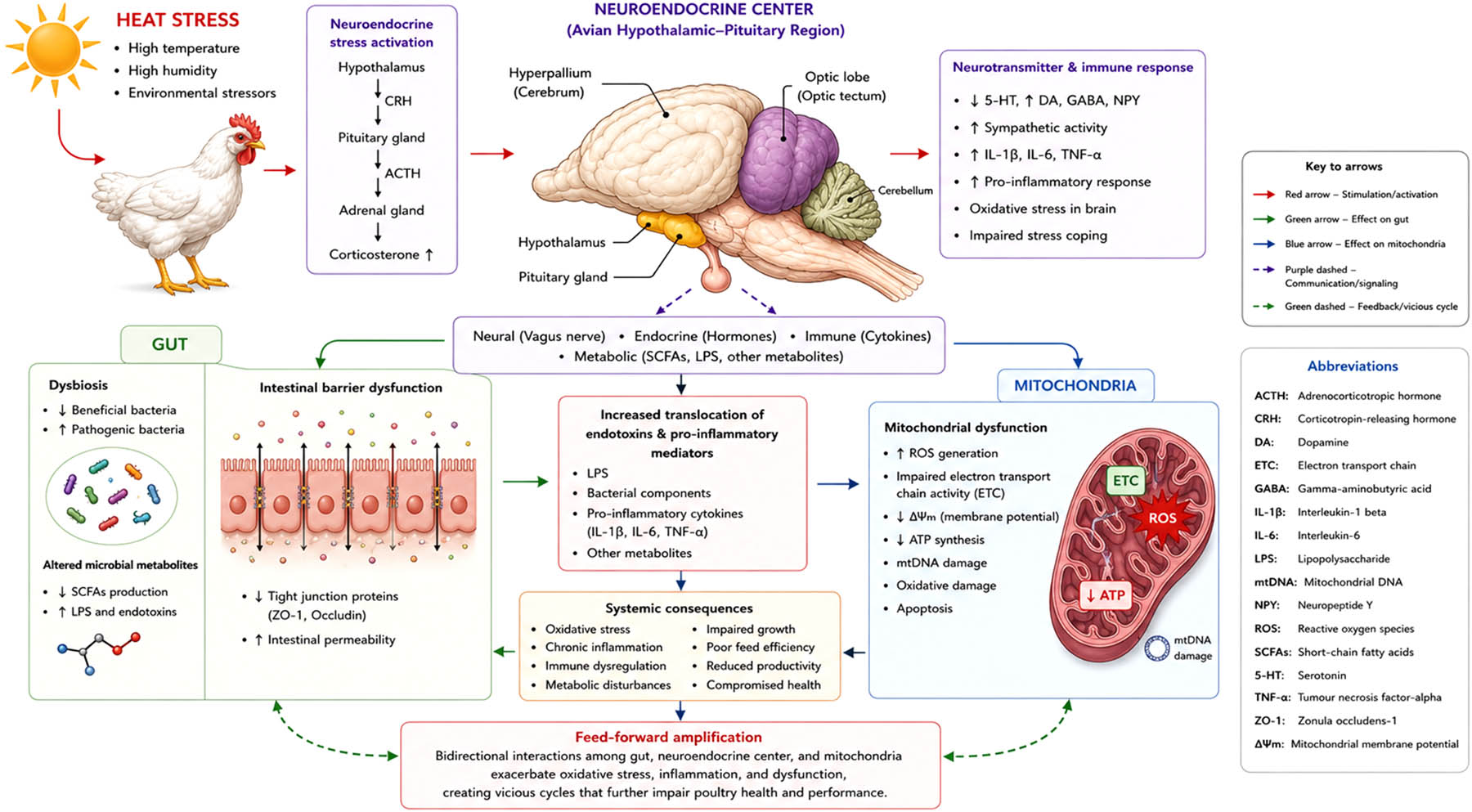
Figure 1
Schematic representation of the gut–brain–mitochondria axis in poultry under heat stress conditions. Heat stress disrupts intestinal homeostasis by altering gut microbiota composition, increasing intestinal permeability, and modifying microbial metabolite production. These alterations stimulate neuroendocrine and immune signalling pathways involving the hypothalamic–pituitary–adrenal axis, neurotransmitters, cytokines, and circulating hormones. Concurrently, mitochondrial dysfunction, characterised by impaired electron transport activity, oxidative stress, reduced ATP production, and cellular damage, further amplifies systemic stress responses. Bidirectional communication among the gut, brain, and mitochondria occurs through neural, endocrine, immune, and metabolic pathways, creating feed-forward loops that contribute to impaired growth performance, immune suppression, metabolic disturbances, and reduced productivity in poultry.
Table 1
Microbiome, neuroendocrine, and mitochondrial pathways affected by heat stress
| Component | Pathway/subcategory | Effects of heat stress | Mechanisms | Consequences | References |
|---|---|---|---|---|---|
| Microbiome (gut) | Morphological alterations | Villus atrophy, crypt depth changes, epithelial erosion, reduced goblet cells | Hypoxia, oxidative injury, reduced blood flow | ↓ Absorptive surface, impaired renewal | Santos et al. (2015) |
| Tight junction disruption | Occludin, claudins, ZO-1, JAM-A disruption | Hypoxia, oxidative stress, and corticosterone elevation | Leaky gut, ↑ permeability (FITC-dextran confirmed) | Lambert (2009); Song et al. (2014); Ruff et al. (2020) | |
| Dysbiosis | ↓ Lactobacillus, Bifidobacterium; ↑ E. coli, Clostridium, Salmonella | Altered motility, mucus, immunity, nutrients | Inflammation, delayed repair, self-amplifying damage | Lan et al. (2004); Shi et al. (2019) | |
| Endotoxin translocation | ↑ Plasma LPS (24–72 h), TLR4/NF-κB activation | Barrier failure | ↑ TNF-α, IL-2; pathogen dissemination to organs | Quinteiro-Filho et al. (2010, 2012); Nanto-Hara et al. (2020) | |
| Nutrient absorption | ↓ Enzyme activity (trypsin, amylase), ↓ transporters | Villus atrophy, inflammation, dysbiosis | ↓ Feed efficiency, body weight gain | Mitchell and Carlisle (1992); Emami et al. (2021) | |
| Gut redox/mitochondrial | ↑ ROS, lipid peroxidation, ↓ ATP | Hypoperfusion, hypoxia | NF-κB/MAPK activation, barrier failure | Kikusato and Toyomizu (2013); Liu et al. (2021) | |
| Neuroendocrine (brain) | Hypothalamic sensing | Panting, vasodilation, ↓ and feed intake | Thermosensitive neurons | Splanchnic hypoxia, gut disturbances | Yahav et al. (2004); Lambert (2009) |
| HPA axis activation | ↑ CRH, ACTH, corticosterone | Chronic stress response | Gut permeability ↑, immune suppression, dysbiosis | Star et al. (2008); Quinteiro-Filho et al. (2012) | |
| Stress hormones | Muscle proteolysis, gluconeogenesis | Corticosterone-mediated catabolism | ↓ Growth, immune resilience, carcass yield | Geraert et al. (1996); Shini et al. (2008) | |
| Neuroinflammation | ↑ Cytokines to the brain, monoamine disruption | LPS translocation | Appetite dysregulation, impaired neuroplasticity | Calefi et al. (2019); Beckford et al. (2020) | |
| Feed intake regulation | ↓ NPY/AGRP, ↑ POMC/CRH | Neuropeptide imbalance | Anorexia, negative energy balance | Nanto-Hara et al. (2020) | |
| Gut–brain signalling | ↓ Vagal tone, sympathetic imbalance | Autonomic dysregulation | ↓ Motility/secretion, dysbiosis feedback | Rostagno (2020) | |
| Mitochondrial | ROS generation | ↑ ETC leakage (complexes I/III) | Substrate-independent surge | Lipid/protein/DNA damage | Mujahid et al. (2006); Akbarian et al. (2016) |
| OXPHOS/ATP disruption | ↓ MMP, proton leak, avUCP downregulation | ROS damage to ETC | Glycolysis reliance, energy deficits | Yang et al. (2010); Liao et al. (2022) | |
| Biogenesis/fusion/fission | ↓ PGC-1α, mitophagy impairment | SCFA deficits from dysbiosis | Mitochondrial fragmentation, apoptosis | Zhang et al. (2016); Hu et al. (2020) | |
| mtDNA damage | ↑ 8-OHdG lesions | ROS proximity, no histones | Respiratory gene failure, ROS vicious cycle | Surai et al. (2019) | |
| Proteotoxicity/UPR | Protein denaturation, HSP60/70 activation | Oxidation/carbonylation | Chronic apoptosis, ATP synthesis failure | Saracila et al. (2023) | |
| Tissue specific | Gut: barrier ROSBrain: neuroinflammationLiver: lipid peroxidationMuscle: protein catabolism | Tissue metabolic demands | Performance/welfare decline | Mujahid et al. (2007); Ouyang et al. (2022) | |
| Interconnections | Dysbiosis → Inflammation → Mitochondria | ↓ SCFA, ↑ pathogens/cytokines | Barrier dysfunction | Systemic ROS, energy failure | Song et al. (2014) |
| Leaky Gut → LPS → HPA | TJ protein loss | Circulating LPS | Corticosterone surge, immune suppression | Alhenaky et al. (2017) | |
| Brain → Gut motility | Neuropeptide/autonomic changes | Vagal tone reduction | Dysbiosis amplification | Cryan and Dinan (2012); Bohler et al. (2020) | |
| ROS → Neuroimmune | NF-κB/MAPK activation | Redox signalling | Neuroinflammation, apoptosis | Ganesan et al. (2017); Chen et al. (2023) | |
| Feedback loops | Dysbiosis–LPS–HPA–ROS cycles | Self-reinforcing | Metabolic inefficiency, catabolism | Akbarian et al. (2016); Kikusato and Toyomizu (2013) | |
| Performance impacts | Anorexia, malabsorption, immunosuppression | Axis breakdown | ↓ Growth, welfare, disease resistance | Lara and Rostagno (2013); Wen et al. (2021) |
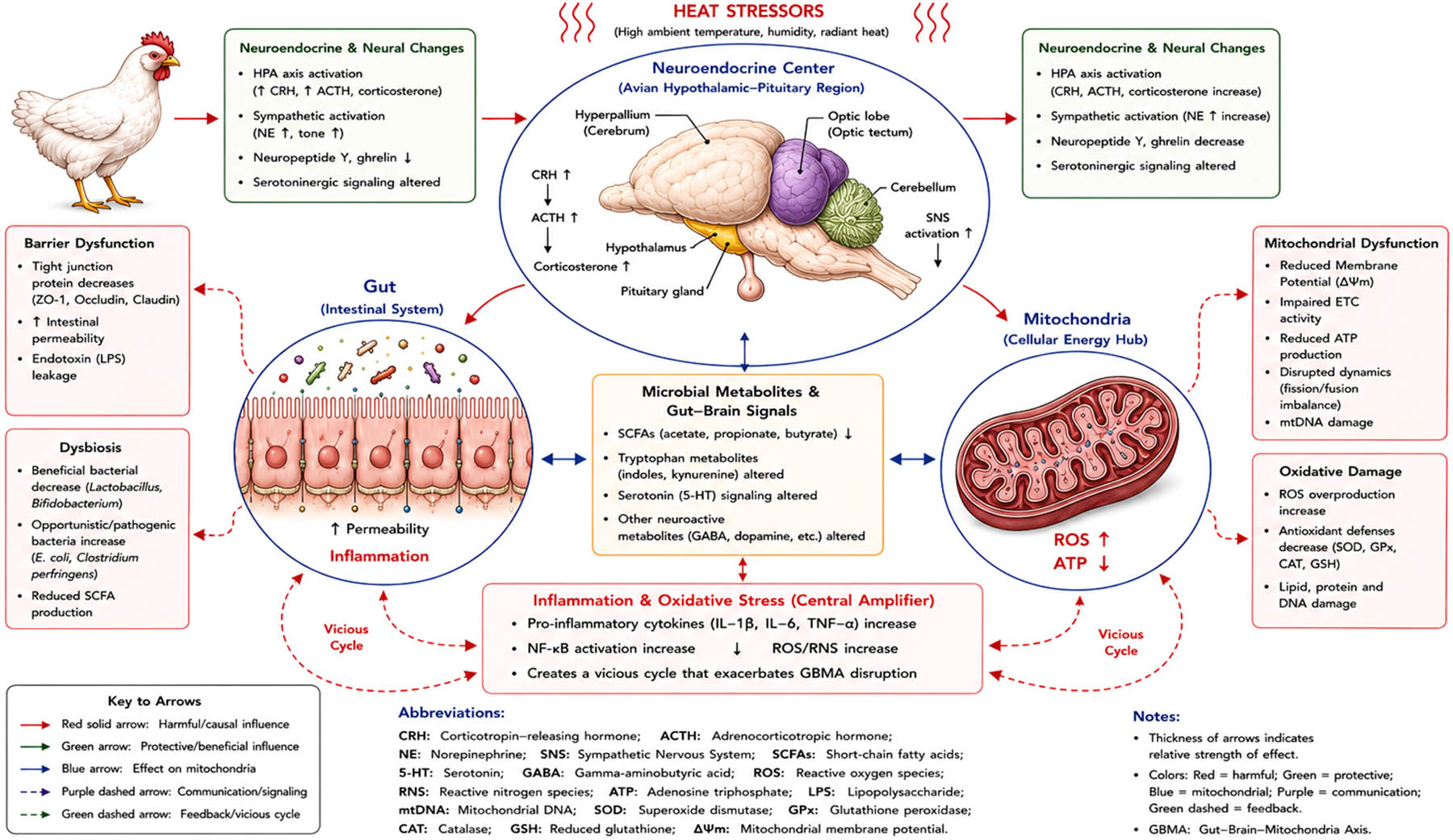
Figure 2
Mechanistic illustration of heat stress-induced disruption of the gut–brain–mitochondria axis in poultry. Heat stress activates neuroendocrine stress pathways, including the hypothalamic–pituitary–adrenal axis and sympathetic nervous system, leading to altered neurotransmitter release, corticosterone secretion, and inflammatory responses. Simultaneously, intestinal barrier dysfunction and dysbiosis increase gut permeability and modify microbial metabolite production, resulting in elevated translocation of endotoxins and pro-inflammatory mediators. These alterations contribute to mitochondrial dysfunction through excessive reactive oxygen species (ROS) generation, impaired electron transport chain activity, reduced ATP synthesis, and oxidative cellular damage. Bidirectional interactions among the gut, brain, and mitochondria are mediated through neural, endocrine, immune, and metabolic signalling pathways, generating feed-forward cycles that exacerbate oxidative stress, inflammation, and physiological dysfunction, ultimately compromising poultry health and performance.
Table 2
Interventions targeting the gut–brain–mitochondria axis in heat-stressed poultry
| Interventions | Types | Key interventions | Mechanisms and benefits | References |
|---|---|---|---|---|
| Nutritional interventions | Probiotics, prebiotics, synbiotics | Lactobacillus, Bifidobacterium, galactooligosaccharides, synbiotics | Enhance intestinal morphology, tight junctions, SCFA production, and reduce pathogens/oxidative stress/corticosterone | Quinteiro-Filho et al. (2012); Cao et al. (2021); Hu et al. (2020) |
| Phytogenics and essential oils | Peppermint, fenugreek, thymol, carvacrol, cinnamaldehyde | Antimicrobial, antioxidant, anti-inflammatory; improve barrier function, HPA axis regulation | Abbass and Abid (2023); Akbarian et al. (2016); Madkour et al. (2025) | |
| BSFL | Antimicrobial peptides, bioactive lipids | Favourable microbiota shifts, antioxidant defences, mitochondrial redox balance | Giller et al. (2021); Beldowska et al. (2023); Sjofjan et al. (2025) | |
| Functional amino acids | Glutamine, tryptophan, methionine, taurine, arginine | Gut barrier maintenance, serotonin/melatonin synthesis, glutathione production, osmoprotection | Chalvon Demersay et al. (2021); Wang et al. (2015); Yue et al. (2017) | |
| Antioxidants | Vitamins E/C, selenium, zinc, polyphenols | Preserve mitochondrial integrity, activate Nrf2, reduce ROS/malondialdehyde | Surai et al. (2019); Olayiwola and Adedokun (2025) | |
| Environmental and management | Cooling and ventilation | Tunnel ventilation, evaporative cooling, fogging, and reduced stocking density | Lower thermal load, HPA axis attenuation, preserve gut/mitochondrial function | Bhadauria (2017); Cuadrado and Dridi (2024); Renaudeau et al. (2012) |
| Early-life thermal conditioning | Mild heat exposure during development | Long-term thermotolerance, antioxidant capacity, gut–brain stability | Yahav et al. (2004); Saeed et al. (2019) | |
| Stocking density, lighting, enrichment | Optimised density, low-intensity lighting, perches/pecking substrates | Reduce HPA activation, improve ventilation/feed intake, and behavioural thermoregulation | Parvin et al. (2014); Bilal et al. (2021) | |
| Precision livestock farming | Wearable sensors and microclimate | Body temperature, respiration, activity monitoring | Early heat stress detection to prevent gut/mitochondrial damage | Bohler et al. (2020); Kennedy et al. (2022); |
| Predictive modelling | Climate + physiology integration | Proactive nutritional/environmental management | Ma et al. (2021); St-Pierre et al. (2003); Karl et al. (2018) | |
| Real-time biomarkers | Corticosterone, cytokines, SCFAs, H/L ratio | Precision intervention targeting axis health | Zaytsoff et al. (2020) | |
| Targeted therapies | SCFA-enhancing strategies | Fibre enrichment, butyrate producers (Ruminococcaceae) | Tight junctions, anti-inflammation, mitochondrial ATP synthesis | Wong et al. (2006); Hu et al. (2020) |
| Emerging mitochondrial stabilisers | Nrf2 activators, uncoupling protein regulators | Reduce ROS, preserve oxidative phosphorylation | Mishra and Jha (2019); Uyanga et al. (2022) | |
| Postbiotics and metabolites | Organic acids, peptides, bacteriocins, and indole derivatives | Gut barrier, neuroimmune signalling, metabolic stability | Arnal and Lallès (2016); Ahmad et al. (2022) |