
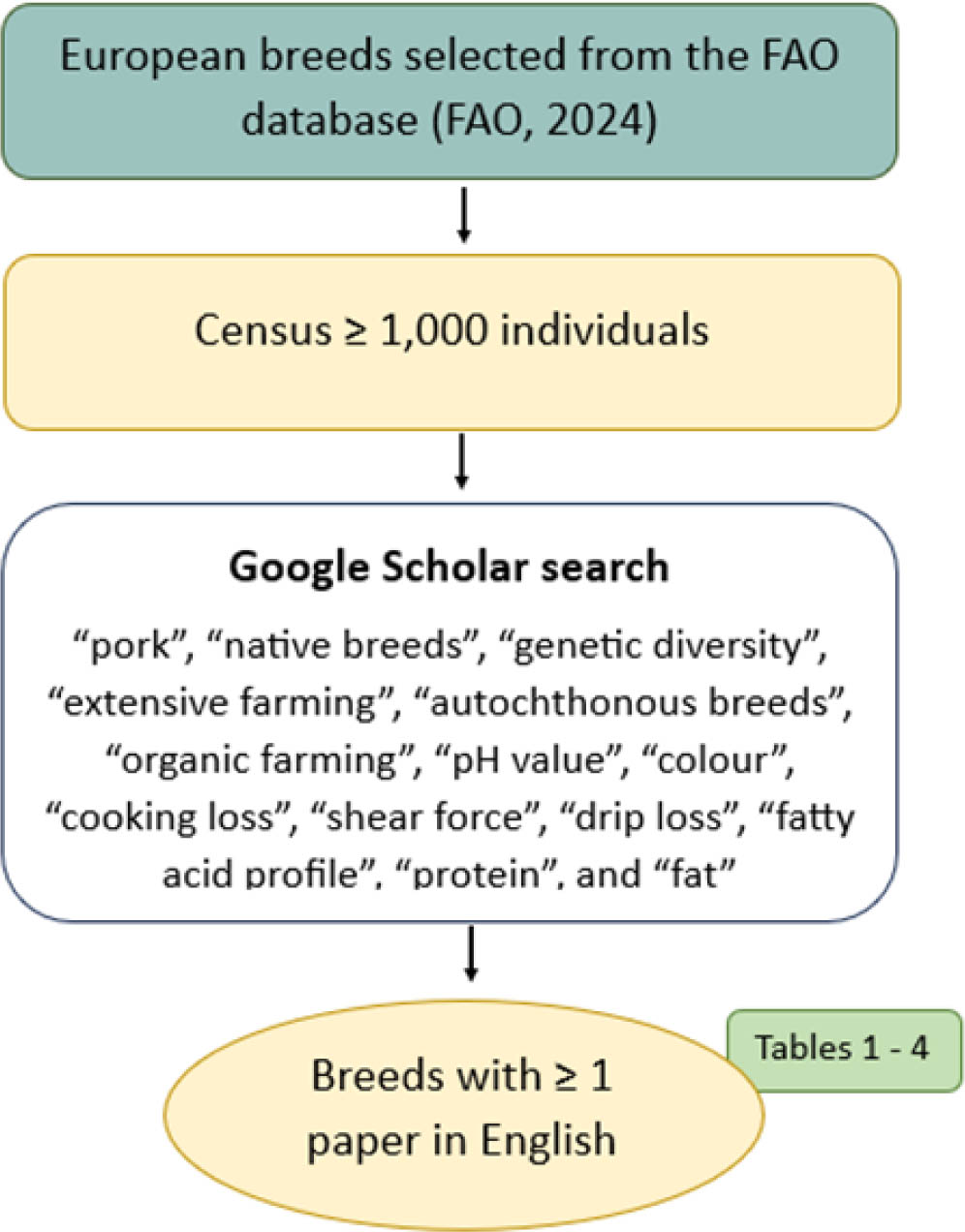
Figure 1.
Methodology for literature search.
Table 1.
Native pig breeds in selected European countries: population data and number of breeding females (FAO, 2024)
| Country | Breed | Total number of animals | Number of breeding females |
|---|---|---|---|
| Southwestern Europe | |||
| Italy | Cinta Senese | 1 992 (update 2023) | 692 (update 2023) |
| Apulo-Calabrese | 4 230 (update 2023) | 704 (update 2023) | |
| Mora Romagnola | 1 233 (update 2023) | 259 (update 2023) | |
| Nero Siciliano | 6 281 (update 2023) | 698 (update 2023) | |
| Spain | Iberian | 3 613 123 (2024) | 564 749 (2024) |
| Negra Canaria | 2 276 (2024) | 614 (2024) | |
| Porc Negre Mollorquí | 1 482 (2024) | 1 372 (2024) | |
| Porco Celta | 4 173 (2024) | 433 (2024) | |
| France | Gasconne | 1 760 (2024) | 1 591 (2024) |
| Portugal | Alentejana | 27 953 (2024) | 3 639 (2024) |
| Bisaro | 38 772 (2024) | 5 028 (2024) | |
| Malhado de Alcobaça | 3 301 (2024) | 429 (2024) | |
| Central Europe | |||
| Slovenia | Krškopolje | 2 006 (2024) | 296 (2024) |
| Poland | Puławska | 3 404 (2024) | 2 488 (2024) |
| Złotnicka Spotted | 1 056 (2024) | 936 (2024) | |
| Złotnicka White | 1 214 (2024) | 1 058 (2024) | |
| Czech Republic | Prestice Black-Pied | 900 (2022) | 394 (2022) |
| Belarus | Belorussian Large White | 2 958 300 (2006) | No data |
| Croatia | Black Slavonian pig | 3 200 (2023) | 2 143 (2023) |
| Hungary | Blond Mangalica | 3 385 (2023) | 3 332 (2023) |
| Red Mangalica | 1 542 (2023) | 1 503 (2023) | |
| Serbia | Mangalica | 4000 (2023) | 1954 (2023) |
| Ukraine | Mirgorod | 2 757 (2019) | 150 (2019) |
| Poltavian Meat | 1 392 (2023) | 130 (2023) | |
| Ukrainian Steppe White | 1 513 (2023) | 174 (2023) | |
Table 2.
Fattening and slaughter parameters of European native pig breeds
| Country | Breed | SW, kg | ADG, g | BF, mm last rib | BF, mm gluteus medius | DY, % | M, % | LMY, % | References |
|---|---|---|---|---|---|---|---|---|---|
| 1 | 2 | 3 | 4 | 5 | 6 | 7 | 8 | 9 | 10 |
| Italy | Cinta Senese | 127–147 | 416 | – | 20–49.3 | 82 | – | 72–76 | Pugliese et al. (2005), Sirtori et al. (2014) |
| Apulo-Calabrese | 144–157 | 359–413 | – | – | 83 | – | – | Micari et al. (2009), Scerra et al. (2024) | |
| Mora Romagnola | 193 | 376 | 57,1 | 62.1 | 80.4 | – | 39 | Fortina et al. (2005) | |
| Nero Siciliano | 62–121 | 162–600 | 39,1 | 39–49 | 79.1–82.5 | – | 40 | Pugliese et al. (2004), Liotta et al. (2005), Bozzi et al. (2019) | |
| Spain | Iberian | 152–190 | 563 | 7.63–80 | 65 | 77.9–81.2 | – | – | Tejeda et al. (2020), Serrano et al. (2009), Ayuso et al. (2018) |
| Porc Negre | 158 | – | |||||||
| Mollorquí | 410 | 72 | 66 | 80.4 | – | Tibau et al. (2019) | |||
| Porco Celta | 167.3 | – | 41.6–43.6 | 48.7 | 80.5 | – | – | Franco et al. (2014) | |
| France | Gasconne | ~175.3 | 439–472 | 44.7–47 | 46.1–49 | 78.7–80 | – | – | Mercat et al. (2019), Lebret et al. (2021) |
| Portugal | Alentejana | 100 | 333–583 | 38.1–55.6 | 39.4 | 73.3–80.9 | – | – | Freitas et al. (2007), Charneca et al. (2019), Martins et al. (2021) |
| Bisaro | 79 | 396 | 17– 21.1 | – | 75.2–76.8 | – | – | Álvarez-Rodríguez Teixeira (2019), Charneca et al. (2019) | |
| Slovenia | Krškopolje | nd | - | 29 | 35.4–36.4 | 79.6–81.1 | – | 43–46 | Čandek-Potokar et al. (2003), Tomažin et al. (2018), Lukač et al. (2019) |
| Poland | Puławska | ~100 | 638–810 | 23 | 12.73–28.86 | 75.33–80 | 49.4–56.11 | – | Wojtysiak and Połtowicz (2014), Debrecéni et al. (2018), Babicz et al. (2020), Milczarek (2021) |
| Złotnicka Spotted | 107 | 590 | 41.3 | 28.9–34.96 | 76.51–80.5 | 41.83–46.28 | – | Kapelański et al. (2006), Grześkowiak et al. (2009), Bocian et al. (2012), Szulc et al. (2012) | |
| Złotnicka White | >70 | – | 27.7 | 34.7 | 46.3 | – | Grześkowiak et al. (2009) | ||
| Czech Republic | Prestice Black-Pied Pig | 94.2–115.2 | ~480 | 36.07–43.21 | 48.76–48.94 | Nevrkla et al. (2021) | |||
| Croatia | Black Slavonian pig | ~135 | – | 55 | 82 | – | 15–43 | Butko et al. (2007), Senčiæ et al. (2013), Kušec et al. (2019) | |
| Hungary | Blond Mangalica | 140–150 | 369 | – | – | – | – | 27 | Tomović et al. (2016), Nchama et al. (2023) |
| Mangalica in general term | 75–120 | 268–299 | – | 50.5–57 | 73–81.5 | – | – | Parunović et al. (2012), Hoha et al. (2016), Radović et al. (2017), Debrecéni et al. (2018), Charlton et al. (2022) | |
| Ukraine | Mirgorod | 100 | 632 | 30.9 | – | 72.5 | 50.4 | – | Tsereniuk et al. (2023) |
Table 3.
Physicochemical characteristics of meat from European native pig breeds
| Country | Breed | SW, kg | pH45min | pH24h | L* | a* | b* | Cooking loss, % | WBSF, N, kg, kg/cm2 | Drip loss, % | References |
|---|---|---|---|---|---|---|---|---|---|---|---|
| 1 | 2 | 3 | 4 | 5 | 6 | 7 | 8 | 9 | 10 | 11 | 12 |
| Italy | Cinta Senese | 127–147 | 6.2–6.4 | 5.82–5.78 | 46–50.1 | 11–14.9 | 2.9–5.4 | 17.9–30.3 | 94.14–99.87 N, 1 0.17 kg | 0.7–2.14 | Pugliese et al. (2005), Sirtori et al. (2014), Aquilani et al. (2019) |
| Apulo-Calabrese | 144.2 | – | – | 46.2–49.3 | 3.9–7.1 | 5.8–6.1 | – | – | – | Caparra et al. (2023), Scerra et al. (2024) | |
| Nero Siciliano | 62–121 | 6.18–6.29 | – | 46.7–50.1 | 14.7–15.3 | 4.9–5.8 | 23.5 | 9.99–10.11 kg | – | Pugliese et al. (2004) | |
| Mora Romagnola | 193 | 6.57 | 6.15 | 42.3 | 8.7 | 2.2 | – | – | – | Fortina et al. (2005) | |
| Spain | Iberian | 152–190 | - | 5.62 | 39.8–41.7 | 8.7–11.3 | 6.4–13.6 | 24.1 | 4.33 kg/cm2 | – | Serrano et al. (2008), Fernández-Barroso et al. (2020), Tejeda et al. (2020) |
| Porco Celta | 167.3 | – | 5.46–5.55 | 47.3–50.7 | 10.4–13.1 | 10.7–11.7 | 19.7–21.9 | 3.64–3.8 kg/cm2 | 1.8–2.7 | Franco et al. (2014, 2016) | |
| France | Gasconne | ~173.3 | 6.34 | 5.57–5.6 | 44–44.7 | 9.7–10.04 | 3.5–3.8 | 14.5 | 24.3 N | 1.7 | Mercat et al. (2019), Lebret et al. (2021) |
| Portugal | Alentejano | ~100 | – | 5.57–5.7 | 49.4–50.8 | 10.3–15.2 | 3.6–8.7 | 17.7–26.9 | 26.6 N | 1.3 | Martins et al. (2020, 2021) |
| Bisaro | 79 | – | 5.44 | 55.1–55.7 | 3.4–7.8 | 4–10.9 | 28.9 | 47.4 N | 3.8 | Martins et al. (2020), Teixeira et al. (2021) | |
| Slovenia | Krškopolje | nd | 6.33 | 5.6–5.71 | 50.4 | 6.6 | 0.9 | 26.9 | 53.2 N | 4.2 | Čandek-Potokar et al. (2003), Lukač et al. (2019), Tomažin et al. (2018) |
| Poland | Puławska | ~100 | 6.10–6.78 | 5.58–5.63 | 52.1–53.17 | 3.1–15.9 | 0.8–16.1 | 20.41–35.9 | 3.7–5.62 kg/cm2 | 1.7–24.89 | Wojtysiak and Połtowicz (2014), Bogucka and Kapelañski (2016), Debrecéni et al. (2018), Milczarek et al. (2019), Milczarek (2021) |
| Złotnicka Spotted | 107 | 6.38–6.57 | 5.56–5.67 | 47.9–49.3 | 4.77–17.2 | 2.5–5.04 | 27.46–29.36 | 43.61 N/cm2 | 2.36–3.4 | Grzeœkowiak et al. (2009), Bogucka and Kapelañski (2016), Bocian et al. (2012), Szulc et al. (2012) | |
| Złotnicka White | >70 | 6.38 | 5.53–5.72 | 43.9–49.54 | 6.3–14.23 | 3.34–4.9 | 22.76–27.62 | – | 3.4 | Grzeœkowiak et al. (2009), Migdał et al. (2017) | |
| Czech Republic | Prestice Black-Pied Pig | 94.2–115.2 | 6.29 | 5.65 | 50.54 | 1.28 | 10.63 | 2.95 | Nevrkla et al. (2021) | ||
| Croatia | Black Slavonian pig | ~153.8 | 5.82 | 49.9 | 20 | 4.7 | – | – | – | Karolyi et al. (2004) | |
| Hungary | Blond Mangalica | 110– 140 | 6.25–6.37 | 5.72–5.74 | 40.3–54 | 4–11.76 | 5.3–11.4 | 18.49 | 43.1 N | 5.9 | Tomoviæ et al. (2016), Imrich et al. (2019) |
| Mangalica in general | 75–120 | 6.1 | 5.47–5.64 | 39.1–50.1 | 2.7–38.2 | 10.4–14.6 | 2.7–26.9 | 42.6 N, 5.05 kg | 4.8–8.8 | Stanišiæ et al. (2015), Radoviæ et al. (2017), Debrecéni et al. (2018), Charlton et al. (2022), Nchama et al. (2023) |
Table 4.
Protein, intramuscular fat content, total MUFA and PUFA fatty acids, and the n-6/n-3 ratio in LTL muscle in European native pig breeds
| Country | Breed | SW, kg | Rearing conditions | Protein, % | IMF, % | n-6/n-3 PUFA | Total MUFA (% of total FA) | Total PUFA (% of total FA) | References |
|---|---|---|---|---|---|---|---|---|---|
| Italy | Cinta Senese | 84 | outdoor | 23.09 | 6.66 | 12.5 | – | – | Aquilani et al. (2019) |
| 130 | indoor | 23.03 | 2.32 | 24.4 | 49.9 | 11.2 | Pugliese et al. (2013) | ||
| Apulo-Calabrese | 84.8 | outdoor | 20.66 | 1.86 | 8.2 | – | – | Caparra et al. (2023) | |
| 144–157 | indoor | 22 | 1.91–2.09 | 15.5*-2 | 48.8 | 12.4 | Aboagye et al. (2020), Scerra et al. (2024) | ||
| Nero Siciliano | 62–121 | outdoor | 22.24 | 5.77 | 10.7 | 53.3 | 10.9 | Pugliese et al. (2004) | |
| indoor | 23.42 | 6.25 | 18.3 | 42.2 | 14.4 | ||||
| Mora Romagnola | 193 | indoor | 23.3 | 6.1 | 47.6 | 11 | Fortina et al. (2005) | ||
| Spain | Iberian | 152 | free range traditional system | 22.44 | 6.6 | – | 57.1 | 6.8 | Tejeda et al. (2020) |
| 145 | indoor | 21.5–21.6 | 6.61–8.6 | 17.7 | 52 | 6.5 | Pardo et al. (2021), Serrano et al. (2008) | ||
| Porco Celta | 167.3 | outdoor | 22.65 | 5.22 | 17.9 | 49.6 | 7.6 | Franco et al. (2014) | |
| France | Gasconne | ~175.3 | outdoor | 23.07 | 2.7 | 6.1–6.26 | 53.7 | 6.6 | Mercat et al. (2019) |
| Portugal | Alentejano | ~150 | outdoor | 23.6 | 6.9 | – | – | Martins et al. (2020) | |
| Bisaro | ~150 | outdoor | 23 | 6 | – | – | |||
| Slovenia | Krškopolje | nd | indoor | 23.2 | 2.81 | 15.7 | 47.5 | 11.6 | Lukač et al. (2019), Tomažin et al. (2018) |
| Poland | Puławska | ~100 | indoor | 22.72–23.3 | 1.9–5.5 | 8.89–29.4 | 56.5 | 3.4 | Debrecéni et al. (2018), Milczarek et al. (2021) |
| Złotnicka Spotted | 107 | indoor | 23.27–25.2 | 2.04–2.6 | 10.78–12.94 | 49.4 | 11.1 | Grzeœkowiak et al. (2009), Debrecéni et al. (2018) | |
| Złotnicka White | >70 | indoor | 24.5 | 1.87 | 10.73 | 47.4 | 12.9 | Grzeœkowiak et al. (2009) | |
| Czech Republic | Prestice Black-Pied | 94.2–115.2 | indoor | 20.12 | 2.29 | 6.7 | 44.07 | 13.37 | Nevrkla et al. (2021); Belkova et al. 2023 |
| Croatia | Black Slavonian pig | ~135 | outdoor | 21.25 | 5.9 | Butko et al. (2007) | |||
| indoor | 21.3 | 4.95 | |||||||
| Hungary | Blond Mangalica | 110– 140 | indoor | 21.83–24.64 | 1.34–5.86 | Tomoviæ et al. (2016), Imrich et al. (2020) | |||
| Mangalica in general | 75–120 | outdoor | 21.45–21.7 | 7.57 | 9.2–12.97 | 44.8–55.5 | 6.5–15.6 | Parunoviæ et al. (2012), Debrecéni et al. (2018) | |
| 75–120 | indoor | 19–24.1 | 1.9 | 17.92–37.3 | 57.2 | 5.9 | Parunoviæ et al. (2012), Nchama et al. (2023) |
Long description: The diagram is organized into four main thematic areas connected by arrows. The central element represents the conservation and sustainable use of native European pig breeds. One branch focuses on breeding strategies, including selection for productivity, disease resistance, robustness, meat quality, and the use of crossbreeding with commercial lines to combine resilience with production efficiency. A second branch addresses conservation policies, emphasizing support through rural development programmes, financial incentives, maintenance of genetic diversity, and preservation of local breeds. A third branch concerns market development and consumer awareness, highlighting promotion of regional products, cultural heritage, sustainability, animal welfare, and the nutritional value of meat from native breeds. The final branch presents the long-term perspective, identifying native breeds as strategic genetic resources that contribute to biodiversity, climate resilience, sustainable livestock production, and future food security. All branches converge toward the overall objective of preserving native pig breeds while strengthening sustainable pork production and premium niche markets.
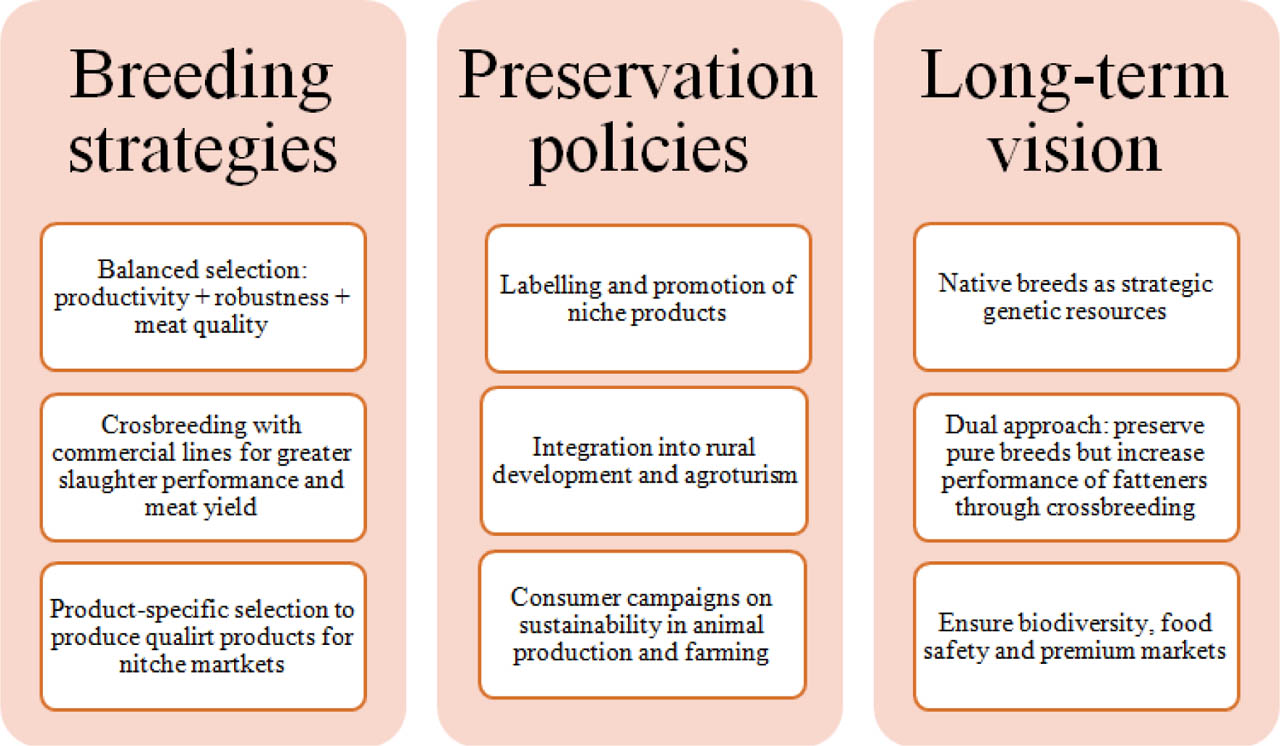
Figure 2.
Diagram summarizing recommendations for conserving native European pig breeds through breeding strategies, sustainable farming, policy support, and consumer awareness.